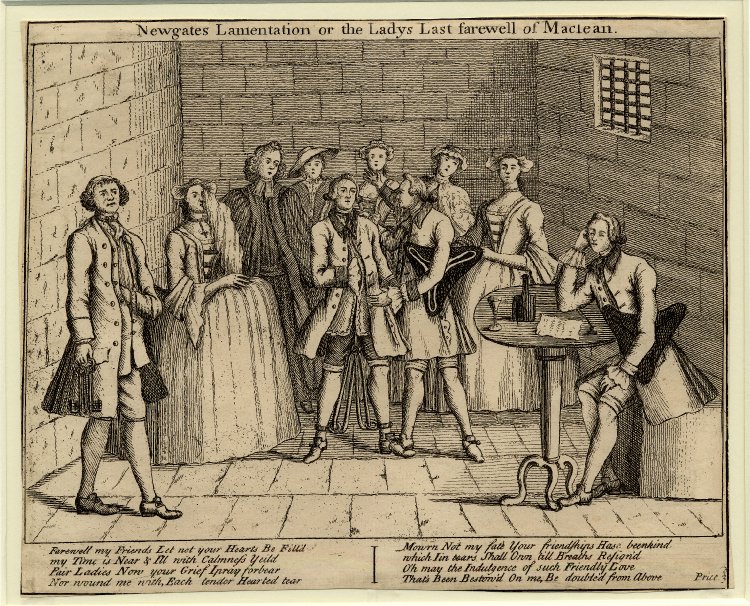
1750: James Maclaine

Gentleman highwayman James MacLaine hanged at Tyburn on this date in 1750.

The debauched son of a Presbyterian minister, MacLaine wasted first an inheritance and later a dowry on expensive clothes, gambling, and ladies of easy virtue; want, however, was his ticket to the immortality of the gallows when he joined fellow penniless gentleman William Plunkett to seek his revenue on the roads. (Inspiring the 1999 film Plunkett & Macleane — which uses one of several alternate spellings available for our man’s surname.)

For several months in 1749-1750 they prowled the environs of a lawless London, and notably Hyde Park, with the exaggerated courtesy demanded by romance of their profession. They found noteworthy prey: once, they stole a blunderbuss from the Earl of Eglington, though Eglington survived to suffer a noteworthy murder years later; in November 1749, they robbed M.P. Horace Walpole, even skimming his face with a pistol-ball that was inches wide from depriving posterity of the gothic novel.*

When caught** by mischance, the mannered† Maclaine became the object of public celebration, much to the bemusement of Walpole — who professed no ill will for his assailant but wondered that “there are as many prints and pamphlets about him as about the earthquake.”

Three thousand people are reported to have turned up on a sweltering summer Sunday to pay their admiration to the rogue, not excluding the very cream of society. Walpole teased his friends, court beauty Lady Caroline Fitzroy (wife of the Earl of Harrington) and her sidekick Miss Elizabeth Ashe, for presenting themselves among these masses to starfuck this latter-day Duval. “I call them Polly and Lucy,” he wrote, alluding to female conquests of the outlaw Macheath in The Beggar’s Opera, “and asked them if he did not sing,”

Thus I stand like the Turk with his doxies around.

Maclaine did not have to borrow Macheath’s ballads, for he was celebrated with verse dedicated all to him — like this “Jemmie Maclaine”, to the tune of Derry Down:

Ye Smarts and ye Jemmies, ye Ramillie Beaux,
With golden cocked hats, and with silver laced clothes,
Who by wit and invention your pockets maintain,
Come pity the fate of poor Jemmy Maclaine,

Derry down derry, etc.

He robb’d folks genteely, he robb’d with an air,
He robb’d them so well that he always took care
My lord was not hurt and my Lady not frighted,
And instead of being hanged he deserved to be knighted!

Derry down derry, etc.

William Hogarth‘s 1751 print cycle The Four Stages of Cruelty, one skeleton overseeing the operating theater where a hanged criminal is dissected is subtly labeled — Macleane.

* Walpole once remarked of the ubiquity of violent crime in London that “one is forced to travel, even at noon, as if one was going to battle.”

** Plunkett was never apprehended; it’s alleged that he ultimately escaped to North America.

† Although our man “has been called the gentleman highwayman,” the player-hating Ordinary of Newgate wrote, “and his dress and equipage very much affected the fine gentleman, yet to a man acquainted with good breeding, that can distinguish it from impudence and affectation, there was little in his address or behaviour, that could entitle him to that character.”

On this day..

1752: Thomas Wilford, the first hanged under the Murder Act of 1751

On this date in 1752,* Thomas Wilford hanged at Tyburn — the first person executed under the Murder Act of 1751.

Approved the previous year but just come into effect on the first of June of 1752, the Murder Act proposed “that some further terror and peculiar mark of infamy be added to the punishment of death” for homicides.**

Since even shoplifting could get you hanged at this period, actually killing someone required an extra twist on the punishment. Parliament killed two birds with one stone here by also addressing the country’s need for anatomical corpses, requiring that the bodies of hanged murderers be delivered “to the hall of the Surgeons Company” where it “shall be dissected and anatomized by the said Surgeons.”†

Wilford presented the surgeons a one-armed specimen with questionable impulse control. As a teenager, he met a prostitute named Sarah Williams in their shared workhouse, and married her, but the honeymoon did not last long. Four days later, his bride stayed out late and to his queries admitted having gone “to the Park” — whereupon Wilford grabbed a knife and slashed her neck so deep as to nearly decapitate her.

“He had no sooner committed the horrid deed than he threw down the knife, opened the chamber door, and was going downstairs when a woman, who lodged in an adjacent room, asked who was there; to which Wilford replied: ‘It is me. I have murdered my poor wife, whom I loved as dearly as my own life,'” quoth the Newgate calendar.

A simple and pathetic crime with an easy disposition for the judiciary. The Newgate Ordinary’s account has a few more details. As specified, his remains were indeed turned over for anatomization.

Another provision of the Murder Act: a death sentence for murder is to “be executed according to law, on the day next but one after sentence passed, unless the same shall happen to be the Lord’s day, commonly called Sunday.” Wilford was condemned on a Tuesday and hanged on Thursday morning; however, the predominant practice moving forward would be to issue such sentences on Fridays in order to give the doomed an extra day to prepare themselves.‡

* Thursday, July 2 was the Julian calendar date of Wilford’s hanging. Our norm has been to prefer the local date (Gregorian or Julian, depending on the country) prior to England’s changeover in 1752 — and then generally to prefer the Gregorian date thereafter. (We’ve made a few exceptions.)

England spent the first eight months of 1752 on the Julian calendar, then transitioned to the Gregorian calendar in September of that year, so in this particular instance we’re hewing it close to the bone.

I infer that the calendar switch is probably also the reason why the Newgate Calendar incorrectly attributes Wilford’s hanging to June 22: the discrepancy between the Julian and Gregorian calendars at this point was 11 days, so a later interlocutor might have supposed that July 2 was a Gregorian date that wanted subtraction. It was a confusing, 355-day leap year for Old Blighty, complete with a new New Year’s Day, so if that’s the explanation I’m inclined to give the author a mulligan for making an unnecessary date adjustment and then miscounting the number of days to adjust.

** The Act’s preamble claims that the “horrid crime of murder has of late been more frequently perpetrated than formerly, and particularly in and near the metropolis of this kingdom, contrary to the known humanity and natural genius of the British nation.” We lack dependable crime statistics for this period to verify this sense of parliamentarians.

† The Murder Act also empowered judges, at their discretion, to order a criminal hung in chains, like these blokes.

‡ The eleven other people — non-murderers — condemned at the same assize were not executed until July 13.

On this day..

1753: Dr. Archibald Cameron, the last Jacobite executed for treason

Dr. Archibald Cameron of Lochiel on June 7, 1753 became the last Jacobite executed for high treason.

The son of the Cameron clan chief who had had to take refuge in France for his role in the Jacobite rebellion of 1715, Archibald was in 1745 sent as an emissary by his older brother Donald to talk the Stuart claimant out of trying a do-over.

But it was Bonnie Prince Charlie who won the charisma check in this encounter, and ere ’45 was out Archibald was fighting under the Pretender’s colors. (Donald, too.)

Sadly for Donald and Archibald, they were as prescient as they were unpersuasive, for by the next spring the Jacobites had been decisively put down in a battle that cost the Clan Cameron alone hundreds of casualties. Both sons followed their father’s path to exile.

Archibald Cameron did, however, venture a couple of furtive visits back to his native soil, and on one of these missions he was betrayed and captured by the British. There were indeed a variety of refugee Jacobite intriguers in this period who were bold enough to canvass the heather for yet another possible rising, a circumstance which Lord Amulree credits for the severity of the Crown against our principal when it caught him.

Dispatched to London to be made an example of, Cameron was condemned to be drawn on a hurdle and cut down still alive for a traitor’s dismembering. He was, in fact, permitted to hang long enough to die, and his corpse was not quartered. After all, there’s making an example, and then there’s making a martyr.

“I the more cheerfully resign my life as it is taken away for doing my duty to God, my king, and my country,” Cameron wrote on the eve of his execution. “Nor is there anything in this world I could so much wish to have it prolonged for, as to have another opportunity to employ the remainder of it in the same glorious cause.”

On this day..

1751: Anna Schnidenwind, the last witch in Baden-Württemberg

Anna Schnidenwind, nee Trutt, was burned at the stake in Endingen am Kaiserstuhl on this date in 1751 — the last “witch” executed in Baden-Württemberg.

There is next to no archival information surviving that would give us insight into this remarkably late Hexenprozess. However, it seems that Schnidenwind got Willinghamed: when a fire destroyed the village of Wyhl, local grandees immediately assumed that the cause of such a devastating event ware eine Zauberin (“would have been a sorceress,” as an abbot wrote in his diary).

Having begun from the conclusion it was simply a matter of finding the witchiest character in the vicinity to fit as the Zauberin. Schnidenwind, a 63-year-old peasant, probably had some pre-existing reputation as a possible witch — a reputation that a visit to the rack obligingly confirmed.

On this day..

1756: Veronika Zeritschin, the last witch executed in Germany

When did Europe stop executing witches?

Early modern Europe’s witch hunt era wound down in the 18th century, but the precise milestone dates are surprisingly tricky to pin down. The superstition outlived the judicial machinery, and some of the last reputed “witches” — like Anna Göldi and Barbara Zdunk — don’t seem to have been formally charged with sorcery.

The clear “lasts” we do have are country by country, earlier or later depending on the vigor of the pushback witch-hunters could muster against the the onset of rationalism.

The last witch execution that can be documented in the Holy Roman Empire’s illustrious history took place on this date in 1756, in Landshut, during the age of Maria Theresa.* Its subject was a 15-year-old named Veronika Zeritschin, who was beheaded and then burned.

There is scant information readily available online as to how she came to that dreadful pass, perhaps because the distinction was long thought to be held by a woman named Anna Maria Schwegelin (English Wikipedia entry | German) — condemned for her Satanic intercourse in 1775. That sentence, it was only latterly discovered, was not actually carried out, leaving poor Anna to die in prison in 1781.

As one might infer, Veronika Zeritschin’s own distinction might not be entirely secure against subsequent documentary discoveries. But as of now, she appears to be the last person executed on German soil as a witch.


Salvator Rosa, Witches at their Incantations (c. 1646). “Rosa has a secret to tell us: how the romantic imagination feeds on terrors and beliefs that were once all too real.”

* Marie Antoinette‘s mother. Maria Theresa’s absolutism was not quite that of the Enlightenment; she was a staunch foe of the trend towards religious toleration:

What, without a dominant religion? Toleration, indifferentism, are exactly the right means to undermine everything … What other restraint exists? None. Neither the gallows nor the wheel … I speak politically now, not as a Christian. Nothing is so necessary and beneficial as religion. Would you allow everyone to act according to his fantasy? If there were no fixed cult, no subjection to the Church, where should we be? The law of might would take command. (Source)

On this day..

1751: John Morrison, Francis McCoy, and Elizabeth Robinson, robbers

Anthony Vaver’s captivating Early American Crime blog neatly summarizes this story. But for readers with a taste for an original colonial hanging-pamphlet, read on …

On this day..

1751: Lobsang Trashi and the Lhasa Rebellion leaders

On January 23, 1751 Lhasa … witnessed another horrible example of Chinese justice. Lobsang Trashi and six other leaders of the rebellion were executed by cutting them into pieces. Other people were beheaded or strangled. The heads of the executed were mounted on spikes. The other leaders were exiled and stripped of their property.

Luciano Petech, China and Tibet in the Early XVIIIth Century

China’s domination of Tibet, dating to 1720, has generated resistance, intermittently violent, down to the present day.

The incident at hand here was a November 1750 Lhasa riot sparked by the assassination of Tibet’s prince by China’s plenipotentiary, who had caught wind of the local ruler’s intention to detach his kingdom from Qing domination.

The royal chamberlain, Lobsang Trashi (German Wikipedia entry | Dutch) managed to escape the scene and found himself at the head of a furious rabble that sacked the Qing embassy, looted a treasury, and killed dozens of Chinese soldiers — and dozens more Chinese civilians.

But the popular furor burned itself out within days, most Tibetan elites sagely declining to get involved in the pogrom pending the likely — and soon, actual — overwhelming Qing response. These guys got the fire-eaters arrested (they’d be handed over to the arriving Chinese army) and installed the Dalai Lama as the new secular as well as religious authority.

On this day..

1757: Father Andreas Faulhaber, seal of the confessional martyr

On this date in 1757, Catholic priest Andreas Faulhaber was hanged at the order of Frederick the Great to defend the seal of the confessional.

Frederick had been appointed by the Heavenly Father, and a cruel earthly one, to a task far too monumental to tarry with theology: lifting the Kingdom of Prussia from the morass of German principalities and into the ranks of Europe’s great powers. Frederick was nominally a Protestant, as was the bulk of his domain, and der Alte Fritz once remarked that this profession pleasingly liberated his sovereignty from papal interference; his real doctrine was nothing but pragmatism.

Accordingly, the great enlightened absolutist sponsored Jesuit educators where schools were needed and Jewish merchants where trade was needed.

Disgusted at Frederick’s aggressive war on Austria, Voltaire scribbled to a friend,

I’ve seen his good intentions dropped
At the first trumpet blast.
They are nothing more than kings;
And live their lives with bloody things,
They take or rape a few provinces
To suit their ambitious ends
I give up, say goodbye princes
I want no one now but friends.

(Source)

But Voltaire did not in fact break with his royal admirer and correspondent over Silesia.

Frederick christened his new reign in 1740-42 by ripping the wealthy* province of Silesia away from the Habsburgs.

The Habsburgs were Prussia’s Catholic rivals for preeminence in central Europe and Silesia too was heavily Catholic, so Frederick extended over that province as liberal a grant of religious toleration as he might.

But the attachments of men for the kings of their forefathers are not always so easily displaced, and neither are those of kings for the most lucrative soil of their patrimony. Austria made two subsequent attempts to retrieve Silesia; together with Frederick’s initial invasion, these are the Silesian Wars.

The last of the three was itself just one theater of the gigantic Seven Years’ War. The conflict between Prussia and Austria over Silesia, and the complex continental diplomatic entanglements** each power effected in its pursuit, were among the root causes of that entire globe-spanning conflict.

Prussia won the first two Silesian Wars handily, but the third was a much more doubtful affair — indeed, Prussia was well on its way to defeat before the shock death of the Russian empress delivered that country into the hands of an unabashed Germanophile who pulled Russia out of the war.

But in view of Frederick the Great’s strained situation prior to this providential deliverance, some of his Silesian subjects made free to prefer their prospective Catholic/Austrian allegiance to that of their recent conqueror.

Desertions among Silesian conscripts, some of them even escaping to Austrian lines, called down the dark side of the religious toleration policy. Frederick let people pray as they liked so that he could rule as he liked; here, when he suspected the Silesian Catholic clergy of countenancing wartime disloyalty among their flock, those religious scruples had overstepped their proper sphere.

And so at last we come to our day’s execution.

One young man caught attempting to desert Frederick’s army was captured and interrogated by his commanders. He allowed that he had undertaken the sacrament of confession before escaping, and expressed to the priest his intention to abandon the army.

The priest, Father Andreas Faulhaber, was arrested on this basis, but between his calm defense of himself and the deserter’s shifting, unreliable story, the military court found little basis to proceed. The impression one gets is that the contemplated desertion was not the main thrust of the confession and that Father Faulhaber accordingly discouraged the sin in passing but didn’t bother to dwell on the point.

The impression is difficult to substantiate because the padre rigorously kept the seal of the confessional — another imposition demanded by faith that secular authorities who had armies to field preferred not to honor.

But evidently looking to serve notice that the monarch’s religious indifference could not be used to abrogate subjects’ responsibility to the state, Frederick himself ordered Faulhaber’s sudden execution for the morning of December 30.

The unfortunate priest only discovered his impending fate moments before it was enacted, but still refused under the makeshift gallows to give up anything incriminating about his parishioner. “Hang up the Jesuit Faulhaber, but let him not have a confessor,” read the order, according to this decidedly Catholic account, which adds that Faulhaber was not actually a Jesuit at all, and the word only added to invoke the going 18th century prejudice against that order.

Prussia won this war, too. It kept Silesia in Prussian hands, and then German hands, for two centuries. The bulk of Silesia was transferred to Poland after World War II.

* Silesia provided one-quarter of all the Habsburgs’ tax revenue, according to Frederick the Great: A Life in Deed and Letters.

** For the Seven Years’ War, Austria made common cause with its traditional foe, France: one consequence of this arrangement was the betrothal of the Austrian princess Marie Antoinette to the future French king Louis XVI.

On this day..

1759: William Davis, St. Croix slave revolt suicide

On the morning of December 14, 1759, William Davis succumbed to a self-inflicted wound rather than face St. Croix’s harsh justice for an alleged slave rising plot.

They strung up his remains just the same.

St. Croix, today part of the U.S. Virgin Islands, was at the time a Danish colony.* As with other Caribbean islands, its economy catered to the lucrative new European taste for sugar — powered by human bondage.

“The establishment of the sugar industry created the demand for labor in the West Indian islands,” Eric Williams wrote. “It was a choice, from the sugar planter’s point of view, of Negro labor or no labor at all. Sugar meant slavery.”

It was, in fact, sugar which raised these insignificant tropical islands from the status of pirates’ nests to the dignity of the most precious colonies known to the Western World up to the nineteenth century …

Tremendous wealth was produced from an unstable economy based on a single crop, which combined the vices of feudalism and capitalism with the virtues of neither. Liverpool in England, Nantes in France, Rhode Island in America, prospered on the slave trade. London and Bristol, Bordeaux and Marseilles, Cadiz and Seville, Lisbon and New England, all waxed fat on the profits of the trade in the tropical produce raised by the Negro slave. … Sugar was king; without his Negro slave his kingdom would have been a desert.

For those in King Sugar’s castle this desert stuff was no mere metaphor, but life and limb itself. They trafficked fantastical wealth from the shores of tiny islets where they took their sleep surrounded by a vastly more numerous** servile population whom they controlled ever so delicately. Just let the serfs of such a manor commence a jacquerie

White planters’ vulnerability to a potential slave revolt, dramatically underscored by a 1733 revolt on neighboring St. John, bred great paranoia about imagined plots: a casual word here or there could be heard as a seditious murmuring, and then a politically motivated judicial machinery of torture, hearsay, and panicked accusations set into motion. It can be maddeningly difficult from the distance of centuries to weigh the truth value of a supposed slave plot strangled in the crib. Intrepid resistance? Or phantom from the planters’ nightmares?

Either way the slaves wound up just as dead.

We have the story of this revolt’s suppression from one of the judges, Engelbert Hasselberg, and this naturally constrains our view. Hasselberg wrote up his report, complete with an index of all the slaves punished, for eyes in Copenhagen. He’s certain that there really was an intended rising, even as he acknowledges a want of firm evidence: “many of the conspirators have refused to confess anything at all, although there has been sufficient evidence against them, insofar as it may be called evidence at all, where rogues have plotted and been the sole witnesses.” That is, a few people’s highly questionable accusations/confessions† sustained the entire affair.

But the story must have had the judges’ hearts in their throats.

Each [Negro] was if possible to slay his master or foreman; next, those whose masters’ plantations lay in the Christianstaed district, were to gather on Colleman’s plantation … and those Negroes who belonged to the West-End, were to assemble at the West-End fort, and first take possession of Fort Friderichswaern and of all the ammunition there to be found. Thereupon all those who had procured weapons were to march to Christianstaed, setting the plantation[s] on fire on the way, and killing or burning all whites who collected to put out the fires, and finally to storm [Fort] Christianstvaern.

Hasselberg’s report begins, oddly enough, by meditating that “the greater part of the slaves on colonies as recently developed as St. Croix are free-born, and have therefore just as good claim to their freedom as we have to ours. One or other fateful occurrence has brought them out of that natural equality which at birth they enjoyed with us, and made those persons our slaves who by a contrary event might have become our masters. What wonder then that such persons seek their freedom when they are provoked by the unreasonable conduct of unwise masters, and when they believe that the enterprise is not impossible.”

For Hasselberg this freely acknowledged natural inclination is not so much a systemic critique as a management challenge, and he expands on the talents required by the slaveowner to extract surplus-labor without “expos[ing] himself to resentment”, while not neglecting to request that Denmark increase its subsidy to St. Croix.

The enterprise was exposed by a few stray remarks from a quarrelsome slave.

It was in the month of December, 1759, that 2 white men, Matthias and Benjamin Bear, were molding bullets on Sr. Soren Bagge’s plantation. A Negro slave by the name of Cudjo, working at that time on Bagge’s plantation, asked Benjamin Bear to give him some of the bullets as a present, but as he was unable to give a proper account of what he was going to do with them, Bear gave him none. But Matthias, who did not think so far ahead, gave Cudjo a dozen bullets while Bear had stepped aside. Bear learned about it, and in the afternoon of the same day, he said to Cudjo, in the presence of a white man, Peter Hyde, and of a number of other Negroes, that he had heard that Matthias had given him some bullets, but he, Cudjo, had better look out, or his head might some day be found lying at his feet. To this, Cudjo replied, addressing himself to the 2 white men, Benjamin Bear and Peter Hyde, “You look out that some of your heads won’t lie at your feet pretty soon.” Peter Hyde then asked, “Whom will you then kill?” and Cudjo replied, “You shall be the first that I shall kill.”

The day before this conversation took place between Bear, Hyde and Cudjo, the Cudjo aforementioned had said concerning Mr. Bagge’s plantation house, “Maybe that house will be mine in a short time,” to which one of Bagge’s Negroes, namely Will, replied, “God damn you, you can’t keep a secret.” The same day Cudjo had asked B. Bear how long it would be until Christmas, and when Bear asked Cudjo why he wanted to know this, he answered, “I am asking about it, as I hope by that time to be a little Petit Maitre.”

Bear and Hyde reported the conversation and under questioning on December 11, Cudjo and his blood brother started revealing details of a slave rebellion in the offing — scheduled to capitalize on whites’ distracting Christmas celebrations. William Davis, a free black, was its supposed instigator.

Davis was under interrogation the very next day. The particular suspicion he was under would have instantly impressed him as placing him in the gravest peril; when induced with a plea bargain-type offer to merely suffer banishment, he “made a frank confession” and “exposed the whole dessein, and gave the names of quite a number of Negroes, some of whom have been found guilty and others acquitted.”

Hasselberg’s categorical assertion that Davis’s plea-induced statement was a “frank confession” doesn’t square comfortably either with Davis’s subsequent attempt to repudiate the “confession” or with the acknowledged denials and acquittals of most of the people he named. Perhaps this speaks well of St. Croix’s judicial restraint, but what might actually have been afoot for Christmas 1759, and how many people it might have involved, is heavily conjectural.

Not least because Davis — in remorse for naming names, perhaps, or else not trusting his captors’ assurance of humane treatment — took any subsequent remarks to an early grave.

[H]e managed to cut his throat in the morning of December 13, while in the fort. The wound was not considered dangerous by the surgeon, and he was immediately bound. He made various confessions after that time, but on the following night, he tore the bandage from his neck, cursed and scolded those who approached him, and swore that if they cut him up piece by piece, and roasted on the fire, he would nevertheless confess nothing. On the following morning, December 14, he died, and he was made an example of.

Hasselberg is not completely explicit here that the posthumous punishment occurred on that same day Davis succumbed, but he does not mince words when it comes to the example itself.

His dead body was dragged through the streets by a horse, by one leg; thereafter hanged on a gallows by a leg, and finally taken down and burned at the stake.†

By Hasselberg’s accounting, Davis was just the first of 14 people hanged, burned, broken on the wheel, or “set up in a gibbet or iron cage” to die of thirst and exposure.§

* St. Croix’s most famous denizen for posterity at this hour was a very small child named Alexander Hamilton.

** Of the British territory Nevis, one late 18th century chronicler remarked, “the present number of whites is stated not to exceed six hundred, while the negroes amount to about ten thousand; a disproportion which necessarily converts all such white men as are not exempted by age and decrepitude into a well regulated militia.” According to Hasselberg, the ratio on St. Croix was 1,690 whites to 11,807 blacks.

† The first slave to provide a corroborating account, one Qvamina, received his freedom and 50 rigsdalers in a conspicuous ceremony performed in front of other slaves.

‡ All translations are via Waldemar Westergaard in “Account of the Negro Rebellion on St. Croix, Danish West Indies, 1759” in The Journal of Negro History, January 1926.

§ William Davis was the first; the full roster of additional executions in Hasselberg’s report:

2. Franch (or French), free negro, convicted by witnesses, but confessed nothing himself.

He was broken on the wheel with an iron crowbar, laid alive on the wheel, where he survived 12 hours. The head was then set on a stake, and the hand fastened on the gallows.

3. Prince Qvakoe, belonging to his Majesty, convicted by witnesses, and has confessed being implicated.

Was executed in the same way as Franch and lived 2 hours.

4. Cudjo, belonging to Doran, is convicted by witnesses, and has himself confessed.

Was burned alive on a pyre, lived in the fire 4½ minutes.

5. Gomas, belonging to John Bradshou, is convicted and has confessed.

6. George, belonging to James Hughes, has confessed and is convicted.

Both these negroes (5 and 6) were first pinched with hot tongs, then hanged by the legs in a gallows, and a dog likewise, by the neck, between them. Gomas lived ½ an hour and was strangled; George lived 3 hours and was strangled.

7. London, belonging to Thomas Lacke, is convicted and has himself confessed.

He was first pinched with glowing tongs, then hanged up by the legs, lived 12 hours and was strangled.

8. Sam Hector, belonging to Pieter Heyliger, Senior, is convicted by witnesses, but has confessed nothing himself.

He was set up in a gibbet or iron cage and lived 42 hours.

9. Michel, belonging to Hugh O’Donnell, is convicted by witnesses, but confessed nothing.

Got the same punishment as Sam Hector, lived 91 hours.

10. Will, belonging to Soren Bagge, is convicted by witnesses, but made no confession.

Was burned alive, lived in the fire 14 minutes.

11. George, belonging to John Cookly, confessed and was convicted by witnesses.

He was pinched with glowing tongs and hanged by the neck.

12. [Name not given], belonging to Manan Rogers, is convicted by witnesses, and made a partial confession.

Was set up in a gibbet from January 18, at 3:30 p.m. to Jan. 27, 8:30 a.m.

13. Sylvester, belonging to James Conningham, has confessed and been convicted by witnesses.

He was burned alive, and lived in the fire 4½ minutes.

14. Jupiter, belonging to W. Burnet, has confessed and been convicted by witnesses.

He was burned alive, and lived in the fire for 1½ minutes.

On this day..

1752: James of the Glen

On this date in 1752, the Scotsman Seamus a’ Ghlinne mounted a gallows above the narrows at Ballaculish with the reproach of Psalm 35 for his persecutors:

False witnesses rose; to my charge things I not knew they laid.
They, to the spoiling of my soul, me ill for good repaid.

Seamus a’Ghlinne — James of the Glen, or just James Stewart — had come there that day to die for the ambush murder of Colin Roy Campbell.

The victim was stock of Clan Campbell, one of the largest Highland clans and one whose loyalties to England’s Hanoverian kings were being richly rewarded.

The Stewarts, who had backed the recent ill-fated Jacobite rebellion in favor of the exiled pretender Bonnie Prince Charlie, were in the opposite predicament.

Colin Campbell was said on that fatal May 14 to be en route to expel the Stewarts from the village of Duror so that Campbells could move in. But even Campbell’s everyday job of extracting resentful rents from estates repossessed from Jacobite sympathizers would have turned many a murderous eye his way.

Someone that day shot Colin Campbell in the back from wooded cover, then vanished, murderous eye and trigger finger and all, never to be never apprehended. So they got James Stewart to answer for it instead.

This wasn’t a tragic case of well-intentioned police developing tunnel vision on the wrong suspect so much as repaying tit for tat in a family feud. The trial was held at the Campbells’ Inverary Castle. Its presiding judge was the Campbell alpha male, the Duke of Argyll. Eleven more Campbells sat on Stewart’s jury. But then, from the Campbells’ side, or London’s for that matter, what was to say that this one murder might not be the germ of a new rebellion if not ruthlessly answered?

Still, there was “not a shred of evidence,” says present-day Glasgow barrister John Macauley, who is pushing for an official reversal of the verdict. “The whole thing from start to finish was a farce.” (Judge for yourself here.)

James Stewart was, however, the foster father of a man who actually was suspected of firing the shot, Allan Breck Stewart, a former Jacobite fighter who had returned from exile in France to collect rents for the Stewarts. Known to have threatened the Campbells previously, Allan was also tried and condemned to death — but only in absentia, since he suspiciously fled to France immediately after the so-called Appin Murder.

Many years later, Robert Louis Stevenson would use this dramatic crime, and Al(l)an Breck’s flight to safety, in Kidnapped. “I swear upon the Holy Iron I had neither art nor part, act nor thought in it,” Stevenson’s Alan says to the fictional protagonist in the novel, just after both have witnessed the murder.

And in reality, Alan too is thought by those who know the case to be clear of guilt in the matter. The Stewart family reputedly knew all along which of their number was Campbell’s real killer, but refused to give him up and kept the family secret for generations. It’s even said that that man had to be forcibly held down on execution day to prevent him giving himself up.

To judge by the most recent research, that man was likely Donald Stewart, the son of Stewart of Ballachulish and the best shot among a group of several young hotheads who resolved together to slay the Campbells’ hated Factor. The conspiracy also goes as the reason — or at least excuse — for keeping Donald silent, since in giving himself up he might see all four of them to the gallows. The late Lee Holcombe makes a comprehensive case for Donald Stewart as the gunman in the 2004 book Ancient Animosity: The Appin Murder and the End of Scottish Rebellion; Donald Stewart was also fingered publicly in 2001 by a matriarch of the Stewarts of Appin, though others of her family have not publicly confirmed that that’s the secret name.

James Stewart’s decaying corpse remained gibbeted on the spot of his execution for 18 months after, a rotting warning to the Stewarts or any late Jacobites. In 1754, a local halfwit called “Daft Macphee” finally tore down the gallows and threw it into Loch Linnhe … but its former position overlooking the modern Ballachulish Bridge is still marked by a mossy stone monument to James of the Glen, “executed on this spot Nov. 8th 1752 for a crime of which he was not guilty.”

A Few Books About the Appin Murder

On this day..