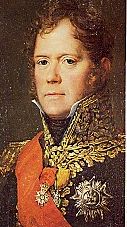
1815: Joachim Murat, Napoleonic Marshal

On this date in 1815, French Marshal-cum-Neapolitan King Joachim Murat was shot in Pizzo, Italy, for a failed attempt to regain his throne.

The charismatic cavalryman cuts a snazzy figure in the Napoleonic era, from its very infancy: it was Murat who secured for the 26-year-old Bonaparte the cannon used to deliver the “whiff of grapeshot” whose odor set Napoleon on the path to becoming Emperor.

Murat knew a good thing when he had it, and thereafter zipped around with the peripatetic conqueror, finding time between dashing mounted charges to marry Napoleon’s sister Caroline.

Murat’s honors multiplied with his commander’s victories: “First Horseman of Europe” (whatever that means); Grand Duke of Berg and Cleves; at last, in 1808, he was appointed King of Naples and Sicily, beneficiary via Caroline of the Corsican’s policy of installing family members to helm his satellite kingdoms.

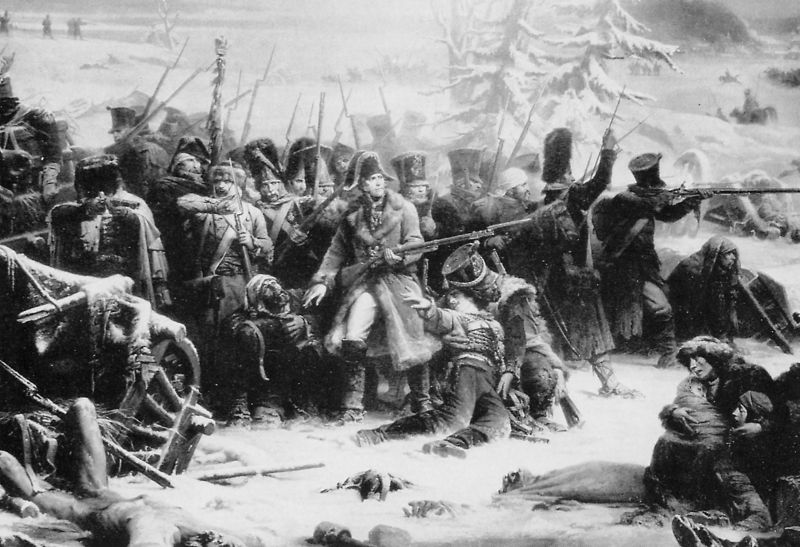
Still, that elevation didn’t mean Murat would just retire to his Mediterranean villa and his mistresses: he was on call when Bonaparte went to invade Russia.

Leo Tolstoy, undoubtedly a hostile witness in his epic War and Peace, renders Murat as something of an oblivious dunderhead:

Though it was quite incomprehensible why he should be King of Naples, he was called so, and was himself convinced that he was so, and therefore assumed a more solemn and important air than formerly. He was so sure that he really was the King of Naples that when, on the eve of his departure from that city, while walking through the streets with his wife, some Italians called out to him: “Viva il re!” he turned to his wife with a pensive smile and said: “Poor fellows, they don’t know that I am leaving them tomorrow!”

But though he firmly believed himself to be King of Naples and pitied the grief felt by the subjects he was abandoning, latterly, after he had been ordered to return to military service — and especially since his last interview with Napoleon in Danzig, when his august brother-in-law had told him: “I made you King that you should reign in my way, but not in yours!” — he had cheerfully taken up his familiar business, and — like a well-fed but not overfat horse that feels himself in harness and grows skittish between the shafts — he dressed up in clothes as variegated and expensive as possible, and gaily and contentedly galloped along the roads of Poland, without himself knowing why or whither.

Like his fellow-Marshal Michel Ney, Murat nevertheless had the realpolitik chops to get on after their thrust to Moscow had so calamitously reversed — in Murat’s case, by cutting a deal with the Austrian Empire to retain his kingship.

But also like Ney, he couldn’t resist joining Napoleon’s ill-fated 1815 reunion tour. Murat could have survived the consequent loss of his throne, but made a quixotic bid to invade with only a handful of men the former possession whose people he quite wrongly imagined would rally to his cause.

Not the realization of the day-dreams of the most dreaming youth, not the visible acting of the strangest visions which the dramatist and romance-writer have conceived, could strike us with more wonder than the simple narration of that which befel the son of the baker of Cahors in his passage from the ranks of the French army to the throne and sceptre of Naples; and, alas! one step farther, an unquiet and a mournful one, to that small court in the castle of Pizzo, where the hero of a hundred fights, — the Achilles of the chivalrous French, — gazed for a second, with uncovered eye and serene brow on the party drawn out to send the death-volley home to his heart.

Well, this depiction of Murat’s end is plainly of more sympathetic character than Tolstoy would have done.

… the disgraceful tribunal, after consultation, declared, “That Joachim Murat, having by the fate of arms returned to the private station whence he sprung, had rashly landed in the Neapolitan dominions with twenty-eight followers, no longer relying upon war, but upon tumults and rioting; that he had excited the people to rebellion; that he had offended the rightful King; that he had attempted to throw the kingdom of Naples and the whole of Italy into confusion; and that therefore, as a public enemy, he was condemned to die, by authority of the law of the Decennium, which was still in vigour.” This very law, by a strange caprice of fortune, was one which Joachim himself had passed seven years before. He had, however, humanely suspended its operations many times, at particular seasons of his rule; and yet this very law, so passed, and so suspended by him, was made the instrument of his death.

The prisoner listened to his sentence with coolness and contempt. He was then led into a little court of the castle, where he found a party of soldiers drawn up in two files. Upon these preparations he looked calmly, and refused to permit his eyes to be covered. Then advancing in front of the party, and, placing himself in an attitude to meet the bullets, he called out to the soldiers, “Spare my face — aim at the heart.” No sooner had he uttered these words than the party fired, and he, who had been so lately King of the Two Sicilies, fell dead, holding fast with his hands the portraits of his family …

* More evidence that blood is thicker than water, since Napoleon and Murat were not chummy. According to Memoirs of Napoleon, His Court and Family, by the wife of another Napoleonic general,

The Emperor did not cherish for Murat the sincere friendship which he entertained for the other officers of the army of Italy. He used frequently to make him the subject of derision; and many of us have heard him laugh at the King of Naples, whom he used to call a Franconi King.

On this day..

1812: Daniel Dawson, for the integrity of sport

On this date in 1812, Daniel Dawson “suffered the awful sentence of the law, at the top of Cambridge Castle, amidst a surrounding assemblage of at least twelve thousand spectators, it being market-day.”

The crowd was an appropriate ornament to the condign punishment of the most famous horse-poisoner in English history — and perhaps the most severely-punished sports cheat in all of modernity.

A tout scrabbling his living about the storied Newmarket tracks of Cambridge, Dawson killed the favorite for a high-profile race (and three other horses besides) by poisoning their trough, intending only to hamper the beasts enough to make good a variety of bookies’ bets against the fair Pirouette.

Although acquitted for that crime, Dawson was promptly returned to the dock for a previous, and previously unsolved, horse-poisoning, and convicted under a “black act” statute to punish livestock-killing.

According to the inevitable trial pamphlet, freely available from Google Books,

DAWSON behaved with a sullen and impudent levity during the trial, and he frequently abused the witnesses whilst giving their testimony, loud enough to be heard throughout the court … with horrid imprecations, ill becoming his unhappy situation, and at other times he was nodding at and saluting with his hand different persons in court. The verdict of GUILTY had not the slightest effect on him, and his general conduct was altogether depraved. On his return to the castle, his conduct, at times, bordered on insanity, and he appears too illiterate to feel a consciousness of wrong, although he has confessed his guilt to the full extent.

(Katherine Watson adds that although Pirouette’s owner sought a reprieve for the poisoner, Dawson “spoke bitterly of the hypocrisy of the Jockey Club, few of the members of which were above cheating.”)

On this day..

1814: Four of five deserters, in Buffalo

On this date* in 1814, an American army in Buffalo, N.Y., shaken by desertions lined up five absconding soldiers for execution.

The memoirs of one Jarvis Hanks, a drummer, recalled the singular scene that ensued.

In this alternative history of the war of 1812, the sergeant commanding the firing party and the soldier not executed make their way down the continent as an odd couple and fight in the Battle of New Orleans.

During the time we remained at Buffalo, five men were sentenced to be publicly shot for the offence of desertion. They were dressed in white robes with white caps upon their heads, and a red target fastened over the heart. The army was drawn up into a hollow square to witness the example that was about to be made of their comrades who had proved recreant to the regulations of the service. Five graves were dug in a row, five coffins placed near them, also in a line, with distance between coffins and graves to enable the criminals to kneel between them. About twelve men were assigned to the execution of each offender. Their guns were loaded by officers, and they were not permitted to examine them afterwards until they had fired.

All things being in readiness, the chaplain made a prayer, the caps were pulled down over the eyes of the poor culprits, and the word of command given: “Ready! Aim! Fire!” They all fell! Some into their graves, some over their coffins. One struggled faintly and the commanding officer ordered a sergeant to approach and end his misery. He obeyed by putting the muzzle of his piece within a yard of his head, and discharging it. This quieted him perfectly!

At this time one of the condemned slowly arose from his recumbent position to his knees and was assisted to his feet. His first remark was, “By God, I thought I was dead”. In consequence of his youth and the peculiar circumstances of his case, he had been reprieved, but the fact was not communicated to him until this moment. He had anticipated execution with his comrades, and when the report of the guns took place, he fell with them, though not a ball touched him. The platoon assigned to him had guns given to them which were not charged, or at least had nothing but powder in them.

Even Dostoyevsky didn’t get to the point where the mock executioners actually “fired”.

These executions took place during the Niagara campaign in the latter stages of the war — the Americans’ last push in their unsuccessful bid to conquer Canada.

* This execution, which obviously has a folklorish quality, has somewhat slippery particulars. The not-necessarily-dependable dating of the Espy file (pdf) places it on this date, as does The Rivers of War, which squares with the quoted soldier’s account of timing and the known troop movements. Hanks’ writings (and that of two other War of 1812 soldiers) is published in Soldiers of 1814: American Enlisted Men’s Memoirs of the Niagara Campaign. (Review.)

Espy names the executed soldiers as John Black, Mahlon Christie, George Orcote, and Isaac Kent.

On this day..

1817: Three criminals in Rome, as witnessed by Lord Byron

On this date in 1817, the day before he left his Roman holiday for Venice, Lord Byron saw three criminals beheaded at the Piazza del Popolo.

He wrote all about it in his correspondence with John Murray.

The day before I left Rome* I saw three robbers** guillotined. The ceremony — including the masqued priests; the half-naked executioners; the bandaged criminals; the black Christ and his banner; the scaffold; the soldiery; the slow procession, and the quick rattle and heavy fall of the axe; the splash of the blood, and the ghastliness of the exposed heads — is altogether more impressive than the vulgar and ungentlemanly dirty ‘new drop’, and dog-like agony of infliction upon the sufferers of the English sentence. Two of these men behaved calmly enough, but the first of the three died with great terror and reluctance, which was very horrible. He would not lie down; then his neck was too large for the aperture, and the priest was obliged to drown his exclamations by still louder exhortations. The head was off before the eye could trace the blow; but from an attempt to draw back the head, notwithstanding it was held forward by the hair, the first head was cut off close to the ears: the other two were taken off more cleanly. It is better than the oriental way, and (I should think) than the axe of our ancestors. The pain seems little; and yet the effect to the spectator, and the preparation to the criminal, are very striking and chilling. The first turned me quite hot and thirsty, and made me shake so that I could hardly hold the opera-glass (I was close, but determined to see, as one should, see every thing, once, with attention); the second and third (which shows how dreadfully soon things grow indifferent), I am ashamed to say, had no effect on me as a horror, though I would have saved them if I could.

— Venice, May 30, 1817

* The date is not stated directly in Byron’s missive, but his movements are known in some detail — for instance, this timeline.

** According to the notes of executioner Mastro Titta, the three criminals “‘decapitati’ al Popolo, per omicidi e grassazioni” this day were Giovanni Francesco Trani, Felice Rocchi and Felice De Simoni.

On this day..

1814: Six slaves in Guyana

An alarming rumour, meanwhile, … spread throughout the Colonies; a rumour which, whatever of truth or fact, little or none, might be at the foundation, gathering, as it went, size and gloom, and dust of slander, was calculated to make them all feel very unhappy. The report was that a slave insurrection had been discovered, having its centre on the Berbice West Coast, but extending right and left so as to include all the shore from the Corentyne Coast to Mahaica, about eighty miles; that the negroes had chosen a governor and other officers; that it was their intention to murder all the white men, and take possession of all the rest; that some of the Demerara East Coast negroes were leaders in the rebellion, especially Philip, a member of the church on Le Resouvenir; and that instruction of the negroes was to blame.

the account which the negroes gave of the matter was, that there had been formed a society in imitation of the Freemasons, they wishing to have, as well as their buckras or masters, a society of that nature; and that the money collected was to support the poor and defray the expense of their dances, &c.; just as it had been formerly very common for them to assume the names of their masters, or of the Governor or Fiscal, and send invitations to friends to supper or a dance, and appoint a captain of their own as president of the feast; sometimes to put feathers in their hats at holiday time and parade the streets. “No one,” as far as Mr. Wray could learn, “had been injured by them, neither was any property destroyed,” yet on 12th April six of the unhappy people apprehended on the West Coast were executed in New Amsterdam as ringleaders, their heads cut off and fixed upon poles on the different estates to which they belonged; one of them white with age, whose master, Mr. Rader, told Mr. Wray that he denied to the last having any bad intentions. Several others were flogged under the gallows, and some were transported.

A proclamation was subsequently issued to the effect that as “the privilege allowed the slaves of the Colony, of publicly or privately dancing on estates and other places at stated periods, had been perverted by them to purposes of the most dangerous nature, all dancing was forbidden until next year, 1815, or the further pleasure of the Court;” … This was followed, late in the year, by another calling upon the colonists to pay their quota of the expenses incurred in crushing the plot and indemnifying the proprietors of the slaves capitally punished … Better still, the law concerning Sunday labour was amended in favour of the slave, forbidding field-work on that day, except in sudden emergencies; and further enactments were issued limiting and regulating the excessive use of the whip, and forbidding the burial of any slave dying suddenly or by suicide, or in consequence of punishment or hurt, without previously acquainting the authorities …

From The Life and Labours of John Wray, Pioneer Missionary in British Guiana.

On this day..

1815: Michel Ney, the bravest of the brave

On this date in 1815, Napoleonic Marshal Michel Ney faced a squad of French troops un-blindfolded and gave them the last order of his wild career:

Soldiers, when I give the command to fire, fire straight at my heart. Wait for the order. It will be my last to you. I protest against my condemnation. I have fought a hundred battles for France, and not one against her… Soldiers Fire!

The carrot-topped commander, just seven months Napoleon’s senior, had like the Corsican distinguished himself at arms during the French Revolution.

He shone thereafter as a ballsy* cavalry officer in the Napoleonic Wars — Bonaparte called him le Brave des Braves (“the bravest of the brave”).

Hitching your star to Napoleon’s was a good career move, for sure.

Until right about …


Michel Ney was named Prince de la Moskowa after the Battle of Borodino 1812. Things kind of went downhill from there.

“[W]e are told of the greatness of soul of the marshals, especially of Ney — a greatness of soul consisting in this: that he … escaped to Orsha abandoning standards, artillery, and nine-tenths of his men.” -Leo Tolstoy, War and Peace

Ney was able to keep things cool with Louis XVIII, but when Napoleon returned from Elba and Ney marched out to capture him, both Marshal and army deserted to the old emperor.

Ney often takes a rap for fouling up the reunion tour with a characteristically reckless cavalry charge during the Battle of Waterloo.

But his real problem was that he couldn’t make up his mind or stir his spirit or just plain read the writing on the wall well enough to get out while the getting was good. Though the Bourbons gave him every opportunity to blow town and spare the new-look ancien regime the embarrassment of having to try him, Ney didn’t do it — causing the king to fume,

By letting himself be caught, he has done us more harm than he did [defecting to Napoleon] on the 13th of March!

A vengeful Chamber of Peers, full of radical more-royalist-than-the-king types, gave him no quarter.

The near-unanimous conviction and death sentence were agreed by the Peers around midnight as December 6 became December 7, and the Bravest of the Brave led out near the Luxembourg Garden that very morning to suffer the sentence passed upon him.

The Bravest of the Brave, a 19th-century general history of the man, is available free on Google Books, as are two volumes of memoirs (1, 2) published posthumously by his family.

French speakers can find other free 19th century texts on Ney linked here.

* His reputation for unshakable courage notwithstanding, John Elting says Ney was also a deft hand at executing a cavalry retreat.

On this day..

1817: Policarpa Salavarrieta, Colombian independence heroine

This morning in 1817, a Colombian seamstress was shot in Bogota for spying on the Spanish forces fighting to quell South America’s Bolivarian independence movements.

Policarpa Salavarrieta — it was the name her brother used for her; her legal given name and origin are romantically lost — was infiltrated into Bogota during the reconquista, when a Spain recovering from Napoleon’s intrusion deployed in force to quash the separatist aspirations of its New World colonies.

It was the day of Simon Bolivar, but Spain had completed its apparent pacification of New Granada* in 1816, and established a stronghold in Bogota. Subversives had to mind their P’s and Q’s.

Although she was a known agitator in the city of Guadas, “La Pola” could slip into Bogota without drawing attention.

There, she used her skills as a domestic to hang around royalist households, sewing up clothes while snooping around, and helping revolutionaries recruit soldiers.

She was arrested when the Spanish busted the network, (the link is in Spanish) and shot publicly with her lover, Alejo Sabarain, and a number** of others — all men, none of them half so well-remembered or beloved as Salavarrieta. She was supposed to have ignored the priests murmuring te deums in her ear on the scaffold in order to exhort the onlookers to resistance.

Over the years to come, she would become an emblematic martyr of independence; just see how many times her theme is visited in this history of Colombian painting (Spanish again). She’s also the only historical (not mythological/allegorical) woman ever used on Colombian currency.

As will be readily surmised, of course, she merits her tribute because the movement in whose service she died soon rallied and carried the day.

* The Spanish territory of New Granada encompassed most of the ice cream of the South American cone.

** Various numbers are given for the day’s total execution count. This site (Spanish) says a total of nine — Policarpa Salavarrieta and eight men, including Alejo Sabarain — and persuasively names all of them.

On this day..