1887: Israel Lipski

(Thanks to Meaghan Good of the Charley Project for the guest post. -ed.)

On this day in 1887, 22-year-old Israel Lipski was hanged at Newgate Prison for the murder of Miriam Angel.

His trial and execution were well-publicized in their day, and were the subject of a 1984 book, The Trials of Israel Lipski: A True Story of a Victorian Murder in the East End of London by Martin L. Friedland.

But Lipski has been largely forgotten now … except as a footnote in a much more famous unsolved murder.

Lipski was of Polish-Jewish origin. His real name was Israel Lobulsk; he changed it when he moved to the UK.

He lived in a boardinghouse and worked as an umbrella and walking-stick salesman. Miriam, who was also Jewish, lodged at the same address, 16 Batty Street.

Miriam was found dead in her bed June 28 of that year. She’d been killed in an unusual way: she was forced to consume nitric acid, also known as aquafortis, a strong corrosive chemical now used in rocket fuel. She was six months pregnant at the time of her death.

Lipski was found hiding under her bed. He too had consumed nitric acid and the inside of his mouth was burned. Investigators later determined he’d purchased an ounce of the chemical that very morning. They theorized he had killed Miriam during a rape attempt.

Lipski, for this part, insisted he was innocent of any crime and told an extraordinary story: he stumbled across two co-workers in Miriam’s room rifling through her things. Miriam was already dead at this point. The two men attacked and robbed him, poured the nitric acid down his throat and threw him under the bed, where he fainted.

The judge’s summing-up to the jury, described by one news account as “lucid and temperate,” went with the rape theory:

… that the murderer of Miriam Angel entered her room under the influence of unlawful passion; that, balked in this design, his passion turned to homicidal fury; and that in a reaction of shame and terror he had taken a dose of the same poison that he had given to his victim. If that theory was probable, continued the judge, the murder was much more likely to have been the work of one man than two.

The climate of pervasive anti-Semitism in East London during this time sealed Lipski’s fate. London’s Jewish population, largely impoverished Polish and Russian refugees, was ever liable to blame for a wide variety of social problems. On top of everything else, Lipski’s legal defense was abysmal and the judge clearly biased. He might have been guilty, but the fairness of his trial is questionable.

Following Lipski’s conviction and death sentence there was worried speculation that he might, after all, be innocent. Several prominent people, including members of Parliament and investigative journalist William Stead, petitioned the Home Secretary for a reprieve or commutation. (Stead referred to Lipski as “the young martyr” and the “much injured young exile.”) The wind went out of their sails, however, after Lipski’s confession was published:

I, Israel Lipski, before I appear before God in judgment, desire to speak the whole truth concerning the crime of which I am accused. I will not die with a lie on my lips. I will not let others suffer even in suspicion for my sin. I alone was guilty of the murder of Miriam Angel.

I thought the woman had money in her room, so I entered, the door being unlocked and the woman asleep. I had no thought of violating her, and I swear I never approached her with that object, nor did I wrong her in this way. Miriam Angel awoke before I could search about for money, and cried out, but very softly. Thereupon I struck her on the head and seized her by the neck, and closed her mouth with my hand, so that she should not arouse the attention of those who were about the house.

I had long been tired of my life, and had bought a pennyworth of aquafortis that morning for the purpose of putting an end to myself. Suddenly I thought of the bottle I had in my pocket, and drew it out and poured some of the contents down her throat. She fainted and, recognizing my desperate condition, I took the rest. The bottle was an old one which I had formerly used … The quantity of aquafortis I took had no effect on me.

Hearing the voices of people coming upstairs, I crawled under the bed. The woman seemed already dead. There was only a very short time from the moment of my entering the room until I was taken away.

Even before his execution, “Lipski” became a part of Londoners’ vocabulary. It was used as both a slur against Jews and as a verb, the way a certain kind of suffocation murder still known as “burking” was named after William Burke of “Burke and Hare” fame.

A year after Israel Lipski’s execution, the name “Lipski” once again came under scrutiny after a murder suspect yelled it out in front of a witness, leaving scholars and true-crime buffs to speculate about its meaning for the next 120 years and counting.

The victim in that case was a prostitute named Elizabeth Stride. The suspect is known only by his trade name, Jack the Ripper.

But that’s another story.

On this day..

1884: Mary Lefley, exonerated by a deathbed confession

On this date in 1884, Mary Lefley was hanged at Lincoln County Gaol for lacing her husband’s pudding with a lethal dose of arsenic.*

It was less than four months since William Lefley ate the rice pudding his wife Mary had left him in the oven while she called at a nearby town. This strange poisoning case is admirably covered by Capital Punishment UK, whose work we’ve featured here before. It’s one of the essential online sources on British execution history.

Shrieking in terror, Lefley had to be dragged to the gallows — still protesting her innocence. She’d never admitted to the crime, and they’d never been able to show that she purchased any arsenic.

There was some thought that William may have committed suicide: he’s known to have attempted it once before. But the more outlandish defense hypothesis that some unknown third party might have snuck in and poisoned the morsel gained unexpected credence in 1893 when a farmer made a deathbed confession to having done just that … over a wholly unrelated-to-Mary financial grudge.

* Mary Lefley knew the last notorious Lincolnshire poisoner, Priscilla Biggadyke — who hanged for poisoning off her husband in 1868. “They are hanging me for my past!” Lefley exclaimed when she was convicted. (Priscilla turned out to be innocent, too.)

On this day..

1881: Po’olua, “darkened in my mind”

This date in 1881 saw the hanging of a native Hawaiian named Po’olua for a homicide of domestic jealousy tinged by almost tragic remorse.

This case is described in the 1991 essay “A Short History of Hawaiian Executions, 1826-1947” by Joseph Theroux.

In 1881, the Hawaiian [Po’olua] grew enraged when his when his common-law wife, according to the papers, “paraded her infidelity” before him and slaughtered her with a “big butcher knife.” Then, in a fit of remorse, he draped his house in mourning with black crepe paper.

… The experts of the day — family doctors and preachers — were conducted in to interview the bewildered man. They questioned him and concluded that he was not insane. Po’olua himsel agreed that he was sane but “darkened in my mind.” … the Reverend H.H. Parker explained the man’s actions this way: “A Hawaiian would do many things which a white man would not.”

When it as found that Po’olua had a heart abnormality and that he would likely die soon anyway, letters of clemency were circulated on his behalf. But he was hanged on May 20, 1881. Permission was sought for a post mortem to investigate the state of his heart, but officials denied the request. The Advertiser remarked that it “should have been done. Being attended to, might have laid him quiet in his grave; but being forbidden, his spirit will rise up Banquo-like for many a day to come.”

On this day..

1880: Daniel Searles, the first hanging in Tioga County

From the New York Evening Express, January 21, 1880.

DANIEL SEARLES HANGED.


THE NEGRO MURDERER OF OLD MR. REWEY

Sketch of a Brutal Crime — The Condemned Man Owns His Guilt and Admits the Justice of His Sentence.

OSWEGOOWEGO, N.Y., January 21. — The first instance of capital punishment in Tioga county occurred here to-day at noon. The extreme penalty of the law was inflicted upon Daniel Searles, an illiterate negro, who in June last murdered Eldridge Rewey, an aged farmer, who lived alone in the neighboring vilage of Newark Valley.

The murder was for the purpose of robbery, and was one of fiendish atrocity. Calling at the farmer’s house in the early evening of June 25, Searles felled him senseless to the floor, and then cut his throat with a razor.

He obtained about $300 by searching the house, and, on preparing to leave, noticed that his victim had revived. Rewey had also drawn a knife from his pocket, as if to defend himself, which the negro wrested from him, and with which he nearly decapitated his helpless victim.

He was arrested next day, tried before Judge Follett at OswegoOwego, and on December 8 was sentenced to be hung to-day.

Searles has made no attempt to deny his guilt, openly confessing the crime and saying he deserved to die for it. He has preserved a brave exterior throughout, and passed his last night on earth seemingly with less anxiety than did his executioner.

The execution took place in a temporary frame structure in the jail-yard, erected for the purpose. A cordon of military attended. The gallows was the same on which Penwell was executed at Elmira in July, 1877, for wife murder. The ponderous drop weighed three hundred pounds.

The spectators were in attendance at 11:45, some two hundred being present. Prayers were said in the prisoner’s cell at noon and the death warrant read to him.

Part of the Daily Triple: 1880 and Death.

On this day..

1880: Andrew Scott and Thomas Rogan, bushrangers

On this date in 1880, Andrew George Scott and Thomas George “condemned to death for the part they took in the outrage at Wantabadgery, resulting in the death of constable Bowen, were executed at Darlinghurst Gaol.”


Andrew George Scott, aka Captain Moonlite (top); Thomas Rogan (bottom)

Scott is our main man here, an Anglican lay reader turned grifter turned flat-out outlaw with the nom de plunder “Captain Moonlite”: one of the strangest characters in Australia’s criminal annals.

How did a fellow with such a family-friendly alias end up involved in an “outrage”?

This colorful, charismatic immigrant (from Ireland, via New Zealand — and, legend has it, with a side trip to Italy to fight with Garibaldi) became a notorious public figure when, in outlandish masked getup, he robbed the bank of the South Victoria gold rush town of Mount Egerton.

His distinctive voice — remember, he was a parish reader — was recognized by his erstwhile friend at the other end of the gun, but Scott brazenly reversed the accusation and actually had his victim in the dock for a time. This Mount Egerton crime is the source of the man’s luminescent nickname, after the signature placed on a stickup note.

When he got out of prison in 1879 — having defended himself with panache, and escaped once along the way — he had a public profile, and actually got out on the lecture circuit for a brief spell.

But he soon returned to the annals of preposterous criminality.

Gathering five young followers, Moonlite went full-time into the bush. Allegedly spurned in a bid to join Ned Kelly‘s gang, Moonlite et al sought work at Wantabadgery Station.

When this refuge, too, turned them away, the outlaws found themselves in a rather pathetic state of hunger and desperately seized the place by main force. The resulting “outrage” was not a wholesale plunder of the station or wanton abuse of the prisoners (no rapes, no murders … although Moonlite did conduct a kangaroo “trial” of one of his hostages for attempting to escape: the verdict was not guilty): it was the inevitable ensuing shootout with police in which the bushrangers James Nesbitt and Augustus Wernicke died, along with the constable Bowen.

Two of the other three who survived this shootout also survived their brush with the law by blaming Captain Moonlite. The “Captain” may have been plenty eager to accept this fatal inculpation for reasons beyond those of mere honor.

In his prolific prison correspondence awaiting execution, Scott avowed his broken-hearted love for James Nesbitt, one of the two companions who had been killed in the shootout. The terms are astonishingly explicit for the time.

“My boy with a golden heart who died trying to save me … He was my constant companion; we had the deepest, truest bond of friendship. We were one heart and soul, he died in my arms and I long to join him, where there shall be no more parting. He died in my arms; his death has broken my hear. When I think of my dearest Jim, I am nearly driven mad. My dying wish is to be buried beside my beloved James Nesbitt”

Scott hanged wearing a ring of the late Nesbitt’s hair,* but his wish to share a burial plot was not honored — until Captain Moonlite was exhumed and reburied in 1995.


(cc) image from AYArktos.

* Asserted in Who’s Who In Gay and Lesbian History from Antiquity to World War II.

Part of the Daily Triple: 1880 and Death.

On this day..

1880: Prevost, predatory Parisian policeman

From a Paris Dispatch report via the New York Times. (Additional paragraph breaks have been added for readability.)

It is just 10 years ago, day for day, that the notorious Troppman, the murderer of the Kink family, was executed on the Place de la Roquette. This morning another convict of the same stamp underwent the penalty of death on the same spot.

Prevost, the policeman who murdered the woman Blondin and the jewelry-dealer, Lenoble, and afterward cut their bodies up and threw the pieces into the sewers, was guillotined there at daybreak.


Thwack: Prevost clobbers Lenoble.

It having become known last night that his appeal for mercy had been rejected by the President of the Republic, a large crowd began to assemble as early as 9 o’clock round the place of execution. To prevent a recurrence of the scenes of disorder which took place there when the young criminals Lebiez and Barre, the assassins of the woman Gilles, were put to death, a strong force of infantry and cavalry guarded the square and kept the people at a distance.

The crowd, in spite of the bitter cold and piercing north-east wind, grew more numerous toward midnight, and by the hour of execution all the thoroughfares leading to the spot were crammed with people.

The executioner arrived at 4 o’clock, and, aided by his assistants, erected the guillotine about 20 paces from the central door of the prison. The guillotine once in order, the headsman and his assistants entered the prison to arrange what is called the toilet of the culprit previous to his death.

The Abbe Crozes, the Chaplain of the jail, was the first to enter the prisoner’s cell. Prevost started up, gazed wildly at the reverend gentleman, and then buried his head in his hands, trembling and groaning.

“Alas!” said the Chaplain, “there is no hope now but in the mercy of God.”

Prevost had lured the jewel-trader Lenoble on the pretext of arranging a transaction, then for no reason save crass acquisition of his wares bludgeoned him to death with the iron rod-and-ball device used to link railroad cars.

It was a premeditated and gruesomely executed crime.

Using butchers’ knives he had pre-obtained for the purpose, Prevost spent the next several hours skinning Lenoble, dismembering Lenoble, and ultimately dicing Lenoble up into cutlets so that he could heap Lenoble in a basket and dispose of Lenoble’s bits in less-suspicious fragments in a variety of sewer grates and refuse heaps.

Such as was recovered was heaped together at the morgue, “a mass of quivering flesh, stripped of skin … bones covered with their tendons, sternum, ribs with fragments of the chest, bones of the shoulder blades and arms … the liver, heart and guts, and the fragments of skin torn off one by one from each severed part.”*

After his capture for this shocking crime, he admitted that he’d also been the author of the unsolved murder several years before of his lover, Adele Blondin — likewise for pecuniary gain, and likewise disposed of in pieces after Pevost’s ghoulish close work with corpse and saw.

The condemned man then left his bed, but he was too much overcome to dress himself. That task was done by the executioner and his assistants. He was then left alone with the Abbe Crozes to prepare his soul. He embraced the Chaplain several times and wept bitterly.

“Take courage, take courage,” said the reverend gentleman.

“Yes, yes,” replied Prevost, “I will take courage and try to meet my fate. I ask pardon of the Police administration, to which I belonged seven years.”

“If this … pawnbroker has been murdered by some one of a higher class in society,” Dostoyevsky had mused in Crime and Punishment in 1866, “how are we to explain this demoralisation of the civilised part of our society?”

Prevost’s demoralization afflicted his cognition as well as his conscience, because he had actually made previous chit-chat with fellow-officers to the effect that were he to commit the perfect crime he would surely go and butcher the body for no-fuss disposal.

The condemned man, after kissing the crucifix three or four times, marched out to the guillotine wit a firm step, and in an instant he was on the fatal bascule.

The spring was touched, a dull thud was heard, and the next second his head fell into the basket.

After the execution the body and head of the murderer were taken to the School of Medicine, and, having been sown together, electrical experiments were made on them, and in the opinion of all the doctors present death must have been instantaneous.

* This quote, and the other interspersed crime details, and the nice bashing illustration, are all via this French crime pamphlet.

Part of the Daily Triple: 1880 and Death.

On this day..

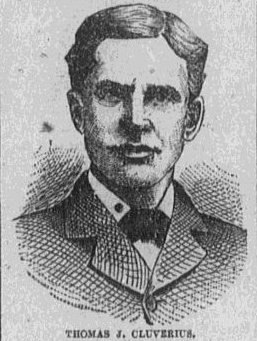
1887: Thomas Cluverius, Richmond murderer


Dallas Morning News, January 14, 1887.

On this date in 1887, a long-running (for the time) legal drama in Richmond ended with the hanging of Thomas Cluverius for murder.

On Friday the 13th — March 13, 1885 — Cluverius killed his cousin and lover Lillian Madison, who was eight months pregnant with his child, an act “as dark as any that can be found in all the calendar of crimes.” (Columbus Daily Enquirer, Jan. 15, 1887)

From the illicit affair to the shocking crime of passion and calculation to the damning lost watch key found at the site of the murder: everything conspired to spill newsprint, not only in Virginia but nationwide.

Nevertheless, by the time he hanged, the young lawyer was supported by at least a chunk of public opinion prepared to credit his dogged insistence on innocence.* He maintained it all the way to the scaffold. The drama of a potential gubernatorial reprieve, backed by hundreds of Old Dominion worthies, went to literally the very last hour of the condemned man.

The facts of this case now 125 years in the grave enjoy meticulous and evocative coverage at The Shockoe Examiner, a Richmond blog that we come to via Murder by Gaslight’s Cluverius post.

We’re very pleased on this occasion to interview a writer who has given “Tommie” and “Lillie” a more literary treatment. John Milliken Thompson‘s first novel The Reservoir (review), just published in the summer of 2011, illuminates the timeless conflicts between lust and propriety, in the very specific locale of post-Reconstruction Richmond.

ET: For you as a writer, how did you come by this story, and why did you decide to make it your first novel?

JMT: I came across a brief mention of the case in a book on Richmond history and made a mental note of it.

Sometime later I began looking into the case and, after finding all kinds of material on the trial and on Richmond in the 1880s, I became more and more intrigued. A failed attempt to turn the story into a nonfiction account led me to write it as a novel.

Book CoverWhat was the most challenging thing about approaching the story?

Creating believable, interesting characters within a compelling plot is THE challenge of writing any piece of fiction. This one was no different, though it helped to have a historical framework and tons of good material to turn to.

That said, one of the toughest things about telling this story was getting the voice right. My goal was to create a narrative that could get close in to Tommie’s head, without revealing too much (to the reader or himself), and then pull farther back.

I found it interesting that you said you “felt so connected to these long-dead people that [you] owed it to them to get it right,” because I have that sense myself sometimes. In the end, what are you hoping that 21st century readers take away from the story? What did you take away from it?

In the end, I think what I most want is for readers to feel moved by the plight of these young people, who made some crucial mistakes and paid dearly for them. We all make mistakes in our youth; sometimes we learn our lessons before we get in deeper, sometimes not.

The inference is that Tommie killed Lillian because she was pregnant. How damaging would Lillian’s giving birth really have been to Tommie socially, professionally, or otherwise? Do we need to look for more complex motivations?

That’s a good question, and Tommie even considers what his life would be like if he had “done the right thing” by Lillie and married her. Even if he had been able to live down the scandal of marrying a pregnant girl, which in those days and in their circle would’ve been significant, it would still not have been the life this ambitious young man had envisioned for himself.

And what about the world he lived in — 1880s Virginia, and the place of the crime, Richmond. What’s this place like a generation after the Civil War? And why did this crime in this place become national news?

Well, Richmond, the former Confederate capital, was making a comeback after being ravaged by the war. This event caught the interest of the general public because of the high standing of the families involved and because the lawyers trying the case were distinguished men and famous orators.

Despite maintaining innocence to the last, it seems pretty difficult to imagine that Thomas Cluverius was actually innocent. Still, at the time there were plenty of people who apparently thought he might be. Why on earth did he attract that level of support? If not for the watch-key, might he have avoided conviction altogether?

That’s the fickle nature of the public — once the scapegoat has been cast out, there is a lingering sense of doubt and guilt that causes many of us to look into our own hearts … let he who is without sin.

I think the watch-key did play a big role, but it wasn’t necessarily the sine qua non. I think the sheer volume of testimony offered by the prosecution overwhelmed any reserve the all-male jury might have felt. The burden of proof, in fact if not by law, lay with the defense, and the proof (of innocence) simply wasn’t there.

What are you working on next?

I’m finishing up a coming-of-age novel about a young woman who suffers a number of poignant losses in turn-of-the-century North Carolina. By the way, until “turn-of-the-century” means turn of the 21st (maybe in two decades?) I’m using that phrase to mean turn of the 20th.

Thanks for inviting me on your blog.

* Or empathize with the young lawyer’s lost-potential pathos.

On this day..

1880: Ned Kelly

On this date in 1880, legendary bushranger Ned Kelly hanged at Melbourne Gaol.

The Dick Turpin of Australian outlawry — in the sense that he’s the first name on the marquee — Kelly was the son of an Irishman shipped to Van Damien’s Land on the British convict transportation plan.

Setting down in Greta, Victoria the Kelly family cultivated a keen reputation for criminality (e.g., see this 1880 newspaper article; also, here).

When Ned was all of 11, pa died doing a six-month prison stint at hard labor for stealing a neighbor’s cow, and it wasn’t much longer before young master Edward was making the acquaintance of the law himself: arrested for assault in 1869 at age 14; arrested once again the following year as an accomplice to the bushranger with the pornstar name, Harry Powers; imprisoned later in 1870 for three years for receiving stolen goods … and then he got into the family horse-rustling racket upon his release. Crime and gaol were just part of Ned’s world.

So was police antagonism.

The man’s famous last years started with what reads as a trumped-up run-in with a cop who turned up at a station complaining that the Kellys had shot him. (The Kelly story is that he got fresh with Ned’s sister and got whacked by a shovel.) Whatever the facts of the matter, it sent Ned and his brother Dan into the bush as fugitives.

At Stringybark Creek, the “Kelly gang” got the drop on the police posse sent to arrest them, and three officers died in the firefight. Now there was real trouble.

An 1878 “Felons Apprehension Act” immediately proscribed the men, making it “lawful for any of Her Majesty’s subjects whether a constable or not and without being accountable for the using of any deadly weapon in aid of such apprehension whether its use be preceded by a demand of surrender or not to apprehend or take such outlaw alive or dead.”

The ensuing two-year saga was a captivating cycle of dramatic robberies, escalating government bounties, state hostage-taking in the form of imprisoned family and friends, and Kelly’s own Joycean self-vindication.

he would be a king to a policeman who for a lazy loafing cowardly bilit left the ash corner deserted the shamrock, the emblem of true wit and beauty to serve under a flag and nation that has destroyed massacreed and murdered their fore-fathers by the greatest of torture as rolling them down hill in spiked barrels pulling their toe and finger nails and on the wheel. and every torture imaginable more was transported to Van Diemand’s Land to pine their young lives away in starvation and misery among tyrants worse than the promised hell itself all of true blood bone and beauty, that was not murdered on their own soil, or had fled to America or other countries to bloom again another day, were doomed to Port Mcquarie Toweringabbie norfolk island and Emu plains and in those places of tyrany and condemnation many a blooming Irishman rather than subdue to the Saxon yoke Were flogged to death and bravely died in servile chains but true to the shamrock and a credit to Paddys land.*

The hunt culminated in a cinematic shootout at the Glenrowan Inn, Kelly an accomplices entering the fray clad in bulky but effective homemade body armor they’d literally hammered out of ploughshares. (It’s thanks to the armor’s protection of his head and trunk that Ned Kelly survived the Glenrowan siege so he could be hanged instead.) Now on display at the State Library of Victoria, it’s the most queer and recognizable artifact of an era that was already then slipping into the past.

Ned Kelly in his armor (left), and the logo of the Victoria Bushrangers cricket club patterned after it (right).

I do not pretend that I have led a blameless life or that one fault justifies another; but the public, judging a case like mine, should remember that the darkest life may have a bright side, and after the worst has been said against a man, he may, if he is heard, tell a story in his own rough way that will lead them to soften the harshness of their thoughts against him and find as many excuses for him as he would plead for himself.

-Ned Kelly, during his trial

This cut no ice with the men who judged him guilty of murder, but the brawler, cop-killer, bank-robber Kelly seems to have found a way to tell that story to posterity and its thoughts have softened very much indeed.

Everything from his hardscrabble upbringing to his romantic man-against-the-world criminal career to his iconic robot-suit armor to his existentially heroic last words “such is life” equips his image for posthumous appropriation. He seems one-half charming anachronism, one-half hirsute postmodern avatar, especially when you go sculpt a mailbox out of him.

131 years dead today, Ned Kelly remains very much alive in memory. To this day, descendants and supporters lay flowers at the Melbourne Gaol where he hanged, and the recent decision to release his remains for reburial (as Kelly himself requested) made national headlines.

As to Kelly in the wider culture … well, you can’t escape him.

* All this Celtic stuff because the cop whose allegation started the trouble was named Fitzpatrick.

On this day..

1888: Hugh Mottram Brooks, for the Trunk Murder

Entomb your mate in a trunk and the Show-Me State will hoist your neck on a rope: Hugh Mottram Brooks found that out on this date in 1888.

This story had made worldwide headlines within hours of the time an employee at St. Louis’s Southern Hotel had opened the door to a guest bedroom emitting a horrible stench and discovered a corpse stuffed in a trunk.


Headline of the St. Louis Daily Globe-Democrat, April 15, 1885. The story occupied the entire front page.

The remains, in life, had belonged to Charles Arthur Preller, an English traveling salesman who had been hanging about the hotel with his impecunious countryman, Brooks.

Those two had been understood on the premises to have been involved, in the Oscar Wilde sense. But the spark for homicide was mere avarice.

The dramatic note left pinned to the late Preller — “so perish all traitors to the great cause” — was almost immediately deemed a red herring, and suspicion descended on Preller’s recent companion, who had absconded with our dead salesman’s money.

A global manhunt pursued the fugitive, who was found to have fled to San Francisco and thence overseas; he was soon arrested in Auckland and extradited back to face a sensational trial — which, by the by, entailed disinterring the corpse to search it for evidence that it had been catheterized. (It hadn’t, and this rubbished the defendant’s alibi that he’d accidentally killed the guy while consensually chloroforming him in the course of a bit of home medicine.)

The wonderful 19th century crime site Murder by Gaslight covers this case and Brooks’s futile defense in meticulous detail. Aptly enough, the Trunk Murderer didn’t have a leg to stand on.

Brooks hanged along with another murderer, Henry Landgraff. The British government did make diplomatic representations on its citizen’s behalf, but they were ignored — prosecutors retorting that London had recently given short shrift to American citizen Patrick O’Donnell.

Part of the Themed Set: Branded.

On this day..

1882: Ham Yeatts

On this date in 1882, William Hamilton “Ham” Yeatts was hanged in Chatham, Va., for the murder of his friend Pressley Adkerson.

When a fellow lures you to a deserted stretch of rural train-track and pops a cap in your head, it’s a given that he’s nursing some manner of grievance.

In the case of Ham Yeatts, that grievance is said to have been a rivalry with Pressley Adkerson — really, we couldn’t make these names up — over the affections of the local knockout, Fanny Rorer. This here page claims that Yeatts, having just wed the girl, was aghast to discover that his friend had deflowered her premaritally.

But we take note of this report of the hanging in the Richmond Daily Dispatch to the effect that the provocation was merely the victim’s nasty prophecy that Yeatts was liable to end up in a penitentiary, the stronger cuckolding allegation arising as the doomed youth made a desperate play for clemency.

Yeatts’s hanging was delayed by a week when he raised these claims of offended manhood — resulting in a bid on his life by a lynch mob, “defeated of their laudable ambition by the alertness of the guards”* — but it was all to no avail.

He requested that he be executed in a blue flannel suit, and that his body be encased in a metallic coffin with a glass face and be placed in an upright position in a cemented grave with steps leading down into it so that those who wished to see him “lying in state” could do so.

So … add vanity to wrath, envy, and lust on Ham’s cardinal sins register.

After the execution the crowd turned their attention to the circus, which had just entered the town, and Yeatts and his crime were for the time forgotten.

Oh.

Though sometimes described as the last hanging in Pittsylvania County, it apparently wasn’t.

Yeatts was only one of four men hanged in various places around the U.S. that August 4, as the Augusta (Ga.) Chronicle described in its next day’s edition …

FERNANDINA, Fla., August 4. — Merrick Jackson, colored, was hanged here to-day, at 1 o’clock, p.m. He murdered a colored boy, named John Thomas, near King’s Ferry, on November 19, 1881. On the scaffold he offered up a prayer, and thanked the Sisters of Charity for their kindness to him. He met his fate with composure. He died by strangulation.


JACKSONVILLE, Fla., August 4. — Harrison Carter, colored, who murdered Lewis Adams, colored, at Baldwin, in this county, on January 6, 1882, was executed in the ail hard here to-day.


MOBILE [Ala.], August 4. — Armand Coleman, colored, was hanged, to-day, at West Point, Miss., for the murder of Georgia Bright, on May 13, 1880. He was sentenced to be hanged on May 4, 1881, and the case was carried to the Supreme Court, where he was resentenced, but respited by the Governor till to-day. Three thousand persons were present, a large number of whom were negro women. The prisoner ascended the scaffold with a firm step, smiling pleasantly. He said he was willing to go and trusted in God. He denied his guilt to the last.


It was not all the hangman’s day, however. Louisiana Gov. John McEnery respited the scheduled August 4 execution of Jack Chapman in Bossier parish. (Chapman still hanged, on September 22.)

* The Daily Inter Ocean (Chicago, Ill.), July 31, 1882.

On this day..