On this date in 1882* Stepan Khalturin** was hanged in Odessa, Ukraine … but not for his most (in)famous crime.
Khalturin (English Wikipedia entry | Russian) came from a well-off peasant family near the city of Vyatka (today, Kirov; it was renamed for an assassinated Bolshevik). As a young carpenter in 1870s St. Petersburg, he fell in with revolutionary circles and became a distinguished propagandist and organizer. Khalturin helped found the first political labor labor organization in Russia, the “Northern Russian Workers’ Union”.
He’s said by other leftist agitators who knew him to have “persuaded his student workers with tears in his eyes to continue propagandizing, but in no event go down the path of terror. From this, there is no return.”
If that used to be his sentiment, Khalturin’s thinking … evolved.
By February 1880, Khalturin was for all intents and purposes in on the terrorism strategy. He took advantage of a workman’s gig at the Winter Palace to pack the cellar full of dynamite,† two floors below the imperial dining room.
But Tsar Alexander II and party had not yet returned when it blew. Eleven people, mostly guardsmen in the intervening room below the dining hall, died in the blast; dozens of others were injured.
Khalturin watched in frustration from the iron gates of the Winter Palace, and slipped away — never detected. His co-conspirator Zhelyabov consoled him with the prospects of mass recruitment sure to be unleashed by this spectacular propaganda of the deed. “An explosion in the king’s lair — the first attack on the autocracy! Your deed will live forever.” (Russian source)
A year later, Narodnaya Volya finally succeeded in assassinating Alexander II in St. Petersburg. Zhelyabov and five others hanged for that.
Khalturin wasn’t involved in that plot: he had escaped to Odessa.
There, he shot a police officer named Strelnikov. He was captured and hanged under a bogus alias, nobody realizing that they were also executing the mysterious Winter Palace bomber.
Unusually considering Lenin’s distaste for terrorism and Narodnaya Volya, Khalturin was elevated in post-Soviet times into an officially-approved revolutionary exemplar. The street Millionnaya running to the Winter Palace in St. Petersburg was cheekily renamed for him (it’s subsequently been changed back). Public monuments went up for the bomber, especially in the environs of his native soil around Kirov.
* April 3 by the Gregorian calendar; March 22 by the Julian calendar still in use in 19th century Russia.
** Appropriately given Khalturin’s Winter Palace work, khaltura is Russian for an item of shoddy construction. The word has no etymological connection to our man, however. (Linguistic tip courtesy of Sonechka.)
On this day in 1883, Emeline Lucy Meaker was hanged for the murder of her nine-year-old sister-in-law and ward, Alice. She was the first woman executed in Vermont and almost the last; the only other one was in 1905, when Mary Mabel Rogers was hanged after killing her husband for his insurance.
Alice’s father died in 1873 and her impoverished mother sent her and her brother Henry to live in an overcrowded poorhouse. There, the little girl was reportedly sexually abused. Others noted that she was “a timid, shrinking child—of just that disposition that seems to invite, and is unable to resist—persecution.”
In 1879, Alice and Henry got a chance for a better life when their much older half-brother* Horace (described by crime historian Harold Schechter as a “perpetually down-at-heels farmer”) agreed to take them in for a lump sum of $400. However, Horace’s wife, Emeline, was unhappy at this extra burden. She referred to Alice as “little bitch” and “that thing.”
Married to Horace when she was eighteen, forty-five-year-old Emeline was (according to newspapers at the time) a “coarse, brutal, domineering woman,” a “perfect virago,” a “sullen, morose, repulsive-looking creature.” To be sure, these characterizations were deeply colored by the horror provoked by her crime. Still, there is little doubt that … Emeline’s grim, hardscrabble life had left her deeply embittered and seething with suppressed rage — “malignant passions” (in the words of one contemporary) that would vent themselves against her helpless [sister-in-law].
Young Alice’s life, however difficult it may have been before, became hell after she went to live with her half-brother and his family.
She was forced to do more and heavier chores than she was capable of, and for the slightest reason, Emeline would beat her horribly with a broom, a stick or whatever else was at hand.
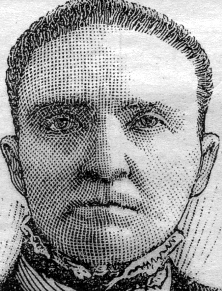
Soon Alice’s sister-in-law dropped the pretense of punishment and simply hit Alice whenever she felt like it. Emeline was quite literally deaf to the little girl’s screams, as she had a severe hearing impairment. So did Horace.
Some of the neighbors later said they could hear the child’s cries from half a mile away, and Emeline had no compunctions about abusing Alice in front of visitors. Everyone in in their small community of Duxbury was aware of what was going on, but no one bothered to do anything about it until it was too late.
Less than a year after Alice’s arrival, Emeline decided to do away with her. The crime is reported in detail in Volume 16 of the Duxbury Historical Society’s newsletter.
Emeline convinced her twenty-year-old “weak minded” and “not over bright” son, Lewis Almon Meaker, to help. He later said his mother had persuaded him that Alice would be “better off dead” and that “she wasn’t a very good girl; no one liked her.”
Emeline’s first suggestion was to take Alice out into the mountain wilderness and leave her there to die, but Almon thought this was too risky. Instead, on the night of April 23, 1880, Almon and Emeline woke up Alice, shoved a sack over her head and carried her to the carriage Almon had hired in advance. They drove to a remote hill and forced Alice to drink strychnine from her own favorite mug, which her mother had given her.
Twenty minutes later, the child’s death agonies ceased and Almon buried her in a thicket outside the town of Stowe.
Emeline and Almon, people who had been concerned about the riskiness of a previous murder plot, didn’t bother to get their stories straight about the unannounced disappearance of their charge, so when the neighbors asked where Alice had gone their contradictory explanations for her disappearance raised suspicions.
On April 26, a police officer subjected both mother and son to questioning. Almon didn’t last long before he broke down and confessed. He led the deputy sheriff to the burial site and they disinterred Alice’s remains, still visibly bruised from her last thrashing. Because the deputy’s buggy was small, Almon had to hold Alice’s corpse upright to keep it from falling out during the three-hour journey back to Roxbury.
That must have been some ride.
Emeline and Almon were both charged with murder. Each defendant tried to put as much blame as possible on the other, but both were ultimately convicted and sentenced to death. Almon’s sentence was commuted to life in prison, but Emeline’s was upheld in spite of years of appeals and a try at feigning madness.
Her violent tantrums, attempts at arson, and attacks on the prison staff didn’t convince anyone she was crazy — they merely alienated her family and others who might have otherwise supported her. Once she realized she wasn’t fooling anybody, she calmed down and passed her remaining days quietly knitting in her cell.
On the day of her execution she asked to see the gallows. The sheriff explained to her how it worked and she declared, “Why, it’s not half as bad as I thought.” For the occasion — she had a crowd of 125 witnesses to impress — she wore a black cambric with white ruffles.
The not-half-bad gallows snapped Emeline Meaker’s neck, but it still took her twelve minutes to die. Emeline wanted her body returned to her husband, but Horace refused to accept it and it was buried in the prison cemetery.
Ten years after his mother’s execution, Almon died in prison of tuberculosis.
* Some reports say Alice was Horace’s niece rather than his half-sister.
On this date in 1881, George Parrott, a cattle rustler popularly known as Big Nose George, was lynched in Rawlins, Wyoming.
His story doesn’t end with his death, however: as his Wikipedia entry notes, Parrott was notable for “Banditry, Murder, being made into a pair of shoes.” Oh, and being pickled.
The series of events that lead to Parrott’s death began on August 19, 1878, when he and his gang tried to wreck a train near Medicine Bow, Wyoming so they could rob it. They loosened a rail and waited patiently, but an alert section foreman spotted the loose rail and notified railroad authorities, who came and fixed it before the train arrived.
Realizing the law would be after them, Parrott’s gang fled toward Elk Mountain and hid in Rattlesnake Canyon, waiting to ambush the posse they knew would be coming.
As soon as the lawmen were within their rifle sights, the bandits opened fire. Parrott killed Tip Vincent, a Union Pacific Railroad agent; one of the other fugitives, “Dutch” Charley Bates, killed Deputy Sheriff Robert Widdowfield. The gang then fled and hid out in Montana for a span, eventually reaching Canada — and all the while continuing their criminal ways.
Parrott couldn’t keep his mouth shut about his outlaw exploits and bragged everywhere he went. Inevitably, someone who’d heard one of his stories went to Rawlins and happened to mention the hook-nosed man who’d tried to derail a train, then killed two people when their plan failed.
“Dutch” Charley Bates was arrested in Green River, Wyoming in December 1878 and put on a train bound for Rawlins to face trial. Ironically, it was the same train he’d tried to derail earlier that year.
But Bates never made it to Rawlins: when the train made a stop at Carbon City, a group of masked vigilantes overpowered Bates’s guards, hauled him off the train, forced him to confess to his crimes and then hoisted him up on a rope to slowly strangle to death.
Parrott remained at large and the reward for his capture grew to $2,000 before his big mouth got him into trouble again. He and his gang had held up several stagecoaches and pulled off a particularly lucrative job in July 1880. He bragged about it to a lady friend, who told other people, and eventually word reached the ears of the Rawlins sheriff. Within hours he was under arrest.
In a repeat of the Bates lynching, a posse forced Parrott from his Rawlins-bound train in Carbon City. R. Michael Wilson, in his book Frontier Justice in the Wild West, writes what happened next:
They escorted him onto the station platform, put a noose around his neck, yanked him up, then lowered him and asked for a full confession. When he hesitated the men pulled him up several times and then promised that if he confessed, he would be given a fair trial — but if he did not confess, he would be hung. Parrott talked, and once he began, he gave every detail of his various criminal ventures, some of which were quite a surprise to the vigilantes. The mob, true to their word, then returned the prisoner to the custody of Sheriff Rankin.
That’s touching behavior for a vigilante mob, but it sure feels like Carbon City could stand to tighten up its railroad security.
At any rate, Parrott was tried for Tip Vincent’s murder in the fall of 1880, convicted, and sentenced to death.
However, on March 20, 1881, thirteen days before he was scheduled to hang, he made a desperate escape attempt. Though Parrott managed to knock Sheriff Rankin unconscious, Mrs. Rankin foiled the breakout by locking up the cells before Parrott could get out. Extra guards were assigned to watch him after that.
As Wilson records,
Sheriff Rankin asked the townsmen to wait the short time remaining before the prisoner was to be legally hanged, but the general opinion was that the sheriff had taken enough abuse from the prisoner and that Parrott might yet escape if left to await his fate on April 2. On March 22 at 10:55 p.m., a party of thirty masked men went to the jail and removed Parrott. They marched him to the telegraph pole … A rope was placed over the crossbeam of a telegraph pole, the noose was secured around the prisoner’s neck, and Parrott was forced to stand upon a barrel. Parrott begged piteously to be shot and cried out that it was cruel to hang him, but his pleas were ignored.
They kicked the barrel out from under him, but it was too short: the rope and Parrott’s neck stretched enough so that his toes touched the ground.
The mob cut him down and went and got a ladder. Parrott climbed it and said he would jump off and break his neck, but as far as the vigilantes were concerned, that was too good for him: they pulled the ladder away instead, and he slowly strangled to death, tearing off one of his ears in the process.
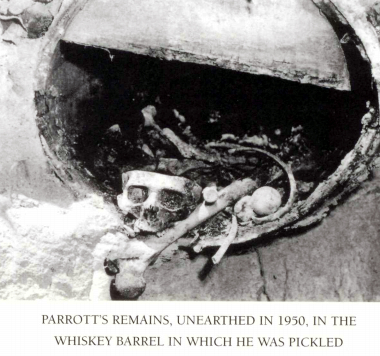
Drs. Thomas Maghee and John Eugene Osborne conducted the autopsy, examined Parrott’s brain, and could find no apparent abnormalities. Osborne then removed a large piece of skin from the dead man’s chest, kept the skullcap, and put the rest of the body in a whiskey barrel full of saline solution, effectively pickling it. The barrel was buried without ceremony, and Dr. Osborne had the skin tanned. He sent the leather to a shoemaker, who made him a pair of shoes with it.
Dr. Osborne was disappointed that Parrott’s nipples weren’t on the tips of the toes like he’d requested (!!!), but you can’t have everything you want in life.
He wore the human leather shoes on special occasions, including at his inaugural ball when he was elected governor of Wyoming in 1890. The skullcap he gave to his fifteen-year-old female assistant, Lillian Heath, who used it variously as a doorstop and an ashtray. (She would grow up to become the first female doctor in Wyoming.)
Parrott’s pickled remains were dug up at a construction site in 1950, and identified after some confusion. His skull, as well as the shoes, are now on display at the Carbon County Museum.
On this date in 1886, David Roberts was hanged at Cardiff for a murder-robbery the October previous.
Both Roberts and his father, Edward Roberts, were arraigned for the murder. The Robertses, father and son, had both been playing cards with the late David Thomas on the night of the crime, and left together with him (as well as another man).
The next day, David Thomas was found in a field bludgeoned and stabbed to death, with David Roberts’ pipe nearby. A search of the Roberts home revealed £66 stashed away in a bloody handkerchief, the approximate amount Thomas as known to have made at market on the day before he died.
Apparently he was persuasive: prosecutors decided to present no evidence against Edward Thomas and allowed him to be acquitted.
So Roberts stood alone on the trap this day, having at least the comfort of having done right by his family duty. Unfortunately the hangman did not quite do right by Roberts fils as he appeared to survive the drop. Witnesses were hastily conducted away while Roberts dangled, still twitching and strangling. The error was ascribed to the condemned man’s “muscular neck,” but this alleged physiognomy only mattered because at this late date British hangmen still designed the parameters of the drop impressionistically.
All that was changing to follow the professional example of the scientific William Marwood, however. Later in 1886, a commission was formed under former Liberal Home Secretary Baron Aberdare to examine the issue. This commission ultimately produced the first official table of drops specifying the fall that should be allotted to prisoners based on their weight, with a view to reliably breaking the neck.
From the Chicago Daily Inter Ocean, January 8, 1889 (paragraph breaks added for readability: the original had none at all):
A DIABOLICAL DYNAMITER.
After Killing Three Persons and Wounding Others He Is Barbarously Lynched
SEATTLE, Wash. T., Jan. 7. — Alfred Shaffer [sic], a Bohemian, fired a heavy charge of giant powder under the house of George Bodala, at Gilman,* thirty miles east of Seattle, at 4:30 o’clock this morning, instantly killing John and Michael Scherrick, and Anna, the 9-year-old child of Bodala, and badly wounding Bodala, his wife, and little son and daughter.
Last spring Bodala caused the arrest of Schaeffer on the charge of criminal assault upon his wife. Schaeffer was sentenced to a short term of imprisonment, and when he was released he made such serious threats against the life of Bodala that he was again arrested, and incarcerated in jail nine days.
When he was released he returned to Gilman, and since then he lost no opportunity attempting to injury Bodala, and this morning put his threats into execution. The two Scherricks and the little girl were instantly killed.
Bodala was brought to the Providence Hospital to-day, and is in a very bad condition. The other three will probably recover. Schaeffer was found by the people of Gilman at his own house. He was placed under arrest, and later in the afternoon, upon the arrival of the sheriff, turned over to that officer.
This afternoon while the Sheriff was at dinner a crowd of 100 broke open the door of the house where Schaeffer was confined, took him to a tree opposite the railroad depot, and strung him up, first trying to make him confess.
He refused, and was hanged.
After thirty seconds he was cut down again and given another chance to confess, still declining he was again elevated and cut down for a second time after forty-five seconds.
He was then very weak, and, efforts to make him confess failing, he was again pulled up, and left hanging until death ensued.
In the 1870s, the illegal settlement of Deadwood, South Dakota attained pride of place among Old West frontier towns, complete with vigilante justice, lethal gunfights, and lucrative brothels.
Yet even though it was the source of South Dakota’s first legal hanging — Wild Bill Hickok’s murderer Jack McCall, who swung in Yankton — Deadwood itself did not play host to a proper judicial execution until this date in 1882.
The unhappy subject of this occasion? James Gilmore, a surly and perhaps deranged Ohioan who had senselessly gunned down a Mexican fellow-laborer named Bicente Ortez when both men were driving wagons on the Pierre-Deadwood route. Gilmore got upset when Ortez spooked his oxen, waited until the teams made camp that night, and then walked up to Ortez during dinner and shot him in the arm.
As the startled Ortez tried to flee, Gilmore pumped three more shots into his back.
(This was near Deadman’s Creek. How trite.)
Anyway, Gilmore’s ox-driving companions might have disliked Ortez themselves because they gave Gilmore a horse and a few bucks and, while his mortally wounded ex-comrade lay painfully expiring all the night long, let the shooter flee into the wilds. He’d be captured only months later, still driving livestock for some ranch.
“Is it for killing that son of a bitch Mexican?” he asked the marshals, incredulously.
(The prosecutor would close his trial with a charge to the jury that “in this land of the free, every man, regardless of color, creed, or other station in life was equal before the law, and the law protected with its folds, the plebian as well as the millionaires, and it knows no difference between the bull-whacker and the bonanza king.”)
Gilmore was convicted of murder and sentenced to die in the autumn of 1881. However, the offender’s advocates pushed his appeals all the way to the U.S. Supreme Court. According to the Cincinnati Daily Gazette (Dec. 16, 1882), whose interest in the case derived from Gilmore’s nativity in Steubenvile, Ohio,
It is the opinion of many who knew him best, that James Gilmore had not a mind sufficiently well balanced to make him responsible for the terrible deed for which he was sentenced. Many stories are told of his strange freaks when a child (he is not yet twenty-two years old), which shows that he was of a very irritable temperament. At one time, fancying himself insulted by a citizen of this place [Steubenville], he attempted to shoot two fine horses belonging to the offender, with a small pistol… At another time he set the school building on fire and then placed himself in the most dangerous position he could find. He would frequently run away from home, and was found once by a brother, who is an officer in the United States Navy, in New York City.
Evidently, Gilmore’s non-naval other brother was a lawyer, who was able to corral testimony as to his sibling’s unsound mind from a variety of worthies who knew the unbalanced James in his youth.
But those appeals ultimately failed, as did Gilmore’s father’s simultaneous push in Washington D.C. (since the Dakotas were still federal territory) for executive clemency. Advised by Gilmore’s detractors that the condemned murderer “was a second Guiteau of a most diabolical character,” (Grand Forks Herald, Oct. 28, 1882), President Chester A. Arthur declined to interfere. Arthur was a guy who couldn’t be soft on Guiteaus.
Gilmore never denied responsibility for murdering Ortez, and at his (private) hanging he attributed the whole thing to his “bad temper” ever since his mother died when he was a child.
Elsewhere in the U.S. on the same busy day, Peter Thomas was hanged in Mansfield, La. for murdering a fellow sharecropper in a rivalry over a woman; John Redd was hanged in Seale, Ala., for murdering a woman in the throes of unrequited love; and, a Mississippi gentleman named A. Farkas was to have been hanged for murdering his wife, Emma, except that the execution was respited at the last moment to permit him a judicial appeal — which Farkas eventually won.
On this day in 1889, 60-year-old John F. Gilman was hanged in Oregon for the murders of William and Elizabeth Eationhover (Eatenhoover, Etenhover).
Elizabeth and her husband Christopher were German immigrants. They arrived with their five-year-old son William in Coquille, Oregon in July 1888 and signed a five-year lease on farmland belonging to Gilman and his wife.
The Eationhovers built a small house forty yards from John Gilman’s house. They hadn’t lived there long before they began having disputes with Gilman about just what they could do on his land. Gilman wanted them to move and offered to cancel the lease, but the Eationhovers refused to budge.
Less than a year had passed before Gilman had decided the only way out of the situation was to cancel his tenants’ lease … on life.
He tried subtlety first, poisoning their food. That didn’t work and he was forced to use a more direct form of homicide.
On Saturday, July 12, 1889, Christopher was returning home after working all week at another, distant farm. When he reached the river, he noticed Gilman on the other side and asked him to row over and give him a ride. Gilman obliged and Christopher continued his journey home — but when he reached the corral, Gilman came up behind him and hit him in the head with one of his boat’s oars. He then pulled out a knife and stabbed him multiple times.
Gilman had made a miscalculation, though — one that saved Christopher Eationhover’s life. He’d been carrying two knives in his pocket, and one had a broken blade. He’d mistakenly pulled out the broken one, and it could not inflict fatal wounds.
As the two men struggled, ElizabethGilman’s wife came out of the house to break up the fight. Christopher then took the opportunity to get away. He staggered down to the river, rowed the boat across and went to get help.
By the time he returned with a posse, however, his wife and child had disappeared. The kitchen table was set for breakfast, and little William’s plate still had food on it, long since grown cold.
When the authorities arrived at the Gilman house, they found John Gilman in bed asleep. He hadn’t even bothered to change his bloodstained clothes. Arrested, he insisted he had no idea where the Eationhovers were or what had happened to them. He suggested that perhaps they’d followed after Christopher and got lost.
A search party found them the next afternoon, poorly concealed in a shallow grave. Nearby was another, empty grave, presumably for Christopher.
The two had died horrible deaths.
Elizabeth had been beaten on the arms, hips and face, and had a bad cut on the back of her head, but the actual cause of death was strangulation. Medical evidence indicated she’d remained alive for a time after the beating.
Five-year-old William had tried to run away, but his killer was too fast for him. He’d been strangled with a rope and his neck was broken.
Gilman would later confess to the crimes. He said he had beaten Elizabeth and then ran off, leaving her semi-conscious and helpless, to kill the child. He then returned to finish off Elizabeth. He claimed he’d strangled the victims (actually hanging William from a tree) because he didn’t want to leave blood evidence in the house.
While clearing out his conscience in this rummage sale (which sorely tempted lynch law), Gilman also confessed to another murder, that of George Morras in 1888. He later recanted his statements, but law enforcement believed he had in fact committed the crime.
John Gilman was indicted for two counts of murder. His wife, Fidelia, was charged as an accessory, but later acquitted. John’s insanity defense failed, and there was no appeal or executive clemency.
One final tragic detail in this very tragic story: on October 21, 1892, nearly three years after the hanging of the man who killed his family, Christopher Eationhover hanged himself.
This date in 1885 saw the hanging in Grand Forks, North Dakota* of 19-year-old farmhand George Miller for butchering his employer’s wife and child in order to loot the farmhouse while the patriarch was away.
For this terrible American Gothic crime, we turn to the American Press.
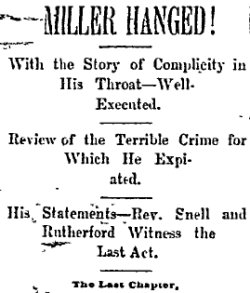
Miller was the first person hanged in North Dakota and the local Grand Forks Herald marked the date with a voluptuous recounting (occupying an entire page, plus two more columns on the next page) of the late scandal all the way to the felon’s scaffold accusation. Here it is, in its entirety …
In the middle of last January when all the earth was wrapped in a mantle of purity, an esteemed minister of the gospel, the father of a bright family of children and a devoted husband with a loving wife, resided on his prosperous farm in the township of Inkster, this county, surrounded with the 320 broad and fertile acres, horses and cattle and improved farming implements he called his own. His earthly possessions he had acquired by industry, thrift and economy, with the wifely assistance and the aid of the little boys and girl that had blessed their union. This gentleman was Rev. C. Y. Snell at one time minister of the Baptist church in Grand Forks, but who had, like nearly all settlers in Dakota taken advantage of his rights and acquired a farm, which had brought a handsome return. His summer’s work done, his grain garnered, he had sent three of his children to Grand Forks to acquire a good education in her public schools, and remaining at the farm, was his wife Abbie and little son Herbie, aged eleven, and the hired man George Miller, a young man of quiet demeanor, aged about 19 years, who had helped to garner the summer’s fruits and whom both Mr. and Mrs. Snell had implicitly trusted.
Thus situated on the 16th of January, Rev. Snell bade his wife and son good-be, little dreaming that the
SHADOW OF THE DEMON
was in his door and before another fortnight his loved ones would be prone, stark and mangled in the icy embrace of blood and horrid death. He went on his errand of good will to Mayville where he was engaged in missionary labor for his Lord and Master. On the 31st of January, two weeks after his absence, he received a telegram informing him of the doleful event — the murder of his wife and boy, and he hastened with bowed form and bleeding heart to the spot where the light of his joy had been ruthlessly extinguished.
OH RUEFUL SCENE!
The demon had done his worst! Have not the details of that heartless butchery been told again and again? Why not draw the veil upon the foul deed? The ghastly corpses of the innocent and unsuspecting sleepers — mother and son, hurled into eternity in a moment while taking the repose of the righteous — as found there by the neighbors a week after the tragedy — divulged the heartlessness of the assassin whoever he might be, and the thorough depravity of the soul that could impel the ruthless ax to deeds of death.
THE VILLAINOUS SHREWDNESS
with which the murderer had avoided suspicion was manifest in the fact that so long a time had elapsed before the discovery of the crime, and will be further apparent as the story progresses. He had been a companion of Henry Rutherford and to avoid immediate discovery, Miller the confessed criminal, had told the nearest neighbors that he intended to give Mrs. Snell a drive on Sunday and that he would haul wood the following week. Thus no suspicion was aroused until late in the week. Friday, Rutherford a simple, untutored laborer who lived alone at Bennett’s place about 60 rods from the Snell residence, thought it strange that there was no stir or animation about the place, and after finding the stock nearly famished, and watering it, alarmed the neighbors and the dreadful truth was discovered. The neighbors H.P. Reiton, Simeon, Miller, C.G. Gordon, Mr. Vietch, Henry Blakely and others found the dead bodies undisturbed and the rifled trunk with its empty money box and the robbed children’s bank just as the murderer had left them. Thus it was plain
THE MOTIVE WAS MONEY —
the sordid lust for gold that causes men to imperil their souls and makes of earth a probationary sheol for evil minds. Mr. Snell had sold considerable grain and when he left he took $300 with him, leaving some money, together with some keep-sakes and the children’s savings in the cash-box in the trunk. After he had gone, Miller sold more wheat and received from agent Holden $205, which he may have turned over to Mrs. Snell or not. But that the robbery of Mr. Snell in some way, was in his mind for a week before the crime was committed is shown by the testimony of Mr. Holden to the fact that Miller asked him a week before, whether he could deliver a load of wheat unknown to Mr. Snell and it further shows that the idea of robbery did not originated with Rutherford at a dance on the 20th of January, only four days before the murder as Miller claimed in his statement before the judge. It shows that the robbery was in contemplation by him without an accomplice and, being ignorant of the fact that Mr. Snell had taken $300 with him to Mayville, he doubtless committed the crime for more money that he received —
FLEEING FROM JUSTICE
After committing the crime, he hastily placed the ax beneath the bed, threw up the bedclothes over the faces of the dead, robbed the trunk of its keep-sakes, harnessed the best pair of horses in the stable, took Snell’s driving gloves and drove forty miles over the cold bleak prairie with the thermometer at 30 degrees below zero, arrived in Grand Forks at break of day Sunday morning in front of the Northwestern Hotel and ordered the team put away and his breakfast prepared. In the sled-box was an overcoat of the boy he had murdered which had probably been left there when the unsuspecting youth last accompanied him in the delivery of the wheat the proceeds of which he contemplated stealing. There was also left there the overalls which Miller had worn and upon which bright specks of blood had been discovered and whose dumb voices cry out testimony against the last black lie of the series which the obdurate murderer coined in the cell against poor simple Rutherford. With the team was Snell’s faithful dog, which followed the fleeing assassin. Upon his arrival here, he commenced a series of ingenious but
BASE COINAGES TO EVADE PURSUIT.
He told Powery, the clerk at the Northwestern Hotel, that he had come to meet his brother at the train and he might go to Winnipeg for a week. He also exhibited some gold pieces which he wanted changed, but the clerk had no change. The design of this story was too evidently to direct pursuit towards Winnipeg, if the team were soon identified as Snell’s. He soon walked off seemingly unconscious of any obligation to pay for his breakfast and next called at the Chicago clothing house, rousing Mr. Ephraim out of his late Sabbath repose. He told Mr. Ephraim a different tale. He was thrown of[f] his guard by the sharp questioning of Ephraim, while selling him the buffalo overcoat, black valise, pocket book, and other out-fit that later led to the capture and identification. He explained the possesion of his roll of bills, amounting to several hundred dollars by saying that he had sold a team of horses receiving $275 for it and intended to go to Turtle Mountain, thus evading the true objective point. He also got rid here of the tell-tale keep-sakes, the gold dollars which Mr. Snell had treasured for years, and the nickles, dimes and quarters which the little Snells had perhaps been years in gathering. Being shown the way to the barbershop of Mr. Kruger by Mr. Ephraim, after he had bought his disguise, he further changed his apperance by getting his hair cut close and his face shaved. Here he left the only clue to the direction in which he was intending to go, by inquiring whether a train left for Crookston, and up to the discovery of this fact by a HERALD representative, the officers seemed to be impressed with the fact that he had really gone to Winnipeg to which point as well as others they telegraphed as soon as it was learned that the team was left in this city. It must be remembered that it was not until the following Saturday that the tragedy was made known and in that time the murderer might have left the country, if he had not been paralyzed by his own wickedness and depravity. Learning at the barbershop that no train left for Crookston on Sunday, he walked to the station on the railroad track and bought a ticket for Fargo, displaying the new red pocket book to the agent. After spending a few days at Fargo among variety women, and having had his picture taken by a photographer, he went to Brainerd, Minn., where he stopped at the house of Malcolm McLaren for a few days more.
I’d be very surprised if our suspect was from Brainerd.
While at Brainerd, he associated with women of loose character and spent considerable money lavishing presents upon them. It seems that he met a female there whom he had formerly known in Iowa. At first he talked to Mr. McLaren about going into business. He wanted to do chores, when he learned that his money was nearly all gone. The St. Paul papers on Sunday morning following the discovery contain accounts of the murder with description of the hired man of Snells, but imperfect, as his disguise was not known, but when the statement of the Northwestern clerk about the gold pieces was published, Mr. Ephraim at once reported the Sunday morning transaction and it was thus that
HIS SIN FOUND HIM OUT.
His new outfit together with the way he had disguised himself were immediately telegraphed to the associated press by the HERALD and with it a statement of the reward offered. When the papers arrived at Brainerd, Miller had quietly decamped, realizing that he was too near the scene of the tragedy. But McLaren, an old detective immediately concluded that the fellow who had staid [sic] at his house was the person sought, and securing a deputization from the sheriff, he drew money for an indefinite trip, learned that Miller had boarded the train with a ticket for Anoka, and followed him up. On the same train went Hartley and another, bent on the same errand and watching McLaren. At Anoka, McLaren happened to strike the bus for the very hotel at which Miller was stopping and he now felt certain of
ARRESTING HIS MAN.
Miller was in his room and armed. McLaren knew the character of the brute better than the inexperienced who put any faith in his pretences during his last days. He concluded to wait till Miller came down, and while McLaren was at breakfast, he heard the murderer’s foot-falls on the stairs and entering the washroom. McLaren immediately left the table and coming up behind Miller with his pistol cocked arrested him, but as he did so, Miller laid his hand on the revolver in his hip-pocket, but the gun of the sheriff had the desired effect and he was disarmed. His attempt to get away from McLaren on various pertexts [sic] and his denial of all knowledge at the start are remembered. It was not until they were in the cars and coming back to Brainerd, that he
CONFESSED HE DID IT ALONE.
The way he happened to weaken was this, McLaren said to him, “Now you may as well tell all about it. I can tell you of a place in the forests where you will never be found, if you get away at the next station.” Miller then told his first story about how he was crazed with drink after being chid by Mrs. Snell, and killed her and the boy, and after getting over his stupor, and seeing what he had done, he stole the money and tried to get away. He reiterated this oft-told tale to Sheriff Jenks and others at Brainerd and again to reporters of Fargo papers, who managed to get up a considerable maudlin sentimentality for him. For prudential reasons, there having been a great deal of feeling that he should be given short shrift and a stout rope, he was kept at Fargo for several days, and finally brought here very quietly and lodged in jail. When it was known that he was in jail and likely to be tried speedily and executed according to law, popular excitement over the enormity of the crime subsided. The Rev. J.T. Davis and Rev. Snell, at an early day obtained an interview with Miller, and he reiterated the intoxication story as before in their presence, calling upon God to strike him dead if his story was not true. He also as positively stated to the gentelemen that he alone did the crime and no one was concerned with him in it.
It was not until after the Grand Jury had found a bill that this mild, child-like and bland assassin,
CHANGED BASE.
He then asserted that Henry Rutherford was with him, concocted the idea of robbery and urged it against his wishes, until he was finally persuaded to connive and assist, although Rutherford he said, actually did the horrible deed, while he did the running away to South America. In the face of his former statements this story only seemed to aggravate his villainy. However, able counsel, Judge C.B. Pratt, was assigned him and every thing that legal subtlety and experience could avail, was rallied to save his neck from the law’s penalty. The people, however, were fortunate in having so learned and able a coadjutor as District Attorney W.A. Selby and so just and firm a judge as Hon. W.B. McConnell; for, notwithstanding the able, artful and persistent defense made by Judge Pratt, justice was vindicated. Upon the defendant’s own plea of “guilty,” ascertained, verified and corroborated by all the witnesses, who fully and completely exonerated Rutherford from the suspicions cast upon him, and satisfied the conscience of the court, sentence of death was passed upon him and his appeal to the higher court sent back with an approval of the action of the District Court. His statement to the Judge, when informed of this action, suggesting some new matters not before mentioned, is still fresh in the recollection of everybody.
The last few days of his life seemed to have passed by him in a happy, careless, indifferent and easy frame of mind. He talked freely about his own execution, expressed no great sorrow or penitence for, at least the part he played in the atrocious crime, but pretended that he was glad the end was so near. His spiritual advisor, Rev. F. Doran conversed and prayed with him and did all in his power to turn his thoughts towards that awful Judge who hath decreed that “whoso sheddeth man’s blood, by man shall his blood be shed.”
HIS LAST NIGHT
on earth was uneventful. About eight o’clock he was left alone for a time in his cell and was seen from Bruce avenue to perform various antics, rising suddenly from his chair and jesticulating wildly with his arms as if again swinging the baleful ax which brained his helpless victims. He was restless and this has been observed that when left to himself and his thoughts, he was not the calm, self-possessed person he appeared to be when in the presence of visitors. During the evening, Rev. Snell had an interview with him for about an hour and a half. The prisoner claimed to others that he had succeeded in persuading Mr. Snell of the correctness of his last story. He was set up with by Deputy Sheriff Ackerman and others until after midnight. At one o’clock he retired and at 7:30 this morning he arose apparently refreshed. He ate a hearty breakfast consisting of beefsteak, potato, cake, etc. His cell has a window pane out and the wind being in the south, Miller was cold and was brought down into the office where he smoked a cigar, one of a number left him some days ago by some women who called upon him and were recognized by the prisoner as old acquaintances. The district attorney was present and inquired further about portions of Miller’s statement made to Rev. Doran. Presently Sheriff Pierce of Nelson county and friends came in, also County Commissioner Steele, Henry Rutherford and Mr. Vietch. Rutherford was told that Miller still insisted upon his story and was asked what he thought of it. He said, “then Miller lies. That is all.” Soon after an interview was had between
MILLER AND RUTHERFORD
in the presence of District Attorney. Miller said to Rutherford: “You know you had a hand in this thing as I have said.” Rutherford, without any trepidation replied: “It is a lie and you know it. I don’t like to be lied about.” Subsequently the statement in the nature of a history of his career and the crime was read in the presence of Rutherford who said nothing. When asked about it, he said it was “no such thing. It was all a dang’d lie!” When asked about the part in which Miller alludes to the false mustache, Rutherford said he had such a mustache but did not think Miller had ever seen it. He said he kept it in his trunk and described it to the district attorney corresponding with the description given by Miller. This circumstance and one in respect to changing wagon boxes, also a statement now made that the Snell stock was not famished, although the witnesses testified that it was, were industriously emplyoed [sic] last night and this morning to weaken the district attorney and cause him to apply for the respite of Miller. Mr. Snell himself after his interview with Miller last night seemed to have been influenced by his story and urged and begged the district attorney to intercede for Miller. Mr. Selby said he could do nothing unless Mr. Snell or some one on his behalf, would swear that Rutherford was an accomplice, when he would take such action as was proper in the cause of justice. Up to noon, Snell had done nothing of the kind. There was also pressure brought to bear from various sources to effect the same purpose, but none were willing to assume any responsibility.
THE LAST HOUR
was spent in the parlor of Sheriff Jenks with Revs. Currie and Doran who administered all the Christian consolation the solemnity of the occasion could afford. They talked to him, prayed for him and he himself made a fervid prayer. His nerve maintained his head erect to the end, which did not seem to fear.
ASCEND THE SCAFFOLD.
At 1:30 accompanied by Sheriff Jenks, he ascended the scaffold. The Sheriff suggested that if he had anything to say he should speak. Miller stood with the rope almost danging in his face, his hands clasped, and his body slightly bent. About two feet in front of him stood Henry Rutherford who, during Miller’s 15 minute talk, kept his gaze firmly fixed on Miller’s face. Rutherford looked like a person suffering great mental strain and slightly changed color at times while Miller was speaking, but his eyes never flinched. Rev. Mr. Snell occupied a position to the left of Rutherford, almost touching him and when Miller alluded to Rutherford’s alleged connection with the murder, Mr. Snell gazed almost fiercely into Rutherford’s face, Rutherford meanwhile keeping his eyes fixed on the doomed man. C.B. Pratt, Miller’s counsel, during the recital of the murderer’s statement, watched Rutherford closely.
Miller spoke with apparent effort and several times during the recital of his story had occasion to put his handkerchief to his eyes.
HIS LAST WORDS.
Gentlemen: — I am accused of the crime of murder which I did not commit. I have not committed murder. I was in company with the party and gave my consent, but gentlemen, I never committed the murder myself.
On the 30th day of January I was in Inkster with Mr. Rutherford. He and I sold 100 bushels of Mr. Snell’s wheat and we divided the money. That night we got home between eight and nine o’clock and Rutherford asked me how much wheat Mr. Snell had and I told him over 200 bushels besides a few loads which I had drawn. He wanted to know how much money was in the house and I told him as near as I could. He wanted to know how we could get it and I told him we could chloroform the folks and get it and he said he would do it. The 22nd, 23rd and 24th we were hauling grain to town and we talked again about getting the money. That night I went down to his house to supper and Mr. Blakely came in and that stopped our talk there. I went to Mr. Snells and that night I had a long conversation with Mrs. Snell and when it got about bed time I went to my room with my lantern and sat down on the bed and pulled off my rubbers when I heard a knock at the back door and went and opened it and Rutherford sad, George are you ready to do that? I said no, I hae had a long talk with Mrs. Snell and she is so good and kind to me that I cannot do it. He says you said you would do it and now you got to do it. He said dead folks tell no tales. He said he would do it and handed me a mustache to put on so folks would not know him and took the axe and went in and I went to the barn and harnessed one horse and was just putting one collar on the other when he came out and said, hurry up George I have done it. I tied the horse and I went in and found them dead. He says hurry up let us get away before anyone happens to catch us moving around so he hurried and got the team hitched up and I went to the house and got the money and gave him an even $100 and took $115 mysel and got what clothes I wanted. I wanted to change my clothes and put on a white shirt, but he said hurry up for I could get what clothes I wanted at Grand Forks. He brought the team up and tied them and I got what things I wanted and he helped me fasten up the storm door. He wanted me to go direct to South America and go right through. Said for me to write him when I got there and he would write me the circumstances here. At this ponit Miller was overcome with emotion and stopped a while.
Now gentlemen, every word hat I have told you is true and now as dear as that family was to me, I never could have consented to murder them as I was used there as their son. I was always treated well; they thought the world of me and I did of them but by the hands of another man’s deed I am to be hung and I am going to my grave and I am thankful that I can trust in God and feel that my sins have been pardoned.
And now I feel that the other party shall receive the same punishment that I have. It is not because I am down on him and it is not for malice but it is just what should be done. As dear and as good as that family was to me I could not go in and murder them. But thank heaven I am willing to die. This world would be no pleasure to me after this and I do not want to go to penitentiary. I am better satisfied to go to my grave. I am fully satisfied and feel that what has been done is just, as that family always used me like a son, always good, always dear in every shape, never refused me money, never refused me anything.
Now, gentlemen, I want you all to remember that this is the truth and nothing else. I won’t meet you any more in this world face to face but I hope we can all meet in the world to come.
When Miller had finished Henry Rutherford turned to District Attorney Selby and asked that he might make a statement of denial.
ADJUSTING THE ROPE.
Sheriff Jenks, who occupied a position on the scaffold just behind Miller, then approached and commenced binding the wretche’s [sic] hands and limbs with straps, and while placing the cap, which was of brown worsted, Miler again commenced to speak, and even while the sheriff was placing the noose around his neck Miller asked his executioner to say “good bye” for him to his friends.
THE DROP.
Barely a second’s time had elapsed from the moment the noose was adjusted before the trap was sprung, so adroitly and neatly did Sheriff Jenks do his work. Miller’s body shot down at 1:45 o’clock with a sickening thud, his neck being broken by the fall. A few moments after the drop the body quivered and the legs were slightly drawn up several times. Life was pronounced extinct 15 minutes after the fall by Coroner Roundwell and at 2:10 the body was cut down and carried into an adjoining cell, where the straps were removed. Shortly afterwards undertaker Caswell took charge of his remains which were interred this afternoon in the cemetery among the unknown sleepers. Thus ends this chapter of the bloodiest and most heartless murder in the annals of Dakota and the murder’s just doom, should be a warning to all evil-doers that there is no mercy for the slayers of the innocent.
MILLER’S STATEMENT.
Following is a statement prepared by Miller and given to Rev. Doran several days since. He swore to it this forenoon before Judge Cochrane, in presence of several gentlemen.
TERRITORY OF DAK.
GRAND FORKS, Oct. 30, 1885.
The last statement and confession of Geo Miller, before his execution in Grand Forks, Oct. 30, 1886.
TERRITORY OF DAK.,
COUNTY OF GRAND FORKS.
I, George Miller, was born in Toledo, Ohio February 17, 1866. My father and mother are both dead; about 12 years ago my mother died and my father 2 years later; have one brother, four years older than myself named Frank, two sisters both younger than I, two and four years; father was Bohemian; mother French; came from Iowa to Casselton last June, 1884, remained there 2 days; from Casselton to Larimore, arriving about the 13th of July, 1884, left there on the 11th, arriving at Mr. Snell’s that evening; at the expiration of four months hired to him for $30.00 a month; never refused to pay me; liked the family; first got acquainted with Henry Rutherford in Mr. Snell’s harvest field. He and I thrashed wheat together in August, 1884; often I met him at Mr. Bennet’s place in the evenings and was with him all through thrashing. Had hauled wheat once or twice before the dance by Brothrs [sic?] Bogs and also by Rutherford; went from Rutherford’s house; I furnished the cutter and he the horse; went together; he and I began to drink together; on the 1st of January took four or five drinks together that day in three different saloons and each took a pint of liquor home with us. The next day Rutherford went to Inkster; came back to “Vietches” where Mrs. Vietch was doctoring him, when Mrs. Snell and Essa Vickery saw him and told me that he was drunk; drank almost every time we went to Inkster; on the 20th of January, 1885, we sold five sacks of Mr. Snell’s wheat; I had 35 sacks of Mr. Snell’s wheat; Rutherford had 20 sacks of his own, we called it 10 bushels; spent most of it for liquor and cigars; changed sacks between the livery stable and saloon; he gave me half the money.
The dance was on Tuesday, the 20th of January; got to the dance about 8 or 9 o’clock, left about 3:30 a.m.; Rutherford asked me how much wheat I had hauled off; told him over 2000 bushels; he asked how much money there was about the house; I told him 6, 7, 8 or 9 hundred dollars; he said can’t we get it; I did not think we could, the trunk was too near the bed; he said we could kill the folks and get it; I did not want to do that, I said wait until we go to town and get some chloroform; Rutherford did not want to do this for fear we would be caught; nothing more was said about it for two days; coming from town I rode with him; he asked me what I thought about what we had talked about; told him it was not right to kill them for a little money;
And for what? A little bit of money.
he said we must work some plan to get it; I told him nothing must be done at this time. Nothing more was said until the Saturday it was done; we went to town together and on returning, when about to separate to go to our homes he asked me to come over that afternoon and help him sack up wheat, I told him I would; he said we would talk over this other thing, referring to the money of Snell’s.
In the afternoon I went over and we worked at the wheat and made all the arrangements to kill the folks; I was to leave with the team either for Larimore or Grand Forks and then take the first train for South America, we were both to go in and do the killing, I stayed at Rutherfords for supper, Harry Blakely came to call on Rutherford, we stayed and talked until eight or nine o’clock, then I started hom and Rutherford and Blakely started to go to Abner Veitches. I went to Mr. Snell’s and did the chores, Mrs. Snell was pleasant and talked pleasant, the last thing I did was to bed the horses and nail up the granary, that was about ten o’clock at night, I then went to the house and whittled my shavings and left them by the stove, pulled my rubbers off my felts and went into my room and set down on the front side of my bed, and was just going to pull of[f] my felts when Rutherford knocked at the kitchen door, I went to let him in, he says are you ready to do that, I told him no I was not, he said it had to be done, you gave your consent at the granary, “dead folks tell no tales.” I said if you want to do it you can, I won’t, he says all right, get me the ax, I went out and got it and when I gave it to him he pulled a false mustache out of his pocket and told me to put it on him, it was black and fastened in the nose with two wires, he had on woolen mittens. I think I got my coat, cap and mittens from the dining room and went to the barn while he did it and had one horse harnessed when he came out and said hurry up I have killed both of them, let us [get out of] the place before anyone sees us moving around, he led out one horse and took the other and hitched on to the sleigh, drove to the front door to hitch both horses, we both went in the house, I went into the bed room and got the money and took it into the dining room and divided it. He had $100, two $20, one $10 and one $50 bill, I had one hundred and fifteen dollars, he put his in his pocket and I put mine in my coat pocket, then I went into the bed room and changed coat and vest, then I got my overcoat and scarf and a large pair of mittens, fine boots and overshoes and handed them to him to carry to the sleigh for me. I took two or three blankets off my bed and took them with me. I got the key and locked up the door, he held up the storm door while I put the blocks against it, we got into the sled and rode up to his corner, he told me to go to South America, I told him I would, when he got to the corner we stopped and bid each other good-bye by shaking hands, he said as soon as I got there I was to write to him and he would let me know how things were, I told him I would.
GEO. MILLER.
Signed in the presence of
JAMES A. JENKS.
GEO. B. WINSHIP
TERRITORY OF DAK.,
COUNTY OF GRAND FORKS.
I, George Miller being first duly sworn on his oath says that I have heard read the foregoing statement by me subscribed and know the contents thereof and the whole thereof and that the statements therein made are true of my own knowledge.
GEO. MILLER.
Subscribed and sworn to before me this 30th day of October, 1885.
J. M. Cochrane,
Judge of Probate.
* At the time, not North Dakota but the Dakota Territory; North and South Dakota would attain statehood four years later.
On this date 125 years ago, a notorious French triple murderer was guillotined outside La Roquette Prison.
This condemned murderer, so infamous that anarchist bomber Ravachol planned to invoke his name as an emblem of crime in a suppressed courtroom speech, slaughtered a prostitute, her maid, and the maid’s child so that he could plunder the apartment’s jewelry.
That’s just one of several more famous (or infamous) contemporaries for whom Pranzini was a sort of subplot character.
The artist Paul Gauguin — though he couldn’t quite remember the name right — suspected that this particular killer plotted his crime at the cafe that both he and Vincent Van Gogh frequented. (Van Gogh painted the proprietress, who was also possibly his lover.)
According to Van Gogh, the whole Pansini [Pranzini] affair, as well as many others, was hatched in this place … From this Pansini case sprang another case, also, according to Van Gogh, hatched in this famous cafe, the Prado case
While Gauguin’s meditations on the guillotine veered to the grotesque, a Norman teenager fresh off an apparition of Jesus Christ found spiritual sublimity in this villain. The woman eventually known as St. Therese of Lisieux later recollected
I heard talk of a great criminal just condemned to death for some horrible crimes; everything pointed to the fact that he would die impenitent…. I felt in the depths of my heart certain that our desires would be granted, but to obtain courage to pray for sinners I told God I was sure He would pardon the poor, unfortunate Pranzini; that I’d believe this even if he went to his death without any signs of repentance or without having gone to confession. I was absolutely confident in the mercy of Jesus. But I was begging Him for a “sign” of repentance only for my own simple consolation.
My prayer was answered to the letter! In spite of Papa’s prohibition that we read no papers, I didn’t think I was disobeying when reading passages pertaining to Pranzini. The day after the execution I found the newspaper “La Croix.” I opened it quickly and what did I see? Ah! my tears betrayed my emotion and I was obliged to hide. Pranzini had not gone to confession. He had mounted the scaffold and was preparing to place his head in the formidable opening, when suddenly, seized by an inspiration, he turned, took hold of the crucifix the priest was holding out to him and kissed the sacred wounds three times! Then his soul went to receive the merciful sentence of Him who declares that in heaven there will be more joy over one sinner who does penance than over ninety-nine just who have no need of repentance.
I had obtained the sign I requested.
Nameless citizens on the square when the blade fell settled for less exalted signs, like the ancient superstition of dipping into the spattered blood. (“Such scenes would disgust the black savages of Dahomey and the Gold Coast,” the London Times sniffed (September 1, 1887), and in vain urged the French government to take up legislation for private executions.)
On this date in 1889, the only guillotine execution in North America took place on the tiny French remnant colony of Saint Pierre, just off Newfoundland.
August(e) Neel had capped a Dec. 30, 1888 drinking binge with fellow fisherman Louis Ollivier by breaking into a boat captain’s cabin they expected to find empty. Instead, they found the armed captain ready to defend himself … so they overpowered him and stabbed him to death.
And then, for some reason — “because we were sloshed and we wanted to find out how much fat the old seadog had in his body,” Neel told the court — the murderous sots dismembered the body.
While the murder was not particularly premeditated, it occurred during a perceived crime wave, and the post-mortem butcher’s act really grossed out the court. (They probably also didn’t do themselves any favors at the bar by having attempted to sail to Newfoundland.) All in all, a prime case for example-setting: Neel, as the lead culprit in the caper, was sentenced to the worst example possible. His partner got 10 years at hard labor.
Now, St. Pierre hadn’t had an execution and didn’t have the infrastructure for it. But French law didn’t let the locals in far-flung islands just do a practical straightforward thing like hang a bloke or shoot a bloke. And it wouldn’t do to have the colony send Neel somewhere where executions were a done thing. It was there in black and white that executions had to be conducted by guillotine, near the site of the crime. And so an old spare guillotine was disassembled, boxed up, and shipped up to St. Pierre from Martinique, expressly to sever Neel’s head.
Neel seems to have been the calmest man on the island, almost philosophically indifferent to the the head-chopper. The community he had aggrieved could not say the same: St. Pierre had to recruit a local petty criminal to serve as executioner, and the guy was so ostracized that he left for France afterwards. They hadn’t thought through the execution procedure to determine who would give the order to drop the blade, so after an uncomfortable pause, Neel himself shouted at the executioner to do it. By the time it hit bottom, human flesh was left grotesquely clinging to the dull imported blade.
The prosecutor vowed in the face of this dog’s breakfast never to seek another death sentence.
Never used again, this infamous device remains in St. Pierre to this day. It can be seen there behind the stairs at the Musée de l’Arche.
The St. Pierre guillotine. (cc) image from The Tedster, who also thoughtfully provides photos of the museum’s explanatory placards. 1, 2, 3, 4, 5, 6.
The Neel story was “re-imagined” — nigh rewritten — for the heavily fictionalized 2000 Juliette Binoche film La Veuve de St. Pierre.
The primary source for this account — apart from the museum placards linked in the caption above — is the invaluable Bois de Justice, an astonishingly encyclopedic resource on the history of the guillotine.

 Khalturin (English Wikipedia entry | Russian) came from a well-off peasant family near the city of Vyatka (today, Kirov; it was renamed for an assassinated Bolshevik). As a young carpenter in 1870s St. Petersburg, he fell in with revolutionary circles and became a distinguished propagandist and organizer. Khalturin helped found the first political labor labor organization in Russia, the “Northern Russian Workers’ Union”.

 Soon Alice’s sister-in-law dropped the pretense of punishment and simply hit Alice whenever she felt like it. Emeline was quite literally deaf to the little girl’s screams, as she had a severe hearing impairment. So did Horace.
 The series of events that lead to Parrott’s death began on August 19, 1878, when he and his gang tried to wreck a train near Medicine Bow, Wyoming so they could rob it. They loosened a rail and waited patiently, but an alert section foreman spotted the loose rail and notified railroad authorities, who came and fixed it before the train arrived.


 In the middle of last January when all the earth was wrapped in a mantle of purity, an esteemed minister of the gospel, the father of a bright family of children and a devoted husband with a loving wife, resided on his prosperous farm in the township of
 This condemned murderer, so infamous that anarchist bomber

