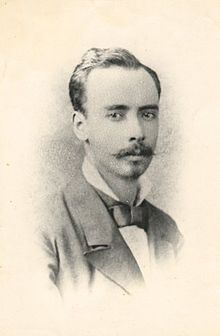
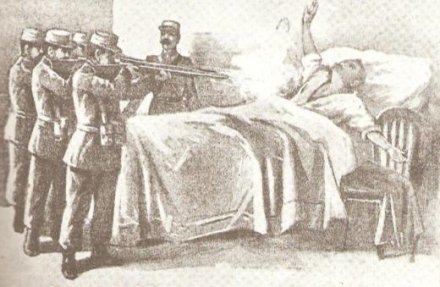
1888: William Showers, “pathetic soul”

(Thanks to Meaghan Good of the Charley Project for the guest post. -ed.)

On this date in 1888, after a hearty breakfast of beefsteak, eggs, sweet potatoes and coffee, William Showers became the eighth man judicially hanged in Lebanon County, Pennsylvania.

He had been condemned for the murder of his grandson, William “Willie” Kahler. An account of his trial and death, assembled by the Lebanon County Historical Society, describes the condemned man as he appeared on the day of his execution: “The aged Bill Showers [he was sixty-two] looked like what he was, a pathetic soul. He was only five feet two inches in height and weighed less than one hundred twenty-five pounds.”

Showers had been dealt a hard hand in life, and he didn’t have a good reputation among his neighbors in the village of Annville. Much to the shame of the family, his only daughter Sara had borne six children out of wedlock. Sara died young in 1886, and her father was left in charge of two of her children: six-year-old Willie Kahler and his brother, Samuel “Sammy” Speraw, age four. (What happened to the other four children has not been recorded.)

Bill Showers was a widower by then. For about six months, with the help of his son and his daughter-in-law, Showers did the best he could to provide a home for his grandsons.

But in April 1887, Showers’s son and his wife stopped helping him care for Willie and Sammy. Bill had never wanted the boys in the first place, and he couldn’t afford to feed them on his own.

For about a month the three of them lived alone and Bill tried to get someone to take the children off his hands. He tried a few different foster homes, but he couldn’t afford to pay the foster parents for the boys’ keep. He took them to an orphanage, but they were refused admission. The county almshouse rejected them also.

Bitter and desperate, Bill complained to a friend, “If no one will take them, I have one place to put them. I won’t be a damned fool and raise other people’s children.”

In mid-May, however, Showers’s normally sulky and reclusive attitude suddenly changed and he went to the neighbors and cheerfully announced that he had finally found another home for the children. Two brothers in Schuylkill County were willing to adopt them and take them to Texas to start a new life, and they would be out of Bill’s hair forever. Showers asked his daughter-in-law to mend the boys’ clothing in preparation for their journey.

Then, on May 17, he borrowed the local minister’s buggy and set off over the mountains to Sammy and Willie’s new adoptive home. A few of the neighbors noticed Showers riding out of town that morning. They also noticed that he was alone.

By May 30, the good citizens of Annville were suspicious enough to go to the local constable, Joseph Fegan. When Fegan questioned Showers as to the whereabouts of his grandchildren, Bill told them a most extraordinary story: on the way to Schuykill County, he said, he’d encountered two black men and asked them for directions.

He then stopped to water his horses, letting the children out of the buggy as he did so. When he returned to the wagon, Willie and Sammy were gone. He believed they’d been abducted by the two black men. But he never reported their disappearances, he said, because he was “too upset.”

No one believed this wild story, and the people of Annville organized search parties to look for the two children, whom they were sure had been murdered. They found their tiny, nearly naked bodies that very same day, in a ditch only about 70 yards from Showers’s house. They had both been beaten and strangled to death.

Showers was arrested, charged with murder and lodged in the county jail. Which was just as well for him, because his neighbors were inclined to lynch him. His son hired a very able local attorney, Frank Seltzer, to defend him. Seltzer selected Frank Lanz, a former state senator, as co-counsel.

The Commonwealth of Pennsylvania charged the defendant only with the murder of Willie. The idea was that if they lost that case, they could go forward and try Showers for the murder of Sammy.

The trial date was in mid-June, and the first thing Showers’s attorneys did was move that it be delayed. As the Lebanon County Historial Society puts it:

Seltzer…had a different view of the situation. He rose and objected to the call of the case with a voice that could be heard in the county jail one-half block away. Promptly and resignedly, his tone of voice changed. As if explaining a baptismal font to a heathen, he told the judges that he and Senator Lantz had been retained for less than a week. Their request for a continuance was not made :in the spirit of vexatious delay” but rather for lack of time to prepare the case for trial and, of prime importance, the inability to have a fair trial in the county at the time in light of the prevailing rumors. Adverse pretrial publicity, pleaded Seltzer, rendered a fair trial impossible at this time.

[The prosecutor] Ehrgood replied to Seltzer that he had been given prompt notice he was going to press for immediate trial and Seltzer would have ample time to prepare, since it was only Monday and he would not be ready for trial until the following Thursday. This was a concession which Seltzer and Lantz hardly appreciated.

The judge agreed with the defense, and set a new trial date for September. This would give time for his lawyers to prepare, and maybe for the rumor mill to stop spinning. These were some of the stories floating around:

  • Seltzer murdered his wife in 1886.
  • He also killed his daughter Sara, Willie and Sammy’s mother.
  • He was in love with a local seamstress, Elizabeth Sargent, and killed his family members to get them out of the way so he could marry her.

The press didn’t help matters.

Headlines in the local papers included shockers like “Annville the Scene of a Murder Most Foul!” and “William Showers Dyes His Hands with His Grandchildren’s Blood!”

During the summer of 1887, Showers’s attorney, Seltzer, fell ill and was confined to bed, unable to assist with the defense. It seemed unlikely that the trial would really take place in September. Perhaps Showers couldn’t stand the suspense anymore, for on September 23 he summoned his sons Stephen and William Jr. to the jail, along with the lawyer Luther F. Houck.

Showers made an oral confession to all of them, speaking in his native German, and Houck wrote it down and translated it into English.

The substance of Showers’s confession was that Elizabeth Sargent had agreed to marry him on the condition that he got rid of the boys, and they had agreed to kill them. Elizabeth, he said, helped him strangle Willie and Sammy and dump their bodies in a pre-dug grave.

In court later that day, Showers pleaded guilty to both murders, and his confession was read out for everyone to hear. Elizabeth Sargent was in the audience and she leaped up and shouted, “That’s a lie!” The judge had her removed from the courtroom. The next day she and her parents took a train out of town. Because Showers had implicated her and the police weren’t sure as to whether she was involved in the children’s deaths, the court issued a bench warrant for her arrest.

The townspeople, however, didn’t believe Showers’s second story any more than they had his first one. They were convinced of Elizabeth’s innocence. She subsequently reappeared and presented an alibi, proving she had not been with Showers on the dates he specified in his statement.

When he heard the news about his client, Selzer rose from his sickbed and rushed to court to try to undo the damage. He begged the judge not to accept the guilty plea. In private, Showers told his attorney the confession was completely untrue and he made up the story because he’d been sick and weak, and people who visited him in jail told him he would be hanged if he didn’t own up to what he did.

Selzer’s argument persuaded the judge: Showers’s guilty plea was withdrawn. He finally went to trial on December 15, 1887.

He testified on his own behalf and gave yet another bizarre story, this time implicating a local man named George Matterness and his dead daughter Sara’s husband, a man named Huffnagle. He said Matterness and Hufnagle, along with two other men in blackface, had visited Showers’s home on the night of May 17 and lead Willie and Sammy out of the house. Matterness, Showers said, had later told him the children were buried in the ditch. Showers had told no one about this before because Hufnagle had repeatedly threatened his life.

The prosecution immediately called George Matterness as a rebuttal witness. Matterness, a teacher, freely admitted he knew Showers slightly, but said the whole story was a lie and he was baffled as to why the old man would have implicated him.

Given the circumstances, it’s surprising the jury actually deliberated till midnight and then on to 8:00 a.m. the next morning before pronouncing Showers guilty.

He told Seltzer, “I’m glad they didn’t find me innocent so they can’t go ahead and try me on the indictment for the murder of Sammy.” He expressed hope that he would prevail on appeal, but the Pennsylvania Supreme Court denied him and the governor quickly issued a death warrant.

Three hundred people were allowed into the prison courtyard to witness the execution. Thousands more clogged the streets around the jail into a “solid mass of morbid minded humanity bent on seeing Bill Showers tripped into endless time.”

The morbid mass got its wish. The small, slight man fell only three feet, and his neck was not broken. He strangled slowly for seventeen minutes.

As Showers’s sons all refused to take custody of the body, he was buried on the grounds of the county almshouse. This was the same institution that had refused to accept his grandsons, an act that would have saved their lives.

On this day..

1884: Two Pennsylvania murderers

On this date in 1884, Joseph Sarver was hanged as a parricide at Indiana, Pennsylvania.

Sarver became enraged by his father’s affair with their housekeeper Mary Kelley, and shot the father dead in his doorway. (He also shot Mary Kelley; she survived.)

As if the parricide rap wasn’t enough to get the blood up, he “greatly intensified the popular feeling against him” by behaving after his arrest like an all-around jerk. Sarver reportedly fought with jailers over the timeliness of his breakfast, made merry in prison, and blithely boasted that “they could never hang him because he was a Democrat, and so was Governor Pattison.” (St. Louis Globe-Democrat, Nov. 14, 1883; Galveston Daily News, same date. It made the national crime blotter.)

He eventually made a full confession, and was said to have died firmly.


Executed on the same date in Cambria County, Penn., Michael Murray “dictated a letter, to be made public after his death, in which he charged that certain persons, possessing the powers of witchcraft, had exercised a spell over him, and while under its influence, he committed the deed.” The deed created by this sorcery was shooting a man on the Pittsburgh turnpike who called Murray a name.

On this day..

1887: Josiah Terrill, “I ain’t guilty of this here charge”

From the out-of-print The palace of death, or, the Ohio Penitentiary Annex: A human-interest story of incarceration and execution of Ohio’s murderers, with a detailed review of the incidents connected with each case by H.M. Fogle (1908):


Chapter 4

Josiah Terrill
September 2, 1887

Hanged Sept. 2, 1887, for the murder of a Meigs County, Ohio, citizen. It is believed that he was innocent but lacked friends and finances to clear himself.

Died Brave, Proclaiming His Innocence


Josiah Terrill, serial number 18,872, a Meigs County murderer, was hanged September 2, 1887. He met his fate bravely and, as is said of college graduates, “acquitted himself with great honor.” Like nine-tenths of the men who die upon the gallows, Terrill denied all knowledge of the crime with which he was charged, and with a last breath declared that he suffered death as an innocent man.

A few hours before the time appointed for his execution, the condemned man awoke from a refreshing sleep and asked for something to eat. The request, of course, was granted. Someone unguardedly expressed surprise at the desire to eat, and Terrill said, “You ain’t going to choke me off that way are you, without anything to eat?”

While Terrill was eating, a Missouri Colonel conversed with him, urging him to unburden his mind if he had any guilty knowledge. The murderer reiterated his oft repeated declaration of innocence, and requested the Warden to give him a drink of whiskey. But the man’s nerve was so great that the Warden declined to give him a stimulant to raise his courage for the trying ordeal.

After the final administration of spiritual comfort, the Warden read the death warrant, and the condemned man was lead [sic] to the scaffold.

Terrill was perfectly cool and collected, and his features shone in their natural color. As he stepped to the trap, Warden Coffin asked him if he had anything to say, to which he replied, “I say I ain’t guilty of this here charge.” “You say you are guilty?” queried the Warden who, with others, misunderstood him. “I say I ain’t guilty of this here charge,” reiterated Terrill. “God in heaven knows I ain’t guilty. There are some people and lawyers in Pomeroy who think they have got satisfaction on me now. That’s all I’ve got to say.”

Warden Coffin then stepped over and shook hands with the condemned man, bidding him good-bye. The minister gravely followed his example, saying in a solemn tone: “Josiah, put your confidence and trust in the Lord.” “I have,” replied Terrill.

He was placed over the trap and, standing as if being measured for a suit of clothes, permitted Deputy Cherrington to adjust the ropes. There was some difficulty in fastening a strap, and he considerately moved his feet to facilitate operations. The black-cap–a rude bag–was placed over his head and the noose adjusted. At 12:34 A.M., before the audience realized that it had happened, Warden Coffin shot the lever from north to south. Rattle went the trap against the sides of the scaffold, and with a boom the body of the condemned man shot down seven feet, oscillated once or twice and then became quiet. There was not a twitch of the muscles or a movement of the body.

Instantly there was a plank placed across two chairs on the platform directly under the body of the hanging man, and two doctors sprang upon the plank to take note of the pulse and respiration. The heart beats were very rapid at first, but after six minutes began to lessen. In twelve minutes he was dead. The rope was lowered so the body could be placed on the plank, the knot was cut and the noose loosened, and then the black-cap removed, exposing the swollen and blackened face. His neck had been broken by the fall, but the rope had not cut the flesh. The body was placed in a coffin and shipped to Pomeroy, where it was buried by the dead man’s mother.

Strange to say, he expressed no desire to meet the aged woman before his death; on the contrary, he remarked at supper that the only person he cared to see was his child (illegitimate).

There has always existed grave doubts in the minds of some of Meigs County’s best citizens as to Terrill’s guilt. The evidence against him was purely circumstantial, but the jury evidently thought it strong enough to warrant a verdict of guilty.

He was accused of murdering an old man for whom he had previously worked. The opinion of the writer is that Josiah Terrill died an innocent man. This opinion is based upon evidence, and what could be learned from some of Meigs County’s best citizens. Certain it is that he was a poor illiterate man, without money and without influential friends.

Charles Phillips, the murdered man, was aged and decrepit. By frugality and hard toil he had accumulated quite a sum of money. Robbery was the motive of the crime, and a bludgeon and knife were the instruments of destruction.

Innocent or guilty, Terrill is in the hands of a just God, where he will remain until that great “Day of Judgment,” when all wrongs will be righted, and the innocent shown and the guilty punished according to the unerring judgement of an ETERNAL GOD.

On this day..

1888: One Newfoundland, for Thomas Alva Edison

(Thanks to Meaghan Good of the Charley Project for the guest post. -ed.)

On this date in 1888, a 76-pound Newfoundland was electrocuted before a crowd in a lecture hall at the Columbia College School of Mines (now the School of Engineering and Applied Science at Columbia University) in New York City. The pooch was an innocent bystander who’d fallen victim to the War of Currents between Thomas Edison and his electrical adversary, George Westinghouse.

Edison was a proponent of direct current (DC), where the electricity flows in one direction from source to receiver. Westinghouse, one the other hand, favored AC, alternating current, where the electrical current will reverse direction from time to time and electricity doesn’t flow from the source to the receiver so much as in between them.

In the late 1800s, as electrical systems were spreading all over America, Westinghouse’s company and Edison’s company were duking it out as to which system would prevail over the other. Westinghouse’s AC, being far more efficient, was usually the system of choice for providing electricity to houses, businesses and streetlights, which was where most of the profits lay. (DC was better for things like batteries.)

Desperate to hold onto eroding market share, Edison saw an opportunity to do Westinghouse dirty when New York State adopted the electric chair as their means of execution. Some notable botches had rendered hanging unpalatable, but industrial electrification was still such a newfangled concept that at the time the law was passed, the chair had yet to be built. Edison figured that a propaganda blitz to make sure the device used AC would help convince the public that the rival current was too deadly to be used in private homes and city streets.

Edison hired Harold P. Brown to help him in his campaign to prove AC’s dangerousness: which brings us to this day’s event, as described in Craig Brandon’s detailed book The Electric Chair: An Unnatural American History.

In private experiments, Brown and his assistant, Arthur E. Kennelly, “attached electrodes to dozens of stray dogs and tried various combinations of volts and amperes before announcing that it took only 300 volts of alternating current to kill a dog, but 1,000 volts of direct current.”


Seriously?*

Satisfied that they were ready to go public, Brown scheduled a demonstration at Columbia on July 30, inviting electricians, scientists and the press to watch. Kennelly and Dr. Frederick Peterson, a member of the Medico-Legal Society of New York, assisted him.

Book CoverBrown opened his demonstration by insisting that he had been drawn into the controversy not out of any self-interest but because of his concern that alternating current was too dangerous to be used on city streets. He denied charges that he was in the pay of any electric light company and had “no financial or commercial interest” in the results of his experiments. Of course, the fact that he was using Edison’s equipment and was assisted by Edison’s chief of research spoke of itself.

Brown then brought in the first experimental subject: a 76-pound Newfoundland dog in a metal cage. The dog had been muzzled and had electrodes attached to one foreleg and one hind leg.


SERIOUSLY?! (cc) image from DanDee Shots.

Brown connected the dog to the DC generator that Edison had loaned him and starting with 300 volts gradually increased the voltage to 1,000 volts. As the voltage increased, the observers noted, the dog’s yelping increased but it remained alive.

Having proven the safety of DC current, Brown disconnected the suffering animal from the DC generator and connected it to the AC generator with the remark, “We shall make him feel better.” (No word on whether he was twirling his mustache as he said so.)

Brown turned the voltage to 330, and the dog collapsed and died instantly.

The viewers were impressed, but Brown wasn’t done yet and brought in another dog. He said he was going to connect this one to the AC generator first. This, he said, would prove that the animal didn’t die because the shocks from the DC generator had weakened it.

Before he could accomplish this, however, an agent from the American Society for the Prevention of Cruelty to Animals arrived and asked Brown to stop the experiment and spare the poor dog’s life. It took some convincing, but in the end Brown agreed to stay of execution. The second dog would die another day.

Although the regular newspapers loved this bit of theater, the trade magazine The Electrical Engineer claimed the experiment was unscientific. The magazine offered a terrible little poem about the proceedings:

The dog stood in the lattice box,
The wires around him led,
He knew not that electric shocks
So soon would strike him dead…
At last there came a deadly bolt,
The dog, O where was he?
Three hundred alternating volts,
Had burst his vicerae

Although the ASPCA might have brought his first experiment to a premature end, Brown was not deterred. He toured New York State for months, giving dog and pony shows before fascinated crowds, where he would electrocute cats, cows, calves, and well, dogs and ponies, using both direct and alternating currents. He paid young boys twenty-five cents apiece to round up stray animals to get fried.

The public watched — but wasn’t fooled, and continued to use alternating currents. Even the 1890 execution of William Kemmler in New York’s brand-spanking new AC electric chair failed to convince anyone that they were going to drop dead if they installed AC electricity in their homes. (Brown helped design the chair.) AC won the War of Currents hands-down.

The poor Newfoundland, having laid down its small life for the greater prosperity of Edison’s investors, died, unmourned, in vain.

* This shock-a-dog diagram is from “Death-Current Experiments at the Edison Laboratory,” an article that Harold Brown published in the New York Medico-Legal Journal, vol. 6, issue 4. He remarks therein, just by the by, on alternating current’s “life-destroying qualities,” and how the august committee carrying out these electrocutions “were not a little startled when I told of them results of recent tests for leakage made by me not long since on the circuit of one of the alternating current stations in this city.” Brown was, he said, indebted to “Mr. Thos. A. Edison, through whose kindness I was allowed the use of apparatus.”

As noted, the thorough Brown put said apparatus to use on a variety of fauna. In the interest of science, he also includes in this same article diagrams on the electrocution of a calf and a horse; we enclose them here for your edification.

On this day..

1883: Leoncio Prado, for defending his homeland

On this date in 1883, Leoncio Prado Gutierrez (English Wikipedia entry | the very much more extensive Spanish) was shot by the Chileans during the War of the Pacific.

Prado’s father, Manuel Ignacio Prado, was twice the president of Peru (1865-1868,* 1876-1879).

As a military man (Prado’s first presidency was as outright dictator), the old man naturally had his son on a soldierly track as well. Leoncio was all of 12 years old when he took part in the Battle of Callao in 1866, defending that city against a Spanish bombardment during the Chincha Islands War.

That war saw Peru and Chile cooperating against Spain, after the latter seized a lucrative cluster of guano islands.

But different resource rivalries put the two former allies at loggerheads in 1879. When Peru nationalized saltpeter mining in the border province of Tarapaca — dispossessing Chilean interests — and Bolivia took similar measures, the countries fought the three-way War of the Pacific, also known as the Saltpeter War.

Chile would win the war decisively, dramatically reshaping Latin America in the process. Peru lost most of Tarapaca to Chile, devastating Peru’s saltpeter industry and provoking a generation of instability and social crisis. Bolivia fared even worse, losing its only littoral province to Chile: Bolivia remains landlocked to this day.

So it’s safe to say that there was something at stake worth fighting for as hostilities commenced.

By this time Leoncio Prado was 26, and a veteran of the intervening years’ Cuban war for independence from Spain.

As the Saltpeter War got underway, Prado returned from the United States where he was preparing an expedition to help Philippines separatists, and formed a guerrilla force. Though this corps had its highlight moments, it was overwhelmed in a scrap with Chilean regulars in July 1880 and Prado taken prisoner.

Considering his lineage and his exploits, he was an honored captive for the Chileans who repeatedly offered to release him on his honor not to take up arms again.

Prado refused these offers for some time, but he finally accepted his parole at the start of 1882 — a low ebb for Peruvian fortunes, for his father had been deposed by a coup and 1881-82 saw leadership of the country violently contested. Prado’s only thought, notwithstanding his pledge to Chile, was for the defense of his country and he rallied another party of guerrillas to his banner. “The enemy’s bullets do not kill,” he cried. “For to die for the fatherland is to live in immortal glory!”

That has proved to be the case for Prado, who certainly stood out from the politicians of his time for his patriotic heroism.

Captured during the decisive Chilean victory at the Battle of Huamachuco where a grenade shattered his thigh, the crippled Prado was regretfully executed in his bed for having broken his previous parole by resuming arms in the fight.

“We were all crying — all but Pradito,” recalled the Chilean captain tasked with overseeing the nasty business.

Six years after Prado’s execution, his aged father — the ex-president — sired yet another son, Manuel Prado Ugarteche. That son would also go on to hold the Peruvian presidency. While in office, he christened the Leoncio Prado Military Academy, an institution distinguished in literature as the setting for the Mario Vargas Llosa novel The Time of the Hero

* Prado pere was ousted from his first turn at the helm of state — a dictatorship — by Jose Balta, whose sad fate has adorned these macabre pages.

On this day..

1887: Ellen Thomson and John Harrison, lovers

Ellen Thomson, the only woman ever executed in Queensland, was hanged this date in 1887, along with her lover John Harrison — both condemned for murdering Ellen’s husband William.

Ellen arrived at Port Douglas in the late 1870s, already a widowed mother.

She became a housekeeper for William Thomson, a man almost twice her age.

Unsurprisingly, they ended up in matrimony.

Unsurprisingly, that May-December match ended in grief.

Ellen’s relationship with the younger marine John Harrison brought the conflict to a head; the husband was murdered in October of 1886. On the eve of the hanging, Harrison attempted to protect his paramour by claiming sole responsibility for the crime … but it was too little, too late. Both were hanged at Boggo Road Gaol.

Port Douglas’s Court House Museum still maintains an exhibit on this milestone case.

On this day..

1884: Charles Henry, iced in the Arctic

On this date in 1884, U.S. Army Private Charles B. Henry of the Lady Franklin Bay Expedition (LFBE) was summarily executed in the distant northern reaches* of present-day Nunavut.


It’s waaaaaay up there. Click to view larger map, but don’t expect details.

The “Greely expedition” — so called after its commander, Adolphus Greely — was dispatched from Washington in the enthusiasm of the First International Polar Year. This was a multinational collaborative to gather scientific data about the globe’s frigid polar reaches; technically, this first IPY spanned 1882 to 1883, but the ill-starred Greely mission set out in 1881.

The LFBE was headed for a narrow icebound inlet named for a woman who lost her explorer husband on an Arctic voyage. That bay juts like a dead tree limb out of the Robeson Channel into the remote northern wildernesses of Ellesmere Island.

The mission laid down for the 25 men of the Lady Franklin Bay Expedition in 1881 was to establish a weather station, and to collect astronomical and geomagnetic data.

But long before the starving remnants of that crew put Private Henry to sudden death, they had supplanted that noble endeavor with the classic objective of polar adventure: mere survival.

Matters started promisingly enough: the ship that ferried these men to their ordeal dropped them without incident at a natural harbor in Lady Franklin Bay, where the intrepid men built Fort Conger — a sturdy frame house 65′ x 21′ x 14′. They would spend the next two years making scientific measurements, exploring, and awaiting planned resupply ships in the summers.

Ice-choked waters, however, do not open reliably to this location. The resupply missions in both 1882 and 1883 failed — and left the mission with a life-or-death choice.

Per prearranged contingency, the supply ships, should they not be able to reach Camp Conger, were to drop their provisions at a backup location. Much against his men’s will, Greely gave up Camp Conger to chase this hypothetical cache. Camp Conger was more difficult for any future ships to reach but was secure, warm enough, and blessed with seal-hunting enough to keep the team in good health.

Camp Sabine was reached only after a terrifying and near-fatal float down the coast in an ice floe (!) and it proved when they reached it a much less congenial spot for wilderness survival. The resupply missions that hadn’t reached Camp Conger had failed so thoroughly that only a very small drop had even made it to Camp Sabine. Conditions prevented the party from returning to Camp Conger or from crossing the water to another inhabited Arctic station: instead, they wintered in the mouth of hell; seal-hunting here was not favorable, and most days they were only able to supplement their dwindling cache of life-giving calories with a few shrimp and scraps of lichen peeled off the frozen rocks.

Not only ravenous hunger afflicted the party, but scurvy too, and still worse a morale collapse among party members who regarded Lieutenant Greely’s leadership very lightly. Huddled in a makeshift stone hut, three years gone from hearth and home, bored and helpless and stretching out less-than-subsistence rations as far as possible and farther, nerves began to fray … and party members began to succumb to conditions.

Charles Buck Henry did not wear well on this desperate party.

“Henry” was actually the new alias of a German immigrant formerly known as Charles Henry Buck. Buck had served time for embezzling whiskey money from a frontier cavalry company, then escaped and slew a Chinese man in a Deadwood, S.D. brawl. Henry stole from the expedition’s small store of food: he was not the only one, but he was perhaps the baldest thief and the one with the fewest redeeming features that would balance this behavior. He’d been confined in March to his sleeping bag as the closest thing to punishment that Greely could visit on him. Still, Henry stole more. Resentful comrades ostracized him, while silently sizing up the discomfiting likelihood that the hulking German would be odds-on to kill any man among them in a fair scrap.

This day, Greely finally caught him stealing once too often.

Notwithstanding promises given by Pvt C.B. Henry yesterday [to stop stealing] he has since as acknowledged to me tampered with seal thongs if not other food … This pertinacity and audacity is the destruction of this party if not at once ended. Pvt Henry will be Shot today all care being taken to prevent his injuring any one as his physical strength is greater than that of any two men. Decide the manner of death by two ball and one blank cartridge. This order is imperative & absolutely necessary for any chance of life.

A.W. Greely
1 Lt. 5 Cav. ASO & Asst
Cmdg. L.F.B. Expd

That order Greely issued to his able assistant, Sgt. David L. Brainard. Brainard proceeded to gather two other men who contrived to “execute” Henry by a stratagem of approaching Henry armed, but casual, and distracting the unrestrained condemned man long enough to get the drop on him. They shot him dead just as Henry recognized his danger and started to lunge for a nearby axe — an incredibly chancy engagement that could easily have turned the whole expedition into a hyperboreal edition of “The Most Dangerous Game” had the mountainous Henry avoided or survived that gunshot.

Instead, his body with its fatal bullet wound was discovered by accident when the Greely party was at long last rescued later that June, and returned along with just seven** (barely) living souls out of the 25 who set sail in 1881. Those fortunate survivors — the relief mission’s commander reported them “crying like children, hugging each other, frantic with joy”† as their rescue vessel pulled into view — would be forever defined by their participation in the LFBE: toasted for their survival story while also dogged by dark rumors of cannibalism.

According to polar and maritime historian Glenn Stein, FRGS, who spent several years researching this jaw-dropping case,‡ they also closely husbanded the story of their one-time mate’s execution. Mr. Stein is also U.S. Liaison a present-day polar journey, the South 2014 Expedition, and he was gracious enough to speak with Executed Today about the LFBE’s execution.


ET: The Lady Franklin Bay Expedition was a U.S. expedition launched as part of the first International Polar Year. Could you situate the LFBE in the context of polar expeditions at this time?

GS: In the years following the 1875-76 British Arctic Expedition, it was suggested that nations should stop competing for geographical discoveries and instead dispatch a series of coordinated expeditions dedicated to scientific research. Eleven nations took part in the first International Polar Year (IPY) 1882-83, and the United States contributed two components to its first participation in an international scientific effort. In 1881, it was decided that the U.S. Army Signal Corps would establish one scientific station 500 miles from the North Pole, at Lady Franklin Bay, Grinnell Land. The other station was at Point Barrow, Alaska.

The executed man in this instance is Charles Henry, formerly known as Charles Buck. This man had a pretty disreputable history. How was he able to get on this expedition? – And, how did he become the Chicago Times correspondent for this journey? Did he actually file any stories?

Buck enlisted in the Fifth Cavalry under the alias Charles B. Henry, and wrote to Lieutenant Greely from Fort Sidney, Nebraska, in April 1881, volunteering for the expedition. Henry had the strong recommendation of his company commander, Captain George T. Price, to back him up. Greely and Price were friends, so Greely leaned toward taking Henry (who repeatedly telegraphed Greely with reminders of his availability). Another story is that Henry joined from Fort Sidney when one of the original expedition members deserted just before it was to leave. However, as far as I’m aware, there was only one desertion from the LFBE, and that person was replaced by Private Roderick R. Schneider, First Artillery.

Supposedly, since Henry was the only volunteer from the Fifth Cavalry, with a strong recommendation from post commander Lieutenant Colonel Compton, Greely decided to take him.

According to A.L. Todd’s Abandoned (1961), before joining the expedition back East, Henry “got permission to stop off in Chicago to visit relatives, and managed to make an arrangement with the Chicago Times to act as that paper’s special correspondent with the Lady Franklin Bay Expedition.” In his Ghosts of Cape Sabine, Len Guttridge (2000) made references to Henry’s newspaper articles: “One or two eventually published in the Chicago Times attested to an effective if florid command of the English language.”

This expedition lasted three years, 1881-1884, and it came to a considerable amount of grief. Could you sketch out what happened to the LFBE, and how it found itself in such a perilous situation in its last months?

By the end of August 1881, a frame house was constructed at Lady Franklin Bay and named Fort Conger. Over the next two years scientific data was collected and sledging parties were sent out, discovering many new geographic features, and setting north, east, and west “farthest” records. Because of the mismanagement of resupply expeditions from the United States, expedition members initiated a planned retreat by boat to Cape Sabine in August 1883 — but the journey turned into a nightmare. The party eventually ended up at Cape Sabine, where the men constructed a stone house for the winter, with an upturned boat for a roof. It was christened Camp Clay. Throughout the following months, the men’s spirits and energy dwindled, and constant hunger was now their companion. Worse, food was being stolen from the commissary storehouse. More than once, angry accusations flew back and forth within the party. The daily ration for each type of food was measured out to hundredths of an ounce.

The first death occurred on Jan. 18, 1884, when Sergeant William H. Cross died of starvation. In spite of the privations, only one man died that winter, even though scurvy was also present. In the spring Death returned with a vengeance.

So by the end, there’s a party near to starvation, just scraping by on a starvation diet. Naturally there’s a temptation for people to steal from the camp rations.

Henry wasn’t the only person to have stolen, but it seems from your description like he was the most distinctly resented by the rest of the party. Why was that?

During his time at Fort Conger, Henry was the originator of many profane remarks, misdeeds, and lies, so Greely and others had learned not to trust him.

Until the publication of my article, “An Arctic Execution,” LFBE historians consistently wrote that no one on the expedition knew of Henry’s criminal history as a forger, thief and accused murderer. However, I discovered within Sergeant Brainard’s unpublished daily notes that he definitely knew of Henry’s past — so who else knew as well? In consequence, although others also stole food, Henry would have been treated with less tolerance.

The specific details of the execution, and the variations on the story that are given later, are quite fascinating. The execution was ordered by the camp commander, but Henry was not confined and had no idea what was coming, because the shooting party could have been in some danger as well. Given the rough and ready circumstances, why then, does the execution party go to such elaborate ends to anonymize the shooter? There’s the “three guns, two balls” order, and then they can’t comply with that since there’s only one usable rifle, so they swear an oath among themselves never to tell.

Firing squad duty obviously preys upon the conscious and subconscious mind. It’s possible that passing the rifle around and swearing an oath replaced the anonymity provided by the “three guns, two balls” order. Keep in mind that, if the three men survived their Arctic ordeal, their participation could impact them for the rest of their lives — in and out of the Army.

This was particularly true of Sergeant Brainard, who was promised a commission by Greely. Decades after the execution, Brainard declared that “no matter what the provocation, the family of a man doesn’t want to think of him as an executioner.”

As a factual matter, it was either Brainard or Francis Long who pulled the trigger, since Frederick distracted Henry and lured Henry into the trap.


Charles Henry (left), and his two potential executioners: David Brainard (center) and Francis Long (right).

What’s left of Henry is buried in New York. If you really wanted to find out what happened, you would have to exhume the remains. Henry’s sister, Dora Buck, did request the exhumation and autopsy of his body, but these were never allowed to take place. Officially, as my article notes, Henry’s remains were buried with full military honors. What we are left with today are cemetery records, which state that Charles Henry “Died of Starvation.”

And you think Brainard carefully managed the way the dangerous execution story got out.

Brainard is like a historian’s dream. Not only was he there, not only was he a very intelligent individual — but he made a record of many things, keeping daily notes that go from start to finish.

I hand-copied each page, three years of field notes, and I referenced these in my article. Those notes represent his impressions at the time they were written, not edited versions. One crucial thing Brainard recorded about Henry was that he “is a born thief as his 7th Cavalry name will show — a perfect fiend.” That’s significant, because it doesn’t appear in Brainard’s published writings. Why omit that piece of information? There’s one reason: Brainard knew beforehand that Henry was a criminal, and if it was known Brainard possessed this information, then he may appear prejudicial regarding the decision to shoot Henry.

It starts to add up, because who had control of the expedition members’ journals on the passage home? Brainard.

Who wrote up an incomplete journal on the way home — and then, many months later, turned in writings covering several more months — but ending in March 1884? Brainard.

I’ve examined the three volumes of his original journal. Everything was very carefully written, and Brainard made sure the story he wanted told got into these journals.

And what transpired afterward?

Sgt. Brainard had been promised a commission by Greely for his leadership on the LFBE. That’s a huge deal — to get commissioned from the ranks for gallant and meritorious service, and not even in wartime, but peacetime. At that time, and for many years thereafter, he was the only living officer of the Army, active or retired, holding a commission awarded for specific distinguished services. I believe Brainard was a “good guy” and a stand-up guy, but at the same time, would he really chance ruining his opportunity to get that commission? The whole execution business could have made things really difficult for him.

When they evacuated Fort Conger, and later on were literally floating south on a piece of ice, there was almost a mutiny. The mutineers went to Brainard, saying Greely had to be relieved of command, that he was going to get everyone killed. But Brainard wouldn’t go along with it — in part, he probably realized it would destroy his future.

You have to start looking at these motivations; and it’s not an entirely unsympathetic view, because people in these positions had jobs to do.

It took a lot of pushing to get Brainard’s commission to Second Lieutenant approved, and this didn’t happen until October 1886. In 1917, when he was near the end of his career, he was actually appointed Brigadier General. Brainard went from buck private to Brigadier General!

After the LFBE’s rescue later in 1884, how was the matter of the execution handled? I’m reading between the lines here, but it seems to me that, while it was not a secret, it was also downplayed as a public matter in the immediate aftermath — Henry buried with full military honors, that sort of thing. As it emerged more publicly thereafter, was there ever any controversy or a significant sentiment that Greely had handled the situation improperly? Was there ever a question about the legality of his order?

Greely made a verbal report regarding the execution to his departmental superiors several days before Henry’s burial. He then wrote to Adjutant General of the Army R.C. Drum in August 1884, to report Henry’s execution and request that a court of inquiry be ordered or a court martial convened regarding the matter. Drum responded in November 1884 that after examining the expedition’s records, “the Secretary of War entertains no doubt of the necessity, and the entire propriety of your action in ordering the execution of Private Henry, under the circumstances and in the manner set forth in your report.”

It was understood that any military officer operating in the field possesses a fair degree of discretion in carrying out orders, and Greely had Henry executed in order to preserve lives.

Newspaper articles certainly featured Henry’s execution, but stories of cannibalism (including the condition of Henry’s remains) and the political scandal related to the mishandling of the attempted relief of Greely prior to his rescue were much more high profile stories.

You have a professional interest in polar exploration, and obviously starvation risks are endemic to these situations when matters go awry. Have you encountered any similar instances of a polar party executing one of its members for the sake of maintaining discipline?

A somewhat similar execution scenario, also an attempt to preserve the lives of starving men, had played out during Sir John Franklin’s 1819-22 Arctic Land Expedition. A detachment of four men from the expedition, including Surgeon John Richardson, discovered that their comrade, Midshipman Robert Hood, had been murdered by an Iroquois voyageur named Michel Teroahauté (also known as Ferohaite).

Under the circumstances, Richardson shot Michel to save their own lives.

How did you come to find out about this story and why did you decide to research it in such depth? Over a century on from the events themselves, what does the fate of Charles Henry have to tell us today?

I can trace back my knowledge of the execution to at least September 1988, when I bought a copy of The Polar Passion, by Farley Mowat (1967). Several years later, I acquired a large collection of items once belonging to General Brainard, which included most of his medals and orders, photographs, books, and a bone knife he brought back from the Arctic. Brainard is a fascinating historical figure and human being (I like to call him the quintessential American), and I spent a good deal of time researching and writing about his life. In the process I discovered there were many contradictory details about the execution.

On July 13, 2005, I was sitting at an outside bar in Jamaica, when it dawned on me that if I dug deep enough, I just might be able to figure out what really happened during the execution of Private Henry.

So, I began jotting down notes on three 4″ x 5″ pieces of paper — “1. Primary Question: Who was the shooter?” Of the three men involved, the evidence dictates the trigger man must have been either Brainard or Long — but in the absence of conclusive evidence we’ll probably never know which one. And I ultimately decided that’s okay, because it’s the way the three wretched souls wanted it to be on that fateful summer day in 1884, and I needed to respect their wishes.

The events during the Lady Franklin Bay Expedition, especially Charles Henry’s fate, are reminders of how crises bring out the best — and worst — in human nature. At various times in our lives we’re all confronted with personal crises: how we deal with them is what counts. Writing “An Arctic Execution” forced me to stretch my mind beyond what I thought were its limits to attempt to understand defining moments in the lives of human beings who were at the brink of oblivion.

A few books about the Greely expedition

* This expedition established a “farthest north” record: it was for the next several years the most northerly latitude that any explorer could document ever attaining.

** One of the seven retrieved by the Thetis, Sgt. Joseph Elison, was at death’s door. Wasted to 78 pounds and stricken with frostbite and gangrene that required his rescuers to amputate both hands and both legs, Elison died at sea — leaving just six survivors of the Lady Franklin Bay Expedition who would ever again set foot on American soil.

† San Francisco Bulletin, July 18, 1884, quoting Winfield Scott Schley — later famous as a Spanish-American War hero.

‡ Glenn M. Stein, “An Arctic Execution: Private Charles B. Henry of the United States Lady Franklin Bay Expedition 1881-84,” Arctic, Vol. 64, No. 4 (December 2011). Read it here (pdf).

On this day..

1886: Twenty-two Uganda Martyrs

(Thanks to Meaghan Good of the Charley Project for the guest post. -ed.)

On this date in 1886, thirteen Catholic men and boys, as well as nine Anglican Christians, were burned alive in Buganda, a kingdom in modern-day Uganda. Most of them pages at the royal court, they had been martyred for their faith.

The kingdom of Buganda came in contact with Europeans in the 1860s; Arab traders had been doing business there a few decades before that. Christian missionaries arrived in Buganda in 1879. In the next few years many court officials converted.

King Muteesa I tolerated Muslims, Catholics and Protestants and played them off against other for political gain, but his sixteen-year-old son, Mwanga II, who ascended the throne in 1884, was a different story altogether. He saw Christianity as a serious threat to his authority and cracked down on its influence.

Mwanga expelled many missionaries ordered converts to renounce their faith on pain of death. He had James Hannington, the Anglican Bishop of Eastern Equatorial Africa, executed in October 1885.

Between 1885 and 1887, Mwanga ordered the deaths of 45 Christian men (22 Catholics and 23 Anglicans). Collectively they are known as the Martyrs of Uganda. Most of them were young. (One of the boys who would die on this day was all of fourteen years old.)

Joseph Mukasa was the first of the Martyrs to die. A page and personal attendant to King Muteesa, he became majordomo after Mwanga took the throne, and had permission to criticize the king. He had converted to Roman Catholicism in 1882. Mukasa had strongly urged Mwanga to spare Bishop Hannington’s life.

For his pains, Mukasa was himself executed and his body burned only two weeks after Hannington. The chief page, Charles Lwanga, became majordomo in his place.

That very same day, Lwanga went and got himself baptized. He was a Catholic catechist, and he anticipated the cup he was about to quaff. The Dictionary of African Christian Biography records:

The following day, the king assembled all the pages and demanded under pain of death that they confess their Christian allegiance. All of them, Catholic and Anglican, except for three, did so. Mwanga was baffled by the solidarity and constancy of the young Christians, but hesitated to carry out his threat to kill them all. Several times in early December the king attempted to intimidate his pages, in spite of visits from the Catholic and Anglican missionaries. On one occasion, Lwanga exclaimed that, so far from helping the white men to take over the kingdom, he was ready to lay down his life for the king.

After the fire in the royal palace on February 22, 1886, Mwanga moved the court temporarily to his hunting lodge at Munyonyo on the shore of Lake Victoria. Here Lwanga continued to protect the pages … and to prepare them for possible martyrdom. By this time, Mwanga had obtained the consent of his chiefs for a massacre of the Christians. Meanwhile, Lwanga himself baptized five of the most promising catechumens. On May 26 … the pages entered the royal courtyard to receive judgement. Once again, they were called upon to confess their faith. This they did, declaring that they were ready to die rather than to deny it. Mwanga ordered them all, sixteen Catholics and ten Anglicans, to be burnt alive at Namugongo.

Several of the condemned were killed before the main event. The oldest, Matthias Kalema, aged about fifty, was dismembered alive and pieces of him were roasted before his eyes. He died slowly and horribly over the course of three days, finally expiring on May 30. Three others collapsed during the march to the execution site in Namugongo and were killed on the spot.

One of them, however, was inexplicably spared at the last possible moment. Denis Kamyuka was pulled away from the fire by some of the soldiers. It’s worth noting that Kamyuka appears to have been among the youngest of the group, around thirteen or fourteen; perhaps his executioners took pity on him for this reason. It is from his testimony that we know the details of what happened to his friends.

Everyone prayed and recited the catechism on the way to their deaths. Each of the pages were bound and wrapped up in reeds before being placed alive in the bonfire. The exception was Mbaaga Tuzinde, the son of the chief executioner; his father, who had pleaded for him to renounce his religion and offered to hide him, ordered that he be clubbed to death before being put into the flames.

Charles Lwanga, their leader, was burned separately from the others and was allowed to arrange his own pyre. As the executioners taunted him he said, “It is as if you are pouring water on me.”

In 1888, Christian and Muslim converts deposed King Mwanga in a British-backed uprising and put his brother on the throne in his place. Mwanga got his crown back in 1889 after he agreed to turn partial control of Buganda to the British East Africa Company. In 1897, however, he declared war on the British and attacked them. Trounced within weeks, Mwanga fled the country and was deposed in absentia. He returned with an army, but was defeated again, this time for good, and exiled to the Seychelles. In the final years of his short life he converted to Anglicanism. He died in 1903, aged 35.

The 22 Catholic converts who were martyred in Uganda during Mwanga II’s reign were beatified in 1920. Denis Kamyuka was present at the ceremony.

The site where the Uganda Martyrs were burned is now a holy shrine, a 33-acre site marked by a distinctive conical building. Every year on this date, pilgrims come there to commemorate Uganda Martyrs Day.


Re-creation of the burning on-site at the shrine. (cc) image from Christian von Schack.

On this day..

1883: Heinrich “Henry” Furhmann, oldest hanged in Montana

(Thanks to Meaghan Good of the Charley Project for the guest post. -ed.)

On this date in 1883, Heinrich “Henry” Furhmann was hanged in Helena in the then-territory of Montana. He was the first person hanged in that city, and at seventy years old, the oldest person ever executed in Montana.

A non-English-speaking German national who walked with a cane, Furhmann was tiny. There was even speculation that at less than 100 pounds, he didn’t weigh enough to stretch the rope.*

Furhmann was executed for the murder of his son-in-law, Jacob Kenck, whom he’d shot three days before Christmas the previous year. While Kenck was standing in the doorway of his saloon on upper Main Street, talking to another man, Furhmann walked up to him from behind and shot him in the head.

The victim collapsed immediately, but didn’t seem to realize what had happened: as a crowd gathered around him, he said, “Boys, what is the matter? Is somebody hurt?” He passed out and was carried home, where a doctor was summoned to tend to his wound.

Furhmann was arrested immediately and, when told Kenck might survive, said he was sorry and would kill him again if he could.

But Furhmann’s disappointment didn’t last long: Kenck died within hours.

The old man had moved to Montana from his native country a decade before, after his daughter, who had emigrated before him, raised the money for his passage. She sickened and died several years after his arrival and Furhmann blamed her husband, Kenck, and nursed a bitter grudge against Kenck the way Kenck hadn’t nursed his late wife back to health.

After the emigre’s arrest he admitted he’d been plotting the murder for a year and had been carrying a gun everywhere he went, waiting for his chance.

News of the murder rocked the community, and that night a crowd gathered in front of the jail. Tom Donovan, in his book Hanging Around The Big Sky: The Unofficial Guide to Lynching, Strangling and Legal Hangings of Montana says they were a mixed lot: “interested citizens trying to maintain law and order as well as angry members of the community who wanted to take care of business, with a sprinkling of curious folks wanting to see how it would all turn out.”

There was quite a lot of shouting, but no actual attempt to storm the jail, and eventually the mob dispersed. The curious, perhaps, went home disappointed.

Given the fact that Furhmann shot the victim at literal high noon on literal Main Street in front of witnesses, it’s surprising that the jury deliberated a full 24 hours before convicting. When jurors returned with the condemnation — after it was translated for the defendant — he responded indifferently, “It is what I expected.”

He didn’t hope for clemency, just for the more-honorable death of a firing squad. Nein!

Furhmann died with a smirk on his face. His last words, referring to Jacob Kenck’s brother, were, “Now Chris Kenck will laugh.”

After his death, doctors removed and examined his brain, which turned out to be of average size and perfectly ordinary in appearance.

* Not that it was being used in Big Sky Country, but the classic drop tables/formula would potentially imply a fall of more than three meters to develop the necessary force to break such a slight man’s neck.

On this day..

1886: Joseph Jackson and James Wasson, at Fort Smith


St. Louis Globe-Democrat, January 31, 1886

America’s most notorious “hanging judge” Isaac Parker issued the sentences resulting in this date’s double hanging at Fort Smith, Ark.

A much more prodigious body count had been ordered initially by the court, but clemencies straight from the hand of U.S. President (and former hangman) Grover Cleveland averted five of seven death sentences on their eve of execution. All the killers under sentence, spared or no, committed their murders in Indian Country.

In February, 1886, seven men were sentenced to be hung on April 23, 1886, but before that day arrived the sentences of all but two had been commuted. The two unfortunates were Joseph Jackson, a negro, convicted of killing his wife at Oak Lodge, Choctaw Nation, on March 9, 1885, and James Wasson, a white man, who participated in the murder of Henry Martin in 1872, but was not apprehended until he took a hand in the killing of a man named Watkins in 1884.* (Source)

Jackson slashed his own throat with the shard of a vase in an unsuccessful bid to cheat the hangman, and sported a terrible gash on his neck when he hanged.

* According to the Atchison (Ks.) Daily Globe of April 30, 1885, Watkins was a cattle baron, whose widow wife then put a $1,000 price on Wasson’s head. The killer’s arrest ensued promptly. Although Wasson hanged for the earlier murder and not for that of Watkins, the aggrieved Texan woman “was here [at Fort Smith] every term of court after Wasson was brought in, and employed counsel to assist the District Attorney in prosecuting him, having, it is said, spent over $7,000 in bringing him to justice.” (St. Louis Globe-Democrat, April 24, 1886.)

On this day..