1905: Rebellious workers of the Red Presnia district

On this date in 1905,* the last bastion of the abortive 1905 Russian Revolution was smashed with mass executions of the radical Russian proletariat who constituted Moscow’s Presnia district.

The long, uphill struggle of tsarist Russia to adapt its economy and political institutions to modernity was nearing its final failure.

A shadow play of that approaching cataclysm would unfold in 1905, when popular dissatisfaction won a short-lived period of constitutional government.

Radicals disdained these half-measures, however, and shook the realm with a general strike in December 1905 — a small quake only, since Russia’s proletariat was still too small to constitute a real threat to the state.

And the capital of insurrectionary labor was Muscovite factory district of Presnia or Presnya. There, a botched attempt to suppress strikers resulted in an armed standoff; “Red Presnia” (Krasnaia or Krasnaya Presnia) ended in carnage when the overmatched workers were besieged by the Semyonovsky Guard.


A political cartoon trilogy on the annihilation of Red Presnia: from the top, The Entrance, The Battle, and The Pacification (picturing the Kremlin sinking in blood). They’re from this public domain Google book; scroll up from the link to pp. 35-38 for more unflattering drawings of the tsar as a tinhorn murderer.

Trotsky recounted the last days of Red Presnia.

On the night of the sixteenth Presnya was encircled in an iron ring of government troops. Soon after 6:00 a.m. on the seventeenth these troops opened a remorseless cannonade. Guns were fired as much as seven times a minute. This continued, with an hour’s respite, until 4:00 p.m. Many factories and houses were destroyed and set on fire. The barrage was conducted from two sides. Houses and barricades were in flames, women and children darted about the streets in clouds of black smoke, the air was filled with the roar and clatter of firing.


Detail view (click for the full image) of an illustration of a Red Presnia barricade under fire from the Semenovsky Guard. (Source)

The glow was such that miles away it was possible to read in the streets late at night, as though it were day. Until noon the druzhiny [the workers’ militia] conducted successful operations against the troops, but continuous enemy fire forced them to stop. Only a small group of druzhinniki remained under arms on their own initiative and at their own risk.

By the morning of the eighteenth Presnya had been cleared of barricades. The “peaceful” population were allowed to leave Presnya; the troops were careless enough to allow people to leave without searching them. The druzhinniki were the first to leave, some of them still with arms. Later, there were shootings and other violence by the soldiers, but by then not a single druzhinnik remained in the area.

The “pacification troops” of the Semyonovsky regiment, who were sent to “pacify” the railway, were ordered not to make arrests and to proceed with out mercy.** They met with no resistance anywhere. Not a single shot was fired against them, yet they killed approximately 150 persons on the railway line. The shootings were carried out without investigation or trial. Wounded men were taken from ambulance wagons and finished off. Corpses lay around without anyone daring to carry them away. One of those shot by the Petersburg guards was the engine-driver Ukhtomsky, who saved the lives of a group of druzhinniki by driving them away on his engine at colossal speed under machine-gun fire. Before they shot him, he told his executioners what he had done: “All are safe,” he concluded with calm pride, “you’ll never get them now.”

“No single act during this period of governmental vengeance,” one chronicle remarked, “stands out more senseless than the punitive expeditions of the Semyonovsky Regiment on the Moscow-Kazan railroad.”

And no single victim exemplified the butchery like the legendary Engineer Ukhtomsky. A journalist relates the story:

In the course of my inquiries about the activities of the Semyonovski regiment along the Moscow-Kazan line, I heard many stories about Engineer Ukhtomski, who showed heroic firmness in the last moments of his life. Part of this information was given by the captain of the Semyonovski regiment which executed him in Lubertzy,† together with three other workingmen. The captain, who observed him in his last moments, was charmed by his personality; the soldiers felt a deep reverence for him, their esteem being expressed in the fact that after the first volley he remained untouched. Not one bullet had grazed him.

His appearance was in no way striking. Of medium height, with vivid, clever eyes, he gave the impression of a very modest, almost bashful, man.

It was a mere accident that he fell into the hands of the punitive expedition. He was traveling in a carriage, when he stopped in the Lubertzy inn, ignorant of the presence of soldiers at the station. He was searched and a revolver was found in his pocket, which caused his arrest. He was brought before the officer in charge.

Questioned as to his name, he refused to reveal it. The officer went over the lists and the photographs of the revolutionists, comparing them with the live original before him. then he exclaimed:

‘You are Engineer Ukhtomski; you will be shot!’

‘I thought so,’ Ukhtomski answered coolly.

This happened in the afternoon, about three o’clock. He was asked whether he did not want to take the communion, and expressed his desire to do so.

After the communion he was taken, together with three workingmen of the Lubertzy brake-factory, to the place of execution. He made the following statement, addressing the officer:

‘I knew that, once in your hands, I should be shot; I was prepared for death, and that is why I am so calm. … ‘

At the place of execution they wanted to blindfold Ukhtomski. He asked the favor of meeting death squarely, face to face. He also refused to turn his back to the soldiers.

The soldiers fired. The workingmen dropped. Ukhtomski was not hurt. He stood erect, arms folded on his breast.

The soldiers fired again. He fell on the snow, but he was still alive and fully conscious. He looked around, with eyes full of anguish.

The captain gave him the coup de grace.

Months later, another Russian revolutionary avenged the Presnia charnel house by assassinating the general who orchestrated it. The tsar reaped a still more fearful whirlwind.


Mother, a 1926 silent film by Vsevolod Pudovkin valorizing the 1905 revolution.

Standing just thirteen years later over the remains of that vanquished tsarism, V.I. Lenin paid the martyrs of Presnia tribute for sacrifices “not in vain”:

Before the armed insurrection of December 1905, the people of Russia were incapable of waging a mass armed struggle against their exploiters. After December they were no longer the same people. They had been reborn. They had received their baptism of fire. They had been steeled in revolt. They trained the fighters who were victorious in 1917 and who now, despite the incredible difficulties, and overcoming the torments of hunger arid devastation caused by the imperialist war, are fighting for the world victory of socialism.

Long live the workers of Red Presnya, the vanguard of the world workers’ revolution!


Moscow metro station Krasnopresnenskaya. (cc) image from Pavel Popov.

* New Year’s Eve by the Gregorian calendar; tsarist Russia was still on the archaic, 13-days-slower Julian calendar, so the dates within Russia were (as reflected in the Trotsky passage) Dec. 17 for the storming of Red Presnia, and Dec. 18 for this date’s slaughter.

** “Act without mercy. There will be no arrests.”

† Summary executions continued for some days, but a Jan. 2, 1906 London Times wire dispatch datelined Jan. 1 appears to situate the particular slaughter that would have claimed Ukhtomsky:

The majority of the revolutionaries in the Presnia quarter succeeded in escaping. About 100 surrendered to General Min to save the houses of the poor from destruction. Artillery and troops are clearing the Kazan railway and are capturing station after station. Three hundred railwaymen have been killed and yesterday 70 were summarily shot at Lubertsy. Moscow is becoming quiet.

“The river Moskva at the Presnia Verck,” the correspondent observed, “is covered with corpses of revolutionaries scattered over the ice.”

On this day..

1909: Valgrand in place of Fantomas

On this date* in 1909, in the first novel of the hit French Fantomas crime serial, the title character escapes the guillotine by having a duped actor beheaded in his place.

Fantomas’s Wikipedia entry calls the character “a transition from Gothic novel villains of the 19th century to modern-day serial killers“: he’s a swashbuckling anti-hero who’s a master of disguise and perfectly okay with getting his hands bloody.

His own personal Javert, an inspector by the name of Juve who has stalked him for years,** has finally managed to have Fantomas convicted of a murder and sent to await execution. (Here’s a synopsis of the book.)

The widow of that crime’s victim — also Fantomas’s lover — subsequently contrives to arrange a tete-a-tete with an actor then portraying Fantomas’s lurid crime spree on the Parisian stage. She wants him to come in costume, which excites the actor as a seriously macabre kink: little does this Valgrand suspect that his own tete will be swapped for the murderer’s by next light.

That following day finds a drugged Valgrand infiltrated into Fantomas’s cell, in a sort of travesty of the noble Sydney Carton‘s guillotine switcheroo. Still suffering the effects of the potion his supposed inamorata has plied him with only hours before, and still made up to resemble the condemned man, he’s incapable of objecting as he’s hustled to the scaffold.

Juve was watching the unhappy wretch, and could not restrain a word of admiration.

“That man is a brave man! He has not even turned pale! Generally condemned men are livid!”

The executioner’s assistants had bound the man upon the plank; it tilted upwards. Deibler grasped the head by the two ears and pulled it into the lunette, despite one last convulsive struggle of the victim.

There was a click of a spring, the flash of the falling knife, a spurt of blood, a dull groan from ten thousand breasts, and the head rolled into the basket!

But Juve … sprang towards the scaffold. He thrust the assistants away, and plunging his hands into the bran that was all soaked with blood, he seized the severed head by the hair and stared at it.

“Good God!” he cried in tones of anguish.

“It isn’t [Fantomas] who has just been put to death!” Juve panted brokenly. “This face has not gone white because it is painted! It is made up — like an actor’s! Oh, curses on him! Fantomas has escaped! Fantomas has got away! He has had some innocent man executed in his stead! I tell you Fantomas is alive!”

And so he was … to the tune of a staggering 32 books over three years. Eat your heart out, J.K. Rowling.

Fantomas on the silver screen

This series has enjoyed a number of adaptations to the screen, and indeed it’s a media milestone as well since the books were cranked out at record pace by a team of writers working simultaneously on modular chapters to meet publication deadlines that fed immediately into cinema deals. There were also comic and radio spinoffs, though they’re not known to have been forward-thinking enough to have had a website.

In the classic first silent adaptation of Fantomas in 1913 (the book was published in 1911), poor Valgrand catches a break: he’s recognized and spared beheading at the last moment. There’s a very thorough guide for viewing that film here.

* The book situates the action where Valgrand is seduced and tricked on December 18, and the narrative makes it clear that the execution itself is at dawn the next morning.

It can be placed in 1909 because a guard mentions the execution of Henri Duchemin, a real historical figure guillotined earlier in 1909. (That year marked a resumption of executions in France; a death penalty opponent serving as President of the Third Republic systematically blocked executions from 1905 through 1908.)

Lady Beltham, whose feminine wiles spring the master criminal, subsequently commits suicide in 1910, which leaves only the one possibility.

** Juve is a big fan of the then-trendy, now-discredited system of Bertillonage; Fantomas consistently runs circles around this “scientific” crime-fighting. Academics, if you please?

Through the incorporation of Alphonse Bertillon’s anthropometrics — the dominant mode of criminal investigation at the time –, as both the narratological and criminological impetus for its exponentially serialized representations of criminality, Fantomas articulates resistance to the representational strategies of the numerical classification of criminals as a means of social and “scientific” control, while compelling the ongoing modern capitalist cycle of mass literary production and consumption.

-Nanette Fornabai, “Criminal Factors: ‘Fantômas’, Anthropometrics, and the Numerical Fictions of Modern Criminal Identity,” Yale French Studies, No. 108 (2005)

On this day..

1903: Tom Horn

On this date in 1903, Tom Horn hanged in Cheyenne — a frontier legend lost in the post-frontier world.

Tom Horn passed the months between trial and execution braiding rope. Legend obviously holds that he made the noose that hanged him.

Horn‘s forty-three colorful years traced the waning days of the Wild West: he was a cavalry scout who helped capture Apache warrior Geronimo, a Pinkerton agent, a hired gun in the murderous Wyoming cattle wars. (He made a side trip to Florida during the Spanish-American War to organize Teddy Roosevelt’s supply train before the Battle of San Juan Hill.)

He had hunted many rustlers to their deaths, though he may have swung for a killing he didn’t do; the verdict against him in the murder of 14-year-old Willie Nickell is still hotly disputed to this day. It turned on a dubious liquor-induced “confession” as recorded by the lawmen who wanted to arrest him.

Horn’s death, to the hymn of “Life’s Railway to Heaven”, is a milestone in the passing of the frontier West; too, it was a milestone in a weird experimental cul-de-sac for modern America’s fascination with technological innovation on the scaffold. A contraption called the “Julian gallows,” named for the man who designed it, used the prisoner’s weight on the trap to open a water valve that filled a barrel that knocked over a post supporting the trap, causing the prisoner to eventually drop without any hangman’s hand on a lever.

A steady,* solitary man, Horn took it all in with equanimity. Maybe it was written: not for this rugged plains gunslinger to lurk on as a relic into the age of flight, cubism, trench warfare. Already in his lifetime the frontier had disappeared into kitsch.

Tom Horn lives on in Wyoming lore, and the tale has no greater curator than Wyoming’s Chip Carlson. Carlson manages www.tom-horn.com and is the author of Tom Horn: Blood on the Moon; he was good enough to chat with Executed Today about our day’s subject.

First things first — did Tom Horn actually do the crime for which he hanged?

Tom Horn was convicted because of social pressure (the fact that he represented the cattle barons) and the political ambitions of the prosecutor and presiding judge.

So what was different in Wyoming after Horn’s execution?

The cattle barons and other big business entities (e.g., mining barons, railroad barons, etc.) had much less influence on public affairs.

He seems like an almost self-consciously inscrutable character. What drove him?

He was a faithful and reliable employee, but seemed to thrive on adrenaline.

Was he just, at the end, a man who couldn’t change as his world changed around him?

Yes, he was out of date and out of the times.

Did people of his own time also see him as a part of the frontier West that was no more?

Yes.

How did you become so interested in Tom Horn? As the go-to expert on his life, what do you find draws others to him, and what sorts of lessons do people draw from his story?

He is the number one Name in Wyoming history, because of the controversies about whether he killed 14-year-old Willie Nickell (tom-horn.com page) and how his trial was conducted. (tom-horn.com page)

I had read every book published about him up till the time I started researching him, and when contrasting the various testimonies in the inquest with the trial, puzzled, how the hell could they have ever convicted him? All this is laid out in my book, Tom Horn: Blood on the Moon.

Two films about Tom Horn — Mr. Horn, starring David Carradine, and Tom Horn, starring Steve McQueen — were released within months of each other in 1979-80.

* His reported last words were coolly directed at one of his executioners who showed anxiety — “Ain’t losing your nerve, are you, Joe?”

On this day..

1902: Ernest Loveswar, the last hanging in Meade County

From the public-domain (1924) The Black Hills trails : a history of the struggles of the pioneers in the winning of the Black Hills by Jesse Brown and A.M. Willard:

BRUTAL DOUBLE MURDER

In the year of 1902, a couple of young men from Sioux City, Iowa, located on a homestead in eastern Meade county, South Dakota, and there they had built a cabin, fenced their claims and were making great efforts to establish for themselves a home out on the broad prairie. They were fine, industrious and honorable young fellows and at odd times worked among the ranchmen in the neighborhood in order to make the money for their several needed improvements.

In the early days of the west the latch string was hung out and everybody that came to the home of the man on the prairie was welcome whether the hour of coming be day or night.

On the 4th day of June, 1902, William Horlocker came riding into Sturgis upon a foaming horse and reported to the sheriff, John Smith, that the day before upon going to the cabin occupied by the men, George Puck and Henry Ostrander, he noticed that the door was ajar and in walking in he found before his startled eves the evidence of a foul murder and in going to the bed in the room he found it occupied by two forms who were strangely still beneath the covers. He turned the covering down and beheld their faces smeared with blood and crushed in a horrible manner. As investigation by the authorities failed to disclose any immediate clue but on the 6th day of June, 1902, a young half breed Indian had attended a picnic at Whitewood and had passed to one of the merchants in that little town a check for 125.00 drawn upon a Rapid City bank, made payable to Ernest Loveswar and purporting to have been signed by George Puck. The next day the check was returned to Whitewood by the Rapid City bank on the grounds that it was an absolute forgery. The cashier of the Whitewood bank thereupon called up Henry Perkins, cashier of the Meade County Bank at Sturgis, who immediately reported this information to Jesse Brown, acting deputy sheriff. Brown at the time was alone in town as both the sheriff and deputy were absent on other duties and he immediately proceeded to ascertain the whereabouts of the Indian, Loveswar, as he realized the check was an important clue pointing to the Indian as being implicated in the murder. Before he had proceeded very far he was met by Mr. Smith, the sheriff, who was returning from the inquest and who upon learning of the news from Brown decided to rest his horses and proceed out into the country in search of the Indian.

Accordingly Smith and Brown, after a change of teams went to the Smith ranch on the Belle Fourche river, made another change of teams, and then after a night of travelling arrived at the place where they expected to find the man, Loveswar. Here, hiding their team behind some bushes just about sunup they quietly proceeded to the house, each one to take a separate door to prevent the escape of the Indian if any attempt should be made. There happened to be but, one door leading into the kitchen and as they came quietly without warning they greatly frightened the lady who was preparing breakfast. Paying no attention to her screams. Brown quickly moved to an adjoining room where he soon had Mr. Loveswar under arrest as he had left his guns in the kitchen. A close search of the Indian failed to reveal anything that would connect him with the crime. However, the Indian was taken along Avith the two men and a stop was made for a time at the Jewett’s road house where Sheriff Smith, who had not been asleep for two days and nights rested for awhile. While he was resting Mr. Brown did not ask the Indian any direct questions as to his knowledge of the crime but volunteered the information that the party, whoever it was, that had committed the deed made a mistake. The Indian thereupon became interested and asked in what way and Brown replied, “In not burning the cabin.” This had the effect of causing the Indian to appear to be very much occupied in deep study and convinced Brown that he had the right man.

The next day the prisoner was taken to the sheriff’s office in Sturgis and very closely examined and questioned but he denied any knowledge of the crime whatever. He was finally asked where he was on the night of the murder and he replied, “At the Pete Culbertson ranch and that no one had seen him because it was late and he had slept in the barn.” The officers told him that two cowboys slept in the barn that same night and that no one else slept there, and in this way several other excuses volunteered by the Indian were rebutted until finally he weakened, broke down and cried and admitted killing the two men.

In his confession he told that he went to the home of the boys and asked them to permit him to stay all night. They told him to come in and gave him a cot to sleep on and he waited until they were in a deep sleep then he quietly took Puck’s gun from the wall, placed it to Puck’s head and his own gun to Ostrander’s head and then pulled the triggers of both guns at the same time. Then he procured an axe and crushed the skull of Ostrander but spared the head of Puck. After covering the faces of the dead men with the blankets he carried Puck’s gun away, but on the road near a Cottonwood tree he threw it away.

The gun was later picked up by Frank Smith and Doctor McSloy. In due course of time a charge of murder was placed against the Indian to which he entered a plea of guilty but Judge Rice refused to accept the plea and ordered that a regular trial be held. States Attorney McClung introduced the evidence on the part of the State and Michael McMahon appeared for the defendant. The evidence on the part of the State of course was mostly circumstantial and the defendant on the other hand had no witnesses except himself. He took the witness stand and denied everything and claimed that the confession had been obtaind by duress and that he had been annoyed and bothered so that he did not remember what he had confessed to but the fact that he had told where the gun he had taken from Puck might be found and that the gun later was found just where he said it would be, and despite the fact that he explained the possession of the check as being the difference paid to him in a horse trade made with Puck whom he claimed wrote it out in the field, explaining the difference of the check signature and the original signature on file at the bank, the jury after retiring brought in a verdict of ”Guilty” and placed the penalty at death.

Also see this auction lot of Loveswar hanging photos.

Thereafter on the 6th day of August he was sentenced to be hanged on the 19th day of September, 1902.

The sentence was duly carried out on that day before a number of invited officials and within an enclosure erected at the side of the court house. This was the last legal hanging in Meade county.

The Indian made out and delivered to Jesse Brown the following written confession : “I am going to write just what I have done in this matter, just the truth so that you all may know. Well, I had a quarrel with Ostrander. I come pretty near having a fight with him. It was about a girl but I will not tell who the girl was but he said he would take her away from me. I waited to get him alone but they were always together so I had to kill both of them. I had nothing against Puck. Well, I went to that house about dark. They said, ‘Stake out your horse and come in.’ I did just that and went to bed. When they were asleep I get up and take Puck’s gun off the wall, held guns in each hand, placed one to Puck’s head and one to Ostrander’s head and pulled both triggers. The thing was done. I ain’t got time to look things around the house. I looked for money but found none, I get blank checks and gun. Now this is all.”

(Signed) “Ernest Loveswar.”

On this day..

1903: Hilario Hidalgo and Francisco Renteria

Border-related violence and crime due to illegal immigration are critically important issues to the people of our state, to my Administration and to me, as your Governor and as a citizen.

Statement (pdf) by Arizona Gov. Jan Brewer on signing the anti-immigration law, which went into effect July 29, 2010

Some stories are just plain classics.

In February 1903, two Mexicans shot up Goddard Station stagecoach stop, for motivations that were never plain. (There was no robbery, but it might have been revenge.)

The shooters got away, but law enforcement soon enough decided that a couple of railroad workers on the Mexican side of the border matched their description, and contrived to lure them into Arizona where they could be arrested.

Hilario Hidalgo and Francisco Renteria, were put on trial for their lives in Prescott, Ariz., in June 1903, where they were doomed to hang on the strength of eyewitness testimony and thirty minutes of the jurymen’s time. Appeals forbidden, the sentence was executed on this date — not six months after the crime.

With feelings of profound regret and sorrow, I hereby invite you to attend and witness the private and decent and humane execution of two human beings, namely: Richard Roe and John Doe. Crime — Murder.

Said men will be executed on July 31, 1903 at 12 noon. You are expected to deport yourself in a respectful manner and any flippant or unseemly language or conduct on your part will not be allowed. Conduct on anyone’s part bordering on ribaldry and tending to mar the solemnity of the occasion will not be tolerated.

-Sheriff’s invitation to the hanging, quoted in Frontier Justice in the Wild West: Bungled, Bizarre, and Fascinating Executions

The men cracked wise at the reading of their death warrant — “I have heard that repeated so often that if it was a song I would sing it to you,” reported the Los Angeles Times (Aug. 1, 1903) — and with “perfect nerve” checked out, calling only “Adios! Adios!” from the scaffold.

It was the last hanging in Prescott, Ariz.

On this day..

1908: Two Persian constitutionalists

TEHERAN, June 24.

Two of the Nationalist leaders, Malik-Mutikalamin and Mannchir Khan, were hanged in the Royal camp to-day. Anxiety is felt regarding the fate of the others, including the President, notwithstanding the verbal promise of the Shah to spare their lives.

The house of Zahir-ed-Dowleh, now Governor of Resht, has been bombarded and looted. A state of terrorism exists.

Troops are guarding the approaches to the British Legation, with orders to shoot fugitives seeking sanctuary there.

London Times, June 25, 1908

On this date, two Persian constitionalist liberals were summarily hanged by the Shah as two factions fought for the future of Iran.

A Constitutional Revolution was shaking that country’s ruling dynasty when the throne passed and the new Shah, Mohammad Ali Shah Qajar, mounted a coup dissolving the newborn parliament and reversing the country’s 1906 constitution. (According to the Shah, constitutionalism was un-Islamic.)

On June 23, the Shah’s Cossacks — he had Russian support, arranged with the connivance of other European powers — bombarded Iran’s parliament, capturing in the process a number of constitutional delegates.

Two in particular, both of them prominent Azali Bab’i exponents of the constitution, would interest the Shah.

Mirza Jahangir Khan (left), and Malek al-Motakallemin.

Journalist, revolutionary, and intellectual Mirza Jahangir Khan Shirazi was a well-known spokesperson of the reformist cause through his paper Sur-e Esrafil. Malek al-Motakallemin was a dissident essayist and preacher with an interest in Persia’s Zoroastrian ancient history.

Their hanging this day calmed the capital for the moment, but hardly settled matters in Iran. (Indeed, one could say matters have never been settled in Iran.) By the next year, Mohammad Ali Shah Qajar was out on his ear (he’d die in exile) — succeeded by the last monarch of the Qajar dynasty.

On this day..

1906: Ivan Kalyayev, moralistic assassin

On this date* in 1906, Ivan Kalyayev (also transliterated Kaliayev, or Kaliaev) was hanged by his own assent for assassinating Grand Duke Sergei Alexandrovich in Moscow.

The Warsaw-born Kalyayev tread the usual path of student radicals — expulsion, arrest, internal exile — into the camp of the Socialist-Revolutionary Party and the trendy propaganda-of-the-deed philosophy.

He was the very epitome there of what Chaliand and Blin call “the moralistic approach to terrorism”; he would slay, of course, from a profound sense of moral outrage, but contextualized that terrible act with a no less dramatic sense of personal moral responsibility.

Revolutionary fellow-traveler Boris Savinkov remembered** of our day’s principal that he

loved the revolution with the tender, profound love felt for it only by those who have made it an offering of the whole of their lives.

Kalyayev voluntarily aborted his first attempt to murder the Grand Duke when he beheld his target’s wife and child riding along in the carriage where he meant to toss his bomb. Upon successfully carrying out the hit two days later, he made no attempt to flee, and at trial requested the death sentence for himself.†

In this behavior, Kalyayev presents the fascinating specter of a terrorist whose certainty of the justice of his crime does not excuse himself from moral responsibility for the crime.

For Kalyayev, the murder itself and its mortal expiation completed its own redemptive cycle. As the murderer wrote to his mother,

I am happy to know I acted in obedience to the call of my duty … It would be ridiculous to think of saving my life now, when my end makes me so happy. I refused to sign the petition for pardon, and you know why. It was not because I have spent all my physical and mental powers; on the contrary, I have preserved all that life gave me for my last triumph in death … I could not accept pardon because it is against my convictions.

This striking attitude recommended him to Camus, who featured it in Les Justes (The Just Assassins), a 1949 play exploring the morality of terrorism.

The second act of the play features Kalyayev’s revolutionary cell disputing his decision not to follow through on his first opportunity to kill the Grand Duke. Ignacio Gotz describes our killer’s posture as, “kill only when absolutely necessary and then accept your own death as proof that murder is not permitted.”

That’s what love is — giving everything, sacrificing everything, without any hope of it being returned.

-The character Ivan Kalyayev, in Les Justes

This was not the only ethos competing for purchase on the story and the soul of Ivan Kalyayev.

The widowed Grand Duchess Elizabeth Fyodorovna visited her husband’s assassin in prison and unavailingly attempted to convert him to Orthodox Christianity. (The Grand Duchess would take her own solace in a religious life, ultimately being martyred by the Bolsheviks during the Russian Civil War; she has since been canonized.)

The Russian paper Novaya Gazeta published a fairly lengthy Russian-language biography of Kalyayev on the centennial of his entry into the executioner’s annals.

* May 23 was the Gregorian date of the execution; it was May 10 by the Julian calendar still in use in Russia at the time.

** Cited in The History of Terrorism: From Antiquity to Al Qaeda.

† With the requisite grandstanding, of course — a moral indictment given added depth by Kalyayev’s personal conduct.

We are separated by mountains of corpses, by hundreds of thousands of broken lives, by an ocean of tears and blood that is flooding the entire country in a torrent of outrage and horror. You have declared war on the people. We have taken up the challenge … You are prepared to say that there are two moralities, one for mere mortals, stating, “Thou shalt not kill; thou shalt not steal,” and another, political, morality for the rulers, for whom it permits everything.

On this day..

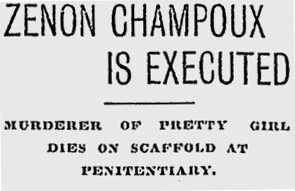
1904: Zenon Champoux, French degenerate

On this date in 1904, the state of Washington carried out its first execution under the auspices of a new law requiring that hangings be held in that state’s penitentiary in Walla Walla.*

Its subject was French-Canadian laborer Zenon Champoux, and his crime was as flamboyant as his moniker: publicly planting a knife in the forehead of a dance hall girl who did not return his affections.

The first man executed under the auspices of the Evergreen State, we admit, is a milestone that’s a bit on the smaller side.

But we think his name stands out admirably in the annals, especially paired with a characterization like the Seattle Star gave him: French degenerate.

“Zenon Champoux, French Degenerate” — it’s the scoundrel who’s rogering your girl, or else the branding on his designer condoms. On this date in 1904, it was just the guy at the end of his rope.

* Previously, hangings had been conducted by counties, in public. Laws removing them to the auspices of the state and behind the walls of a prison were in vogue at the time.

Washington went on to abolish the death penalty in 1913, only to reinstate it again in 1919.

On this day..

1901: “Black Jack” Tom Ketchum, who was left in three pieces

On this date in 1901, a two-bit outlaw from a vanishing frontier made his reservations for hell.

Tom Ketchum — who had become known as “Black Jack” when misidentified with another hombre he resembled — was the last man to hang in America for attempting to rob a train. Given the way the authorities in Clayton, N.M., conducted the job, that’s probably for the best.

This Texas-born outlaw enjoyed a colorful career in the 1890s Southwest plundering trains, killing folk, and other distinctively American pastimes. His name attaches to the [in]famous Hole in the Wall Gang.

He was finally caught attempting a dangerous one-man train robbery, when a conductor (taking part in his third stickup, and tired of being on the wrong end of the gunbarrel) got the drop on Ketchum and winged him with a shotgun. Too weakened by his injury to escape, Ketchum surrendered himself to the law, and his wounded arm to the surgeons.

The un-amputated remainder belonged to Clayton, N.M. — New Mexico Territory, that is, which was not yet a state at this time, but was keen on making an example to stanch the tide of train robberies.

(Formally, the charge that hung Ketchum was “felonious assault upon a railway train”; he was the only person executed for this offense before the Supreme Court decided that a hanging crime needed more victims than just an iron horse. This jurisprudential advance might not have done Black Jack very much good anyway, since neighboring Arizona had also put in an extradition request for murder.)

So far, so good.

Then, they actually dropped him.

When the body dropped through the trap the half-inch rope severed the head as cleanly as if a knife had cut it. The body pitched forward with blood spurting from the headless trunk. The head remained in the black sack and flew down into the pit.

SOME MEN GROANED.

Some men groaned and others turned away, unable to endure the sight. For a few seconds the body was allowed to lie there half-doubled up on its right side, with the blood issuing in an intermittent stream from the severed neck as the heart kept on with its mechanical beating. Then with cries of consternation the officers rushed down from the scaffold and lifted the body from the ground. It was only then apparent exactly what happened.

The drop of the body was seven feet and the noose was made so it slipped easily. Ketchum was a heavy man, and the weight of the body, with the easy-running noose, caused the rope to cut the head cleanly off. Dr. Slack pronounced life extinct a little over five minutes from the time the body dropped through the trap. It is stated too much of a drop was given for so heavy a man.

Just so we’re clear: a seven-foot drop is much, much too far for a man of Ketchum’s 190-plus pounds. Maybe they were distracted by rumors of an escape attempt.

The newspaper account above cites much more forgettable scaffold-talk from Ketchum, but we can’t help but find charm (and obviously, black humor) in his alleged last words,

I’ll be in hell before you start breakfast, boys! Let her rip!

Fictional? If so, they’re more like what Ketchum’s last words ought to be. Although let St. Peter‘s ledger reflect that Ketchum was a decent enough chap to post a letter to President McKinley on the morning of his own execution copping to several robberies for which other people were imprisoned.

Initially buried — naturally — at Clayton’s Boot Hill, this infernal denizen’s grave can now be found (and more than a century on, tourists and admirers do find it) at Clayton Memorial Cemetery.

On this day..

1900: Ada Chard Williams, the last woman hanged at Newgate

On this date in 1900, Ada Chard Williams was hanged for murdering an infant girl.

A baby farmer, Williams took in unwanted children for money … money that went a lot further when the child died. The milestone nature of her hanging in the yard of Newgate Gaol, which would be closed two years later,* was entirely unforeseen at the time.

Justice moved fast in the Williams case, as evidenced by the London Times blurbs covering the case.**

Monday, December 11, 1899

POLICE COURTS. — At the South-Western, William Chard Williams, 41, and Ada Chard Williams, 24, his wife, were remanded, charged with the wilful murder of a child entrusted to their care, and whose body was found in the Thames at Battersea with the skull battered in. The female prisoner said they were perfectly innocent of the charge. The child was delivered by her to another woman and was then quite well.

Saturday, December 30, 1899

POLICE-COURTS. — At the South-Western the charge against William Chard Williams, 41, and his wife, Ada Williams, 24, of the murder of a child named Selina Jones, 21 months old, which had been entrusted to their care, was further investigated. Mr. Bodkin, who prosecuted for the Treasury, stated the facts of the case as already published, and added that the bodies of two other children tied up in the same way as that of the child Jones had been found in the Thames in July last, and the suggestion of the prosecution was that they had been put in the river by the prisoners. After some evidence had been given the prisoners were again remanded.

Saturday, January 20, 1900

POLICE-COURTS. — At the South-Western, William and Ada Chard Williams, man and wife, were finally examined and committed for trial charged with the murder of Selina Jones, an illegitimate child, 21 months old, which had been entrusted to their care.

Monday, February 19, 1900

CENTRAL CRIMINAL COURT. — Before Mr. Justice Ridley, the trial was concluded of William Chard Williams, 41, clerk, and Ada Chard Williams, 24, his wife, charged with the murder of an illegitimate child named Selina Ellen Jones, 21 months old, which had been entrusted to the care of the female prisoner in August last. On September 27 its body was found in the Thames in a condition which indicated that it had been stunned and strangled before being put into the river. The jury found the female prisoner guilty, and she was sentenced to death. The male prisoner was acquitted.

Wednesday, March 7, 1900

EXECUTION AT NEWGATE. — Ada Chard Williams, 24 years of age, who was convicted at the Central Criminal Court of the wilful murder of Selina Ellen Jones, a child which had been placed in her care, was executed at Newgate yesterday morning. There were present at the execution Lieutenant-Colonel Milman, Governor of Newgate and Holloway Prisons, Mr. Under-Sheriff Metcalfe, representing the High Sheriff of the county of London, Dr. Scott, medical officer of Newgate and Holloway, and other officials. Billington was the executioner. An inquest was subsequently held in the Sessions-house, Old Bailey, before Mr. Langham, Coroner for the City. Lieutenant-Colonel Milman gave evidence, stating that the execution was carried out satisfactorily. Death was instantaneous. The prisoner made no confession. The jury returned the usual verdict.

* Male executions were transferred to Pentonville Prison and female executions to Holloway Prison thereafter.

** With the exception of the last, these items are all from the Times index summarizing its news articles, and not the articles themselves.

On this day..