2008: Wang Zhendong, ant profiteer

The two timeless pursuits of man — a bigger boodle, and a better boner — brought Wang Zhendong to execution in Liaoning province this date in 2008 for a nine-figure ant-farming scam. True story.

With the sort of screw-thy-neighbor entrepreneurial spirit of the times, the aptly-named Wang engorged himself to the tune of 3 billion yuan — around $400 million, give or take — running a pyramid scheme based on the reputed herbal aphrodisiac polyrhachis vicina roger. (Seriously, “roger”.)

From 2002 to 2005,* ten thousand Chinese investors fantasizing of 40 and 60% returns ponied up $1,300 a pop for ant-breeding kits with a street value of twenty-five bucks.

Sex: it makes men stupid.

The buyers were supposed to return the formicids after a few months so the company could process them into aphrodisiacs and miscellaneous other remedies … then watch the money gush. Some early investors were paid off by those who got sloppy seconds, but eventually the ponzi scheme collapsed and the pigeons realized that the ants they’d sprung for were really a pig in a poke.

By the time investigators cockblocked the company in 2005, less than 1% of the proceeds could be recovered. At least one sucker committed suicide realizing he had shot his life’s wad.

“He should just die,” one non-suicidal investor told the western press. “He hurt so many people. Some people even sold their house, their cars. People don’t have money, and they don’t have work. What can they do?” What, no bailout?


A “beware of ant scam artists” poster put up in Shanghai. Image (c) MFinChina and used with permission.

Besides Wang’s petite morte this day, fifteen of his company’s former managers drew prison sentences ranging from five to ten years.

* Everybody was doing it.

On this day..

2008: A son, all in the family

On this date in 2008, Abura Apalalu of Longorinyangai village, Namalu Sub-county, in Nakapiripirit District of Uganda convened a traditional (but illegal) tribunal to try his two sons for raping their sister.

Apalalu found the youths guilty and condemned his own flesh and blood to death … after which they were both beaten by fellow-villagers, one of them fatally.

The incident illustrates the challenge of getting people in the Karamoja region, where traditional systems are used to serve justice, to conform to the rule of law as enshrined in Uganda’s constitution.

Last year alone, according to the UPDF 3rd Division spokesman, Capt. Henry Obbo, five people were hanged on orders of the Karimojong traditional clan court sitting at Namalu in Nakapiripirit District.

Nakapiripirit District Community Development Officer Michael Edikoi says under the traditional justice system, a person who kills is supposed to be killed. “You are told to dig two graves, one for the person you have killed and the other for yourself. Then you are forced to bury the dead before being stoned to death and buried in the other grave next to your victim,” he said.

On this day..

2008: Behnam Zare, pleading for his life

On this date in 2008, Behnam Zare (or Zareh) was hanged in Shiraz for murdering, at the age of 15, another youth during a fight about a bird.

Evidently about 19 when he was finally put to death, Zare was hanged without any prior notice to his lawyer or his family.

A recording of Zare’s voice in what turned out to be his last call with his lawyer, pleading “I want to stay alive. Please, please I want to stay alive,” was used to open a 2008 documentary against executing juvenile offenders.

That attorney who represented Zare (and created the documentary) was Mohamad Mostafaei — an activist lawyer who described various forms of official harassment for his unwelcome work. Mostafaei has recently been in the news for his representation of Sakineh Mohammadi Ashtiani, the woman who made international headlines for receiving a sentence of stoning to death. (Mostafaei also represented cause celebre Delara Darabi, hanged in 2009.)

Just a few weeks ago, Mostafaei fled Iran ahead of an arrest warrant (several members of his family were also arrested as virtual hostages).

He was interviewed by the BBC in exile in Oslo. (Read on to the comments for a transcript.)

(Also of interest: Mostafaei’s gut-wrenching description of another child offender’s hanging in October 2009, and the desperate attempts to beg for mercy from the victim’s parents. StopChildExecutions.com has regular coverage of the juvenile death penalty in the Islamic Republic.)

On this day..

2008: Nine hanged in Iran

Iran has been dinged for ramping up its execution pace in the wake of its mid-2009 crisis of political authority. (Like this, just yesterday.)

There might well be something to that, but Iran’s “baseline” starting point for any such escalation is already pretty high, and had already been trending up.

It was in that spirit at dawn this day last year that Tehran’s Evin Prison conducted a mass hanging of eight men and one woman, with a tenth potential victim spared at the last moment only due to the absence of his family.

All were executed for homicide, including the woman, one “Tayyabeh”, who insisted that she was tortured into confessing to burying her 8-year-old stepdaughter alive.

On this day..

2008: Amoudou Samassa, to quell a lynch mob

Last year on this date, a Central African Republic presidential guard summarily executed a man in a hospital to satisfy a lynch mob pursuing him for murdering his wife.

Amoudou Samassa was supposed to have stabbed his estranged wife to death, provoking an armed mob intent on dispensing street justice. After gendarmes pried him away unkilled, the incensed crowd jammed the streets of the capital Bangui.

Reuters reported that when negotiations to disperse them proved fruitless,

one guard officer, Lt. Jean-Claude Ngaikoisset, finally told the crowd: “If the death of this criminal is the only thing you’re asking for to clear these avenues, then I see no objection”.

File it under “Creative solutions to gridlock.”


Central African Republic security forces.

On this day..

2008: Michitoshi Kuma, “It can’t be undone now”

On this date in 2008, during a record-setting year for executions, Japan hanged Michitoshi Kuma, 70, and Masahiro Takashio, 55.

Michitoshi Kuma attracts our notice in particular not simply because he insisted throughout his trial and appeal that he was innocent of abducting and murdering two seven-year-olds in 1992 … but because the circumstantial evidence that convicted him was buttressed by a DNA testing regime that has fallen into disrepute.

One crucial piece of evidence against Kuma was the DNA samples taken from blood near the victims’ bodies. The samples were tested with DNA typing of the MCT118 locus.

The same method of testing was used in the case of the murder of a young girl in Ashikaga, Tochigi Prefecture, in 1990, known as the Ashikaga case. The test result was seen as crucial evidence in supporting the life sentence handed down to the accused, Toshikazu Sugaya.

However, the result was overturned when the DNA was tested again as part of the immediate appeal filed by Sugaya’s defense counsel after his request for a retrial was dismissed.

Sugaya, 62, was freed from prison on June 4, 17 years after police had arrested him.

“At first glance, DNA tests look scientific. That’s why it’s dangerous to have complete faith in them,” Iwata said.

“The tests were carried out in a particularly sloppy way in the early 1990s, when the Iizuka and Ashikaga cases occurred,” he said, adding that the Iizuka case likely was another example of a wrongful conviction.

“It can’t be undone now,” one of the defense lawyers lamented upon hearing of the hanging — conducted, as per usual in Japan, in secret and without prior notice to either the inmate or his attorneys.

The Ashikaga case, in which another prisoner convicted about the same time as Kuma and with the same DNA technology was exonerated and released a few months after Kuma’s hanging, embarrassingly reversed what had once been a signal judicial triumph for early DNA testing.

“The media treated the science as if it were invincible, like Atom Boy,” [one of Toshikazu Sugaya’s attorneys] said sarcastically. “They just kept admiring the DNA judgment without reservations.”

The objections Sugaya’s exoneration prompted about Kuma’s conviction, of course, arrived a bit too late.

On this day..

2008: Tseng Fu-wen, drug dealer

June 26 is U.N. Anti-Drug Day, and if this year follows the recent trend, China will be marking the run-up with the salutary execution of consumers and/or vendors of chemical compounds disapproved by the state. (Update: Yes indeed it did.)

On June 24, 2008, for instance, Tseng Fu-wen, “a Taiwanese citizen who was convicted of producing or selling methamphetamine, heroin and other drugs,” was put to death in the eastern province of Fujian.

Two accomplices drew a prison sentence and a suspended death sentence (typically commuted to a prison sentence after two years).

Prosecutors said the Taiwanese trio started making drugs in October 2006.

Police arrested them one month later in Xiamen after they bought 50 kilograms of ephedrine to make methamphetamine, commonly known as “ice.”

The police also recovered 63.8 kilograms of ice, plus “varying quantities of other drugs such as heroin, and equipment and raw material in a workshop,” the agency said.

The method of execution does not appear to have been reported by the state media; China uses both lethal injection and gunshot, but I have not been able to document which method prevails in Fujian.

On this day..

2008: Anandrao Sainu Koram, Naxalite informer

Last year on this date, India’s Maoist “Naxalites” publicly beheaded a former comrade who had surrendered and collaborated with police.

Naxalites.

The incident that occurred in village Murgaon of Dhanora sub district has the entire Maoist-affected region in the grip of tension because of the manner in which the reprisal has been carried out.

A group of 40 to 50 Maoists went to the village Saturday night, called out Anandrao Sainu Koram from his house, tied him to a tree and beheaded him in full view of the villagers who had gathered at the spot, deputy superintendent of police Anant Rokde said Sunday.

“They also warned Anandrao’s colleague Shantaram Gawde, who too had surrendered to the police in April this year along with three others, that he would meet the same fate if he did not desist from acting as an informer,” Rokde told IANS on the basis of the complaint lodged by Anandrao’s wife.

The 23-year-old Koram was reportedly the fourth surrendered Naxalite slain by insurgents in as many months of the long-running and escalating conflict … which, needless to say, has been dire for civilians.

On this day..

2008: The Bali Bombers

On this date — mere hours ago as of this writing — three of the most infamous terrorists in two nation’s histories were shot in a jungle clearing on Indonesia’s Nusa Kambangan Island.

“At around 00:15 am (1715 GMT Saturday) the three convicted men on death row, Amrozi, Mukhlas and Imam Samudra, were executed by firing squad,” said attorney general’s office spokesman Jasman Panjaitan.

“The autopsy results show that all three are dead. The family members are now bathing the bodies.” (Source.)

The men were taken from prison and tied to wooden crosses in the Indonesian prison island’s forest, where they were shot simultaneously by three separate firing squads for the October 12, 2002 bomb attack on the island of Bali that claimed 202 lives.

Though taking place in Indonesia, the strike was aimed at westerners vacationing at a tourist hot spot. Eighty-eight Australians were slain, along with 76 other (predominantly European) foreigners. The only shred of regret the late executees ever betrayed was that the infidel body count wasn’t higher.


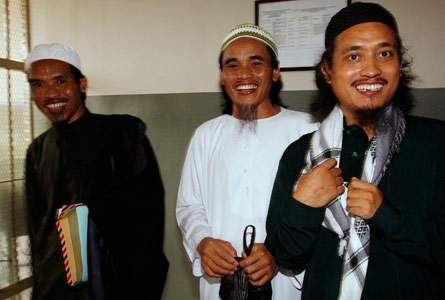
The mediagenic murderers display a range from insouciant to jocular in most of their photos. The ever-grinning Amrozi — in the middle — was known as the “smiling assassin.”

The three facing death today* have occupied most of the intervening six years endeavoring to transmute their criminal celebrity into the dearer coinage of martyrdom through the doubtful influence of the Philosopher’s Stone mass media.

Despite their body count, burial disturbances, and even the prospect of some follow-up strike by at-large members of Jemaah Islamiyah, a base metal the late bombers will remain. Picture the most fanatical devotee of any cause you care to conjure drawing any enduring inspiration from this juvenile twaddle.

Indonesia has appeared to sidle towards this execution, ginger at inflaming Islamic radicals; Australia, which has no death penalty itself, has been controversially mum and bombing victims and their families conflicted.

It remains to be seen whether the high-profile case has legs among militants. But its undertones of race, religion and national sovereignty are being very closely watched by one group of Australians in particular: the Bali Nine, Australian nationals in Indonesian custody for drug smuggling.

Three of the nine are currently on death row, reportedly “somber” at this day’s shootings — no doubt aware that they could be next.

Update: True to the publicity-savvy rep, Imam Samudra reportedly knocked out a nasheed or nasyid just before his execution that’s now a hot ringtone download.

[audio:Imam_Samudra.mp3]

* A fourth man was also death-sentenced, but that sentence was vacated on appeal.

On this day..