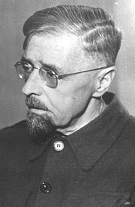
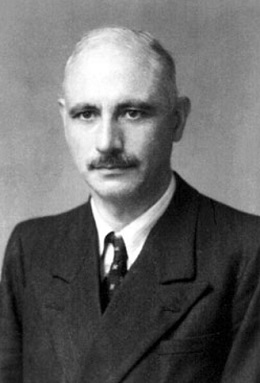
1946: Gen. Leopold Okulicki murdered in Soviet prison

The fate of the last Commander in Chief of Home Army General Leopold Okulicki “Niedzwiadka”, imprisoned in Moscow and murdered there, symbolize the postwar fate of the Home Army and of Poland.

-2012 resolution of the Polish parliament

On this date in 1946, Polish Home Army General Leopold Okulicki was murdered by the NKVD in a Moscow prison.

Okulicki (English Wikipedia entry | the much more detailed Polish) embarked his military career at the tender age of 16, when he ditched school in favor of an Austrian legion on the eastern front of World War I — then segued directly into newly independent Poland‘s subsequent war against the Soviets.

Already a veteran soldier, Okulicki proceeded to the Warsaw military academy and made soldiering his career. He had advanced to the brass by the time Hitler and Stalin destroyed Poland in 1939. Okulicki had the tragic honor to maintain the hopeless defense of Warsaw, but went underground thereafter with the remains of the Polish state — hunted by Germans and Soviets alike.

The NKVD caught him in January 1941, but his residence in the discomfiting environs of Lubyanka prison was ended by the Soviet Union’s arrangement with Poland following Operation Barbarossa. Paroled back into the field, he played a leading part for the Polish Home Army for the balance of the war — finally becoming its supreme commander in the last weeks of the war.

Now that the Nazis were no longer knocking on the gates of Moscow, the Soviets renewed their interest in detaining Okulicki, which was again effected with relative ease. (Comparing German and Soviet secret police, Okulicki would say that the NKVD made the Gestapo look like child’s play.) Sentenced “only” to a 10-year prison term at the Russians’ postwar show trial of Polish leadership, Okulicki disappeared into Soviet detention and was never seen again.

In the Khrushchev era, the USSR revealed that Okulicki had died on Christmas eve of 1946 at Butyrka prison; subsequent revelations of the medical records there revealed that he had succumbed to organ damage suggestive of having been beaten to death — perhaps as punishment for hunger-striking.

The post-Communist Russian state has posthumously exonerated Okulicki of his show-trial conviction; he is, of course, an honored figure in post-Communist Poland where many streets and squares bear his name.


Plaque honoring Gen. Okulicki in Warsaw. (cc) image from Tadeusz Rudzki.

On this day..

1946: One sex killer and four POW camp murderers

This date in 1946 saw the largest mass execution in Alberta: five men all hanged for murder.

One of these, Donald Sherman Staley, was a hated sex-murderer who had raped and killed boys in Calgary and Alberta that summer. But he is the undercard in this event.*

The remaining four were all German prisoners of war from the lately concluded world war. They did not, as their onetime commanders in Europe, face judgment for war crimes: no, Bruno Perzonowsky, Walter Wolf, Heinrich Busch and Willi Mueller had while marking time in the Medicine Hat POW camp contrived to execute a fellow-prisoner as a subversive.

Naturally this camp “execution” was rank murder from a legal perspective. But the day-to-day reality of the Medicine Hat camp was that the few Canadian officials banked on the 12,000 or so German detainees to run the place themselves.**

Medicine Hat’s German leadership consisted of Nazi ideologues, but the politics and life experiences of its inmates, regular grunts snatched from various battlefields, deviated widely from the Reich’s ideal. In 1943, convinced that the less fascist elements in camp were cogitating a plot to displace the Nazi silverbacks in camp, that clique convened a drumhead trial and hanged August Plaszek, a Catholic and former French Foreign Legionnaire.

After the war ended, this murder too resulted in a hanging — but as of the second killing that is the focus of this post, the Canadian investigation was being stonewalled and the true believer types still bossed Medicine Hat with near-impunity.

The second murder was triggered by a threat not to Nazi authority in Medicine Hat — but in Berlin.

After the shock of the Valkyrie plot that came within a whisker of assassinating Hitler, the Fuhrer publicly demanded a purge of traitors, anywhere and everywhere.

The POW Karl Lehmann was just such a one, to Hitlerian eyes. Another Catholic — a dubious class for sure — Lehmann was a husky former languages professor who had been dragooned into the military and subsequently captured in Tunisia.† He had been in Medicine Hat for two years when Col. Stauffenberg’s bomb went off in Wolfsschanze, growing ever bolder vilifying the Third Reich and anticipating its approaching defeat.

In September 1944, our quartet of future gallows-fodder lured Lehmann to a room where he sometimes gave lectures, and there began browbeating him about communists in camp. As Lehmann vainly denied any such connection, his assailants got a noose around him and hoisted him to his death.

Having now had two political assassinations on their watch, Canada finally got serious and threatened the entire population of prisoners with the prospect of being punished as murderers were they merely to fail to report a murder plot to which they had become privy. They also started reshuffling the prisoner population in an effort to break up the Nazi prison gang. Both measures worked — aided, of course, by the advance of Allied armies in the European theater — and nobody had the ill fortune to follow Karl Lehmann’s fate.

Lethbridge Gaol had to be outfitted with a whole new condemned bloc just to hold the prisoners bound for their end this date. (Its existing capacity was only two.)

* Staley’s desperate argument for clemency was that he was a “sexual insane” who could not govern his compulsions: “I must have been born this way and should not be held responsible for what I done, but should receive treatment of some kind instead of being condemned to die for something I can’t help.” “Merciful” proposals ran towards employing him as a guinea pig for mental health hospitals’ experiments with, e.g., lobotomy.

** Canada’s deference to German detainees also made it party to a scandalous execution of Wehrmacht deserters conducted by a surrendered German army in Canadian custody in 1945. (Canada helpfully supplied their prisoners the necessary guns.)

† Under Field Marshal Rommel‘s command, no less: though he was perhaps Hitler’s ablest general, the Desert Fox all but openly disdained national socialism. He was himself implicated in the July 20 plot, and made to commit suicide.

On this day..

1944: Thirteen from the Ehrenfeld Group and the Edelweiss Pirates

On this date in 1944, the Gestapo publicly hanged 13 men without trial at an S-Bahn station near Cologne.

Heavily bombed by the Allies in World War II, the Rhineland industrial center had spawned two overlapping anti-Nazi movements both represented in this evil baker’s dozen. Their purchase on posterity’s laurels of anti-Nazi “resistance” has been debated ever since.

The first of these were the Edelweiss Pirates (English Wikipedia entry | German), a thousands-strong network of dissident young people dating back to the 1930s after Berlin made youth membership in the Sieg Heiling Hitler Youth (HJ) mandatory.

Often derogated as mere “delinquents”* — who failed to articulate “a positive view of goals”** — the heavily working-class Edelweißpiraten were expressly delinquent from the Third Reich’s project of youth indoctrination.

“Our banding together occurred primarily because the HJ was dominated by a certain compulsion to which we did not want to submit,” one “pirate” declared to Gestapo interrogators. Another said that his clique simply wanted “to spend our leisure time going on trips as free boys and to do and act as we pleased.”†

Many looked longingly back on the Bündische Jugend, romantic and far less authoritarian traditions of youth outdoorsmanship that the new regime had suppressed.‡ These pirates shirked their Hitler Youth “responsibilities” and did their rambling without odious political officers, repurposing old hiking tunes into confrontational subversive songs that they backed up with a penchant for fistfights with the HJ. A song of one band, the Navajos, ran:

Hitler’s power may lay us low,
And keep us locked in chains.
But we will smash the chains one day.
We’ll be free again.
For hard are our fists,
Yes! And knives at our wrists,
For the freedom of youth
The Navajos fight.

We march by the banks of the Ruhr and the Rhine
And smash the Hitler Youth in twain.
Our song is freedom, love, and life.
We’re Pirates of the Edelweiss.

Maybe one ought to see these as a totalitarian state’s edition of nascent 20th century youth counterculture, rejecting the stultifying ideology imposed upon them but not yet sure of their own project.

The discourse parsing the degree of “criminality” in youth defying a criminal society strikes the author as an all too precious critique from the security of the postwar world. These pirates might make for less congenial martyr figures than the likes of Sophie Scholl but in the end, they took desperate risks to maintain a sphere of freedom in circumstances of inconceivable peril. Not much adult opposition to Hitlerism with proper manifestos did better than they.

And the Pirates had a handle on larger stakes than their own jollity. Many gangs listened to outlawed foreign broadcasts, committed acts of politically charged vandalism and sabotage, and hid army deserters or Jews. Certainly the authorities viewed them politically when they were subjected to Gestapo torture.

Some current and former Edelweiss Pirates were among the young people in increasingly war-ravaged Cologne who in 1943-44 came under the sway of an escaped concentration camp prisoner named Hans Steinbrück. His “Steinbrück Group” (or “Ehrenfeld Group”, for the suburb where they had their headquarters and, eventually, gallows), the second faction represented in the November 10 hangings, had a more distinctly criminal cast — stealing food and trading it on the black market.

Steinbrück, who claimed anti-fascist motives of his own, was also ready to ratchet up the associated violence past adolescent brawling. He stockpiled illegal weapons and had his gang shoot several actual or suspected gendarmes on a “Nazi hunt” shortly before their arrest. He would ultimately be accused of plotting with Eidelweiss Pirate Barthel Schink to blow up a Gestapo headquarters. The activities of the Ehrenfeld Group in particular have been controversial for many years: were they resisters, or merely gangsters who conveniently appropriated a patina of anti-fascist activism?

Under whatever label, their activities were far too much to fly as youthful transgression; Heinrich Himmler himself ordered the Ehrenfeld gang busted up in the autumn of 1944. Sixty-three in all were arrested of whom “only” the 13 were extrajudicially executed: Hans Steinbrück, Günther Schwarz, Gustav Bermel, Johann Müller, Franz Rheinberger, Adolf Schütz, Bartholomäus Schink, Roland Lorent, Peter Hüppeler, Josef Moll, Wilhelm Kratz, Heinrich Kratina, and Johann Krausen. (Via)

* They would survive the end of the war and prove defiant of the Allied occupation authorities too, which is one reason they had to fight until 2005 for political rehabilitation. Perry Biddiscombe explores this Pirates’ situation in occupied postwar Germany in “‘The Enemy of Our Enemy’: A View of the Edelweiss Piraten from the British and American Archives,” Journal of Contemporary History, January 1995.

** Hans-Christian Brandenburg in The History of the Hitler Youth)

† Both quoted by Daniel Horn in “Youth Resistance in the Third Reich: A Social Portrait,” Journal of Social History, Autumn 1973.

‡ Hence the Edelweiss — a Wandervogel symbol.

On this day..

1944: Joseph Watson and Willie Wimberly Jr.

(Thanks to Meaghan Good of the Charley Project for the guest post. -ed.)

On this date in 1944, Private Joseph Watson and Technician Fifth Grade Willie Wimberly Jr. of the U.S. Army were executed for a brutal attack on two French civilians.

They broke into a farmhouse only a few hundred yards from their company bivouac area, shot the elderly farmer and his unmarried daughter, and raped the woman. Their crimes and deaths are described in French L. MacLean’s book The Fifth Field: The Story of the 96 American Soldiers Sentenced to Death and Executed in Europe and North Africa in World War II.

At 8:00 p.m. on the evening of August 8, 1944, Watson and Wimberly, both of them already drunk, arrived at the farmhouse and bartered for a liter of apple cider. They spoke no French but were able to get their point across. The farmer and his daughter were wary of the inebriated pair and, after they left, barricaded the door.

Five minutes later, the two soldiers returned and battered it down.

Wimberly hit the man on the head with his Tommy gun and Watson forced the woman into a chair. Then, just like that, they left again. The two victims went upstairs, barricaded themselves into another room and double-locked it.

A few hours later the two soldiers returned and fired at least twenty .45 submachine gun rounds through the upstairs door, wounding both of the French civilians.

The farmer staggered downstairs and went to get help, but his daughter’s tibia was fractured and she was unable to flee. She was raped in turn by each of the men while the other held her at gunpoint.

At trial she couldn’t identify either of her attackers. The farmer identified Wimberly out of a lineup of six black soldiers, but wasn’t sure about Watson.

Their identification wasn’t really needed, however. Watson was found passed out at the crime scene in the morning, still wearing his bloodstained pants, with the fly unzipped. Wimberly had left, but he left his helmet liner (marked with a unique serial number) on the steps of the farmhouse.

When questioned, Wimberly blamed the entire thing on Watson. Watson made several contradictory statements about the night of the crime before pulling the old amnesia gag. He admitted he’d gone to the farmhouse with Wimberly and added, “I must have gotten drunk because the next thing I knew I was in the yard with a Colonel, two Lieutenants and two MPs.”

Given the circumstances, there wasn’t much either man could say to show why he should not be convicted and executed.

Justice was quick: they were hanged less than three months after their crime. Wimberly went first and was pronounced dead at 10:29 p.m. Watson followed and was dead by 10:48. Eight days later, General George S. Patton had a letter sent to the rape victim, apologizing for what she’d been through and for the soldiers’ part in it.

On this day..

1939: Operation Tannenberg public mass executions begin

This photo (from the German Bundesarchiv) captures an SS execution of Poles in Kornik just weeks into the German occupation of Poland in 1939, fruit of a pre-planned Nazi project to secure the new territory as lebensraum.

Operation Tannenberg (English Wikipedia entry | German | Polish) could be seen as a vanguard for the mind-boggling exterminations to come in subsequent years, cementing the army’s commitment to a campaign that extended well beyond territorial conquest. Alexander Rossino examines this understudied segment of World War II in Hitler Strikes Poland: Blitzkrieg, Ideology, and Atrocity and contends that “the unlimited, almost nihilistic violence of the Wehrmacht” emerges first in these initial weeks of the Polish campaign, which proved a “transitional conflict” pivoting towards the more notorious atrocities to come. “The invasion of Poland thus occupies a crucial place in the history of Nazi Germany’s descent into mass murder and genocide.”

Drawn up by Hitler, Himmler, and Heydrich and officially authorized on August 25, a week before Germany invaded Poland, Tannenberg intended to destroy Poland’s elites — from intelligentsia and nobility down to community priests and teachers, and the politically active across the spectrum from Communist to monarchist. The hope was to leave the subject nation supine, incapable of challenging Berlin’s designs on her future. Estimates I have seen vary widely but tens of thousands of Poles (with a liberal portion of Polish Jews) were shot by SS Einsatzgruppen units under Tannenberg even by the end of 1939, and kilings continued apace thereafter. Though not the literal first Operation Tannenberg Killings, the October 20-23 period marked the first public mass executions; a Polish-language list of the incidents and victims involved is available here.

The very name Tannenberg is a nationalist allusion to Germany’s time-immemorial rivalry with Poland; the original Battle of Tannenberg saw the rising Polish-Lithuanian empire defeat the Teutonic Knights, essentially breaking the latter as a European power. This defeat resonated in 20th century German national mythology not unlike the Battle of Kosovo for Serbia; in 1914, Field Marshal Paul von Hindenburg made himself a household name by smashing the Russians in a battle vaguely in the vicinity, and cannily christened it, too, the Battle of Tannenberg. (The Germans put up a monument to it which they felt obliged to tear down later in the war as they were being driven out of Poland.)

On this day..

1946: The Neuengamme camp war criminals

On this date in 1946, eleven men convicted by a British war crimes court of war crimes at the Neuengamme concentration camp hanged at Hamelin prison.

Neuengamme held about 106,000 prisoners from 1938 until the British overran it on May 3, 1945. (In a tragic coda, many of the last prisoners died when the ships to which they had been transferred were mistakenly strafed by the Royal Air Force that same day.)

Though its primary purpose was slave labor — Neuengamme inmates cranked out bricks and armaments — rather than extermination, close on half of its residents died of the maltreatment. Anne Frank’s elderly roommate-in-hiding “Albert Dussel” (his real name was Fritz Pfeffer) died there of enterocolitis in 1944; Suriname national hero Anton de Kom succumbed to tuberculosis at Neuengamme days before it was liberated.

Nor was Neuengamme above more direct methods — of course it wasn’t. As the Third Reich collapsed, Neuengamme was used to dispose of 71 leftists for no better reason than the Nazis begrudged their potential postwar life; meanwhile, Jewish children who had been subjected to medical experiments were hanged by their stonehearted SS doctor.

That gentleman, Alfred Trzebinski, was one of the men in the dock for Neuengamme, and ultimately, one of the men on the scaffold.*

Camp commandant Max Pauly and SS Schutzhaftlagerführer Anton Thumann were among the 10 others executed for Neuengamme, all together on October 8, 1946.

* Sigmund Freud’s grandson Walter worked for the War Crimes Investigation Unit on (among other cases) Trzebinski’s Bullenhuser Damm school hangings.

On this day..

1943: Michal Kruk, Przemysl Pole who aided the Jews

In the German-occupied city of Przemysl, Poland on September 6, 1943, Michal Kruk and several other non-Jewish Poles were publicly executed for their roles sheltering Jews being rounded up for the local ghetto — bound, naurally, for worse fates thereafter.

Przemysl’s Jewish community was almost completely annihilated during the Holocaust.

On this day..

1946: Leon Rupnik, Erwin Rosener, and Lovro Hacin, for the occupation of Slovenia

On this date in 1946, the postwar state of Yugoslavia executed a trio of World War II occupation figures.


Left to right: Leon Rupnik, Erwin Rosener, and Lovro Hacin.

An Austro-Hungarian subject by birth, Leon Rupnik followed his native Slovenian soil into (proto-)Yugoslavia after the empire collapsed in World War I, and climbed the military ranks in the interwar era.

General Rupnik, as he could then be called, was the man tasked with engineering fortifications along the Italian and Austrian borders to ward off a fascist invasion. Modeled on the Maginot Line and every bit as effective, the Rupnik Line was little more than a speed bump when the Germans and Italians swept in during April of 1941.

But Gen. Rupnik was an open Nazi sympathizer, so sentimentality for his failed bunkers scarcely deterred him from joining the new occupation government as an enthusiastic collaborator, and he served or a time as the president of the German puppet province and the mayor of its capital, Ljubljana.

Erwin Rosener was a onetime brownshirt who became an SS General and was tasked by Heinrich Himmler with suppressing partisan resistance in Slovenia. He did the usual dirty things such a job entails, ordering torture and executions of hostages; Gen. Rosener also helped Gen. Rupnik organize the right-wing paramilitary Home Guard (Domobranci).

Lovro Hacin, the third member of the doomed party, was the police chief of Ljubljana.

Rupnik was shot. Rosener and Hacin were executed by hanging.


Rupnik (leftmost on the platform) reviews fascist Dombranci militia with Bishop Rozman and (rightmost) Gen. Rosener, January 30 1945.

Three others escaped execution at the same trials. Vilko Vizjak and Mha Krek both drew prison terms; Bishop Gregorij Rozman did as well, but his trial occurred in absentia and Rozman lived out his in exile.

On this day..

1944: Jacques Stosskopf

For most prisoners at the Netzweiler-Struthof concentration camp in Alsace, the fall of 1944 marked a time of disbursement to other detention sites — a clear sign that Allied forces were close at hand.

But both the disbursement order (in mid-September) and the Allied arrival at Struthof (in November) were just a little too late for Jacques Stosskopf, who was executed by the Nazis on Sept. 1 that year, even as the Germans were beginning preparations to disband the camp. How he was executed is unclear; stories from witnesses differ about whether prisoners at the camp were hanged, shot or gassed.

But it isn’t Stosskopf’s end that catches attention; rather, it is how he spent the war years, and his involvement, as a Frenchman, in the German U-boat war.

A native of Paris (born Nov. 27, 1898, in the City of Light), Stosskopf was of Alsatian heritage and spoke fluent German. He joined the French artillery in 1917 and received the French Croix de Guerre for his actions in World War I.

After the war, he entered the Ecole Polytechnique and earned a degree in marine engineering. As World War II approached, Stosskopf was appointed to lead the naval construction unit at Lorient, on the French coast. He eventually was promoted to the rank of Chief Engineer, 1st Class.

In June 1940, the German army took control of Lorient and began using the naval facility there to repair and resupply their U-boats. When they realized that the U-boats were vulnerable to attack by Allied air forces, the Germans set about fortifying the base as a refuge for their submarines.

Stosskopf worked with the Germans to design the new U-boat station, creating one of the most famous and impenetrable naval bases of the war: the double roof over the bunkers allowed them to withstand even a direct bomb hit, so even though the city of Lorient itself was almost 90% destroyed by Allied bomb raids, the bunkers continued to stand.

Between 1940 and 1944, the Germans built three such bunkers, capable of sheltering more than 25 submarines; from these fastnesses, German U-boats carried out relentless attacks against both military and civilian targets.

Because of his involvement with the naval station, Stosskopf was considered a collaborator by the local French citizenry. So when he disappeared in February 1944, they assumed that he had been promoted by his German compatriots and had been called to work in Germany.

In fact, all the while he was working on the U-boat port, Stosskopf had been collaborating not with the Germans but with the Alliance Reseau, a French resistance group headed by Marie-Madeleine Fourcade. Each week, he met with his resistance contact, providing information about boats going out to sea, the names of their captains, and the location of the missions. Because of these reports, many U-boats were intercepted at sea and their captains killed in Allied attacks.

In the end, Stosskopf was given up by a captured member of the Resistance, and he was caught up in the German Nacht und Nebel (Night and Fog) program. This roundup of suspected resistors of the Reich was undertaken by the Germans as a last-ditch attempt to regain some control over a war they could see slipping away; Nacht und Nebel abductees were spirited away at night and disappeared “into the fog” — never to be heard from again.

Stosskopf’s ultimate fate lay at Natzweiler-Struthof, a small concentration camp in the Vosges Mountains, in the Alsace region. Struthof, as it was called, was the only camp built on French territory, and it was the primary holding place for captured members of the French Resistance.

It was also the first camp liberated by the Allies (on Nov. 23, 1944), but by that time, most of the detainees had been evacuated. (For more detailed information on this camp and its prisoners, go to www.scrapbookpages.com/Natzweiler. Or, for a different perspective, read Night and Fog, by Arne Brun Lie, a prisoner’s account of life at Struthof, or the novel Necropolis, by Boris Pahor, a story based on his own experiences at the camp.)

At war’s end, the citizens of Lorient were amazed to learn the truth of Stosskopf’s activities, which were made public when he posthumously received the French Legion of Honour (1945). In 1946, the submarine base at Lorient was renamed in his honor. Today, visitors can tour the base at Lorient and see how it was operated.


Submarine Base Chief Engineer Stosskopf
Arrested and deported by the Gestapo Feb 21, 1944, for his activity in the resistance.
Disappeared.

To get a personal look at Jacques Stosskopf, read Jacques Camille Louis Stosskopf 1898-1944, a book of documents and testimony about his life compiled by his children, Francois Stosskopf and Elizabeth Meysembourg-Stosskopf.

On this day..

1946: Vojtech Tuka, Slovakian Prime Minister

Slovak fascist politician Vojtech Tuka was hanged on this date in 1946 by the postwar Czechoslovakian government.

A lawyer, academic, and journalist, Tuka spent the decade leading up to World War II in prison for inciting Czechoslovakia’s Slovakian half to break with the Czechs.

These calls found their footing in 1938-39 when the Third Reich’s expansion crippled Czechoslovakia; a newly autonomous Slovak region under Prime Minister Jozef Tiso soon began pushing for outright independence.

In fact, one of the last actions of the pre-war Czechoslovakian state was to deploy troops to occupy Slovakia under martial law and (momentarily) depose Tiso on March 9, 1939. This desperate attempt to preserve Czechoslovakia was the action triggering Germany’s outright takeover of Czech territory. Tiso was in full support, and in reward he got restored as leader of the now “independent” Slovakia … in reality a German client state.

Tuka was right there for the ride.

In October 1939, Tiso became President of Slovakia, and appointed our man Vojtech the Prime Minister. Tuka would hold that office for the bulk of the coming war years, until ousted by the Slovak National Uprising late in 1944, and distinguish himself early for his enthusiasm in deporting Jews to German camps — and implementing comprehensive domestic anti-Semitic laws.*

But that decade in prison had not done Tuka’s health any favors. He suffered a stroke late in the war, and emigrated, wheelchair-bound, to Austria. He was arrested there and returned to Slovakia; by the time of his trial, he had suffered multiple strokes and was partially paralyzed.

Nevertheless, he was condemned as a war criminal for throwing Slovakia into war against the Soviet Union and for the defeated Slovak Republic’s anti-Jewish measures.

* Dieter Wisliceny, an Eichmann assistant, was a key German liaison to the Slovaks.

On this day..