1969: Sirhan Sirhan condemned

On this date in 1969, Sirhan Sirhan was condemned to the California gas chamber for assassinating Robert F. Kennedy.
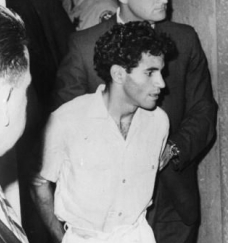
The aggrieved Palestinian was not marked by fate to suffer that last extremity of the law, however; instead, his sentence was commuted to life imprisonment when all existing death penalty statutes were invalidated in 1972.*

As a result, Sirhan Sirhan remains alive as of this writing, serving that sentence in the Golden State’s Pleasant Valley State Prison. He’ll be next up for parole in 2011.

(In a parole appeal back in 1982 — he’s been on a bit of a losing streak — the convicted assassin had the chutzpah to complain that “if Robert Kennedy were alive today, I believe he would not countenance singling me out for this kind of treatment.”)

Although the guy was seen in a crowded room pulling the trigger (onlookers tackled him) and he subsequently confessed to the deed, there has long been a conspiratorial counternarrative suggesting that other shooters were there, too. It’s pretty hard to say that the guy who emptied his chamber in front of dozens of witnesses wasn’t involved, but there are versions of this where he’s a Manchurian Candidate-style hypnotized patsy.

Politics: much more interesting in the 1960s.

Precisely because that is so, this particular man’s crime attracts retrospective interest for what followed: the charismatic Democratic frontrunner from Camelot cut down; the sinister Richard Nixon arising in his place to bomb Cambodia, burgle Watergate, and create the Environmental Protection Agency. Sirhan Sirhan “assassinated modern U.S. history.”

That really seems a bit much.

Sirhan Sirhan himself has contributed to the trippy theorizing about his case by being all over the map on it. At one point, he attempted to plead guilty and draw the death penalty; the trial judge forced him to go through with a defense. Subsequently, as noted, he’s whinged for an early release. He’s claimed to have had no memory of the attack, which certainly isn’t what he said after he got arrested.

Ultimately, the most self-evident explanation has always been the first one that he offered: “I did it for my country.”

Sirhan was a Jerusalem-born Palestinian dismayed by Israel’s success in the Six-Day War, and by America’s concomitant foreign policy tilt towards Israel.

Kennedy was a strong advocate of that policy, and his death happened to coincide with the anniversary of war.

Maybe that’s just what they want you to think. But it has to be allowed that the cause in question has claimed more lives than just RFK’s.

* People v. Anderson, decided by the California Supreme Court. Later that same year, the U.S. Supreme Court would issue Furman v. Georgia, which would have had the same effect for Sirhan Sirhan.

On this day..

1965: Perry Smith and Dick Hickock, In Cold Blood subjects

This date in 1965 saw the end of the road (and the end of the rope) for Dick Hickock and Perry Smith, the drifters who slaughtered the Clutter family in Holcomb, Kansas, and inspired Truman Capote’s magnum opus In Cold Blood.


Hickock (left) and Smith.

These ex-cons — Smith, the smart Korean War veteran; Hickock, the fallen high school jock turned small-time hood — got a tip from a fellow jailbird that Herbert Clutter’s farm had a well-stocked safe.

On November 15, 1959, they raided the farm, tied up and shotgunned the family of four, and made off with … 40 bucks. Alas: no safe.

The horrific, out-of-nowhere brutality of the crime — “apparently the work of a psychopathic killer” — made national headlines and drew Manhattanite Truman Capote out to small town Kansas (along with novelist Harper Lee, whom Capote used to gain the confidence of locals).

The killers were caught on the lam in Nevada, and as the case unfolded,* Capote’s sympathy for Smith unlocked a spellbinding book that put this day’s murderers in the literary canon.

I really admired Mr. Clutter, right up until the moment I slit his throat.”

– Perry Smith

(Perry Smith was first protrayed on celluloid by actor Robert Blake, who would one day stand trial himself for arranging the 2001 murder of his wife. Blake was acquitted.)

In Cold Blood has drawn criticism from the outset: for its accuracy, or for its problematic relationship between author and subject, or for its pride of place in the true crime genre. (Or the “nonfiction novel” genre Capote claimed it created.)

But as literary milestone, its place is secure.

In Cold Blood, in multiple media

* More detail about Smith and Hickock and Capote and the Clutters in this trutv article.

On this day..

1965: John Harris, white anti-apartheid martyr

On this date in 1965, John Harris hanged in Pretoria Central Prison for an anti-apartheid bombing: the first and only white person put to death for political crimes in apartheid South Africa.

An idealistic young teacher, Harris planted a bomb in a whites-only section of Johannesburg’s Park Station, intending to demonstrate that whites, too, opposed racial segregation. But the bomb threat he phoned in was not acted upon, and the symbolic device killed a 77-year-old woman and badly burned many others.

5.30 am was the time set for the execution. We were all awake, thinking of John. Not long afterwards the phone rang. Ad Hain answered. The voice said: “Your John is dead.” She recognised the voice as one of the Special Branch men’s.

-John Harris’s widow’s testimony to the post-apartheid Truth and Reconciliation Commission

His death (reportedly with “We Shall Overcome” on his lips) earned affecting tribute and flattering comparisons from his black countrymen.

Mr. Harris, a teacher and a member of the Liberal Party since 1960, is one of those few courageous White men in South Africa who believed passionately in racial equality, identified himself with the oppressed people and suffered persecution. His passport was seized in 1963. He was served with banning orders in February 1964 preventing him from continuing his work with the Liberal Party and the Non-racial Olympic Committee.

Like many others, he became convinced that there was no way left to influence the situation except by clandestine activity. When most of his colleagues in the underground organization, the African Resistance Movement, were jailed or fled the country, he tried to plan a spectacular demonstration. He placed a bomb in the Johannesburg station and telephoned the police so that the area would be cleared. The police did not act promptly and an elderly lady lost her life as a result of the explosion.

Under the prevailing circumstances in South Africa, the means of struggle are for the liberation movement to decide in the light of the conditions in the country.

The responsibility for the consequences lies very much on the rulers of Pretoria who, in defiance of the world and all sense of decency, created a situation which left no other alternative to decent people than to engage in violence.

In mourning the execution of Mr. Frederick John Harris, let me say that it will not be forgotten that in the struggle of the South African people this man, a member of the privileged group, gave his life because of his passionate belief in racial equality. This will serve to strengthen the faith of all those who fight against the danger of a “race war” and retain their faith that all human beings can live together in dignity irrespective of the colour of their skin.

I have recently received a message sent by him from his death cell in Pretoria Central Prison in January. He wrote:

“The support and warm sympathy of friends has been and is among my basic reinforcements. I daily appreciate the accuracy of the observation that when one really has to endure one relies ultimately on Reason and Courage. I’ve been fortunate in that the first has stood up — my ideals and beliefs have never faltered. As for the second, well, I’m not ashamed — I know I’ve shown at least a modicum of the second. ”

When I think of John Harris, the first White martyr in the cause of equality in South Africa, I am reminded powerfully of a great White American, a man who gave his life over a century ago — on December 2, 1859, to be exact — because of his passionate hatred of slavery: I mean John Brown.

People said then that John Brown was eccentric, that he was unwise in attacking the arsenal at Harper’s Ferry, Virginia, and that his act would only strengthen the slave lords.

History has made a very different judgement. Whether the particular act of John Brown was right or wrong, wise or unwise, his cause was right and invincible.

-1965 statement on this date’s hanging by Achkar Marof

Harris’s conviction was secured with the states-evidence turn of one of his compatriots in the white anti-apartheid African Resistance Movement. For this betrayal, John Lloyd earned his freedom and had already moved to England by the time Harris was executed.

Lloyd built a public service life of his own in the UK. However, his bid for parliament on the Labour ticket in the 1990s was scotched when public exposure of his past (as (a) a leftist terrorist; and (b) a betrayer of his fellow-leftists) brought him more baggage than one man can tote in a general election.

Harris’s rough treatment under arrest also continues to haunt his former interrogators in South Africa.

On this day..

1961: William Morgan, the Americano

On this date in 1961, American William Morgan — once an anti-Batista rebel — was shot in Havana’s La Cabana fortress for counter-revolutionary activity against the Castro government.

The high school dropout and army washout went to Cuba around late 1957 or early 1958.

He’d had an unsettled life, this Morgan. He’d been a convict, a circus sideshow, a wanderer. But he was about to make his name.

This strange gringo soon to be nicknamed “El Americano” walked into the Escambray Mountains and joined a group of anti-Batista rebels that was unaffiliated with Castro’s 26th of July Movement. Morgan won the respect of Cubans for his courage and his evidently un-mercenary commitment to the cause.

Fatally for him, that cause was a constitutional-democracy take on opposing the Batista dictatorship.

Morgan was stridently anti-Communist and not shy about saying so.

“There isn’t anyone in Cuba who doesn’t know where I stand-Fidel, Raul, or anyone. I am anticommunist. I don’t like them.”

That attitude would put him on a collision course with the only other foreigner to hold a comandante rank among the anti-Batista guerrillas: Argentinian Ernesto “Che” Guevara.

Those two men’s columns nearly exchanged shots when Guevara was dispatched by Castro to reach an understanding with Morgan. Morgan and Guevara came to terms that day — there was a revolution to be won, after all — but animosity would remain between these two impassioned freedom-fighters whose visions of freedom could never be reconciled.

They personify the competing choices before post-Batista Cuba, in those first years when Cuba kept to a tenuous hold on non-alignment.

Morgan supported that revolution; he even made the headlines for dramatically foiling a Dominican-backed plot to topple Castro in 1959.

But it was Guevara who was the future. More radical July 26th members won senior spots in the new administration, while outsiders like Morgan got assignments like frog-farming. Geopolitical events saw Cuba sliding into the Soviet camp.

Disenchanted, Morgan started plotting for real.* It didn’t work.

He was caught in late 1960, held incommunicado for a period, then tried, convicted and condemned two days before his execution (along with fellow-traveler and -plotter Jesus Carreras Zayas (Spanish link)) after nightfall March 11, 1961.

Morgan’s execution was carried out by a fellow Yanqui, Herman Marks — himself destined to run afoul of the Castro regime down the road. (Marks fled back to the U.S.) The sympathetic account of el Americano‘s death is quite the flowery affair, with the Cubans kneecapping Morgan when he defiantly refuses to kneel.

Castro himself is sometimes said to be present, the shadowy observer issuing the fatal commands to which Morgan will not bow, like the insouciant silhouette of Stalin behind a screen at trials where his former henchmen were purged.

A poetic touch, though one would think a head of state might have more pressing business than personally orchestrating executions: and indeed, it seems that Fidel actually spent that evening at a diplomatic reception with Soviet and Chinese ambassadors. Two months later, Castro officially declared Cuba a socialist state.

And as with Morgan, so with many of his brethren-in-arms from the Escambray Mountains. It took Havana the better part of the 1960s to suppress anti-communist “bandits” in Morgan’s old stomping-grounds — Cuba’s (successful) War Against the Bandits.

* There’s more skullduggery in Morgan’s shadowy life than this post has space for, but theories exist that the Dominican plot he “foiled” was actually one he had been an earnest participant in before it was sniffed out by Cuban security, with the war hero Morgan forced to betray it.

On this day..

1960: Oliviu Beldeanu, for the Berne incident

On this date in 1960, Romanian anti-communist Oliviu Beldeanu was executed at Jilava prison for a headline-grabbing protest he’d orchestrated in Switzerland five years before.

Beldeanu (here‘s his Romanian Wikipedia page) was the ringleader of a group of Romanian exiles who’d commandeered the Romanian embassy in Bern(e) in February 1955.

The aptly-named Berne Incident was meant to be a symbolic protest — Communist symbols smashed, damaging secret correspondence released, that sort of thing — but it did also result in an embassy driver being shot to death.

These “legionary fascist groups”* and “traitors abroad,” (pdf) (in the official lexicology of Bucharest) were handled fairly gently by Switzerland, predictably keen to stay clear of diplomatic incidents.

Beldeanu et al drew lenient prison sentences from which they were released early.

And that would have been the end of it … but a Communist cloak-and-dagger operation after the ex-cons were freed lured Beldeanu to Berlin. He was kidnapped by the East German Stasi and flown to Romania, there to be subject to a perfunctory trial and speedy execution.

* “Legionary fascist” denunciations — associating the Switzerland activists with Romania’s notorious Iron Guard — cited by Paul Nistor, “The five who scared … America, too. The immediate effects of the attempt in Bern (1955) over the Romanian diplomacy”, Valahian Journal of Historical Studies, Dec. 2009.

On this day..

1967: Ronald Ryan, the last hanged in Australia

At 8 a.m. in Melbourne this date in 1967, as a moment of silence was observed across Australia, Ronald Ryan was hanged in Pentridge Prison for killing a guard during a prison break. He would be the last man put to death Down Under.

Ryan, a small-time thief, broke out of that selfsame Pentridge Prison’s lower-security districts with fellow-prisoner Peter John Walker late in 1965, prompting a high-profile holiday season manhunt.

Still, with capital punishment fading in Australia — and especially in Victoria, where nobody had hanged since 1951 — even the jury that doomed Ryan thought its sentence was strictly pro forma. Eleven of them later joined nationwide petitions for clemency when Liberal Premier Henry Bolte made plain his intention to let the hanging go forward.

Though Bolte did in fact gain seats at the next polls, the anti-hanging campaign had a breadth hard to comprehend forty-plus years later.

A media witness recalled that he “came away from Pentridge Prison in 1967 firmly opposed to capital punishment,” and some form of that sentiment seemed to take throughout Australia. Its state and federal governments abolished their various death penalties over the ensuing generation.

Ryan’s hanging “ensured that no government anywhere in the country would politically risk imposing the death penalty again,” the criminal’s biographer said.

It also gave the man a lasting foothold in Aussie popular culture. Clips from a couple of subsequent films made about him can be seen online here and here.

Ryan’s attorney, Philip Opas, has continued to maintain his man’s innocence. (pdf)

On this day..

1960: The assassins of Hazza Majali

On this date in 1960 — just two days after they had been sentenced — Saleh Safadi, Mohammed Hindawi, Lt. Husham Dabbas, and Karim Shaqra were hanged in Amman’s Hussein Mosque Square for assassinating Jordan’s prime minister earlier that year.

The marquee casualty of Jordan’s standoff against Nasserite Egypt, Hazza Majali might have just been a footnote to the story. According to King Hussein of Jordan: A Political Life,

[i]t may be that the bomb plot which cost Hazza Majali his life was also aimed at the King himself. The first bomb, which killed the prime minister, was followed by a second explosion at the scene less than forty minutes later. Had the King followed through on his initial intention to visit the bomb site, he might well have been caught in the second blast.

Though the bombings didn’t get King Hussein, they claimed 11 other lives besides Majali’s.

The assassins’ conspiracy traced back to neighboring Syria, which at that time was (briefly) unified with Egypt as the United Arab Republic. Syria and Jordan have found plenty of reasons to bicker over the years, and the former’s alliance here with Nasser‘s pan-Arabism added a pointed ideological critique of Jordan’s throwback Hashemite dynasty.*

Syria and the UAR were busily subverting U.S.-backed Jordan, and in this venture they enjoyed dangerously considerable popular support within Jordan; Majali in particular was “regarded by some Jordanians — and particularly Palestine refugees — as a virtual tool of the Western powers.” (New York Times, Aug. 30, 1960)

So it was a dangerous situation, and King Hussein did well to escape those years un-blown-up himself.

Several weeks of brinksmanship followed Majali’s assassination, with Jordanian troops massed on the Syrian border. Matters stopped short of outright war, but Nasser, Syria, and the UAR were all explicitly accused of this operation and others at the resulting trial of the assassins in December: the plot was supposed to have originated in Damascus, been paid for in Damascus, and used bombs shipped from Damascus.

Eleven in all were condemned to death, but seven of those sentences were given in absentia to suspects who had absconded to Nasser’s dominions.

* In response to the Egypt-Syria union, the kindred Hashemite rulers of Jordan and Iraq had formed the Arab Federation of Iraq and Jordan. That arrangement was even shorter-lived than the UAR, because the Iraqi Hashemites were almost immediately overthrown. You can get Jordan’s official take on those perilous years here.

On this day..

1961: Adnan Menderes

On this date in 1961, the Turkish Prime Minister deposed in the previous year’s military coup was hanged at the island of Imrali.

Condemned at the same trial as his comrades in government,* Adnan Menderes delayed his execution with an unsuccessful suicide bid. Revived from a sleeping pill-induced coma, the gag about Istanbul was that he would soon be fit enough to hang.

Twenty-four hours and one involuntary stomach-pumping later, and he was.

The 62-year-old Smyrna/Izmir native had had a memorable run. He served in Ataturk’s army, then toppled Ataturk’s political party: Menderes won the first three free elections in Turkey in 1950, 1954, and 1957, a feat never since replicated. He was notorious for his temper and sensitivity to criticism, reportedly given to smashing things in his office and demonstrably given to firing ministers and aides for even trifling differences of opinion. Just months before his ouster, he’d survived a plane crash in England — “the former Premier,” observed the New York Times,** “might have gone down in Turkish history as a great patriot and champion of the people” if he had died in it.

His ignominious end didn’t blacken his name to posterity. Years later, he (and the officials who preceded him to the gallows) was posthumously pardoned and reburied in an Istanbul mausoleum. Today, he’s so far from public opprobrium that his name can be found on public accommodations like airports and ferries

There’s more information about Menderes available online in Turkish, including this biography and this film:

* Among the co-defendants also condemned but reprieved was Mahmut Celal Bayar, President of the Republic of Turkey. Bayar died in 1986 at age 103, supposedly the longest-lived head of state or head of government in all of history.

** September 17, 1961.

Part of the Daily Double: Turkey’s “Left-Wing Coup”.

On this day..

1961: Fatin Rustu Zorlu and Hasan Polatkan

On this date in 1961, two former Turkish ministers of state were hanged together on the island of Imrali.*

A ten-month trial on the island of Yassiada had ended just the previous day, condemning 15 to death; 12 sentences were commuted, leaving only the biggest fish to fry.

Zorlu, the former Foreign Minister, and Polatkan, late the Finance Minister, were both implicated in the financial crimes often characteristic of high office. Zorlu was also condemned for helping instigate a notorious 1955 anti-Greek riot. The two were helicoptered to Imrali for a pre-dawn hanging.

Zorlu, at least, was reported to have died game. He helped slip the noose over his own neck, and at his hanging “asked that he be allowed to kick away the chair himself. Permission was granted.” (Los Angeles Times, September 18, 1961)

* Tangentially, the prison on Imrali is the one American drug-smuggler Billy Hayes subsequently escaped from. Hayes went on to write Midnight Express, later adapted for the silver screen by Oliver Stone.

Part of the Daily Double: Turkey’s “Left-Wing Coup”.

On this day..

Daily Double: Turkey’s “left-wing coup”

With this post, we unveil a new metadata category, the Daily Double — related executions on actual consecutive dates in the same year. (We’re also retroactively defining an old Themed Set post into this category.)

The Turkish Republic, so violently born, has endured a tumultuous past half-century or so. In keeping with the Cold War Zeitgeist, it also enjoyed its share of coups.

The first such struck in May of 1960, toppling the elected (but by then deeply unpopular with young military officers) government of Adnan Menderes. Menderes had been Prime Minister for a decade, but he and two of his ministers would check out with the distinction of being the last politicians executed in Turkey.

On this day..