On this date in 2010, a former Communist Party of China (CPC) anti-corruption official was shot … for corruption.
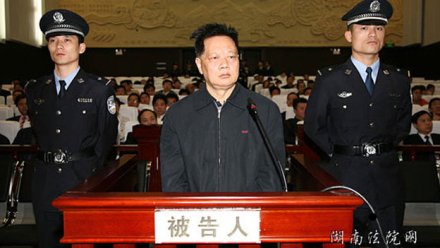
Zeng, former secretary of the Chenzhou Municipal Commission for Discipline Inspection of the CPC and vice secretary of the CPC Chenzhou Municipal Committee, gorged on 31 million yuan ($4.7 million) in bribes from 1997 to 2006, doling out lucrative mining contracts and sinecures in exchange.
Although known in the Hunan coal-mining city as “a modern-day Heshen” — Chenzhou residents whose businesses had been widely subject to Zeng’s crude protection-racket shakedowns set off fireworks to celebrate his arrest — Zeng was all but impossible to dislodge.
Zeng bribed up to higher officials for protection as effectively as he squeezed those below. It’s just another piece of the graft so endemic in China that it’s frankly represented in popular literature. (And has often appeared on the execution grounds, too.)
“Officials, especially high-ranking ones, are basically not held accountable for paying bribes,” a journalist who wrote a book about Zeng told NPR. “This is because China’s judiciary is not independent enough.” Zeng wasn’t even charged with this crime — just extortion.
Zeng’s well-placed protectors defeated at least three investigations. He was only overcome by an order from the very top: President and Party Chairman Hu Jintao, who scribbled onto a secret report of Zeng’s antics,
“To Comrade Wu Guanzheng: Put more effort into investigating corruption in Chenzhou. Signed, Hu Jintao, July 19, 2006.”
Three months later, Zeng was under arrest.
The effects of power, corruption, privilege, and cutthroat economies did not go with him. After all, on the same date Zeng was put to death, officials elsewhere in Hunan province also announced the execution of one Chen Haitao for torching an airport shuttle bus. The blaze killed two and seriously injured three others.
Chen committed the arson to revenge society as he had “blamed his business failure on social injustice,” the court said in a statement.
On this date in 1724, Willem Mons was beheaded in St. Petersburg for peculation.
Mons was the brother of the German commoner Anna Mons, a beautiful young woman who segued from being the May-December lover of Peter the Great‘s trusted admiral Franz Lefort to the mistress of the teenage emperor himself. Peter and Anna had a famous (famously scandalous) romance through her twenties, but as she entered her thirties and heard the clock ticking, her bid to make Peter put a ring on it by flirting with a Prussian diplomat came to grief and got her briefly tossed in prison.
Willem Mons was still a minor when his big sister fell from Peter’s graces. He would prove to have an equally adroit instinct for imperial bedchamber politics.
“One of the best-made and most handsome men that I have ever seen,” in the French ambassador’s estimation, Mons hustled his way into the train of the woman Peter had married instead of Anna — Catherine.
There Willem Mons and his other sister Matryona Balk monopolized the access routes to the empress and lucratively tolled all petitioners who traveled them. Wealth and status accumulated; the immigrant bourgeois’s son even stopped going by William in favor of the more impressive “Moens de la Croix”.
Not surprisingly, the emperor himself was the last to discover the open secret of his wife’s household’s river of graft.* Peter, who could be quite the moralist, was incensed; he interrogated the chamberlain so terribly that the young man fainted dead away.
“Moens de la Croix” was no longer. In both senses.
Having issued the confessions to condemn himself under the very credible threat of torture, Mons was socked away in Peter and Paul Fortress. Catherine made bold to defy Peter’s edict that nobody petition him for Mons’s life; in response, the enraged tsar smashed a Venetian mirror with his bare hand and roared, “thus I can annihilate the most beautiful adornment of my palace!” Court observers reported that marital relations between the two were visibly strained well after the scandal.
These weren’t happy days for the oft-sickly Peter; indeed, they were the last months of his life. Early the next year, he would succumb to a gangrenous bladder and leave the throne to this very Catherine. Perhaps his decrepit state accounts for the likely scurrilous rumor that the handsome chamberlain’s real offense wasn’t so much corruption as cuckoldry. It’s fair to say that such an affair would have been an extraordinarily reckless thing for Catherine.
On November 16, 1724, William Mons and Matrena Balk were taken in sledges to the execution site. Mons behaved courageously, nodding and bowing to friends he saw in the crowd. Mounting the scaffold, he calmly took off his heavy fur coat, listened to the reading of the sentence of death and laid his head on the block. After his death, his sister received eleven blows of the knout, very lightly administered so that not much harm was done, and was exiled for life to Tobolsk in Siberia. Her husband, General Balk, was given permission to marry again if he wished. (Source)
The late courtier’s severed head was preserved in alcohol (legend says that the fuming Peter made Catherine contemplate it). It was eventually deposited in the Kunstkamera museum, famous for housing Peter’s gross horde of collected pickled fetuses, dwarves, and other medical curios. Mons’s head still resides there today.
“Let the sceptical read the ‘Country Justice’ to see what subtle threads were strong enough for a witch-halter!” (Source)
On this date in 1652, Joan Peterson was hanged at Tyburn for witchcraft.
Joan is a long time in the ground, and her dying refusal to be cowed by the officious prelate ordained to badger her into self-incrimination would alone stand her in very worthy stead in these pages. Even the hangman got annoyed when Joan, at the gallows,
was by the Ordinary nine on ten times earnestly pressed to confesse something against the said Mrs. Levingstone: Whereupon the Executioner told the Ordinary, he might be ashamed to trouble a dying woman so much, to which he replyed, he was commanded so to doe, and durst doe no otherwise. And afterwards the said Ordinary still insisting in his discourse, and very often pressing the said Peterson to confesse and discharge her conscience before God and the world; she answered that she had already confessed before the Bench, all she had to confesse; that she had made her peace with God; and therefore desired to dye in quiet, for now she was to appeare before God who presently would Judge her, and that God was witnes, that she dyed Innocently, and was in no wise guilty of what was laid to her charge.
Go, Joan.
This account comes to us from one of the surviving pamphlets (pdf) about her case, a document that, were it produced today, would probably draw a severe sanction under Britain’s nasty libel laws for its scandalous indictment of Joan’s persecutors.
It lays out an unscrupulous conspiracy of local grandees scrabbling after inheritance money, in which the “Witch of Wapping” swung for being the only honest broker in the room. Sure, we can’t prove it. But the rival, anti-Joan pamphlet (also at that same pdf link) has a lot of rot about our woman damningly chattering with a diabolical familiar in the cunning guise of a squirrel.
According to the pro-Joan pamphleteer, the trouble started when an elderly woman named Lady Powell died, leaving her wealth to a particular relative — the “Mrs. [Anne] Levingstone” mentioned in the excerpt above — and stiffing several others.
These others contrived a scheme to charge Anne Livingston with witchery in order to separate her from her windfall and get their own hands on it. Though witch-hunting never really reached the epidemic dimensions in England that it often achieved on the continent — the English ban on torture helped prevent self-sustaining cycles of forced denunciations — it did have its moments, and the characters in question may have been encouraged by the recent exploits of notorious witch-diviner Matthew Hopkins in preposterous judicial homicide.
But they weren’t targeting Joan Peterson at all. They just wanted to use her to get at Livingston.
When Peterson, a local healer with a knack for fixing migraines, refused a bribe to accuse Livingston of sorcering, the plotters made it an offer she couldn’t refuse (and protected themselves from exposure) by accusing Joan herself.
Our pamphlet presents a riveting and revolting story of the conspirators essentially being one with the local judicial officials — in fact, when it comes to trial, they’re literally Joan Peterson’s judges — but even as they groped her for witches’ teats and the like, they endeavored “to perswade the said Peterson to confess [since] she needed not fear what she confessed, for it was not her life they aimed at, but to have matter whereby to accuse one Mrs. Levingston, who had gotten the said Lady Powels estate, and thereby had undone 36 Persons of the said Ladyes Kindred.”
Playboy parliamentarian (and, recently, regicide) John Danvers* made a rare appearance in the neighborhood to help orchestrate events. Danvers was a sound man to have for an expedient financial racket; he was famous for acquiring his fortune by marrying an older widow. She’d since died, and he’d since squandered it.
Even with the fix in, however, Joan’s ability to produce physician testimony and a written post-mortem ascribing Lady Powell’s death to natural causes — the doctors were impressed she’d managed to make it to age 80 what with the “the Dropsie, the Scurvey, and the yellow Jaundies” — ran that whole case aground.
Considering the incriminating threats and blandishments Joan had heard, however, they just got her on a second, simultaneous indictment — for bewitching one Christopher Wilson, on the grounds that he’d gone to her for a cure, gotten a little better, and then relapsed. If you think modern libel law is harsh, you should see Protectorate malpractice law.
Wilson, one should add, did not make this complaint himself: others were induced to level the charge on his behalf, while the court itself barred most defense testimony with threats to imprison the witnesses as probable witches themselves. (Nevertheless, some did appear for Joan.) Somehow, this was enough for conviction.
Even after her condemnation,
the said confederates and their agents went very often to her promising her a Repreive or Pardon if she would confesse that Mrs. Levingstone had Imployed her to make away the life of the Lady Powell, to which she replyed she could not, because it was altogether false. But one of the said confederates urging her againe to say something against Mrs. Levingstone, she told him he was a rogue, and gave him a blow on the face, which made his nose bleed: Where it is to be noted, that what for love of money they could not tempt her to, they resolved at last for love of her life to force her to, by necessitating her either unjustly to confesse a notorious falsehood against the said Mrs. Levingstone or else to dye without mercy or Repreive, which otherwise was proffered her by the said Confederates, to make her unjust in doing the same.
On this date in 1915, New York City cop and New York City mafioso Charles Becker was electrocuted at Sing Sing for engineering a hit on bookie Herman Rosenthal.
This case of police corruption and gangland gunplay owned the Big Apple’s headlines in the early nineteen-teens — it even gets a callout in The Great Gatsby. Whether it was rightly decided has been hotly contested ever since.
Sing Sing had already prepared for Becker’s death.
Invitations had been despatched in the middle of July to those chosen to witness the execution. There were three dozen in total, and they went to doctors and to a sanitary engineer, to representatives of the press, and to the operators of several wire services. One, scarcely surprisingly, was sent to Swope of the World, but the reporter — to his undoubted chagrin — was recuperating from a bout of rheumatic fever and his doctor had forbidden him to attend. Swope despatched another World reporter in his stead; the man arrived at Ossining bearing a large sheaf of handwritten instructions setting out in considerable detail exactly how the story should be covered. Preparations were also made to cater for the needs of the large body of newsmen expected to descend on Sing Sing without the benefit of invitations. Linemen spent several days installing additional telegraph wires and Morse code senders in a shack opposite the death–house.
Inside the condemned cells, white curtains were fitted across the bars of all the cells that Becker would have to pass on his way to the execution chamber, so that the other inmates would not be able to see him as he walked by. In the execution chamber, guards tested each piece of equipment. The lieutenant’s electrocution was scheduled to be the first at which a new system of signals would be used, as the New York Times reported:
Instead of the old method, by which the executioner signalled with his arm to the man in charge at the power plant, there is a little electric button behind the chair, and above it is tacked a placard bearing the following gruesomely suggestive instructions: “Five bells, get ready; one bell, turn on the current; two bells, turn on more current; three bells, turn on less current; one bell, shut off current; six bells, all through.”
New York’s newspapers remained predominantly hostile to the condemned man. The Times spoke for most of the Manhattan press when it observed that Becker’s death sentence was a punishment not just for Herman’ s death, but for the arrogance Rosenthal’s killer had displayed during his strong–arm days: ‘He paid for the times when “Big Tim” called him “Charlie”. He paid for his one–time power, that almost of a dictator, over the underworld of New York. And he paid for his pride in all this.’ Several dailies had issued their reporters with instructions to study Becker carefully for signs of weakness or incipient collapse; in the end, opinion seemed evenly divided between those who thought that the policeman continued to display an ‘iron nerve in the face of doom’ and those who discerned the onset of a nervous breakdown.
The lawyers were more generous. [Williiam] Bourke Cockran paid tribute to his client’s astounding self–control: ‘His hand is just as cool and his voice as steady as can be.’ John McIntyre said that he had never previously doubted the verdict of a jury in a murder trial. ‘But in this case I say that if Becker is executed tomorrow I will carry to my grave the conviction that at least one innocent man has suffered the death penalty.’ And Joseph Shay, another of the lieutenant’s old attorneys, released a statement of his own: ‘I believe that Becker is dying a martyr, and that his innocence will be established in time, perhaps by the deathbed confession of Vallon or Webber. Rose is too low to confess even on his deathbed.’
Becker himself was woken early on his last morning. At 8am his prison clothes were exchanged for special black cotton shirt and trousers, made without metal buttons or wire stitching; he was given black felt slippers instead of shoes. A guard shaved a spot on his temple, ready for the electrode. Another appeared carrying a pair of shears and neatly slit Becker’s trouser leg almost to the knee. When the time came this would allow the death–house guards to affix a second wire to the condemned man’s calf.
The next portion of the day was passed in writing: a love letter for his wife, a final statement for the press. At two in the afternoon the policeman saw his relatives for the last time. His brothers John, the detective, and Jackson, now a Wall Street broker, found him sitting in his cell, gazing at a small photograph of Helen that he kept on the wall. The meeting was so difficult that the two men were relieved when one of the other prisoners along death row broke the awkward silence by singing ‘Rock of Ages’. Becker joined in with the chorus.
Helen Becker reached Sing Sing, pale and breathless from her journey, soon after 11pm. Her husband had been waiting for her with increasing anxiety for most of the evening. Becker was so popular in the death–house that he had received special permission to spend more than an hour and a half with his wife in the warden’s room. The guards, who had been given strict instructions to keep their eyes on the prisoner at all times, turned their backs as the couple embraced for the final time. ‘No condemned man at the prison had ever had such sympathetic treatment,’ observed the World.
Helen left the prison at 1.30 in the morning, and Becker was returned to his cell. ‘I am tired of the world and its injustice to me,’ he told Father Curry, the New York priest. ‘My happy life has been ruined; I have not been given a chance a mere dog would get.’ Warden Osborne, coming to say good-bye at 2.30am, found his prisoner awake and sitting on the edge of his cot, ‘his chin sunk in his hands’. At four, Father Cashin heard Becker’ s last confession, which contained no admission of guilt and ended with the firm assertion: ‘I am sacrificed for my friends.’
The execution was set for 5.45am. Outside the walls, a double line of guards poked long sticks through the fence that marked the limit of the prison grounds to keep back the crowds assembling there. Inside, the executioner – a small, sharp-faced, balding electrician dressed in a baggy grey sack suit, a striped shirt, polka–dot tie and pointed patent leather shoes – checked his equipment for the final time.
Becker was the one hundred and sixteenth prisoner to die at Sing Sing since electrocution was first used to execute a man in August 1890. The victim on that occasion had been an axe-murderer named William Kemmler, who was accidentally subjected to ‘a far more powerful current than was necessary’ and died ‘in convulsive agony’, flames jetting from the base of his spine and purplish foam spewing from his lips. The technique for electrocuting a man had been refined somewhat since then, but it was still common for the death-house to fill with the odour of burning flesh and scorched hair as the moistened electrical conductors placed against the condemned man’s skin dried out. A lengthy electric shock could ‘turn blood into charcoal and boil a brain’. When a prisoner was ready to enter the chamber, he was issued with thick muslin underwear, and little wads of cotton would be forced into his ears and nostrils to prevent scalding brain fluids spurting forth uncontrollably when the current was applied.
Thomas Mott Osborne, who had vowed never to be present when a man in his charge was being executed, walked away from the death–house at 5am, leaving Deputy Warden Johnson to bring the policeman from his cell. Becker, who was still awake when Johnson came for him, went quietly to his death. A dozen steps took him from his cot to the door leading to the execution chamber. At 5.42 the witnesses clustering inside saw a narrow red door swing open, and the condemned man entered the room. He walked with a strange, hobbled gait, his knees locking involuntarily. His face was a mask. The chair, surprisingly insubstantial, stood on a thick rubber mat almost in the centre of the room. There was no glass and no partition to separate Becker from the witnesses who had come to watch him die, the nearest of whom sat only 10 feet away. The electric chair itself, the man from the American observed, ‘had had a double coat of varnish and its metal fixtures had been burnished for the occasion.’ Straps dangled loosely from its arms and legs, and a heavily–insulated wire hung from a goose-necked fixture above it. The policeman’s guards, anxious to spare the condemned man the agony of a lengthy wait, hurried so much with the buckles that they neglected to secure one of the restraints that stretched over his chest. Becker’s last words, uttered as another leather strap was fastened across his mouth, were a recitation of the Catholic litany: ‘Into Thy hands, O Lord, I commend my spirit.’
Five bells rang, then one. The executioner took his hands out of his pockets and threw a long wooden lever on the wall. The raucous drone of electricity filled the room, a green flash shot from the equipment and Becker’s muscular body lurched forward against the straps, his head twisting sideways and upwards as though attempting to escape the shock.
Charley Becker was the largest man ever brought into the execution chamber at Sing Sing, and it may be for this reason that his electrocution was horribly botched. Too little current was applied at first, so that the death agonies became protracted. The temperature within the dying man’ s body rose to 140 F, the loose strap across his chest burst open, flames were seen to spurt from his temple, and despite the administration of 1,850 volts for a full 60 seconds, Charles Farr, the death–house doctor, found Becker’s heart ‘not only still beating, but pounding strongly.’ In the end it took nine minutes and three separate jolts to kill the prisoner, though the representative of the World observed that ‘to those who sat in the grey-walled room and listened to the rasping sound of the wooden switch lever being thrown backward and forward, and watched the greenish-blue blaze at the victim’s head and feet and the grayish smoke curling away from the scorched flesh, it seemed an hour.’ The whole affair was described in later years as ‘the clumsiest execution in the history of Sing Sing.’
As the reporters gathered to witness the execution filed out of the chamber, they were handed copies of Becker’s final letters. The first was addressed to Governor Whitman:
You have proved yourself able to destroy my life. But mark well, Sir, these words of mine. When your power passes, the truth about Rosenthal’s murder will become known. Not all the judges in this State, nor in this country, can destroy permanently the character of an innocent man.
The second letter was a final testament. Becker had spent much of the night memorising it, in the hope of being allowed to deliver it himself, but the guards had not permitted this.
‘I stand before you,’ this statement began,
in my full senses knowing that no power on earth can save me from the grave that is to receive me, and in the presence of my God and your God I proclaim my absolute innocence of the crime for which I must die. You are now about to witness my destruction by the State … And on the brink of my grave, I declare to the world that I am proud to have been the husband of the purest, noblest woman that ever lived, Helen Becker. This acknowledgement is the only legacy I can leave her. I bid you all goodbye. Father, I am ready to go.
CHARLES BECKER
When most of the reporters had left, Becker’s corpse was removed to the autopsy room for the usual examination, arms dangling, head hanging back, legs swinging. Dr Farr stripped the black cotton shirt from the lieutenant’s hulking body, and was startled to discover that it concealed the little photo of Helen that Becker had kept on the wall of his cell. The dead man had pinned it to his undershirt, with the face turned inward, over his heart.
It was on this date that notoriously corrupt Chinese minister of state Heshen or Ho-Shen was forced to commit suicide in lieu of execution.
The able child of a Manchu military officer, Heshen came of age in the long reign of the emperor Qianlong.
That Heshen rose above his modest station with this monarch’s favor was the source of no small resentment. Rumors circulated that the attractive young former bodyguard reminded the emperor of a lost, beloved concubine — with all that implies.
“Elegant in looks, sprucely handsome in a dandified way that suggested a lack of virtue,” a Korean diplomat described Heshen.
Whatever there might have been to the homosexuality angle, Heshen exploited the imperial protection to gorge himself on the state’s revenues; he’s reported to have filled the bureaucracy with clients who saw to it that Heshen got a yuan out of every tael that passed through state business in the last quarter of the 18th century. He even dynastically married his own son to one of Qianlong’s daughters.
It was the peak of the Qing dynasty’s glory, and the dawn of its imperial stagnation. Heshen — resplendent, omnipotent, and sunk in vice* — remains to this day its persona par excellence.
As long as the emperor lived, Heshen had a virtual free hand.
But as soon as the emperor died — on February 7, 1799, at the age of 87 — the successor** Jiaqing destroyed him.
Citing Heshen’s inability to suppress the nettlesome White Lotus and Miao rebellions, Jiaqing arrested and tortured the former retainer into copping to all manner of offenses both mortal and venial.
My thoughts dwell ever on the Confucian precept: ‘For three years after a parent’s death none of his former surroundings should be changed.’ …
But as regards Ho Shen, his crimes are too grave to admit of possible pardon … Ho Shen is a deep-dyed traitor, lost to all moral sense, who has betrayed his Sovereign and jeopardised the State. As self-constituted dictator he has usurped supreme authority.
Seeing the man’s abrupt change of fortunes, Heshen’s people in the bureaucracy fell over each other to denounce him.
He was condemned to the horrific expiation of “slow slicing”; however, given “the undesirability of executing the chief Minister of State like a common felon in the public square,” Jiaqing “allowed him the privilege of committing suicide, as a mark of high favour and out of regard to the dignity of the nation.”
A principal accomplice was made to witness Heshen ceremonially hanging himself; then the accomplice was reprieved of his own death sentence and sent into exile.
The new sovereign found his nation’s dignity sufficiently upheld by the doomed man’s melancholy inventory of loot destined (of course) for the re-appropriation of the Qing … and sufficiently outraged that, upon discovering weeks after the some artifact Heshen had failed to enumerate,
Had these facts come to Our knowledge before the 18th day of the 1st Moon [i.e., February 22], we should assuredly have decreed Ho Shen’s decapitation, even if We had spared him the lingering death and dismemberment.
However, he has already been permitted to commit suicide, and thus luckily escaped the extreme penalty of public execution. We do not, therefore, insist on his corpse being hacked to pieces.
Jiaqing had better to worry about his own now-declining state, which was about to be hacked to pieces by encroaching European powers.
Having made an example of Heshen and a handful of his most visible allies, he was still saddled with the endemic structural corruption Heshen had fostered in the institutions of Qing governance.
“Historians have tended to see Jiaqing’s failure of nerve in purging the bureaucracy of all tainted officials as something of an original sin whose commission predetermined the dynasty’s steady decline,” writes William T. Rowe of this turning point. “But given the need for at least some continuity in routine administration, it is not at all clear that he could have acted otherwise.”
And so Jiaqing struggled in vain to maintain China’s fading prestige; his reign would witness economic erosion and a burgeoning opium trade that eventually led it to war with the British and humiliating western domination.
Since a sclerotic bureaucracy at once crushing in its expanse, helpless in its effect, and riven with self-dealers, is a timeless theme (especially in China), Heshen persists as a lively emblem of corruption.
Heshen’s luxurious mansion — which was also among Jiaqing’s indictments — still stands; today, it’s a museum.
* It bears remembering that it is principally by the testimony of Heshen’s enemies that we know him.
** Technically, Jiaqing had been ruling since Qianlong symbolically “abdicated” in 1796; in reality, Qianlong continued to run the realm until his death.
On this date in 2004, the former deputy governor of China’s Anhui province was executed for official corruption.
It was just weeks after Wang’s conviction for grifting some 100 million yuan in real estate transactions dating back to the mid 1990’s.
We suppose Wang did his appeals no favors by steadfastly denying guilt — although he might have reckoned that the national “determination … to fightcorruption” thwarted any such plan.
Instead of confessing to his crimes, Wang had stood against the public prosecutors and even continued to seek bribes during the investigation from some private business owners, said Wang Huanhai, head of the investigation team.
According to the prosecutor, Wang attempted to use the bribe to buy over more relations, hoping the Central Commission for Discipline Inspection of the Chinese Communist Party would spare him from being inquisited.
During the first trial on Dec. 29, 2003, Wang denied all the allegations, but in the latest trial confessed to most of the crimes and argued for a light penalty on the grounds that the bribes he had taken were not big enough to justify a death penalty.
His request was turned down, given the amount involved in the case as well as his resistance to investigation.
Wang’s prosecutors said he was an orphan and had climbed up the social ladder with an inferiority complex. “That’s why he was dictatorial and could not stand anyone questioning him,” said Wang Huanhai, “Nor did he ever confess to his wrongdoing in public.”
On this day in 2009, Chinese citizens Zhang Yujun and Geng Jinping were shot to death in connection with China’s tainted milk scandal.
The affair caused some 300,000 infants to became sick, six of them fatally. They were killed by powdered milk tainted with melamine, an industrial chemical used in plastics and fertilizer. Zhang, a dairy farmer from the province of Hebei, sold hundreds of tons of tainted milk powder in 2007 and 2008; he was the largest supplier. Geng supplied toxic milk to dairy companies.
The scandal was stupendous and made headlines all over the world. According to Time magazine, the tainted milk found its way to Taiwan, Singapore and Japan. China’s $232 million dairy export industry cratered as the European Union and a dozen nations in Asia and Africa banned Chinese milk and milk products. The farmers who depended on milk sales for their livelihood were reduced to simply pouring their surplus stock down the drain, and since nobody wanted to buy dairy cows under these conditions, some farmers just slaughtered their animals.
Top: Chinese farmers destroy tainted milk. Bottom: Zhang Yujun (left) and a supplicating Geng Jinping (right).
Nor was milk wasn’t the only export product with this problem; Wikipedia’s timeline of the scandal states melamine was subsequently discovered in Chinese eggs, egg powder, baking ammonia, chicken, crackers and animal food.
Melamine was added to the milk to fool government protein tests, which would show whether the milk had been diluted or not. (Watered-down milk had been a problem in the past; in 2004 thirteen Chinese babies died of malnutrition after being fed milk that was so watery it had almost zero nutritional value.) Melamine, like protein, is high in nitrogen, so the presence of melamine in food would cause the protein content to appear higher than it really was.
It isn’t clear whether the people who altered the milk knew — or cared — that it was poisonous. Very poisonous. Melamine is never supposed to be used in food; it causes kidney stones and in some cases complete renal failure, especially in young children. A child can take over six months to recover from exposure.
Some blame must be attached to the (suspect) Chinese food safety administration, which in May 2008 reported that over 99% of baby milk powders had been deemed safe. (In fact, one major dairy company had begun hearing complaints about its baby milk as far back as the previous December.) The Ministry of Health was informed about the sick infants in July. There are strong suspicions that the government tried to suppress the reports to avoid embarrassment; the Olympics were in Beijing that summer and the world’s eye was on China. The scandal was only made public in September, after the Games.
Twenty-one people involved in the scandal were brought to trial on various charges in December 2008, and convicted in January.
Tian Wenhua, the general manager of the Chinese dairy giant Sanlu, pleaded guilty to producing substandard goods and was sentenced to life in prison. She admitted she’d known the milk was bad for four months before she reported this fact to the authorities. Sanlu tried to keep complaining parents quiet by giving them free milk, which was also tainted. Tien was widely perceived as being the person most responsible for the scandal, and many were disappointed that she didn’t get the death sentence.
Other defendants received various prison terms. One of them was given a suspended death sentence, but only Zhang (guilty of endangering public safety) and Geng (guilty of producing and selling toxic food) were actually executed.
The previous village chief, Cao Xinbao, had profiteered gleefully from his run at the top with sweetheart deals on rapidly appreciating real estate for himself and his connections.
Cao Haixin, a reformist farmer, beat Cao Xinbao at the polls in 1995 and set about making unwelcome inquiries into the whereabouts of millions of yuan … at which point a goon squad of the ancien regime led by Cao Xinbao’s own brother actually invaded Cao Haixin’s home looking to intimidate or murder him. No subtlety needed.
Instead, the mayor grabbed a hunting rifle and killed his predecessor’s brother in the affray.
Astonishingly, Cao Haixin was the man arrested for this incident, and sentenced to death in a provincial court seemingly stacked with Cao Xinbao allies. A Zhengzhou municipal judge reportedly told one of the condemned man’s many supporters that local village officials had on a full-court press for execution as the case worked its way through the system.
Eventually — after a few cycles of appeals to the Supreme Court, which in turn fruitlessly referred inquiries back to those very village officials who wanted him dead — Cao Haixin was executed in secret. The next day’s news announcement reported nine executions, but listed only eight names.
The problem, analysts say, is that the national and provincial governments are dependent on local strongmen such as Cao Xinbao to implement the state’s basic rural policies concerning land, grain and taxes. Local cadres’ control of these policies affords them ample opportunities to line their own pockets.
These strongmen often wear the multiple hats of local clan leader, village chief and party boss. They often have a corrosive influence on China’s fledgling village election system, leaving peasants with little recourse to justice.
…
Today, the faith of many of the villagers–faith in the law, in China’s future and in themselves–lies shattered.
Cao Haixin’s widow and 14-year-old daughter struggle to survive. Many of the villagers, lawyers and journalists who fought for more than two years to stop Cao’s execution remain depressed and cowed.
“I feel powerless and frustrated,” said one of Cao’s lawyers. “I ask myself, did I help to deceive the masses by even participating in this sham trial?”
Ten years ago today, former Chinese politburo member Cheng Kejie was executed for gobbling up an impressive $5 million in bribes.
The onetime chairman of the Guangxi Zhuang Autonomous Region was (and, as best I can determine, remains) the highest-ranking official judicially executed since the Communists took power in China in 1949. He’d spent the best part of the 1990s soaking up kickbacks from his powerful post, much of it secreted in out-of-country accounts.
The execution was part of a massive campaign against official corruption which has long bedeviled China’s economic surge. Cheng’s own former boss around this time warned that “graft could destroy China”.
Cheng’s execution was announced after the fact, at the same time that China belatedly publicized the arrest of former Vice-Minister of Public Security Li Jizhou in a billion-dollar smuggling scandal. Li somehow managed to duck execution for similarly show-stopping corruption allegations (including scandalous details supplied by his mistress*), a fact which raised eyebrows in the People’s Republic about improper influence.** He “deserves to die ten thousand times over,” opined the Beijing Youth Daily.
Here in 2010, China (whose wholesale execution pace is quietly on the decline) has moved — not without opposition — to drop the death penalty for a number of non-violent economic crimes. That rollback apparently would not apply to bribery, however.
On this date* in 1527, Jacques de Beaune was hanged on the gallows of Montfaucon for peculation.
Beaune (French Wikipedia entry) was an aged man well into his 70s or 80s, and had served four kings’ treasuries, rising to become Superintendent of Finance for Francis I.
His slow-motion ruin began with France’s military involvement in Italy earlier that decade, in which capacity the French commander near Milan suffered a grievious reverse and had to abandon Lombardy.
Furious buck-passing ensued:
The commander blamed the defeat on a lack of pay for his Swiss mercenaries;
The paymaster — Beaune — blamed the lack of funds for the mercs on the Queen Mother, Louise of Savoy‘s calling in a debt
The ensuing investigation revealed this story to be true, but Beaune was obliged to retire from the court because of the Queen Mother’s fury at him.
And that might have been that, but for the further French misadventures in Italy.
In 1525, Francis himself contrived to be captured at the Battle of Pavia, elevating Louise of Savoy to regent in his absence. By the time the spendthrift king had been ransomed back, his treasury was nigh empty and Louise knew just the person to blame.
An audit of Semblancay’s accounts intended to turn up some loose ducats embarrassingly showed that the noble was actually a creditor of the king, but
on 13 January 1527, after Semblancay had returned to Paris on business, he was arrested and thrown in the Bastille … the king and his council … had been looking for ways of raising within five days 370,000 livres needed for the payment of troops. Semblancay was known to be a very rich man and the prospect of confiscating his property must have been tempting. (Source)
Semblancay was tried by a handpicked favorite of the court, with the predictable result on a somewhat nebulous embezzlement/corruption thing; a jailhouse snitch once in the great lord’s employ gave evidence against him. The doomed man, perhaps untroubled to be relieved of the infirmities of his advanced age, was supposed to have been downright chill walking through Paris to his death, and he was met with respect by a citizenry that could hardly help sympathizing with this wizened but serene victim of the royal wrath.
Lorsque Maillart, juge d’Enfer, menoit
À Monfaulcon Samblançay l’ame rendre,
À votre advis, lequel des deux tenoit
Meilleur maintien ? Pour le vous faire entendre,
Maillard sembloit homme qui mort va prendre
Et Samblançay fut si ferme vieillart
Que l’on cuydoit, pour vray, qu’il menast pendre
À Montfaulcon le lieutenant Maillart.
When Maillart, judge of Hell,
To Montfaucon led Samblançay to give up his soul,
Which of the two, in your mind,
Had the better demeanour? To enlighten you,
Maillart seemed the man whome death would take
And so sturdy an old man was Samblançay,
That one truly believed that it was he who led
Lieutenant Maillart to be hanged at Montaucon.
This case is less well-remembered today than it ought to be; to contemporaries, the hanging of France’s treasurer for corruption was an awfully noteworthy event.† (Opinions at the time seemed to be split on the justice of the matter, even though Semblancay was posthumously rehabilitated; later generations have more strongly gravitated to the understanding that he was railroaded.)
And it launched an ensuing, decade-long project of Francis’s, to squeeze wealthy financiers through the commission de la Tour Carree and thereby get in the good graces of the early modern bond markets unsettled by France’s 1520s fiscal faceplant.
We noticed in a great Press from twenty to twenty-five huge Gallows-birds round a great Table [bourreau, punning bureau] covered with green Cloth, staring at each other, with their Hands as long as Crane’s Legs and their Nails two Feet long at least, — for they are forbidden ever to pare them, so that they become as crooked as Bills or Boat-hooks — and just at that time was brought in a great Bunch of Grapes which they gather in that Country, from the Vine called Extraordinaire, the Grapes from which often hang on Poles. As soon as the Bunch was laid there, they put it under the Press, and there was not a Berry from which they did not squeeze Oil of Gold, insomuch that the poor Bunch was carried off so drained and stripped, that there was not a Drop of Juice or Liquor left.
Most of those Tour Carree prosecutions didn’t result in executions — “merely” confiscations of lands and titles which could be re-sold, and sentences which could be commuted for a fine. R.J. Knecht, in The Rise and Fall of Renaissance France, 1483-1610, puts the king’s profit on such confiscations into the millions of livres.
But to make those shakedowns seem a small price to pay, the threat of Semblancay’s example must have lurked in the background for targeted nobles.
(Semblancay himself had been reckless enough not to accept an initial mostly-exoneration in the inquiry that preceded his arrest and trial, since part of it required him to “repay” supposed debts to Louise of Savoy. His appeal against that part of the judgment might have set him up to be the cautionary example for everyone else.)
The Beaune name would scintillate to posterity through such illustrious descendants as Renaud de Beaune (French link), a notable archbishop; and, more salaciously, Escadron Volant all-star Charlotte de Beaune Semblançay, who seduced powerful nobles at Catherine de’ Medici’s behest.
A lengthy French history of our day’s early modern moneybags can be perused here; when visiting Tours, you can revisit the days when he was in the chips by crashing at one of the many buildings he put, the Hotel de Beaune-Semblancay.
** There’s another (translated to English) meditation Marot wrote on Semblancay here, in the first-person voice of the hanged man. Marot was a friend of the eventually-executed French linguist and translator Etienne Dolet, and his own unorthodox opinions would eventually require him to flee the realm for his life.
We do note that in this era of combative pamphleteering, the geezer who made himself a tycoon by administering the taxes wasn’t universally supported by the literary set. Roger de Collerye (cited here) hooted Jacques de Beaune into the hereafter with the verses,
Tremblez, tremblez, larrons gros & petiz!
Retirez vous, gens trop fins et subtilz!
Absentez vous bientost & prenez terre,
Gens de finances et tresoriers gentilz
Qui d’attrapper estes tant ententifz.
Sur vous surviegne tempeste & tonerre!
Craignez la court qui vous donna la guerre
Bien asprement, quant je l’ay pance,
Souvieigne vous de la mort Sant Blancey!
† It happened yet again in September 1535, to Jean Poncher. Historically, proximity to the French crown’s revenues was also proximity to the gallows.


 This case of police corruption and gangland gunplay owned the Big Apple’s headlines in the early nineteen-teens — it even gets a callout in The Great Gatsby. Whether it was rightly decided has been hotly contested ever since.
 The able child of a
  It was just weeks after Wang’s conviction for


 The onetime chairman of the
