1775: Maharajah Nandakumar, judicially murdered?

On this date in 1775, inconvenient Indian official Nandakumar (or Nand Kumar, or Nuncomar) was hanged on a forgery charge — all too conveniently inflicted at the very time he was accusing British Governor-General Warren Hastings of corruption.

Nandakumar and Hastings decidedly did not get along; the Indian believed he had been unfairly denied a plum career assignment.

He leveled in response an accusation that Hastings was taking payola in exchange for his appointments.

English pols involved in the administration of India, such as Philip Francis, John Clavering and George Monson, had their own rivalries with Hastings and wanted to pursue these charges. Instead, within weeks, Nandakumar was facing years-old forgery charges,* and two months after his trial, he was at the end of a rope.

Hastings’ actual involvement in this circumstance is impossible to prove, but

Warren Hastings: not a man to be trifled with. (Portrait by Tilly Kettle.)

The certain facts are that Nand Kumar was Hastings’s enemy, that [India’s Chief Justice Elijah] Impey was Hastings’s friend; that at a moment of grave crisis in Hastings’s life, when Nand Kumar was the most eminent witness against his name and fame, that witness was arraigned on a charge that was very old, that had been suddenly converted from a civil to a criminal charge; that he was tried, found guilty, and executed. On the basis of that bare narrative of facts it would seem that if Hastings had nothing to do with the matter, he might almost as well have had as far as the judgment of posterity went. The thing was too apt, the conditions too peculiar not to leave their stigma upon the memory of the man who gained most by them.

This sort of questionable administration of the crown’s possessions on the subcontinent would lead in 1781 to the Amending Act, an attempt to place India on an organizational footing more conducive to the confidence of an increasingly dubious public.

Parliamentarian heavyweight Edmund Burke would eventually weigh in on the hanged man’s side, charging that Hastings had “murdered this man, by the hands of Sir Elijah Impey.” In a report to the select committee established by the Amending Act (cited in this tome), Burke noted

that this Trial and Execution was looked upon by many of the Natives as political; nor does the Committee conceive it possible, that, combining all the Circumstances together, they should look upon it in the Light of a common judicial Proceeding; but must regard it as a political Measure, the Tendency of which is, to make the Natives feel the extreme Hazard of accusing, or even giving Evidence of corrupt Practices against any British Subject in Station, even though supported by other British Subjects of equal Rank and Authority. It will be rather a Mockery, than a Relief to the Natives, to see Channels of Justice opened to them, at their great Charge, both in the Institution and in the Use, and then Appeals, still more expensive, carefully provided for them, when, at the same Time, Practices are countenanced, which render the Resort to those Remedies far more dangerous than a patient Endurance of Oppression, under which they may labour.

Hastings was impeached for corruption in 1787 — it took Burke, who served as one of the prosecutors, two full days to read the 20-count indictment against him, though Burke’s own attempt to add judicial murder to the bill of particulars was jettisoned — along with the now ex-Chief Justice Impey.

Both were acquitted, even though investigations had laid bare a sort of endemic, routine bakhsheesh: “the native offers because he thinks he is bound to do so, and the Englishman accepts because he fears to hurt the giver’s feelings.” Hastings acknowledged availing himself of donatives, generally arguing that it was the done thing, benefited the East India Company for which he worked, and everything stayed well this side of egregious.

The (lurid) conduct of this impeachment proceeding, and its effect for consolidating British imperial control away from the irregular hands of the British East India Company while generating a national mythology of missionary civilization, is the subject of a fascinating book, The Scandal of Empire: India and the Creation of Imperial Britain.

Another record of the trial is available free from Google books; J. Duncan M. Derrett considers the facts of the forgery case (it “was not a judicial murder”) in the collision of Hindu and English law in “Nandakumar’s Forgery” in The English Historical Review of April 1960.

* He forged part of a will to recover a bad loan. All concerned appear to agree that this charge is factually accurate, which is, of course, a long way from explaining why the matter required immediate adjudication at this juncture.

Incidentally, while forgery could get you hanged in England, it was a much less serious offense under Hindu law.

Part of the Themed Set: The Empire Strikes Back.

On this day..

1976: Valery Sablin, Hunt for Red October inspiration

On this date in 1976, the real-life Soviet political officer whose naval mutiny inspired Tom Clancy’s Cold War thriller The Hunt for Red October was shot in Moscow for treason.

No, unlike his fictional counterpart Marko Ramius (Sean Connery, in the 1990 cinema adaptation excerpted above), Valery Sablin didn’t make it to the West.

But the real Valery Sablin wasn’t trying to make it.

Sablin was the political officer aboard the submarine-killer Storozhevoy. He was also a dedicated Leninist incensed at the notoriously corrupt gerontocracy of the Leonid Brezhnev era.

When he led his mutiny in Riga, his plan was to take the Storozhevoy to St. Petersburg and, Aurora-like, sound the tocsin for a Soviet Tea Party to restore the ideals of the Revolution.

Basically, Sablin had the exact opposite intent of his literary offspring.

This being the 1970s, when figuring out what the devil was happening in the black box of the USSR constituted its own academic discipline, the incident was misinterpreted in the western media — but understandably so.


View Larger Map

The sea route from Riga to St. Petersburg begins in a westerly direction, towards Sweden, and the spectacle of Soviet fighters turning back a vessel steaming for Gotland (combined, of course, with the natural susceptibility of the western audience to the notion) suggested that the mutineers had aimed not at revolution, but at defection.

Under the headline “Newspaper Reports Soviet Ship Mutiny” sourced to Agence France-Presse and datelined Stockholm, Jan. 22, the Jan. 23, 1976 Washington Post reported:

Crewmen on board a Soviet coast guard vessel in the Baltic mutinied and tried to sail the ship into Swedish territorial waters in November, the evening newspaper Expressen said today.

Citing foreign visitors recently returned from Riga, the paper said the mutiny took place Nov. 7 after celebrations in Riga marking the Soviet revolution.

The paper said a Soviet submarine and a number of helicopters forced the ship to return to Riga.

This was the version of the story that aspiring spy novelist Tom Clancy encountered. In his reworking, it became the bold (and successful) defection of a state-of-the-art Soviet submarine and its deft commander … effected, of course, with a little help from the derring-do of the spooks at Langley.

Moscow was pleased to let this be the version that people heard, to the extent they heard anything at all of the incident. Though not exactly flattering, it was much less threatening than the potential storyline of “Soviet officers are so fed up with party corruption that they’re trying to revolt”.

Not until 1990 did the real story get out.

It’s pretty safe to say that the Valery Sablin who died this day would not have had a lot of sympathy for Marko Ramius,* and still less for the Reaganite writer who turned Sablin’s deed inside-out and made it the cornerstone of his own personal mint.

Trust the fact that history will judge events honestly and you will never have to be embarrassed for what your father did. On no account ever be one of those people who criticise but do not follow through their actions. Such people are hypocrites — weak, worthless people who do not have the power to reconcile their beliefs with their actions. I wish you courage, my dear. Be strong in the belief that life is wonderful. Be positive and believe that the Revolution will always win.

-Sablin’s last letter to his son

Russian speakers may enjoy this documentary about the Sablin mutiny.

* Another inversion: in order to make his break for the Free World, the fictional (and, significantly, ethnically Lithuanian) Ramius murders the ethnically Russian political officer, Ivan Putin, assigned to his ship; the real Sablin was himself that zealous political officer, and imprisoned the ship’s captain in the course of the mutiny.

On this day..

1704: John Quelch, pirate

On this date in 1704, John Quelch was hanged on a Boston wharf for piracy.

Quelch had re-appeared in New England less than a year after hastily absconding with a new privateering vessel while the owners tried to sort out the captain’s sickness.

(The captain suspected his crew were up to no good, but the mutineers locked him in his cabin and set sail before the investors could act on the information. The ill captain died at sea and was pitched overboard — in what order, no one can say.)

The privateer Charles had been tricked out and licensed to raid French shipping off Newfoundland, but the avaricious mutineers saw much better buccaneering prospects preying on the gold-laden Portuguese possessions in South America.

One small problem: Portugal had formed an alliance with England.

So when the Charles re-appeared, heavy with the sort of mineral wealth not to be found in North America, authorities could not fail to notice that its crew

Have lately Imported a considerable Quantity of Gold dust, and some Bar and coin’d Gold, which they are Violently Suspected to have gotten & obtained by Felony and Piracy, from some of Her Majesties Friends and Allies …*

This all looks very neat on the legal docket (and it certainly did to the jury-less Admiralty court, the first time this instrument had been used outside of England), except that pirates and piracy were far more integrated into the fabric of the colonial frontiers than their desperado reputation might suggest. Pirates shifted in and out of their outlaw careers; even the strictly law-abiding colonists traded knowingly with these freebooters. Certainly some momentary mutual convenience between London and Lisbon for reasons of continental politics was very far from most colonists’ scope of care.

John Quelch seems to be among those operating in the grey economy, and in this case bringing “gold and silver to specie-starved colonial economies.”**

Hunger for hard currency in an environment of wartime depreciation of various sketchy paper notes helps explain why Quelch’s trial raised hackles in New England. Here were men who had by dint of enterprise and adventure plucked nearly 1,000 pounds of gold from faraway Brazil and hauled it back home to New England, honestly paid out the shares to the crew and gone to settle up with the privateering syndicate’s financiers.

And the high-handed English governor Joseph Dudley responded by clapping them in irons and trying them for their lives, using a dubiously legal and heretofore unprecedent drumhead military tribunal at which Dudley himself presided while his son† prosecuted.

It’s a nice setup for winning convictions, which is exactly what happened.

In the process, Dudley blew through a good portion of the pirates’ confiscated booty, making it rain for “Stephen North, who kept the Star Tavern in which the trial was held, for entertainment of the Commissioners during the sitting of the Court of Admiralty” and that sort of thing. If a later denunciation circulated by Cotton Mather is to be believed, the Dudleys did not scruple to wet their own beaks, either.

There have been odd Collusions with the Pyrates of Quelch’s Company, of which one instance is, That there was extorted the sum of about Thirty Pounds from some of the crew for liberty to walk at certain times in the prison yard. And this liberty having been allowed for two or three days unto them, they, were again confined to their former wretched circumstances.

(The rest of the cash went neither to the privateer’s investors nor back to the aggrieved Portuguese, but was shipped to English mints under the capable administration of Isaac Newton.)

Little wonder at the unrepentant Quelch’s parting shot on this date.

Sarcastically interrupting one of his five fellow-sufferers’ bog-standard scaffold injunction against running with a bad crowd, Quelch urged the throng of onlookers to better “take care how they brought Money into New-England, to be Hanged for it!”

Their bodies remained gibbeted in the harbor.

In Quelch’s Gold: Piracy, Greed, and Betrayal in Colonial New England, Clifford Beal argues that Quelch’s trial marked the onset of an official crackdown on pirates that would drive these formerly semi-legitimate operators further underground and therefore into greater violence. He even suggests, at a bit more of a stretch, that Quelch’s case presaged the colonial resistance to the mother country’s political and economic dictates that would later blossom into the American Revolution.

As for the gold, much of it was not recovered in 1704. Legends to the effect that it remains stashed on New Hampshire’s Star Island continue to attract treasure hunters.

* From the proclamation of Quelch and his crew‘s arrest, quoted in Pirates of the New England Coast, 1630-1730.

** Villains of All Nations: Atlantic Pirates in the Golden Age, by Marcus Rediker.

† That son, Paul Dudley, later endowed a still-extant lecture series at Harvard University — the oldest endowed lectureship, even though (or rather because) the donor’s intention that it be directed “for the purpose of detecting and convicting and exposing the Idolatry of the Romish church” was eventually neglected.

On this day..

1979: Ignatius Kutu Acheampong, former dictator of Ghana

On this date in 1979, former Ghanaian military strongman Ignatius Kutu Acheampong was shot in the aftermath of Jerry Rawlings’ successful coup d’etat.

Acheampong had executed a coup of his own in 1972 and run the unsteady West African state for most of the 1970s — a period of economic and political crisis — until he himself was toppled by another General, Fred Akuffo.

Acheampong was retired to his home village by the new regime, but he would not enjoy such satisfactory treatment when a national revolution ended Akuffo’s reign and brought junior officer Jerry Rawlings to power.

Less than two weeks after Rawlings was installed as Ghana’s new head of state, Acheampong was executed on a charge of corruption. This would not sate the considerable popular anger at the outgoing military clique, which went on to gorge itself on Akuffo and five others later that same month.

Former NFL defensive back Charlie Peprah is Acheampong’s grandson.

On this day..

1952: Liu Qingshan and Zhang Zishan, the first corruption executions in Red China

China has been clamping down on official malfeasance lately, but corruption trials have a long and storied vintage in the realm.

The very oldest casket in the cellar has stamped upon it this date in 1952, when Maoist China carried out its first corruption executions.


The public trial of Liu Qingshan and Zhang Zishan. (Source.)

“Faithful and unyielding” during wartime, Liu Qingshan and Zhang Zishan exploited their resulting positions of authority to plunder economic development money.

Theirs was the signal case in an anti-corruption “campaign against three evils” that ended late in 1952, with the announcement that 196,000 party members and cadres had been convicted of something. (Cited here.)

One then-youthful man remembered that

in the winter of 1951, Mao launched a national campaign against what he called the three evils — corruption, waste, and bureaucracy. Taking advantage of the winter holidays, students were sent to various places as members of so called Tiger Hunting Teams. With six other students I was sent to the Art Supply Service then attached to our school. It was housed two miles from the campus. I worked there under the office of the Campaign Against the Three Evils. The entire staff and all the workers were organized to study Party policies attached to this campaign. The staff was then called upon to make a clean breast of their crimes and accuse others they knew to be criminals as well. These crimes included embezzling, forgery, theft, bribery and other white collar crimes. Some suspects were already being locked up in isolated rooms within the offices. Most of those locked up were directors on various levels. Some were even old Party members from the early Yanan days. We had no mercy on those we saw to be “criminals.”

I learned from the newspaper that corruption and waste had become very serious problems indeed. It also revealed how Party cadres had degenerated from revolutionary heroes into grafters. The best example we were told of was two senior cadres, the secretaries of the Tianjin Prefectural Party Committee, Liu Qing-san and Zhang Zi-shan, who were even sentenced to death for their crimes. The Party wanted to show that its own members were not exempt from justice. In showing this, they concurred with the old Chinese belief that it was best to execute one as a warning to a hundred.

Took the words right out of Mao’s mouth.

Only if we execute the two of them, can we prevent 20, 200, 2,000 or 20,000 corrupt officials from committing various crimes.

… although of course, that was a primitive age; one could hardly expect that sort of startling yield on investment in today’s on-the-go China. “[T]he effect would not be so great. To show our determination, we would have to execute several more than two.”

On this day..

1539: Richard Whiting, the last Abbot of Glastonbury

Letter to Thomas Cromwell from his man in Somerset,* Richard Pollard, a local gentry type making out well under the Dissolution of the Monasteries:

Pleaseth it your lordship to be advertised, that … the same 15th day [of November] the late abbot of Glastonbury went from Wells to Glastonbury, and there was drawn through the town upon a hurdle to the hill called the Torre, where he was put to execution; at which time he asked God mercy and the king for his great offences towards his highness, and also desired my servants then being there present to see the execution done, that they would be meane [communicate] to my lord president and to me that we should desire the king’s highness of his merciful goodness and in the way of charity to forgive him his great offences by him committed and done against his grace, and thereupon took his death very patiently, and his head and body bestowed in like manner as I certified your lordship in my last letter. And likewise the other two monks [John Thorne and Roger James, executed with Richard Whiting] desired like forgiveness, and took their death very patiently, whose souls God pardon.

And whereas I at my last being with your lordship at London moved your lordship for my brother Paulett, desiring your lordship to be a mean that he might have the surveyorship of Glastonbury, which I doubt not but he will use and exercise the said office to the king’s most profit and advantage, and your lordship’s goodness herein to him to be shown he shall recompense to his little power, I assure your lordship he hath been very diligent, and divers others by his means, to serve the king at this time, according to his duty and right…

the late abbot of Glastonbury, afore his execution, was examined upon divers articles and interrogatories to him ministered by me, but he could accuse no man but himself of any offence against the king’s highness, nor he would confess no more gold nor silver nor any other thing more than he did before your lordship in the Tower …

From Wells, the 16th day of November.

Your assured to command,

Rychard Pollard

Once one of the greatest religious houses in England (and the legendary burial place of King Arthur), Glastonbury Abbey today is a picturesque ruin. Cornell University has published some 19th century photos of the abbey’s remains in a less manicured, more gorgeously overgrown situation.

Pollard had just a few weeks before exonerated the monastery of any profligacy, and the abbot seems perhaps not to have even been properly charged or attainted … but as one can discern in Pollard’s cloying appeal to keep the surveying position in the family, the practical henchman had no qualms as events unfolded about taking a commercial position on the end of the Abbot of Glastonbury.

For your public domain perusing pleasure: The last abbot of Glastonbury: and other essays, by Cardinal Francis Aidan Gasquet.

* Pollard had been in the thick of the destruction of Henry Courtenay, Marquess of Exeter just the year before.

On this day..

2006: Yuan Baojing, gangster capitalist

On this date in 2006, one of Beijing’s wealthiest plutocrats (along with two of his relatives) caught a lethal injection for the shady side of his business.

Yuan Baojing, “stock market whizzkid”, had risen from the nameless masses of China’s countryside to prosper in “Red” China’s authoritarian capitalism.

Though worth billions (or at least hundreds of millions), Yuan went down over the trivial sum of $9 million — the amount he reckoned a business associate had taken by fraud.

But then, it’s always impolite to count the corpses stuffed into the pillars of capital. The surprise here is that Yuan got caught: he’d hired a dirty cop to kill that business partner, but after the plot failed the cop started blackmailing the tycoon. Yuan responded by hiring his brother and cousin to pop the cop.

Yuan survived a scheduled execution the preceding October by transferring billions in assets to the Chinese government — understandably triggering some complaints about fair play.

Those billions bought him five months.*

On this date, he and his hirelings were given a public trial in Liaoyang, followed by an immediate lethal injection in one of China’s mobile execution vans.

* The mogul’s wife, Tibetan dancer Zhou Ma, was herself swindled during this period as she spread around cash trying to save her husband’s life.

On this day..

2003: Nobody in Illinois

Six years ago today, a scandal-plagued governor of Illinois cleared out the state’s death row.

Republican George Ryan, in a speech two days before the end of his term, announced a mass commutation for anyone under sentence of death in Illinois — 157 people plus 10 others with pending legal challenges to vacated sentences, and four condemned men pardoned outright.

[flv:https://www.executedtoday.com/video/George_Ryan_clemency_announcement.flv 300 225]

Once a pro-death penalty legislator, Ryan grew increasingly discomfited with the state’s administration of the error-prone ultimate sanction.

That “demon of error” was dramatically unveiled for Ryan by Anthony Porter, a mentally retarded death row inmate who fortuitously avoided execution by two days on a legal technicality, and was subsequently exonerated by Northwestern University journalism students.

Seen as part of a pattern of wrongful convictions — like that of Rolando Cruz, who was cleared in the early 90’s despite the dogged efforts of then-Attorney General (and present-day quasi-Senator) Roland Burris to execute him in the face of exculpatory DNA evidence.

The governor imposed a moratorium on conducting executions for most of his term, culminating with this day’s controversial (though it did score him a Nobel Peace Prize nomination) announcement. Maybe there’s just something in the water at the Springfield governor’s mansion that attracts its residents to impolitic death penalty interventions.

Successor Rod Blagojevich called Ryan’s blanket clemency “a big mistake”, and his formal continuation of the Ryan moratorium on actual executions has been a dead letter since inheriting a vacant death row meant that no capital case reached the end of its appeals on his watch.

For the favor of sparing Blagojevich the burden of handling a death warrant — although one doesn’t get the sense that Blago is the type for a troubled conscience — George Ryan has been unkindly repaid.

Now residing in federal prison on corruption charges, the ex-governor’s own clemency petition has been complicated by sensational allegations of Blagojevich’s graft.

That petition is addressed to an outgoing executive oppositely inclined on the death row commutation question. Ryan authorized one actual execution early in his term, and spared this day’s host; George W. Bush, his virtual mirror image, has issued one commutation and carried out 155 executions during his time as chief executive of Texas and of the United States.

George Ryan is reportedly skeptical of his prospects for receiving a pardon.

On this day..

2003: Liu Yong, for corruption

On this date in 2003, Liu Yong’s situation took a very abrupt turn for the worse.

The wealthy Communist Party member and Shenyang city legislator had been sentenced to death 20 months before in a corruption case for ordering the murder of a tobacco vendor as part of a mafioso racket of graft, extortion, black marketeering, and kindred mayhem.
When that sentence was reduced on retrial on a showing that Liu’s confession was extracted by torture, public outcry at the appearance of a well-connected insider getting off scot-free led the Supreme Court to take the unprecedented step of yet again re-trying a criminal case itself.

“According to China’s legal system, a criminal case can usually be tried only twice,” as China Daily lightly put it.

Amnesty International is less measured, and alleges that the irregular Supreme Court hearing was ordered by political insiders to buttress the credibility of the country’s anti-corruption drive — and to avoid setting any precedent that evidence of torture should mitigate criminal sentencing. (China certainly found defenders for the trial (the link is to an ugly layout of raw HTML).)

The high court handed down its sentence this very day, after which Liu was immediately hailed to one of China’s mobile execution vans, given a lethal injection, and cremated.

On this day..

2007: Zheng Xiaoyu, former Director of the State Food and Drug Administration

One year ago today, China made to clean up its image — with public health advocates, if not with human rights advocates — by executing* its former Food and Drugs minister for economic crimes.

Zheng Xiaoyu, China’s drug regulation capo from 1994 to 2005 and only (“only”?) the fourth minister-level official to be put to death in China since the immediate aftermath of Mao Zedong’s reign, was sentenced for extracting bribes from pharmaceutical companies he nominally regulated in exchange for approving their worthless and/or unsafe products.

One bogus antibiotic he rubber-stamped killed ten in China before it was pulled from the market, but it was dangerous Chinese products exported abroad — including lethal pet food ingredients to the United States and a cough syrup that killed dozens in Panama — that lit a fire under the export-driven colossus. The court that rejected his appeal explicitly referenced Zheng’s danger to China’s international reputation — simultaneously shifting focus from structural weaknesses by individualizing them to Zheng’s personal failings.

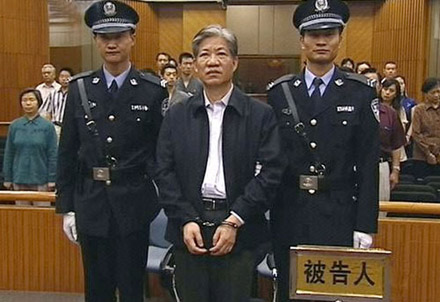
Zheng Xiaoyu hears his death sentence.

On this same day it announced Zheng’s death, China anxiously unveiled plans to safeguard the food supply for its upcoming turn under the Olympic klieg lights. That acid test is now upon it: opening ceremonies are mere weeks away as of this writing.

It may have been a politically-driven execution and an unusually heavy sentence, but Zheng’s passing was exulted in China. Someone even tried to put his name on a rat poison — rejected for that most distinguished reason of modern capitalism, Zheng’s own intellectual property in his name.

For an interesting dive into the social and legal currents surrounding this case, check out this .pdf edition of Criminal Bar Quarterly.

* The method of execution was not announced, and to my knowledge has not been conclusively documented. Gunshot was the longtime standby for Chinese executions, but China has shifted heavily towards lethal injection in recent years; it’s generally assumed that Zheng suffered the latter fate.

On this day..