2007: A factory manager in a packed stadium

Last year on this day, six people were reportedly trampled to death when a massive crowd stampeded after watching the execution of a 75-year-old factory manager in North Korea.

The man, who is not named in English-language sources I’ve perused, had fabricated his father’s past as a good Communist when in fact dad worked to suppress the reds. That con kept the family among North Korea’s privileged elite for years.

According to the South Korean nonprofit Good Friends, he faced a snap tribunal and immediate execution in Suncheon this day, in a stadium with 150,000-plus* onlookers, part of a campaign of stepped-up public executions that Good Friends says (.doc) has been driven by the insular country’s decade-long famine. (See another one — illicitly filmed graphic video included — here.)

And he wasn’t the only one to depart the premises in a body bag. The stampede is said to have occurred after the proceedings as spectators were leaving; the cause, if there was one, is sketchily described, although some news reports call it a “melee.” Thirty-four others were reportedly injuried in the crush.

* The figure 170,000 is also cited.

On this day..

1621: Not Katharina Kepler, thanks to her son Johannes

On October 4, 1621, the Duke of Württemberg declared Katharina Kepler free of a witchcraft charge for which she had barely avoided execution … with the help of her son, the astronomer Johannes Kepler.

The famous scientist was very well along his career, and his mother (German Wikipedia link) a too-old-for-this-crap 69, when authorities in her native town of Leonberg initiated proceedings in 1615.

It says here she was an eccentric, cantankerous old dame, just the sort liable to face a gossip campaign that would promote her into partnership with the Evil One. She was only one of a number of people targeted in the town’s witch-spasm, noticeably occurring as the Catholic-Protestant conflict was stoking that crucible of modernity, the Thirty Years’ War — a fine time and place for infernal superstition.

Several of the suspected were put to death.*

Kepler, whose heterodoxy and heliocentrism made him a touchy figure in a fraught time for scientists, might have done her no favors with his trippy Dream, whose overt musings on “daemons” and the like might have drawn suspicion onto the family. Johannes made six years of atonement struggling — ultimately successfully — to keep his mother alive and untortured.

Commuting back and forth from his work in Linz (showing an admirable capacity for keeping his head while others about him were in danger of losing theirs, Kepler discovered his third law of planetary motion in 1618; apparently he also read Galileo’s father on one of the trips between Linz and Leonberg), he organized his mother’s defense and wrote her briefs in his own hand.

It finally paid off.

The judicial college at the University of Tübingen — Kepler had matriculated there as a younger man — opened the door to Katharina’s release by declaring the evidence insufficient either way, and issuing a split-the-baby conviction directing that she be shown but not subjected to the instruments of torture.

On September 28, 1620, the Feast of St. Wenceslas, the executioner showed Katharina Kepler the instruments of torture, the pricking needles, the rack, the branding irons. Her son Johannes Kepler was nearby, fuming, praying for it to be over. He was forty-nine and, with Galileo Galilei, one of the greatest astronomers of the age — the emperor’s mathematician, the genius who had calculated the true orbits of the planets and revealed the laws of optics to the world. Dukes listened to him. Barons asked his advice. And yet when the town gossips of Leonberg set their will against him, determined to take the life of his mother on trumped-up charges of witchcraft, he could not stop them.

There were tidal forces at work in this little town. The events around the duchy of Württemberg would gather into themselves all the violent changes of the day, for by their conviction of Katharina, the consistory (the duke’s council), the magistrates, and the Lutheran church authorities had bundled together their fear of Copernicus and their anger against Johannes, a man they had already convicted of heresy. The Reformation, like an earthquake, had cracked Western Christianity, stable since the fifth century, into Catholics and Protestants, and the Protestants into Lutherans, Zwinglians, Calvinists, Anglicans, and Anabaptists, with the many camps drifting apart like tectonic plates. Even the heavens had begun changing, and Kepler had been a part of that change. … Fear ruled Europe — fear of difference, fear of change.

And there, in one corner of Swabia in southern Germany, the mother of a famous man, a mathematician and scientist, a respected, pious Lutheran, nearly paid with her life.

Early that morning, she was led to the torturer by Aulber, the bailiff of Güglingen, who was accompanied by a scribe for recording her confession, and three court representatives. The torturer, with the bailiff standing to one side, then shouted at her for a long time, commanding her to repent and tell the truth and threatening her if she didn’t. He showed her each instrument and described in detail all that it would do to her body — the prickers, the long needles for picking at the flesh; the hot irons for branding; the pincers for pulling and tearing at the body; the rack; the garrote; and the gallows for hanging, drawing, and quartering. He adjured her to repent, to confess her crimes, so that even if she would not survive in this world, she could at least go to God with a clear conscience.

Stubborn Katharina was having none of it.

Do with me what you want. Even if you were to pull one vein after another out of my body, I would have nothing to admit. (Source)

Having survived the “torture,” she was in the clear; at her son’s relentless insistence, the Duke ordered her released six days later.

Katharina Kepler died naturally the following April. There’s a school named for her (German link) in nearby Güglingen, Germany, where ma Kepler spent 14 months in prison. (German again)

* This German timeline of Leonberg says the witchsmeller got nine out of 10 targets. Other versions have slightly different head counts for the persecution; at any rate, Katharina wasn’t alone.

On this day..

1795: Tula, Curacao’s Nat Turner

On this date in 1795, the slave whose rebellion had shaken the Dutch Caribbean colony of Curaçao was publicly tortured to death with his chief confederates.

The Landhuis Knip commands the plantation where Tula’s revolt began — the dark history behind the Dutch Antilles’ charming facade.

On August 17, 1795 Tula (English Wikipedia page | Dutch) launched a well-planned insurrection on the island, one of the major transit points in the Atlantic slave trade.

Inspired by the Haitian Revolution — and reasoning that, since France occupied the Netherlands, that whole Declaration of the Rights of Man thing ought to be trickling down to Dutch colonies — the rebels freed slaves plantation to plantation and quickly swelled near 1,000.

Of course, Jean-Jacques Rousseau aside, the slaves were also irate that they were damn slaves.

Although the outside forces of international geopolitics played a role in inspiring the 1795 revolt, slaves could find sufficient justification for insurrection in the domestic policies that Dutch planters employed to keep their slaves laboring in Curacao. The planters maintained a harsh regime in which many privileges that had traditionally been bestowed upon slaves had been removed in order to heighten productivity and increase plantation profitability. By 1795, most slaves were being forced to work on Sundays, which had generally been a day of rest in the past, and many planters hired their slaves out to maximize profits by exploiting their labor. It had also become customary for all of the slaves on a plantation to be punished in response to the offense that an individual slave among them had committed. (Source)

A priest was sent as envoy from the worried white community to the rebel encampment, with an offer of amnesty for submission.

Tula (sometimes surnamed as Tula Rigaud) and fellow leaders Bastiaan Karpata (or Carpata), Pedro Wakao (or Wacao) and Louis Mercier received him politely, hosted him overnight, and told him to get lost. This is Tula:

Father, do not all the persons spring from Adam and Eve? Was I wrong in liberating twenty-two of my brothers who were unjustly imprisoned? Father, French liberty was a disaster for us. Each time one of us is punished, we are told: “Are you also looking for your freedom?” One day I was arrested, and I begged mercy for a poor slave; when I was liberated, my mouth was bleeding. I fell on my knees and I cried to God: “O Divine Majesty, O Most Pure Spirit, is it Your will that we are ill-treated? Father, they take better care of an animal.”

And subhuman was the torture Tula, Karpata and Wakao* bore for their insistence on freedom when a fellow slave finally — inevitably? — betrayed them.

At a spot now commemorated by a beachfront monument, the three had their bones systematically shattered with an iron rod, their heads lopped off, and their bodies tossed into the sea. (Despite the metadata on this post, it wasn’t precisely “breaking on the wheel” — but the bone-shattering was pretty much the same idea.)

Curacao remains today a Dutch possession; slavery was abolished there in 1863. August 17, the dawn of these Dutch slaves’ inspiring and fatal revolt for freedom, is now honored on the island — and off it.

* It’s unclear to me whether Mercier, who was captured earlier, was also executed with the others, or whether Mercier’s sentence had already been carried out by this time.

On this day..

1780: Major John Andre, Benedict Arnold’s handler

On this date in 1780, the honorable British Major John Andre got what Benedict Arnold had coming to him.

Piqued that his (quite considerable) brilliance in the field did not earn honors he thought his due, General Benedict Arnold contrived to betray West Point to the British during the American Revolution — the plot that made his name a synonym for treachery.
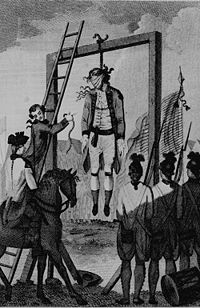
As the scheme ripened, the turncoat asked Sir Henry Clinton for “a personal interview with an officer that you can confide in.”

Enter Clinton’s adjutant John Andre, head of British Special Intelligence.

The dashing officer, well-liked in society on either side of the permeable divide between Tories and Patriots on the continent, slipped into Haverstraw, N.Y. to make the arrangements. On his way back — when he already thought himself safely clear of American-held territory — he was nabbed with the incriminating documents.

The narrowly-averted betrayal was mirrored by the narrowest of escapes: luckily for Benedict Arnold, Andre was received in custody by a subordinate officer of his, whose initial report to Arnold alerted the general to his danger and enabled him to escape to the British a whisker ahead of the law.

Treason, of the blackest dye, was yesterday discovered. General Arnold, who commanded at West Point, lost to every sentiment of honor, of private and public obligation, was about to deliver up that important post into the hands of the enemy. Such an event must have given the American cause a dangerous, if not a fatal wound; happily the treason has been timely discovered, to prevent the fatal misfortune. The providential train of circumstances which led to it, afford the most convincing proofs that the liberties of America are the object of Divine protection.

It was a gentlemanly war, and Andre didn’t seem like the guy to hang in the whole exchange. But his argument before a court-martial that he was merely availing “an advantage taken in war” by agreeing to talk to an enemy general who wanted to hand them the keys to a fort didn’t fly: he’d been behind enemy lines, out of uniform, sneaking around. That made him a spy.

And the British refused to obtain Andre’s liberty by trading the man the Americans really wanted to execute.

Instead, by year’s end, the hero of Saratoga was commanding redcoats in the field — perhaps a little nervously; when he asked a captured American what might happen to him should he be taken, the reply was “Cut off your right leg, bury it with full military honors, and then hang the rest of you on a gibbet.”

John Andre was left holding the bag, to the dismay of just about everyone American and British alike. This extended account of the luckless major’s last moments* is from the pen of Continental Army surgeon James Thacher.

Major Andre is no more among the living. I have just witnessed his exit. It was a tragical scene of the deepest interest. During his confinement and trial, he exhibited those proud and elevated sensibilities which designate greatness and dignity of mind. Not a murmur or a sigh ever escaped him, and the civilities and attentions bestowed on him were politely acknowledged…

The fatal hour having arrived, a large detachment of troops was paraded, and an immense concourse of people assembled; almost all our general and field officers, excepting his excellency [George Washington] and his staff, were present on horseback; melancholy and gloom pervaded all ranks, and the scene was affectingly awful … Major Andre walked from the stone house, in which he had been confined, between two of our subaltern officers, arm in arm; the eyes of the immense multitude were fixed on him, who, rising superior to the fears of death, appeared as if conscious of the dignified deportment which he displayed. He betrayed no want of fortitude, but retained a complacent smile on his countenance, and politely bowed to several gentlemen whom he knew, which was respectfully returned. It was his earnest desire to be shot, as being the mode of death most comformable to the feelings of a military man, and he had indulged the hope that his request would be granted. At the moment, therefore, when suddenly he came in view of the gallows, he involuntarily started backward, and made a pause. “Why this emotion, sir?” said an officer by his side. Instantly recovering his composure, he said, “I am reconciled to my death, but I detest the mode.” While waiting and standing near the gallows, I observed some degree of trepidation; placing his foot on a stone, and rolling it over and choking in his throat, as if attempting to swallow. So soon, however, as he perceived that things were in readiness, he stepped quickly into the wagon, and at this moment he appeared to shrink, but instantly elevating his head with firmness, he said, “It will be but a momentary pang,” and taking from his pocket two white handkerchiefs, the provost-marshal, with one, loosely pinioned his arms, and with the other, the victim, after taking off his had and stock, bandaged his own eyes with perfect firmness, which melted the hearts and moistened the cheeks, not only of his servant, but of the throng of spectators. The rope being appended to the gallows, he slipped the noose over his head and adjusted it to his neck, without the assistance of the awkward executioner. Colonel Scammel now informed him that he had an opportunity to speak, if he desired it; he raised the handkerchief from his eyes, and said, “I pray you to bear me witness that I meet my fate like a brave man.” The wagon being now removed from under him, he was suspended, and instantly expired; it proved indeed “but a momentary pang.” He was dressed in his royal regimentals and boots, and his remains, in the same dress, were placed in an ordinary coffin, and interred at the foot of the gallows; and the spot was consecrated by the tears of thousands.

Thus died, in the bloom of life, the accomplished Major Andre, the pride of the royal army, and the valued friend of Sir Henry Clinton. He was about twenty-nine years of age, in his person well proportioned, tall, genteel and graceful. His mien respectable and dignified. His countenance mild, expressive and prepossessing, indicative of an intelligent and amiable mind. … considered as a skilful, brave and enterprising officer, and he is reported to have been benevolent and humane to our people who have been prisoners in New York. … The heart of sensibility mourns when a life of so much worth is sacrified on a gibbet. General Washington was called to discharge a duty from which his soul revolted; and it is asserted that his hand could scarcely command his pen, when signing the warrant for the execution of Major Andre. … Could Arnold have been suspended on the gibbet erected for Andre, not a tear or a sigh would have been produced, but exultation and joy would have been visible on every countenance.

Andre makes a sort of loyalist counterpart to Nathan Hale. Interestingly, Thacher’s account — in which he uses his old diaries for a book that was published in 1823 — footnotes an extended narration of Nathan Hale in a comparative vein, complaining that “whilst almost every historian of the American Revolution has celebrated the virtues and lamented the fate of Andre, Hale has remained unnoticed, and it is scarcely known that such a character ever existed.” Today, in terms of their public recognizability, the two are rather reversed.

* Andre was to have been hanged October 1, but the matter was stayed when a British deputation arrived under flag of truce to make one last parley for their man’s life.

On this day..

1957: Jacques Fesch: playboy, cop killer, saint?

On this date in 1957, the dissolute son of a wealthy banker went to see Jesus on the guillotine at Paris’ La Santé Prison.

Annoyed that his estranged father wasn’t keen to finance his dream of moving to the South Pacific for a life on permanent vacation, Jacques Fesch robbed a moneychanger on the Rue Vivenne to raise the revenue — and then shot dead a police officer who gave him chase, orphaning a four-year-old girl.

Outrage at the murder of a policeman was redoubled as the callow hedonism — adultery, an abandoned illegitimate kid, and nary a hard day’s work in his life — of its privileged perp became widely known. Then, too, there’s the novelty of a financial sector scion requiring a firearm for larceny.

Fesch’s Catholic lawyer, Paul Baudet, undertook the Dostoyevskyan mission of saving client’s life and soul alike. The disinterested kid called him “Pope Paul” or “Torquemada,” but gradually — and then all of a sudden — something got through there.

Little by little I was led to change my ideas. I was no longer certain that God did not exist. I began to be open to Him, though I did not yet have faith. I tried to believe with my reason, without praying, or praying ever so little! And then, at the end of my first year in prison, a powerful wave of emotion swept over me, causing deep and brutal suffering. Within the space of a few hours, I came into possession of faith, with absolute certainty. I believed, and could no longer understand how I had ever not believed. Grace had come to me. A great joy flooded my soul and above all a deep peace. In a few instants everything had become clear. it was a very strong, sensible joy that I felt. I tend now to try, perhaps excessively, to recapture it; actually, the essential thing is not emotion, but faith. (Source)

Almost overnight he gave himself to monklike asceticism, but the legal situation was not as promising as the spiritual. French President Rene Coty declined to spare him under pressure from police, and on grounds that leniency to a cop-killer would blow back on officers then trying to quell rebellion in Algeria.

Tell your client that he has all my esteem and that I wanted very much to reprieve him. But if I did that, I would put the lives of other police officers in danger. (Source)

Fesch didn’t want to die, but he accepted his penalty with resignation.

Now, my life is finished. ‘Like a little spring flower which the divine Gardener plucks for His pleasure,’* so my head will fall — glorious ignominy — with heaven for its prize! (Source)

His prison writings have filtered out widely since his beheading, and fed a burgeoning personal cult; he is often compared with the penitent “good thief” crucified with Christ. The valence of that conversion for the death penalty as a contentious political or theological issue, however, is not necessarily abolitionist. Fesch himself mused that imminent execution might have been the very thing that moved his soul.

Do you know, sometimes I think, in good faith and with horror, that the only way I can be saved [in God] is perhaps not to be saved [from the guillotine] in the human sense of the word? (Source)

Controversially, the layabout who slew a policeman has been latterly proposed for canonization within the Catholic Church — although Fesch’s defenders here observe that saints from Paul on down have often had unsavory backstories.

The young man is much better known in Romanic lands than among Anglophones — here’s an Italian homily for him:

* Quoting St. Therese of Lisieux, an apt inspiration.

On this day..