1895: Emma Williams, Frank Tinyana, and Jackey

From The Advertiser (Adelaide, SA), Nov. 5, 1895:
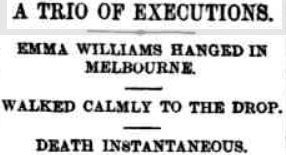
Melbourne, November 4.
Emma Williams, who was convicted of the murder of her child at Port Melbourne on August 13 last, was executed in Melbourne Gaol this morning in the presence of about a dozen persons.

Public excitement was aroused over the murder when it was first discovered owing to the callous and unfeeling way in which the deed was done and the careless attitude of the mother afterwards. The victim, who was only two years of age, was taken by its mother to the pier in the Sandridge Lagoon, where she tied a stone to its body and pushed it into the water.

After her conviction the Anti-Capital Punishment League made strenuous efforts to obtain a reprieve, chiefly because the condemned woman alleged that she was pregnant.

Medical examinations did not support that statement, and it was discovered on Friday last that the condition which lent color to the woman’s statements was produced artificially.

At first Williams treated her terrible sentence with apparent unconcern, being buoyed up with the hope of reprieve; but when that expectation had passed she became most devout and earnest in her attentions to the ministrations of the gaol chaplain (the Rev. H. F. Scott), by whom she was attended to the scaffold. She expressed great sorrow for the crime she had committed and for the loose life she had led.

She remained in that frame of mind to the end.

When the sheriff demanded the body of the prisoner from the governor of the gaol at the door of the little cell alongside the gallows this morning she walked calmly on to the drop, but her face was blanched and wore a terrified expression.

In answer to the usual questions from the sheriff as to whether she wished to say anything Williams answered “No,” in a low but firm voice.

The white cap was immediately drawn over her face and the rope adjusted, and then, as Roberts, the hangman, turned to pull the lever, she exclaimed, “Oh, Lamb of God, I come.”

The next moment the drop fell, and at that moment Williams uttered a nervous, plaintive exclamation that was not quite a scream. Then all was over. The whole of the proceedings did not occupy more than a quarter of an hour, and death was instantaneous.

The dead woman had a very eventful career, having been married when she was 14 years old. At 15 she bore a daughter, who is still living. Her husband left her, and afterwards died in the Melbourne Hospital, while the widow continued a career of dissipation. Her daughter was adopted by a friend of her husband, and the child which she drowned was born after his death.

She was born in Launceston, Tasmania, where her mother still lives.

Brisbane, November 4.
A double execution took place at the Boggo Road Gaol this morning.

Jackey, an aboriginal, was hanged for the murder of a Javanese, Jimmy Williams, at Mount Morgan, and Frank Tinana [or Tinyana -ed.], a Dative of Manila, was executed for the murder of Constable Conroy, on Thursday Island. The men behaved well in prison. Jackey was able to recite prayers taught him by the Bey. Mr. Simmonds, and Father Dorrigan attended Tinana, who admitted having committed murder. He said he bad a jealous quarrel with another colored man, in which Constable Conroy attempted to arrest him. He then stabbed Conroy to death.

During the past few days both condemned men ate and slept well, and this morning they partook of breakfast. When they came upon the scaffold Tinana was agitated and seemed afraid. Neither man spoke.

The preliminaries were quickly arranged and the bolt was drawn. Death, in each case was apparently instantaneous. When Jackey, whose height was nearly 6 ft, fell blood burst from his nose and stained his white cap.


Diagram from an 1880 memorandum the British government sent to colonial authorities in Queensland detailing procedures for the cutting-edge long drop hanging method.

No colored men were present to witness the execution, which was carried out in the presence of the usual officials. Jackey left a letter to a woman who is looking after his child, telling her to take great care of the infant, to bring it up as a white man’s, and not to let it drink rum or go to the blacks’ camp. Tinana left a letter coached in terms of great affection to his wife.

On this day..

1591: Brian O’Rourke, Irish lord

On this date in 1591, Brian na Múrtha Ó Ruairc — Brian O’Rourke to the English who killed him — was drawn and quartered as a rebel at Tyburn.

O’Rourke was a chieftain in a disappearing world, the Gaelic Ireland that the English had been engaged in reducing ever since King Henry VIII realized that he was King of Ireland back in 1542.

O’Rourke’s patrimony in this Tudor conquest was the kingdom of West Breifne, with a lineage going right back to its 12th century founder. As far as the Tudors were concerned he was just one more truculent local lord to subdue — even if the very “proudest man this day living on the earth.” (per Nicholas Maltby)

O’Rourke’s pride put him into opposition against the English satrap and even led him to succor sailors taking refuge from the shattered Spanish Armada in 1588. But the scope of his autonomy was narrowed and narrowed as expanding English occupation crept upon his environs.

In the end it was his brother-Celts in Scotland who finished him: when O’Rourke turned up there in 1591 seeking license to recruit sword-arms from King James VI (James was not yet James I of England at this point), Queen Elizabeth successfully prevailed upon her Scottish counterpart to arrest and extradite the man — an incident that triggered a riot in Glasgow.

Tried on the highly dubious grounds of treason against England committed in Ireland — plus a lese-majeste incident of having the queen’s image dragged in the mud tossed into the indictment for good measure* — O’Rourke scornfully refused to plead, or to defend himself unless Elizabeth herself would deign to sit in judgment — sovereign to sovereign. The court required only O’Rourke’s body, not his assent, to proceed.

O’Rourke had a sharp enough tongue when minded to deploy it, however. On the scaffold, he witheringly abused the notoriously avaricious bishop Miler Magrath who had been sent to minister to him. Then …

Upon Wednesdaie the 3 of November, Bren O’Royrke was drawne to Tyborne, and there hanged, his members and bowels burned in the fire, his heart taken out, and holden up by the hangman, naming it to be the archtraytors heart, and then did he cast the same into the fire, then was the head stricken off, and his bodie quartered

-John Stowe, The Annales of England (1605) (via)

O’Rourke’s son Brian oge O’Rourke inherited his position, and his struggle, until younger brother Tadgh O’Rourke deposed him with English support. Tadgh died young in 1605 — and with him, West Breifne expired too.

* Enjoy an itemized list of the naughty O’Rourke’s many offenses against English sensibilities from page 144 of this public domain volume.

On this day..

1803: Ludovicus Baekelandt, Vrijbos bandit

On this date in 1803, Flemish outlaw Ludovicus Baekelandt was guillotined at Bruges with about 20 of his gang.

Deserting the army of the conquering French, Baekelandt set up as a bandit preying the deep spruce forests of the Vrijbos, eventually attaining leadership of a gang more than 30 strong.

Baekelandt is one of those whom popular memory and national sentiment (resentful here of the French occupation) has elevated into huggable social banditry. But the evidence remaining us testifies to little but a garden-variety brigand whose offenses were in no way confined to property crimes.

The gang was rounded up in 1802 and the Bruges court heard testimony from more than 100 witnesses, eventually dooming 21 men and three women to death for a litany of murders and robberies.

Almost all the information about Baekelandt available online is in Dutch; if that tongue is in your toolkit, gentle reader, this public-domain book is sure to level you up on Ludovicus Baekelandt and friends.

On this day..

1929: Habibullah Kalakani, Tajik bandit-king

Warlord Habibullah Kalakani, deposed after ten months styling himself King of Afghanistan, was publicly shot on this date in 1929.

An ethnic Tajik whose surname alludes to his native village north of Kabul, Kalakani served in the army of Emir Amanullah Khan.*

This Khan aspired to far-reaching reforms that would modernize his marchlands kingdom and not for the last time an Afghan ruler found this programme stoked a furious resistance among tribal grandees. Kalakani, though derisively nicknamed Bacha Seqao (son of a water-carrier) was just such a grandee, having pivoted profitably from regular military orders to highway robbery.

When Khan’s forces had vacated Kabul to manage a Pashtun rebellion in the south — only the latest of numerous tribal risings that plagued the Khan years — Kalakani in late 1928 sprang a surprise Tajik rebellion from the north and marched on the unprotected capital.

Amanullah evacuated Kabul with a quickness, personally behind the wheel as he blazed his Rolls Royce ahead of Kalakani’s cavalry all the way to India and eventual exile in Europe.


Kalakani

But the “bandit king” soon found his own government strained by the same tensions that had elevated him. Pashtun rebels who used to chafe under a western-oriented king now chafed under a Tajik one — in fact, the only Tajik to rule Afghanistan in its modern history — and their fresh rebellion soon toppled Kalakani in his own turn. He was shot with his brother and their aides, contentedly telling his firing squad, “I have nothing to ask God, he has given me everything I desired. God has made me King.”

Kalakani is still the third-last king of Afghanistan and is still bitterly — violently — controversial on his native soil, where whether you reckon him a hero or a thug depends upon your kinship. Just weeks ago as we write this, a reburial of Kalakani’s remains in Afghanistan provoked bloody ethnic melees on the streets.

* Although there is no specific connection here to Habibullah Kalakani, an execution blog would be remiss not to include a reference to this sadly undateable National Geographic photo tracing to Khan’s reign of one of those real-life dangling man-cages so beloved of the sword-and-sandals fantasy genre. Per NatGeo’s caption, an actual thief was “put in this iron cage, raised to the top of the pole, so that his friends could not pass food or poison to him, and here he was left to die.”

On this day..

1862: Thomas Sanders, rapist

Thomas Sanders was hanged on this date in 1862 at Melbourne Gaol.

An ex-con at Norfolk Island, Sanders took to the bush with another man named John Johnson and in 1862 perpetrated a terrifying home-invasion raid upon the farm of Henry Cropley. They spent five hours there, eating, relaxing, and terrifying the family, comfortably remote on Keilor Plains from any possible source of help. Nobody died — but Sanders too a liking to the family serving-girl Mary Egan and raped her. Egan gave the evidence about her harrowing ordeal — and subject to Sanders’s own direct cross-examination* — just three weeks before Sanders hanged:

The tall man was standing in the middle of the room. I turned to look at him, and he told me to turn my face away, and put a chair for me against my master and missis. He then told the other man to “tie my master’s hands up,” and pulled a rope out of his pocket, and tied him up. He afterwards told me to get up and make tea. I got up and stood at the fire, but was so frightened I could not make tea.

When I saw my master tied up I began to cry, and the little man came up and told me to “shut up,” at the same time pulling a pistol out of his pocket. Sanders then searched the rooms. I saw him as I was standing at the mantelpiece. Johnson was walking about the kitchen with a double-barrelled pistol in each hand.

I thought they were then going away, but they came back again, and Sanders saw the ham hanging up in the kitchen. After they had had their own supper, Sanders sent Johnson to ask me if I would have any. I said I would not.

They had been drinking a bottle of port wine and some spirits. I then heard them go into my rom and pull out my little box. Sanders then said it was time to put the girls to bed.

He told my missis to go into her room, and then came back and took the cradle in. He stopped there some time. I can’t say how long, and then came out, and said to me, “You, girl, you go to bed.”

I went in, and he followed me into my room with the candle.

I was going t bed with some of my things n, and he made me get out and take off everything, except my chemise.

He then tied me hand and foot to the four corners of the bed, and as my foot slipped while he hurt my ankle, I kicked him in the face.

He then said, “Oh, you —- little wretch; I’ll give it to you for that.” I ceased to resist him, as I saw it was no good, and my master had told me to do what he told me. I did not resist him, because he had pistols in his pocket and he said if I did not do what he ordered me he would blow my head off, and would think no more of my life than a cat’s.

He ordered me then to be quiet, and tied my hands behind me. He then brought the other man in, and said, “Isn’t she an enticing little devil.”

I didn’t hear the other man say anything.

They then went out, and took the candle with them, and, after remaining a few minutes, Sanders returned, and said, “Now, my good girl, I’ll give it to you for kicking me in the face.”

It was in the dark. I could not see him, but I knew his voice. I think he was undressed.

He got into bed, and I said to him, “For God’s sake not to do anything t me, for I was a poor orphan girl.”

He did not seem to hear, but I spoke loud enough for my master and mistress to hear.

I then heard him at the foot of the bed, and he asked me “if I had any relations in the colony.”

I said “Yes, I had brothers and uncles.”

He said he didn’t care, and then he had connection with me.

I said, “God help me; there is no help.”

(The witness here described the circumstances, and was almost unable to proceed from agitation. They distinctly proved that a rape was committed.)

Afterwards I begged him to untie me, as the flesh was rising over the ropes, and hurt me. He then untied me.

I never told any one afterwards, as I never dreamt they would be taken up. I afterwards told the doctor everything.

The witness here looked round, at the desire of the Bench, and said, “These are the two men. The one (pinting to Sanders) is the man who had connexion with me.”

* Egan was credited with maintaining her composure admirably under the trying circumstances, but at noe point Sanders asked a question “of such a brutal nature that her firmness, which had been remarkable, gave way, and she had to be removed, in a fainting fit, from the court. The prisoner Johnson made some remark, and Sanders exclaimed “Oh, she’s well tutored!”

On this day..

Deathed Up to the Nines: Executed Today’s Ninth Annual Report

When The Day of the Dead rolls around it’s time to break out the candles for another birthday, somehow Executed Today‘s ninth since it entered crying in 2007. Hell, we’ve been around so long that Day of the Dead has evolved new traditions in our lifetime.

If you’re among the 4,651 or so humans and bots who follow @executedtoday on Twitter you might have inferred from our erratic presence that it’s been more like the nine circles of hell managing the most recent year out.


The frozen lake of the loveless is where bloggers go.

This perdition stuff is as narrow as it is exaggerated. Overall, this writer’s life is in a better place than it was 12 months ago — it’s merely that the transitions involved grievously strain the allotment left for executions. Executioners, strange caste, still have other interests.

The ninth year now in the books was not a triumph but a dark passage, a test to survive; it has not produced many of this site’s greatest posts — and the best among them surely include Meaghan Good’s guest offerings, without which Executed Today would have folded up its gallows long ago — but at least there have been 365 plus the leap year.

We’re ready for Year X.

On this day..

1857: James Copeland, repentant gangster

On this date in 1857, “the great southern land pirate” James Copeland went to the gallows in the now-abandoned Mississippi town of Augusta.

Copeland‘s criminal career is the subject of a wonderfully old-timey reader by the Perry County sheriff who noosed him. (As it says right there on the title plate. Sheriff J.R.S. Pitts does not shrink from injecting his own story into the narrative, and to get to the action the reader must first wade through tedious digressions into the hangman’s biography, his civic-minded rationales for a prurient interest in outlaws — “such a life and history cannot fail, even at this late date … of materially interesting and benefiting the public at large” — and some whinging about the libel suits that dogged his attempts to materially benefit the public at large.)

After an “introduction”, a “preface”, and an “explanatory”, our volume comes at last to an illustrated 100-page autobiographical narrative which Pitts says that Copeland dictated to him while cooling his heels in jail.

Hardened and violent in life, Copeland under the eaves of death seems to made that familiar return to God and repentfully confessed his path into depravity beginning with youthful delinquencies the condign punishment of which was consistently deflected by his mother, “who always upheld me in my rascality.”

Having fallen into a legal scrape for pig-thieving, Copeland left behind charming rascality for Godfather territory when he made contact with an outlaw named Gale Wages and concocted a plan to vacate the charges by destroying the documentation … by torching the courthouse in which they rested.

“Such a sight I never had before beheld,” Copeland remembered of the blaze. “The flames seemed to ascend as high, if not higher than the tops of the tallest pine trees; they made everything perfectly light for over two hundred yards around.” After that bonfire, Copeland gave himself over to the guidance of a man who turned out to be halfway between Jabba the Hutt and a Masonic lodge chief.

Wages, Copeland found, had “a great many persons concerned with him, in different parts of the country, some of them men of wealth and in good standing in the community in which they lived.”

They had an organized Band that would stand up to each other at all hazard; they had a Wigwam in the city of Mobile, where they held occasional meetings … they had many confederates there whom the public little suspected …

I was there introduced by Wages, (who was their president,) as a candidate for membership, I should have been rejected, had Wages not interceded for me. I was finally passed and admitted to membership. Wages then administered to me the oath, which every member had to take. I was then instructed and given the signs and pass-words of the Clan.

Maybe the gang was right to doubt him, for Copeland broke this oath by divulging to his hangman-biographer numerous names of members as well as the Encyclopedia Brown-esque cipher this gang used to send coded messages.

Over the course of the next decade and more, Copeland’s narration has the gang and he romping through Dixie in misadventures that range from the charmingly picaresque — finagling a guest role at a Methodist pulpit by posing as wandering preachers upon which they netted several hundred dollars from the inevitable passed hat — to the much less charming:

A legend of $30,000 in gold that the squad claimed to have buried in Catahoula Swamp still circulates in Mississippi — spur to thus-far frustrated treasure hunters down to the present day.

We can’t know to what degree the voice that we read is Copeland’s own or that of Pitts interposing but the narrator we have affects at times a stagey horror at his sins.

With the gang determined to be rid of an Irish boatman on the Mississippi, Copeland draws the short straw to bludgen him to death in his sleep: “Oh, God! when I look back, it makes me shudder. Even now it chills the blood in my veins.” Copeland bashed his brains in with a hatchet and as day broke they slipped the weighted corpse into the river.

Copeland had moved up the ranks enough to share the marquee in the “Wages-Copeland gang” by the time things got real dark. In early 1844, a summit of the gang’s leadership determined spies were afoot and four of the suspected “butted their heads against a slung-shot hung to a man’s arm, and they went floating from Mobile wharf down the channel of the river.” Others they left “in a situation where he told no more tales” and “fed … the contents of two double-barrel shot-guns, about forty-eight buck-shot, and put him in a swamp near Eslaya’s old mill” and “put a rope around his neck, and we very soon squeezed the breath out of him.”

The end of the line could really have been any one of these incidents or the numerous others this post elides — enough blood feuds and hand-to-hand murders and the odds are sure to turn against you in the long run.

In 1849, now a wanted man, Copeland started drinking at a grocery near Mobile

and became intoxicated, and in that situation I imagined every man I saw was trying to arrest me. I fell in with a man by the name of Smith, an Irishman, and a difficulty occurred between us; I concluded that he intended to arrest me. I drew my double-barrel shot gun upon him and intended to kill him. He was too quick for me; he threw up my gun, drew his dirk and stabbed me just above the collar bone.

Having made himself both conspicuous and immobile, Copeland was tracked down by a posse and now he was really in the soup: “one indictment against me in Alabama for larceny, and another against me in Mississippi for murder.” Copeland pleaded guilty in Alabama and served a jail sentence there, hoping that the passage of years would buy him some opening to escape the hanging sentence that would surely await in neighboring Mississippi. But the Magnolia State was on its game and had a timely extradition request ready to receive James Copeland the moment his term in the Alabama pen expired.

The day arose clear and beautiful on which the sentence of the law and of outraged humanity was to be executed on the man who had so often violated their most sacred behests. The sky was blue and serene; the atmosphere genial; all nature was calm and peaceful; man alone was agitated by the various strong emotions which the execution of the fatal sentence of retributive justice on a fellow-man could not but create.

The place of execution was distant from the city of Augusta one-quarter of a mile. The gallows was erected on a beautiful elevation that was surrounded by the verdure of shrubby oak and the tall, long-leaf pine. The ground was everywhere occupied by thousands of spectators, gathered from Perry and the surrounding counties, to witness the solemn scene. It was indeed one that they will long remember.

About the hour of noon, the prisoner, after being neatly clad, was led from the jail by the officers of the law, placed in the ranks of the guard formed for the occasion, and the procession moved slowly toward the fatal spot.

Soon the doomed man appeared on the gallows. The death warrant was then read to him, and he was informed that he had but a short time to live.

He proceeded to address the awe-struck and silent multitude. He especially urged the young men present to take warning from his career and fate, and to avoid bad company. His misfortune he attributed principally to having been mislead while young.

When he had concluded, a number of questions were asked by the immediate spectators, in relation to crimes which had transpired within their knowledge; but he would give no direct answer — shrewdly eluding the inquiries.

The Sheriff then asked him, in hearing of many lookers on, if the details of his confession, previously made to that officer, were true. He replied that they were.

His hands were then tied and the cap pulled over his face, and he was told that he had but a few moments to live. He exclaimed, “Lord, have mercy on me!” and he was praying when the drop fell, and a brief struggle ended his blood-stained career.

On this day..

1543: Pietro Fatinelli, betrayed by Lando

On this date in 1543, a young nobleman named Pietro Fatinelli was executed for plotting to overthrow the mercantile oligarchy of the Tuscan city-state Lucca.

The Fatinelli family “was of ancient lineage, but had recently played little part in the running of the government,” according to Mary Hewlett in The Renaissance in the Streets, Schools, and Studies. Lucca itself was beginning to wane in importance in the 16th century in the shadow of her Italian rivals and the Holy Roman Emperor Charles V

The young Pietro was able enough to establish himself as an envoy to the imperial court, and ambitious enough to conceive it the platform from which he would redeem the fortunes of Lucca and Fatinelli alike.

Complicit with his friend Captain Giambattista Bazzicalupo di Chiavari, Fatinelli pltted to do away with some of the principal families whom Fatinelli detested, as they represented the merchant oligarchy that spurned his more ancient and noble family.

News of the plot came to the ears of the Lucchese government when Fatinelli unadvisedly mentioned his intentions to Count Agostino Lando, an opprtunistic nobleman from Piacenza, while the two were residing in Venice.


You can’t trust Lando.

Thinking to make some profit at no risk to himself, Lando secretly informed the Lucchese of Fatinelli’s intentions. The signoria acted with utmost secrecy and was able to seize the unsuspecting Bazzicalup di Chiavari while he was reconnoitring in Lucca. They put him to the torture and he cnfessed and revealed the details of the plot, after which he was summarily executed. [August 25, 1542 -ed.]

As Fatinelli resided at the imperial court and had powerful prtoectors, the Lucchesi had a difficult time extraditing him. It took all their powers of persuasion to prove to the emperor that Fatinelli was a traitr. Eventually convinced, Charles V handed Fatinelli over to the Lucchesi, who tried him and publicly executed him after he apologized to the citizens of Lucca. The emperor insisted that, as a last favour, the young man be given the name of his denouncer, as a reward for having repented and admitted his guilt.

Though Fatinelli was defeated, the disaffection with his native city-state proved far deeper-seated than his own person. Just four years after Fatinelli’s hot head fell on the scaffold, another Lucchese nobleman attempted an even more daring revolution.

On this day..

1996: Arshad Jameel, military man

Pakistani army Capt. Arshad Jameel (or Jamil) was hanged at Hyderabad Prison 20 years ago today.

Capt. Jameel exploited a security sweep to orchestrate the summary execution of nine Indian-armed terrorists … who turned out not to be terrorists at all, but ordinary residents of Tando Bahawal village whom Jameel had a personal grudge with.

It was a resonant case in a country dominated by its military and only wide public outrage at the journalistic expose unveiling the crime put Jameel in the dock of a military court.

Even so, the wheels turned so painfully slow that Pakistanis could not but suspect an institution accustomed to a broad grant of impunity of dragging its feet. Four years deep into Jameel’s appeals, two sisters of victims protested the delay by publicly immolating themselves on September 11, 1996. They died painfully of their burns, but they got the result they wanted: appeal denied.

On this day..

1905: Ed Lamb, bully

This date in 1905 was — in the title of the Manatee County Historical Society publication about the case — The Day They Hanged Ed Lamb in Braidentown/Bradentown/Bradenton.

It all started in the schoolyard.

Lamb’s son was the resident bully at the local Braden River School until one day that January he picked a fight with the son of Dave Kennedy and surprisingly got his — the bully’s — ass kicked.

Like many a child since, young master Lamb sent his problem up the generational chain of command. Ed Lamb, a mill hand, raised the beef with Dave Kennedy, a farmer, when the latter stopped by the mill a few days later to sell his wares, even menacing Kennedy with a knife.

But for the second time, a Kennedy went all lion on a Lamb and overpowered his antagonist. Enraged and embarrassed, Lamb stalked away to his nearby home, got a shotgun, and wasted Dave Kennedy. Masculinity: vindicated. Stunned bystanders allowed Lamb to escape.

Our Manatee County correspondent gives the surreal vignette from his own family history of the Kennedy children — being dismissed from school at news of the murder — walking home on a dirt road that very day and passing the disgraced Lamb family on a wagon with their possessions, heading out of town. “One of the children standing beside the roadway became frightened thinking that Ed Lamb would pop out fo the trunk at any moment.” He didn’t: Ed was on a lam all his own, and was recaptured the next morning and spirited away to Tampa to protect him from lynching. Lamb spent the months between his conviction and his execution harrying the local newspaper with letters entreating folks straighten up and get right with God, letters that notably failed to breathe word one of apology to the Kennedies.

The drop fell at 12 minutes past 12:00 non. But the rope slipped and the prisoner was raised a second time and shot into eternity. He was rendered unconscious by the first shock and never knew that he was let to fall a second time. His neck was broken by the second fall and he was pronounced dead by Dr. John Holten of Sarasota. He mounted the gallows cool and fearless and died without a murmur or a struggle. Inside the jail, 40 witnesses were in the jail when the execution took place, the gallows being inside the building. A few white people and a great many Negroes were congregated around the jail, but perfect order was maintained.

Lamb’s son, brother and sister-in-law were present when he mounted the scaffold, but were overcome and left before the drop fell. The doomed man kissed them goodbye and asked them to meet him in heaven. His wife was unable to come to the jail to see him for the last time. Was photographed. Lamb dressed himself for the scaffold with great deliberation. And at his request, was photographed after being attired for death. He talked freely. But in his last speech he said nothing about the crime for which he suffered. He said that he was willing to die. That he had made his peace with God and wanted all of his heirs to meet him in a better world. Sheriff Wyatt was cool and carried out his part well. The noose was adjusted and the black cap pulled down over the prisoner’s face. And the trap sprung that sent the murderer to meet his maker. The death warrant directed that the execution take place in private between the hours of 11:30 and 12:00, but the sheriff allowed the condemned man 12 minutes longer lease on life.

Manatee County paid Coursey and Barnett $16.70 for Lamb’s hangin’ suit, and paid J.W. Wilhelm & Co. $21.35 for his coffin.

On this day..