1903: Peter Mortensen, divinely accused

On this date in 1903, Peter Mortensen was shot over a lumber bill.

The evidence against Peter Mortensen was circumstantial: a moonlight witness, some unexplained cash, and a perceived insufficiency of vigor in insisting upon his innocence when suspicion fell upon him.

Though this much sounds pretty speculative, Mortensen’s very direct pecuniary interest in Hay’s death was harder to wave away. Mortensen, a Salt Lake contractor, owed money to George Ernest Romney’s* Pacific Lumber company. On the evening of December 16, 1901, he summoned Romney’s employee James R. Hay — who was also Mortensen’s friend, neighbor, and fellow-teacher at a Mormon Sunday school — to pay up.

Hay never made it home.

The next day, Mortensen had a receipt for the payment in Hay’s hand, and Hay had a cashless grave and a bullet hole in his head. Rarely have means, motive, and opportunity converged so exactly.

Public sentiment against Mortensen was so overwhelming** that selecting an impartial-ish jury proceeded at a weeks-long crawl as Mortensen’s attorney met prospect after prospect by bluntly asking whether they had formed an opinion as to his man’s guilt. Prospect after prospect confirmed that they had done. By the end, the court had been reduced to issuing “open venires” bypassing the regular jury summons process and authorizing anyone handy to be inducted into the jury pool. Deputies scoured Salt Lake City like press gangs, hunting for possible jurymen.

In all, the court dismissed some 600 prospective jurors for bias (which was quite a lot for the time), and ran through $4,500 in that process alone (likewise).

Those finally seated had to weigh, along with the more conventional indicia of guilt, the inflammatory witness testimony of James Hay’s father … who said he didn’t just have a pretty strong suspicion about the defendant, but that he actually knew Mortensen did it. “God revealed it to me,” the elder Hay said with “tears streaming down his cheeks” according to a report in the Idaho Daily Statesman of June 6, 1902.

He appeared to me by the Holy Ghost and put the words of His Spirit into my mouth. I had to utter them, for I knew they were true. I cannot and will not deny it here, neither will I deny it when I meet my God on the last day.

This is not the only manifestation I received. On Tuesday noon I saw the trail of blood leading from the railroad tracks to where my son-in-law was buried. I saw it in a vision just as plainly as when I afterwards visited the spot.

Again, this is judicial testimony in an American courtroom in the 20th century.

The fact that it appeared — and that the trial court refused a defense demand to instruct the jury not to consider supernatural visions in the light of real evidence — formed the central argument of Mortensen’s appeal. In the end, Utah’s Supreme Court refused to vacate the sentence. Still, the weird appearance of “divine revelation evidence” in a Utah courtroom led the Mormon patriarch Joseph F. Smith to issue a finding distancing the Church of Jesus Christ of Latter-Day Saints from any embarrassing mummery:

[N]o member of the Church of Jesus Christ of Latter-day Saints should, for one moment, regard such testimony as admissible in a court of law, and to make the case perfectly clear it may be further stated that such evidence would not be permissible even in a Church court, where rules of evidence, though not so technical, are founded largely upon the same principles that govern the rules of evidence in a court of law. Any attempt, therefore, to make it appear that such evidence is in keeping with the tenets of the “Mormon” faith is wholly unjustified

About six weeks before Mortensen’s execution, a prison break took place at the penitentiary. It’s been given out latterly that the arrogant Mortensen was so unpopular even with his fellow-prisoners that they intentionally left him stuck in his cell. 1903 press accounts appear to indicate otherwise — that he was not the only convict left stuck in his cell, and that Mortensen’s particular rum luck wasn’t a social lack but a digital one: somebody dropped the necessary set of keys. Either way, there was no way out, and neither when Utah’s governor interviewed Mortensen personally to see about his mercy application. Never mind his popularity with prisoners; Mortensen’s continued insistence on innocence while pleading for his life was the real diplomatic failure.

Mortensen selected shooting rather than hanging as his method of death, and went to it “firm as a rock.” He left only a last statement repeating his vociferous and widely disbelieved denial of Hay’s murder.

To the world I want to say and swear by the heavens above, by the earth beneath, and by all I hold near and dear to me on this earth, that I am not guilty of that cowardly murder of my dearest friend. I ask therefore no man’s pardon for aught that I may have done in life. I am confident that my life is an example to most people. I lay no claim — please strike out the last two words — I do not say that I am better or more worthy of respect of the world than the average man, but I have done my duty to my father and mother, my brothers and sister, and to other near relatives. I have done my absolute duty toward my wife and my five little babies. May God keep and care for those sweet darlings.


Salt Lake Telegram, Nov. 20, 1903.

* Yes, those Romneys. George Ernest Romney‘s significantly younger first cousin George Wilcken Romney became Governor of Michigan, and was in turn the father of the 2012 Republican Presidential nominee Mitt Romney. The mutual grandfather of George E. and George W. designed the St. George Tabernacle.

** Even Mortensen’s wife thought him guilty, for he had gone out that fatal evening of the 16th with Hay, and returned an hour later “deathly pale.” However, while God’s hearsay to Mr. Hay was available in open court, Mrs. Mortensen’s evidence was not: Utah law prohibited wives testifying against their husbands.

On this day..

1720: Edward Hunt, the first counterfeiter executed in colonial Pennsylvania

On November 19, 1720, Edward Hunt was hanged in Philadelphia. He was the only Pennsylvanian executed for treason prior to the American Revolution — that treason being not the betrayal of the state (in the sense we might think of it today), but counterfeiting.

In the bitterness of his scaffold speech, which disdains the customary acknowledge-my-guilt, pray-for-my-soul form of the genre to complain about his case, Hunt made plain that he was not reconciled to the justice men had rendered him.

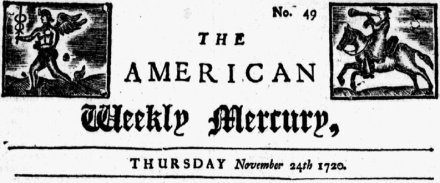
The American Weekly Mercury of Thursday, November 24 published “this extraordinary Piece” only with a preface complaining that “it is evident, that the following Speech was intended to misrepresent the Administration and Justice of this Government, as well as to infuse both ill Principles and Practices into the Minds of the People.”

The Dying Speech of Edward Hunt, formerly taken in Rebellion at Preston, and transported a bound Servant to the Island of Antigua, before his Execution upon the 19th Instant, at Philadelphia, where he had been legally convicted of High Treason, and most justly condemn’d for his Counterfeiting Spanish Silver Coin, made current* by Act of Parliament within all his Majesties Colonies in America.

It may be expected, that I should say some thing now concerning my Life and Conversation, which i must with Sorrow own to God and the Word has not been according to the Precepts and Principles of the Church, in which I was bred and educated: But with a sincere repentance and hearty Sorrow I do lament all the Errors of my past Life, firmly believing in my Saviour Jesus Christ, in whose Merits and ever flowing Mercy I do only trust for Salvation and Pardon, who has promised Eternal Life on no other Terms to the most Righteous upon Earth.

As to the Crime that now I suffer for in particular, I must own it is an Offence against the Laws, which I hope God will pardon me since he knows that I did not do it with any Design to cheat or defraud any one, or to make a Practice of Coining; but being ignorant of the Breach of any Laws of God or Man, I thought I might cut those Impressions as innocently as any other, or the Stamps that the Gentlemen of this place imploy’d me about, to make Farthings.** I am an English Subject, and desired to have the Privilege of the Laws of England, but it was not granted in any Point, except in Condemning me.

I am the first unhappy Instance of this kind that ever suffered in the King’s Dominions, pray God it may be a Warning to all, not to offend wilfully in the same that I did through Ignorance: For if I had known it, I would not have taken all the World to have done it. God give me a patient Resignation to submit to his blessed Will, in whatsoever he please.

I do heartily ask Forgiveness of all that I have offended in any manner of way, and do sincerely forgive all that have injured or offended me; particularly Mr. John Moore and Morris Birchfield, and the Evidence that swore against me in that Tryal. I do solemnly declare, That I know not any thing, or have been guilty of any one thing laid to my Charge in that Matter, or any of the other things laid to my Charge, by John Butler, either in England or Ireland.

I did petition the Honourable Governor for a Reprieve, until the King’s Pleasure was known concerning me, being I could not be tried by the Laws of England in all Points, as a Church of England Man ought to be: But it was a Privilege too great for me to obtain. Pray God to forgive them all, and every one that has a hand in taking away my Life any manner of way, and that my Blood be not required at their Hands, for they know not what they do. I am on Earth judged and condemned to die for the Breach of a Law of Man that was not duly published, which for that Reason I transgress’d it ignorantly, though the first that suffers for the Transgression of unknown Laws, or that was sentenced according to the Laws of England, without the Privilege of a Subject, which I desired of the Judge, which I know was not qualified by the same Laws to try me.

I do not know what Advantage there can be to any in my Death, and that I could not appeal to my King, neither before nor after my Tryal. I do not speak this because I am not in Charity with all the World, I do, from the Bottom of my Heart, forgive all in Obedience to my Saviour’s Command and Example, who suffered more for me, being innocent, and had not only done no Harm, but Good, and pray’d even for is cruel Persecutors and Murderers, and promised, That those that follow his Examples in this World by patiently enduring the Cross, shall reign with him to all Eternity: To Him therefore I commit all, an my poor Wife, beseeching him to help her, and be her Support and Comfort, and preserve her poor Soul free from the Polutions [sic] of the World, that through his precious Merits we may meet where we shall be both happy to all Eternity, in the merciful Arms of our dear Lord and Saviour Jesus, who I do beseech to receive my poor Soul.

According to Kenneth Scott’s Counterfeiting in Colonial America, Edward Hunt’s wife, Martha, got a £500 fine and a lifetime prison sentence for misprision of treason. (If that book is up your alley, Scott has an even more specific Counterfeiting in Colonial Pennsylvania.)

* Early colonial American commerce was severely hampered by a shortage of English/British currency. As a result, coins minted in Spain’s lucrative southern territories served as the colonies’ primary currency in the 17th and 18th centuries, particularly the iconic eight-real silver “pieces of eight”.

This is the reason why the currency of the present-day U.S. isn’t an “American pound sterling” but the almighty dollar: Dutch colonists had brought a coin called the leeuwendaalder to their former New Amsterdam (New York) province, the name deriving from the German thaler. As the pieces of eight corresponded to the thaler/daalder, it inherited the same name. Indeed, the “Spanish Dollar” remained legal tender in the post-colonial United States until 1857.

This is also the reason for reckoning of the eight constituent bits that comprised the dollar, and hence of the American colloquialism “two bits” to denote $0.25 … and, later, the adjective “two-bit” to man something cheap, mean, or small-time.

** They may have been Spain’s coins, but it’s wildly implausible that any Englishman could think he could counterfeit “innocently.”

On this day..

1427: Johann Bantzkow, Mayor of Wismar

On this date in 1427, the merchant-mayor of Wismar was beheaded — the incidental casualty of a Baltic trade war.

The Hanseatic League, that vast trading cartel stretching from Europe’s Low Countries in the west to Novgorod in the east, was in its glory at the start of the 15th century. The Hanse dominated Baltic trade.

Its major rival was Denmark, which had brought most of Scandinavia together in the Kalmar Union.


Map of the Hanseatic League at its apex, circa 1400. (Via Wikipedia)

Come the 1420s, the Danish monarch was Eric of Pomerania, a handsome and headstrong king. He would come to blows with Hanse cities over the Duchy of Schleswig.

Schleswig is the “neck” of Denmark’s Jutland peninsula. In the present day, the German-Danish border splits Schleswig horizontally: north Schleswig is Danish soil; south Schleswig, German.

To summarize a complicated history, the historical Duchy of Schleswig was long a bone of contention between the pre-modern precursors of those current states. Since Germany was very far from a unitary entity where we lay our scene in the 15th century, Denmark’s immediate rival for Schleswig was that territory’s southern neighbor, Holstein. Eric had fought intermittently in the 1410s and 1420s against the counts of Holstein over who controlled what and upon what terms in south Jutland.

After securing a legal ruling favorable to his claims from the Holy Roman Emperor, Eric in 1426 began enforcing his rights by force.

Holstein in turn sought aid from Hanseatic towns many of whom — wary of Denmark as a rival to its Baltic trading stranglehold — did indeed enter the fray on the side of Holstein. Hanseatic ships began raiding southern Denmark in the spring of 1427.

Wismar, a Hanse wool-trading port just a few kilometers outside of Holstein, was one of these cities. Johann Bantzkow (German link), its merchant ruler, supplied some 200 sail for the Hanseatic flotilla.

Unfortunately for the Hanse, and for Bantzkow, the Danes proved to have naval superiority and dealt a crushing defeat to the Hanseatic fleet on July 11, 1427 — then once again on July 25. A number of Wismar ships were captured in the process.

Public anger in Wismar was intense. That city had seen its own social conflicts in the generations preceding between the town’s patricians and its guilds; now popular anger over the souls lost at sea caused Bantzkow’s fellow-mayor Hinrik van Haren to be slain by the mob. Bantzkow himself was condemned judicially, and his influential family could not manage any better succor than a death by the sword instead of the horrible prospect of the breaking-wheel. Claus Jesup (German link), a leader of guilds, made himself mayor of a rearranged political order.

The prospective realignment was itself reversed in 1430, and the re-established magnates put up a Bantzkowsche Sühnekapelle (German again), or Bantzkow Penance Chapel, to atone for the unjust beheading. Regrettably, the chapel was demolished in the 19th century.

Given setbacks at sea, Holstein and its remaining Hanseatic allies focused on actual conquest in Schleswig, and with much better success. Eric was eventually forced after great expense to sue for a costly stalemate,* an affair which helped to undermine Eric’s own hold on power until he was finally deposed in 1440.

However, Eric’s success on the seas — and his urgent need for funds — led to his establishing Denmark’s Sound Dues on 1429, collecting lucrative tolls from all foreign ships sailing between the Baltic Sea and the Kattegat.** This tax would remain a pillar of the Danish state well into the 19th century, at times providing up to two-thirds of the government’s operating income.

A new Hanse was re-founded in 1980 as a cultural exchange network among the historic cities of the federation.

* Control of Schleswig-Holstein never was definitively resolved, and it re-emerged as a famously devilish diplomatic problem in the 19th century — prompting Lord Palmerston to remark that “only three people … have ever really understood the Schleswig-Holstein business — the Prince Consort, who is dead — a German professor, who has gone mad — and I, who have forgotten all about it.”

** It’s thanks to Sound Dues that Elsinore, the main tolling point, got big and rich enough for Shakespeare to set Hamlet there.

On this day..

1922: Taffy Long, Herbert Hull, and David Lewis, Rand rebels

RAND MINING RECOVERY.

LOWER WORKING COSTS.

(From our correspondent.)

JOHANNESBURG, Oct. 28. The Rand Daily Mail, in an article dealing with the economic situation of the Union, gives striking figures illustrating the steady advance of the gold industry on the march towards prosperity.

Profits for the July-September quarter show an increase of £1,136,000 over the previous quarter. This has been accomplihed not only by lowering wages, but by all-round improvement in efficiency per unit, mining costs having fallen from 25s. 8d. in 1921 to 20s. 5d. in September, 1922 …

[T]he Rand Daily Mail says that these facts “represent unmistakable omens of coming prosperity which should steel the downhearted farmer to greater effort and encourage the suffering industrialist throughout the Union, and transform the pessimism of the merchant into healthy confident and hope.” (London Times, Oct. 30, 1922)


THREE RAND EXECUTIONS.

ANTI-GOVERNMENT RIOT.

(From our correspondent.)

JOHANNESBURG, Nov. 17. The bitterest feeling prevails among the workers over the refusal to reprieve the three men, Long, Hull, and Lewis, who were condemned to death for murder in connexion with the Rand revolt, and were executed at Pretoria to-day.

Appeals for mercy poured in till almost the last moment, and an open-air mass meeting was held, in which prominent Communists took part. At this meeting angry and threatening speeches were made; the names of General Smuts and Sir Lionel Phillips were boohed, and the crowd attempted to break into the Town Hall, severely injured a detective, and was finally dispersed by armed police. The public generally approves the Government’s firmness. The condemned men sang the Red Flag on the scaffold. (London Times, Nov. 18, 1922)


“Come dungeons dark or gallows grim the sun will be our parting hymn.”

FUNERAL OF RAND MURDERERS.

COMMUNIST APPEAL TO CHILDREN.

(From our correspondent.)

JOHANNESBURG, Nov. 19. Remarkable scenes recalling the funeral of the victims of the great strike of 1913 were witnessed at the burial of the remains of Long, Lewis, and Hull, who were executed on Friday. The coffins, in separate hearses, were followed by thousands of workers, with banners and regalia, representing every trade union. “The Red Flag” was sung at the graveside and addresses were delivered, in which members of Parliament, of the Provincial Council, and Town Councils participated.

…

The latest development of Communist propaganda in Johannesburg is the distribution broadcast among children and students as they are leaving their schools and colleges of a pamphlet denouncing as “legalized murder and a blot on history” the execution of the men convicted of murder at special treason courts. (London Times, Nov. 20, 1922)

On this day..

1688: Goodwife Ann Glover, Salem trial run

On this date in 1688, colonial Boston hanged its last witch … or, its first Catholic martyr.

Goodwife Ann Glover was an Irishwoman who had been among some 50,000 Catholics deported to Barbados* by Oliver Cromwell during the 1650s.

1688 finds her with a daughter, desperately poor, as housekeepers in Boston to one John Goodwin and his family.

After one of Goodwin’s daughters accused the Glovers of stealing some linen, the daughter got cussed out and — per Cotton Mather’s credulous account of the washerwoman’s devilry — “visited with strange Fits, beyond those that attend an Epilepsy or a Catalepsy, or those that they call The Diseases of Astonishment.” In fact, four Goodwin children began suffering these symptoms, and would do so for weeks on end, only abating enough for meals and a good night’s sleep. (They would finally be cured, weeks after their supernatural tormenter’s hanging, by having to fast for a couple of days.)

The family doctor diagnosed “an hellish Witchcraft.” Mather has an extensive description of their thrashings, but his contemporary, Boston merchant Robert Calef, charged in his anti-Mather tract More Wonders of the Invisible World that Mather himself did not shy from “taking home one of the children, and managing such intrigues with that child, and printing such an account of the whole … as conduced much to the kindling of those flames, that in sir William‘s time threatened the destruction of this country.”

This Glover case is Cotton Mather’s underreported debut on the witchcraft scene. With the moderating hand of his father away, the ambitious 25-year-old divine took on a starring role in the drama. He would boast of it in published material in the years following, and as Thomas Hutchinson later observed,

The printed account was published with a preface by Mr. Baxter, who says, ‘the evidence is so convincing, that he must be a very obdurate Sadducee who will not believe.’ It obtained credit sufficient, together with other preparatives, to dispose the whole country to be easily imposed upon by the more extensive and more tragical scene, which was presently after acted at Salem … these books were in New-England, and the conformity between the behavior of Goodwin’s children and most of the supposed bewitched at Salem, and the behavior of those in England, is so exact, as to leave no room to doubt the stories had been read by the New England persons themselves, or had been told to them by others who had read them. Indeed, this conformity, instead of giving suspicion, was urged in confirmation of the truth of both.

Years later, when the public turned against Mather’s appalling leading role in the Salem Witch Trials, one of the Goodwin children was among the parishioners whom Mather detailed to come to his defense. “[Mather] never gave me the least advice, neither face to face nor by way of epistles, neither directly nor indirectly,” insisted Nathaniel Goodwin, later to become the executor of his estate. “[H]e never advised me to anything concerning the law, or trial of the accused person.”**

Eventually persuaded by the children’s mysterious or staged illnesses, the town magistrates hauled Goody Glover in for questioning and set upon her poor command of the King’s English. Glover was a native speaker of Gaelic; she had lived in Boston for only a few years, and it’s likely that whatever degree of English she picked up in her indenture in Barbados was heavily creolized by that island’s enormous mid-17th century influx of African slaves for the sugar plantations.

Whatever she said sounded like it came straight from perdition to the ears of Cotton Mather.

she being sent for by the Justices, gave such a wretched Account of her self, that they saw cause to commit her unto the Gaolers Custody. Goodwin had no proof that could have done her any Hurt; but the Hag had not power to deny her interest in the Enchantment of the Children; and I when she was asked, Whether she believed there was a God? her Answer was too blasphemous and horrible for any Pen of mine to mention. An Experiment was made, Whether she could recite the Lords Prayer; and it was found, that tho clause after clause was most carefully repeated unto her, yet when she said it after them that prompted her, she could not Possibly avoid making Nonsense of it, with some ridiculous Depravations. …

It was not long before the Witch thus in the Trap, was brought upon her Tryal; at which, thro’ the Efficacy of a Charm, I suppose, used upon her, by one or some of her Cruel the Court could receive Answers from her in one but the Irish, which was her Native Language; altho she under-stood the English very well, and had accustomed her whole Family to none but that Language in her former Conversation; and therefore the Communication between the Bench and the Bar,’ was now cheefly convey’d by two honest and faithful men that were interpreters.

Just imagine how apoplectic this guy would be if he ever heard “para Espanol o prima dos.”

One can readily picture confusion and malice multiplying one upon the other as it passes not only between two different tongues but also between two different cosmologies. We don’t know very much about Ann Glover; even her name is a slave name. But she was Catholic, and so had a religious world of saints and symbols that her persecutors could readily equate with demons. (Querying her in the condemned cell at one point, Mather is told that “saints” forbid her cooperating with his Protestant exhortations, but he understands it as “spirits” — apparently the Gaelic word is one and the same — and he presses her for the identities of these infernal agents.) She probably did not remotely share her prim persecutors’ regard for temperance and submission. She was of course poor and uneducated, ready prey for the entrapment of a well-schooled prig who could scarcely conceive the lives she had already led in Ireland and Barbados. If one likes, one might take her as the luckless victim of a conservative clergy’s backlash against the slow fade of its authority.

Glover’s broken speech and wrong religion surely made it easy to “other” her. Even so, at least in Mather’s construction, Goodwife Glover’s condemnation reads as if it proceeded with at least the partial participation of the accused.

Several rag dolls were recovered from Glover’s home, and Mather says that Glover agreed that these were “her way to torment the Objects of her malice … by wetting of her Finger with her Spittle, and streaking of those little Images.” Even if this matter is just as her foe depicts it, Glover wouldn’t exactly by the only person in history to be irritated by her employer, nor to satisfy her vengeance on some fetish of an untouchable enemy.

Glover might herself have believed in the folk magic whose practice was only slowly ebbing away at this time; Mather even says that Glover obligingly healed a boy whom she had bewitched when his mother testified at her trial.

Or she might have defiantly embraced the sorcery accusations against her as a last rebuke to the Puritans who had torn her from hearth and home all those years before and now despised her as an idolatrous papist. Her contemporary defender Robert Calef just thought she was a bit out of her gourd; “the generality of her answers were nonsense, and her behaviour like that of one distracted,” giving “crazy answers to some ensaring questions.” The court actually explored this possibility as well by empaneling a group of medical men to explore Glover’s competency. They found her compos mentis.

It’s too bad that we don’t have Goodwife Glover’s own account of herself. Instead we read her through axe-grinding interlocutors.

Mather wearied his victim with demands to convert, along with an interpreter since “she entertained me [in her cell] with nothing but Irish.” (He didn’t mean whiskey.) It was only “against her will” that Mather prayed with her — or maybe more like “at her” — although he also claimed to have extracted an admission that other witches were operating who would continue to afflict the Goodwin children.

She was drawn on this date to the gallows at Boston Neck — coincidentally almost the very spot where Boston’s Catholic Cathedral of the Holy Cross stands today.

There’s a precious alleged† first-person account of her execution:

There was a great concourse of people to see if the Papist would relent … Her one cat was there, fearsome to see. They would to destroy the cat, but Mr. Calef would not [permit the cat to be killed]. Before her execution she was bold and impudent, making to forgive her accusers and those who put her off … She predicted that her death would not relieve the children, saying it was not she afflicted them.

November 16 is now, by a 1988 tricentennial resolution of Boston’s considerably more Catholic-friendly city council, Goody Glover Day in that city. What better spot to celebrate than at Goody Glover’s Irish pub?

* Such deportees were said to be “Barbadosed”.

** This is not the only link between those Massachusetts witch-hunts; Rebecca Nurse, one of the women hanged at Salem, might have visited Ann Glover in jail.

† So far as I have been able to determine this widely-reproduced quote sources entirely to a 1905 Journal of the American Irish Historical Society piece. This was itself reproduced from a strongly partisan article titled “A Forgotten Heroine” and published in a devotional Catholic magazine, The Ave Maria. It was written by Harold Dijon, an instructor at a Baltimore Catholic school, without primary footnotes — only a general citation that it has “been gleaned from Cotton Mather, Upham, Drake, Moore, Owens, Calef, Cartrie, and papers of the Massachusetts Historical Society.” I have not been able to locate the document Dijon quotes here.

On this day..

2010: Farid Baghlani, womanslayer

On this date in 2010, Farid Baghlani was hanged in Ahvaz for a 2004-2008 serial murder spree that claimed the lives of six women.

At trial, Baghlani openly attributed his crimes to his hatred for women, probably not a defense calculated to maximize his prospects of acquittal. Those who lost loved ones to Baghlani returned the sentiment, and celebrated his execution by handing out sweets.

On this day..

1969: Liu Shaoqi dies under torture

At 6:45 a.m. on this date in 1969, the Chinese Marxist statesman and intellectual Liu Shaoqi passed away secretly in a room of the Kaifeng Municipal Revolutionary Committee building.

He had not been executed in the literal sense. But his death was the mere bodily consequence of an Orwellian civic annihilation: the onetime President of China, fallen to unperson. Like the Man in the Iron Mask, his identity was secret from his own guards (and later from the crematorium workers who disposed of the remains); his own children did not learn of his death until 1972.

A Communist revolutionary from student days in the early 1920s, Liu was among the first to publicly turn against Mao’s Great Leap Forward. In 1959 Liu succeeded Mao as President of the People’s Republic of China, and led the walkback from the Great Leap’s destructive stab at modernization.

A years-long factional struggle within the Chinese Communist Party would ensue, pitting Maoists against a more reform-minded clique.

Liu and the reformers got the worst of it in the 1960s. Mao and Maoists seized power back in the 1966 Cultural Revolution, and purged Liu as a “capitalist roader” — “China’s Khrushchev” ran one denunciation.

The renegade, hidden traitor and scab Liu Shaoqi and other sham Marxists and political swindlers … dished up the theory of taking the electronics industry as the center … They also said, “The development of a modern electronics industry will bring about a leap forward in our industry, and it will be a starting point for a new industrial revolution in the history of China.” This is a reactionary principle for opposing the principle of taking steel as the key link.*

Liu endured months of frightful public harassment leading up to his September 1967 arrest: there were episodes when Mao’s “Red Guards” broke into his official residence and even plastered Liu’s own walls with anti-Liu placards,** as well as “struggling against” campaigns with mobs of anti-Liu demonstrators hurling abuse while Liu was made to stand in a pose of contrition. The formal allegations, for whatever such things are worth, were that Liu worked as a World War II traitor for the Americans, Japanese, and/or nationalists.†

Liu was badly mistreated in custody, possibly as a way to kill him off extrajudicially or just for the sadistic pleasure of bringing one who once stood so high to the depths of literally wallowing in his own shit. By summer 1968 Liu was suffering from pneumonia, cankered with bedsores, and could only be fed through a nasal tube. His neglectful medical care gradually wasted him to death.

Mao himself died in 1976. A reformist and onetime Liu ally, Deng Xiaoping, eventually emerged as China’s post-Mao leader. Soon thereafter the Chinese Communist Party officially rehabilitated Liu and declared several of his writings, so recently forbidden, to be “Marxist works of great significance.” He has remained an official hero, and political martyr, ever since.

* 1971 salvo quoted in Lowell Dittmer, “Death and Transfiguration: Liu Shaoqi’s Rehabilitation and Contemporary Chinese Politics,” The Journal of Asian Studies, May 1981.

** “The Kuomintang vilified me for years but never used such language,” recalled Liu’s wife — who survived a decade in prison herself after her husband’s fall.

† Mao’s widow would later admit that thousands of people were detailed to comb through the records of the Japanese occupation in search of anything prejudicial to Liu.

On this day..

1806: Fra Diavolo, royalist guerrilla

On this date in 1806, the Neapolitan partisan Michele Pezza was hanged as a bandit.

Better known by his infernal nickname “Fra Diavolo” — “Brother Devil” — Pezza (English Wikipedia entry | Italian) was forced into the army of the Kingdom of Naples as punishment for manslaughter in 1797, just in time to experience its thrashing at the hands of the French Republicans rolling down the peninsula.

By 1799, Naples was no longer a kingdom at all, but a French-modeled and -backed republic, one of several in Italy.

Populist, Catholic resistance to these impositions commenced almost immediately. Fra Diavolo was destined to become the enduring legend of this sanfedismo movement.

Pezza’s band, which eventually numbered as much as 4,000, stalked the roads around Rome and Naples, terrorizing French soldiers and Republicans. They had a reputation for cruelty.

Francis Maceroni, a writer and an aide (and eventual biographer) for Napoleonic marshal Murat, charges that Fra Diavolo was merely “a well known assassin and highwayman [who] could not but be infamous, in any service. Brief, he was put upon his trial, — found guilty of as many horrid felonies as would fill a dozen volumes like that of ‘Rookwood,’ and hanged upon a gibbet of extraordinary height, at the Ponte della Maddalena at Naples.” The author is disgusted that the name Fra Diavolo “has not only been immortalized by his atrocious crimes, but by the appliances of fine music and operatic representation” for the outlaw “was a most unmitigated mass of evil, without one redeeming point.”

Actually, his effectiveness with irregulars was a very significant redeeming point in a dirty-war environment.

After Naples’ Parthenopean Republic was deposed by France’s foes, Pezza was retired with an aristocratic title, a substantial pension, and a trophy bride: just the Bourbons’ way to say thanks.

But he was recalled to the field when the French re-invaded Naples in 1806, briefly installing Napoleon’s brother Joseph Bonaparte as the new Neapolitan king, and again set to raiding with a mass of guerrillas. This time the French hunted him to ground, defeating his irregulars in an October 1806 engagement and capturing Fra Diavolo himself days later.

Pezza hanged as a brigand in Naples, but the city’s exiled royalty funded a funeral mass for their lost commander in the cathedral of Palermo.

Maceroni wasn’t kidding about the “fine music and operative representation,” by the way. Daniel Auber composed a hit 1830 debut, Fra Diavolo.

On this day..

1571: Anneken Hendriks, cursed Mennonist

On this date in 1571, Anneken Hendriks was martyred in Amsterdam as an Anabaptist.

She was about 53 years old and illiterate, and had come to Amsterdam from Frisia. Considering her outlaw faith could have done better than to move in next to the underbailiff. He soon apprehended his neighbor for “having forsaken the mother, the holy church, now about six years ago and having adopted the cursed doctrine of the Mennonists, by whom she had been baptized on her faith.”

That’s per the Martyrs’ Mirror catalog of Protestant martyrdoms. For the 1685 edition of this volume, Dutch illustrator Jan Luyken favored poor Anneken Hendriks with one of his grisly illustrations.

Anabaptists — practitioners of adult baptism — were heavily persecuted in the Low Countries and throughout Europe, particularly after right-thinking folk were shocked by the short-lived Anabaptist commune at Muenster. Anneken Hendriks, sure enough, had by the words of the sentence against her “not been for six or seven years at confession, or at the holy, reverend sacrament, but went to the meetings of the cursed sect of Mennonists or anabaptists, so that they have even held secret meetings or assemblies at her house.” She also threatened traditional marriage by “marrying” her husband “by night, at a country seat, after the manner of the Mennonists.”

Our source here notes that Anneken Hendriks was tortured by rack and strappado for the names of other Anabaptists. She refused to divulge any, but she was chatty enough on the way to her burning — warning her former neighbor that God would punish him if he kept up the Judas act, and spurning her Catholic would-be confessors — until they stuffed her mouth with gunpowder to still her heretical tongue.

On this day..

1752: James of the Glen

On this date in 1752, the Scotsman Seamus a’ Ghlinne mounted a gallows above the narrows at Ballaculish with the reproach of Psalm 35 for his persecutors:

False witnesses rose; to my charge things I not knew they laid.
They, to the spoiling of my soul, me ill for good repaid.

Seamus a’Ghlinne — James of the Glen, or just James Stewart — had come there that day to die for the ambush murder of Colin Roy Campbell.

The victim was stock of Clan Campbell, one of the largest Highland clans and one whose loyalties to England’s Hanoverian kings were being richly rewarded.

The Stewarts, who had backed the recent ill-fated Jacobite rebellion in favor of the exiled pretender Bonnie Prince Charlie, were in the opposite predicament.

Colin Campbell was said on that fatal May 14 to be en route to expel the Stewarts from the village of Duror so that Campbells could move in. But even Campbell’s everyday job of extracting resentful rents from estates repossessed from Jacobite sympathizers would have turned many a murderous eye his way.

Someone that day shot Colin Campbell in the back from wooded cover, then vanished, murderous eye and trigger finger and all, never to be never apprehended. So they got James Stewart to answer for it instead.

This wasn’t a tragic case of well-intentioned police developing tunnel vision on the wrong suspect so much as repaying tit for tat in a family feud. The trial was held at the Campbells’ Inverary Castle. Its presiding judge was the Campbell alpha male, the Duke of Argyll. Eleven more Campbells sat on Stewart’s jury. But then, from the Campbells’ side, or London’s for that matter, what was to say that this one murder might not be the germ of a new rebellion if not ruthlessly answered?

Still, there was “not a shred of evidence,” says present-day Glasgow barrister John Macauley, who is pushing for an official reversal of the verdict. “The whole thing from start to finish was a farce.” (Judge for yourself here.)

James Stewart was, however, the foster father of a man who actually was suspected of firing the shot, Allan Breck Stewart, a former Jacobite fighter who had returned from exile in France to collect rents for the Stewarts. Known to have threatened the Campbells previously, Allan was also tried and condemned to death — but only in absentia, since he suspiciously fled to France immediately after the so-called Appin Murder.

Many years later, Robert Louis Stevenson would use this dramatic crime, and Al(l)an Breck’s flight to safety, in Kidnapped. “I swear upon the Holy Iron I had neither art nor part, act nor thought in it,” Stevenson’s Alan says to the fictional protagonist in the novel, just after both have witnessed the murder.

And in reality, Alan too is thought by those who know the case to be clear of guilt in the matter. The Stewart family reputedly knew all along which of their number was Campbell’s real killer, but refused to give him up and kept the family secret for generations. It’s even said that that man had to be forcibly held down on execution day to prevent him giving himself up.

To judge by the most recent research, that man was likely Donald Stewart, the son of Stewart of Ballachulish and the best shot among a group of several young hotheads who resolved together to slay the Campbells’ hated Factor. The conspiracy also goes as the reason — or at least excuse — for keeping Donald silent, since in giving himself up he might see all four of them to the gallows. The late Lee Holcombe makes a comprehensive case for Donald Stewart as the gunman in the 2004 book Ancient Animosity: The Appin Murder and the End of Scottish Rebellion; Donald Stewart was also fingered publicly in 2001 by a matriarch of the Stewarts of Appin, though others of her family have not publicly confirmed that that’s the secret name.

James Stewart’s decaying corpse remained gibbeted on the spot of his execution for 18 months after, a rotting warning to the Stewarts or any late Jacobites. In 1754, a local halfwit called “Daft Macphee” finally tore down the gallows and threw it into Loch Linnhe … but its former position overlooking the modern Ballachulish Bridge is still marked by a mossy stone monument to James of the Glen, “executed on this spot Nov. 8th 1752 for a crime of which he was not guilty.”

A Few Books About the Appin Murder

On this day..