“I am as a grain of sand on the beach of the black race. The black race has lost its pride and dignity and is slowly dying from within and without. My death ends my tears, and the fortune of watching my race slowly die. If there is such a thing as an Antichrist, it ain’t one man, but the whole white race.”
Francois had donned a mask and, with a couple of confederates, stuck up a drug house in 1977.
The mask slipped, exposing Francois’s face — and the home invaders decided to murder the eight prisoners to keep them from making the ID. All were shot in the head execution-style.
Somehow, two survived to identify Marvin Francois. It was an easy conviction. (A confederate, Beauford White, was executed for the same crime in 1987.)
Once the death sentence was on the books, appellate attorneys developed a genuinely sympathetic profile of Francois’s background, if not his crime. A federal appeals court on the day before Marvin Francois died could not help but agree that
[t]he proffered evidence shows that Francois was the product of a sordid and impoverished childhood environment. His parents were not married. His father was a habitual heroin addict who never worked, who brought other addicts into the home for the ingestion of heroin in front of Francois when a child, and who beat Francois because he would not fight with other children when he was a boy. Francois’ mother often worked as a prostitute and was of little benefit to Francois during his childhood. She married but Francois’ step-father abused him. Francois grew up as a child of the street. At the same time he was smart, and although not finishing school, he obtained his G.E.D.
The behavioral scientists in their affidavits posit that “… some offenders, like Marvin Francois, are themselves victims of circumstances that shape their lives in ways beyond their deliberate control.” They suggest that given Francois’ chaotic antisocial upbringing, “clear mitigation of punishment compellingly surfaces.”
Nevertheless, the panel concluded that, given the extent of the crime (and his existing history of violence), all this sob-story stuff “would not have affected the sentencing outcome in this case had it been submitted to the jury.”
That was that.
It was a touching parting for at least one good friend on death row with him. “We wanted to send him out on a high,” a fellow-prisoner later remembered of sharing a last cigarette with Francois while imagining it a joint. “It took a little out of me when they killed him. I’d grown real attached to him.”
According to David von Drehle’s Among the Lowest of the Dead, that disattachment was rather unusually distant: Marvin Francois’s final resting place is … the sea off Dakar, Senegal.
Francois had asked that his ashes be scattered in Africa. Susan Cary, the longtime activist … was determined that this last wish would be honored. But it was one thing to find bus fare for a condemned man’s family, and quite another to raise the money for a trip to Africa. Cary collected the cremated remains of Marvin Francois and put them in a shoebox in her closet, where they sat for two years while she tried to figure out how to get them across the ocean.
In 1987, Michael Radelet, Cary’s frend and fellow activist, announced that he was going to Senegal to visit a relative. Take Marvin, Cary suggested. Radelet was game, but there were rules — human remains can’t just be toted from country to country. Uncertain as to the relevant legalities, Radelet contacted John Conyers, a prominent black congressman from Detroit; Conyers strongly opposed the death penalty, he was well known in Africa, and he had offered more than once to help Florida’s anti-death penalty crusaders any way he could. The congressman pulled the right strings, and shortly before his trip Radelete received an official letter announcing that the Senegalese government would be happy to welcome “Brother Marvin” home.
… Radelet had a darkly comic view of the world. Traipsing around Senegal, shoebox in hand, he would place the box on the opposite chair at restauants and say things like “Marvin, would you like some water?” On sightseeing jaunts, he would take snapshots of the shoebox in front of important buildings and picturesque vistas. Finally, Radelet carried the box to a bluff outside Dakar, a lovely spot with the city in the distance and the Atlantic spread out below. He took one more snapshot – “Marvin at the seashore” — then opened the box and sprinkled the ashes on the sun glittered waves. As he gazed into the oceanic expanse, it occurred to him that this very water might have rocked and sloshed all the way from Florida; now, the waves lapped the shores of Africa, bearing the remains of Marvin Francois to his dreamland.
The aforementioned Michael Radelet — now at Colorado University, not Florida — holding forth on more up-to-date death penalty trends:
On this date in 1686, the English executioner Paskah (or Pascha) Rose was hanged at Tyburn for burglary — by his predecessor and his successor, the famed hangman Jack Ketch.
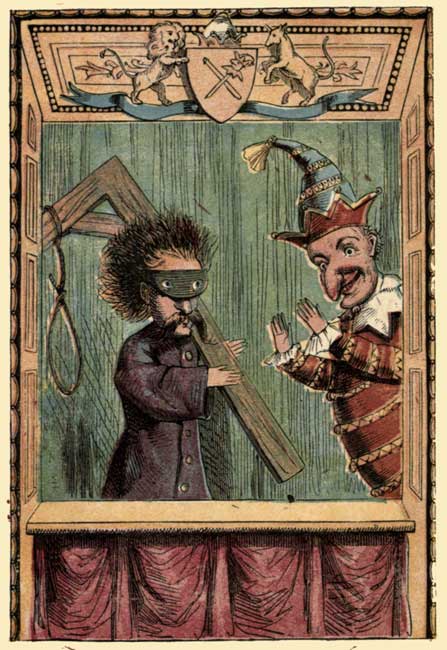
The “Jack Ketch” character from a Punch and Judy puppet show: traditionally, Punch gets the better of their meeting and hangs Jack Ketch.
The Irish immigrant Ketch is the first name in English executioners. Indeed, you can call any of his successors right down to Pierrepoint a “Jack Ketch” and be perfectly understood.
The immediate successor, however, was Ketch’s own assistant — who inherited top billing after Ketch went to jail for “affronting” a sheriff.
Jack Ketch had been trodding the scaffold-boards, hanging, beheading, and drawing-and-quartering for two-plus decades at that point: he’s thought to have been appointed in 1663, and he’d inserted himself into those performances rather more prominently than an executioner ought by botching some of Restoration England’s most high-profile executions.
There’s little reliable information about these early executioners, but it seems Ketch’s reputation for clumsiness had forced him to issue an “Apologie” justifying himself.
But the man unquestionably had longevity in his favor, which is more than Paskah Rose could say.
Within months of becoming the chief London executioner, Rose and another man were chased down in the act of burgling clothes from a house, “the Goods found in Rose’s Breeches.”
Rose and his co-defendant Edward Smith accordingly hanged along with three others at Tyburn this date — by Jack Ketch, now returned from his carceral retirement for one last tour.
Ketch died late that same year of 1686, but has lived on in any number of ballads, doggerels and broadsides immortalizing the name. He was surely aided in this by the less impressive caliber of many who succeeded him: it wasn’t long after Ketch dispatched Pascha Rose that another “Jack Ketch” — an ignoble profession that wouldn’t until centuries hence be drawn from the country’s respectable classes — also met Pascha Rose’s same fate.
One of these two gentleman might well be the flesh-and-bones person behind the ghoulish ecorche sculpture known as “Smugglerius”.
This beautifully ghastly item was commissioned of sculptor Agostino Carlini by the anatomist William Hunter: it is the cast of a hanged man, meticulously flayed of his skin to reveal the musculature for the convenience of future students’ sketches. Those students gave their subject the jocular nickname, since in life it was thought to be a smuggler.
For good measure, Carlini posed the corpse in the manner of the Hellenistic marble Dying Gaul.
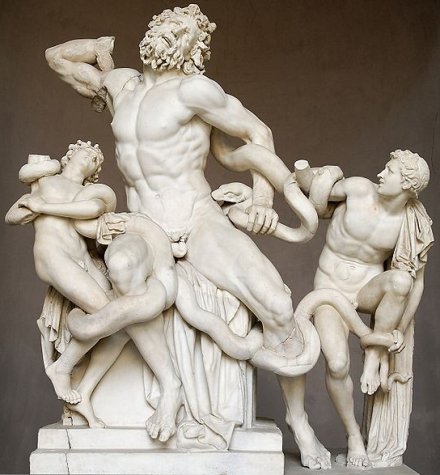
Dying Gaul (known in the 18th century as Dying Gladiator), one of the world’s best-known classical sculptures. (cc) image from Tom Magliery.
He recked not of the life he lost, nor prize,
But where his rude hut by the Danube lay,
There were his young barbarians all at play,
There was their Dacian mother, — he their sire,
Butchered to make a Roman holiday; —
All this rushed with his blood; — Shall he expire,
And unavenged? — Arise! ye Goths, and glut your ire!
A copy of Agostino Carlini‘s bronze cast of “Smugglerius”, displayed in Edinburgh. (cc) image from Chris Hill.
So that is Smugglerius, an astonishing artifact. For decades, it (actually a copy of Carlini’s original, which is long lost) has been parked at the Edinburgh College of Art, translating thence into countless students’ anatomical sketch pads.
To trace the ecorche‘s origin, we have, to start with, this letter from John Deare … not the tractor guy, but a noteworthy Liverpool sculptor. At time of writing in 1776, he was a 15-year-old matriculating art student:
One of the men bid me tell you, that Mr. Carter would give me half-a-guinea, at least, a week, for the first part of my time, and fifteen shillings for the latter part; but you will write to him, and ask him what he proposes: he is, just as they say, a blustering fellow, but a good man. I have seen two men hanged, and one with his breast cut open at Surgeons’ Hall. The other being a fine subject, they took him to the Royal Academy, and covered him with plaster of Paris, after they had put him in the position of the Dying Gladiator. In this Hall there are some casts from Nature that are cut from the middle of the forehead down to the lower part of the body, one part excoriated, and the other whole.
With the direct reference to the Dying Gladiator/Dying Gaul pose, we seem very clearly to have a bead on the creation of Smugglerius, and the letter suggests that it was one man taken from a pair of hanging subjects. Conveniently (or inconveniently) there were just two such pairs of executions at Tyburn in the spring of 1776: those of Benjamin Harley and Thomas Henman on May 27; and, those of Samuel Whitlow and James Langar on April 12.
Now, artist Joan Smith and anthropologist Jeanne Cannizzo have recently, and very publicly, argued that Smugglerius is not Harley or Henman, but James Langar — a man from the earlier hanging pair. This claim even teased an exhibition carrying the perhaps unfortunate title Smugglerius Unveiled.
The case for Langar basically has two components:
Deare dated his letter about the “Dying Gladiator” on May 1, so the executions must precede that date — which means that it’s one of Langar or Whitlow.
It’s more likely that Langar, a soldier, would have had the outstanding physique to attract Hunter’s interest. (Whitlow was a domestic servant who robbed his master in an unrelated crime.)
Headlines aside, this sleuthing obviously falls well shot of airtightness.
Historian Tim Hitchcock, incidentally a moving spirit behind the creation of the invaluable Old Bailey Online database, doesn’t find James Langar a persuasive candidate. In private communication with this site (4 April 2012), he remained “still very much of the opinion that [Smugglerius] is either Thomas Henman or Benjamin Harley … I am even more convinced now than before.” Here’s the case for one of the Harley/Henman pair:
Harley and Henman were smugglers. You know … like Smugglerius?
Trial records indicate death-sentenced prisoners also condemned to anatomization, and they do not say that about Whitlow and Langar, who were merely thieves
Harley and Henman, by contrast, had killed; they were therefore subject to the Murder Act, and accordingly sentenced “to be afterwards dissected and anatomized; which sentence was executed upon them”*
All things equal outside of the date on Deare’s letter, Harley and Henman look much the likelier source of Smugglerius. (If so, we seem to lack any good reason to prefer Harley as the Smugglerius model as against Henman, or vice versa. Flip a coin.)
The historiography for Langar depends inordinately upon the present-day interlocutor’s confidence in the “1 May” date a Georgian-era teenager slapped onto a bit of personal correspondence with, one can be sure, nothing resembling academic gravity. May 1 could be mistaken outright (maybe it was June 1, and he wrote “May” out of the previous 31 days’ habit); or, it could be only a reference to when Deare began a letter that he might have composed over several weeks; or, it could be that the author had some trivial reason of personal expediency to backdate.
Maybe so, maybe not. But who would have thought anyone would be interested in Harley or Henman (or Langar) going on two and a half centuries after their deaths.
Executed Today had occasion to discuss this fascinating object d’art and its discomfiting origin with one of Hitchcock’s collaborators, IUPUI Professor of British History Jason M. Kelly.
ET: What’s the background? Why is Smugglerius being produced at all in 1770s Britain?
JK: Well, 1768 marked the establishment of the Royal Academy of Arts. It took over 20 years to create.
The idea was to give Britain a school of art — of painting, sculpture, and architecture — to rival its continental peers. The French had established art academies in the previous century; they were among the premier art schools in Europe, if not the premier schools.
The British didn’t have anything comparable. And, in an age of rivalries, both political and cultural, artists and patrons alike saw the Royal Academy as central to British national identity.
The Academy hired William Hunter to be the professor of anatomy. He was an anatomist — a doctor — by training, not an artist, so he was very interested in teaching things like musculature, skeletal structure, and the circulatory system.
Smugglerius was not William Hunter’s only ecorche. He had made at least one other as a teaching aid, and he was proud to associate himself with it. He even poses for a portrait with a miniature version of it.
They had to get the body from the gallows to the art academy. Then they flayed it. In this case, somebody decided to pose the corpse as the Dying Gladiator.
They had some time prior to rigor mortis to get everything situated. in this case, they flayed him, posed him, then let him dry out, possibly overnight, so that they could make a mold of his body.
Beyond its immediate use as a teaching device, it’s also an art object for appreciation in its own right. How do you read that phenomenon?
This is very much a representation of the power of the state, the unrestrained power.
The execution itself is a display of power, but the government went further when in 1752 it passed the Murder Act allowing the College of Surgeons to get six bodies a year to dissect.
Ordinary people had no desire to have their remains used in this way. In the example of Smugglerius, the criminal was executed. Then, the body was desecrated — transformed into an art object for elite connoisseurs.
The sculpture was meant to represent ideal beauty as well as the terrifying strength of the state. The very people who were meant to appreciate the model of the Dying Gaul were the same people holding the reigns of power. In a sense, this image reinforced the elites’ view of the world, both aesthetically and politically.
Why pose the figure in this way, as the Dying Gaul or Dying Gladiator?
There’s one reading of Smugglerius to the effect that it was very subversive because the Dying Gladiator was seen as emblematic of the decline of Rome: the sculpture represented Rome’s decadence and corruption.
an inveterate abuse, which degraded a civilised nation below the condition of savage cannibals. Several hundred, perhaps several thousand, victims were annually slaughtered in the great cities of the empire; and the month of December, more peculiarly devoted to the combats of gladiators, still [in the early 5th century] exhibited to the eyes of the Roman people a grateful spectacle of blood and cruelty … which had so long resisted the voice of humanity and religion.
So, you could speculate that this pose slyly represented contemporary executions under the Bloody Code in the same critical way.
The Gladiator was also one of the best-known and -admired classical sculptures in all of Europe, along with the Laocoön.
In the 18th century they were compared as two examples of dignified dying. Contemporaries saw a certain stoicism in the sculptures — even though Virgil wrote that Laocoön cried out.
Ultimately, Smugglerius reminds us what happens when power is unrestrained. In a world where most people don’t have a voice, the state can ignore the rights and dignity of individuals. The real story here is the story of arbitrary authority and the importance of an enfranchised citizenry with the ability to put limits on those wielding power.
* Hanged felons not sentenced to anatomization could still wind up being taken apart in an operating theater, either as a result of their striking a direct bargain with the surgeons, or involuntarily via London’s growing trade in illicit corpses.
Shrieking in terror, Lefley had to be dragged to the gallows — still protesting her innocence. She’d never admitted to the crime, and they’d never been able to show that she purchased any arsenic.
There was some thought that William may have committed suicide: he’s known to have attempted it once before. But the more outlandish defense hypothesis that some unknown third party might have snuck in and poisoned the morsel gained unexpected credence in 1893 when a farmer made a deathbed confession to having done just that … over a wholly unrelated-to-Mary financial grudge.
* Mary Lefley knew the last notorious Lincolnshire poisoner, Priscilla Biggadyke — who hanged for poisoning off her husband in 1868. “They are hanging me for my past!” Lefley exclaimed when she was convicted. (Priscilla turned out to be innocent, too.)
We take this story from the dispatch filed the same day for the London Telegraph and reprinted in the New York Times. Paragraph breaks have been added for readability.
Dilatory as the French authorities are in bringing culprits to trial, they dispatch them with terrible haste so soon as their guilt has been certified by the final Court of Appeal. No public notice is ever given of an execution, and few people ever hear of it until it is all over.
A paragraph appeared in an evening paper last night to this effect: “The Commission of Pardons has commuted the sentenced passed on PASCAL and LUCIPIA; the appeals of SERIZIER, BOIN and BOUDIN have been rejected.” To the world at large this paragraph conveys no hint as to the date of execution; the initiated read between the lines that on the following morning, dawn will rise on a dismal military pageant on the plains of Satory.
There is, nevertheless, a certain amount of uncertainty in the matter, so very closely are all such secrets kept in France; and it was only on the receipt of a hint from a high authority that some time after midnight I determined to start with a friend for Satory. The impression made upon me by the ghastly spectacle I shall try to describe in the plainest possible language.
SATORY.
A finer exercising ground than the plain of Satory it is not possible to imagine. The ground is as flat as a billiard-table, and it is not devoid of a certain beauty — the thick turf being singularly fresh, and he vast square plain surrounded by a belt of fine trees.
Troops are marching in companies to take up their appointed positions on the ground. A raised battery is a prominent object, and opposite to it, at some distance, is a huge earthen mound, against which a target stands out distinctly in black and white. The troops are forming in three sides of a square, which is completed by this butt.
It is not until you get quite close to the mound that you perceive on the lower ground immediately in front three white sticks ranged in a line, each about four feet high and five feet apart. These are the poteaux against which the culprits are to stand.
A good many soldiers, not on duty, have turned out en amateur to see the show; they collect on the top of a mound near the butt, but they are driven down by the artillery sentinels and mounted police, who, dressed in a little authority, canter about with superfluous fidgety zeal.
The morning air is chill, and everybody on duty or off duty tries to comfort himself with a smoke. “Nous avons encore trente-cinq minutes,” says a sergent-de-ville, in a grumbling, querulous tone. And the condemned men? They only had thirty-five minutes, and methinks they had as much reason to complain.
A soldier proceeds to work at the target, sqwing it off short; he is going to take it away, perhaps, that it may not divert the soldiers’ aim; and one feels irritated with him for being so slow.
One wonders, too, that they have allowed the red signal flag to remain at the top of the butt. Would not a Communist see an omen or an augury in the accident?
An engineer close to me is coolly fashioning wedges, in preparation for the artillery practice, which is to begin “aussitot que cette affaire est finie.”
Another protests impatiently that he wants his breakfast. Three dogs, which are perpetually frightening the horses of the mounted police, as well as the riders, excite continual merriment. There are scarcely more than a dozen civilians present, but I observe two women.
One — a brazen-looking creature, with a black mustache, and wearing that peculiar kind of hooded cloak which you see constantly in Belgium — was laughing a hoarse, harsh laugh, that chilled one’s blood. The other was charmingly dressed in black silk, and looked like a lady; she spoke to nobody; her face was deadly pale; her eyes were large with tears, and yet there was a strange compression about the lips that told of intesnse firmness of purpose. Her bearing was rigidly calm, but I fancied that the stick of her dainty black parasol was snapped in two.
What had that woman to do at such a scene? I know not; but, assuredly, it was not curiosity that brought her there. There was now a slight diversion. A cart drove up covered with black cloth, and hid itself away to the left of the poteaux.
THE EXECUTIONERS AND THE CONDEMNED.
Then the pelotons or firing parties marched in and piled arms opposite the same slim sticks about which everything in that huge plain seemed to gather of its own accord.
The pelotons were taken, one from the line, two from the Chasseurs de Vincennes. Hardened though they must be by this time and embittered though they are against the Communists, I do not think, to do them justice, that they liked their duty. They looked pale, they were perpetually falling out, and they smoked with suspicious eagerness.
I tried to impress on my own mind that these fellows were murderous ruffians who had slain unoffending fellow-creatures in cold blood. SERIZIER and BOIN, Colonel and Lieutenant in the Communist army, had tortured and killed the very priests who had devoted themselves to the task of tending the wounded on both sides, for no reason but that they were good men. BOUDIN had actually shot down a chemist in the Rue Richelieu because he protested against his son, a mere lad, being impressed into working at a barricade.
But, with the best will in the world, I could not persuade myself that it was right and proper for 5,000 soldiers to be brought out under arms for the mere sake of killing three defenceless wretches. Meanwhile the minutes passed on; the officers rolled up cigarettes, compared watches, and consoled each other with the reflection, “Soyez tranquille, mon cher, ca sera l’heure militaire.”
And so it was; for just as the first silvery tones of a distant church clock were wafted across the heath, striking the hour, the trumpets rang, the drums beat Aux champs, the troops dressed up, and the three ambulance wagons dashed into the square at a sharp trot.
The prisoners had not been apprised of their appeal hvaing been rejected until four o’clock in the morning, but they seem to have accepted their fate with singular philosophy. They had all eaten and drunk, and SERIZIER had asked for a “pipe of tobacc” for the last time. In driving along he said to the two gendarmes by whom he was accompanied, “Wat a mistake I made to quit Belgium! Quelie belle affaire j’ai fait la. C’est egal, je saurai bien mourir.”
Strangely enough, he confessed to a Dominican, a priest of the ver order against which he had shown such diabolical hatred.
Each man was accompanied by two gendarmes. And here I cannot help noting one of the strange peculiarities of an over-excited state of mind. When the drums beat “Aux champs,” the merely dramatic feeling of the scene was intensely moving.
And yet when, a moment later, I first caught sight of the tops of the jack-boots of the first tell gendarme who appeared at the ambulance doors, I was so forcibly reminded of “Le Petit Faust,” and scores of other pieces wherein these functionaries are held up to ridicule, that I almost burst out into hysterical laughter.
The tragedy, however, soon proved too terrible, for the gendarme was closely followed by BOIN, who had scarcely touched the ground before he exclaimed, waving his hat in the air, “Vive la Commune!”
The three men walked quickly to the poteaux, and placed themselves in position as coolly as though it were the most natural thing in the world. They then, as though with one accord, flung their hats or caps into the air, and shouted several times in thrilling tones, “Vive la Commune!”
They all three were smoking. SERIZIER threw away his pipe, but BOIN kept his cigar in his hand, and BOUDIN was actually smoking as he fell. The face of the latter was so covered up by the handkerchief with which he alone allowed his eyes to be bandaged that his features could not be discerned.
SERIZIER, who was in the middle, indignantly threw down the handkerchief with such force as to cast it far beyond him. BOIN also refused the bandage wherewith the soldier stationed beyond him offered to cover his eyes, and by an involuntary action he put it into his pocket.
BOUDIN was coarsely clad; and SERIZIER, an undersized man, with heavy sensual features, looked like the type of a London rough. BOIN was a tall, well-built man, having good, clean-cut features and black mustaches. He was dressed in a light-brown velvet coat, Garde Nationale trousers, and a colored-scarf round the waist.
THE EXECUTION.
The priest, going up to each in turn, kissed him on both cheeks, in what seemed to me a hurried and perfunctory manner.
Then, while the sentence was being read to the prisoners in a quick, low, quite inaudible tone, BOIN made a long harangue, much of which was lost in the perpetual rolling of those ghastly drums.
But one could distinguish snatches of sentences such as “Soldiers, you are children of the people as we are, and we will show you how children of the people can die. Nous mourons innocents,” and then opening wide his light coat — he wore no waistcoat — he offered his white shirt-front for a mark, and, striking his heart with his open palm, he exclaimed: “Portez armes en joue! feu! tirez au coeur!”
This he repeated several times, and while he was yet speaking, standing out clear away from the poteaux and looking death at ten paces literally in the face, a sword flashed in the sun, and the three men leaped from the ground only to fall to it in horrible contortions.
The smoke and the report were unheeded, for all the senses of the horrified spectator were arrested by the awful spectacle of writhing limbs and twisting hands.
BOIN seemed to be rewarded for his bravery by suffering less than the others, but SERIZIER literally rolled over, and BOUDIN also moved. The surgeon then went up, examined BOUDIN first, and then directed one of the sergeants in reserve to give the coup de grace in the ear. Then SERIZIER was examined and treated in the same way; and lastly, after a considerable interval, BOIN was dragged into position and dispatched.
I cannot give you any idea of the sickening impression produced by this seemingly deliberate butchery.
I say seemingly, for the men may have been dead, but, in any case, surely if the coup de grace must be given, it should be done at once. I did not time the proceedings, but, long as my description is, I believe that not more than two minutes elapsed from the time that the ambulance wagons came on to the ground to the time that the volley was fired.
Several more minutes, however, elapsed before the dull thud of the last coup de grace delivered a bout pontant right into the poor wretch’s ear struck upon the ground. I have seen something of the horrors of war at Sedan and Strasbourg; I have witnessed the degradations of a public hanging in England, but have never seen anything so horrible as this supplemental butchery of the coup de grace.
AN AFTER SCENE.
When the surgeon and his attendants retired fro the poteaux, it became evident that painfully long as the interval had been, he had not been sparing of trouble. For with an eye to dramatic effect, he had disposed the bodies symmetrically, so that their feet should point towards the defiling troops.
Then the trumpets struck up a lively tune, and all the troops present — three batteries of artillery, carbineers and other caalry, four or five battalions of the line, engineers, &c. — some five thousand men — marched at quick step before the stark, stiff, staring bodies.
I cannot think that such a sight can have any other effect than that of exciting sympathy for the guilty. To see a man lying on his back there, his head a shapeless mass and the large red spot on his breast growing every moment larger and larger, and to think that not ten minutes ago he was speaking with passionate eloquence — this tended rather to make one forget his crimes than to remember his cruelty.
Yet I am bound to confess that this feeling is not shared by all, for when the troops had passed by, and the black van had driven up and unladen its dreadful burden of plain coffins, I saw an officer point with his foot at the yet warm brains of BOIN, and I heard him say, “C’est avec celui qu’il a fait son discours.”
On this date in 1944, Italy’s fascist rump government shot its former naval commander in Parma.
Inigo Campioni (English Wikipedia page | Italian) was both a Senator and the Admiral in charge of Italy’s main battle fleet when war came in 1940.
Knocked for overcaution during a few engagements with the British, he was relieved of his leading command position by the end of that year.
Come September 1943, he was at the island of Rhodes when Italy agreed to an armistice with the Allies. This was actually quite an unlucky spot to be, since the Germans, anticipating this development, had prepared a lightning Dodecanese Campaign to seize Italy’s positions in the Greek islands.
Many Italians resisted the German incursion, and suffered some of the war’s more infamous massacres for their trouble.
Campioni, who likewise recognized the government that signed the armistice, was captured within three days.
Unlike those recalcitrant Italians who met a summary fate, the admiral’s stature made him worth the trouble of trying to persuade. He was shipped first to a camp in Poland then to a prison in the northern Italian fascist statelet still headed by his former boss, Mussolini.
Campioni just kept refusing to recognize this Italian Social Republic: even to the end, he had a reprieve from shooting on offer for the price of an expedient word.
For never speaking that word, and instead suffering the fusillade with fellow-admiral Luigi Mascherpa, Admiral Campioni has been well-honored in posterity.
On this date in 1484, the onetime royal barber turned noble scoundrel was hanged at the terrifying Montfaucon gibbet.
Jolly grotesque “Olivier le Necker” (“Olivier the Devil”) statue in Tielt, Belgium. (cc) image from Zeisterre.
The scheming Olivier le Daim (English Wikipedia page | French), who ought to be patron saint of networking, got himself a gig as the sovereign’s coiffeur and glad-handed his way from straight razors all the way to the aristocracy. A presumably smooth-shaved Louis XI created him comte de Meulant.
Louis was an inveterate schemer known as the “Universal Spider”, and Olivier — excuse me, the comte — from his sprawling fortified manor proved an eager confederate. As Louis had a gift for infuriating the realm’s noble houses, he liked to elevate commoners into his entourage, men like our “Meulant” and Cardinal Balue whose loyalty could be relied upon since they owed their positions to the crown.
“That terrible Figaro whom Providence, the great maker of dramas, mingled so artistically in the long and bloody comedy of the reign of Louis XI,” Victor Hugowrote of our man in The Hunchback of Notre Dame. “This barber of the king had three names. At court he was politely called Olivier le Daim (the Deer); among the people Olivier the Devil. His real name was Olivier le Mauvais.” [Meaning “the bad”, as with “Charles le Mauvais”, the king Charles the Bad — a real bastard.]
With the disintegration of Burgundy following the death of Charles the Bold, le Daim was sent to that duchy’s Belgian reaches to connive them into French hands.
And if, according to everyone else, Oliver the Bad was a swaggering, nasty villain, he still remained loyal to Louis all the way to the latter’s deathbed. Louis recommended him to his successors’ favor, but once the Spider King was gone the put-upon lords of the realm vented their blueblooded spleens upon Olivier. (A servant of Olivier’s named Daniel also suffered the same fate.)
It’s not clear to me that history records the exact charge furnishing the pretext for his execution this date — this suggests abuse of his power to order executions — but it does certainly bequeath us this epitaph:
Cii gist le Diable
Baptisé le Dain
Jugé pendable
Barbier suzerain
In 1881, the Hawaiian [Po’olua] grew enraged when his when his common-law wife, according to the papers, “paraded her infidelity” before him and slaughtered her with a “big butcher knife.” Then, in a fit of remorse, he draped his house in mourning with black crepe paper.
… The experts of the day — family doctors and preachers — were conducted in to interview the bewildered man. They questioned him and concluded that he was not insane. Po’olua himsel agreed that he was sane but “darkened in my mind.” … the Reverend H.H. Parker explained the man’s actions this way: “A Hawaiian would do many things which a white man would not.”
When it as found that Po’olua had a heart abnormality and that he would likely die soon anyway, letters of clemency were circulated on his behalf. But he was hanged on May 20, 1881. Permission was sought for a post mortem to investigate the state of his heart, but officials denied the request. The Advertiser remarked that it “should have been done. Being attended to, might have laid him quiet in his grave; but being forbidden, his spirit will rise up Banquo-like for many a day to come.”
On this date in 1998,* Wissam Issa and Hassan Jabal were shockingly hanged in public in Tabarja, Lebanon.
Executions hadn’t seen the outside of prison walls in that country for 15 years at that time — back when there was a civil war on.
But Issa and Jabal were condemned for a home burgling attempt gone wrong(er): when the owners unexpectedly returned, Issa fled — but Jabal gunned them down. They both answered for the murders.
Marched out onto a somewhat jerry-built hanging platform (Issa was stoic; Jabal, unmanned), the two died at dawn before a crowd of 1,500 to 2,000 spectators … and plenty of cameras. The grisly proceedings made the nightly news, of course.
“It was horrible,” one Tabarja woman remembered. “The kids were playing at hanging each other afterwards at school.”
Oddly enough, it was also the last hanging (private or public) for over five more years to come. Later in 1998, a staunch death penalty foe became Prime Minister, and refused to approve any execution warrants.
Two centuries ago today, the only man to assassinate a British Prime Minister was hanged for his trouble.
The man at the end of the rope, John Bellingham, was a Liverpool businessman who had gone to Archangel, Russia to do some export/import trade and there been spuriously accused a debtor and slapped in prison for five years.
His target, Spencer Perceval, was the pious Tory heir to the late William Pitt, and famous (or infamous) for his evangelical personal rectitude and an accompanying status-quo smallness. (He was physically short, too.) “He has looked at human nature from the top of Hampstead Hill,” snorted his contemporary Sydney Smith, “and has not a thought beyond the little sphere of his own vision.”*
Though others judge more generously of him, Perceval’s overall reputation is that of the prim caretaker, violently anti-Bonaparte, anti-Catholic, anti-adultery, anti-worker, anti-egalitarian, anti-democratic, anti-slavery. Anti- a lot of things.
Anti-cluttering up his schedule was the thing that did him in.
John Bellingham returned from his sojourn in the Romanovs’ dungeons in 1809, understandably embittered over his ordeal and the bankruptcy it had driven him into. He then besieged the government with demands for compensation, but met a cold reception all over and got no reply at all for his request to meet with Spencer Perceval.
So Bellingham did what anyone would do: he walked up to Perceval at Westminster on May 11, 1812, and shot him dead.
Then the strange perpetrator with the private grievance re-seated himself comfortably by the fireplace (rather than exploiting the hubbub to fly), where he was promptly arrested. They didn’t mess around back then: John Bellingham was on trial for his life four days after pulling the trigger.
Nevertheless, as the rumor first spread there were fears — or in some cases, hopes — of Jacobin intrigues afoot. And it’s safe to say that the nation’s magnates had better cause than its underclasses to mourn Perceval. “Among the multitude,” one parliamentarian remembered of those days, “the most savage expressions of joy and exultation were heard: accompanied with regret that others, and particularly the attorney-general, had not shared the same fate.”
Clearly something less than fully rational, Bellingham was also more than lucid enough for the hemp. A minister who visited him in the hours before his execution found him unsettlingly unrepentant, and attributed to “the perverse inflexibility of his character” Bellingham’s delusional “self-vindication. He had accordingly taken his ground, and there he obstinately stood; and the weakness of his allegations only increased the firmness by which he was determined to maintain them.”
He had, indeed, maintained them openly at trial, bizarrely casting his homicide as a blow for better government to remind ministers of state to keep longer office hours.
Finding myself thus bereft of all hopes of redress, my affairs ruined by my long imprisonment in Russia through the fault of the British minister, my property all dispersed for want of my own attention, my family driven into tribulation and want, my wife and child claiming support, which I was unable to give them, myself involved in difficulties, and pressed on all sides by claims I could not answer; and that justice refused to me which is the duty of government to give, not as a matter of favour, but of right; and Mr. Perceval obstinately refusing to sanction my claims in Parliament; and I trust this fatal catastrophe will be warning to other ministers. If they had listened to my case this court would not have been engaged in this case, but Mr. Perceval obstinately refusing to sanction my claim in Parliament I was driven to despair, and under these agonizing feelings I was impelled to that desperate alternative which I unfortunately adopted. My arm was the instrument that shot Mr. Perceval, but, gentlemen, ought I not to be redressed; instead of that Mr. Ryder referred me to the Treasury, and after several weeks the Treasury sent me to the Secretary of State’s office; Mr. Hill informed me that it would be useless to apply to government any more; Mr. Beckitt added, Mr. Perceval has been consulted, he would not let my petition come forward.
Gentlemen, A refusal of justice was the sole cause of this fatal catastrophe; his Majesty’s ministers have now to reflect upon their conduct for what has happened. Lord Gower is now in court, I call on him to contradict, if he can, the statement I have made, and, gentlemen, if he does not, I hope you will then take my statement to be correct. Mr. Perceval has unfortunately fallen the victim of my desperate resolution. No man, I am sure, laments the calamitous event more than I do. If I had met Lord Gower he would have received the ball, and not Mr. Perceval. As to death, if it were to be suffered five hundred times, I should prefer it to the injuries and indignities which I have experienced in Russia, I should consider it as the wearied traveller does the inn which affords him an asylum for repose, but government, in the injustice they have done me, were infinitely more criminal than the wretch, who, for depriving the traveller of a few shillings on the highway, forfeits his life to the law. What is the comparison of this man’s offence to government? or, gentlemen, what is my crime to the crime of government itself? It is no more than a mite to a mountain, unless it was proved that I had malice propense towards the unfortunate gentleman for whose death I am now upon my trial. I disclaim all personal or intentional malice against Mr. Perceval.
According to a Frenchman in England at the time, the still-sympathetic public raised for Bellingham’s widow and orphan a subscription “ten times greater than they could ever have expected in any other circumstances.”
A few topical books
* In Peter Plymley’s Letters, which is full of vituperation for Perceval’s harsh Irish policy … words that could go just as readily for many a reputed statesman in many a time and circumstance over the two centuries elapsed since.
I cannot describe the horror and disgust which I felt at hearing Mr. Perceval call upon the then Ministry for measures of vigour in Ireland. If I lived at Hampstead upon stewed meats and claret; if I walked to church every Sunday before eleven young gentlemen of my own begetting, with their faces washed, and their hair pleasingly combed; if the Almighty had blessed me with every earthly comfort — how awfully would I pause before I sent forth the flame and the sword over the cabins of the poor, brave, generous, open-hearted peasants of Ireland! How easy it is to shed human blood; how easy it is to persuade ourselves that it is our duty to do so, and that the decision has cost us a severe struggle; how much in all ages have wounds and shrieks and tears been the cheap and vulgar resources of the rulers of mankind; how difficult and how noble it is to govern in kindness and to found an empire upon the everlasting basis of justice and affection! But what do men call vigour? To let loose hussars and to bring up artillery, to govern with lighted matches, and to cut, and push, and prime; I call this not vigour, but the SLOTH OF CRUELTY AND IGNORANCE. The vigour I love consists in finding out wherein subjects are aggrieved, in relieving them, in studying the temper and genius of a people, in consulting their prejudices, in selecting proper persons to lead and manage them, in the laborious, watchful, and difficult task of increasing public happiness by allaying each particular discontent. In this way Hoche pacified La Vendee — and in this way only will Ireland ever be subdued. But this, in the eyes of Mr. Perceval, is imbecility and meanness. Houses are not broken open, women are not insulted, the people seem all to be happy; they are not rode over by horses, and cut by whips. Do you call this vigour? Is this government?


 One of these two gentleman might well be the flesh-and-bones person behind the ghoulish



 Inigo Campioni (