1993: Leonel Herrera, perilously close to simple murder?

On this date in 1993, Leonel Herrera was executed by lethal injection in Huntsville, Texas, for shooting two policemen. Herrera’s last statement averred,

Herrera’s sister Norma self-published this book about the case — keeping a promise to her executed brother.

I am innocent, innocent, innocent. Make no mistake about this; I owe society nothing. Continue the struggle for human rights, helping those who are innocent, especially Mr. Graham. I am an innocent man, and something very wrong is taking place tonight. May God bless you all. I am ready.

Well, Herrera wasn’t the first to go to his death maintaining his innocence. The circumstances (and circumstantial evidence) of the crime rate on the forgettable side.

But Leonel Torres Herrera was a bit different from his cousins in hopeless protestation: while he died this evening, his name lived on … in a landmark Supreme Court decision

Herrera v. Collins

Years after Herrera was convicted and death-sentenced, multiple affidavits were produced to the effect that his late brother, Raul, was the real killer.

This evidence was naturally pursued with gusto by the condemned man.

Unfortunately, a claim like Herrera’s of “actual innocence” faces a very high bar when raised in appellate courts, once a prisoner has already been convicted and their presumption of innocence become a presumption of guilt.

That this arbitrary rule of the game has a defensible rationale — could any criminal justice system operate if prisoners could continually relitigate their cases while memories fade and evidence ages into obsolescence? — does not make it the less Kafkaesque for individual prisoners, some of whom are in fact innocent.

Herrera presented this problem in unusually stark terms. Lacking any procedural violation upon which to hang his hat as an appeals issue, his claim pitted substance against form in the Supreme Court. (Oral arguments at Oyez.org)

You already know how it ended.

Chief Justice William Rehnquist’s opinion patiently explained a jurisprudential truism loftily uncolored by any experience in life liable to introduce a sense of kinship with a Hispanic man charged with a Texas cop-killing who uncovers too late the evidence that could save him.

“[A]ctual innocence” is not itself a constitutional claim.*

Instead, the Court recommended — tongue no doubt planted firmly in cheek — that Herrera apply for executive clemency, a dead letter procedure in Texas used exclusively in a good cop/bad cop routine opposite the black robes.

“Judicial restraint forbids relieving you,” says the court. “Go ask the governor.”

“The courts have thoroughly reviewed the case,” intones the governor. “May God have mercy on your soul.”

Herrera himself may or may not have been innocent. At the end of the day, he went down because the game was rigged against him: his exculpatory evidence was not available at trial, when it might have introduced “reasonable doubt” — as Rehnquist’s opinion put it, “in state criminal proceedings the trial is the paramount event for determining the guilt or innocence of the defendant.” Once that evidence became available deep in the appeals process, it was procedurally barred, and far from such a slam-dunk exoneration that any institutional actor would stick his, her or its neck out to lift Leonel Torres Herrera from the gurney.

Justice Harry Blackmun’s dissent retorted,

Just as an execution without adequate safeguards is unacceptable, so too is an execution when the condemned prisoner can prove that he is innocent. The execution of a person who can show that he is innocent comes perilously close to simple murder.

Whether “simple murder” happened in Huntsville this night in 1993, perhaps no one can really say with certainty.

But as DNA evidence and other forensic advances in the intervening years have increasingly eroded confidence in the reliability of the justice system that metes out death, Herrera v. Collins stands as a key precedent in a case now before the Supreme Court — in which states (joined by the Obama administration) are asking the justices to agree that convicted prisoners have no right to cheap, simple, and frequently dispositive DNA testing that may not have been available when they were tried.

Given the composition of the court (including three holdovers from the Herrera majority), that decision figures to have Leonel Herrera rolling over in his grave.

* Rehnquist conceded a theoretical possibility that extraordinarily persuasive evidence could generate relief on due process grounds. Antonin Scalia and Clarence Thomas went much further, claiming that prisoners had no right to anything but their trial and their (procedural) appeals.

On this day..

1994: John Wayne Gacy, scary clown

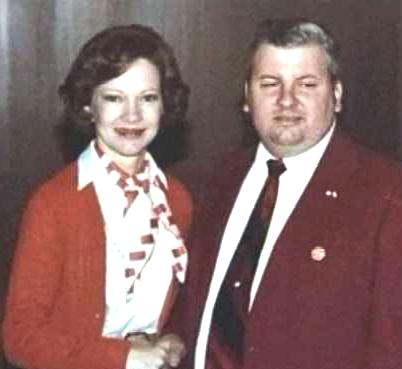
This date in 1994 was the last on earth for Pogo the Clown — better known as John Wayne Gacy.


Hello, children.

The local small businessman and closeted pederast filled his crawlspace with the remains teenage boys he’d either kidnap off the street, or hire in his capacity as an independent contractor.

When he wasn’t raping and murdering, he kept up appearances as a Democratic machine operative (once photographed with First Lady Rosalynn Carter) and amateur block party harlequin.

Gacy was a notable “serial killer artist” in the years he spent awaiting lethal injection.* In that capacity, the clown motif continued to inspire him.


* The lethal injection was botched with a clogged IV tube. It took 18 minutes.

On this day..

1947: Willie Francis, this time successfully

(Thanks to Gilbert King, author of The Execution of Willie Francis (book site), for the guest post, the second of two. Read the first here.)

On May 9, 1947, Willie Francis was executed in the same electric chair that he had walked away from a year and a week earlier, when a drunken prison guard and trustee bungled the wiring. Willie’s story had made front-page headlines around the country as the United States Supreme Court grappled with questions about what the State of Louisiana was permitted to do with regard to double jeopardy and cruel and unusual punishments.

One of the things that drew me to this story as I was working on my book, The Execution of Willie Francis, was the shroud of secrecy that surrounded the Willie Francis case.

Willie was accused and convicted of killing 53-year-old Andrew Thomas, a Cajun pharmacist who was something of a mystery to the people in the small town of St. Martinville, Louisiana. Thomas’ brother Claude was the town’s chief of police, and Willie was convicted by twelve Cajun jurors and sentenced to death by a Cajun judge. His court-appointed attorneys neither called nor cross examined any witnesses, and did not even make a case in defense of their 16-year-old client.

The prosecution based its entire case on a confession obtained while Willie was in police custody without the aid of a lawyer. In this confession, Willie wrote, “it was a secret about me and him,” which was never explained. It was obvious to me that there was more to Willie’s story than the version presented in trial and to the public.

In my research, I came across a photograph taken on the evening Willie had survived his own execution. He’d been brought back to his cell, and the sheriff allowed reporters and a photographer to visit with Willie, where he told them that death tasted “like peanut butter” and looked a lot “like shines in a rooster’s tail.” The photographer asked for a few pictures, and Willie, holding his dog-eared Bible, stood in front of a dull pink wall. The flash fired.

This picture was never used by any of the newspapers. There was a lot of glare on the wall, and the photographer had gotten a much better one of Willie smiling — the picture that ended up on the front page of many newspapers the next day. But there was some writing on the wall image that was barely legible. I scanned it onto my computer and ran it through Photoshop, adding contrast and burning and dodging until the words could be read. The handwriting matched Willie’s.


Detail of the enhanced photograph. Click for the full image.

Not surprisingly, the sheriff had testified under oath that Willie had confessed to killing Andrew Thomas in writing on the wall of his cell a month before he was scheduled to die in the chair. But the Sheriff had also taken Willie’s words out of context, reading only select portions of the writing, and mischaracterizing others. In fact, Willie Francis, just as he had when he wrote in his confession that “it was a secret about me and him,” alluded to something different than the robbery-turned killing prosecutors accused him of. Willie wrote, “Practically I killed Andrew by accident. It will happen once in a life time”

Only two people know the truth about that fateful confrontation at the house of the Cajun bachelor and the black teenager who once worked for him. Both are dead, and the official story does not ring true. Willie Francis never denied killing Andrew Thomas. But he disputed the prosecution’s accusation that he was trying to rob the pharmacist. “I wasn’t after money,” Willie insisted to a reporter before he went to the chair a second time. Yet he would never elaborate, and took whatever “secret” there was between him and Thomas to his grave.

On this day..

1948: U Saw and the assassins of Aung San

On this date in 1948, Burma hanged six for a shocking assassination that haunts the country to this day.

The previous summer — specifically, at 10:37 a.m. on July 19th — independence hero/proto-head of state Aung San and six members of his cabinet had been massacred by gunmen

The trail quickly led back to rival pol U Saw, himself a former Prime Minister of under British colonial rule.

U Saw had once defended in court the hero of a peasant revolt that the British had quelled with some difficulty. His own maneuverings were heretofore of a more slippery character, having negotiated with the British government early in World War II for independent dominion status — and then turned around and negotiated with the Japanese for consideration in their occupation government.

(The British caught him at his act, and locked him up for the rest of the war. Aung San — “hands … dyed in British and loyal Burmese blood,” Winston Churchill charged* — had also collaborated with the Japanese, who were viewed as liberators by many who had struggled against British domination.)

U Saw was executed with three collaborators in this plot this day at Insein prison, while two others were hanged at Rangoon prison.

But were the British the unindicted co-conspirators?

The damage done by the assassination, in any event, could not be undone with the noose. Aung San appeared to be the only person with sufficient stature to govern Burma effectively. After his death, the newly independent country suffered impotent governments, ethnic conflict, and eventually coups that have today brought to power one of the more repugnant military dictatorships in the world.

The current Burmese junta has for a generation held under house arrest the most recent person to democratically win (but not assume) the office of Prime Minister: Aung San’s daughter, Nobel laureate Aung San Suu Kyi.

* Churchill said this after Aung San’s assassination. See London Times, Nov. 6, 1947, p. 4.

On this day..

1946: Not Willie Francis, who survived the electric chair

(Thanks to Gilbert King, author of The Execution of Willie Francis (book site), for the guest post, the first of two. Read the second here.)

Death, Delivered

The truck was a 1941 International Harvester K–3 two-ton cornbinder, from the manufacturer known at the time for its production of heavy-duty farm equipment. Painted red, it was mounted with a large, gray sheet-metal trailer, unmarked and nondescript. In fact, the only thing odd about this truck was the additional muffler and exhaust pipe that extended from the roof of the van. It would not have turned heads, at least not until it pulled up to park behind a Louisiana parish jail. Then, as photographs show, people would stop dead in their tracks and stare, as if some ancient beast of classical mythology was lurking behind the thick, metal doors. And when Captain Ephie Foster, the Angola prison guard who, on May 3, 1946 had arrived to execute Willie Francis emerged from the truck, they stared at him, too — their somber eyes carefully registering the face of a killer.

May 3rd was supposed to be Willie’s last day on earth. His head had been shaved and his pant leg had been torn so that current could cleanly surge through the body of the 17-year-old Louisiana youth as he sat strapped into the electric chair known as “Gruesome Gertie.” But things did not proceed as planned in the small town of St. Martinville. Foster and his assistant had been drinking and did not wire the chair properly on that hot morning, and when the switch was thrown, Willie convulsed and screamed for more than a minute, until it became obvious to everyone in the death room that something was wrong. “I am not dying,” Willie shouted, until finally, the sheriff ordered the electricity shut off.

Deputies put Willie back in his cell and Louisiana Governor Jimmie Davis was called as town officials were unsure what to do with the boy who walked away from the electric chair. About an hour later, Davis had made up his mind. Foster was to load the chair back into the truck and drive it home to Angola where it would be fixed. Then they’d send it back to St. Martinville a week later where Willie Francis was to be re-executed.

Gruesome Gertie had haunted the dreams of many a condemned man in Louisiana. Willie was the twenty-third person to take the deadly current, but the first to survive an electrocution. By the 1940s, executions were private affairs. They took place behind the walls of prison complexes, and the most anyone might see of them would be a hearse driving out with a coffin loaded in the back.

But Louisiana had a traveling electric chair that turned an execution into a bizarre, macabre road show.

A crowd would often gather to watch prison officials unload Gruesome Gertie and bring her into a parish jail. The chair would then be attached to two long, black, snake-like cables that would lead back to the truck, plugged into a powerful gasoline engine in the back that gave Gertie her juice. The engine was loud, and people were drawn to the noise from blocks away. On May 3rd, one of the people in the crowd in St. Martinville, Louisiana was Frederick Francis, Willie’s father. He’d arrived with a coffin and was seen pacing back and forth beneath a live oak tree, waiting to claim the body of his youngest son.

I’d been working on my book, The Execution of Willie Francis for nearly two years, but had never seen a picture of the truck that had delivered death to so many condemned men (and one woman, Tony Jo Henry) in Louisiana. I’d read about it in countless newspaper stories, as well as in Ernest Gaines’ book, A Lesson Before Dying, which was loosely based on Willie’s story. But it wasn’t until I had the opportunity to go through the legal files of Bertrand DeBlanc, the lawyer who took Willie’s case after the botched execution, that I ever got a glimpse of the truck. DeBlanc lived across the street from the St. Martinville jail, and when the truck parked in front of his house, he was just another curious onlooker who went outside with his Brownie camera to take pictures.

The photographs DeBlanc took on that fateful day not only provide a record of one of the most famous execution attempts in this country’s history, but they also serve to illustrate the inequity of the death penalty in the south at the time. Lynchings were becoming less common, but the implied bargain of swift justice pacified the vigilante cry for death. This innocuous looking truck rolled through small Louisiana towns to execute mostly black men at the hands of white law enforcement officials. But when townspeople gathered around, and the doors swung open and Gertie was taken up the back steps and fired up, the spectacle of this traveling show of death sent as strong a message to blacks as any public mob lynching.

On this day..

1995: Nie Shubin. Oops.

On this date in 1995, Nie Shubin was shot in the back of the head in Hebei Province for the rape and murder of a woman in Zhang Ying village.

According to a 1994 newspaper report (.pdf) supplied by the authorities,

After a week of skillful interrogation, including psychological warfare and gathering evidence, police officers made a breakthrough. On September 29, this vicious criminal finally confessed to having raped and murdered the victim. On August 5, while loitering around Zhang Ying village, he stole a shirt and then walked to the vicinity of the Xinhua Road police station, where he saw Ms. Kang ride her bicycle into a corn-field path. He went after her, knocked her off her bike, dragged her into the field, beat her unconscious and raped her. He then used the shirt to strangle her to death.
Sounds pretty definitive, even if they did have to beat it out of him. A confession is a confession, after all.

Except, not.

In 2005, another man admitted to the murder, reportedly supplying persuasive crime scene details to boot.

Nie Shubin’s parents — who had complied with China’s one-child policy — have unsurprisingly been devastated by the loss of their only son, which they learned about the day after his execution when the boy’s father attempted to deliver a care package to the prison.

“All my hopes,” said the mother, “rested with him.”

Update: As of late 2011, the poor mother is still fighting to formally exonerate her executed son.

On this day..

1992: Billy Wayne White, after 47 minutes

On this date in 1992, longtime heroin user Billy Wayne White waited 47 minutes while his executioners probed for a vein suitable to inject the lethal cocktail he incurred for a 1976 robbery-murder in Houston.

On this day..

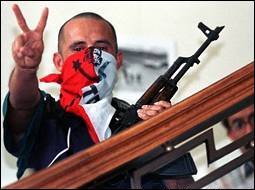
1997: Hostage-takers in Lima

On this date in 1997, Peruvian paramilitaries stormed the Japanese ambassador’s residence held hostage for 126 days by leftist rebels.

Peace out.

All 14 of the Tupac Amaru Revolutionary Movement (MRTA) were slain in the raid,* along with two of the commandos and one hostage. Officially, there were no “executions” at all.

Unofficially?

It’s pretty well-documented that some — perhaps most — of the terrorists were taken alive, and thereafter summarily executed. (pdf of Defense Intelligence Agency cable hosted by the National Security Archive)

However untoward the outcome and however unimpressive the foe, the operation was a master stroke for then-President Alberto Fujimori. Peru’s neoliberal taskmaster had introduced the world to the auto-golpe, the “self-coup”, a Cromwellian maneuver of shuttering parliament in order to rule as dictator, and he thereafter made ruthless suppression of Peru’s ruinous internal conflict the calling card of his presidency.

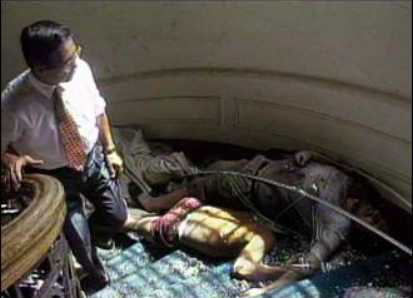
The DIA cable linked above claims Fujimori himself ordered the commandos to take no prisoners. He did not scruple to show himself in the middle of the bloodbath.


Alberto Fujimori made sure to get himself snapped standing over the bodies of the guerrillas, including MRTA leader Nestor Cerpa Cartolini.

El Presidente banked the political capital from having restored civic order, but it wasn’t the only capital he was banking. Three and a half years later, with a corruption scandal darkening his door, Fujimori absconded to Japan, faxed in his resignation, and became a fugitive.

Even there, he continued to justify his authoritarian governance.

Many Peruvians have always agreed with Fujimori’s self-assessment, even many who regret his well-publicized disregard for human rights.

But human rights researcher Michael Baney calls this day’s executions “pointless.”

“The MRTA was a spent force by the time of the embassy takeover,” said Baney. “The takeover was an act of total desperation, which is evidenced by the fact that the leader of the movement, Nestor Cerpa Cartolini, personally participated in it.”

After spending the best part of a decade in exile, Fujimori returned to the headlines by boldly returning to the hemisphere — to Chile, specifically, which arrested him and extradited him on a Peruvian warrant.

Just days ago as of this writing, Fujimori was convicted in his own former courts of authorizing death squads,** and sentenced to 25 years in prison. (Here’s some legal analysis.)

In the court of public opinion, it’s a different matter.

Fujimori’s daughter Keiko, a Peruvian congresswoman, figures to be a leading contender for the presidency in 2011, and has said she would pardon her father if given the opportunity.

“A majority of Peruvians think that Fujimori was guilty of serious human rights violations, but a majority also believe that he was a good president,” Baney observed. “And Fujimori really does believe that he single-handedly saved his country from economic and political collapse, and that Peru needs him around.”

* “Operation Chavin de Huantar”, profiled in several Spanish-language documentary videos available online. (Such as this one.)

** Not specifically related to this day’s MRTA killings, although these could be prosecuted in the future.

On this day..

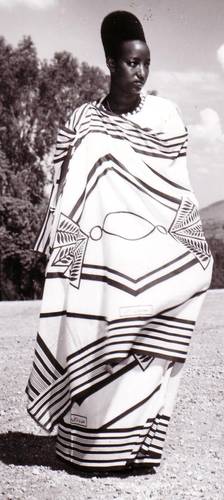
1994: Rwandan Queen Dowager Rosalie Gicanda, and six attendants

When the Rwandan genocide erupted following the April 6, 1994 assassination of President Juvenal Habyarimana, the southern province of Butare went initially unscathed. Its large and powerful Tutsi population had limited the foothold of violent Hutu paramilitaries.

That calm lasted a mere fortnight, however, and was shattered this date in 1994 when the aged widow of Rwanda’s last monarch was hauled to Butare city’s national museum and shot along with several of her caregivers.

Taken in marriage in 1942 (French link) by King Mutara III, Rosalie Gicanda had stayed out of politics after he died mysteriously and Rwanda became a republic.

Being an emblematic Tutsi in April 1994, however, was all the political involvement needed to doom her. According to Human Rights Watch.

At 11 a.m. … a detachment of soldiers commanded by Lt. (jg) Pierre Bizimana, acting under the orders of Capt. Nizeyimana, invaded the modest home of Rosalie Gicanda … About eighty years old, she lived a quiet life as a devout Catholic, sharing her home with her bed-ridden mother and several women and girls who cared for them both. Because she eschewed any involvement in politics and behaved with discreet dignity, even the most anti-Tutsi politicians had left her largely undisturbed throughout the thirty years of Hutu rule…. The soldiers passed through the wooded enclosure that protected the house from the main street and entered the little house with its air of faded respectability. They seized the former queen and six others, leaving her bed-ridden mother and one girl to care for her. The soldiers passed by the ESO and then took Gicanda and the others to a place behind the national museum where they shot them. One teenaged girl, left for dead, survived to recount the murders. The soldiers returned to pillage Gicanda’s home in the afternoon and, two days later, they killed her mother. …

The news that this gracious lady and others from her household had been taken away by soldiers in the back of a pickup truck spread rapidly and alarmed Tutsi and all others who opposed the genocide. They concluded that if soldiers dared to seize even this revered person, then no one was safe.

That conclusion, of course, was well-founded. Over 200,000 Butare Tutsis are thought to have suffered Gicanda’s fate (or worse) in the ensuing months, making it the Rwandan genocide’s bloodiest province.

Pierre Bizimana was sentenced to death for Gicanda’s killing in 1998; I have been unable to document whether that sentence was ever carried out. His commanding officer, Idelphonse Nizeyimana, was arrested in October 2009.

On this day..

1945: Gen. Charles Delestraint

On this date in 1945, French general and Resistance figure Charles Delestraint was hastily disposed of, ten days before the liberation of Dachau.

Delestraint, who also spent the First World War as a POW, was among those who noticed the hidebound military dogmas of the past needed updating.

With de Gaulle, Delestraint was a forceful advocate in the interwar period for mechanized warfare.

He didn’t get far enough, certainly not as far as the soon-to-be-vaunted Wehrmacht.

In 1940, just months after retirement, Delestraint was recalled to lead a mechanized division against the Germans, which of course turned out to be a spectacular triumph of tank warfare … for the Germans. While the French distributed armor units throughout their forces, the Germans massed them at a schwerpunkt aiming to break through the French line and speedily conquer in the rear.

Delestraint later remarked of the doctrinal difference,

We had 3,000 tanks and so did the Germans. We used them in a thousand packs of three, the Germans in three packs of a thousand.

Recruited subsequently into the French Resistance and thence betrayed, Delestraint enjoined the hospitality of many concentration camps and the tender mercies of one of their more infamous torturers.

Uncertainty remains over exactly how the Germans killed Delestraint, or even why the Dachau commandants wanted to finish off him in particular, although he was a primo catch in the anti-Resistance operation. The body was immediately cremated, camp records of the execution order disappeared if they ever existed, and eyewitness testimony at variance.

But dying in Dachau for the French Resistance? By any standard, that’s a passport to hero status, as attested by any number of Rue General Charles Delestraints to be found in his native land.

On this day..