1998: Wissam Issa and Hassan Abu Jabal

On this date in 1998,* Wissam Issa and Hassan Jabal were shockingly hanged in public in Tabarja, Lebanon.

Executions hadn’t seen the outside of prison walls in that country for 15 years at that time — back when there was a civil war on.

But Issa and Jabal were condemned for a home burgling attempt gone wrong(er): when the owners unexpectedly returned, Issa fled — but Jabal gunned them down. They both answered for the murders.

Marched out onto a somewhat jerry-built hanging platform (Issa was stoic; Jabal, unmanned), the two died at dawn before a crowd of 1,500 to 2,000 spectators … and plenty of cameras. The grisly proceedings made the nightly news, of course.

“It was horrible,” one Tabarja woman remembered. “The kids were playing at hanging each other afterwards at school.”

Oddly enough, it was also the last hanging (private or public) for over five more years to come. Later in 1998, a staunch death penalty foe became Prime Minister, and refused to approve any execution warrants.

* Reports of May 25 instead of May 19 are out there, but that’s easily disproven by, e.g., this Robert Fisk dispatch on the hanging which saw print on May 21, 1998.

On this day..

1964: Namgyal Bahadur, Bhutan assassin

On this date in 1964, three officers were executed in Bhutan, including former deputy commander in chief Namgyal Bahadur, for assassinating Prime Minister Jigme Dorji.

Jigme Dorji

A member of the powerful Dorji family and brother-in-law to the Bhutanese king, Dorji was overseeing a modernization campaign for the insular Himalayan kingdom. On April 5, 1964, while the king was in Europe for medical treatment, Dorji was shot dead while relaxing on his veranda. No wholesale seizure of power was attempted.

The entire affair has long been murky, and it seems it was murky to those involved, too.

The assassin, one Zambay,* was caught within days, and he implicated a number of powerful people — including not only Namgyal Bahadur, but the king’s Tibetan mistress.

She eventually fled the country, though her alleged involvement fueled rumors of a Chinese connection, or (more plausibly) of palace politics between her faction that that of the rival Dorjis. Old guard military guys versus the modernizers is another hypothetical dimension, although again the specifics (why now? what was the last straw?) are wanting.

* Zambay was executed on July 4.

On this day..

1920: Maria Bochkareva, Russian Joan of Arc

On this date in 1920, the Cheka shot famed female soldier Maria Bochkareva (or Botchkareva).

The “Russian Joan of Arc” was a peasant woman from Novgorod by way of Siberia.

She’d been in the workforce since the age of eight, and had passed almost continuously through abusive male relationships (violently drunken father, marriages to two wife-batterers). She’d also in that time shown herself a natural leader, and become a construction foreman.

It seems the great war came for Bochkareva as a liberating, almost redemptive, force: at least, that is the conclusion of hindsight.

In her memoir Yashka: My Life as Peasant, Exile and Soldier (freely available here), she recalls the spirit of patriotism that swept Russians into war, just as it did German and French and British youths.

a gigantic wave of popular enthusiasm, sweeping the steppes, valleys, and forests of vast Russia, from Petrograd and Moscow, across the Ural mountains and Siberia, to the borders of China, and the Pacific coast.

There was something sublime about the nation’s response. Old men, who had fought in the Crimean War, in the Turkish Campaign of 1877-78, and the Russo-Japanese War, declared that they never saw such exaltation of spirit. It was a glorious, inspiring, unforgettable moment in one’s life. My soul was deeply stirred, and I had a dim realization of a new world coming to life, a purer, a happier and a holier world.

…

“Go to war to help save the country!” a voice within me called.

This dovetailed nicely (we do not say insincerely) with Bochkareva’s own striving for a more meaningful life than was on offer in her second marriage.

To leave Yasha for my personal comfort and safety was almost unthinkable. But to leave him for the field of unselfish sacrifice, that was a different matter. And the thought of going to war penetrated deeper and deeper into my whole being, giving me no rest.

Bochkareva appealed directly to the tsar and secured his personal permission to enlist. She earned several decorations for heroism in the tsarist army … and when the Romanovs fell, the pre-Bolshevik revolutionary government under Alexander Keresnky gave her permission to create an all-female formation: the Women’s Battalion of Death.

(“Of Death” was a bombastic cognomen any unit could receive by pledging never to surrender.)

“Come with us in the name of your fallen heroes,” Bochkareva implored in an appeal to Russian women in June 1917. “Come with us to dry the tears and heal the wounds of Russia. Protect her with yours lives. We women are turning into tigresses to protect our children from a shameful yoke — to protect the freedom of our country.”


Maria Bochkareva, center, supervises shooing practice. (Source)

Some 2,000 answered the summons.

Only around 300 of these could withstand Bochkareva’s iron discipline, and though other women’s battalions would follow (one, for instance, defended the Winter Palace against the Bolsheviks), only Bochkareva’s saw service on the front.


The Women’s Battalion at a Moscow ceremony in the summer of 1917.

Although amenable to Kerensky’s Provisional Government, Bochkareva was an unmitigated anti-Bolshevik.

According to her memoirs, her “tigresses” continued fighting while the rest of the front was fraternizing, and enraged her male comrades by drawing artillery fire. She had to flee male soldiers intent on lynching her when she was still fighting after peace was announced. She had a hard time getting used to the idea of the new Soviet government, and the feeling was mutual: her battalion was soon disbanded and it wasn’t long before she took a steamship into exile.

(Her memoirs contain a harrowing account of her once being detained as a counterrevolutionary and barely avoiding execution.)

That memoir of Bochkareva’s was dictated in New York in 1918, just a few months since she had been in the trenches facing the Kaiser. Clearly she did not believe her mission to “heal the wounds of Russia” had been accomplished, for it was her attempt to return to the fight against the Bolsheviks that doomed her: in spring 1919, she went to the Russian Urals during the civil war to try to form a women’s unit under the White Admiral Kolchak.

But she was captured by the Reds inside of a year, and sentenced as an enemy of the people.

There’s an interesting open-access academic article about Bochkareva and the woman-soldier phenomenon here, as well as a larger bibliography here.

A few topical books

On this day..

1917: Emil Rebreanu, Forest of the Hanged inspiration

On this date in 1917, Romanian Lieutenant Emil Rebreanu was hanged for attempted desertion by the Austro-Hungarian army.

Here’s Rebreanu’s entry at the Enciclopedia Romaniei, which says in brief that he was one of 14 (!) brothers born in the part of present-day Romania that was then attached to the Kingdom of Hungary.

Upon the outbreak of World War I, Rebreanu was drafted into the Austro-Hungarian forces and fought on several fronts. But his removal to the lines to fight against the independent Romanian state was a front too far: he attempted to cross the lines to the Romanians on the night of May 10-11, but was captured, court-martialed, and sentenced to hang.

However, tragedy for the sizable Rebreanu family was a boon to world literature.
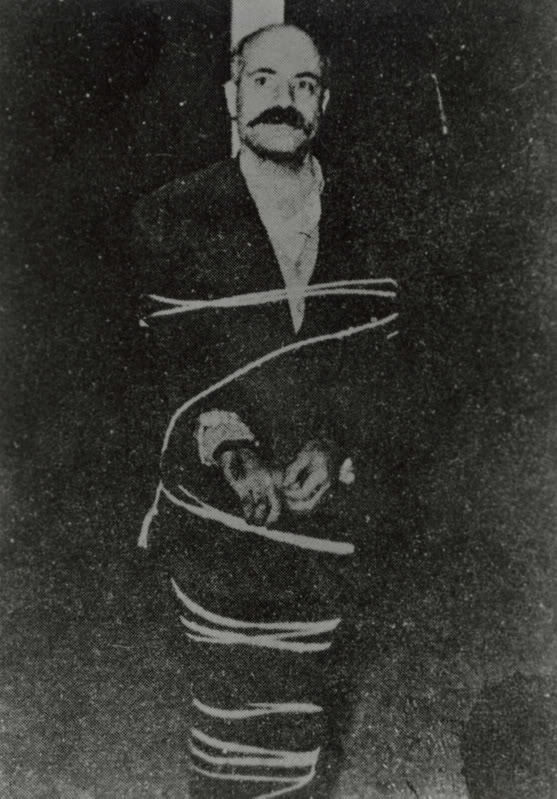
One of Emil’s many brothers was author Liviu Rebreanu, one of the greats of Romanian letters.

The latter’s 1922 novel Forest of the Hanged clearly draws upon his brother’s fate: in Forest, a Romanian officer uneasily serving in the Habsburg army first condemns a Czech deserter to death as part of a tribunal, then attempts himself to desert to Romania.

For his trouble, the character suffers the exact same fate as Emil Rebreanu.

A 1965 Romanian film, also called Forest of the Hanged, adapts this novel for the silver screen.

On this day..

1958: Khosrow Roozbeh

On this date in 1958, Iranian communist Khosro(w) Roozbeh was shot in Qezel Qal’eh prison.

“A popular teacher at the Military Academy, Rouzbeh was the author of a number of pamphlets on chess, artillery warfare, and, together with Ovanessian, the country’s first political lexicon,” blurbs Tortured Confessions: Prisons and Public Recantations in Modern Iran.

He was also not only a communist, but a radical within the context of Iran’s communist Tudeh Party.

After the 1953 CIA-backed coup restored the Shah of Iran, his government persecuted Tudeh activists as a fifth column.

Thousands were arrested, and brutally tortured into betraying their comrades. While most weren’t put to death, Roozbeh was both a true militant — he opposed moderates’ attempt to make common cause with the liberal Mossadegh government that the Shah had deposed — and the organizer of a network of military infiltrators. The British embassy called him the “Red Pimpernel” for his uncanny talent for slipping traps and getting about in disguise. But that act never has a long shelf-life.

Roozbeh was finally winged in a 1957 shootout and taken into custody, where he was tortured into his own confessions (e.g., that he had assassinated Tudeh members who were too willing about their police collaboration). After spending his last night on this planet putting NaNoWriMo to shame by cranking out a 70-page political manifesto, he’s supposed to have met his executioners defiant to the last, refusing a blindfold and crying “Long Live the Tudeh Party of Iran! Long Live Communism! Fire!”

But the volley that silenced Roozbeh’s cry can be seen in retrospect to mark the definitive elimination of communism from Iran’s political stage, the piece de resistance for SAVAK’s campaign of suppression.

After Roozbeh, Tudeh slipped into irrelevancy (Spanish link) … leaving little but the outsized myth of its most renowned martyr.

On this day..

1956: Andreas Dimitriou and Michalis Karaolis, the first EOKA men hanged

On this date in 1956, the British hanged two members of Cyprus’s nationalist resistance underground, the EOKA


Andreas Dimitriou (left) and Michalis Karaolis.

Michalis Karaolis murdered a local constable; Andreas Dimitriou (or Demetriou) hadn’t managed to kill his target, and only injured the British intelligence agent he shot. This, however, occurred two days after the enactment of draconian emergency regulations to counteract EOKA terrorism, under which merely possessing a firearm could be a hanging offense, never mind discharging it into someone.

The two of them weren’t connected to one another save in their common support for expelling the British from the Mediterranean island and reuniting it to the Greek mainland. It was a longtime, long-frustrated Hellenic dream.

Great Britain, even while the death penalty was eroding domestically, spurned international appeals for clemency — the Greek government made history by filing the first state-vs.-state petition to the European Commission of Human Rights a few days before the execution — reckoning that its credibility as a hard line against terrorism was at stake.

In Nicosia, where the hangings took place, schools were shuttered, armed paratroopers patrolled streets barred to traffic, and newspapers operated under a censor’s requirement not to inflame the populace.

In Athens, beyond the reach of the crown, the soundness of this policy was unpleasantly confirmed. Seven deaths and hundreds of injuries resulted from the ensuing brickbats with police. (The mayor of Athens personally smashed up a tributary plaque to Queen Elizabeth II.) And in retaliation, the EOKA subsequently executed two British soldiers it had captured, Gordon Hill and Ronnie Shilton … although British skepticism over this claim required an additional statement clarifying the matter.

On this day..

1970: Ibrahim Husain Muhammad

This from a May 7, 1970 London Times channeling of a Reuters report:

Mogadishu, Somalia, May 6 — Almost 50,000 people watched as a Somali soldier was executed by a firing squad today — the first public execution in the republic — for the murder of a girl.

In a statement read out at the execution, Lieutenant Ali Abdul-Rahman, the Attorney General, said: “The aim of imposing capital punishment on any citizen is to teach real justice, without which there can be no discipline here.”

Private Ibrahim Husain Muhammad was sentenced to death by a military tribunal in July, 1968. His appeals to the military High Court and to the Somali Supreme Court were rejected.

Somali dictator Siad Barre had good cause to worry about “discipline here.”

Whether the regime of the onetime Italian carabineire “taught justice” is another matter altogether.

On this day..

1942: José Abad Santos, Chief Justice

On this date in 1942, Jose Abad Santos was shot by the Japanese forces occupying the Philippines.

Brother of a famous socialist agitator who fought the Japanese from the bush, Jose Santos had an impeccably mainline elite career: university degrees in America, corporate lawyering gigs, followed by a stint in the Ministry of Justice and elevation to the high court.

In December 1941, Santos administered the oath of office to re-elected president Manuel Quezon even as the archipelago was being invaded by the Japanese. Quezon would evacuate, forming a government-in-exile.

Santos preferred to stay, and would spend his last remaining weeks as the Philippines’ Acting President.

“It is an honor to die for one’s country,” he would say to his son, after their capture. (The son survived.) “Not everybody has that chance.”


Santos (who’s also been on stamps) is pictured in the back left on the 1000-peso bill. (The woman at bottom front is another executed patriot, Josefa Llanes Escoda.)

On this day..

1945: Dachau Massacre

On this date in 1945, American troops liberated the Dachau concentration camp in Upper Bavaria — and then proceeded to summarily execute a number of its SS personnel.

The “Dachau massacre” involves several distinct incidents of wantonly killing defenseless POWs by American troops, who may have been set on edge by warnings of potential fake-surrender gambits, and then evidently went right off the rails with discovery of emaciated dead bodies around the place. In particular, a stranded transport that had been sent from Buchenwald, christened the “death train”, greeted the liberators with a 40-car phantasmagoria of horror.


“We had seen men in battle blown apart, burnt to death, and die many different ways, but we were never prepared for this. Several of the dead lay there with their eyes open, a picture I will never get out of my mind. It seems they were looking at us and saying, ‘What took you so long?'” -Private John Lee

“It made us sick at our stomach and so mad we could do nothing but clinch our fists. I couldn’t even talk.” -Lt. William Cowling

These stunned, outraged soldiers, some of them still teenagers, would soon have a bunch of disarmed German troops from the camp under their power. Uh-oh.

As the dry but shocking (and also marked “Secret”: nobody ever faced a court-martial for the incident*) U.S. Army investigation remarked, “The sight of these numerous victims would naturally produce strong mental reaction on the part of both officers and men. Such circumstances are extenuating, but are the only extenuating facts found.” (Read the entire report in this forum thread.)

The behaviors these facts propose to extenuate may also produce a strong mental reaction. “‘After what we saw, we shot any German guards we saw on sight,” one of the Dachau liberators admitted in the 1990s.

  • A Lt. William Walsh took the surrender of four SS men near one of these train cars, then forced his prisoners inside the car and shot them on the spot.
  • About seven Germans taken prisoner at the camp’s Tower B were lined up a few steps away from the tower preparatory to marching them elsewhere, when for sketchy reasons one of their American guards started shooting, and then others followed suit.
  • And the most notorious of the incidents, about 50 captured SS men were segregated from other POWs — again, by Lt. Walsh — and lined up in the camp coalyard by the wall of the hospital. There they were machine-gunned, resulting in 17 deaths before a superior officer interceded.

Another 25 to 50 guards were killed by prisoners themselves, many with the implicit blessing of American infantrymen who stood by and watched, and or the explicit blessing of Americans’ weapons on loan from sympathetic troopers.

The irony in all this was that most of the camp’s regular guards had already fled the place. The SS men whom outraged Americans were shooting down in the Dachau charnel house were Waffen-SS who had been transferred from the eastern front just days before and whose specific purpose in the camp was to surrender it to the western Allies. They probably considered this assignment far away from the vengeful Red Army a very lucky break.

It wasn’t so lucky: this is the mischance of war. But they didn’t have anything to do with Dachau’s horrors, and their deaths in a unthinking bloodlust disgraced only their executioners.

“German soldiers after their surrender as prisoners of war to American troops were summarily shot and killed by such troops.”

-Conclusion of the Army Inspector General’s report

* Court-martial charges were filed, but quashed. The whole affair remained unknown to the public until the 1980s.

On this day..

1945: Hermann Fegelein, Eva Braun’s brother-in-law

On this date in 1945, Waffen-SS officer Hermann Fegelein was shot in the Reich Chancellery’s basement, or else its garden.

“One of the most disgusting people in Hitler’s circle,” in the estimation of Albert Speer, this rank opportunist had found his way there via Heinrich Himmler’s patronage.

On June 3, 1944, Fegelein married right into Hitler’s personal clique by tying the knot with Gretl Braun — sister of longtime Hitler mistress Eva Braun. Hitler and Himmler were both official witnesses.

They had a two-day wedding bash. Then the western allies landed at Normandy.

Fegelein still found plenty of time to party and womanize for the eleven remaining months that he and national socialism had a run of the place. But as a rank opportunist, he also had his antenna up for a post-Nazi arrangement by the spring of 1945. Here, his proximity to power did him no favors.

Posted directly to Hitler’s bunker as Himmler’s personal representative, the guy would have a harder time than some anonymous bureaucrat in slipping out of besieged Berlin.* When he absented himself from the bunker for two full days, Hitler himself noticed.

The guy sent to retrieve Fegelein found him drunk in a Berlin flat, hurriedly stuffing valuables into suitcases with a mystery woman who promptly disappeared out the window.

Having obviously been attempting to desert, Fegelein was in a fix when he was hauled back to the bunker.

Unluckily for Fegelein, this was also the date that Reuters reported news that his patron Himmler had attempted to surrender Nazi Germany to the U.S. and Britain — news that made its way into the hands of a livid Hitler. You’ve got Fegelein trying to defect (incidentally inviting Eva Braun to come with), his boss is selling right out, and he’s consorting with a potential mole.

According to James O’Donnell, Hitler and his loyal satrap Martin Bormann were obsessed with leaks in the last days of the war, and the circumstances of Fegelein’s capture conspired to make him look like a potential source of those leaks.

As the Fuhrerbunker consumed itself in paranoia, Fegelein — only slowly sobering up — disappeared into the hands of the Gestapo, and was shot. His body, presumably abandoned with other casualties of little interest to Berlin’s conquerors, was never recovered.

Hundreds of kilometers to the south on the same day, Hitler’s longtime Italianate partner Benito Mussolini was getting his. It would be a stark warning to Germany’s fading dictator not to let the same fate befall him.

Hours after Hermann Fegelein’s execution, his sister-in-law Eva finally wed Adolf Hitler … and on April 30, those two took their lives together.

A week after Hermann Fegelein’s execution, on May 5, his widow bore him a posthumous daughter: Eva Barbara Fegelein, named after the child’s late famous aunt.

* Fegelein had actually been out in Bavaria with Himmler — “safe”, relative to what happened to him — but taken a hazardous flight back into besieged Berlin just a couple of weeks before his death. He was either trying to be Himmler’s dutiful personal plant in the bunker, or trying to use his posting as a pretext to retrieve for the perilous postwar years the many valuables he had cached in Berlin.

On this day..