1778: James “Sandy Flash” Fitzpatrick

On this date in 1778, Revolutionary War-era bandit James Fitzpatrick was hanged — very badly — at Chester, Pennsylvania.

Fitzpatrick was then, and still is now, a legendary character in Chester County. He’s better known as “Captain Fitz” or, with a bit more flair, “Sandy Flash”.

Born to Irish immigrants in Chester, Fitzpatrick joined up with the Continental Army when the Revolutionary War broke out.

But after being subject to the commonplace but brutal punishment of flogging for some failure of military discipline, Fitzpatrick deserted, swimming off Long Island in the dead of night and eventually returning home. There, he was recognized as a deserter and clapped in jail until he agreed to fight again.

All this built up a terrific grudge in the young man’s heart, and he “agreed” just long enough to get out from behind bars and abscond again. After warding off yet another press gang sent to retrieve him, Fitzpatrick vengefully took to the road.

This was not necessarily out of bounds for Fitzpatrick’s milieu. As detailed by Rosemary Warden (“‘The Infamous Fitch’: The Tory Bandit, James Fitzpatrick of Chester County,” Pennsylvania History Summer 1995):

Fitzpatrick’s bold outlawry must be seen against the background of many Chester Countians’ lack ofsupport for the Revolution, ranging from passive neutrality to outright loyalism. Forty percent were Quaker, settled most heavily in the eastern township. Only a small number actively supported the Revolution or the British cause … Fitzpatrick’s two favorite targets, militia recruiters and tax collectors, often met violent opposition in Chester County during this period, and not always from loyalists …

It is not surprising that revolutionary General Anthony Wayne wrote to Council President Thomas Wharton in the spring of 1778, to suggest that he stop recruiting troops in Chester County, a wasted effort, and concentrate on raising men in Berks, Lancaster, York, or Cumberland Counties. Nor is it surprising that a loyalist bandit who particularly targeted militia officers would find clandestine support and safe hideouts in Cheser County.

Playing to the hilt the part of “Tory highwayman,” Captain Fitz targeted Chester County Whigs, and especially agents of the revolutionary government. And he did not neglect the opportunity to inflict with the flog the suffering he had once endured himself. Still,

Despite his many crimes, there was a rough chivalry in the character of the man which exhibited itself in his marked gallantry towards women, in his open, generous disposition to aid them on when ill fortune bore heavily; indeed, he was never known to rob a poor man or ill-treat a female. Many are the instances related when he bestowed upon the destitute that which he had taken from those in good circumstances, and the weak or defenseless never suffered at his hands. On one occasion an old woman, who made a meagre living by peddling from house to house odds and ends of female apparel, encountered Fitzpatrick in the neighborhood of Caln Friends’ meeting-house. She was at the time on her way to Philadelphia to buy goods, and all the money she possessed was on her person. She had never seen Capt. Fitzpatrick, and she informed, the tall, handsome stranger that she was told that the outlaw had made some demonstrations in that neighborhood a short time before, and she was afraid that she might fall in with him and be robbed of all her money. Fitzpatrick, by a few questions, drew from her the particulars of her business, and her difficulty in winning an honest livelihood. He then good naturedly told her she need be under no apprehension, Fitzpatrick never warred upon the weak or defenseless, that she was talking to that personage; and taking a purse from his pocket containing several gold pieces, he gave it to her to aid her in increasing her scanty stock of goods. Then, wishing her a safe journey, he turned into the woods and disappeared.

What a guy.

His prey among the Whig well-to-do not being constrained to treat Fitz with any similar measure of gallantry, the bandit was at length captured when, in the course of raiding a household, he briefly set down his weapons — and his hostages jumped him. (The hostages in question had an argument with each other afterwards over who should get the reward.)

“Sandy Flash” is a prominent character in Bayard Taylor‘s portrait of revolutionary Pennsylvania, The Story of Kennett, where, Turpin-like, he’s “transformed” (the author’s own words) “from a living terror into a romantic name.” Here, Bayard dramatizes an allegedly real exploit, in which Fitzpatrick boldly presents himself at a public inn* where a posse hunting him has holed up.

All eyes, turned towards the crossing of the roads, beheld, just rounding the corner-house, fifty paces distant, a short, broad-shouldered, determined figure, making directly for the tavern. His face was red and freckled, his thin lips half-parted with a grin which showed the flash of white teeth between them, and his eyes sparkled with the light of a cold, fierce courage. He had a double-barrelled musket on his shoulder, and there were four pistols in the tight leathern belt about his waist.

Barton turned deadly pale as he beheld this man. An astonished silence fell upon the group, but, the next moment, some voice exclaimed, in an undertone, which, nevertheless, every one heard,—

“By the living Lord! Sandy Flash himself!”

There was a general confused movement, of which Alfred Barton took advantage to partly cover his heavy body by one of the porch-pillars. Some of the volunteers started back, others pressed closer together. The pert youth, alone, who was to form the third party, brought his musket to his shoulder.

Quick as lightning Sandy Flash drew a pistol from his belt and levelled it at the young man’s breast.

“Ground arms!” he cried, “or you are a dead man.”

He was obeyed, although slowly and with grinding teeth.

“Stand aside!” he then commanded. “You have pluck, and I should hate to shoot you. Make way, the rest o’ ye! I’ve saved ye the trouble o’ ridin’ far to find me. Whoever puts finger to trigger, falls. Back, back, I say, and open the door for me!”

Still advancing as he spoke, and shifting his pistol so as to cover now one, now another of the group, he reached the tavern-porch. Some one opened the door of the barroom, which swung inwards. The highwayman strode directly to the bar, and there stood, facing the open door, while he cried to the trembling bar-keeper,—

“A glass o’ Rye, good and strong!”

It was set before him. Holding the musket in his arm, he took the glass, drank, wiped his mouth with the back of his hand, and then, spinning a silver dollar into the air, said, as it rang upon the floor,—

“I stand treat to-day; let the rest o’ the gentlemen drink at my expense!”

He then walked out, and slowly retreated backwards towards the corner-house, covering his retreat with the levelled pistol, and the flash of his dauntless eye.

* Specifically, the Unicorn, a patriotic tavern. Filed under “small world”: this pub was owned by Joseph Shippen, the uncle of the woman who would marry soon-to-beturncoat Benedict Arnold.

On this day..

1922: Eugene Weeks, by Sheriff Robb

“Minister-Sheriff Hangs Iowa Murderer, Resigning Des Moines Pastorate to Do So” read the New York Times headline for the execution this date of Eugene Weeks.

Our interest here is not drawn by Weeks, who hanged for the forgettable murder of a grocer, but by his executioner, a truly American character running a truly American grift.

Winfred E. Robb parlayed decorated service as a World War I chaplain into a postwar book paying sentimental martial tribute to “young men … [and] their glorious death” the better to inspire “a greater patriotism and the dedication of himself to the common good of his fellows.”

Robb had returned from the European theater to his prewar gig as pastor of Des Moines independent evangelical congregation, the First Federated Church. (It still exists, nearing its centennial in the guise of a megachurch preaching “triumphalist, Americanized Christianity”.)

Our pastor proved amenable to exchanging this ministry of God for that of a more temporal power, and was elected Sheriff of Polk County in 1920 on an anti-corruption platform. The New York Times reported that his “campaign pledges of ‘cleaning up’ Des Moines have been followed by vigorous efforts against bootleggers and disorderly places.”

Among these edifying duties was another that some of his congregation found less tasteful: while Iowa had centralized its hangings at the penitentiary in Fort Madison, each execution remained the responsibility of the local sheriff in the county which sent the man to death row. That meant Pastor Robb.

Evidently some members of Robb’s congregation objected to this office, but where theology (potentially) clashed with politics, our man was prepared to render unto Caesar.

After all, in America, who knows how high a hangman might rise?

A co-conspirator of Weeks was executed on the same scaffold a few weeks later, and by the same Sheriff Robb. Robb’s self-satisfied justification for conducting these hangings could come straight from Rick Perry campaign literature.

Brainless people who have no ability to think … will condemn and rave and shout as usual. Unthinking religious fanatics will plead and pray and forget that God is a God of justice and mercy, and that judgment is as much a duty of love as mercy is the delight of love.

America is cursed today with a lot of spineless reformers. They think of a minister as a sissy, sexless, spineless creature with lily white hands who spends his time attending ladies’ societies and pink teas.

Tough love, baby. This was an apostle of muscular Christianity.

So Weeks resigned his ministerial commission, and on this date he skipped the ladies’ societies and put Eugene Weeks to death for murder.

By the end of the year, our hammer of the Lord had found himself on the anvil side of the law, and maybe rethinking those duties of love. Prohibition was Sheriff Robb’s milieu and the cause of his fall, as told by this Associated Press wire story printed in the New Year’s Eve Miami Herald:

IOWA PARSON-SHERIFF HELD FOR BOOTLEGGING

Jailer, Whose Sons He Arrested, Accuses Preacher Who Presided at Hanging.

DES MOINES, Ia., Dec. 30. — Sheriff Robb, Polk county’s preacher-sheriff, who gained nation-wide prominence last fall through officiating at the hanging of two murderers at Fort Madison penitentiary, was arrested here today charged with unlawfully disposing of liquors as the sensational backfire action on the part of his jailer, William McMurray, whose own sons had been arrested by the sheriff for alleged complicity in the theft of $30,000 worth of bonded whiskey from the county jail Wednesday night. The sheriff’s bond was fixed at $1,000 which he furnished and the hearing set for January 3.

John Robb, brother of the sheriff, and himself a minister, who has been acting as a deputy for his brother, also was arrested charged with larceny, on information sworn out by Jailer McMurray and released on $500 bond. Neither charge was made in connection with the theft of the 47 cases from the jail Wednesday night.

Later additional charges were filed against Sheriff Robb by McMurray which alleged the sheriff had illegally sold cider presses and other paraphernalia used in making liquors, which had been seized in raids.

Charges that Sheriff Robb personally sold 35 quarts and 75 pints of whiskey to L.S. Hill, president of the American Lithographing company, a month ago, and has given away and sold seized liquors to other persons, furnished the basis for the charges which McMurray filed. Mr. Hill denied he bought liquor from the sheriff.

Greater patriotism hath no man than this, than to peddle seized drug contraband to local oligarchs under guise of law enforcement. At least you could never accuse the guy of keeping those hands lily-white.

Part of the Themed Set: Americana.

On this day..

1916: Mary the Elephant

On this date in 1916 — true story — this happened.

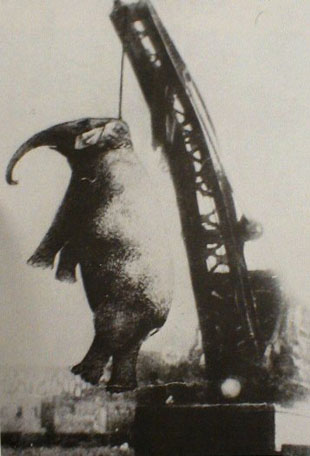
The circus elephant Mary hanged Sep. 13, 1913 in Erwin, Tennessee

Five-ton circus elephant Mary (yes, she has her own Wikipedia page) was in Kingsport, Tennessee on the chintzy fairgrounds touring circuit with Sparks World Famous Circus.

Billed as as “The Largest Living Land Animal on Earth,”* this exotic creature was a prime draw for the circus — and also a beloved pet of the Sparks family.

Unfortunately, this valuable asset was placed in the temporary stewardship of an inexperienced “under keeper” whom the circus had had to scoop up at a recent stop to cover staff turnover. Between shows on September 12, that fellow somehow (accounts conflict) enraged Mary, and (again according to one version among several) she

“collided its trunk vice-like [sic] about [the under keeper’s] body, lifted him 10 feet in the air, then dashed him with fury to the ground … and with the full force of her biestly [sic] fury is said to have sunk her giant tusks entirely through his body. The animal then trampled the dying form of Eldridge as if seeking a murderous triumph, then with a sudden … swing of her massive foot hurled his body into the crowd.”

It’s apparent in this report that the facts of an already-sensational event almost instantly began disappearing into its spectacle. See the largest land animal on earth! See it maul its handler to death! But what happened next lifted Mary all the way to legend.

The owners knew they had to euthanize the “mankiller,” or if they didn’t know they were soon persuaded by mushrooming press attention and towns threatening to ban the Sparks circus.

But how? They couldn’t shoot Mary to death — she apparently survived gunshots from the vengeful crowd in the immediate aftermath of the trampling; firearms just didn’t pack the wallop to put down a pachyderm in 1916. The area didn’t have the sort of electrical juice available that Thomas Edison had once used to drop a circus elephant during his weird campaign for the electric chair.

The choice for the baleful logistical task of killing a 10,000-pound evildoer was hanging, selected over “crushing it between railroad cars.”

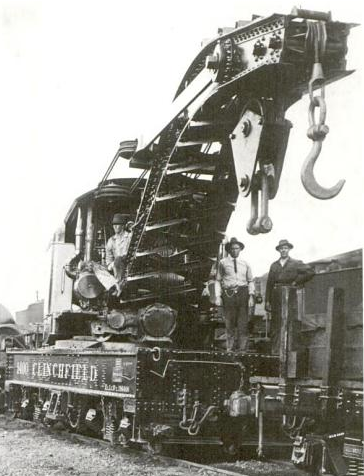
And for stringing up “Murderous Mary”, you need no ordinary gallows. No, for this job, you’re using the hoist on a train derrick and an industrial-strength chain for a noose.


The actual train derrick that hanged Mary the elephant. The leftmost man, seated on the machine, is the “executioner” who worked the controls, according toThe Day They Hung the Elephant.

The railroad was game for the operation, provided the circus would come to it. So on this date, the circus train cars loaded up for the nearest usable train derrickscaffold at Erwin, Tennessee.

There, a procession of all five Sparks elephants — the routine was supposed to keep Mary compliant, and it did the trick even though some observers later remembered the condemned creature behaving unusually skittishly — marched to the railyard.

There Mary was noosed with a 7/8″ chain and hoisted up. The chain broke, and the animal shattered its hip crashing to the ground; another, still larger, chain, did the trick on the second try.

Talk about a spectacle. Talk about scary clowns.

There’s something about this event abidingly piteous, even shameful. It may be for that reason that it’s also abidingly mysterious. The particulars about what happened on the day they hanged the elephant and what became of the body (a steamshovel dug a grave, but the exact location was never marked and there’s a wild story that it was dug up later for ivory) are the topics of conflicting, nth-hand rumors. Some in Erwin don’t to this day want to discuss the matter. Others, just the opposite.


Image (c) John Pugh of SourceToSea.net and used with permission.

* Sparks evidently kept the “largest living land animal” marquee in use for Mary’s successor, as indicated by this 1919 poster (pdf) for the show.

Part of the Themed Set: Americana.

On this day..

1951: Eliseo Mares, “silently and horribly”

On this date in 1951, Eliseo (sometimes rendered “Elisio”) Mares was shot in Utah for murder.

He was condemned for the 1946 murder of an Ohio sailor en route to California for his marriage. (Mares claimed self-defense.) The wait for his execution — “five long years,” Mares told a reporter* after he lost his last appeal — was unusually protracted for the time.

By the time his case had wended its way through the courts, county-managed executions had been consolidated at the state prison at Point of the Mountain. Mares was the first put to death there.

Not until 25 years later, in a reminiscence by one of the witnesses, Salt Lake Tribune reporter Clark Lobb, was it disclosed that Mares “died silently and horribly.” Two of the four bullets fired from 15 feet away struck Mares in the hip and abdomen. It was several minutes before the prisoner was declared dead.

This source speculates that the poor marksmanship was intentional, but whether intentional or not, it must have been an appalling spectacle.

The sheriff directing the proceedings immediately began pushing for a switch to away from the error-prone firing squad to the gas chamber. (No dice, although the 1955 legislature did approve a switch to electrocution that fell through for want of funding.)

* UP wire report quoted in the New York Times, Sept. 9, 1951.

Part of the Themed Set: Americana.

On this day..

1867: Bridget Durgan, “hardly human”

On this date in 1867, Irish immigrant maid Bridget Durgan (or Durgin, or Dergan) was hanged in New Brunswick, New Jersey for murdering the mistress of the house.

In this instantly sensational case, Durgan at first represented herself the party raising the hue and cry with the neighbors as her mistress was slaughtered by two unknown visitors. (Since it was a doctor’s house, the “unknown visitors” part wasn’t an unusual circumstance.)

Unfortunately our maidservant conducted this office without recognizing that her own dress was bloodstained and would implicate her in the crime — as would the suspicious circumstance that the homicide took place on the very eve of Durgan’s involuntary termination date, the victim having judged her contribution to the household inadequate.

If Durgan’s published confession is to be believed — and many didn’t believe it, since the condemned woman’s stories varied wildly before settling on the rather pat version that none of the other suspected participants were involved — she had come down in the world from a less abject birth in Ireland, transferred upon her victim a hatred conceived for a previous mistress in a previous household, and done the deed in some confused attempt to supplant Mrs. Coriell.

(This confession offers a florid narration — and illustration (pdf) — of the dying woman staying Bridget’s coup de grace long enough to give her infant child one last kiss.)

So, from the standpoint of criminal heinousness and public outrage over same, this was definitely the sort of thing to hang a body.

Difficult questions of weighing the proper level of culpability for offenses committed by those with a seemingly diminished mental capacity were at this time becoming a hot topic in criminology; in a few years, a madman who assassinated a president would make them national news.

Poet and women’s rights activist Elizabeth Oakes Smith, then entering her seventh decade, went to see Bridget Durgan. It was, she said, a habit of hers to “visit the prisons … that I may the better understand my own sex in every aspect.”*

Smith published a study (pdf; the same analysis was also printed in the New York Times) of our unhappy subject for the edification of the popular press. It’s quite an interesting read for a window on the social outlook in the post-Civil War North, doubly so when recalling as one reads that Smith is attempting to argue a case for clemency for her subject, and against the death penalty in general.

In the scale of human intelligence I find Bridget Durgin on the very lowest level. She has cunning and ability to conceal her real actions; and so have the fox, the panther, and many inferior animals, whose instincts are not more clearly defined than those of Bridget Durgin …

Ain’t nothin’ but mammals: left, Bridget Durgan, as illustrated in her confessions (pdf); center, a panther ((cc) image from Iain Purdie); right, a cunning fox ((cc) image from Jakob Newman).

her hair combed close to her head … give the observer an opportunity to notice her strong animal organization. She is large in the base of the brain, and swells out over the ears, where destructiveness and secretiveness are located by phrenologists, while the whole region of intellect, ideality and moral sentiment is small …

Her texture, temperature, all are coarse; hair coarse and scanty, forehead naturally corrugated and low, nose concave and square at the nostrils, leaving a very long upper lip … her eyes wavering constantly. They open across, not below, the ball, and the pupil is uncommonly small; I should say she would be naturally dim-sighted. It is purely the eye of a reptile in shape and expression. The jaws are large and heavy, but the mouth is small … narrow gums, catlike in shape, with pointed teeth.


(cc) image from Jarrod Carruthers.

There is not one character of beauty, even in the lowest degree, about the girl — not one ray of sentiment, nothing genuine, hardly human …

I looked upon Bridget Durgin without prejudice, and I describe her without exageration. She was born without moral responsibility, just as much as the tiger or the wolf is so born;

Tiger ((cc) image from Chris Ruggles); wolf ((cc) image from C. Young Photography).

and the question naturally arises, what is the duty of a wise, humane and just legislator in her case … whether it is right to take an irresponsible, morally idiotic creature, and she a woman, whose sex has had no voice in making the laws under which she will suffer, and hang her by the neck till she is dead, is a question for our advanced civilization to consider.

Durgan, who bore all the public opprobrium of a Casey Anthony — plus points for being unattractive,** and for class-based moral panic, and for actually being convicted — had little chance to avoid her sentence, as Smith herself admitted.

When the time came, she met her fate steadily (in some quarters, this was also held against her insofar as it could support the “dumb animal” narrative) and yanked aloft on an upward-jerking gallows, ushered to the afterlife by a couple thousand people who crowded adjoining buildings for a view into the jailhouse yard. (A spectators’ platform collapsed.) This bit of technological wizardry was poorly engineered and, rather than efficiently snapping Durgan’s neck as was its intent, strangled the murderess to death instead.

“More abominable curiosity, more mawkish sentimentality, more religious affectation, has been expended on this bloodthirsty animal than we remember in the case of almost any other modern criminal,” complained The New York Times.

* Smith had another reason for familiarity with prisons: her son Appleton Oaksmith, late a filibuster in William Walker‘s party, did time during the Civil War for pro-Confederate gun-running and slave trading. His mother helped secure him a pardon.

** The New York Times (May 21, 1867) had simply called our hated Irishwoman “ordinary-looking.” We’ve seen with, for instance, Charlotte Corday that observers are wont to shape perceived feminine beauty according to perceived criminal monstrousness, and vice versa.

Part of the Themed Set: Americana.

On this day..

1915: Charles Becker

On this date in 1915, New York City cop and New York City mafioso Charles Becker was electrocuted at Sing Sing for engineering a hit on bookie Herman Rosenthal.

This case of police corruption and gangland gunplay owned the Big Apple’s headlines in the early nineteen-teens — it even gets a callout in The Great Gatsby. Whether it was rightly decided has been hotly contested ever since.

Author Mike Dash, who maintains a dashing historical blog, delved into this Jabba’s Palace in Satan’s Circus: Murder, Vice, Political Corruption and New York’s Trial of the Century. He was generous enough to grant Executed Today permission to excerpt Satan’s Circus for the narration of Becker’s last hours.


Sing Sing had already prepared for Becker’s death.

Invitations had been despatched in the middle of July to those chosen to witness the execution. There were three dozen in total, and they went to doctors and to a sanitary engineer, to representatives of the press, and to the operators of several wire services. One, scarcely surprisingly, was sent to Swope of the World, but the reporter — to his undoubted chagrin — was recuperating from a bout of rheumatic fever and his doctor had forbidden him to attend. Swope despatched another World reporter in his stead; the man arrived at Ossining bearing a large sheaf of handwritten instructions setting out in considerable detail exactly how the story should be covered. Preparations were also made to cater for the needs of the large body of newsmen expected to descend on Sing Sing without the benefit of invitations. Linemen spent several days installing additional telegraph wires and Morse code senders in a shack opposite the death–house.

Inside the condemned cells, white curtains were fitted across the bars of all the cells that Becker would have to pass on his way to the execution chamber, so that the other inmates would not be able to see him as he walked by. In the execution chamber, guards tested each piece of equipment. The lieutenant’s electrocution was scheduled to be the first at which a new system of signals would be used, as the New York Times reported:

Instead of the old method, by which the executioner signalled with his arm to the man in charge at the power plant, there is a little electric button behind the chair, and above it is tacked a placard bearing the following gruesomely suggestive instructions: “Five bells, get ready; one bell, turn on the current; two bells, turn on more current; three bells, turn on less current; one bell, shut off current; six bells, all through.”

New York’s newspapers remained predominantly hostile to the condemned man. The Times spoke for most of the Manhattan press when it observed that Becker’s death sentence was a punishment not just for Herman’ s death, but for the arrogance Rosenthal’s killer had displayed during his strong–arm days: ‘He paid for the times when “Big Tim” called him “Charlie”. He paid for his one–time power, that almost of a dictator, over the underworld of New York. And he paid for his pride in all this.’ Several dailies had issued their reporters with instructions to study Becker carefully for signs of weakness or incipient collapse; in the end, opinion seemed evenly divided between those who thought that the policeman continued to display an ‘iron nerve in the face of doom’ and those who discerned the onset of a nervous breakdown.

The lawyers were more generous. [Williiam] Bourke Cockran paid tribute to his client’s astounding self–control: ‘His hand is just as cool and his voice as steady as can be.’ John McIntyre said that he had never previously doubted the verdict of a jury in a murder trial. ‘But in this case I say that if Becker is executed tomorrow I will carry to my grave the conviction that at least one innocent man has suffered the death penalty.’ And Joseph Shay, another of the lieutenant’s old attorneys, released a statement of his own: ‘I believe that Becker is dying a martyr, and that his innocence will be established in time, perhaps by the deathbed confession of Vallon or Webber. Rose is too low to confess even on his deathbed.’

Becker himself was woken early on his last morning. At 8am his prison clothes were exchanged for special black cotton shirt and trousers, made without metal buttons or wire stitching; he was given black felt slippers instead of shoes. A guard shaved a spot on his temple, ready for the electrode. Another appeared carrying a pair of shears and neatly slit Becker’s trouser leg almost to the knee. When the time came this would allow the death–house guards to affix a second wire to the condemned man’s calf.

The next portion of the day was passed in writing: a love letter for his wife, a final statement for the press. At two in the afternoon the policeman saw his relatives for the last time. His brothers John, the detective, and Jackson, now a Wall Street broker, found him sitting in his cell, gazing at a small photograph of Helen that he kept on the wall. The meeting was so difficult that the two men were relieved when one of the other prisoners along death row broke the awkward silence by singing ‘Rock of Ages’. Becker joined in with the chorus.

Helen Becker reached Sing Sing, pale and breathless from her journey, soon after 11pm. Her husband had been waiting for her with increasing anxiety for most of the evening. Becker was so popular in the death–house that he had received special permission to spend more than an hour and a half with his wife in the warden’s room. The guards, who had been given strict instructions to keep their eyes on the prisoner at all times, turned their backs as the couple embraced for the final time. ‘No condemned man at the prison had ever had such sympathetic treatment,’ observed the World.

Helen left the prison at 1.30 in the morning, and Becker was returned to his cell. ‘I am tired of the world and its injustice to me,’ he told Father Curry, the New York priest. ‘My happy life has been ruined; I have not been given a chance a mere dog would get.’ Warden Osborne, coming to say good-bye at 2.30am, found his prisoner awake and sitting on the edge of his cot, ‘his chin sunk in his hands’. At four, Father Cashin heard Becker’ s last confession, which contained no admission of guilt and ended with the firm assertion: ‘I am sacrificed for my friends.’

The execution was set for 5.45am. Outside the walls, a double line of guards poked long sticks through the fence that marked the limit of the prison grounds to keep back the crowds assembling there. Inside, the executioner – a small, sharp-faced, balding electrician dressed in a baggy grey sack suit, a striped shirt, polka–dot tie and pointed patent leather shoes – checked his equipment for the final time.

Becker was the one hundred and sixteenth prisoner to die at Sing Sing since electrocution was first used to execute a man in August 1890. The victim on that occasion had been an axe-murderer named William Kemmler, who was accidentally subjected to ‘a far more powerful current than was necessary’ and died ‘in convulsive agony’, flames jetting from the base of his spine and purplish foam spewing from his lips. The technique for electrocuting a man had been refined somewhat since then, but it was still common for the death-house to fill with the odour of burning flesh and scorched hair as the moistened electrical conductors placed against the condemned man’s skin dried out. A lengthy electric shock could ‘turn blood into charcoal and boil a brain’. When a prisoner was ready to enter the chamber, he was issued with thick muslin underwear, and little wads of cotton would be forced into his ears and nostrils to prevent scalding brain fluids spurting forth uncontrollably when the current was applied.

Thomas Mott Osborne, who had vowed never to be present when a man in his charge was being executed, walked away from the death–house at 5am, leaving Deputy Warden Johnson to bring the policeman from his cell. Becker, who was still awake when Johnson came for him, went quietly to his death. A dozen steps took him from his cot to the door leading to the execution chamber. At 5.42 the witnesses clustering inside saw a narrow red door swing open, and the condemned man entered the room. He walked with a strange, hobbled gait, his knees locking involuntarily. His face was a mask. The chair, surprisingly insubstantial, stood on a thick rubber mat almost in the centre of the room. There was no glass and no partition to separate Becker from the witnesses who had come to watch him die, the nearest of whom sat only 10 feet away. The electric chair itself, the man from the American observed, ‘had had a double coat of varnish and its metal fixtures had been burnished for the occasion.’ Straps dangled loosely from its arms and legs, and a heavily–insulated wire hung from a goose-necked fixture above it. The policeman’s guards, anxious to spare the condemned man the agony of a lengthy wait, hurried so much with the buckles that they neglected to secure one of the restraints that stretched over his chest. Becker’s last words, uttered as another leather strap was fastened across his mouth, were a recitation of the Catholic litany: ‘Into Thy hands, O Lord, I commend my spirit.’

Five bells rang, then one. The executioner took his hands out of his pockets and threw a long wooden lever on the wall. The raucous drone of electricity filled the room, a green flash shot from the equipment and Becker’s muscular body lurched forward against the straps, his head twisting sideways and upwards as though attempting to escape the shock.

Charley Becker was the largest man ever brought into the execution chamber at Sing Sing, and it may be for this reason that his electrocution was horribly botched. Too little current was applied at first, so that the death agonies became protracted. The temperature within the dying man’ s body rose to 140 F, the loose strap across his chest burst open, flames were seen to spurt from his temple, and despite the administration of 1,850 volts for a full 60 seconds, Charles Farr, the death–house doctor, found Becker’s heart ‘not only still beating, but pounding strongly.’ In the end it took nine minutes and three separate jolts to kill the prisoner, though the representative of the World observed that ‘to those who sat in the grey-walled room and listened to the rasping sound of the wooden switch lever being thrown backward and forward, and watched the greenish-blue blaze at the victim’s head and feet and the grayish smoke curling away from the scorched flesh, it seemed an hour.’ The whole affair was described in later years as ‘the clumsiest execution in the history of Sing Sing.’

As the reporters gathered to witness the execution filed out of the chamber, they were handed copies of Becker’s final letters. The first was addressed to Governor Whitman:

You have proved yourself able to destroy my life. But mark well, Sir, these words of mine. When your power passes, the truth about Rosenthal’s murder will become known. Not all the judges in this State, nor in this country, can destroy permanently the character of an innocent man.

The second letter was a final testament. Becker had spent much of the night memorising it, in the hope of being allowed to deliver it himself, but the guards had not permitted this.

‘I stand before you,’ this statement began,

in my full senses knowing that no power on earth can save me from the grave that is to receive me, and in the presence of my God and your God I proclaim my absolute innocence of the crime for which I must die. You are now about to witness my destruction by the State … And on the brink of my grave, I declare to the world that I am proud to have been the husband of the purest, noblest woman that ever lived, Helen Becker. This acknowledgement is the only legacy I can leave her. I bid you all goodbye. Father, I am ready to go.

CHARLES BECKER

When most of the reporters had left, Becker’s corpse was removed to the autopsy room for the usual examination, arms dangling, head hanging back, legs swinging. Dr Farr stripped the black cotton shirt from the lieutenant’s hulking body, and was startled to discover that it concealed the little photo of Helen that Becker had kept on the wall of his cell. The dead man had pinned it to his undershirt, with the face turned inward, over his heart.

I have no idea.

On this day..

2010: William Garner, arsonist

(Thanks to Meaghan Good of the Charley Project for the guest post. -ed.)

On this day in 2010, at 10:38 a.m., at the Southern Ohio Correctional Facility in Lucasville, convicted arsonist and quintuple murderer William L. Garner got the needle for the crimes he had committed eighteen years earlier.

Garner had burglarized the Cincinnati, Ohio apartment of Addie F. Mack on January 26, 1992, after he stole her purse and keys while she was being treated in a hospital emergency room.

After taking some electronics, Garner set three fires within the residence, although he knew there were children asleep inside it. Markeca Mason and Richard Gaines, both 11, Denitra Satterwhite, 12, Deondra Freeman, 10, and Mykkila Mason, 8, all died of smoke inhalation. Addie Mack’s oldest child, 13-year-old Rodriczus Mack, escaped through a window; he was the only survivor.

Rodriczus, Denitra, Deondra and Mykkila were siblings, and Markeca was their cousin. Richard was a friend of Rodriczus who happened to be spending the night.

Thanks to a tip from an observant taxi driver, Garner was arrested the next day and quickly confessed. He considered the children’s deaths to be “accidental” because he only set the fires to obliterate his fingerprints and he believed the children would smell the smoke and be able to get out in time.

Unfortunately, the apartment’s smoke detector was inoperable.

Garner was nineteen years old at the time of the murders. He had a criminal record dating back to age eleven, and following his January 1992 arrest he racked up thirteen behavior infractions in prison … including a fire-setting incident.

A psychologist who interviewed him said he functioned at the level of a 14-year-old, and his IQ tested at 76, barely above the juridical cutoff mark for mental retardation. When asking for clemency, Garner’s attorneys cited these factors as well as his “extremely violent and dysfunctional” upbringing, and also argued that he was brain-damaged due to lead poisoning.

In June 2010, the parole board voted unanimously to reject Garner’s clemency request, stating in its report, (pdf)

Considerable weight was afforded the considerable mitigation presented. It is clear that Mr. Garner suffered developmentally and was raised in an exceptionally and horrendously abusive environment. However, we cannot conclude that the mitigating factors are significant enough to outweigh the aggravating circumstances of an offense resulting in the death of five innocent children.

Garner was executed a month later, using Ohio’s recently-adopted “one-drug” lethal injection protocol (most states use, as Ohio had previously, a cocktail of three). It didn’t go smoothly.

A Toledo Blade article provides a detailed account of his last moments. The prison had to open a second viewing room to fit all the people who came to watch him die.

On this day..

1675: The murderers of John Sassamon, precipitating King Philip’s War

On this date in 1675, Puritan colonists’ hanging of three Wampanoag Indians helped trigger a brutal bout of ethnic cleansing, King Philip’s War.

The condemned men’s victim, Wassausmon — known by his Christian, Anglicized name of John Sassamon — was a converted Massachuseuk, briefly a Harvard attendee (1653)*, and eventually a translator for several tribes when dealing with the early settlers. Sassamon fought on the colonists’ side during the Pequot War, which has graced these pages before, and was generally seen as very sympathetic to the colonial cause, at one point becoming a schoolmaster at the inception of the towns of Natick and Ponkapoag.

After his work as a translator, Sassamon returned to the Puritan fold to become a minister in the Plymouth Colony.

Because of his high position in both the white and native worlds, though, he drew some resentment from both sides. It was Sassamon’s sense of loyalty to both sides of the growing tension between the natives and colonists that led to his demise.

King Philip (natively known as Metacomet) became head (Sachem) of the Wampanoag Confederacy in 1662 after his brother’s death.

Though initially trade-friendly with the burgeoning colonies to the north and east, the Wampanoag were also feeling the squeeze from the Iroqouis Confederation gaining power to the west. In 1671, the colonies presented the Wampanoag with an ultimatum: give up their arms and submit to English law, or be forced out.

The colonists had tried this tactic before with the Pequot (hence the Pequot War), Narragansett, and other native tribes with great success. As expected, Philip blinked, and the English moved in.

But the Sachem was predictably unhappy with the relationship. Three years later, he had assembled a band of warriors and was ready to, er, renegotiate.

Sassamon got wind of Philip’s planned attack on Plymouth Colony and warned its governor Josiah Winslow. Two months later, Sassamon was fished out from under the ice of Assawompset Pond.

With one witness claiming that a trio of King Philip’s men had knocked off the translator and dumped the corpse, the Puritans became convinced that Philip was already getting involved in their affairs.

In June 1675, four months after Sassamon’s body was found, a mixed jury of Indians and colonists convicted three Pokanoket Indians of murdering Sassamon, and on June 8, they were hanged.**

The executions helped bring tensions to the breaking point, and Philip decided it was his time.

On June 18, he launched an attack on homesteads in Swansea, and the war was on. The colonists struck back, laying siege to Mount Hope with the thought of gutting the insurgency by capturing its leader. That move failed, and King Philip escaped to recruit more tribes to his cause. Eventually, the forces included five major native tribes fighting colonists and two other major tribes.

Things got ugly fast: the conflict would become one of North America’s bloodiest colonial wars, and touch everyone who lived in the region. In September, the New England Confederation officially declared war on the Native Americans of the area.

After suffering months of casualties, the colonists finally gained a foothold in the conflict in December. By spring, King Philip’s War was in full swing, with atrocities happening on both sides. But the native forces were being worn down, and the colonists began clawing back. Despite rampant destruction of towns across the colonies (including complete abandonment of a dozen or more), the colonists had fortresses to retreat to and boats to resupply them; the natives needed to trade with the colonists to get their arms. The situation was unsustainable, and when Canadian supply lines fell through, King Philip’s adventure was over.

Persistent enemies of many of the raiding tribes, the Plymouth-allied Mohegans took the offensive and broke up Philip’s warrior bands, scattering them across the Northeast. By the following summer, the Narragansett were defeated and dispersed, and the colonists were granting amnesty to natives who surrendered and could document non-participation. (Others were not so lucky.) In July, King Philip himself was isolated and on the run, taking refuge in Mount Hope. It was there that John Alderman, a Native American, shot him on August 12, 1676.

Philip’s body was mutilated: he was quartered and beheaded, and his head was displayed in Plymouth Colony Fort for years to come.

After the war, Mary Rowlandson, who was taken captive by Philip’s men, wrote a memoir about her experience. Philip’s escapades were also later made into a play.

* Harvard, founded in 1636, started its “Indian Harvard” in 1655 which saw a total of five students: Caleb Cheeshahteamuck (Aquinnah Wampanoag) took a degree in 1665 and died of tuberculosis a year later; classmate Joel Iacoombs (Aquinnah Wampanoag) disappeared in a shipwreck off Nantucket before walking; John Wampus (Aquinnah Wampanoag) bailed after a year and went to sea; and Benjamin Larnell and an otherwise unnamed “Eleazer” caught smallpox and died the year they enrolled.

** One account reports that only two of the Indians died on the first drop; the third was spared by his rope breaking, and after confessing the guilt of all three, he was re-executed.

On this day..

1872: Franks survives Fiji’s first hanging

On this date in 1872, the Melanesian realm of Fiji was favored with its first official public hanging.

It’s not as easy as it looks.

Enjoy this comprehensive botch from the firsthand account relayed by the New York Times:


A Fiji Execution.

The first attempt made in Fiji to carry a capital sentence into effect brought about one of the most remarkable incidents to be found in the annals of public executions. The Fiji Times of June 1 furnishes the following account:

“A horrible and brutalizing scene was witnessed last Tuesday morning by a number of persons who went to see the execution of the man Franks for the murder of Mr. Thomas Muir on board the Marion Rennie. He had been sentenced to suffer the extreme penalty of the law, and was to have been hanged on Monday, the 27th ult., but a gross miscarriage of justice was allowed to occur.

“The time appointed came and went, but the execution did not take place, for the simple reason that it did not suit the private convenience of the Sheriff. The poor wretch, who had by anticipation suffered the horrors of death, was then left in all the harrowing and unimaginable anxiety and uncertainty as to his fate from hour to hour until late in the evening, when he was informed that he must be hanged in the morning at 6 o’clock.

“Every preparation was made the previous night, the rope was fixed, and the noose adjusted. Rain fell, however, and wetted the rope, which was a very thick one, and in the morning it had to be dried before a fire. The time came, the rope was again fixed, the culprit and the hangman were on the scaffold, and before slipping the noose over the wretched man’s head the hangman had to sit down and place one of his feet in and pull with all his might to make the knot run; then after placing it over Frank’s head he had the utmost difficulty in making it fit anything like tight, but not nearly so tight as it should have been.

“Then the drop fell, and when the rope tightened with a slow dull thud, Franks was apparently dead for about three minutes, when his limbs began to move and he gave several groans, and then spoke. He prayed of those around him to put him out of his agony, to ‘let him meet his Maker in peace.’

“Then, through being improperly pinioned, he raised one arm and got hold of the rope, and so partly relieved himself from the fearful strain upon his neck. He still continued to beg to be put out of his misery, telling them he forgave them for the ‘black job’ they had made of it.

“But the frightful scene was not yet over.

“One of the officials, (the deputy was not to be found,) on the impulse of the moment, ran and cut the man down, when he fell heavily to the ground, there not being any attempt to catch him in his fall. Franks was then removed to the prison.

“Thus ended this ‘black job,’ which for horror is almost unparalleled. Its effect upon the spectators was such that one strong man actually fainted away.

“Thus the majesty of the law in Fiji has been asserted. Its most terrible sentence, death, has been attempted to be inflicted, and signally failed.

“The wretched man, after the terrible ordeal through which he passed, has been reprieved. Had another attempt been made to hang him, so strong was the feeling of indignation on the beach, we fully believe there would have been a riot.

“The question arises as to what should be done with the man. He has to all intents and purposes suffered the penalty of the law. Twice he has experienced horrors the like of which no man can imagine, and after being hanged and cut down by the officials, surely his punishment has ceased.

“The sentence was that he be hanged until ‘dead,’ but instead of being so hanged the officers of the law cut him down before death. The man should be free, for it must be clear that the law cannot punish him twice for the same offense.

“The best way to do now would be to pay his passage out of the country, and be rid of such a fellow from among us.

“Franks states that when the bolt was drawn and he fell, he thought he felt something break at the back of his neck, and he was praying and thinking of God and heaven. Then the memory of a wreck from which he was rescued passed before his mind. He saw himself cling to the chains till washed away; then seizing a rope attached to a floating spar, and clinging to it until washed back again on deck by a heavy sea. All the details of the wreck passed through his mind, and then came the thought, ‘Why do I not die?’ And finding he could breathe he suspected foul play and an intention to torture him by prolonging his sufferings. Then he spoke and clutched the rope, willing and wishing to die, but not a prolonged death.”

On this day..

2007: Christopher Newton

After Christopher Newton’s death in Lucasville, Ohio by lethal injection on this day in 2007, his attorney read a prepared last statement that apologized for the murder of a fellow inmate: “If I could take it back, I would.”

But the evidence of the “bizarre” execution says Newton was right where he wanted to be.

From the time the obese career criminal (pdf) garroted his cellmate in 2001,* he cooperated with investigators only to the extent that cooperation would grease the wheels of that so-called machinery of death. The entire thing was engineered to get Newton his last parole.

It still took him over five years to land on a gurney, but if you think that’s inefficient, get a load of the execution itself.

For going on two hours, the injection team poked and prodded at Newton’s veins in vain, trying to squeeze a lethal shunt into its gargantuan subject.

“We have told the team to take their time,” read a sign that a prison spokesperson held up in the hush-hush viewing chamber an hour into this discomfiting procedure. “His size is creating a problem.”

Minutes later, the 19-stone condemned man got a bathroom break during his own execution.

So far as anyone could see, the delay was anything but agony for Newton, who was generally observed smiling, laughing, and chatting it up with the prison personnel who were struggling to kill him. Finally, they managed to do it — an achievement which Ohio has latterly demonstrated is by no means a given.

* And allegedly drank some of Jason Brewer’s blood to boot, though this claim proceeding from a man who was intentionally pursuing a death sentence merits skepticism.

On this day..