1872: Communards Serizier, Boin and Boudin

On this date in 1872, three adherents of the late Paris Commune were shot at Satory (which was doing steady business in the execution of Communards).

We take this story from the dispatch filed the same day for the London Telegraph and reprinted in the New York Times. Paragraph breaks have been added for readability.


Dilatory as the French authorities are in bringing culprits to trial, they dispatch them with terrible haste so soon as their guilt has been certified by the final Court of Appeal. No public notice is ever given of an execution, and few people ever hear of it until it is all over.

A paragraph appeared in an evening paper last night to this effect: “The Commission of Pardons has commuted the sentenced passed on PASCAL and LUCIPIA; the appeals of SERIZIER, BOIN and BOUDIN have been rejected.” To the world at large this paragraph conveys no hint as to the date of execution; the initiated read between the lines that on the following morning, dawn will rise on a dismal military pageant on the plains of Satory.

There is, nevertheless, a certain amount of uncertainty in the matter, so very closely are all such secrets kept in France; and it was only on the receipt of a hint from a high authority that some time after midnight I determined to start with a friend for Satory. The impression made upon me by the ghastly spectacle I shall try to describe in the plainest possible language.

SATORY.

A finer exercising ground than the plain of Satory it is not possible to imagine. The ground is as flat as a billiard-table, and it is not devoid of a certain beauty — the thick turf being singularly fresh, and he vast square plain surrounded by a belt of fine trees.

Troops are marching in companies to take up their appointed positions on the ground. A raised battery is a prominent object, and opposite to it, at some distance, is a huge earthen mound, against which a target stands out distinctly in black and white. The troops are forming in three sides of a square, which is completed by this butt.

It is not until you get quite close to the mound that you perceive on the lower ground immediately in front three white sticks ranged in a line, each about four feet high and five feet apart. These are the poteaux against which the culprits are to stand.

A good many soldiers, not on duty, have turned out en amateur to see the show; they collect on the top of a mound near the butt, but they are driven down by the artillery sentinels and mounted police, who, dressed in a little authority, canter about with superfluous fidgety zeal.

The morning air is chill, and everybody on duty or off duty tries to comfort himself with a smoke. “Nous avons encore trente-cinq minutes,” says a sergent-de-ville, in a grumbling, querulous tone. And the condemned men? They only had thirty-five minutes, and methinks they had as much reason to complain.

A soldier proceeds to work at the target, sqwing it off short; he is going to take it away, perhaps, that it may not divert the soldiers’ aim; and one feels irritated with him for being so slow.

One wonders, too, that they have allowed the red signal flag to remain at the top of the butt. Would not a Communist see an omen or an augury in the accident?

An engineer close to me is coolly fashioning wedges, in preparation for the artillery practice, which is to begin “aussitot que cette affaire est finie.”

Another protests impatiently that he wants his breakfast. Three dogs, which are perpetually frightening the horses of the mounted police, as well as the riders, excite continual merriment. There are scarcely more than a dozen civilians present, but I observe two women.

One — a brazen-looking creature, with a black mustache, and wearing that peculiar kind of hooded cloak which you see constantly in Belgium — was laughing a hoarse, harsh laugh, that chilled one’s blood. The other was charmingly dressed in black silk, and looked like a lady; she spoke to nobody; her face was deadly pale; her eyes were large with tears, and yet there was a strange compression about the lips that told of intesnse firmness of purpose. Her bearing was rigidly calm, but I fancied that the stick of her dainty black parasol was snapped in two.

What had that woman to do at such a scene? I know not; but, assuredly, it was not curiosity that brought her there. There was now a slight diversion. A cart drove up covered with black cloth, and hid itself away to the left of the poteaux.

THE EXECUTIONERS AND THE CONDEMNED.

Then the pelotons or firing parties marched in and piled arms opposite the same slim sticks about which everything in that huge plain seemed to gather of its own accord.

The pelotons were taken, one from the line, two from the Chasseurs de Vincennes. Hardened though they must be by this time and embittered though they are against the Communists, I do not think, to do them justice, that they liked their duty. They looked pale, they were perpetually falling out, and they smoked with suspicious eagerness.

I tried to impress on my own mind that these fellows were murderous ruffians who had slain unoffending fellow-creatures in cold blood. SERIZIER and BOIN, Colonel and Lieutenant in the Communist army, had tortured and killed the very priests who had devoted themselves to the task of tending the wounded on both sides, for no reason but that they were good men. BOUDIN had actually shot down a chemist in the Rue Richelieu because he protested against his son, a mere lad, being impressed into working at a barricade.

But, with the best will in the world, I could not persuade myself that it was right and proper for 5,000 soldiers to be brought out under arms for the mere sake of killing three defenceless wretches. Meanwhile the minutes passed on; the officers rolled up cigarettes, compared watches, and consoled each other with the reflection, “Soyez tranquille, mon cher, ca sera l’heure militaire.”

And so it was; for just as the first silvery tones of a distant church clock were wafted across the heath, striking the hour, the trumpets rang, the drums beat Aux champs, the troops dressed up, and the three ambulance wagons dashed into the square at a sharp trot.

The prisoners had not been apprised of their appeal hvaing been rejected until four o’clock in the morning, but they seem to have accepted their fate with singular philosophy. They had all eaten and drunk, and SERIZIER had asked for a “pipe of tobacc” for the last time. In driving along he said to the two gendarmes by whom he was accompanied, “Wat a mistake I made to quit Belgium! Quelie belle affaire j’ai fait la. C’est egal, je saurai bien mourir.

Strangely enough, he confessed to a Dominican, a priest of the ver order against which he had shown such diabolical hatred.

Each man was accompanied by two gendarmes. And here I cannot help noting one of the strange peculiarities of an over-excited state of mind. When the drums beat “Aux champs,” the merely dramatic feeling of the scene was intensely moving.

And yet when, a moment later, I first caught sight of the tops of the jack-boots of the first tell gendarme who appeared at the ambulance doors, I was so forcibly reminded of “Le Petit Faust,” and scores of other pieces wherein these functionaries are held up to ridicule, that I almost burst out into hysterical laughter.

The tragedy, however, soon proved too terrible, for the gendarme was closely followed by BOIN, who had scarcely touched the ground before he exclaimed, waving his hat in the air, “Vive la Commune!”

The three men walked quickly to the poteaux, and placed themselves in position as coolly as though it were the most natural thing in the world. They then, as though with one accord, flung their hats or caps into the air, and shouted several times in thrilling tones, “Vive la Commune!”

They all three were smoking. SERIZIER threw away his pipe, but BOIN kept his cigar in his hand, and BOUDIN was actually smoking as he fell. The face of the latter was so covered up by the handkerchief with which he alone allowed his eyes to be bandaged that his features could not be discerned.

SERIZIER, who was in the middle, indignantly threw down the handkerchief with such force as to cast it far beyond him. BOIN also refused the bandage wherewith the soldier stationed beyond him offered to cover his eyes, and by an involuntary action he put it into his pocket.

BOUDIN was coarsely clad; and SERIZIER, an undersized man, with heavy sensual features, looked like the type of a London rough. BOIN was a tall, well-built man, having good, clean-cut features and black mustaches. He was dressed in a light-brown velvet coat, Garde Nationale trousers, and a colored-scarf round the waist.

THE EXECUTION.

The priest, going up to each in turn, kissed him on both cheeks, in what seemed to me a hurried and perfunctory manner.

Then, while the sentence was being read to the prisoners in a quick, low, quite inaudible tone, BOIN made a long harangue, much of which was lost in the perpetual rolling of those ghastly drums.

But one could distinguish snatches of sentences such as “Soldiers, you are children of the people as we are, and we will show you how children of the people can die. Nous mourons innocents,” and then opening wide his light coat — he wore no waistcoat — he offered his white shirt-front for a mark, and, striking his heart with his open palm, he exclaimed: “Portez armes en joue! feu! tirez au coeur!”

This he repeated several times, and while he was yet speaking, standing out clear away from the poteaux and looking death at ten paces literally in the face, a sword flashed in the sun, and the three men leaped from the ground only to fall to it in horrible contortions.

The smoke and the report were unheeded, for all the senses of the horrified spectator were arrested by the awful spectacle of writhing limbs and twisting hands.

BOIN seemed to be rewarded for his bravery by suffering less than the others, but SERIZIER literally rolled over, and BOUDIN also moved. The surgeon then went up, examined BOUDIN first, and then directed one of the sergeants in reserve to give the coup de grace in the ear. Then SERIZIER was examined and treated in the same way; and lastly, after a considerable interval, BOIN was dragged into position and dispatched.

I cannot give you any idea of the sickening impression produced by this seemingly deliberate butchery.

I say seemingly, for the men may have been dead, but, in any case, surely if the coup de grace must be given, it should be done at once. I did not time the proceedings, but, long as my description is, I believe that not more than two minutes elapsed from the time that the ambulance wagons came on to the ground to the time that the volley was fired.

Several more minutes, however, elapsed before the dull thud of the last coup de grace delivered a bout pontant right into the poor wretch’s ear struck upon the ground. I have seen something of the horrors of war at Sedan and Strasbourg; I have witnessed the degradations of a public hanging in England, but have never seen anything so horrible as this supplemental butchery of the coup de grace.

AN AFTER SCENE.

When the surgeon and his attendants retired fro the poteaux, it became evident that painfully long as the interval had been, he had not been sparing of trouble. For with an eye to dramatic effect, he had disposed the bodies symmetrically, so that their feet should point towards the defiling troops.

Then the trumpets struck up a lively tune, and all the troops present — three batteries of artillery, carbineers and other caalry, four or five battalions of the line, engineers, &c. — some five thousand men — marched at quick step before the stark, stiff, staring bodies.

I cannot think that such a sight can have any other effect than that of exciting sympathy for the guilty. To see a man lying on his back there, his head a shapeless mass and the large red spot on his breast growing every moment larger and larger, and to think that not ten minutes ago he was speaking with passionate eloquence — this tended rather to make one forget his crimes than to remember his cruelty.

Yet I am bound to confess that this feeling is not shared by all, for when the troops had passed by, and the black van had driven up and unladen its dreadful burden of plain coffins, I saw an officer point with his foot at the yet warm brains of BOIN, and I heard him say, “C’est avec celui qu’il a fait son discours.”

On this day..

1897: Five Barcelona anarchists

THE BARCELONA ANARCHISTS.

(Through Reuter’s Agency.)

BARCELONA, May 4.

The five Anarchists sentenced to death for complicity in the dynamite outrages here during the Corpus Christi procession last year were shot at 5 o’clock this morning in the moat of Monjuich Castle. The troops intrusted with the carrying out of the sentence fired repeated volleys at the criminals, who all met their doom calmly, their eyes fixed on the public, who were kept at a distance by a large force of soldiers. The condemned men, who all had their hands tied behind them, bowed to the public as they arrived at the scene of execution. Mas asked the firing party to come nearer. Nogues, Molas, and Alsina exclaimed: — “We are innocent! This is murder!” Just before the first volley was fired all cried together: — “Long live Anarchy! Long live Revolution!” Molas then gave the word for the soldiers to fire. Four of the prisoners fell dead immediately, but Alsina remained on his knees not even wounded. At the second volley he fell, but was not killed outright, and it was not till a third volley had been fired that he was pronounced to be dead. (London Times, May 5, 1897)

The “outrage” that occasioned the executions this date in 1897 was the previous June’s bombing of a Catholic processional, attributed by police to an unidentified anarchist and by anarchists to a police agent provocateur.*

Whoever chucked that egalitarian explosive triggered an outrage of the law, els procesos de Montjuic — wherein the wholesale arrest of hundreds of accused “terrorists” under a general suspension of civil liberties resulted not only in this day’s five executions but in countless tortures courtesy of the Inquisitorial equipment still on hand in the venerable Montjuic dungeons.

It was not only anarchists but liberals and republicans who felt the effects of this right-wing crackdown; 87 people were tried in camera by drumhead military tribunals under emergency antiterrorist legislation. Notary Salvador Dali Cusi, father of the famous painter, appeared as a defense witness in one trial, successfully persuading the court that one of his lefty friends nevertheless sported impeccable patriotic credentials and required “merely” exile.

The upshot of it all was to smash up the militant Catalan working class.

Said smashing notably failed to settle the small matter of who actually threw the bomb. As per their dying proclamations, it almost certainly had nothing to do with Lluís Mas, Josep Molas, Antoni Nogués and Joan Alsina — men who were alleged by the state to have been party to an ambitious bombing campaign all over the city. This campaign never went off and the only evidence supplied for its existence came from men tortured to describe it.

Tomas Ascheri, a militant anarchist whose confession helped get the others shot, has long been suspected a police plant, a hypothesis at odds with Ascheri’s shared presence at the wrong end of the firing squad this date. Occam’s Razor — and somebody probably used an Occam’s Razor on Ascheri in between the thumbscrews and the strappado — suggests that the guy’s betrayal was likewise nothing but an inability to withstand “enhanced interrogation.” (Nogues and Mas also signed “confessions” under torture. This public-domain Spanish text by another post-Corpus Christi torture victim denounces that nation’s methods both in Montjuic and in the Philippines.)

Torture in Spain, torture in Russia … the danse macabre proceeds in the dungeons of Mont-juich and St. Petersburg.

-Kropotkin, April 1897

Ongoing state violence in turn invited reciprocation.

Over in England, the Italian anarchist Michele Angiolillo was incensed by the executions, and the tortures suffered by Spanish refugees who had fled to England. “Angiolillo saw, and the effect surpassed a thousand theories,” wrote Emma Goldman. “The impetus was beyond words, beyond arguments, beyond himself even.”

Angiolillo made his way to Spain. On August 8, he joined the great tradition of anarchist avengers by assassinating the torture-happy Prime Minister, Antonio Canovas del Castillo.

* The argument for a false flag operation is a circumstantial one: the parade included a number of high muckity-mucks, like a right-wing general and the Bishop of Barcelona, detested by anarchists … and yet the bomber managed to let all the VIPs pass and attack only a knot of common people at the tail end of the train.

According to this book, a French journalist later reported that one of his countrymen by the name of Jean Girault, a genuine albeit “misguided” anarchist, did the deed. Girault fled to France and eventually to Argentina.

On this day..

1905: Chief Zacharias Kukuri

On this date in 1905, in the midst of Germany’s genocidal destruction of the Herero people in its Southwest Africa colony (present-day Namibia), the Otjosazu chief Sacharias Kamaituara Kukuri was hanged in Windhoek.

More than half the Herero population perished following an abortive attempt to resist German colonization during this unfortunately little-remembered period, perhaps the very first of the 20th century’s ample store of genocides.

Our man’s execution occurred at the moment of a policy pivot: after the horrific extermination policy initially practiced by General Lothar von Trotha, Germany’s Herero policy was “moderating”. Von Trotha’s extermination order had been officially reversed by Berlin; by November of 1905, the murderous general would be recalled to Germany. Instead, they’d be collecting the Herero into concentration camps.

It was into the Windhoek camp that Kukuri arrived as the wounded prisoner of a German ambush.


The concentration camp under the walls of Windhoek’s Alte Feste (Old Fort). Today, the fort is a museum … and the camp, forgotten, is the grounds of a high school. (Source)

Of course, it goes without saying that, even if state policy no longer aimed officially at racial annihilation, the system of concentration camps continued the de facto genocide: the systematic destruction of Herero life in order to incorporate the population as a subject proletariat (enlightened self-interest — the colony’s “economic future would be completely destroyed by the extermination of the indispensable labor power” — is what finally trumped von Trotha). At the same time, camps structured a punitive neglect of Herero living conditions, a years-long “period of suffering” in which Herero died of overwork, malnutrition, disease and neglect as surety against any future resistance. Courts-martial of fighting-age men alleged to have had some hand in resisting by arms the German onslaught completed the salutary lesson.

Missionary sources provide us with eyewitness accounts of conditions in the camps. Missionaries stationed in the Herero Konzentrationslager reported to their superiors in Germany on the extensive and unchecked rape, beatings and execution of surrendered Herero by German soldiers. Missionary Kuhlmann spoke of the delight of settler women witnessing the drawn-out public hangings of captured Herero in Windhoek. At one such hanging, a drooling Herero fighting for his life was berated” ‘You swine, wipe your muzzle’. (pdf source)

Kukuri fell into this last category.

His fate is especially poignant for us (and, convenient to date) thanks to the memoirs of Friedrich Meier, one of the many German Christian missionaries who had poured into Namibia ever since it became a German colony. As Meier’s account of swapping Biblical allusions with Kukuri in the shadow of the latter’s gallows underscores, these missionaries had achieved some inroads.

I did not see the slightest trace of fear on him, instead it was as if he were going to a wedding. ‘Muhonge’, he said at one stage, ‘oami otja Elias mohamakuao na je otjinga me keende kejuru metemba,’ i.e. ‘Muhonge, like Elias, I too travel to heaven in a waggon.’

Having arrived at the execution site, I noticed how he kept looking at the gallows, at which preparations were still taking place. I feared for his tranquility and asked him to stop looking at it. ‘Muhonge,’ he said to me, ‘I hear everything, why should I not look at it? For is it not “my wood” [my cross]?’

When we finally stood underneath the gallows, we prayed together that beautiful song: ‘So then take my hand and lead me.’

German:

English:

Possibly he noticed that I was worried about him. Anyway when I was finished he said, ‘It would appear that you still fear that I am afraid, but have I not told you: “When a father calls his child, does that child then fear to go to him?” Give my wife, who is in Okahandja, my greetings and tell her that I have died in the faith of the lord Jesus, so too tell my children if you should ever see them.’ I asked him again to be infatuated with the lord Jesus. ‘Lord Jesus, you help me,’ with this, after he had given me his hand, he climbed up the ladder. Soon the noose was laid around his neck. And then — never will I forget that moment — the unheard-of happened, as he fell the noose slipped and the wretch fell to the ground. He lost consciousness for a moment, so too, the observers were dumbstruck. Today I still see how his eyes sought me out. Soon, however, two soldiers were there, they lifted him up, and then a little to the side, on orders of the major who led the proceedings, he was shot.

Kukuri’s grave can still be seen at the Gammans cemetery (German link) in Windhoek.

His memory as an emblem of Herero dignity under persecution also remains in present-day Namibia.

Anette Hoffmann (in “The Merits and Predicaments of Opacity: Poetic Strategies of Evasion and Resistance” for the fall 2007 Research in African Literatures) relates a later “praise poem” for 1959 Herero martyrs, whose allusion to the hanged chief (as “Hauzeo”) emphasizes his agency, rather than his victimhood.

For he as the son of the chief Kukuri and must die since Samuel Maherero had escaped to Botswana. They said that if they kill him, then that could serve as a symbol that they had exterminated the sovereignity of the Herero … he was taken to a tree near the White’s cemetery in Otjomuise, which is still here today. I can show you his grave. He is still there until now, near the railway line to Aris … when he was taken to the tree, the tree of Hauzeu, as you hear about it, it was said: now you will be hanged to die. Heavily wounded as he was, he had a rope around his neck and was hanged. However, his weight broke the rope. Then the Germans said he was innocent and had to be released. But he himself insisted to be hanged again … [he said] “I have come to see the children of Tjamuaha’s house, those left in the camps of enslavement: to see them with my own eyes … this is why I have come: take me up the tree.” They did and he died. He lies at Hauzeu’s tree. He had given himself to be hanged.

On this day..

1894: George Painter, Chicago infamous

While there may be serious doubt about the wisdom of capital punishment it is at present imposed by the law of this State, and if it is to be applied in any case then it should be in this … Any man who will live off of the shame of a woman and beat her from time to time as he would a dog, and finally kill her, must expect to suffer the penalty of the law.

-Illinois Gov. John Altgeld denying clemency to George Painter (Jan. 25, 1894)

On this date in 1894, the Land of Lincoln bloodily botched (but ultimately accomplished) the hanging of George Painter.

Painter died for the sordid murder of prostitute-lover-income source Alice Martin.

Painter insisted he was out at the pub when Martin was throttled and bludgeoned to death in their mutual bed, but the timelines left the alibi leaky and a patch of bloodiness on the reprobate’s coat undid him.

Despite swearing his innocence on pains of being “condemned to a flaming hell for all eternity” and winning three gubernatorial reprieves as his appellate lawyers scrounged up sketchy supportive testimony from various lowlifes, matters were pretty solidly against him by the end. So much so that the seemingly-sturdy rope, “of the same coil with which the anarchists were hanged,” snapped jaggedly when Painter was dropped.

The condemned killer’s body carthwheeled from the jolt of the rope’s end, crashing headlong into the concrete floor. Doctors advised that Painter’s neck was broken and life gone or ebbing … and puzzled executioners, unsure what to do with this unusual semi-successful botch, hauled the hemorrhaging near-corpse back up the scaffold, strapped it up, and dropped it again. You can’t be too careful.

We came by this story on the website of Robert Loerzel’s Alchemy of Bones, a wonderful book about another infamous turn-of-the-century Chicago homicide. (Loerzel’s post gives the train-wreck Painter case a much more detailed rubbernecking.)

Although the subject of Loerzel’s book, the immigrant sausage-maker Adolph Luetgert, was not put to death for his trouble, we were thrilled that the author sat down with Executed Today to find out a little bit about how criminal justice looked in Chicago on the eve of the 20th century.

Book CoverET: One of the aspects that you cover in Alchemy of Bones that’s also present in the Painter case is circumstantial evidence of uncertain probative value. What’s a definitive piece of evidence to a late 19th-century juror?

RL: Obviously if we had a time machine and we could go back 100 years and reinvestigate some of these cases with today’s forensic science, I think we would find a lot of cases of miscarriages of justice. It’s hard to tell looking at these cases today when all you have is these newspaper articles and court transcripts. You can look at it with common sense and try to determine from what people are saying whether there might be some element of doubt.

Today there’s been this huge change with the introduction of DNA evidence and we’ve suddenly discovered that a huge number of people on death row or in prison who are innocent. And that has caused a lot of people to question the reliability of eyewitness testimony and the identification of suspects.

All these things — the testimony of witnesses who say they saw something or said, yeah, that’s the guy — that’s what people in the 19th century were being convicted on. We’re talking about an era when even fingerprints weren’t being used yet.

In the Luetgert case one of the key things was that they found some bone fragments. The Luetgert case is one of these rare murder cases where for all intents and purposes there was no body found. We have some of those cases still today where someone is missing; all the circumstances seem to point to the fact that someone is dead. And prosecutors and police face an additional hurdle — they have to persuade a court that a murder actually happened.

With those sorts of cases, you had some bones that were found. The forensic science of the time — you coudn’t run a DNA test on it. Part of the question was, were those bone fragments even human? Is it possible that pig bones or cow bones were found in a sausage factory? Of course it was possible.

The Luetgert trial was one of the first cases which had testimony from anthropologists, which was a pretty new field at the time. They brought in some experts from the Field Museum.

How did that go?

It wasn’t necessarily the greatest start — but it was sort of like the criminal justice system started to take some baby steps toward bringing science into the courtroom.

Later, in the 1920s or 30s, there was a landmark case called Frye. They still today have the Frye rule — when courts look at a witness to determine if he is an expert. In the Luetgert case, they didn’t do that, and it was kind of a carnival. A high school chemistry teacher was one of the people they put on the stand to testify about the bones.

Luetgert’s crime, murdering his wife and dissolving her or possibly stuffing her into the sausages, was so much more infamous than Painter’s. Why didn’t Luetgert get the death penalty?

Then as now, it was somewhat arbitrary which criminals would get the death penalty and which would get a prison sentence.

In Illinois during that era, there were a lot of people convicted of crimes and sent to prison for much less than a life sentence. They had a system there of “indeterminate sentence” where they would sentence someone to a wide range of possible terms, maybe from two years to 50 years; it was really flexible and vague with the idea that it was a more humane way of dealing with criminals.

It probably also put the thought in the minds of jurors that, do we want to put this guy in prison and he might be getting out in a few years?

In the Luetgert case, there was some outrage that if you were going to convict a person of this crime, you have to sentence him to death. Some people thought that they sentenced him to life in prison because, what if his wife is still alive? There were all these stories coming out at the time of the trial where people thought they had seen Mrs. Luetgert.

So there was the thought, what if we hang him and a year later, Mrs. Luetgert shows up?

None of the jurors ever came right out and said it, but it’s possible that that doubt played some role in the decision not to sentence him to death.

Luetgert’s case got national media attention which Painter’s did not. Was it a milestone for that kind of treatment? What was the media landscape for crime reporting at the time?

There were a few other cases during that era, so it’s hard for me to say that this was the first. But it was certainly an early example of a sort of 19th century equivalent of what we experience with, for instance, the O.J. Simpson trial.

Newspapers covered it in great depth. In Chicago they had a dozen newspapers at the time; they would print page after page of transcripts and reports — far more detailed than anything you see in trial coverage in newspapers now.

The prosecutor, who later became Governor of Illinois, had six scrapbook volumes of newspaper coverage, with clips from Los Angeles and Buffalo and Baltimore and New York.

It actually looks like a lot of newspapers around the country did what we today call news aggregating. We complain about sites like the Huffington Post … well, a 19th century newspaper in a small town in Iowa would just publish a huge long excerpt of a story from a Chicago newspaper. And sometimes they would credit it and sometimes they wouldn’t.

Compared to present-day one- and two-paper cities, that’s still quite a difference.

There’s a lot of media out there now. If you look on the web, blogs, news aggregator sites, TV and radio. We still have a lot of media coverage now, it’s just spread out into a lot of different channels.

I was frankly shocked when I was researching how detailed some of the articles were. It helped me as a researcher. Interestingly, the readership included a lot of people who were not necessarily well-educated, yet newspapers wouldn’t hesitate to run page after page of transcripts. Nowadays, I think you’d have an editor saying, “give me 10 inches.”

Having written the book on the case, do you think Luetgert was rightly convicted?

I believe so. More than the forensic testimony, Adolph Luetgert’s behavior after his wife disappeared sort of points to a guilty conscience. He feared that certain people would go to the police and he either offered them jobs or threatened them.

Though this is precisely the sort of fuzzy circumstantial evidence those 19th century juries were acting on.

That’s absolutely true. In some of these cases you look at, what’s the difference between a man acting suspicious and an innocent man being wrongfully accused? There’s some overlap there.

On this day..

1936: Allen Foster, who fought Joe Louis

More than twenty-five years ago, one of the southern states adopted a new method of capital punishment. Poison gas supplanted the gallows. In its earliest stages, a microphone was placed inside the sealed death chamber so that scientific observers might hear the words of the dying prisoner to judge how the human reacted in this novel situation.

The first victim was a young Negro. As the pellet dropped into the container, and the gas curled upward, through the microphone came these words: “Save me, Joe Louis. Save me, Joe Louis. Save me, Joe Louis…”

It is heartbreaking enough to ponder the last words of any person dying by force. It is even more poignant to contemplate the words of this boy because they reveal the helplessness, the loneliness and the profound despair of Negroes in that period. The condemned young Negro, groping for someone who might care for him, and had power enough to rescue him, found only the heavyweight boxing champion of the world. Joe Louis would care because he was a Negro. Joe Louis could do something because he was a fighter. In a few words the dying man had written a social commentary. Not God, not government, not charitably minded white men, but a Negro who was the world’s most expert fighter, in this last extremity, was the last hope.

-Martin Luther King, Why We Can’t Wait

This story isn’t precisely accurate as Dr. King told it, but the factual basis for this empathetic legend is Allen Foster.

On this date in 1936, Foster was the first man executed by lethal gas in North Carolina — and en route to this minor distinction he punched his ticket for commemoration in civil rights literature when he flourished a flamboyant uppercut to witnesses as he was led to the gas chamber and cried out, “I fought Joe Louis!” It was an allusion to having matched with the world champ when both were youngsters in Alabama.

This coincidental brush with celebrity was about as strange as the fact that it occurred in a gas chamber at all.

After the arrival of the electric chair, the South adopted it virtually across the board; North Carolina had switched from hanging to electrocution in 1910.

But the Tarheel State was also generally more progressive than its neighbors;* V.O. Key would write of North Carolina, “It has been the vogue to be progressive. Willingness to accept new ideas, sense of community responsibility toward the Negro, feeling of common purpose, and relative prosperity have given North Carolina a more sophisticated politics than exists in most southern states.”

Part of that “sophisticated politics” was, in the 1930s, a growing debate about the application — indeed, the mere existence — of capital punishment.

According to Trina Seitz’s “The Kiling Chair: North Carolina’s Experiment in Civility and the Execution of Allen Foster” (North Carolina Historical Review, Jan. 2004):

North Carolinians were beginning to doubt the effectiveness of the sanction and the method used to enforce it. Furthermore, private citizens, humanitarians, and state institutions alike were increasingly scrutinizing the demographics of those being put to death.

Though this scrutiny did not lead so far as actual abolition, it provided the receptively reformist environment for Mitchell County Dr. Charles Peterson’s “pet project” of switching the execution protocol to lethal gas.

The reason for his fascination with gas seems to be obscure; the method had never been employed east of the Mississippi. Maybe it had something to do with 1932’s remarkably smooth gassing of a North Carolinian from nearby Burke County in Nevada, the nation’s gas chamber pioneer.

Whatever the reason, Peterson took a seat in the legislature in 1935 and won adoption for his idea in this very first session.

Unfortunately for Peterson — and doubly so for Foster — North Carolina didn’t have quite the same facility with hydrogen cyanide, and Foster’s execution was a notorious botch that immediately got people back on the electrocution bandwagon.

Foster was doomed for raping a white woman — this may be progressive North Carolina, but it’s still the South — and according to Seitz’s rendering of the News and Observer‘s first-hand report:

“Good-bye.” The Negro’s lips framed the words so clearly that no man in the witness room could doubt what he had said. As he said it, he winked and then forced a smile at the faces peering in at him. Then he began to suffer. No man could look squarely into his eyes and fail to perceive that they were registering pain. The Negro fought for breath, knowing he was going to die and fighting to get it over with as quickly as possible …

he sucked the gas desperately until his head rolled back three minutes later, indicating to physicians that the man finally had lost consciousness. But after a period of quiescence, his small, but powerfully built torso began to retch and jerk, throwing his head forward on his chest, where witnesses could see his eyes slowly glaze … The torturous, convulsive retching continued spasmodically for a full four minutes.

Officially, it took about 11 minutes for Foster to die, and as those agonizing minutes dragged by a physician broke the witness room’s mortified silence by exclaiming, “We’ve got to shorten [the execution method] or get rid of it entirely.” Um, yeah? The prison warden was quoted the next day as saying that even hanging was preferable to this.

The ensuing political controversy, however, did not succeed in reverting the method to electrocution.

Like the original electric chair, North Carolina’s gas chamber was the beneficiary of some hasty technical fixes: heating the gas chamber (it was at the freezing point when Foster died; Colorado executioners advised North Carolina that this would impede the gassing); tweaking the chemical formula.

The very next week, a white murderer named Ed Jenkins followed Foster into the toxic plume, this time to rave reviews: he “died painlessly and the method of execution was humane”. These advances were enough to keep the gas chamber in place, although the state legislature considered several bills to return to electrocution from 1937 to 1943.

During one such debate, North Carolina playwright Paul Green testified to the assembly (per Seitz),

Some day the electric chair and the gas chamber will be set up in the State Museum as symbols of an age of horror and ignorance. School children will look at them and feel superior to us as they look back upon an era of ignorance

Three hundred sixty-two people ultimately died in North Carolina’s gas chamber. And as Green anticipated, the execution chair resides today in the state’s Museum of History.

* This is still true of North Carolina: it has employed the allegedly more humane method of lethal injection since 1984, when no other Southern state save Texas used the needle until the 1990s; that use has been sparing enough that its per-capita execution rate remains markedly lower than most other former Confederate states; and in 2009, North Carolina implemented a stillcontroversial Racial Justice Act empowering condemned prisoners to challenge their sentence with statistical evidence of racial disparity even though courts don’t require this at all.

On this day..

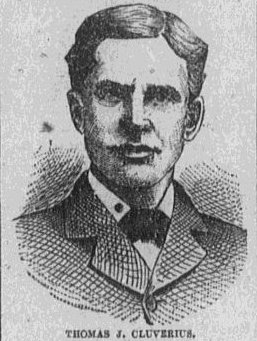
1887: Thomas Cluverius, Richmond murderer


Dallas Morning News, January 14, 1887.

On this date in 1887, a long-running (for the time) legal drama in Richmond ended with the hanging of Thomas Cluverius for murder.

On Friday the 13th — March 13, 1885 — Cluverius killed his cousin and lover Lillian Madison, who was eight months pregnant with his child, an act “as dark as any that can be found in all the calendar of crimes.” (Columbus Daily Enquirer, Jan. 15, 1887)

From the illicit affair to the shocking crime of passion and calculation to the damning lost watch key found at the site of the murder: everything conspired to spill newsprint, not only in Virginia but nationwide.

Nevertheless, by the time he hanged, the young lawyer was supported by at least a chunk of public opinion prepared to credit his dogged insistence on innocence.* He maintained it all the way to the scaffold. The drama of a potential gubernatorial reprieve, backed by hundreds of Old Dominion worthies, went to literally the very last hour of the condemned man.

The facts of this case now 125 years in the grave enjoy meticulous and evocative coverage at The Shockoe Examiner, a Richmond blog that we come to via Murder by Gaslight’s Cluverius post.

We’re very pleased on this occasion to interview a writer who has given “Tommie” and “Lillie” a more literary treatment. John Milliken Thompson‘s first novel The Reservoir (review), just published in the summer of 2011, illuminates the timeless conflicts between lust and propriety, in the very specific locale of post-Reconstruction Richmond.

ET: For you as a writer, how did you come by this story, and why did you decide to make it your first novel?

JMT: I came across a brief mention of the case in a book on Richmond history and made a mental note of it.

Sometime later I began looking into the case and, after finding all kinds of material on the trial and on Richmond in the 1880s, I became more and more intrigued. A failed attempt to turn the story into a nonfiction account led me to write it as a novel.

Book CoverWhat was the most challenging thing about approaching the story?

Creating believable, interesting characters within a compelling plot is THE challenge of writing any piece of fiction. This one was no different, though it helped to have a historical framework and tons of good material to turn to.

That said, one of the toughest things about telling this story was getting the voice right. My goal was to create a narrative that could get close in to Tommie’s head, without revealing too much (to the reader or himself), and then pull farther back.

I found it interesting that you said you “felt so connected to these long-dead people that [you] owed it to them to get it right,” because I have that sense myself sometimes. In the end, what are you hoping that 21st century readers take away from the story? What did you take away from it?

In the end, I think what I most want is for readers to feel moved by the plight of these young people, who made some crucial mistakes and paid dearly for them. We all make mistakes in our youth; sometimes we learn our lessons before we get in deeper, sometimes not.

The inference is that Tommie killed Lillian because she was pregnant. How damaging would Lillian’s giving birth really have been to Tommie socially, professionally, or otherwise? Do we need to look for more complex motivations?

That’s a good question, and Tommie even considers what his life would be like if he had “done the right thing” by Lillie and married her. Even if he had been able to live down the scandal of marrying a pregnant girl, which in those days and in their circle would’ve been significant, it would still not have been the life this ambitious young man had envisioned for himself.

And what about the world he lived in — 1880s Virginia, and the place of the crime, Richmond. What’s this place like a generation after the Civil War? And why did this crime in this place become national news?

Well, Richmond, the former Confederate capital, was making a comeback after being ravaged by the war. This event caught the interest of the general public because of the high standing of the families involved and because the lawyers trying the case were distinguished men and famous orators.

Despite maintaining innocence to the last, it seems pretty difficult to imagine that Thomas Cluverius was actually innocent. Still, at the time there were plenty of people who apparently thought he might be. Why on earth did he attract that level of support? If not for the watch-key, might he have avoided conviction altogether?

That’s the fickle nature of the public — once the scapegoat has been cast out, there is a lingering sense of doubt and guilt that causes many of us to look into our own hearts … let he who is without sin.

I think the watch-key did play a big role, but it wasn’t necessarily the sine qua non. I think the sheer volume of testimony offered by the prosecution overwhelmed any reserve the all-male jury might have felt. The burden of proof, in fact if not by law, lay with the defense, and the proof (of innocence) simply wasn’t there.

What are you working on next?

I’m finishing up a coming-of-age novel about a young woman who suffers a number of poignant losses in turn-of-the-century North Carolina. By the way, until “turn-of-the-century” means turn of the 21st (maybe in two decades?) I’m using that phrase to mean turn of the 20th.

Thanks for inviting me on your blog.

* Or empathize with the young lawyer’s lost-potential pathos.

On this day..

1943: Rosanna and Daniel Phillips

Executions on New Year’s Day have not been unheard-of in U.S. history, but it’s been Auld Lang Syne since the last such event — a North Carolina double-gassing on this date in 1943.

The previous year, January 1, 1942, had seen the Tar Heel state host the Rose Bowl at Duke University’s stadium: that was just 25 days after Pearl Harbor, and the California coast was considered a potential target. With war in the Pacific trending America’s way, however, the tournament of Roses — although still not the associated parade — was back in Pasadena on New Year’s 1943. So instead, North Carolina did this.*

Daniel and Rosanna Phillips, black sharecroppers, died consecutively in the Raleigh Central Prison gas chamber for the ax murder of their farm owner a mere five months before.

This laboring couple, lovers living out of wedlock (they married after the murder), seem to have had a violent relationship with one another; their 13-hour trial would feature the defendants’ mutual recriminations of black magic, and allegations by each that the other one was the real killer. (Theft appears to have been the motive.)

(The lengthiest accessible summary of this case that I’ve been able to find is in this pdf of a lengthy journal article, “Black Female Executions in Historical Context” (scroll all the way to p. 77).)

The U.P. wire report (as run in the New York Times, Jan. 2, 1943) says that the pair forgave each other by the end. Still, Daniel was gassed first “at the request of the State Parole Commission, on the possibility that he might make a last-minute statement exonerating his wife,” which would have spared Rosanna. One wonders if she was still in a forgiving mood when she found out that he hadn’t breathed the word that might save her.

At least some newsmen also reported a malfunction in the chair’s cyanide-dropping rack for Rosanna’s execution, which required guards to re-open the chamber after its strapped and hooded subject had been sealed in, and putz about the mechanism while she waited.

* Actual reason to do this on New Year’s Day: the mere happenstance of automatically scheduling execution dates a set number of days after the defendants’ last appeal failed.

On this day..

1867: The Manchester Martyrs

On this date in 1867, three Fenians hanged for the murder of a Manchester policeman.

They were the Manchester Martyrs — Michael O’Brien, William Philip Allen and Michael Larkin.

“Who were they?” an admiring James Connolly later asked, rhetorically.*

Two members of the Fenian organisation -– Kelly and Deasy –- were trapped in Manchester, and lay awaiting trial in an English prison. The Fenians in that city resolved to rescue them. [Manchester was a hotbed of Irish radicalism -ed.] This they did by stopping the prison van upon the road between Manchester and Salford, breaking open the van, shooting a policeman in the act, and carrying off their comrades under the very eyes of the English authorities.


Marker on the spot of the ambush that started all the trouble. (cc) image from Tom Jeffs.

Out of a number of men arrested for complicity in the deed, three were hanged. These three were ALLEN, LARKIN and O’BRIEN –- the three Manchester Martyrs whose memory we honour today.

There were actually five in all selected to stand trial for their lives for what the British dubbed the “Manchester Outrage”; although all five were condemned to swing, one received clemency and a second was pardoned outright since the evidence against him was soon proven to have been entirely perjured.

Indeed, all five of the men asserted their innocence in the shooting even when they acknowledged joining the crowd attempting to free their brethren.

But they, and especially their partisans, were still more energetic asserting the Fenian cause from the platform afforded by the legal antechambers to the scaffold. “God save Ireland!” they cried at several dramatic points in the trial — and these words titled a beloved patriotic tune in the martyrs’ honor.

The British, basically, freaked at the effrontery of an Irish mob hijacking a police wagon, making Fenian as dirty a word among the Anglo respectable as terrorist is today, and stampeded the case to judgment without dithering overmuch about fine points like meticulous investigation. While respectable liberals could (and did) make the clemency case on grounds of actual innocence, the right-thinking were scandalized by Irish marches in overt support of Fenianism.

“These Irish are really shocking, abominable people,” Queen Victoria wrote privately to one of the government’s Tory cabinet members. “Not like any other civilized nation.”

So it was a bloodthirsty rabble, baying and not a little drunk, that gathered outside the walls of Manchester’s New Bailey Prison to see Allen, Larkin, and O’Brien hang** for their abominableness. This lot also happened to witness the last public hanging in Manchester; England shifted to private executions the next year.

But these by no means represented everyone in Manchester.

The very week of the Fenian ambush, a philosopher had dropped in to Manchester to visit a local industrialist. These were, granted, not Englishmen but Germans. Still, Karl Marx and Friedrich Engels were keenly interested in the Fenian cause.

Marx exhorted English workers, now and over the years ahead, to make common cause with Fenianism; he apparently authored this clemency appeal for the Manchester Martyrs sent by the First International. The very day after the execution, Engels — our Manchester industrialist — compared the martyrs to John Brown and prophesied that the hangings “accomplished the final act of separation between England and Ireland.” (See Marx at the Margins: On Nationalism, Ethnicity, and Non-Western Societies)

These martyrs have stood the test of time, in part because Engels’ prediction (more or less) came to pass. But we think it’s their countryman Connolly whose epitaph rings truest — the summons three men in Manchester issued posterity to stand against monstrous edifices as “unyielding foes even to the dungeon and the scaffold.”

We honour them because of their heroic souls. Let us remember that by every test by which parties in Ireland to-day measure political wisdom, or personal prudence, the act of these men ought to be condemned. They were in a hostile city, surrounded by a hostile population; they were playing into the hands of the Government by bringing all the Fenians out in broad daylight to be spotted and remembered; they were discouraging the Irish people by giving them another failure to record; they had no hopes of foreign help even if their brothers in Ireland took the field spurred by their action; at the most their action would only be an Irish riot in an English city; and finally, they were imperilling the whole organisation for the sake of two men. These were all the sound sensible arguments of the prudent, practical politicians and theoretical revolutionists. But “how beggarly appear words before a defiant deed!”

* Connolly was observing the anniversary of the men’s death in 1915, which was the same anniversary a 13-year-old Kevin Barry began his own path to future martyrdom by attending a Manchester Martyrs memorial.

** Hanged badly. Notoriously erratic hangman William Calcraft only killed Allen on the drop; descended the gallows to help Larkin along; and was denied access by O’Brien’s confessor, who said he held that strangling man’s hand full 45 minutes until he finally succumbed.

On this day..

1843: Allen Mair, irate

(Thanks to Meaghan Good of the Charley Project for the guest post. -ed.)

On this day in 1843, 84-year-old Allan Mair was hung in Stirling, Scotland.

He was condemned for the murder of his wife. Mair is notable not only for being the oldest person ever executed in Scotland, but also for his unusually long, bitter scaffold speech, as recorded in Alex Young’s book The Encyclopaedia of Scottish Executions 1750 to 1963.

The meenister o’ the paarish invented lees against me. Folks, yin an’ a, mind I’m nae murderer, and I say as a dyin’ man who is about to pass into the presence o’ his Goad. I was condemned by the lees o’ the meenister, by the injustice of the Sheriff and Fiscal, and perjury of the witnesses. I trust for their conduct that a’ thae parties shall be overta’en by the vengeance of Goad, and sent into everlasting damnation. I curse them with the curses in the Hunner an’ Ninth Psalm: “Set thou a wicked man o’er them” — an haud on thee, hangman, till I’m dune — “An’ let Satan stand at their richt haun. Let their days be few, let their children be faitherless, let their weans be continually vagabonds”; and I curse them a —

At this point, the executioner drew the bolt, but Allen wasn’t done raging against the dying of the light. The old fella got his hands free and grabbed the rope, delaying his strangulation; the slipshod executioner had to fight off his prey’s clutches to hang him.

There’s an original broadside from this execution here.

On this day..

1903: Willis, Frederick, and Burton van Wormer

I know the vicinity of our old Dutch settlements to have been very subject to marvelous events and appearances. Indeed, I have heard many stranger stories than this …

-Washington Irving, “Rip Van Winkle”

On this date in 1903, an“unusual if not unprecedented” execution occurred when three brothers died one after the other in the Sing Sing electric chair. (Correction: at Clinton Prison, not Sing Sing.)

Willis, Frederick, and Burton van Wormer — stock, as their name suggests, of vintage Dutch family whose more reputable products ca be found on various Empire State placenames — were doomed for the Christmas Eve, 1901 murder of their uncle.

The family tree’s branching over generations had put family enmities between relatives; in this case, working stiff John van Wormer’s home in Columbia County, N.Y. was mortgaged to his brother-in-law (and the eventual murder victim), richie-rich Peter Hallenbeck. After John passed away, Peter lowered the boom and foreclosed on the widow, booting John’s sons out of the house.

The boys got even with an unsubtle gangland masked home raid, riddling their Uncle Scrooge with bullets.

(Signs of the times: the murder happened mere weeks after William McKinley‘s assassination, and testimony had one of the boys bragging with reference to the fatal gut-shot wound inflicted on the late president. “I made a Czolgosz shot. I shot him in the stomach.”)

Though these three attracted national public sympathy — someone even telegrammed a bogus reprieve signed, “The President of the United States” in a vain stab at delay — their case was pretty open-and-shut.

Since they were doing death as a brother act, it was only fair that they sort out precedence within the family: the condemned themselves decided the order of their execution, with Willis first, Frederick second, and Burton third. The whole thing took 15 minutes.

But leave it to the youngest child to stick out from the crowd. Frederick, the baby of the family, actually managed to survive the electric chair, sort of. Not walk clean away from it like Willie Francis would do, but impolitely revive when he was supposed to be laid out dead like folk used to do back in the bad old hanging days.

The executions went off without a hitch and the brothers were pronounced dead. Later, after they’d been laid out in the autopsy room, a guard saw one of them out in the autopsy room, a guard saw one of them, Frederick Van Wormer, move a hand. Then an eye flickered. The prison doctor was immediately summoned. Putting a stethoscope to the “dead” man’s heart, he discovered it was still beating. Frederick’s heart (it was determined later) was bigger than that of anyone executed up to that date, so two charges of full current had failed to kill him. The convict was carried back to the chair and kept in it until he was dead beyond the shadow of a doubt. [he died without actually being re-executed -ed.]

In part because of accidents like these during the early decades of the electric chair, numbers of people weren’t convinced it was as deadly as it was supposed to be. (Source)

They’re not kidding about that brain bit, either.

A fellow by the name of Edward Anthony Spitzka autopsied the van Wormers, “direct[ing] my attention especially to the brains. The opportunity afforded by this triple execution was certainly most rare, and a similar case will not soon occur again,” and found Frederick with a robust 1.6 kg brain, compared to less than 1.4 kg for his siblings. Now that JSTOR has opened its oldest journal content, you can read all about Spitzka’s meddlings in the van Wormer grey matter here.

Additional historical artifacts: an original invitation to the proceedings.

On this day..