1894: Six anarchists in Barcelona

On this date in 1894, on the very day that anarchist terrorist par excellence Emile Henry was guillotined in Paris, six more anarchists were executed by firing squad outside Barcelona’s Montjuich Fortress.

Mariano Cerezuela, Bernat Siveval, Jaime Sogas, Jose Codina, Villarubbia, and Manuel Archs were condemned just weeks prior by a military court for complicity in the attempted assassination earlier that year of Spanish Marshal Arsenio Martinez Campos. Some had originally been rounded up in the general anti-anarchist crackdown after the bombing of the Liceu theater … although another man would be put to death for authoring that crime later in 1894.
Only one of their number, Sogas, died penitent.

In the report of the London Times (May 22, 1894),

[t]he condemned men were conveyed from the chapel, where they had spent the night, to the place of execution by an underground passage, the first two to appear being Sogas and Cerezuela. The former, who confessed last night, joined in the prayers offered by the priest, and he and Cerezuela walked quietly to their doom. The other prisoners, however, shouted all kinds of revolutionary cries. The convicts were placed in line, and at the first shot they all fell to the ground. It was found, however, that in the case of Sogas and Codina the bullets had not taken effect, and a second shot was necessary.

On this day..

1789: Skitch, amidst the tears of thousands

London Times, April 14, 1789:

Exeter, April 8. Friday last were executed at Heavitree-gallows, William Snow, alias Skitch, for breaking the house of Richard Adams, in the parish of Romansleigh, and stealing a quantity of plate thereout; and James Waybourn, for robbing farmer Stokes, near Bickley-wood. They were perfectly resigned to their fate; yet it was with difficulty that Waybourn was induced to answer any questions respecting his guilt.

The behaviour of Skitch manifested how little there is in the approach of death, when the human mind is brought into a calm and pious disposition, by serious meditation on the attributes of an all powerful and gracious Deity. He declared that day to be the happiest of his life; and exhorted the spectators to avoid his errors. He had hung but a few seconds, when the rope slipped from the gallows, and he fell to the ground. It is impossible to describe the feelings of the multitude at the thought of his being again suspended; yet was this painful interval less afflicting to the magnanimous sufferer than to the spectators. Skitch heard their sorrowful exclamations, and said, with an air of compassion, “Good people, be not hurried; I can wait a little:” and the executioner wishing to lengthen the rope, which had slipped, Skitch calmly waited till Waybourn was quite dead, when the rope was taken from the deceased’s arms, in order to compleat the execution of Skitch, who was a second time launched from the cart amidst the tears of thousands.


An overgrown gravestone in a Heavitree church cemetery. (cc) image from HayneZ.

On this day..

1647: Mary Martin, infanticide

From Portland in the Past: With Historical Notes of Old Falmouth, by William Goold.


[Michael Mitton] came from England … in 1637 … [and] lived near the Cape Elizabeth landing of Portland bridge … “One Mr. Mitton related of a triton, or mere-man which he saw in Casco bay. The gentleman was a great fowler, and used to go out with a small boat or canoe, and fetching a compass about a small Island for the advantage of a shot, was encountered with a triton, who laying his hands upon the side of the canoe, had one of them chopped off with a hatchet by Mr. Mitton, which was in all respects like the hand of a man. The triton presently sunk, dying the water with his purple blood, and was no more seen.” …

There is one indelible blot on the character of Mitton. In 1640, Winter wrote to Trelawney from Richmond’s island this: “Mr. Francis Martin is here with us, and is not settled in any place as yet to remain. This next week I shall go up to Casco with him to seat him in some place there. I know not how he will lie here well, except he have brought money with himself, and here is nothing to be gotten without hard labor.” Martin was evidently a decayed gentleman, or he would not have been styled Mister by Winter. This was an honorable title then. Two years later Winter again mentions Martin to his principal: “Also herein goes a bill upon Mr. John Martin for his uncle Francis Martin. Also he was with us five months and spent upon our provision, and cannot pay for anything. He is in a bad way of living here with his two children. He plants a little Indian corn and that is all he hath to live upon. He hath neither goat nor pig, nor any thing else. He is old and cannot labor, and his children are not brought up to work, so I know not what shift he will make to live.”

These “two children” were daughters. The fate of the eldest is given by Willis, being the substance of her history as written in Winthrop’s journal. Willis says: “Martin, an early inhabitant of Casco, was the father of two daughters, whom, being about to return to England to arrange his affairs, he left in the family of Michael Mitton. During their residence of several months with him in 1646, he insinuated himself into the favor of the eldest, named Mary, whom he seduced. She afterwards went to Boston and was delivered of a bastard child, of which she confessed Mitton to be the father. Overcome with shame, she endeavored to conceal her first crime by the commission of a more heinous one in the murder of her infant; for this she perished on the scaffold at the early age of twenty-two years, in March, 1647.” Cotton Mather says of her trial: “When she touched the face of the child before the jury, the blood came fresh into it, so she confessed the whole truth concerning it.” He also says: “Her carriage in her imprisonment and at her execution was very penitent. But there was this remarkable at her execution. She acknowledged her twice essaying to kill the child, and now through the unskilfulness of the executioner she was turned off the ladder twice, before she died.”

The York records give the date of Mitton’s death to be in 1660.


From the Journal of John Winthrop (also available on Google books):

finding herself to be with child, and not able to bear the shame of it, she concealed it, and though divers did suspect it, and some told her mistress their fears, yet her behavior was so modest, and so faithful she was in her service, as her mistress would not give ear to any such report, but blamed such as told her of it. But, her time being come, she was delivered of a woman child in a back room by herself upon the 13 (10) (December 13) in the night, and the child was born alive, but she kneeled upon the head of it, till she thought it had been dead, and having laid it by, the child, being strong, recovered, and cried again. Then she took it again, and used violence to it till it was quite dead. Then she put it into her chest, and having cleansed the room, she went to bed, and arose again the next day about noon, and went about her business, and so continued till the nineteenth day, that her master and mistress went on shipboard to go for England.

They being gone, and she removed to another house, a midwife in the town, having formerly suspected her, and now coming to her again, found she had been delivered of a child, which, upon examination, she confessed, but said it was still-born, and so she put it into the fire. But, search being made, it was found in her chest, and when she was brought before the jury, they caused her to touch the face of it, whereupon the blood came fresh into it. Whereupon she confessed the whole truth, and a surgeon, being called to search the body of the child, found a fracture in the skull. Before she was condemned, she confessed, that she had prostituted her body to another also, one Sears. She behaved herself very penitently while she was in prison, and at her death, 18 (1,) (March 18) complaining much of the hardness of her heart. She confessed, that the first and second time she committed fornication, she prayed for pardon, and promised to commit it no more; and the third time she prayed God, that if she did fall into it again, he would make her an example, and therein she justified God, as she did in the rest. Yet all the comfort God would afford her, was only trust (as she said) in his mercy through Christ. After she was turned off and had hung a space, she spake, and asked what they did mean to do. Then some stepped up, and turned the knot of the rope backward, and then she soon died.


Cotton Mather’s father Increase Mather favored the occasion with a sermon on Ezekiel 16:20-21 — “‘is this of thy whoredoms a small matter, that thou hast slain my children?'” Whereof great notice was taken.”

On this day..

1816: Five Boers for the Slachter’s Nek Rebellion

“All those who know anything of the history of South Africa,” writes Ian Colvin, “have heard of Slachter’s Nek. (English Wikipedia entry | the more detailed Afrikaans)

“The very name has something of evil omen about it, and it is the gallows-tree on which the ravens of discord have sat and croaked ever since the five rebels were hanged in the memorable year of Waterloo.”

You’ve got to admit that a place like “Slachter’s Nek” (or Slagtersnek) definitely ought to be associated with a hanging. Luckily for this site, it is.

Though subsequently a grievance for the Dutch-descended Boers — a monument was erected in the hanged men’s honor on the centennial of their execution — this particular evil omen barely even registered when it came to British colonial disturbances.

A farmer, one Frederik Bezuidenhout, started the trouble by defying an order to appear in court for his maltreatment of a native; the Brits hunted him to a cave and killed him in a shootout.

This led to a very slightly wider spasm of resistance which one could very generously account “Quixotic”: a few dozen other Afrikaner farmers bent on driving out the “tyrants”, most of whom wisely threw in the towel when the tyrants’ military showed the colors. (With the literal boots-on-the-ground support of the colony’s preponderance of Dutch burghers.)

Thirty-nine stood trial, with a half-dozen death sentences meted out. In defiance of a widespread expectation of clemency, only one was spared.

Four of the five hanging ropes broke. Still no reprieve: fresh nooses were procured.

On this day..

1930: Eva Dugan, her head jerked clean off

On this date in 1930, Eva Dugan was badly hanged.

A former Alaskan cabaret performer, Dugan relocated to warmer climes, took a job keeping house for a to New York.

A mysterious teenage accessory, “Jack”, was never found. Eva was picked up and extradited after the missing rancher’s remains turned up in a shallow grave.

The grizzled former frontierswoman — she followed the Klondike gold rush in her youth — took her fate nonchalantly.

“Wal, I’ll die with my boots on, an’ in full health,” she scolded her jurors. “An’ that’s more’n most of you old coots’ll be able to boast on.”

Eva Dugan’s health may have been full — though she bid unsuccessfully for clemency claiming mental illness — but her body was halved.

At 5 a.m. this date, wearing a homemade silk shroud, a composed Dugan mounted the gallows at the state prison in Florence.

Her death was instantaneous, for the rope, when it snapped at the end of the drop, severed her head from her body.

Five witnesses, two women, fainted. Altogether there were five women in the chamber at the time of the execution. It was the first time in the history of Arizona that an execution was witnessed by women.

Thanks in part to this ghastly scene, Arizona in 1934 replaced the gallows with the western states’ hot new killing technology, the gas chamber … leaving Dugan the last female client of that state’s hangman.

(Another woman, Ruth Judd, narrowly missed swiping Dugan’s distinction; Judd’s hanging sentence was commuted for insanity just days short of her scheduled 1933 hanging.)

On this day..

1957: Walter James Bolton, the last hanged in New Zealand

New Zealand got itself permanently out of the execution business after hanging Walter Bolton this date in 1957 for the murder of his wife.

The 68-year-old farmer was condemned after his wife finally succumbed to a year-long bout with some mysterious recurring ailment — and the post-mortem revealed long-term arsenic poisoning. Since Bolton turned out to have been having an affair with his wife’s sister, the pieces just fell right into place.

Jurors found these circumstances credible enough to stretch Bolton’s neck, but there’s the small problem that Walter Bolton himself also tested for arsenic poisoning.

The defense argued that the farm’s wells must have soaked up the poison from sheep dip.

But if you like your wrongful executions more sinister than dunderheaded, you might turn a wary eye to that adulterous sister-in-law, Florence Doherty, who committed suicide a year after Bolton hanged. This 2001 Investigate magazine argues (beginning on p. 24 of the pdf) that Doherty may have been a serial arsenic poisoner.

(Bolton’s hanging was also botched, to complete the official dog’s breakfast.)

Whether or not Bolton was rightly accused, nothing along the lines of a public scandal over the case triggered death penalty abolition in New Zealand.

It was rather the First World’s collctive mid-20th century move away from capital punishment. Various abolition efforts building in the 1950’s finally led to a 1961 free vote on the matter, in which ten members of the conservative National Party broke party ranks to eliminate the death penalty for all ordinary crimes. (Decades later, a Labour government also eliminated the death penalty for treason; New Zealand has only ever hanged one person for that crime.)

On this day..

1688: Philip Standsfield

Oh Gentlemen, see, see dead Henrys wounds,
Open their congeal’d mouthes, and bleed afresh.
Blush, blush, thou lumpe of fowle Deformitie:
For ’tis thy presence that exhales this blood
From cold and empty Veines where no blood dwels.
Thy Deeds inhumane and unnaturall,
Provokes this Deluge most unnaturall.

Lady Anne Neville in Shakespeare’s Richard III

There long persisted superstition* of ancient vintage that the wounds of a murder victim will bleed in the presence of the murderer.**

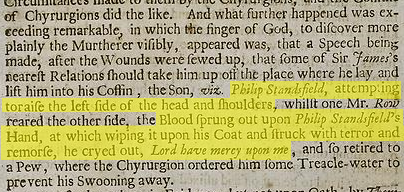
This date in 1688 saw the execution in Edinburgh of one Philip Standsfield (sometimes Stansfield or even Standfield) for parricide, his conviction being secured in part by the supposed accusation of his father’s corpse.

The prodigal firstborn of James Standsfield was an incorrigible scoundrel, and the state had a considerable circumstantial case to the effect that said scoundrel finally popped the old man to prevent disinheritance. (It also appeared that he’d tried to do it other times over the years.)

Circumstantial evidence is nice.

But how about some forensic evidence to really cinch a conviction? No DNA evidence here in the 17th century, so maybe something a little more … supernatural?


From A True Relation of a Barbarous Bloody Murther etc., available here.

The King’s Advocate insisted — over the objections of a defense attorney that “it was a superstitious observation, founded neither upon law nor reason” — that the corpse’s having bled on Philip Standsfield but none of the others in his party simultaneously attempting to move it “he must ascribe … to the wonderful Providence of God, who in this manner discovers murder.”

Divine forensics. That’s even better than the arson evidence Texas used to kill Cameron Willingham.

And it had the same result, to wit,

the said Philip Standsfield to be taken upon Wednesday next, being the 15th of February instant, to the Market-cross of Edinbrugh, and there, betwixt two and four o’clock in the afternoon, to be hanged on a gibbet till he be dead, and his tongue to be cut out and burnt upon a scaffold, and his right hand to be cut off and affixed to the east port of Haddingtoun, and his body to be carried to the Gallowlie betwixt Leith and Edinburgh, and there to be hanged up in chains; and ordains his name, fame, memory, and honours to be extinct, his arms to be riven forth and delete out of the books of arms …†

Well, you get the idea. Executed Today would like to apologize to the dempster of Edinburgh for keeping Philip Standsfield’s name, fame, and memory alive.

In our defense, we are hardly the only ones: this is thought to be the last time that Scottish law employed the bleeding-corpse “test”.

* Some other instances of purported “bleeding at the touch” may be perused here.

** In a 1927 piece in the Journal of the American Institute of Criminal Law and Criminology, Canadian jurist William Renwick Riddell says this folk belief “was wide spread and is not dead yet” and offers in a footnote (perhaps by way of explaining his interest) that “when at the Bar, I was once offered such evidence by my client; but I declined to use it.”

† The execution was botched, and the gibbeted body illicitly pulled down and tossed in a ditch — which is where the elder Standsfield’s had been discovered.

On this day..

1892: Two Georgian bandits, witnessed by Stalin

On this date in 1892, two outlaws were hanged (and a third spared at the last moment) in Gori, Georgia — part of the tsarist Russian Empire.

Josef Djughashvili, the future Stalin, was a teenager when he saw an 1892 public hanging in Gori.

The most noteworthy executioner present on this occasion was not on the scaffold, but in the audience: a 14-year-old student at an orthodox church school named Joseph Djugashvili. You know him by his later, steely revolutionist alias: Stalin.

This precocious, ferocious youth attended the public hanging with school mates to whom he was already a natural leader.

He and his friends sympathized with the doomed Caucasians, so insouciant at being strung up by the tsarist oppressor: conversing after the gruesome spectacle, Djugashvili would maintain that the men had not been consigned to hell, for they had suffered enough in the present.

But this boy was not made for theologizing; though he proceeded to seminary school in Tiflis — the best education prospect for an impoverished family — he disappeared thence into the life of professional revolutionary outlawry.

The recent (and well-received) biography Young Stalin recaptures this scene from Joseph Djugashvili’s youth.

The condemned men had stolen a cow and, in the ensuing pursuit, had killed a policeman. But the boys learned that the criminals were actually just three “peasants who had been so oppressed by landowners that they escaped into the forest,” petty Robin Hoods, attacking only local squires and helping other peasants …

The boys were fascinated. “Soso Djugashvili, me and four other schoolboys climbed a tree and watched the terrifying show from there,” remembers one of the group, Grigory Razmadze … Another spectator whom Stalin would later befriend and promote was Maxim Gorky, then a journalist, soon to be Russia’s most celebrated writer.

The Gorelis sympathized with these brave Caucasian bandits … The crowd became menacing; double ranks of Russian soldiers encircled the square. The drums began to beat. “The authorities in uniforms lingered around the scaffold,” wrote Gorky in his article. “Their dreary and severe faces looked strange and hostile.” They had reason to be nervous.

The three bandits in leg irons were marched onto the scaffold. One was separated from the others — he had been reprieved. The priest offered the two condemned men his blessings; one accepted and one refused. Both asked for a smoke and a sip of water. Sandro Khubuluri was silent, but the handsome and strong “ringleader,” Tato Jioshvili, smiled and joked valiantly before the admiring crowd. He leaned on the railings of the gallows and, noticed Gorky, “chatted to people who had come to see hi die.” The crowd threw stones at the hangman, who was masked and clad completely in scarlet. He placed the condemned on stools and tightened the nooses around their necks. Sandro just twirled his moustache and readjusted the noose. The time had come.

The hangman kicked away the stools. As so often with Tsarist repression, it was inept: Sandro’s rope broke. The crowd gasped. The scarlet hangman replaced him on the stool, placed a new noose round his neck and hanged him again. Tato also took a while to die.


Even Joseph Stalin was a child once.

One would have to really like the difficult-to-prove notion that executions have a brutalizing effect encouraging violence in others in order to see in this hanging the germ of the incomprehensible suffering young master Djugashvili would eventually unleash.

It’s not like this was Stalin’s only childhood exposure to brutality, and not too many of those buddies who watched this date’s hanging grew up to kill 20 million people.

Gori was one of the last towns to practise the ‘picturesque and savage custom’ of free-for-all town brawls with special rules but no-holds-barred violence. The boozing, praying and fighting were all interconnected, with drunken priests acting as referees… [At festivals during Stalin’s youth] the males in each family, from children upwards, also paraded, drinking wine and singing until night fell, when the real fun began. This ‘assault of free boxing’—the sport of krivi—was a ‘mass duel with rules’; boys of three wrestled other three-year-olds, then children fought together, then teenagers and finally the men threw themselves into ‘an incredible battle,’ by which time the town was completely out of control, a state that lasted into the following day—even at school, where classes fought classes.


This is Russia, not Georgia: festive Maslenitsa fisticuffs.

The small Georgian town that spawned the first name in Soviet terror actually maintained a public statue to its most famous son until 2010 — when it was finally removed in an apparent anti-Russian gesture in the wake of the South Ossetia war.

On this day..

1879: Takahashi Oden, dokufu and she-demon

On this date in 1879, Takahashi Oden was put to death for murder at Tokyo’s execution grounds — the last woman beheaded in Japanese history.

Oden confessed to slaying her lover, and was also suspected of poisoning off her husband.

This made her perhaps the most infamous of Japan’s dokufu, poison-women — a perceived epidemic of the early Meiji period. Oden’s infamy thrust her into the crime genre’s characteristic harvest pulp literature, like Takahashi Oden yasha monogatari. (Takahashi Oden, the She-Demon’s Tale)

“Oden’s body became part of a scientific discourse that worked to produce ‘knowledge’ about feminine norms based on determinist biological differences,” Sharon Chalmers observes. “Deviancy was also characterised in terms of ‘masculine’ traits … [and] female transgression was read as sexual excess.”

And the feeding frenzy of the popular press around each new dokufu only exaggerated the effect: the sexual rapacity angle moved media.*

Since Japan was all about divining the secrets of the human form from the condemned, Oden was dissected after her death.

According to Murder Most Modern: Detective Fiction and Japanese Culture, the anatomizing team was especially keen on delineating that scientific discourse of feminine deviance. And, of course, the pamphleteers were keen on publicizing it. In this case, standing as we do today outside the surgeons’ intellectual framework, we can readily discern the corpse’s role for these men as grist for the ideological mill.

Immediately following her execution, her body was taken to the hospital affiliated with the Metropolitan Police Office (Keishicho) and dissected by an army surgeon and three regular doctors. Some accounts of this autopsy reveal that these doctors focused their attention on Oden’s genitalia during the procedure. Her bizarre autopsy is said to have been prompted by a newly emerging field of study called zokaki ron, roughly “the study of (re)productive organs.” A cross between sheer superstition and legitimate study of anatomy, zokaki ron was getting much scholarly as well as popular attention as one of the branches of science recently introduced from the West. After the autopsy, the primary operating surgeon, Osanai ken (1848-85), made the following report on Oden: “Abnormal thickness and swelling of the labia minor. Over-development of clitoris. Enlargement of vagina.” For Osanai — a skilled physician who is credited with having performed the first operation in Japan with chloroform and even makes an appearance in Shibue Chusai (1916), a novel by Mori Ogai (1862-1922) about a doctor of Chinese medicine in late Edo period Japan — such physical abnormalities explained Oden’s violent nature: after all, she ruthlessly slit her victim’s throat and left him in a pool of his own blood, and it took several blows for the authorities to execute her as she kicked and screamed in resistance.


Autopsy of Takahashi Oden, from Takahashi Oden yasha monogatari.

Though a lot of water has passed under the bridge since Oden’s day, she was the subject of a 1958 Nobuo Nakagawa film, Dokufu Takahashi Oden.


Katsuko Wakasugi as the title character in Dokufu Takahashi Oden.

* For more on the Oden story as crime literature, see Mark Silver’s “The Lies and Connivances of an Evil Woman: Early Meiji Realism and ‘The Tale of Takahashi Oden the She-Devil'” in Harvard Journal of Asiatic Studies, June 2003 — or, his book Purloined Letters: Cultural Borrowing and Japanese Crime Literature, 1868-1937.

On this day..

1818: Robert Johnston, under horrific circumstances

(Thanks to Meaghan Good of the Charley Project for the guest post. -ed.)

On this day in 1818 in Edinburgh, Scotland, 22-year-old Robert Johnston faced capital punishment for the robbery of a candlemaker. The authorities were nothing if not zealous: that day, Johnston would be hanged no less than four times.

Alex Young, in his book The Encyclopaedia of Scottish Executions 1750 to 1963, provides an account of the gruesome debacle that was Robert Johnston’s execution:

After praying and shaking hands with the clergymen, he mounted the scaffold and looked boldly around him, before helping the executioner adjust the rope, and giving the signal.

The drop fell – but the excessively short length of rope enabled him to stand on the platform. As the Magistrates ordered carpenters to cut a wider opening, cries of “Murder” came from the crowd.

The cries were followed by a shower of stones, which sent the Magistrates and the carpenters to the shelter of the Tolbooth Church doorway, through which they passed into the police office.

Almost every window glass in the church suffered from the stones, as did Johnston who had been abandoned on the platform.

“Cut him down—he’s alive!” rang out, as the crowd took possession of the scaffold. Johnston, despite hanging many minutes, was alive, and after taking the rope from his neck and arms and the cap from his head, he was carried off towards High Street. The scaffold structure proved too robust, but Johnston’s waiting coffin was broken up and thrown through the church windows.

The police and military combined forces to wrest the hapless Johnston from his would-be saviors and took him, unconscious, to the police office, where a surgeon bled him until he was determined fit to be re-hanged.

This time Johnston was carried by six men and the scaffold, surrounded by soldiers.

Again the executioner made a bungle of it. The rope was now too long and Johnston had to be lifted while the rope was shortened by winding it around the hook.

Again, shouts of “Murder!” and “Shame! Shame!” rang out, and only the military presence prevented another riot. Johnston struggled for many minutes before passing into eternity.

The next day, the Magistrates fired both the master of works and the executioner, who was named John Simpson. They also issued a fifty-guinea reward for information leading to the identification of Johnston’s rescuers. It went unclaimed.

(Here’s the Newgate Calendar entry)

On this day..