1888: Prado, before Gauguin

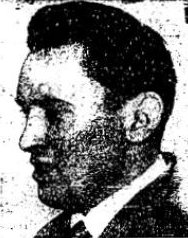
On this date in 1888, “Prado” — also known as “Count Linska de Castillon”; he never copped to his real identity — was beheaded as a thief and murderer at Paris.

The trial of this intrepid criminal promised, in the London Times‘ Nov. 6, 1888 preview, to be “one of the most extraordinary of our times”

He [Prado] is a Spaniard, and was brought up at Gijon, but he refused to say who he was. When 14 years of age he visited Mozambique, India, China, California, the West Indies, and North America. In 1872 he was a sub-lieutenant in the Carlist bands. He then lived by his wits. He once crossed the French frontier and stole 8,000f. At the battle of Somorrostro he was wounded by a shell, and removed to a hospital, from which he enticed the sister of the Order of Saint Vincent de Paul who nursed him. She belonged to one of the first families in England. He married her, and with her visited the Holy Land, but her health failed, and she died on their return to Italy. Prado says he married a second wife at Lima, with a dowry of 1,200,000f., and that after her death he committed many daring robberies.

He’s the most interesting man in the world.

This vagabond upon the overgrown lost highways of fortune eventually ditched wife #2 in penury in Spain and proceeded to France where he mooched off a local girl and her absentee American sugar daddy, until one night he slashed the throat a dame named Marie Aguetant, the lover of a late-working croupier, and plundered their domicile of chattels.

Prado eluded capture for some time, keeping his lover, taking another — both of whom ended up in the dock with their insolent Don Juan, along with various male intimates in various aspects of accesorizing. None of those others drew a death sentence, but as the interest of the London Times suggests — it fronted near-daily trial dispatches from Paris — all this stuff about cabals of swarthy men ravishing women of their virtue and their valuables made global news.

It also moved Third Republic bodice-ripping true crime like this zippy little volume, “Prado ou Le Tueur de Filles,” with a copyright notice as late as 1931.

A savage crime by a strange character, but now that it’s long departed all living memory, it scarcely stands out. Legion are the lotharios who have slain for the pedestrian motivation of gold.

In a post-bourgeois order, “we will no longer see men like Pranzini, Prado, Berland, Anastay and others who kill in order to have this metal,” the French terrorist Ravachol‘s suppressed address to the courtroom declared in 1892. “The cause of all crimes is always the same, and you have to be foolish not to see this.”

Yes, I repeat it: it is society that makes criminals and you, jury members, instead of striking you should use your intelligence and your strength to transform society. In one fell swoop you’ll suppress all crime. And your work, in attacking causes, will be greater and more fruitful than your justice, which belittles itself in punishing its effects.

-Ravachol


Just a few days before this headline-grabbing execution, impressionist painter Vincent van Gogh undertook the most famous thing he ever did off-canvas: after his latest dispute with roommate and fellow-artist Paul Gauguin, van Gogh sliced off his own left earlobe.*

It was in this abnormal circumstance that Gauguin, fresh to Paris fleeing from the scene of the self-mutilation in Arles, attended Prado’s beheading, even forcing his way through a line of gendarmes to obtain a closer view.

“[H]e may have had the counterphobic desire to reassure himself of his courage by taking an unflinching look at Prado’s execution,” writes Bradley Collins. “Gauguin may have identified with both the executioner and his victim. On the one hand, by watching the state kill a man, he could vicariously release some of his pent-up aggression toward Vincent. On the other, by identifying with Prado he could vicariously atone for the guilt he felt about precipitating Vincent’s breakdown and abandoning [Arles].”

Aptly for Gauguin’s personal demons, the guillotine managed to botch this job, too — giving Prado a non-fatal facial injury and requiring the now-wounded condemned to be repositioned for another chop.

All this pate-slashing sure seems to have found its way into Gauguin’s next creation:


Gauguin’s grotesque “Jug in the form of a Head, Self-Portrait”. “Within one work, he has become both the bloody, earless Vincent [Van Gogh] and the guillotined Prado.” –Collins

* Latter-day revisionist hypothesis: Gauguin actually cut off van Gogh’s ear in a fight, but both painters kept to a cover story to keep everyone out of trouble. That version would only thicken the psychological stew for Gauguin’s pilgrimage to the guillotine and subsequent “self-portrait”.

On this day..

1952: Lennie Jackson and Steve Suchan, of the Boyd Gang

On this date in 1952, Steve Suchan and Lennie Jackson were hanged at Toronto’s Don Jail for the murder of a policeman.


Lennie Jackson (top) and Steve Suchan

Both Such and Jackson were members of the Boyd Gang, a swashbuckling troupe of show-stealing bank robbers in post-World War II Toronto … but in the timeless mold of the folk hero outlaws.

Not hanged with them (or ever; he died in British Columbia in 2002) was the gang’s leader and namesake, Edwin Alonzo Boyd.

The wartime commando legendarily launched his stick-up career by robbing a bank so unrecognizably made-up that he was able to walk back in and change a $20 without notice a few days later.

Boyd’s further exploits (and occasional close scrapes: he seemed to have a gift for not getting hit when people shot back at him) plundering banks, and then escaping jail with the cohorts who became the “Boyd Gang” to plunder some more, threw a splash of color across the headlines of staid 1950s Ontario that moved newspapers.

Toronto historian Mike Filey remarked in this CBC documentary

When the Boyd Gang stuck up a bank and it made the front page, people started cheering for them, because it put some excitement in their lives. And of course the interesting thing about Edwin was, if there is such a thing, he was a “good” bad guy.*


More about this movie here

Jackson and Suchan were two of that group who helped author the Boyd Gang’s most notorious larcenies. And they put a screeching halt on the “fun” of the Boyd gang’s crime spree in March 1952 when they shot a Toronto cop dead at a traffic stop.

Suddenly, it wasn’t just the banksters getting hurt. The crooks couldn’t dodge the ensuing manhunt.

But somehow the quartet of criminals locked up in the Don Jail with this murder rap hanging over them actually managed to escape again, hours ahead of their arraignment. It turned out to be the bandits’ last great exploit, worth only a few days of liberty before they were recaptured.

Jackson and Suchan went from trial to gallows — said to be a badly botched hanging — in mere weeks. Boyd and another gang member named Willie Jackson (the two Jacksons weren’t related) drew long prison sentences from which they were paroled in 1966.

Some Books about Edwin Boyd

* Or was he?

On this day..

1865: Henry Wirz, for detainee abuse

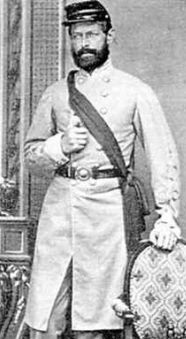
On this date in 1865, Henry Wirz was hanged in Washington, D.C. for running a notorious Confederate prison camp.

A Swiss-born doctor (“Henrich” was the real handle) whom time and tide found practicing in Louisiana at the onset of the Civil War, Wirz apparently got into the prison-guarding ranks when a war injury left him unfit for the front lines.

But it was front-line fitness in the northern army that would set the scene for his controversial hanging.

The North’s advantage in men and materiel shaped Union strategy as the war progressed, and it eventually caused the Union to halt prisoner exchanges. Exchanging casualty for casualty was a winning strategy on the battlefield, so why return to your enemy a man for a man? Besides,

[Grant] said that I would agree with him that by the exchange of prisoners we get no men fit to go into our army, and every soldier we gave the Confederates went immediately into theirs, so that the exchange was virtually so much aid to them and none to us.

Benjamin Butler (we’ve met him before)

As designed, then, the South began piling up more and more POWs to maintain with its ever-straitened resources late in the war. And if exchange was out, that really only left one form of “release”.


Andersonville Prison survivor John L. Ransom’s view of the prison, from the Library of Congress.

Andersonville — officially, Camp Sumter, located near the tiny Georgia town of Andersonville — was only established in 1864, but acquired considerable notoriety in northern propaganda for the year and change that Wirz ran it. The prisoners didn’t enjoy it much, either.

Wuld that I was an artist & had the material to paint this camp & all its horors or the tounge of some eloquent Statesman and had the privleage of expresing my mind to our hon. rulers at Washington, I should gloery to describe this hell on earth where it takes 7 of its ocupiants to make a shadow.

Union prisoner diary, July 1864. Note the prisoner’s anger at Washington — whose refusal to exchange naturally infuriated its stranded POWs

Out of some 45,000 prisoners held at Andersonville during its existence (not all at one time), nearly 13,000 succumbed to disease and malnutrition.* After the war, photos of wasted survivors inflamed (northern) public opinion, already tetchy over Abraham Lincoln’s assassination. Walt Whitman wrote of Andersonville,

There are deeds, crimes that may be forgiven but this is not among them. It steeps its perpetrators in blackest, escapeless, endless damnation.

Damnation is up to higher powers, of course, but the North wanted somebody to answer for Andersonville on this mortal coil. Lincoln’s successor Andrew Johnson overruled mooted charges against Confederate President Jefferson Davis and his Secretary of War James Seddon, leaving — in that great American tradition — Heinrich Wirz holding the bag.**

Shatner sighting!

The trial had an undeniable aspect of victor’s justice.† Even at the gallows, the Union guards chanted, “Wirz, remember Andersonville!” as the condemned man was readied for the noose, and then dropped. The hanging failed to break the man’s neck, and he strangled as the chant continued.

Southern efforts to reshape the story of Andersonville began in the lifetimes of Wirz’s contemporaries; this fulsome volume supporting the charges answered Jefferson Davis in terms that sound strikingly contemporary:

So long as Southern leaders continue to distort history (and rekindle embers in order to make the opportunity for distorting it), so long will there rise up defenders of the truth of history … To deny the horrors of Andersonville is to deny there was a rebellion. Both are historic facts placed beyond the realm of doubt.

But of course, it does not require denying the horrors of Andersonville to notice the circumstances — the privation of the entire South late in the war — and to wonder that Wirz and Wirz alone was held to account. Plenty of people think he got a bum rap.


Daughters of the Confederacy monument to Wirz. (cc) image from divemasterking2000.


Pro-Wirz marker in Andersonville, Ga. (Click for easier-on-the-eyes version, reading in part, “Had he been an angel from heaven, he could not have changed the pitiful tale of privation and hunger unless he had possessed the power to repeat the miracle of the loaves and fishes”). (cc) image from Mark D L.

Recommended for general reading: the UMKC Famous Trials page on this case, several of whose pages have been linked in this entry. A number of nineteenth-century texts by (or citing) Andersonville survivors are available from Google books, including:

Since this is a controversy of the Civil War — and one that can be engaged without having to get into that whole slavery thing — there have been thousands of published pages written about it, with many more sure to come in future years.

A few books about Henry Wirz and Andersonville

As an interesting aside, Civil War POW camps including Andersonville (but not only Andersonville) gave us the term “deadline,” which had a more startlingly literal definition in the 1860s — a perimeter beyond which prisoners would be shot on sight, which policy could make a handy stand-in for walls. Gratuitously killing an insane prisoner who crossed Camp Sumter’s “dead line” was one of the atrocities laid to Wirz, who we take it would not have been at home to the word’s decreasingly urgent appropriation in the wider culture.

* Wirz’s defense showed, to no avail, that the prisoners and the guards received the same rations, with similarly deleterious effects among both, and that the commandant was on record pleading with his superiors for more.

** Wirz’s attorney claimed that his man was offered (and refused to take) a last-minute pardon on November 9 in exchange for implicating Jefferson Davis.

† Wirz and borderlands guerrilla Champ Ferguson were the only Confederates executed for their “war crimes”. There was at least one other prison guard who faced similar charges of prisoner maltreatment, John Henry Gee; Gee was acquitted and released in 1866. (For more on the latter, see “A Little-known Case from the American Civil War: The War Crimes Trial of Major General John H. Gee” by Guénaël Mettraux in the Journal of International Criminal Justice, 2010.)

On this day..

1492: Sir Nicholas de Mimsy-Porpington, Nearly Headless Nick

(Thanks to Elizabeth M. Hull for the guest post. -ed.)

Post-mortem resident of Gryffindor House, Hogwarts School of Witchcraft and Wizardry, Hogsmeade, U.K.

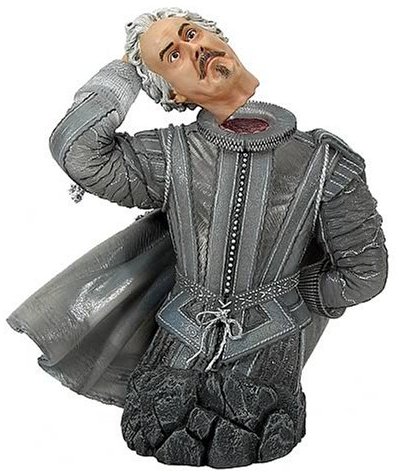
A minor character in J.K. Rowling’s Harry Potter saga, Nearly Headless Nick remains one of the most memorable. Executed — badly — on Halloween of 1492, Sir Nicholas de Mimsy-Porpington became the ghost of Gryffindor House. The school has about 20 resident ghosts: the Grey Lady (Helena Ravenclaw) and the Bloody Baron of Slytherin House died violently as well, in a murder-suicide.

Rowling says that her editor suggested that she cut a ballad Mimsy-Porpington wrote about himself from The Chamber of Secrets. In the song, the ghost claimed to have been executed for “a mistake any wizard could make,” a “piffling error,” a case of wizardry gone wrong. Asked by Lady Grieve (otherwise unknown) to straighten her teeth, Mimsy-Porpington seems to have given her a tusk. “They” imprisoned the piffler immediately, though he cried all night that he could fix his mistake, and his beheading followed the next morning.

Unfortunately for Mimsy-Porpington, his was not the only incompetence: “they’d mislaid the rock/Where they usually sharpened the axe”! The “cack-handed twit” of a headsman said “this may sting a bit” to the gibbering wizard, and swung the axe in the air. Alas, unable to sharpen the blade, the executioner was reduced to bestowing numerous blows: “But oh the blunt blade! No difference it made,” the ghost sang,

My head was still definitely there.
The axeman he hacked and he whacked and he thwacked,
“Won’t be too long,” he assured me,
But quick it was not, and the bone-headed clot
Took forty-five goes ’til he floored me.

(The full ballad is here and here; the original handwritten version can be seen here.)

After repeated strokes of the edgeless axe, Mimsy-Porpington finally expired. On festival occasions, he re-enacts his near-beheading, a show quite popular with the Hogwarts student body (Prisoner of Azkaban, p. 159).

However, the bone-headed, cloddish headsman was unable to completely behead the wizard. As Ron Weasly notes, the ghost is merely nearly headless.


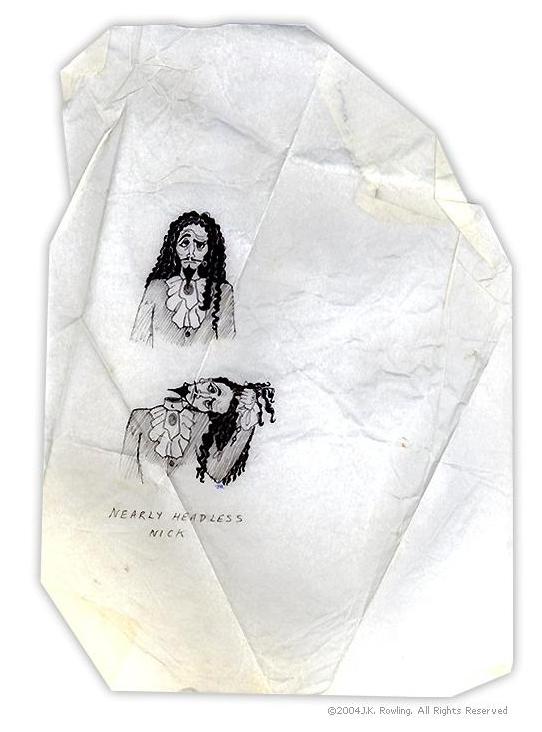
Nick, as played in the Harry Potter films by John Cleese. Rowling’s own original sketch of Nearly Headless Nick is here.

While he gets a great deal of pleasure from entertaining Hogwarts residents by swinging “his whole head . . . off his neck and . . . onto his shoulder as if it was on a hinge” (Sorceror’s Stone, p. 124), his condition limits his access to the dizziest heights of post-mortem society. Beheading was an aristocratic execution, meant to bring a swift death to the privileged, those able to hunt legally in their lifetime. In the afterlife, the beheaded aristocrats have established a “Headless Hunt” Club, and have blackballed Mimsy-Porpington, who misses their entrance requirements by that much: “‘half an inch of skin and sinew holding my neck on.'” Unable to participate in Club sports like “Horseback Head-Juggling and Head Polo,” Mimsy-Porpington is denied admission into the elite society (Chamber of Secrets, p. 124).

Sadly, their scorn for his crippling condition is not limited to exclusion from their company.

Mimsy-Porpington’s five hundredth Deathday anniversary party, held on Halloween 1992, welcomes hundreds of ghosts from as far away as Kent to a feast of rotten fish, putrid, “maggoty haggis,” and a tombstone cake with grey icing, while an orchestra of 30 musical saws plays waltzes. The Deathday Boy’s speech is interrupted by the members of the Headless Hunt: “Sir Properly Decapitated-Podmore” begins a game of Head Hockey, sending his own head sailing past the humiliated Mimsy-Porpington as he tries to address his guests (Chamber of Secrets, p. 132-7).

Somehow the courageous Gryffindor ghost overcomes this diabolical heads-up-manship and several months as a petrified cloud to live a useful afterlife, helping Harry many times. Most significantly, in the final pages of The Order of the Phoenix, a traumatized and grieving Harry turns to Mimsy-Porpington, hoping to discover a way to keep his dead friend and guardian Sirius Black alive. “‘You’re dead,'” Harry says, “‘But you’re still here, aren’t you? … People can come back, right? As ghosts. They don’t have to disappear completely.'” Mimsy-Porpington gently tells Harry that he can only “‘walk palely'” where his living self once trod, “‘neither here nor there,'” hovering between life and death for fear of the unknown. However, Black risked his life joyously and died laughing; he will not linger between death and life. Harry must live on without him.

There may be historical precedent for Mimsy-Porpington’s death in the botched execution of James Scott, Duke of Monmouth (1685), when the notorious Jack Ketch took five blows to kill the rebel, and finally had to use a knife to sever the last “skin and sinew” connecting the head to the corpse. Monmouth’s hairstyle in portraits from the late 1600s resembles that drawn by Rowling in her sketch of Nearly Headless Nick, although that sketch shows a beard style from the early 1600s, nearly 70 years earlier. Moreover, the ghost enters Harry Potter’s life wearing an Elizabethan neck ruff and says that he has not eaten in nearly 400 years, implying a death in the late 1500s.

In spite of this wibbly-wobbly timeline, Mimsy-Porpington’s deathdate establishes the firm chronology of Rowling’s series: the five hundredth anniversary of his death in 1492 would fall in 1992; therefore the events of Chamber of Secrets (published in 1997) must occur in 1992. The dating of the series is confirmed five books later by the tombstones of Harry’s parents, who died on Halloween Day, 1981 (Deathly Hallows, p. 328). For J.K. Rowling, death, the last enemy — not life — marks the measure of this world’s time.

On this day..

1870: Jacob Wallace, Henry Coston, and Moses and Peter Newby

The Daily Cleveland Herald, September 22 1870

THE VIRGINIA GALLOWS HORROR.

Tortured by a Bungling Hangman — Half Executed with a Rotten Rope — A Monster under the Gibbet.

The four negroes who were hanged on Friday last at the Court House of Isle of Wight county, Virginia, were convicted of the murder, under most brutal circumstances, of Josiah P. Grey, a citizen of that country, in December last. Six negroes were implicated in the crime, named respectively, Guyanetta Mears, Alfred Bunckley, Moses and Peter Newby, alias Lawrence, Jacob Wallace, and Henry Coston, alias East. The last five were immediately arrested, Mears having either effected his escape in a somewhat miraculous manner, or, as it is rumored, having been lynched by his captors. The five taken were tried at the August term of Isle of Wight county. Bunckley having turned State’s evidence, escaped, but by their own confession of complicity in the killing, four of them were condemned to be hanged. The Norfolk Virginian gives this account of the execution:

About 12 1/2 o’clock the officers entered the cell in which the prisoners were confined, and striking off their iron shackles, tied their hands behind their backs, at the same time telling them they could make any communication which they wished. To this no satisfactory answer was returned, and the condemned continued chanting their prayers for mercy from on high. As soon as the pinioning was performed, the condemned were marched out of the jail on the steps and upon the scaffold.

They walked firmly and undoubtedly, with one exception, Moses Newby, who shook as if in an ague fit, and were ranged in the following order: Peter Newby, Henry Coston, Moses Newby, and Jacob Wallace. The fatal nooses were then adjusted, when the Sheriff read the death warrant and sentence of death. The prisoners were informed that they could have an opportunity of saying a few words each.

The feet of the condemned having been pinioned upon their first taking their stand upon the scaffold, as each one ceased to speak the black cap was drawn over his head, and when all had finished, the scaffold was cleared of all but the condemned and at exactly 1 o’clock, at a signal from Deputy Sheriff Ely, the prop was pulled violently away, and the drop fell.

Then ensued a scene the recital of which we would willingly spare our readers, and a repetition of which we earnestly hope it may never be our lot to witness. As the bodies fell in the drop, the two end men, Peter Newby and Jacob Wallace, both large, athletic men, snapped the rope like pack-thread, and fell heavily to the earth, apparently insensible.

The other two remained suspended; but one was hanging by only one strand of the rope, the other two having been broken by the fall. Moses Newby died instantly, his neck being broken, but Henry Coston lived for nearly ten minutes, gasping for breath, and his limbs working convulsively.

The two men on the ground lay still for a few minutes, when Jacob Wallace rose to a sitting posture and broke into prayers and supplications. Peter Newby lay a while longer, when he also sat up, but kept silent, except groans extorted by pain. Their feet were then untied, when both stood up, Newby leaning heavily against the steps of the gallows, while Wallace walked back and forth, praying intently. New ropes were procured and adjusted to the beam, the two men hanging preventing the drop being raised. At the expiration of seventeen minutes the physicians in attendance, Drs. Jordan and Chapman, examined the bodies and pronounced them both dead, when another horror was enacted which made strong men shudder and turn pale.

Instead of lowering the bodies as is always customary, the ropes were cut, allowing the ghastly corpses to fall with a horrible thud at the very feet of the two half-hanged men standing below. Not content with this, the brutal monster who officiated as hangman, an occupation which he dishonored, and who rejoices in the name of the name of [sic] John J. Murphy, descended from the scaffold, and taking hold of the rope attached to the neck of one of the dead men, drew the body by it across the yard, and tumbled it into the coffin, as if it had been a dead dog. He repeated the operation on the next one, and seemed to think that by his disgusting brutality he had done some meritorious action.

During the whole of the time this disgusting scene was transpiring, Wallace and Peter Newby, although suffering horribly from the effects of the rope around their necks, in their fall, betrayed no emotion, save that Wallace used the time in praying loud and fast. Newby looked on apparently as unconcerned as if he was not an actor in the dreadful drama.

The new ropes, which were of stout cotton cord, having been fixed, the drop was replaced and the miserable men mounted the scaffold the second time, this time never to return alive.

The condemned both spoke to the crowd around in the same strain as before, at the conclusion of which the black caps were again drawn over their heads, and at half past one o’clock the drop again fell, and the ropes proving strong enough, they were left struggling in the air. Neither of their necks were broken, and for several minutes they gave painful evidence of life by their forced breathing and the convulsive jerking of their arms and legs. They were allowed to hang for half an hour, when they too were cut down, placed in their coffins, and taken to the court-house graveyard for interment.

[editor’s note: here’s the perfunctory and much less colorful New York Times report of the incident.]

On this day..

1983: Jimmy Lee Gray, drunk-gassed

Just after midnight on this date in 1983, Jimmy Lee Gray gruesomely paid with his life in the Mississippi gas chamber for raping and murdering a three-year-old.

Mississippi’s gas chamber had had a checkered history since its first usage in 1955, and with America just emerging from a long lull in executions, Jimmy Lee Gray was its first client in 19 years.

“Sumbitch took a little three-year-old girl out into the bush and he raped her,” executioner T. Barry Bruce would later explain of the man’s crime. “Then he tried to shove her panties down her throat with a stick, then he pushed her head into a little crick full of running shit and then he broke her neck. So yeah, I feel real sorry for Jimmy Lee.”

Gray was on parole at the time for the 1968 murder of his teenage sweetheart, so no — nobody felt all that sorry for Jimmy Lee, not even his mom.

But the reason that questions about the affair were being directed at the executioner (usually a party as silent in these matters as he is implacable) was that Jimmy Lee Gray’s had been drunk on the job — and the execution was a notorious horrorshow.

“Gasping” or “moaning” a recorded eleven times, Gray convulsed wildly in the Parchman death chair, slamming his unrestrained head “with enough force to shake the chamber” against a metal pole that some user interface genius had positioned right behind the death chair. The witness room was cleared eight minutes into the affair, with Gray still thrashing about.

Though the Magnolia State contended that Gray was clinically dead within two minutes, that head-smashing act disturbed everyone.

As a result, for the third time in a half-century, Mississippi switched to a newer and supposedly more humane method for killing people — adopting lethal injection for anyone sentenced to death after July 1, 1984. (Three more prisoners already condemned under the old sentencing guidelines would die in the gas chamber in the late eighties, however.)

Actual executions in the U.S. were still novel enough in the early 1980s that Gray’s made national news — albeit distinctly second fiddle to the tense Cold War escalation occasioned by the September 1 Soviet downing of Korean Air Lines flight 007.

On this day..

1749: Samuel Henzi, excluded

What happens to a dream deferred?

Does it dry up
like a raisin in the sun?
Or fester like a sore–
And then run?
Does it stink like rotten meat?
Or crust and sugar over–
like a syrupy sweet?

Maybe it just sags
like a heavy load.

Or does it explode?

Langston Hughes

Those lines, written for 20th century America’s struggle with racism, are rooted in the timeless conflict between the haves and the have-nots, and those “exploding” dreams deferred have provided more than a few subjects for these morbid pages.

This date in 1749 saw the beheading of writer and reluctant revolutionary Samuel Henzi (German Wikipedia page), along with two fellow-conspirators in a plot to overthrow the aristocratic government of Bern(e).

Still operating off a 13th century constitution, Berne had ossified into an oligarchic society with privilege derived from heredity and the capable but low-born frustratingly locked out. This arrangement had provoked intermittent uprisings and challenges, but as of the mid-18th century, it was still going strong, and “patricians mockingly observed that the citizens must be stripped of their feathers, that they might not want to fly.” (Source)

Henzi was a man with the ambition and the talent to soar above his place.

Eloquent, cultured, a guy to bang out some French poetry on the side, Henzi had been among a group of lower gentry who in 1744 petitioned for a change to Bern’s governing council, which at that time had become a privately held dynastic trust among a few top burghers.

For a suggestion as incendiary as allocating council seats by lot the better to represent the class, Henzi was treated as a rebel and exiled to Neuchatel.

dass ein eingewurzelter Staatskrebs mit Demuth nicht geheilt werden kann; nein! man muss den Degen in die Faust nehmen, wenn man die verlorne Freiheit wieder erobern will.*

Returning on a pardon, he found that not much had changed. The doors to employment in the civil administration shut tight against him, and not being bought off with a minor sinecure he fell in with a circle of malcontents dreamily conspiring to blow the whole thing up.

These plotters were exposed and three considered ringleaders — merchant Samuel Niklaus Wernier, Stadtlieutenant Emanuel Fueter, and Henzi — were beheaded on this date, each reputedly requiring more than one stroke of the sword.

On embarking with their two sons to quit the Helvetic territory, the wife of Henzi exclaimed, “I would rather see these children sink in the Rhine-stream than they should not one day learn to avenge the murder of their father.” However, when the sons came to manhood, they displayed more magnanimity than their mother; and one of them, who rose to distinction in the service of the Netherlands, requited with good offices to the burghers of his native town the unmerited misfortunes which they had brought upon his family. (Source)


Henzi’s fate greatly excited German dramaturg (and original Conehead) Gotthold Lessing — indeed, he would remark that no other event moved him so deeply.

Almost immediately after Henzi’s decapitation, Lessing wrote his first tragedy, the never-finished but aptly-titled Samuel Henzi, which is available in the original German here.**

Wann man des Staates Flehn, der sie aus Gunst erkoren,
Der nur aus Nachsicht fleht, empfängt mit tauben Ohren;
Wann wer der Freiheit sich das Wort zu reden traut,
Zum Lohn für seine Müh ein schimpflich Elend baut;
Freiheit! wann uns von dir, du aller Tugend Same,
Du aller Laster Gift, nichts bleibet als der Name:
Und dann mein weichlich Herz gerechten Zorn nicht hört,
So bin ich meines Bluts –– ich bin des Tags nicht wert.

* That is, “humility cannot cure the cancer of the state; one must take the sword in fist.” The comment is cited in Edward M. Batley, “‘Tu executes comme tes maitres jugent!’ – The Henzi Affair and the question of Lessing’s political judgment”, German Life and Letters, July 1984.

** Lessing’s next stab at stagecraft in the key of seria produced what’s generally described as the German theater’s first domestic or bourgeois tragedy, Miss Sara Sampson (German Wikipedia entry).

On this day..

1926: Ziya Hursit and others for a plot against Ataturk

On this date in 1926, 15 people who had been sentenced to death only the day before for attempting to assassinate Turkish statesman Atatürk were hanged in Constantinople.

Ziya Hursit (English Wikipedia entry | Turkish), a former National Assembly delegate who didn’t see eye to eye with Atatürk, generally goes down as the ringleader in this affair.

Their object? To gun down the President during a visit to Izmir a few weeks previous. When interrogated, Hursit “admitted at the outset his intention to kill the President of the Republic.” (London Times, June 29, 1926)

Frictions with said President had been growing over the preceding months, as Atatürk broke the eggs to make the Turkish Republic’s omelet.

In early 1926, Mustafa Kemal also sought to bring the manner in which Turkish society was regulated into line with European countries. On 17 February 1926, the Turkish parliament approved a new civil code which was translated almost verbatim from the civil code in the Swiss canton of Neuchatel. The changes it introduced included: granting Turkish citizens the right to choose their own religion, thus abolishing the previous prohibition on apostasy from Islam; officially recognizing only civil marriage ceremonies conducted by representatives of the civil authorities … outlawing polygamy; making divorce dependent on a decision of the courts; lifting the ban on Muslim women marrying non-Muslims; and granting men and women equal inheritance rights.

The new Civil Code was followed by a battery of further legal reforms to try to bring Turkey into line with contemporary Europe. On 1 March 1926, parliament approved a new Penal Code, which was translated from the Italian Penal Code of 1889. A Code of Obligations was introduced on 22 April 1926, again based on the one in Swiss canton of Neuchatel. On 9 May 1926, parliament approved a new Commercial Code, which was largely based on German law.

(Source)

This first of the Turkish Republic’s political assassination attempts and arguably its last serious bid to reverse secularism licensed an efficient purge and further consolidation of power by Atatürk, who over the weeks ahead shattered the remnants of the Unionists and Progressive Republicans and settled in for essentially secure autocratic governance for the balance of his life.

The alleged conspirators in the hit — not all of them as eager as Hursit to avow responsibility over the two-plus weeks’ trial — were hanged at a couple different locations in the former capital this date, bearing placards damning them for “attempting to assassinate our President, Mustapha Kemal Pasha, who is the saviour of Turkey’s honour.” One of them had a botched execution with a broken rope and a do-over.

(The quote is from the London Times dispatch about the executions, printed July 15, 1926. This story gives the figure of 15 hanged; it appears to me that the correct number that date was either 13 or 14, with two additional death sentences handed down in absentia. It was, in any event, more death sentences than the public prosecutor himself had demanded (11) in the case.)

* The city wasn’t renamed Istanbul until 1930.

On this day..

1916: Cesare Battisti and Fabio Filzi

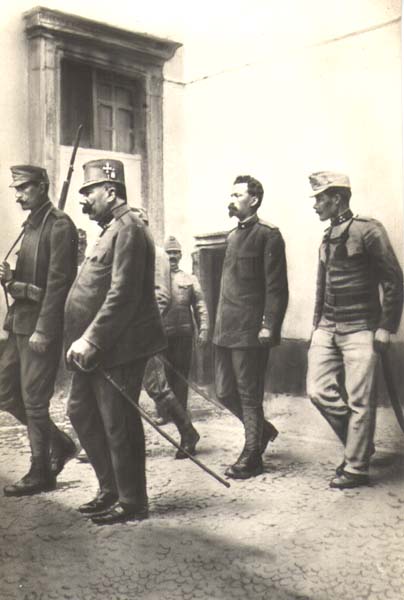
On this date in 1916, the Austro-Hungarian empire executed Cesare Battisti and Fabio Filzi for treasonous Italian nationalism.

It was the multiethnic Habsburg state that was itself dying of its constituents’ national aspirations; in little more than two years, the state entity that carried out this day’s sentences would no longer exist at all.

Pre-World War I, Battisti (English Wikipedia entry | Italian) was actually a Socialist representative in the Austrian parliament.

When the unpleasantness broke out, though, he made a break for the peninsula where he agitated* (successfully) for Italian entry into the fray against Austria-Hungary. Irredentists had long coveted Habsburg properties with a heavy Italian population, like the Adriatic port of Trieste and Battisti’s own native Trento; the war offered an opportunity to swipe those territories, notwithstanding Italy’s putative prewar alliance with the Austrians.

Although already 40 years of age when Italy entered the war, the intrepid Battisti enlisted to fight. He was captured along with an otherwise obscure subaltern, Fabio Filzi, on the Alpine slope of Monte Corno (now known as Monte Corno Battisti) repelling the Austrian Strafexpedition.**

Austria did not stand on ceremony with these men; their capture took place on July 10, their trial on July 12, and their executions at the Castello del Buon Consiglio — an ironic Calvary, for a parliamentarian — later that same day. (To complete the scene, the strangulation-hanging was botched when Battisti’s first rope broke.)

The Austrian writer Karl Kraus would observe that “they thought they were hanging Italy, but it was really Austria on the gallows.”

Whichever one it was, they took a lot of pictures.


Battisti and Filzi as prisoners.


Battisti leaving the courtroom en route to his execution.


Battisti approaches the scaffold.


Battisti waiting at the scaffold as the sentence is read.


The Austrian army offers a prayer and salute to the shrouded body of Cesare Battisti.

* As a socialist who broke against the internationalist position and in favor of violent nationalism, Battisti was an ally of Benito Mussolini. It was Battisti, actually, who pioneered the socialist-nationalist-newspaperman act upon which Mussolini would later raise is own star, to such an extent that Battisti’s paper, Il Popolo — the apparent inspiration behind Mussolini’s own subsequent paper, Il Popolo d’Italia — gave the still-obscure future Duce some of his earliest gigs.

A martyr’s death during World War I fortuitously spares Battisti’s legacy the unpleasant association with his friend’s postwar turn towards fascism, so there are many streets and plazas named for Battisti, as well as a memorial in Trento. He’s also honored by name in the 1918 patriotic tune La Leggenda del Piave (lyrics).

** “Punitive expedition”.

On this day..

1879: Three botches in three states

America’s weird love-affair with Frankenstein execution technology has been an occasional theme on this blog, but the fact is that the old-school execution methods these ghastly machines replaced were unpleasantly hit-and-miss.

On this date in 1879, three different U.S. states produced botched executions, each blurbed this New York Times article. (pdf)


One is attracted most readily to the firing-squad execution of murderer Wallace Wilkerson in Utah.

Wilkerson appealed the constitutionality of this method of execution, and in 1879’s Wilkerson v. Utah, the U.S. Supreme Court held that “the punishment of shooting as a mode of executing the death penalty for the crime of murder in the first degree is not” cruel and unusual punishment.

This legal precedent has actually been cited* by the present-day Supreme Court in rejecting legal challenges to lethal injection. Which is ironic, because a couple of months after the high court issued Wilkerson v. Utah, Wilkerson suffered a very cruel execution indeed.

The doomed man talked the officials conducting his execution into allowing him to die without being strapped down. With the resultant range of motion, Wilkerson at the last breath before the fusillade hit him drew his shoulders up as he braced for the impact — and pulled the white target pinned to his shirt above his heart.

The volley didn’t kill him — it just knocked him out of his chair to the ground, screaming “Oh, my God! My God! They have missed!”

He bled to death in 27 minutes, prompting the tongue-in-cheek observation by the Ogden Junction that “the French guillotine never fails.”


Meanwhile, on the very same day in Missouri …

ST. LOUIS, Mo., May 16.–A special dispatch from Booneville, Mo., says: “John I. West, who murdered a tramp last October, was to-day hanged at the Old Fair Ground near this city. When the trap was sprung, at 11:41 A.M., the rope broke, and the culprit fell to the ground on his back, but was too weak to rise. His groans and the gurgling sounds of strangulation were terrible to hear. He was picked up and speedily raised to the trap again, and, while being held by four or five men, was dropped a second time. This time he swung, and in 11 minutes was pronounced dead.

After reaching the platform of the gallows, West spoke nearly half an hour to the crowd present, reiterating his confession of the murder of Shinn, reviewing his past life, and appealing to young men and women to take his fate as a warning. There were about 8,000 people present, among whom was the father of West, who had come from Chapin, Ill.
(There’s a great deal more about West’s crime in the Times article, but it’s pretty dull reading for all the column-inches. He was a tramp who committed a semi-random murder, seemingly activating all the crime-freakout circuits so familiar to cable news programmers.)


Hillsboro, North Carolina, held a first-ever triple hanging — of the “Chapel Hill burglars”. As you might guess, these gentlemen burgled, and said burgling occurred in Chapel Hill. It was for housebreaking, not murder, that they were condemned, with the help of a confederate who turned state’s-evidence against them as soon as the lot was arrested.

Each of the culprits proclaimed his innocence to the last moment. [Lewis] Carlton spoke for an hour, and said his salvation was sure. The parting between [Henry] Andrews and his sister on the scaffold was most affecting, and moved the crowd of witnesses to tears. All the doomed men bore themselves firmly, and showed no signs of wavering. The hanging took place at 2:30 P.M., and was very badly conducted. The ropes around the necks of [Henry Alphonso] Davis and Carlton were too long, and their feet rested on the ground. They were raised up and the ropes retied, causing death by strangulation.

(According to this “history of the University of North Carolina” page, one of the burglars’ victims was writer Cornelia Phillips Spencer. Famous as the woman who rang the bell re-opening UNC in 1875, her role in closing the university in the first place in 1870 and her retrograde racial politics have recently been in Tar Heel news. The linked article suggests that her brush with the Chapel Hill burglars might have given Spencer an appreciation for the Ku Klux Klan’s version of order. After all, a white supremacist vigilante is just a liberal who’s been burgled.)

The St. Louis Globe-Democrat of May 17, 1879 adds of our men’s exit (in an addendum to a report primarily about the aforementioned West) that

[t]he execution was romantic in the extreme. Just as the doomed men ascended the platform a murky cloud, which had been drifting around, hung over the crowd and the instrument of death. Alfonso Davis began to speak, and as he opened his mouth the thunder began to peal, and the rain came down in torrents. Not a man, woman or child in the vast crowd moved or seemed to be aware that the rain was falling, so wrapped up in the death scene were they. At times the cloud threw such a dense shadow over the scene that it seemed as though night had enveloped the place. Then the lightning, vivid and intense, lit up the field of blood and cast forward, in bold and statuesque relief, the figures of the doomed and their executor as he stood like an artilleryman, lanyard in hand, ready to send the signal of death forward … the souls of three burglars went out and beyond, forked lightning illuminating their way and the wildest of thunder pealing their requiem.


The Bayou State redeemed this black day for the executioner’s craft by the uneventful hanging one Robert Cheney (black, of course) “for ravishing Amelia Voight in June, 1878.”

All told, four states killed six men on May 16, 1879, but only two of them died “cleanly.”

* The author of the New York Times opinion piece cited here, Gilbert King, has guest-blogged on this site:

On this day..