1793: Olympe de Gouges, a head of her time

On this date in 1793, Olympe de Gouges’ forward thoughts were removed from her shoulders in the Place de la Revolution.

Most recognizable today for her Declaration of the Rights of Woman and the Citizen* — a proto-feminist call for equality of the sexes issued in response to the day’s revolutionary but guy-centric Declaration of the Rights of Man and of the Citizen — de Gouges was much more than a one-issue woman.

Fully engaged with the liberal intellectual currents of the Enlightenment, de Gouges spent the 1770’s and 1780’s in Parisian salon circles cranking out plays (over 40) and petitions, pamphlets and manifestos on animal welfare, poverty, the treatment of orphans, and ending slavery.

The latter issue, and not women’s rights, was the cause her contemporaries would have most associated with her.

But the natural-born gadfly didn’t pick her battles with injustice, and the Terror was a bad period to be indiscriminate. Like some of her Girondist associates, she risked the Paris mob’s wrath by openly opposing Louis XVI‘s execution — right in character, Olympe was down on the whole idea of the death penalty — and she carried principle into foolhardiness by printing broadsides savaging Robespierre.

Show trial time.

There can be no mistaking the perfidious intentions of this criminal woman, and her hidden motives … calumniating and spewing out bile in large doses against the warmest friends of the people, their most intrepid defender.

Misogynist condescension veined the prevailing interpretation of this misbehavior.

Olympe de Gouges, born with an exalted imagination, mistook her delirium for an inspiration of nature. She wanted to be a man of state. She took up the projects of the perfidious people who want to divide France. It seems the law has punished this conspirator for having forgotten the virtues that belong to her sex.

And strange to say, that condescension outlived Robespierre by centuries.

Only recently, as mainstream thought has (sort of) caught up with de Gouges, has the scope of her work (French link) attracted renewed appreciation, and Olympe been acknowledged an Olympian herself.

* Article 10: “Woman has the right to mount the scaffold; she must equally have the right to mount the rostrum.” The work was dedicated to Marie Antoinette.

On this day..

2001: Mona Fandey, witch doctor

On this date in 2001, former pop singer and shaman Mona Fandey was hanged with two accomplices at Kajang Prison outside Kuala Lumpur, closing the noose on one of the world’s weirdest and most sensational recent crimes.

Aging B-list pop crooner Maznah Ismail — “Mona Fandey” was her stage name — had transitioned to a gig as a high-rent spiritualist and healer, known locally as a bomoh.

In that capacity, she and hubby Mohd Affandi Abdul Rahman landed a politician with more money than sense. After collecting a bunch of cash from him, they got him to lie down with his eyes closed as part of a ritual that was supposed to make money fall from the skies. Instead, the couple’s assistant Juraimi Hussin chopped off his head, and Mona went on a shopping spree.

The effect of the grisly celebrity murder was heightened by Mona’s cheery demeanor throughout the trial and thereafter, as if a murderess’ notoriety was the pinnacle she never achieved as an entertainer.

She and her husband maintained an unsettling placidity about their demise to the very end. Some sources say she uttered the mysterious remark, “I will never die” just before her hanging. (Others have everyone silent.)

The end of the three killers was hardly the end of such a headline-grabbing case in the public memory. Her cell is becoming a protected “heritage site”, and her story has been treated on screens both small and silver.

On this day..

1615: Kate McNiven, the Witch of Monzie

(It’s Samhain — the ancient, pagan wellspring of Halloween. Thanks to Royelen for this timely remembrance of a completely undated witch-burning from Scottish folklore.)

A gurgling fountain at the property border announces a gentle place. The fountain has a small pond filled with friendly goldfish which swim your way. They are hoping for morsel of food but it feels like an appropriate welcome to a local herb shop.

The mission is to find a remedy for leg pain. For a few moments the pain can wait while the lemon thyme gets rubbed by fingers gathering up the smell for a delightful inhalation. And then there is the basil, the chocolate mint, the rosemary — and so it goes with rows and rows of little pots of tiny green plants, each fragrant in a unique way. Each creating its own sensation.

When sated with nasal stimulation, it’s time to enter the house. It causes no surprise when cheery sounding chimes ring as the door opens. Inside the walls are lined with shelves. Each shelf is filled with glass jars. Each jar has a different dried leaf. There are many jars. An herb shop employee is happy to help.

“Pain, long-standing muscle pain? In your leg. Uh-huh. It’s possibly a nutritional deficiency, you want to take calcium, two pills twice-a-day. You’ll know in two weeks if this is the cause.”

This knowledge, long forgotten and now denied by Western medicine, may have been the kind of knowledge that got Kate McNiven killed.

Scottish lore has it that Kate McNiven’s community of Monzie in Scotland first sought her out for her wisdom, maybe for her herb cures and curse-ending charms. Then, in the era of witch burnings, her community pulled her from her service and burned her to death. After killing her, Kate McNiven’s community made her a local legend.

Today we might assess Kate McNiven as a real witch based on the power of the curse she left behind — a curse which the generations passed down and which now comes to us across the Internet; a curse which leaves us the tale of a talisman known as the Inchbrakie Moonstone.

Though there are no official records, the curse is said to begin in 1615* when Kate was accused of witchcraft. Having been found guilty, word spread of her immediate execution by fire. A landowner of a nearby estate, having come upon the fire preparations, asked the gathered crowd to stop their execution plan. While he had no success, he did win favor from the named witch.

As the fires around her grew, Kate McNiven began her curse. The landowner of execution site was cursed, then the area known as Monzie was cursed, and finally she honored the unsuccessful estate owner who attempted to stop her execution. She threw from the fires a charm — a blue stone that had been around her neck — and told him that if he kept it close, he would always be blessed with sons and they would always be blessed with lands.

The legend goes that the cursing was successful. The landlord on whose land she died was not able to pass the property on. Monzie withered.

Of course, the land owner who pleaded her case kept the stone near as directed. As the legend goes it always was put on the fingers of the daughter-in-laws and heirs were always produced. Centuries of fecundity were enjoyed until one descendant made the mistake of allowing the stone to be moved outside of the estate. That was the end of the good run and proof of Kate’s powers as a witch.

Is the legend of the Witch of Monzie a romantic retelling of a woman’s death or is it a community reassuring itself that the executed woman was guilty of her crimes? Maybe both. Maybe more.

Swiss psychotherapy pioneer Carl Jung’s theory of the shadow tells us that Kate McNiven’s peers attributed to her what they could not accept in themselves. They found her untrustworthy and capable of doing strange things. For some reason, she of all people was chosen as the one to be the scapegoat. It may have been for no other reason than she didn’t point the finger at someone else. The people of Monzie did not fight for her release, and they likely felt relieved that the pressure was off of them. Their untrustworthiness and strange behaviors were not under scrutiny. For the moment, they were safe.

It’s easy to imagine Kate McNiven as Tessie in Shirley Jackson’s short story, “The Lottery”:,

The children had stones already. And someone gave little Davy Hutchinson a few pebbles.

Tessie Hutchinson was in the center of a cleared space by now, and she held her hands out desperately as the villagers moved in on her. “It isn’t fair,” she said. A stone hit her on the side of the head. Old Man Warner was saying, “Come on, come on, everyone.” Steve Adams was in the front of the crowd of villagers, with Mrs. Graves beside him.

“It isn’t fair, it isn’t right,” Mrs. Hutchinson screamed, and then they were upon her.

* Not only the year but the century of Kate McNiven’s — or M’Niven, McNieven or Nicniven — execution is disputed. Sources report both 1615 (in the midst of King James’ witch-sniffing reign), and 1715 (which would make her one of the last witchcraft executions in Scotland).

But there is no original documentation — a University of Dundee archivist has confirmed this for Executed Today — and McNiven is not listed in Scotland’s witch executions database. She was promulgated in a 19th-century text, The Holocaust, or, the Witch of Monzie and could be entirely fictional. (Update: The myth dissected in comments.)

On this day..

2007: Not Earl Wesley Berry … for the time being

Minutes before he was to die this day last year, the lethal injection of Mississippi murderer Earl Wesley Berry was stayed by the Supreme Court — the signal that it had imposed a de facto moratorium on executions while it considered the constitutionality of lethal injection.

Condemned to die for kidnapping and beating to death Mary Bounds in 1987, Berry was your basic unappealing death row case with no particular issue either substantive or technical likely to help him out in the courts.

Luckily for Berry, the fundamental issue of whether whether the lethal injection regime used in Mississippi and in most of the United States was cruel and unusual punishment had reached the high court at just time time.

Also luckily, the phone lines were open: Berry got his reprieve with about 15 or 20 minutes to spare.

Berry’s stay finally clarified a few weeks of uncertainty that prevailed after the Court took last year’s lethal injection challenge, Baze v. Rees.

Could executions still go forward while lethal injection was under review? Would the holdup be limited to Kentucky, where the appeal originated? Was there any manner of case-by-case flexibility?

Berry was the bellwether. The execution-friendly Fifth Circuit Court let Berry’s scheduled date go ahead, making the hapless killer “the last best chance for prosecutors to restart executions this year [2007].”

But Earl Wesley Berry’s luck was only about seven months long: he was executed on May 21, 2008, the second prisoner put to death after the moratorium expired upon the Court’s rejection of Baze.

On this day..

1618: Walter Raleigh, age of exploration adventurer

On this date in 1618, schemer, explorer, and lover Walter Raleigh fell permanently out of favor.

One of the biggest wheels of Elizabethan England, Raleigh (who also rendered his name Rawleigh, Rawley, and most commonly, Ralegh) charmed his way into the Queen’s inner circle, and possibly her pants, and was even thought to be a contender for her hand.

In between gorging on royal monopolies, scribbling poetry, popularizing tobacco, and introducing the potato to Ireland [allegedly], Raleigh got his New World on by attempting to colonize Virginia,* helping fund it with privateering operations against England’s rivals in the land-grab game. The city of Raleigh, North Carolina — present-day North Carolina was part of the Virginia Colony back in the day — is named for him.

Proud, powerful, and the queenie’s pet. Just the sort of courtier other noble suckups loved to hate.

When the palace fave secretly dallied with one of the Queen’s ladies-in-waiting, he went on the royal outs and got real familiar with the Tower of London. Though he managed to patch up with Elizabeth, things were never quite the same for Sir Walter. Elizabeth’s successor James I put him back in prison (suspending a death sentence) for supposedly participating in the Main Plot.

Raleigh passed the time under lock and key burnishing his Renaissance man rep by writing various poetry and treatises, including an account of his voyage to Guyana. Convinced the legendary city of El Dorado was in the vicinity, Raleigh eventually prevailed upon James to release him to make another run at it.

But a dust-up with a Spanish outpost in South America left his son dead, and the Spanish ambassador hopping mad. Raleigh was arrested upon his return, and the death sentence reinstated.

At 66 years of age or so, Walter Raleigh had had a pretty good run.

He took his punishment with equanimity, writing tenderly to his wife, and examining the blade that would take off his head on the scaffold with the observation,

“This is a sharp Medicine, but it is a Physician for all Diseases.”

His wife creepily kept the severed head for the remaining 29 years of her life.

There’s a more detailed tour of Raleigh’s life here, and a site linking many works by and about Raleigh here.

* As Governor of Virginia, Raleigh forbade injuring Indians on pain of death, according to Giles Milton’s Big Chief Elizabeth. Raleigh’s “imperialism with a human face” policy had exchange programs of Indians visiting England, most notably Pocahontas.

On this day..

1839: Sebastien-Benoit Peytel, notwithstanding Balzac

On this date in 1839, Honore de Balzac’s crusade to save a condemned man got the chop.

Sebastien-Benoit Peytel was a notary and minor journalist death-sentenced that August for murdering his wife and their servant, one of those countless local outrages whose passing notice flies before the years.

Driven by sentimentality or opportunism or literary conceit — but with a genuine sense of aggrieved justice — the French writer Balzac, who had met Peytel, took up his pen on the condemned man’s behalf.

I am extremely agitated by a horrible case, the case of Peytel. I have seen this poor fellow three times. He is condemned; I start in two hours for Bourg.

Blowing through 10,000 francs of his own money on travel and investigation, Balzac could never make the case to the public as compellingly as it evidently appeared to him.

The English writer William Thackeray was then abroad in Paris, and if we are to credit his more measured defense of Peytel,* Balzac was counterproductive to his cause.

Perhaps Monsieur de Balzac helped to smother what little sparks of interest might still have remained for the murderous notary. Balzac put forward a letter in his favor, so very long, so very dull, so very pompous, promising so much, and performing so little, that the Parisian public gave up Peytel and his case altogether.

Thackeray’s own (yawn) account won’t bring the rhetoricians out of their seats. Conniving Frenchmen: fresh take.

I am not going to entertain you with any sentimental lamentations for this scoundrel’s fate, or to declare my belief in his innocence, as Monsieur de Balzac has done. As far as moral conviction can go, the man’s guilt is pretty clearly brought home to him. But … [i] t is a serious privilege, God knows, that society takes upon itself, at any time, to deprive one of God’s creatures of existence. But when the slightest doubt remains, what a tremendous risk does it incur! In England, thank heaven, the law is more wise and more merciful: an English jury would never have taken a man’s blood upon such testimony: an English judge and Crown advocate would never have acted as these Frenchmen have done; the latter inflaming the public mind by exaggerated appeals to their passions: the former seeking, in every way, to draw confessions from the prisoner, to perplex and confound him, to do away, by fierce cross-questioning and bitter remarks from the bench, with any effect that his testimony might have on the jury.

…

[Y]ou may see how easy a thing it is for a man’s life to be talked away in France, if ever he should happen to fall under the suspicion of a crime.

Eventually, he pivots from Peytel’s execution this date to state a more general argument against the death penalty, at least in its public form.

Down goes the axe; the poor wretch’s head rolls gasping into the basket; the spectators go home, pondering; and Mr. Executioner and his aides have, in half an hour, removed all traces of the august sacrifice, and of the altar on which it had been performed. Say, Mr. Briefless, do you think that any single person, meditating murder, would be deterred therefrom by beholding this — nay, a thousand more executions? It is not for moral improvement, as I take it, nor for opportunity to make appropriate remarks upon the punishment of crime, that people make a holiday of a killing-day, and leave their homes and occupations, to flock and witness the cutting off of a head. Do we crowd to see Mr. Macready in the new tragedy, or Mademoiselle Ellssler in her last new ballet and flesh-colored stockinnet pantaloons, out of a pure love of abstract poetry and beauty; or from a strong notion that we shall be excited, in different ways, by the actor and the dancer? And so, as we go to have a meal of fictitious terror at the tragedy, of something more questionable in the ballet, we go for a glut of blood to the execution. The lust is in every man’s nature, more or less. Did you ever witness a wrestling or boxing match? The first clatter of the kick on the shins, or the first drawing of blood, makes the stranger shudder a little; but soon the blood is his chief enjoyment, and he thirsts for it with a fierce delight. It is a fine grim pleasure that we have in seeing a man killed; and I make no doubt that the organs of destructiveness must begin to throb and swell as we witness the delightful savage spectacle.

Lost among literature’s towering oaks, our day’s humble shrub has a literary footnote of his own for authoring, in 1832, Physiologie de la Poire (“The Physiology of the Pear”), a protracted satire exploiting Louis-Philippe‘s reputation as “the Pear King.” (Contrary to some reports, Peytel does not appear to have invented this image.)

According to these antiquarians, the book contains the author’s “hilarious” predictions of the ways he will not die.

“Il ne sera pas guillotine‘ comme Bories, Raoulx …”

* Thackeray argued that the trial was badly done and the evidence insufficient for execution but expressly stopped well short of expressing confidence in Peytel’s innocence.

On this day..

1553: Michael Servetus, but not to defend a doctrine

On this date in 1553, Calvinist Geneva showed it could keep up with the Inquisition by burning the theologian Michael Servetus as a heretic.

A generation or two into the Protestant Reformation, and the ministers of Rome were in full-throated I-told-you-so. The splintered religious authority had set all manner of alien doctrine afoot in the land. Adult baptism! No original sin!

Servetus believed all this queer stuff. He also believed in a unitarian — that is, not trinitarian — deity.

Catholics and Protestants both hunted him from pillar to post for heresy.

After busting out of the Inquisition’s clutches in France, Servetus fled towards Italy, but made an unaccountable stopover in John Calvin’s Geneva. He well knew that capture here would be fatal: he had had an acrimonious correspondence with Calvin. Was he seeking thrills? Martyrdom? A place in this blog?

“I will burn, but this is a mere event. We shall continue our discussion in eternity.”

He quaffed all those bitter cups when he was recognized hanging out at a church service and condemned to death for sundry heresies after a sensational trial heavy with theological artillery, personal vituperation, and municipal politics. Calvin, gracious in victory, requested beheading rather than burning. He was scorned as needlessly merciful.

Of course, all manner of Christian fauna were being martyred by other Christians in the 16th century. Still, the Spanish physician is an interesting dude.

His rejection of the Trinity has secured him honored consideration from various latter-day sects, from Jehovah’s Witnesses to Oneness Pentecostals to general humanists to Unitarian Universalists:

Besides all that stuff, in his day-job capacity as doctor, Servetus was apparently the first European to understand pulmonary respiration. Nobody even noticed that until decades after his death.

“To kill a man is not to defend a doctrine, but to kill a man.”*

The execution of this smart, odd duck for non-violent heresy is not generally considered the highlight of Mr. Predestination’s career, but you can get some of Calvin’s side of the story in this collection of his letters. It’s worth allowing that heretics were being burned by the thousand elsewhere in Europe at this time; Servetus is noticeable in part because what was routine in England or Spain was exceptional in Geneva.

Servetus’ ashes will cry out against [Calvin] as long as the names of these two men are known in the world. –Walter Nigg

* This observation, sometimes attributed to Servetus himself, was in fact uttered by Sebastian Castellio.

On this day..

1864: Klatsassin and four fellow Tsilhqot’ins

On this date in 1864, five Tsilhqot’in warriors were hanged as common criminals in Quesnel, British Columbia, for resisting white incursion during the Chilcotin War.

The only possibly authentic image of Klatsassin extant. (From this image archive.)

An indigenous nation in northern B.C., the Tsilhqot’in or Chilcotin* had been relatively insulated — though not completely isolated; they had well-established fur-trading contacts from the early 19th century — from the colonization that had swept the continent over the preceding centuries.

In 1862, two cataclysms turned that world upside down.

First, a smallpox epidemic sweeping out of mining camps decimated the Tsilhqot’in population.

Second, gold was discovered in the adjacent inland Cariboo region — and the ensuing gold rush to the inaccessible vein saw whites laying multiple roads through Tsilhqot’in territory. At least one of the entrepreneurs racing to complete the first road might have exploited tribal labor and forced women into prostitution.

The specific internal mechanisms and deliberations that triggered the response are lost to us, but the community must have felt itself under siege — and certainly the building projects, unchecked, would serve to project crown authority into the tribal land. The roads, too, are a specific trigger in the European encounter with North American natives. If it had not been gold, it would have been something else, and soon.

The Chilcotin War or Chilcotin Uprising erupted in April 1864 when a Tsilhqot’in party slew a civilian road-building crew. Bloodthirsty rumors (sometimes unreliable) of Indian atrocities quickly set abroad in the colonial capitals.

Despite almost limitless land to disappear into, the leader, Klatsassin (or Klattasine, or Klatsassan), was captured that August with seven of his followers by the expedient of luring him under assurance that they would be treated as prisoners of war.

Instead, they were tried as common murderers. Five were condemned — including both Klatsassin and his son. (Two others were arrested the following year, and one of them hanged as well.)

In 1993, the government of British Columbia apologized for the executions.

There’s an out-of-print (but available used) book, The Chilcotin War by a descendant of one of the whites killed in it. Several links in this piece go to the excellent canadianmysteries.ca site on this incident, which contains a trove of text from primary documents of the time.

And “Canadian Mysteries” is the apt title. “Klatsassin,” in the native tongue, simply means, “we do not know his name.”


The peak in the center of this photograph is “Mount Klattasine,” and the glacier stretching towards the upper right is also named for the hanged war chief.

* Many other transliterations are possible: e.g., Tsilqut’in, T?inlhqot’in, Chilkhodin, Tsilkótin, Tsilkotin.

On this day..

2007: Five young men

Last year on this date, according to a Deutsche Presse-Agentur report of the Syrian news service, five youths were publicly hanged in Aleppo, Syria.

Syria executed five youths by hanging in a public square on Thursday after they were convicted of murder and robbery, the Syrian news agency reported.

The hanging was carried out in Bab al-Faraj, a public square in the centre of the city of Aleppo, 350 kilometres north of Damascus, in the early hours on Thursday, according to the agency.


Bab al-Faraj square.

A military court had convicted the men, aged between 18 and 23, of premeditated murder for the purpose of committing robbery, according to the online news service, Syriano.

Syrian human rights groups have called for the abolition of military courts, which were installed under emergency law in 1963.

On this day..

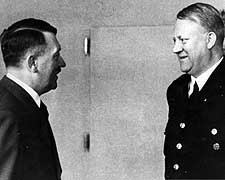
1945: Vidkun Quisling, who made his name as a traitor

On this date in 1945, eponymous Nazi collaborator Vidkun Quisling was shot at Oslo’s Akershus Fortress for high treason.

By the time of his death, the Nazi collaborator (English Wikipedia page | Norwegian) had already given his surname to English and other languages as a synonym for traitor.

Just deserts for his efforts as chief of the fascist party Nasjonal Samling to aid the Nazi conquest of his home country. Quisling interrupted a radio broadcast on April 9, 1940 to proclaim himself Prime Minister* and order cooperation with invading Germans.

Although Quisling’s lack of popular support compromised his value even as a puppet, he remained as Minister President of Norway through the war — a crucial tool in Germany’s counter-encirclement jousting with Britain, nicely explained at the outset of Frank Capra’s American propaganda flick Why We Fight:

He enjoyed public regard commensurate with his station.


A 1944 cartoon in Sweden (which remained tenuously neutral and unoccupied during the war) indicates that Quisling had already made his name a byword for treachery. The caption reads:
“I am Quisling.”
“And the name?”

Norway had abolished capital punishment in 1905, but its government-in-exile reinstated it expressly for dealing with high-level collaborators.

Though Quisling himself may have deserved this and worse, the justice and legality of so doing has been controversial ever since.


The site of Quisling’s execution. Some other shots from his trial are in this 60-year Norwegian-language retrospective.

* Thought to be the first on-air putsch in history.

On this day..