1002: St. Brice’s Day Massacre

On this date over a millennium past, according to the chronicle of John of Wallingford, King Ethelred the Unready of England conducted a massacre of Danes living in the realm.

The character of this sanguinary event — named after a fourth-century French bishop whose feast day Nov. 13 happens to be — lies half-buried in history’s shifting sands. Surely the slaughter of every Dane in a Britain then very much in the Scandinavian orbit would have been not only morally reprehensible but logistically unimaginable.

The accepted, albeit sketchy, story has it that to consolidate his own authority — or to check an actual or suspected plot against him — Ethelred ordered the surprise apprehension and summary execution of some sizable number of Danish lords and mercenaries. British historian Thomas Hodgkin characterizes it as a sort of coup d’etat.

On this date, it was the Danes who were unready for Ethelred.

But whatever its true extent or immediate object, it occurred within the context of intensifying conflict between the English crown and Scandinavian aspirants. Ethelred was to spend the better part of his life struggling — both militarily and through the ruinous tribute of Danegeld — to hold back the incursions of the Viking king Sweyn I.

The St. Brice’s Day Massacre exacerbated those tensions. Sweyn’s sister was apparently among those massacred, and — whether driven by vengeance or simply availing a pretext — Sweyn resumed harrying the English kingdom in the following years.

By 1013, Sweyn had driven Ethelred to Normandy and ruled all of England, welding together a Norse empire fringing the whole north of Europe.

But the empire — and England’s place in it — proved an historical cul-de-sac. Authority in England would be contested for another half-century, gradually sapping the crown’s strength until the Norman Conquest in 1066 swept aside Viking power and set England on a course that would redefine its history.

Update: The story of Ethelred, Normandy, and the Vikings told in Episode 3 of Lars Brownworth’s Norman Centuries podcast:

[audio:http://c4.libsyn.com/editions/58550/17915/03-richard-the-good.mp3]

The British History Podcast covers the St. Brice’s Day Massacre in episode 328.

On this day..

1755: Rowley Hanson

On this date in 1755, a young soldier named Rowley Hanson was hanged at Tyburn.

Though the hanging, like many of its era, was for a trifling theft, the account of the Newgate ordinary (chaplain) did not dwell overmuch on the watch he stole from a London barrister.

What wrought his ruin was, the company he fell into, when a drummer [in the army]; and shocking delusion from the most abandoned, and unnatural crew of wretches, that ever the world knew, called Sodomites, first led him into that damnable violation of all laws, natural, civil, and religious.

…

all he had besides his pay arose from the advantages which he received from those worse than brutes, whom St. Paul has complimented with the name of men, who leaving the natural use of the woman, burned in their lust one towards another; men with men working that which is unseemly, and receiving in themselves that recompense of their error which was meet.

…

This unfortunate youth, who laid open the way to these short observations, declared himself much more affected with sorrow, for that he had been among so vile a set of wretches, than that he was to suffer death for the robbery … He thanked God, who had thus afflicted him, and given him time to repent; and generally when we conversed he wept very bitterly.

On this day..

1914: Carl Hans Lody

On this date in 1914, German spy Carl Hans Lody was put to death in the Tower of London during the opening months of World War I.

Lody‘s was the first execution in the Tower since its heyday as the chopping-block of disfavored nobility had passed in the mid-18th century. Times had changed by the era of trench warfare: Lody was not beheaded, but shot inside a wooden shed erected for the purpose in the Tower yard. Ten more German spies, who seem to have had a harder go of infiltrating Britain than their English counterparts had in Germany, would suffer the same fate by war’s end.

A Berlin-born naval officer, Lody had no experience spying but was tapped for the job because he had traveled abroad and spoke English well enough to pass for an American tourist. He was dead scarcely three months after he entered the Isles, though his work may have helped a U-boat sink a British warship.

According to A.W. Brian Simpson in Domestic and International Trials 1700-2000, the case was a legal landmark as the first espionage trial in England held partly in camera — outside the public view. The outcome, however, was a foregone conclusion, and Lody himself didn’t bother to contest his guilt — seemingly fixated on going to his grave with nothing short of the utmost in romantic gentlemanly decorum.

Part of the Themed Set: Spies.

On this day..

1925: Sidney Reilly

On this date in 1925, legendary British spy — and subsequent James Bond inspiration — Sidney Reilly was shot in a forest outside Moscow for his efforts to overthrow the Soviet government.

Fact blends insensibly into fiction in Reilly‘s biography; much of what is known or believed about him is conjectural or colored by his posthumous valorization, such the 1967 book Reilly: Ace of Spies written by [the son of] his onetime cloak-and-dagger collaborator Robin Bruce Lockhart — who was himself a close friend of Bond author Ian Fleming.
However, even at the word of less sensational biographers — such as Andrew Cook — Reilly lived a life almost too extraordinary for belief.

A Jewish child of tsarist Russia born in what is now the Ukraine, Reilly claimed to have escaped Odessa by faking his death and hopping a ship bound for Brazil. Like much of Reilly’s life, the story is unverifiable, but by hook or by crook — and possibly by way of a murder in France — he arrived in London in 1895, hitched himself to a wealthy woman a few months after the suspicious death of her husband (discarding the inconvenient surname Rosenblum in the process), and became entangled with British intelligence.

In the first decade of the 20th century, he apparently spied promiscuously on England’s imperial rivals Germany and Russia, though the particulars are disputed. He arrived in Port Arthur, Russia, shortly before the outbreak of the Russo-Japanese War and may have provided the Japanese fleet intelligence enabling it to navigate the mined harbor — in addition to a copious side business in war profiteering. He may also have had a hand in capturing British oil concessions in Persia and reconnoitering behind German lines during World War I.

Like his fictional heir 007, he gambled often and left a string of lovers and mistresses in his wake. His true allegiances, and the extent to which his exploits were inflated or outright fabricated, are debated to this day.

The adventures that brought both death and fame were his machinations to overthrow the Bolshevik government in the fraught early months after Lenin took power. A planned coup d’etat in September 1918 came to grief and Reilly fled Russia steps ahead of the authorities, who subsequently condemned him to death in absentia.

Notwithstanding the sentence, which had been ruthlessly visited on his less-fortunate conspirators, Reilly was lured back to the USSR in 1925 by the Soviet counterintelligence project Operation Trust. Intending to meet anti-Bolshevik agitators, he was instead arrested at the border and tortured at the infamous Lubyanka Prison, where he kept notes on cigarette papers about enemy interrogation techniques for the eventuality of an escape or release that never came.

Part of the Themed Set: Spies.

On this day..

1783: John Austin

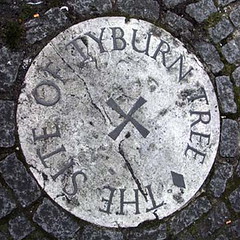
On this date in 1783, highwayman John Austin was hanged at Tyburn for robbing and murdering John Spicer on the road to London.

The village Tyburn on the outskirts of London had been used for public hangings dating to the 12th century. Though not the only site of executions in London, it was the iconic one. Situated at the modern intersection of Edgware and Bayswater Roads on the northeast corner of Hyde Park, the distinctive “Tyburn tree” — a triangular gallows capable of hanging over twenty prisoners simultaneously — made a foreboding landmark round which teemed thousands of spectators on execution days. Some 1,200 people were executed on this singular device.

Public executions typically began four kilometers away at Newgate Prison, where the condemned were loaded into ox carts for a two-to-three-hour procession through public streets now at the very core of London, perhaps including stops at public ale houses.


View Larger Map

While Tyburn carved its niche during England’s age of religious bloodletting, its social role had changed significantly by the 18th century. Most of the doomed were offenders against property, often executed for stealing negligible sums or else reprieved for transport to the New World or, later, Australia. Peter Linebaugh’s The London Hanged intriguingly suggests that hangings of this era were an assertion of nascent capitalism, violently throwing off the remains of feudal labor relations. (Summarized more thoroughly in this friendly review.)

Even that formative age was receding. Once a neighboring village, Tyburn had been swallowed up by the city; a generation before Austin’s death, residents of the now-upscale neighborhood had successfully pushed for the removal of the macabre “Tyburn tree”.

Austin was hanged, instead, on a portable gallows, a typical penitent imploring heavenly mercy and taking 10 minutes to strangle to death — the very last execution at that somber and storied crossroads.

Here’s the story of the Tyburn hangings from London writer Peter Ackroyd:

On this day..

1920: Kevin Barry

On this date in 1920, 18-year-old Irish Republican Army Section Commander Kevin Barry was hanged in Dublin’s Mountjoy Prison for the murder of English Private Harold Whitehead in an IRA ambush just six weeks prior to the execution.

Denying the authority of the British (civilian) court, the young medical student went undefended, insouciantly reading the newspaper in court as the government built its case against him. His was the first execution of the Irish War of Independence, and stoked Irish nationalist sentiment on the island and abroad.

Refused a request to be shot as a soldier, Barry nevertheless went jauntily to his fate, his bearing making great gains for IRA recruitment and fixing his own name in the firmament of Irish independence martyrs. Britain’s insistence on treating him as a murderer rather than a prisoner of war was widely received as an insult to the movement he represented.

It was not until 1989 that Barry’s short life received a biographical treatment, Kevin Barry and His Times, by the hanged man’s nephew. But a 1920’s song celebrating Barry has survived since that time as a popular hymn of Irish Republicanism.

On this day..