1547: Not Thomas Howard, because Henry VIII died first

On this date in 1547, the Duke of Norfolk was to have been beheaded.

But thanks to the previous day’s death of the corpulent 55-year-old King Henry VIII, the duke’s death warrant was never signed, and the condemned noble died in bed … seven years later.

A force in the gore-soaked arena of English politics for two generations, Thomas Howard had steered two nieces into the monarch’s bed. Both girls had gone to the scaffold,* and the disgrace of the second, Catherine Howard, brought a collapse in the whole family’s fortunes. Thomas Howard’s son Henry was not as lucky as the father: Henry was beheaded just a few days before the king succumbed, on the same charge of treason that almost claimed Thomas this day.

Though Howard pere would survive long enough to see his title restored, this day was far from the last chapter of his grasping family’s encounter with that classic Tudor denouement, the chopping-block. Thomas, his executed son, and his executed grandson today stock the family tombs at St. Michael, Framlingham — itself a sort of late monument to the aristocracy unmade by Henry’s reforms more than by his executioners.

* “She has miscarried of her savior,” Howard famously remarked of the male heir his niece Anne Boleyn delivered stillborn. A few months later, the Duke presided over Anne’s trial and voted to condemn her to death. (Hat tip: Fiz.)

Part of the Themed Set: The English Reformation.

On this day..

1923: Edith Thompson and Frederick Bywaters

On this date in 1923, adulterous lovers Edith Thompson and Frederick Bywaters were simultaneously hanged at two different prisons in England for the murder of Thompson’s husband.

From left to right, Freddy Bywaters, Edith Thompson, and the victim, Percy Thompson. (Source.)

As a bored middle-class housewife, Edith had struck up an affair with their handsome, adventurous 18-year-old boarder.

The affair met a horrifying and sensational conclusion when Bywaters confronted the cuckold in October 1922 and slew him in the ensuing altercation.

Bywaters was unquestionably and confessedly guilty, but the case became a national cause celebre — and an enduring historical artifact — because of the widow’s place in it.

Mrs. Thompson had fled the crime scene to police distraught and implicated her paramour. The police didn’t view her as a witness, but as an accomplice. In dozens of love letters that soon surfaced, she had fantasized about escaping Percy Thompson and claimed to have attempted to poison him. Coroners could not establish that she had in fact done so, and no evidence but her letters linked her to the crime; those letters were not given to the jury as a whole but censored for her frank treatment of menstruation, abortion, and lovers’ rendezvous. Thompson’s defenders see them as some mixture of escapism and confused romanticism much less sinister than the crown charged — though the letters are indeed suggestive of more than sensuality.

Both were condemned.

Bywaters gallantly defended his lover’s innocence throughout the ordeal and more than a million people petitioned the government for her reprieve.

Edith Thompson’s fate bore an unmistakable stamp of gendered social prejudice from the start. “Mrs Thompson was hanged for immorality,” her lawyer would say later. That sense has only become more pronounced in the intervening 85 years.

Academics have taken on the matter:

Women in the 1920s had won certain freedoms, and writings on sex and marriage now presented married women as legitimate sexual beings, but there was still significant hostility towards the expression of explicit female sexuality, let alone a woman’s adultery, especially with a younger man. In the years immediately after the First World War there was particular concern to differentiate normal from deviant sexual behaviour, acceptable from unacceptable, and the War’s aftermath saw deep concern as to the disruptions of gender boundaries.

And here, in a piece contrasting the Thompson-Bywaters case with a recent hanging in Singapore:

[T]he stark contrast between the cases of the men, on the one hand, and the woman on the other, raises issues about the gendered aesthetics of sentimentality and abjection in media representations of contested death-penalty cases.

From a less exalted plane, Rene Weis, author of a book about Thompson, is convinced of Thompson’s innocence:

Edith Thompson paid a terrible price for daring to be ruled by her passions, and for behaving out of her social class. If confirmation were needed that it was her perceived immorality that brought her to perdition, it is provided by the foreman of her jury. “It was my duty to read them [the letters] to the members of the jury … ‘Nauseous’ is hardly strong enough to describe their contents … Mrs. Thompson’s letters were her own condemnation.”

The sexuality at the heart of the affair was to set its mark upon this day’s grim doings as well. When hanged, Thompson bled copiously from her vagina, feeding speculation that she had been pregnant or that her uterus had inverted.

Her hangman — who also executed Hawley Harvey Crippen — emerged from the secretive procedure raving, and retired shortly thereafter. Some friends thought a lingering disturbance over his part in the Thompson case eventually led him to commit suicide. (John Ellis reportedly hated hanging women.)

Besides Weis’ book, this renowned case has also generated a fictionalized treatment and a 2001 film, as well as inspiring the recent novel The Adulteress.

On this day..

1663: Illiam Dhone

On this date in 1663, Illiam Dhone was shot for treason at Hango Hill on the Isle of Man.

William Christian — “Illiam Dhone” is a Gaelic sobriquet meaning “Brown William” — committed his fatal offense in 1651: as a powerful Manx pol charged with defense of the island against a prospective Roundhead invasion, he overthrew the Royalist lords and bloodlessly surrendered instead.

Although documentation seems to be fragmentary, an overreaching assertion of lordly prerogatives by James Stanley, Earl of Derby, of late made Cromwell‘s prisoner, might have prepared a powder keg ignited by the efforts of the Earl’s wife to ransom her husband by the Isle’s sacrifice.

Treason doth never prosper, so with the prosperity of Cromwell’s revolution, Christian earned the Manx governorship. Only upon restoration of the crown did his putsch come a cropper.

“In all likelihood Illiam Dhone was probably executed as an act of revenge by the Stanley family,” Roger Sims of the Manx Museum says. “However, the fact remains that Illiam Dhone’s actions in surrendering the island probably saved a great many lives and a great deal of property.”

The case, however, proceeded despite a general amnesty that should have spared the “traitor”. A week after he had already delivered himself of his dying denunciation against “a prompted and threatened jury, a pretended Court of Justice, of which the greater part were by no means qualified,” his appeal finally reached London — and was granted.

The patriot’s martyrdom made its mark in literature with the Gaelic ballad “Baase Illiam Dhone” (lyrics and translation, sheet music) and Sir Walter Scott’s Peveril of the Peak.

On this day..

1739: Penelope Kenny and Sarah Simpson

On this date in 1739, Penelope Kenny and Sarah Simpson were publicly hanged in colonial New Hampshire for “feloniously concealing the death of a[n] … infant bastard child.”

The first people — male or female — executed in New Hampshire history had separately disposed in August 1739 of their respective newborns. Unluckily for them, some never-discovered third woman did the same thing around the same time much less adroitly … and her dead infant was found in a well.

The ensuing investigation uncovered (in one case by the forcible ministrations of a midwife team) the recent pregnancies of this day’s victims, and though Simpson claimed her child was miscarried, she still fell under a law making a capital crime of covering up the death of a baby.

Today, Executed Today interviews New Hampshire historian Christopher Benedetto, whose research situates Kenny and Simpson in the context of their times:

In provincial New Hampshire, as was common across colonial America, the punishment of fornication and bastardy was harsh, and the stigma that followed could cost a working class woman her livelihood. When Penelope Kenny and Sarah Simpson gave birth in August 1739, they both knew that the physical product of their sexual improprieties must be concealed. It was an awful decision to have to make, but in their minds “infanticide might have seemed a matter of survival.” The discarding of illegitimate children, however, seems to have been an issue in New Hampshire long before 1739. In 1714, the General Assembly passed “An Act to Prevent the Destroying and Murdering of Bastard Children,” which declared

Whereas many lewd women that have been delivered of Bastard children, to avoid shame and escape punishment, do secretly bury or conceal the death of their children…Be it therefore enacted…that if any woman be delivered of any Issue of her body, male or female, which if it were born alive should by law be a Bastard; and that she endeavor privately either by drowning or secret burying thereof…so to conceal the death thereof that it may not come to light, whether it were born alive or not but be concealed. In every such case the Mother soe offending shall suffer Death…except such Mother cann make proof by one witness at least, the Child whose death was by her so intended to be concealed was born dead.

Executed Today: The first hanging in New Hampshire didn’t happen until 1739?!

Christopher Benedetto: There were plenty of capital laws and there definitely were cases where people were tried for their lives, but why it took so long … they had crossed some sort of a boundary. I’m sure the loss of so many children only a few years before [in a diphtheria epidemic] made these crimes that much more shocking.

ET: You’re working on a book on crime in New Hampshire.*

CB: The criminal history of Massachusetts has been studied for so long, but there’s really nothing like this for New Hampshire at all. And there’s so much there. There’s a whole chapter in the book on infanticide and child murder.

ET: What’s the perspective you get working deeply in a local milieu?

CB: I think having grown up here, my own family I’ve been able to trace back to the 1650’s in Massachusetts … it’s always been a big part of my life.

I like being able to go to different sites where these things actually happened. I think that’s true for any historian — you’re drawn to the specific places. The town I grew up in, Ipswich, they have plaques of people who lived there. Anne Bradstreet‘s house is still there.

I could walk on a lot of the streets or at least go to some of the places where these things took place.

But to me, history is about people. It’s about passions. To me, these people are so much like us today. Human nature has not changed a lot over the years.

ET: Does that lead to any conclusions on the death penalty in general?

CB: It’s one of the few things that’s as controversial now as it was two, three hundred years ago. I don’t think capital punishment prevents crime. I do think there are certain instances where the crime is so heinous, so bad — I don’t know, I’m sort of in the middle on it. I think we should reserve the right to do it, but does it improve our society at all?

ET: What advice would you have for a young person about being a historian? What’s the historical method for you?

CB: I would say, just be curious. You’ve got to be relentless. You’ve got to go after what you’re passionate about — nobody wants to do research about something they’re just not interested in.

To me, I love writing, but I think one of the most thrilling parts can be when you’re sort of on the hunt. I kind of see being a historian — and not just professionally; anyone who’s researching a family history — you’re almost like a quilter. You’re taking all these little pieces of fabric and just trying to create a whole picture. That might be my favorite part, taking all those pieces of information and just putting them together.

It’s not that nobody had ever written about that execution [of Kenny and Simpson] before, but maybe nobody had taken all that information and just kind of put it together in that way. You’re not always going to have something 100% new to say, but you might present it in a way that casts a new light or makes somebody think about it differently.

* Tentatively titled Gruesome Stories from the Granite State with an anticipated release in 2009 through regional press Commonwealth Editions.

Part of the Themed Set: The Spectacle of Public Hanging in America.

On this day..

1684: Baillie of Jerviswood

On this date in 1684, the Scottish patriot Baillie of Jerviswood was convicted of treason and immediately executed, for his part in the Rye House Plot against the Stuart King Charles II.

Baillie was a lesser player in the Protestant scheme — whose nature and extent, or even existence, are matters of historical debate — supposedly to do away with the Catholic-leaning ruler and his outright catechumen brother and heir James. Baillie was implicated under torture, and while disowning any part of a conspiracy declined — “with striking truthfulness” — to deny a design on Scottish rebellion.

His summary hanging would enter the pantheon of English depravities in the north country, but he achieved another sort of immortality as well.

During an earlier stint in prison, a proscribed fellow patriot’s 12-year-old daughter had smuggled him messages — becoming acquainted with Baillie’s own son, whom she would eventually wed. The girl gained fame in adulthood as Lady Grizel (or Grisel, or Griselle) Baillie.

“Werena my Heart’s licht I wad dee”
-Lady Baillie

THERE ance was a may, and she lo’ed na men;
She biggit her bonnie bow’r doun in yon glen;
But now she cries, Dool and a well-a-day!
Come doun the green gait and come here away!

When bonnie young Johnnie cam owre the sea,
He said he saw naething sae lovely as me;
He hecht me baith rings and mony braw things—
And werena my heart’s licht, I wad dee.

…

The legendary tableau of intrigue between Baillie and his future daughter-in-law was itself fruit for literature, given time enough to ripen into legend. Kinswoman Joanna Baillie, one of the great litterateurs of the early 19th century, made use of the episode to open a lengthy ballad to Lady Grizel in Metrical Legends of Exalted Characters:

I.
Within a prison’s hateful cell,
Where, from the lofty window fell,
Thro’ grated bars, the sloping beam,
Defin’d, but faint, on couch of stone,
There sat a pris’ner sad and lone,
Like the dim tenant of a dismal dream.
Deep in the shade, by low-arch’d door,
With iron nails thick studded o’er,
Whose threshold black is cross’d by those
Who here their earthly being close,
Or issue to the light again
A scaffold with their blood to stain,–
Moved something softly. Wistful ears
Are quick of sense, and from his book
The pris’ner rais’d his eyes with eager look,–
“Is it a real form that thro’ the gloom appears?”

II
It was indeed of flesh and blood,
The form that quickly by him stood;
Of stature low, of figure light,
In motion like some happy sprite;
Yet meaning eyes and varying cheek,
Now red, now pale, seem’d to bespeak
Of riper years the cares and feeling
Which with a gentle heart were dealing.
“Such sense in eyes so simply mild!
“Is it a woman or a child?
“Who art thou, damsel sweet? are not mine eyes beguiled?”

III
“No; from the Redbraes’ tower I come;
“My father is Sir Patrick Hume;
“And he has sent me for thy good,
“His dearly honour’d Jerviswood.
“Long have I round these walls been straying,
“As if with other children playing;
“Long near the gate have kept my watch
“The sentry’s changing-time to catch.
“With stealthy steps I gain’d the shade
“By the close-winding staircase made,
“And when the surly turnkey enter’d,
“But little dreaming in his mind
“Who follow’d him so close behind,
“Into this darken’d cell, with beating heart, I ventured.”

IV
Then from the simple vest that braced
Her gentle breast, a letter traced
With well-known characters, she took,
And with an eager, joyful look,
Her eyes up to his visage cast,
His changing countenance to scan,
As o’er the lines his keen glance past.
She saw a faint glow tinge the sicky wan;
She saw his eyes thro’ tear-drops raise
To heaven their look of silent praise,
And hope’s fresh touch undoing lines of care
Which stress of evil times had deeply graven there.
Meanwhile, the joy of sympathy to trace
Upon her innocent and lovely face
Had to the sternest, darkest sceptic given
Some love of human kind, some faith in righteous Heaven.

V
What blessings on her youthful head
Were by the grateful patriot shed,
(For such he was, good and devoted,
And had at risk of life promoted
His country’s freedom and her faith,
Nor reck’ning made of worldly skathe)
How warm, confiding, and sincere,
He gave to her attentive ear
The answer which her cautious sire
Did to his secret note require;–
How after this with ‘quiries kind,
He ask’d for all she left behind
In Redbraes’ tower, her native dwelling,
And set her artless tongue a-telling,
Which urchin dear had tallest grown,
And which the greatest learning shown,
Of lesson, sermon, psalm, and note,
And Sabbath questions learnt by rote,
And merry tricks and gambols play’d
By ev’ning fire, and forfeits paid,–
I will not here rehears, nor will I say,
How, on that bless’d and long-remember’d day,
The pris’ner’s son, deserving such a sire,
First saw the tiny maid, and did admire,
That one so young and wise and good and fair
Should be an earthly thing that breath’d this nether air.

…

On this day..

1927: Rajendra Lahiri

On this date in 1927, Bengali revolutionary Rajendra Lahiri was hanged by the British colonial government for his part in a notorious train robbery.

The 35-year-old post graduate was one of ten members of the anti-British Hindustan Republican Association involved in daringly robbing the Number 8 Down Train in Uttar Pradesh two years before — the so-called Kakori train robbery.

They escaped with a supply of treasury money to fund their operations. Perhaps more importantly, they struck a spectacular public blow against the empire.

The Kakori train robbery, as depicted in the Indian film Rang De Basanti.

Four of the conspirators were condemned to hang, to considerable popular outrage. Lahiri died first, and though less illustrious than ringleaders Ram Prasad Bismil and Ashfaqullah Khan who would follow in the next few days, is like them now remembered as a martyr for independence

On this day..

1581: Edmund Campion, Ralph Sherwin and Alexander Briant

On this date in 1581, three English Catholic martyrs were hanged, drawn and quartered at Tyburn, casualties of the bloody confrontation between religious and secular power of the English Reformation.

Edmund Campion — later sainted — was the towering figure among them and the great attraction for those that thronged the Tyburn scaffold on a rain-drenched Friday.

A brilliant Oxford scholar once tipped as a possible future Archibishop of Canterbury, Campion abjured his Anglican holy orders in favor of Rome — a mortal peril in Elizabethan England.

He slipped away to Ireland, then to the continent and safety. But at age 40, after nearly a decade abroad, the missionary zeal of the converted called him back to Albion as part of a secret Jesuit mission. Hunted from the day he set foot back in Britain, he survived a year on the run, an underground minister to an illicit faith.

Though priestly investiture alone technically made him capitally liable, a government with millions of Catholic citizens grappled for some firmer ground upon which to condemn the renowned intellectual. Since Campion succumbed neither to torture nor to blandishments, nor to the surreal interludes when he was hauled out of his dungeon and made to debate with the Crown’s theologians, he was finally convicted on the strength of made-to-order witness testimony to the effect that his mission had some vague upshot of undermining Queen Elizabeth’s hold on her subjects.

In effect, it was very much like convicting him for his faith: the Anglican-Catholic conflict had crystallized, and dozens of priests would follow the route of Campion in the years to come. Between a mutually implacable state and church, either flesh or soul must burn.

Not a few of those who trod the martyr’s path would take inspiration from the beatific Jesuit — as young Henry Walpole, whose own route to Calvary is said to have begun when he was spattered by Campion’s blood this day and come full circle to his own execution 15 years later. Walpole’s embrace of martyrdom fairly glows from his proscribed tribute to Campion:

Hys fare was hard, yet mylde & sweete his cheere,
his pryson close, yet free & loose his mynde,
his torture great, yet small or none his feare,
his offers lardge, yet nothing coulde him blynde.
O constant man, oh mynde, oh vyrtue straunge,
whome want, nor woe, nor feare, nor hope coulde chaunge.

…

Yee thought perhapps, when learned Campion dyes,
his pen must cease, his sugred townge be still.
But yow forget how lowd his deathe yt cryes,
how farre beyond the sownd of tounge or quill.
yow did not know how rare and great a good
yt was to write those precious guiftes in bloode.

That famous eloquence was Campion’s legacy, so overwhelmingly so that he presents in the lineup of men who might have written Shakespeare.

His best-know work was “Campion’s Brag”, the scornful nickname his foes gave to an apologia he produced while underground in England … and to whose steady words Edmund Campion proved true this day:

[B]e it known to you that we have made a league — all the Jesuits in the world, whose succession and multitude must overreach all the practices of England — cheerfully to carry the cross you shall lay upon us, and never to despair your recovery [to Catholicism], while we have a man left to enjoy your Tyburn, or to be racked with your torments, or consumed with your prisons. The expense is reckoned, the enterprise is begun; it is of God, it cannot be withstood. So the Faith was planted: so it must be restored.

But Protestant England did withstand the enterprise. The generation to come saw Catholic ideas and writing put to withering siege, Campion’s not least among them. For all the tribute of history to the man of Christlike fortitude, it is by no means apparent that the enjoyments of Tyburn and the kindred “practices of England” did not, after all, lay a cross heavier than English Catholics could bear.

On this day..

1740: Not William Duell

On this date in 1740, five criminals were hanged at Tyburn.

Sixteen-year-old William Duell was among them. He was hanged — but he did not die. As recounted in The Newgate Calendar:

WILLIAM DUELL was convicted of occasioning the death of Sarah Griffin, at Acton, by robbing and ill-treating her. Having suffered, 24th of November, 1740, at Tyburn, with Thomas Clock, William Meers, Margery Stanton and Eleanor Munoman (who had been convicted of several burglaries and felonies), his body was brought to Surgeons’ Hall to be anatomised; but after it was stripped and laid on the board, and one of the servants was washing it, in order to be cut, he perceived life in him, and found his breath to come quicker and quicker, on which a surgeon took some ounces of blood from him; in two hours he was able to sit up in his chair, and in the evening was again committed to Newgate, and his sentence, which might be again inflicted, was changed to transportation.

Failed hangings were not unheard-of at this time … and if transportation was no mean sentence, the young criminal must have reflected that matters certainly could have gone much worse for him.

On this day..

1910: Hawley Harvey Crippen

On this date in 1910, the notorious wife-murdering doctor Hawley Harvey Crippen was hanged at London’s Pentonville Prison.

The sensational trial, which saw the American-born homeopath convicted for dismembering his shrewish and unfaithful wife Cora in an attempt to take up with his young mistress, fitted Crippen for both a noose and a likeness at Madame Tussaud’s. (More trial background here.) It has also made his case twice a landmark in the history of crime and technology: once at the time of his arrest, and again just last month as of this writing.

The core of a case a jury found so open-and-shut as to require just 27 minutes to convict was the poorly explained disappearance of Crippen’s wife, followed by the discovery of a considerably mutilated female corpse under the Crippens’ home.

Although much of the crown’s evidence was speculative and circumstantial — to say nothing of the bodice-ripping gossip of nymphomania and infidelity — a corpse under the floorboards tends to be a compelling circumstance to a jury.

Presumably that anticipation prompted Crippen to flee the Scotland Yard investigation with his mistress Ethel le Neve under assumed names on an ocean liner bound for Canada. The case made criminological history as the first use of wireless communication to apprehend a suspect when the ship’s alert captain telegraphed Crippen’s presence to land as the ship steamed away — enabling a policeman to board a faster boat and arrest the pair as they docked in Quebec.

In the century since Crippen went to the gallows still maintaining his innocence, the case has endured in popular notoriety. The killer’s life has been novelized, meditated upon and borrowed for fiction, offering a draught of inspiration to Alfred Hitchcock along the way.

Books inspired by the Crippen case …

Given his suspicious behavior, scant had been the credence given Crippen’s protestation of innocence.

Until now.

In a meeting of Edwardian crime and cutting-edge technology, two scientists from Crippen’s home state of Michigan stunningly announced in October that DNA testing proves the body was not Cora Crippen after all.

If true, it would appear to void Crippen’s conviction in its particulars without quite exonerating the hanged man from the natural question: whose was the corpse? The manufacture of clothes on the body dated it to the Crippens’ occupancy of the house.

One of Crippen’s modern sleuths, in a wholly speculative vein, thinks it might harken to an altogether different sort of crime: a botched back-alley abortion, just the sort of thing a financially struggling physician might have been involved in.

Maybe.

But if the test invites a modern investigator to look 97 years backwards, it also suggests a posture of epistemological humility. It’s just possible that the light this test casts on our own time is as searching as that it shines on 1910.

The Prejudice of Science

The Crippen case was a classic 19th century-style detective job — the inspector who made the arrest cut his teeth as a younger man on a Jack the Ripper murder — but it took place on the brink of a revolution in forensic science.

Just a few years before, fingerprinting had been embraced by British and American law enforcement and begun its march towards total institutionalization. On the heels of fingerprinting came a multiplicity of biometric approaches to crime scenes — hair and fiber analysis, blood typology, and most recently and dramatically, DNA.

And they, in turn, have brought a rising faith in science to adjudicate the law.

While the “CSI Effect” — jurors’ expectation of case-breaking scientific evidence — conventionally plays as a hindrance for prosecutors who usually have no such thing, the excess deference given to less-than-conclusive forensic evidence can likewise cut against the defense. Evidence mishandled at crime labs, even cooked outright, factors into numerous recent post-conviction exonerations. The once ironclad credibility of fingerprint evidence has itself been undermined by subsequent forensic advances.

In short, for all its undoubted contributions to criminal justice, forensic science packs along its own set of pitfalls, caveats and blinders reflexively privileging evidence of the laboratory.

This is not a reflex to indulge uncritically. History grants the benefit of hindsight, but rarely the luxury of certitude.
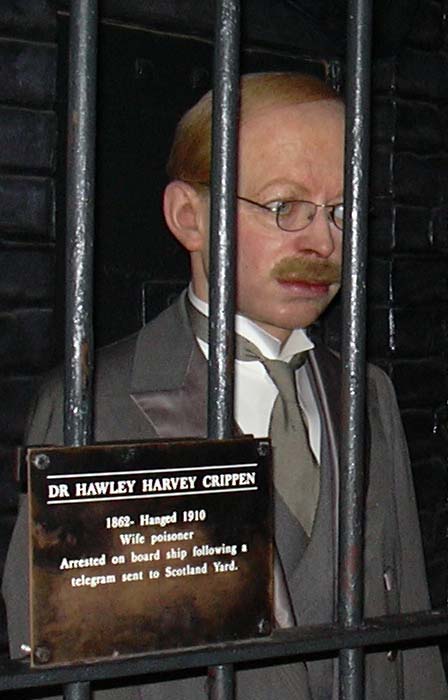
A waxwork Dr. Crippen at Madame Tussaud’s. Image used with permission.

So if the prospect of Crippen’s innocence intrigues, that unexplained body — that sudden flight for Canada — that (permanent) failure of Cora Crippen to resurface — nevertheless remain. They might lead us to question our implicit faith in the finality of DNA’s verdict on history rather than the other way around.

Are we certain that an unbroken line of blood relations really connects Cora Crippen to the modern DNA donors of her “family”?

Are we certain that a reliable chain of custody has preserved the original tissue samples unsullied across a century?

And if we are certain, what do we make of that body after all?

It is humans who must ultimately interpret and contextualize even the firmest forensic science. Whatever we might believe of Dr. Crippen we retain the burden of that belief, with all its intrinsic potential for grievous wrong.

The tales Hawley Crippen has yet to unfold from the grave might or might not shed still another different light on our understanding of what happened at 39 Hilldrop Crescent a century ago.

The gentleman’s place as a continuing attraction at Madame Tussaud’s, however, seems assured.

On this day..

1720: Captain John “Calico Jack” Rackham

On this date in 1720Nov. 18, 1720, the pirate captain “Calico Jack” Rackham was hanged together with his crew by the British governor of Jamaica.

Nicknamed for his flamboyant clothing, the Bristol-born buccaneer plundered the West Indies during the “Golden Age of Piracy”, having ousted his former captain Charles Vane. Rackham is chiefly remembered to history for two who were not hanged with the rest of his crew: Anne Bonny and Mary Read, rare female pirates who served aboard Rackham’s ship.

Immortalized by Daniel Defoe in his pseudonymous A General History of the Pyrates, Bonny and Read came to piracy by different paths but were both every bit the part and leaders aboard their ship — “very profligate, cursing, and swearing much, and very ready and willing to do any Thing on board.” Bonny, at least, was Rackham’s lover — having eloped with him from her husband.

Upon capture, both women “pleaded their bellies” to escape the gallows, and though it’s unclear whether either really was pregnant, it seems the gambit spared both from execution.

Read died in prison shortly after, while Bonny vanished from history — prompting speculation that she had escaped, secured a pardon, been ransomed by her wealthy father, and/or returned again to piracy under a different guise. Reportedly, she castigated Rackham at their last meeting in prison for lying drunk below decks while only the women resisted the capture of their ship: “I am sorry to see you here Jack, but if you had fought like a man, you need not be hanged like a dog.”

As the world’s best-known women pirates, Bonny and Read are recalled as anything from sexualized historical curios to action heroines to proto-feminists.

They feature in Disneyland’s “Pirates of the Caribbean” ride, the Witchblade comic book series, utopian theorizing, popular history … and the occasional action figure.

Update: A much more detailed foray into the lives of these daring women is at Scandalous Women.

Also, I posted this under the wrong date: it should be Nov. 18. Balls.

On this day..