1901: Three Boer rebels against the Cape Colony

On this date in 1901, Petrus Jacobus Fourie, Jan van Rensburg, and Lodewyk Francois Stephanus Pfeiffer were shot by the British at Graaff-Reinet.

They were among the numerous subjects of the British Cape Colony whose sympathy with the independent Boer republics which Britain was in the process of conquering extended so far as aiding their Dutch brethren’s resistance. In this case, the young men joined the famed Boer guerrilla Gideon Scheepers — and whatever one might say about the fuzziness of ethnic and national identity in a frontier region, this rated in London’s eyes as rebellion.

On July 6, 1901, Scheepers executed a raid on the town of Murraysburg — “Scheepersburg”, he called it — and put loyalist houses to the torch.

The British Gen. John French sent columns of men into the rugged Camdeboo Mountains in an effort to trap the irksome commando. Scheepers and most of his troop of about 240 men escaped, but about 27 or 28 Cape Colony rebels were captured (along with a few free staters, who could not be charged as rebels).

A particularly revolting incident happened in the execution of the three who were shot. This was, that the firing parties were a body of ten men, five with ball, and five with blank cartridges. After the word “present,” which brings the rifle to the shoulder, one of them “‘pulled off” before the command “fire” was given, and the bullet blew off the top of one man’s head.

-British guard Wilfrid H. Harrison in his Memoirs of a Socialist in South Africa

Eight of these people were executed as rebels over the ensuing weeks, with the aid of Jan Momberg, one of their erstwhile mates who turned Crown’s evidence against them to save his own life.

After Fourie, van Rensburg and Pfeiffer were shot on Aug. 19, Ignatius Nel and Daniel Olwagen — both teenagers — died at Graaff-Reinet on August 26; and, Hendrik van Vuuren, Fredrick Toy and Hendrik Veenstra were shot at Colesberg on September 4.

Though the British made an effort to obscure the final resting-places of these potential martyr figures, their graves were located. Fourie, van Rensburg and Pfeiffer, along with Ignatius Nel and Daniel Olwagen, are among the men subsequently exhumed and placed in a collective grave. A monument in Graaff-Reinet honors these and three other guerrillas executed there … one of whom is Gideon Scheepers himself, who was captured in October of 1901 and executed the following January.

There’s a good deal more about Scheeper’s rebels, and these men in particular, in a two-part article by a descendant of van Rensburg here: part 1 | part 2.

On this day..

1817: Not Hall or Read, prosecuted for blood-money

Miscarriages of justice perpetrated by actors in a position to extract private benefit from generating criminal prosecutions is a story as old as the hills. This one, as reprinted in the London Morning Chronicle, Aug. 25, 1817, at least has a happy ending:

EXTRAORDINARY CIRCUMSTANCE

Two soldiers, named Hall and Morrison, were on the 26th July tried for a highway robbery at the Stafford Assizes, before Baron Garrow, convicted, and ordered to be executed. They were prosecuted by a man named Read, a bricklayers labourer, who swore that they knocked him down and robbed him of a shilling and a penny, in a church-yard at Wolverhampton, on the 23d July. The evidence of the woman in whose house the prisoners resided, went to prove that they did not sleep at home on the night of the imputed robbery. To those two witnesses the evidence was confined, and against it there appeared nothing upon the trial, except the declarations of the prisoners, containing facts which were afterwards sworn to be others, and which, after the utmost labour of a few benevolent persons, were the means of saving the innocent prisoners from a death which appeared to all to be inevitable.

The two soldiers were, upon the 23d of July, drinking at an hour too late for admission at their lodging at Wolverhampton, and, after applying in vain to be allowed to go into the guardroom to sleep, walked about the village to kill time.

In loitering through the church-yard they met a man who seemed to be in want of work, and, like themselves, without a lodging for the night. A conversation ensued, and the stranger told them his name was Read; that he was a bricklayer’s labourer out of employment, and a Hertfordshire man.

It happened, that in his description he hit upon the part of the country from which one of the prisoners came. A jesting dialogue took place between them, and at length it was agreed that they should wrestle.

Hall was the friendly opponent of Read upon the occasion, and he was thrown in the first round of wrestling. In the second, however, Hall was more successful in the feat of activity, but his triumph nearly robbed him of his life. The vanquished man dropped a shilling and a penny from his pocket. Morrison immediately picked up the money, said it would do for beer, and put it into his pocket. The soldiers quizzed Read about his loss, and were heard by a watchman near the spot acknowledging that they had the shilling, and would certainly dispose of it in the most convivial way.

Read growled about his money, and showed a disposition to quarrel, but did not utter a word about his being robbed of it. About five o’clock in the morning the three were seen near the market-place by another watchman, and the soldiers were bantering Read upon the same subject.

The good humour of Read, however, at this time, appeared quite broken up; he spoke of having the soldiers taken into custody, but was answered by a laugh from them. A grocer, named Powis, saw them all under similar circumstances, and heard Read complain of no attempt at robbery, but saw that he was not pleased at being laughed at.

The grocer soon after met a man named Roberts, the keeper of the House of Correction at Wolverhampton, and mentioned to him that Read said two soldiers had got his money. The answer of Roberts, which did not strike the grocer as extraordinary at first, was, “I must see that man; this is a good job.”

The event, however, soon explained the language. Roberts immediately inquired after Read, questioned him upon the loss he had sustained, and in a very short time apprehended the two soldiers upon the charge of robbing Read in the highway of a shilling and a penny. Before the magistrate, Read swore that the soldiers knocked him down and robbed him of his money in the church-yard. Their commitment was immediately made out, and they were sent to the Assizes of Stafford, where, on the Saturday following they were tried and condemned for the capital offense.

The inhabitants of Wolverhampton knew nothing of the intention of Read upon the interference of Roberts in this transaction. It was generally concluded amongst them that the angry state of mind in which Read appeared, would have influenced him to swear a common assault, but nothing at all serious was apprehended from the wrestling bout. There was consequently no interference upon the part of those who were acquainted with many of the circumstances; and the matter died away until the village was struck with horror at an account in the Stafford paper of the proceedings of the Assizes. An old man was reading the paper in an ale-house to a number of politicians, who were not much affected at any thing they heard until he came to that part which stated the number of persons left for execution. Amongst the names were those of Hall and Morrison. The whole population of Wolverhampton instantly showed how they felt upon an occasion so dreadful.

The Rev. Mr. Guard, one of the most venerable characters in that part of the country, who officiates in the village where Hall’s family resides, upon hearing the event of the trial, set out for Wolverhampton, where he found the people already meeting and acting upon this subject. The men were to be hanged this day (Saturday last), and not a moment was to be lost. Mr. Guard, who had known Hall from his infancy, and would have staked his life upon the integrity of the young man, made a quick but deep inquiry into the facts, and having found every thing confirmatory of his innocence, followed Baron Garrow on his circuit to state what he had learned from the very best authority, and obtain a respite.

He saw Mr. Baron Garrow, but his Lordship appeared to see no reason to alter the opinion which he had formed from hearing the trial. The worthy Clergyman, however, was so well convinced of the truth of his own information, that he could not help exclaiming, with more zeal than discretion, “I see you are determined to hang these poor men.”

Mr. Baron Garrow was naturally offended at this intemperate observation, and an eminent Barrister remarked, that Mr. Guard’s object was wholly defeated by the use of it.

Mr. Guard was not, however, to be turned from the endeavour to save the lives of the two soldiers; there was another quarter to which he could apply. He immediately came to town, and went without ceremony to Lord Sidmouth, to whom he obtained an easy access. He remained in conversation with his Lordship between three and four hours, and Lord Sidmouth afterwards declared, that he never in his life saw such an interest taken in the fate of men who were not related by domestic ties to the individuals whom he was labouring to save. This meeting gave Mr. Guard hopes; though Lord Sidmouth had observed, that in cases of this kind the Judge was necessarily better acquainted with all the bearings of the evidence than the Secretary of State, and therefore his power was seldom interfered with, except under circumstances of strong fact.

Mr. Guard posted back to Wolverhampton the moment after he parted from the Secretary. A meeting of the inhabitants was called, at which Mr. Mander, and all the other respectable residents of Wolverhampton attended.

The witnesses were sworn, and a Petition to the Prince Regent was signed and delivered into the hands of Mr. Guard, who, accompanied by Mr. Charles Mander, very soon after arrived in town. These two gentlemen went, with Mr. Pearsall, of Cheapside, to Lord Sidmouth, and put into his hands the evidence of the innocence of the soldiers. His Lordship requested that Mr. Pearsall would relate the circumstance.

That gentleman repeated the manner in which Read and the two soldiers had acted in the presence of the watchmen and the grocer. Lord Sidmouth was just going up with the Recorder’s Report, and said, that upon his return he would examine the affidavits, and act upon them. Mr. Pearsall observed, that the men were ordered for execution on Saturday, but was assured by his Lordship that their case should not be neglected, and that the affidavits should be laid before the Attorney-General.

Upon the next meeting, Lord Sidmouth said there had been no necessity for laying the affidavits before the Attorney-General. The case, he observed, was one of the most interesting that ever came before him.

Indeed, such was the effect of the affidavits upon him, that he was not only immediately convinced that the soldiers should not be executed, but, in the absence of his clerks, he wrote the dispatch for their respite with his own hand, and sent it to the Sheriff; “because,” said his Lordship, “I could not endure the thought that the soldiers should have one hour more of unnecessary anxiety.”

Mr. Pearsall said there was no doubt that the men had no intention of felony; it would also appear, at another time, that the prosecutor had no intention of indicting them, until he was instigated by Roberts, with the view of gaining the reward called “Blood-money,” which was accordingly pocketed by Read and the keeper of the prison, to the amount of 80l.

Lord Sidmouth declared, that, under such circumstances, an immediate investigation should take place. He coincided in the opinion of the impropriety of Roberts’s conduct, and said a pardon would be instantly granted to the soldiers. He also complimented, in the warmest manner, the conduct of Mr. Guard and the other gentleman, who had exerted themselves. In the course of his observations to Lord Sidmouth, Mr. Guard said he would give up half his fortune to save the life of Hall, so convinced was he of his honesty.

While these operations were going forward in London, affidavits, copied from those handed to the Secretary, were brought to Mr. Baron Garrow by Lieut. Buchanan, of the same regiment as the soldiers, and a respite was instantly granted by his Lordship when he read them.

The Officer stated, that Baron Garrow, upon reading the affidavits, said, if the facts had been known before, their respite should have been granted; and asked whether they would, upon being pardoned, be taken into the regiment again? Lieutenant Buchanan immediately replied, that they would be most gladly received.

On this day..

1817: Four arsonists in the rain

Account from the Derby Mercury, Aug. 21, 1817:

THE EXECUTION OF
John Brown, Thos. Jackson, Geo. Booth & John King.

The above unfortunate men were arraigned at our late Assizes for setting fire to certain hay and corn stacks, the property of Winfield Halton, Esq. of Southwingfield, in this county, and after a long and impartial trial were found guilty on the most satisfactory evidence, by a very respectable jury of their fellow countrymen. The awful sentence of the law was passed upon them in the most impressive manner by the Judge, who endeavoured to prepare them for the fate which awaited them by assuring them that the heinous nature of their offence precluded all hopes of mercy.

For some days after their condemnation, however, they cherished a hope that pardon or at least a mitigation of their sentence might be extended to them. Under this impression they persisted in asserting their innocence of the crime for which they were about to suffer, and even when this delusion could no longer influence their conduct, their denial of all participation in the offence of which they had been convicted was repeatedly made in the most solemn manner. The faithful exhortations of the Chaplain, and also of a Dissenting Minister, who at their own request attended Brown and Booth, failed to draw a confession of the fact from them. Still they did not appear unimpressed by certain religious convictions which might have been expected to lead to contrition. But in the midst of their profession of forgiveness towards their prosecutor and the witnesses who appeared against them, there was a manifest irritation of mind and a vindictive expression of feeling which justified a doubt of the sincerity of their repentance.

This was particularly the case with Brown and Booth, who were confined together. Jackson exhibited a calmer state of spirit, but still protested that he was not guilty. King shewed the most absolute submission to the fate which awaited him, and his assertions of innocence seemed to be made more in deference to the wishes of his fellow criminals, than to arise from another cause. Indeed he had made a confession of the offence before his trial, but was led subsequently to retract what he had admitted.

It was vainly hoped that at the place of execution they would prove by their confession that their general professions of contrition were sincere. But they had previously stated that they should die with the protestations of innocence on their lips, and not even the dread prospect of that eternity on which they were about to enter was able to produce a charge in this determination.

They were brought out upon the scaffold about a quarter before one o’clock, and seemed but little affected by the sad solemnities by which they were surrounded. After the Chaplain had concluded his devotions, in which they appeared to unite with some degree of fervour, they sang a hymn, all joining in it except King, whose manner expressed a firmness bordering on indifference, and a high disdain of the enthusiastic fervours by which the others seemed to be sustained. Booth and Brown addressed the immense multitudes who were assembled before them; the former expressing himself in unwarrantable terms against individuals whom he named, and the latter exhorting the croud to religious faith and practice.

They, as well as Jackson spoke familiarly to their acquaintances who came to witness their tragical end, and their whole behaviour betrayed an insensibility to their real situation which it was painful to observe, and would be difficult to account for, were not their previous abandoned characters sufficient to furnish the solution. The drop fell from under them about five minutes after one o’clock, and they seemed to die almost without a struggle.

Such was the deportment of these wretched men; even in the closing scene of their lives, aggravating the heavy criminality of their former conduct, by their continued protestations of innocence. Many circumstances tended to produce this. The state of the prison in which they were confined did not, unfortunately, admit of their being in solitary cells, and their intercourse with each other seems to have given them hardihood to deny what had been so clearly proved against them, by evidence which has not been in the slightest degree affected by any circumstances that have subsequently transpired. Indiscreet communications from their friends, by which they were assured that their innocence was believed by their neighbours, farther tended to make them persevere in their first protestations. They seemed unwilling to destroy the sympathy which they believed they had succeeded in exciting.

Still it appears incredible to many that guilt should be so bold, and the professions of religion loudly made by two of the criminals are thought by some to be greatly in favour of their sincerity. Nothing however is more common than protestations of innocence even at the place and hour of execution; nor is it wonderful, where all moral feeling has been outraged during a long course of years that it should not be displayed in a nice regard to truth even in the most awful moments.

The professions of religion made by men who have not been brought by penitence to confession, may well be regarded with suspicion, and such conduct would be inconceivable were we not aware that a species of fanaticism is abroad in the world which separates religion from morals, and substitutes mere profession in the place of practice.

As every fact which may tend to illustrate the principles of human action deserves notice, it is worth observing, that a heavy shower happening, whilst the men were singing the hymn, two of them deliberately retreated to the shelter of an umbrella which was expanded on the drop, and a third placed himself under cover of the door way. The inconvenicne of being wet was felt and avoided by men who knew they had not five minutes longer to live!! The whole of the scene now recorded was one of great horror, increased by the conduct of the criminals themselves. The many thousands of spectators behaved with great decorum, but retired from the spectacle apparently little impressed with sympathy towards men who had evinced so much insensibility to the real nature of their own unhappy condition.

On this day..

1883: James Burton, William Marwood’s last

On this date in 1883, the illustrious hanging career of executioner William Marwood came to an inglorious conclusion.

The Billy Beane of the Victorian gallows, Marwood brought metrics — that is, calculated drop distances designed for killing precision — to a craft long characterized by clumsy amateurism.

James Burton, 33, had killed his 18-year-old wife in a violent quarrel earlier that same year; according to his confession, after she jabbed him with an umbrella and threatened to swear his life away,

my temper got the best of me, and I struck her, and we both fell. She got up first to check me not to hit her any more. At that time I could not see out of my own eyes for tears, and she cried out, ‘Oh, Jim Burton, I am only trying you don’t hit me any more,’ and I said it was too late now, for I have not a home for myself. I was blind at the time with passion, and I picked up a stone and hit her with it, and she fell down in the same place where her body was picked up. Then she said, ‘Jim, don’t, for that is my last; do come with me, Jim.’ (Glasgow Herald, Aug. 8, 1883)

Hardly a criminal mastermind, Burton proceeded to wander the town of Tunstall for several furtive days trying to screw up the nerve to commit suicide.

Instead, William Marwood ended up with the task.

The 174th and last client of the great executioner surely didn’t present any difficulties in the Mass * Acceleration department, but even for Marwood there’s more to a hanging than striking force. By some last-moment faint, stumble, or twist Burton fell through the trap wrong, dinging the side of it and getting the long slack of the noose caught under his arm.

Marwood, who was an aging man of declining strength at this point, had to haul poor Jim Burton up through the trap. “When drawn up Burton presented a shocking appearance,” one reporter on-site put it.

As Burton moaned “Oh Lord, help me!” Marwood readied for an inelegant do-over: not bothering to reset the trap, he hurriedly unwound the rope and positioned it as it ought while Burton stood heaving on the platform. When all was in readiness, Marwood simply shoved the uxoricide back into the hole.

This time, Burton died. But Marwood himself had not long to outlive him: he passed away four weeks later, on September 4, at the age of 65.

On this day..

1795: Jerry Avershaw, contemptuously

From the Newgate Calendar:


A century since highwaymen were as common as insolvent debtors are now.

Public vehicles were then little known. The roads were covered with night travellers, either on horse or foot, who became the easy prey of one or two armed and desperate ruffians. Turpin, Sixteen-String-Jack, and others of less notoriety, almost made these criminals fashionable; for, strange to say, there is a fashion even in crime.

Their daring was great; and in a country where personal prowess and high courage were so much prized, it was not to be wondered at that such characters should obtain a sort of fame. Now that our roads are covered with stage coaches, the race of highwaymen is extinct; solitary individuals of the species may be now and then met with, but the “calling” has decidedly fallen into disuse; pickpockets have succeeded them, and robberies are thus achieved with greater facility, less danger of personal violence, and with less dread of legal punishment.

The callosity of London thieves is dreadful. The Rev. Mr. Cotton is ordinary of Newgate, and in allusion to that gentleman’s spiritual consolation on the fatal platform, they call hanging, “dying with your ears stuffed with cotton.”

A pickpocket lately gave it as his reason for following his profession, “That it didn’t hurt above the arm pits;” i.e. that if discovered, the punishment was transportation, not hanging.

None of the numerous depredators we have already noticed, can excel in villainy, the subject of the present memoir. He was one of the most fierce, depraved, and infamous of the human race.

From early life he exhibited in his disposition a combination of the worst feelings of our nature, which, as the period of manhood approached, settled into a sort of prerogative of plunder and depredation, by which he seemed to consider himself as entitled to prey on the property, and sport with the lives, of his fellow creatures, with the most heartless impunity.

He attached himself to gangs of the most notorious thieves, and imposters, over whom, by a kind of supererogatory talent for all sorts of villainy, he very soon acquired unlimited influence and command, and by whose aid he committed such numerous and daring acts of highway-robbery, house-breaking, and plunder, as made him the dread and terror of the metropolis and its vicinity.

Kennington Common, Hounslow Heath, Bagshot Heath, and indeed all the commons and roads for several miles round London, were the scenes of the predatory depredations of Avershaw and his associates; and such a degree of terror had his repeated acts of robbery and brutality inspired, that the post-boys, coachmen, and all whose duty compelled them frequently to travel over the theatre of his exploits, trembled at his name and dreaded his visitation.

Although the peculiar features of the criminal laws of our country for a long time operated to the impunity of this abandoned ruffian and desperado, the cup of his iniquities was gradually filling, and he at length fell under the hand of outraged justice; but not till, unhappily, he had added a new act of murder to the long and black catalogue of his unatoned crimes: and it is lamentable to record that so base, so villainous, and so bloody a being, should have found creatures, bearing the form and name of men, so entirely forgetful of their duties to society and to God, as not only to become the admirers and apologists of what they misnamed the valour of Avershaw, but who absolutely affected to trace something prophetic in the fiendlike declarations he had too often made, that “he would murder the first ****** who attempted to deliver him into the hands of justice,” because, in the spirit of his diabolical declarations, he did actually shed the blood of a fellow-creature, who in the performance of his duty as a police officer, essayed the arrest of this most notorious of culprits.

Jerry Avershaw was the son of a laboring man who worked at one of the dye houses at Bankside — his father having met with a severe accident, was rendered incapable of following his usual employment — the support of the family consequently devolved upon the mother who took in washing, and was very indulgent to her family.

Jerry was educated in the parochial school of St. Saviour’s, Southwark — and at an early age resorted to places of public amusement which were then established in the neighborhood of St. George’s fields, where he soon became distinguished by his extravagant style of dress and profuse expenditure.

He associated at that time with many respectable young men, who were unacquainted with his real character, and way of living. This however became at length so notorious that he was obliged to seek associates in the lowest pot-houses, where from his superior address and appearance — and the liberal manner in which he spent his money — he was always welcome. Without reference to his other crimes, we shall proceed to give an account of his remarkable trial.

Jeremiah Avershaw, alias Abershaw, was tried before Mr. Baron Perryn, at Croydon, July 30th, 1795.

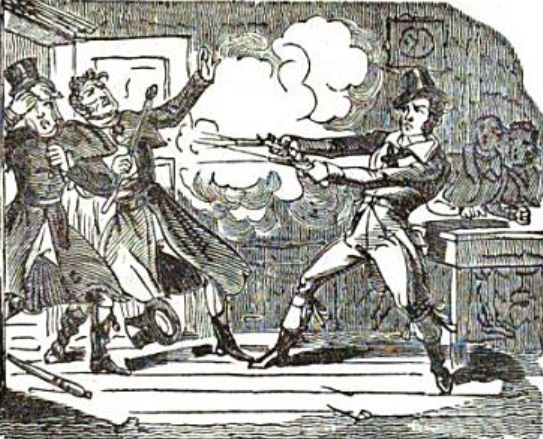
The prisoner was charged on two indictments; one for having, at the Two Brewers Public-house,* Southwark, feloniously shot at and murdered D. Price, an Officer belonging to the Police-Office, held at Union-hall, in the Borough. The other indictment was for having, at the same time and place, fired a pistol at Bernard Turner, another officer attached the office at Union-hall, with an intent to murder him.

Mr. Garrow, the leading counsel for the prosecution, opened the case to the Court and jury, by stating, that the prisoner at the bar, being a person of very ill fame, had been suspected of having perpetrated a number of felonies. The Magistrates of the Police-Office in the Borough of Southwark, having received information against the prisoner, sent, as was their duty, an order for his apprehension.

To execute the warrant, the deceased Price, and another officer of the name of Turner, went to the Two Brewers, a public-house, in Maid Lane, where they understood he was then drinking, in company with some other persons.

At the entrance of a parlour in the house, the prisoner appeared in a posture of intending to resist. Holding a loaded pistol in each of his hands, he with threats and imprecations desired the officers to stand off, as he would otherwise fire at them.

The officers, without being intimidated by those menaces, attempted to rush in and seize him, on which the prisoner discharged both the pistols at the same instant of time, lodging the contents of one in the body of David Price, and with the other wounded Turner very severely in the head. Price after languishing a few hours died of the wound.

Mr. Garrow was very pathetic and animated in his description of the several circumstances composing the shocking barbarity. To prove it, he would call four witnesses, whose evidence, he said, would be but too clear to establish the prisoner’s guilt.

The Jury would be enabled to judge from the facts to be submitted to them, and would undoubtedly decide on the issue joined between the Crown and the prisoner at the bar.

The learned counsel accordingly called Turner, the landlord of the house, a surgeon, and a fourth witness; but as the substance of their evidence is comprised in Mr. G’s opening of the indictment, it would be superfluous to repeat it. Turner said positively, he saw the prisoner discharge the pistols, from one of which he himself received his wound, and the contents of the other were lodged in the body of Price, who died very shortly after. The surgeon proved that the death was in consequence of the wound.

Mr. Knowles and Mr. Best were counsel for the prisoner, but the weight of evidence against him was too strong to be combatted by any exertions.

Mr. Baron Perryn summed up the evidence, on every essential part of which his lordship made several apposite, pointed, and accurate observations. The counsel for the prisoner, he remarked to the jury, had principally rested his defence on the circumstances of several other persons being present when the pistols were discharged, by some of which they contended the death wound might possibly have been inflicted. But, with respect to that part of the transaction, it would be proper for the jury to observe, that the witness Turner, had sworn positively to his having seen the prisoner in the act of discharging the contents of the pistol.

The jury, after a consultation of about three minutes, pronounced the dreadful verdict of — Guilty.

Through a flaw in the indictment for the murder, an objection was taken by the counsel. The indictment did not state that Price died in St. Saviour’s parish. This was argued nearly two hours, when Mr. Baron Perryn intimating a wish to take the opinion of the Twelve Judges of England, the counsel for the prosecution, waiving [sic] the point for the present, insisted on the prisoner’s being tried on the another [sic] indictment, for feloniously shooting at Barnaby Windsor, the officer who apprehended him after he had shot Price, which the learned counsel said, would occupy no great portion of time, as it could be sufficiently supported by the testimony of a single witness. He was accordingly tried and found guilty on a second capital indictment.

The prisoner, who, contrary to expectation, had in a great measure refrained from his usual audacity, began with unparalelled insolence of expression and gesture, to ask his lordship if he “was to be murderd by the evidence of one witness?” several times repeating the question, till the jury returned him Guilty.

When Mr. Baron Perryn put on the judicial cap, the prisoner, unconscious, and regardless of his dreadful situation, at the same time put on his hat, observing the judge with contemptuous looks while he was passing the sentence. When the constables were removing him from the dock to a coach, he continued to vent torrents of abuse against the judge and jury, whom, he charged with, as he styled it, his murder.

As his desperate dispostion was well known, he was, to prevent resistance, hand-cuffed, and his thighs and arms also bound strongly together, in which situation he was conveyed back to prison.

So callous was this ruffian to every degree of feeling, that on his way to be tried, as he was passing near the usual place of execution on Kennington Common, he put his head out of the coach window, and with all the sang froid imaginable, asked some of those who guarded him, if they did not think he would be twisted on that pretty spot by Saturday.

He was executed on Kennington Common, on the 3rd of August, 1795, with James [John] Little for the murder of Mr. Macevoy and Mrs. King at Richmond, and Sarah King for the murder of her new born bastard, at Nutfield, Surrey, in the presence of an immense multitude of spectators, among whom he recognized many acquaintances and confederates, to whom he bowed, nodded, and laughed with the most unfeeling indifference.

He had a flower in his mouth, and his waistcoat and shirt were unbuttoned, leaving his bosom open in the true style of vulgar gaiety: and, talking to the mob, and venting curses on the officers, he died, as he had lived, a ruffian and a brute! He was afterwards hung in chains upon Wimbledon Common.

The infamy of his life, and the atrocity of his deeds, rendered him a fit object for the posthumous punishment of hanging in chains on the arena of his crimes, and (painful as is the record, the truth must be told,) while the disgusting carcass of this malefactor, devoured by the birds and withered by the elements, gradually disappeared, the spot on which he had been gibbetted was converted into a temple of infamy, to which the thieves and vagabonds of London resorted in a sort of pilgrimage; and while the leading ruffians of the flash school, of which Avershaw was the child and champion, procured from his decaying and piece-meal carcass the bones of his fingers and toes to convert into stoppers for their tobacco-pipes, the tyro villains contented themselves with tearing the buttons from his clothes, as mementos of the estimation in which they held their arch prototype.


The newsmen effected horror that “Abershaw continued to the last moment of his existence in the same hardened state” (Telegraph, Aug. 4, 1795) and “took no notice either of his fellow-sufferers, or what the clergyman endeavoured to say to him” — then “when the executioner took the whip and touched the horse, made a spring from the cart, and was heard to repeat a horrid curse the last word he spoke.”

Avershaw’s larger-than-death performance of “dying game” would in subsequent years be a much-honored exemplar among kindred spirits who would not occasionally be required to attempt to outdo him in dramatic contempt of the gallows.

On this day..

1834: Eliza Joyce, confessed poisoner

(Thanks to Meaghan Good of the Charley Project for the guest post. -ed.)

On this date in 1844, Eliza Joyce was hanged on the roof of Cobb Hall at Lincoln Castle for the murders by poison of her two daughters and her stepson.

She was the fifth and last woman to be publicly hanged at the castle during the 19th century, and she remains the last woman in England to be hanged for a crime she’s pleaded guilty to.

Eliza had married William Joyce, a gardener, in 1840. He had two children by his prior marriage, Emma and William Jr., and he and Eliza went on to have a daughter together, Ann.

However, Emma died suddenly in October 1841 and William took sick the following year. In September 1842 he was visited by a doctor, who prescribed medicine for him. Eliza went to the chemist’s … where she picked not that medication, but arsenic.

Her husband found out and took the poison back to the chemist’s, where they realized some of it was missing. By then William Jr.’s condition had worsened considerably and he was showing symptoms of arsenic poisoning. Before his death at Christmastime he gave a statement, confirming his stepmother had given him the arsenic. He was fifteen years old.

Early in 1843, Eliza’s baby daughter Ann also died. Eliza was charged with William Jr.’s murder, but the indictment was thrown out on a technicality. She was then re-charged with attempted murder, which at the time carried the same penalty: death. But at her trial she claimed William Jr.’s poisoning was accidental: she’d spilled some of the arsenic powder on the floor, she said, and picked it up with a spoon, and later without washing it she used the same spoon to give William his medication.

The jury bought the story and Eliza was freed in the summer of 1843.

However, in light of what had happened, her husband cast her out and she had to move into the workhouse.

Eventually, her conscience began to trouble her and she confessed she’d been guilty all along of William Jr.’s murder, and that she had also poisoned both Emma and Ann with laudanum.

When asked why she’d done such terrible things, she plaintively replied, “I don’t know, except I thought it was such a troublesome thing to bring a family of children into this troublesome world.”

By now fully resigned to her punishment, she offered no defense to the court and pleaded guilty to both girls’ murders. (She couldn’t be charged with her stepson’s murder a second time.) William Calcraft handled her execution, and (for once) he didn’t botch it; she died quickly and quietly.

The prisoner walked with tolerable firmness, being only occasionally supported; and once, when about midway on the platform, she paused for a second, and turned to take a parting glance at the sunny scenery by which she was surrounded, and, as if to bed a lingering farewell to the bright and glorious world which she had sacrificed: her face and features wore an aspect of ghastly agony which none can forget who gazed upon her. Having ascended to the top of the tower on which the scaffold was erected, her bonnet was removed, her arms pinioned, and the cap placed over her face. She then ascended the step of the gallows. The effect of her appearance on the immense crowd was awfully striking. In an instant, the hootings, bellowings, and imprecations, which ever distinguish such enormous assemblages, were hushed, and a profound stillness reigned throughout the living mass.

–The Hull Packet and East Riding Times, Aug. 9, 1844

On this day..

1831: John Bell, age 14

Fourteen-year-old John Bell was hanged at Maidstone Prison on this date in 1831, for slashing the throat of a 13-year-old chum near Rochester in order to steal a pittance of poor relief that boy had received from a parish church. (The murder netted “three half-crowns, a shilling, and a six-pence” per the Aug. 6, 1831 Preston Chronicle, from which the facts of the case below are also drawn.)

Bell’s little(r) brother James gave the evidence that would hang John: that John spied Richard Taylor and on a lark announced that they would slay him for his pennies.

To this end John borrowed James’s knife, and before employing it to open Richard’s carotid artery, retired with Richard to a turnip-field where the blade pared a few snacks for greedy boys.

Then on the pretense of taking a shortcut home, James guided Richard into a woods where avarice guided his hand to a greater sin than turnip-theft. Showing a streak of the same ruthless acquisitiveness, 11-year-old James demanded half the proceeds lest he blab on his brother — leading John, whose situation was beginning to dawn upon him, to exclaim, “Torment will come upon me for this; I know I shall be hanged!”*

The hardihood which the culprit had displayed at his trial, and even when sentence was passed, deserted him as he entered his cell. He wept bitterly; and when his mother visited him on Sunday afternoon, [the day before the hanging -ed.] he acused her of being the cause of bringing him to his “present scrape.”

On Sunday evening, after the condemned sermon had been preached by the Rev. Chaplain, Bell made a full confession of his guilt. His statement did not materially differ from that which was given on the trial; but he added some particulars of the conduct of his victim before he murdered him, which make the blood run cold.

He said that when he sprung upon Taylor with the knife in his hand, the poor boy, aware of his murderous intention, fell upon his knees before him — offered him all the money he had, his knife, his cap, and whatever else he liked. Said he would love him during the whole of his life, and never tell what had happened to any human being. This pathetic appeal was lost on the murderer, and without making any answer to it, he struck the knife into his throat!”

At half-past 11 o’clock, the solemn peals of the prison bell announced the preparations for the execution. After the operation of pinioning, &c. had been completed, the culprit attended by the Chaplain, &c., walked steadily to the platform.

When he appeared there, he gazed steadily around him; but his eyes did not quail, nor was his cheek blanched. After the rope was adjusted round his neck, he exclaimed in a firm and loud tone of voice, “Lord have mercy upon us. Pray good Lord have mercy upon us. Lord have mercy upon us. All the people before me take warning by me!”

Having been asked if he had any thing farther to say, he repeated the same words, and added, “Lord have mercy upon my poor soul.”

At the appointed signal, the bolt was withdrawn, and in a minute or two the wretched malefactor ceased to exist.

The body is to be given over to the surgeons at Rochester for dissection.

The number of persons present could not be less than 8,000 or 9,000.

The jury did not even retire to come to its verdict, but it strongly endorsed commuting the consequent (mandatory) death sentence.


The Spectator editorialized for the occasion (and we draw this text from its reprint in the Standard of Aug. 8, 1831):

The boy Bell, whose conviction of the murder of little Taylor, near Chatham, we mentioned in our last number, was hanged on Monday, at Maidstone. Bell was only 14 years of age; and, from the utter neglect of his education, could hardly be regarded, even had he been much older, as an accountable being.

It does not appear, from any thing that transpired at the trial or after it, that he felt any greater qualm in killing Taylor, than he would have done in killing the rabbit to whose squeak the dying shriek of the child was, with horrid reality, compared by the brother of the slayer.

Was an untutored boy like this, with his chubby cheeks and flaxen locks, and every attribute of childhood, a proper subject for the halter and the dissecting-knife? Is it required that our code, like that of Moloch, should receive its sanction by the sacrifice of infants? Are our children and schoolboys already murderers in intention, that we should offer them such an example; or was it our grown-up men that we sought to deter from crime by so revolting a specimen of punishment?

Of all the legal tragedies that have been enacted for the last twenty years, there has been none so replete with horror.

And yet we are told therer wer multitudes assembled to behold it! And the masses that pressed forward to glut their eyes with the expiring convulsions of the miserable boy were angry because they had to wait from eight to eleven o’clock until their longing was satisfied!

* This quote is from the Liverpool Mercury of Aug. 5, 1831.

On this day..

1701: Esther Rodgers, repentant

O my dear Friends — Take Warning by me. Here I come to Dy, and if God be not Merciful to my Soul, I shall be undone to all Eternity — If I do not turn by Repentance. I Bless God, I have found more Comfort in Prison, than ever before. O Turn to God now. O how hard it is to Repent; If you go on in Sin, God may give you up to a hard Heart. Oh! Turn whilst the Day of Grace lasts.

These, shouted to a crowd of thousands, were the last uttered by repentant sex worker and infanticide Esther Rodgers at her hanging in Ipswich, Mass., on this date in 1701. Esther Rodgers’s life story and jailhouse conversion in New England are richly explored by author and sometime Executed Today guest blogger Anthony Vaver on his site, Early American Crime. Take a look here.

On this day..

1830: Charles Wall

(Thanks to Meaghan Good of the Charley Project for the guest post. -ed.)

On this date in 1830, Charles Wall was hanged at Worcester Prison for the murder of his fiancee’s daughter.

Wall’s fiancee, Mary Chance, lived in the town of Lye and had two illegitimate children. Wall was not their father and didn’t support them financially, but he seemed fond of them and was never known to mistreat them.

The oldest child, five-year-old Sally, vanished without a trace on May 16, 1830. Sally and her mother had gone out visiting with Wall, and that evening the little girl asked permission to go outside and play. She never returned, and her mother and Wall searched frantically for her until the wee hours, but to no avail.

Little Sally’s body wasn’t recovered until May 19; it was found at Old Swinford at the bottom of a limestone pit some 240 feet deep. She had died of a fractured skull. But did she fall … or was she pushed?

Several people reported having seen Wall alone with Sally the night of her disappearance. One witness picked him out of a lineup of more than a dozen men and said he’d seen Wall carrying Sally, who was sobbing and begging to be allowed to go home for her supper. Another witness saw Wall walking alone from the direction of the limestone pit at 9:00 that evening. Still a third witness said that on the morning of May 16, Wall had asked her some questions about which limestone pits in the area were being worked.

The inquest returned a verdict of willful murder against Wall and he was brought to trial. Nicola Sly’s A Grim Almanac of the Black Country notes,

For every witness called by the prosecution, the defense countered with a witness who had either seen Sally playing alone around the top of the unfenced mineshaft on the night of her disappearance, or who testified about the kindness shown by Wall to both of Mary Chance’s illegitimate children.

Mr. Justice Park told the jury that he personally could not see any possible motive that Wall might have for killing the little girl, reminding them that nobody had spoken of anything but kindness and fondness between Wall and his alleged victim.

He was convicted anyway, after only fifteen minutes’ deliberation on the part of the jury, but they recommended mercy. Wall’s death sentence was not respited, though. He was hanged two days later, still protesting his innocence.

On this day..

1815: Eliza Fenning, for the dumplings

Two hundred years ago today, an Irish serving-girl named Eliza Fenning hanged for poisoning her master’s family. The reliability of the judgment against her was widely questioned in 1815 and has not improved with age.

Robert Turner’s family, along with one of his apprentice stationers all sat down to a meal of dumplings that Eliza, a cook, had prepared for dinner on March 21 of that same year. Within minutes, all were in agony. As Charlotte Turner, who was the mistress of the house even though only a few months older than Ms. Fenning, told the Old Bailey:

I was taken ill myself in less than three minutes afterwards; the effect was so violent, that I had hardly time to get into the yard before my dinner came up. I felt considerable heat across my stomach and chest, and pain.

Q. Was the vomitting of a common kind?

I never experienced any thing before like it for violence; I was terribly irritated; it was not more than a quarter of an hour my apprentice Roger Gadsell was taken very ill in a similar way to myself.

It appeared from the symptoms — and from the blackened dough of the dumplings — that the meal had been laced with arsenic, that cunningly ubiquitous terror of the 19th century. The inference of family, Crown, and eventually court was that Eliza had availed the opportunity of preparing the food to revenge herself on the Turners because Charlotte Turner had caught her some days before sneaking into the apprentices’ room for a snog.

It’s a sure thing that homo sapiens has murdered for feebler reasons than this, but the insufficiency of the provocation, the vociferous denials of the condemned, and the puzzling fact that she too ate the noxious dumplings — all these things militated against confidence in the verdict which was hotly disputed in the public at large. Methods of establishing the presence and quantity of arsenic in a sample were extremely primitive in general, and painfully specious as applied by the surgeon who came to that verdict in the Fenning case.

The court inconclusively pursued the various ingredients in the dish: the same flour had been used for a meat pie that had brought up nobody’s dinner, so that was out; Eliza suggested the milk might be to blame, or a new yeast the house obtained on the eve of the dinner party. There is a wide-ranging effort in the transcript to establish the young woman’s access to an arsenic packet that Robert Turner kept in a desk drawer to poison mice, but this seems little relevant; it was an unlocked desk drawer in a busy household, plus arsenic was widely available in town. Everyone had effective access to arsenic, should she or he have a mind to find it.

As friend of the site (and occasional guest blogger) Richard Clark puts it in his overview, “it is difficult to be sure whether Eliza was guilty or not” even all these years later. But it’s a certainty that what was developed against her in 1815 would fall leagues short of any present-day standard for a confident conviction. Was she really unbalanced enough to try to murder the entire household over a tongue-lashing, yet steely enough to eat the poisoned dish herself to dispel suspicion, yet incautious enough not to have readied any other alibi for the moment when attention would turn to the cook? What possible basis could she have had for believing that she could salt in enough of the toxin to kill everyone else but eat a safely sub-lethal dose herself?

And maybe, as with Cameron Willingham, we might best begin with the premise: was there actually a dose of arsenic, laid in by a sinister hand — or might some contaminant carelessly proximate to the food supply of an unruly metropolis have been the true and undetected culprit?*

The case dissolves under even mild scrutiny into a tissue of social and medical quackery: the uppity servant, the sexually precocious Irishwoman, the assassin infiltrating the dumplings. (See Judith Flanders’s The Invention of Murder: How the Victorians Revelled in Death and Detection and Created Modern Crime for a scathing defense of Fenning.)

Whatever it was that the family puked up, everyone did so speedily enough to remain among the living. Attempted murder, however, was still a capital crime in England, and would remain so until 1861.

Though her case would attract widespread sympathy and public controversy, Eliza Fenning’s defense before the bar was all but nonexistent: four good-character witnesses, plus this statement:

My lord, I am truly innocent of all the charge, as God is my witness; I am innocent, indeed I am; I liked my place, I was very comfortable; as to my master saying I did not assist him, I was too ill. I had no concern with the drawer at all; when I wanted a piece of paper I always asked for it.

That’s the whole of it — complete and unabridged. It is a pathetic thought to consider this helpless plea in light of the idea that the food might have been poisoned accidentally; tunnel vision had already settled on a semi-coherent story of the embittered serving-girl’s revenge,** and without the art to draw out some different interpretation of the few facts available, Eliza found her place fixed by the self-validating suspicions cast upon her.

She held to her innocence all the way to the end; it was put about that a Newgate screw had overheard her father bid her do so no matter what lest he lose all honor after she died. One last character assassination for the road.

Supporters — and she has had many, down to the present day — flocked to Eliza’s Irish wake in the days after her hanging (the body “being placed in the kitchen of the house, and dressed out in ribbons, flowers, &c.”†) and then thronged a funerary procession from Red Lion Square to the tombs of St. George Bloomsbury.

* In 1900, to the consternation of brewers, around 6,000 pub-fanciers in northern England fell ill from beer that turned out to be contaminated with arsenic present in an ingredient (sulphuric acid) that made a different ingredient (glucose) that went into the beer.

** As Fenning was condemned just a few weeks before Waterloo, the paranoia that England’s burghers nurtured over the prospect of incipient Jacobinism must be presumed a relevant part of the scenario … doubly so, considering the young lady’s nationality.

† The Lincoln, Rutland and Stamford Mercury, Aug. 4, 1815. Reports that the family had the effrontery to accept 40 quid worth of gifts from well-wishers were also lamely represented by Fenning’s persecutors as black marks on the family name.

On this day..