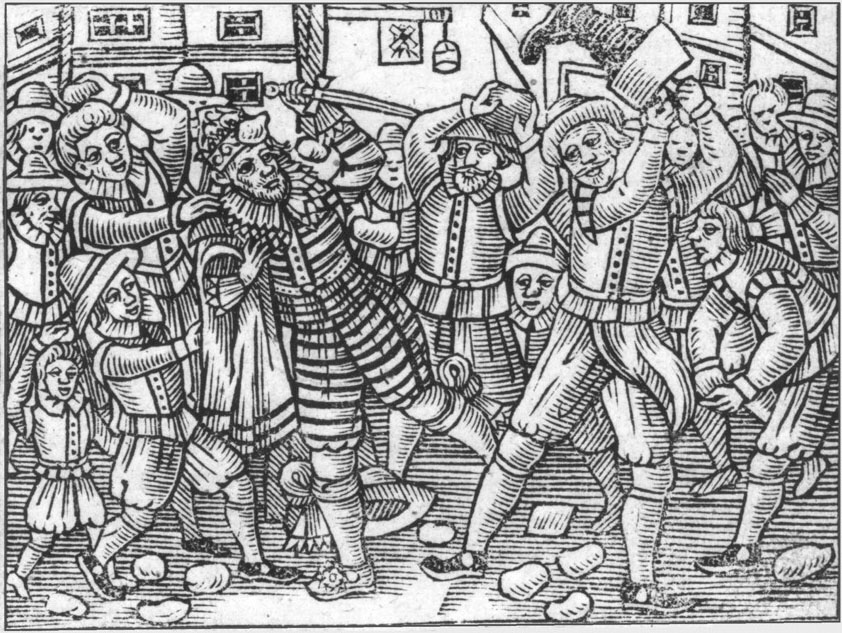
1628: John Lambe murdered

Here Dr Lambe, the conjurer lyes,
Against his will untimely dies
The Divell did show himselfe a Glutton
In taking this Lambe before he was mutton
The Divell in Hell will rost him there
Whome the Prentises basted here.
In Hell they wondred when he came
To see among the Goats a Lambe.

–Libel (one of many) on John Lambe’s murder

Friday the 13th of June in 1628 bore foul luck for John Lambe, an aged astrologer, magician, and folk healer so hated of Londoners that a mob fell on him as he returned from theater this evening and butchered him in the street.

While we hope to justify Lambe’s presence in these pages under our going interest in lynchings, his curious homicide transgresses the boundaries of Executed Today as surely as did Lambe transgress those of Stuart London.

North of 80 at the time of his death — although still vigorous enough at that age to defend himself with a sword — Lambe came to misfortunate public notoriety in the 1620s. These were crisis years when the crown sowed the dragon’s teeth that would in later years devour Charles I. Lambe’s slaughter was a little taste of worse to come.

Sources from the period view Lambe as both a shameless fraud and a vile wizard, with no consistency between the propositions save for their vitriol. Lambe seems like he got the worst of both perceptions at once: he faced a 1619 complaint to the Royal College of Physicians that he was a “mountebank and impostor.” [sic] Three years after that, he was in the dock for witchcraft

What Lambe did do was beat two charges in as many years that could easily have hanged him: the aforementioned witchcraft case in 1622, and a rape charge in 1624. Evidence in either case was underwhelming, but the charges themselves were incendiary; Lambe’s knack for slithering out of the hangman’s grasp must have suggested for the man on the street a channel to sinister higher powers.

Commoners bestirred themselves about this time against the realm’s own higher powers — the politically ham-fisted new king Charles and his grapples with Parliament to secure sufficient tax revenue for his inept war with France and Spain.

In all this mess, the Duke of Buckingham — royal favorite and possible lover of Charles’s father — was the number two man in the kingdom, and the number one object of hate.

In the mid-1620s, Lambe became conjoined in the public eye with Buckingham — as Buckingham’s demon-summoning henchman, say. Was it the Duke’s pull that spared his familiar the noose? Was it Lambe’s necromancy that captured the king in the thrall of his detested aide?

Did it even matter?

From the distance of centuries the particulars of the supposed affiliation between the two seems difficult to establish,* but it sufficed for Lambe’s death (and Buckingham’s too) that they were analogues for one another, that their respective villainies could be multiplied one atop the other.

Despite all that tinder lying around, we don’t know the exact spark for Lambe’s murder on June 13, 1628. A few months before, Buckingham had fled a humiliating military defeat in France; Parliament and King were at loggerheads that June, forcing the reluctant Charles to accede to a Petition of Right on June 7 that remains to this day a bedrock document of Britons’ liberties.

On the 13th, Lambe was recognized by “the boyes of the towne, and other unruly people” attending a play at the Fortune Playhouse.

As he left it, some began to follow him. Maybe it was just one insult too tartly answered that multiplied these hooligans, or maybe there was a ready rabble that immediately took to his heels. The frightened Lambe picked his way to the city walls menaced all the way by his lynch mob, hired a few soldiers as an ad hoc bodyguard, and by the dark of night tried desperately to find some sort of shelter from the crowd growing in both number and hostility. Under the mob’s threat, a tavern put him out, and a barrister likewise; his guards fled their posts; and someone at last laid his hands on John Lambe. By the time the frenzy had passed, Lambe’s “skull was broken, one of his eyes hung out of his head, and all parties of his body bruised and wounded so much, that no part was left to receive a wound.” Many contemporaries must have understood it as the just punishment that courts could not manage to exact.


Woodcut of the assault on Lambe outside the Windmill Tavern, from the title page of A Briefe Description of the Notorious Life of Iohn Lambe (1628)

The libels now rejoiced openly in Lambe’s summary justice — nobody was ever prosecuted for his murder — and anticipated another one to follow it.

“Who rules the Kingdome? The King. Who rules the King? The Duke. Who rules the Duke? The Devill,” one menacing placard announced. “And that the libellers there professe, Lett the Duke look to it; for they intend shortly to use him worse then they did his Doctor, and if thinges be not shortly reformed, they will work a reformation themselves.”

Their thirst for “reformation” was not long delayed.

Ten weeks after Lambe’s murder, a disaffected army officer named John Felton at last enacted the swelling popular sentiment and assassinated Buckingham.

“The Shepheards struck, The sheepe are fledd,” one unsympathetic doggerel taunted, recalling the dead wizard whose supernatural exertions could no longer protect his wicked patron. “For want of Lambe the Wolfe is dead.”

The History of Witchcraft podcast has an excellent episode on Dr. Lambe here.

* So says Alastair Bellany, whose “The Murder of John Lambe: Crowd Violence, Court Scandal and Popular Politics in Early Seventeenth-Century England” in Past and Present, vol. 200, no. 1 is a principal source for this post. (It’s here, but behind academic paywalls.)

On this day..

1715: Margaret Gaulacher, Cotton Mather ignorer

American poet Jill McDonough wrote this moving sonnet to the Irish servant Margaret Gaulacher (sometimes also called Margaret Callahan), who was hanged on this date in 1715 for the infanticide of her (ill-)concealed newborn.

June 4, 1715: Margaret Gaulacher
Boston, Massachusetts

The news that week includes a lyonefs
displayed, attacking Fowls and Catts. They watched
her feeding time, remarked on her mercilefs
cruelty. Meanwhile, Cotton Mather preached
against Hard-hearted Sinners, and Hardnefs of Heart.
He helped with her confession, which reflects
on attempts to destroy her unborn child, a part
of her Wicked crime, completed through Neglect.
Now hers is a Stony Heart, of Flint. Ah! Poor
Margaret, behold: the congregation calls
on your wondrous Industry, Agony, your death four
days off. Pray for a Clean, and a Soft Heart; don’t fall
from this fresh gallows to the Mouths of Dragons,
unconcerned, adamant, so little broken.

I believe the poet here may be getting “June 4” here from the Espy file of historical U.S. executions. Unfortunately that date is not correct; it’s unequivocal in primary colonial news accounts that this hanging occurred on Thursday, June 9.*

But McDonough is spot on about the Cotton Mather vs. Hard-hearted Sinners theme of the execution. That vigorous gallows evangelist favored — he surely thought it was “favored” — the poor condemned wretch with every exertion private and public of his considerable rhetorical powers to save her soul ere she swung.

Gaulacher never quite submitted in the way Mather thought a proper condemned woman ought.

The illiterate woman signed off on an obviously Mather-written statement admitting the justice of her sentence and warning (as was standard scaffold fare) any hearers against her iniquities: “Swearing and Cursing … Profanations of His Holy Sabbaths … Rebellion against my Parents … the Sins of Unchastity.” But this pro forma gesture was the end of it; she obdurately refused to make a public show of Mather-friendly contrition and continued to show in private an unbecoming bitterness at her execution — in Mather’s eyes, clear evidence that she had not made a proper peace with her maker.

We have no access to the hanged woman’s inner life save via an interlocutor who obviously wasn’t on her same wavelength. Maybe she loved her unchaste carnal life too much to part with it in resignation. Likely, though she kept her Catholicism hidden from Mather, she didn’t feel right at home with the stridently Protestant settlement’s rituals and its congregationalist conversion milieu. Like them or not, however, she had to endure them: within a month of Margaret Gaulacher’s hanging, a book of two lengthy Cotton Mather sermons delivered to her in the presence of the entire congregation of Boston’s Second Church was being advertised for sale.

The text below consists of extracts from those two sermons — the parts where Rev. Mather gets personal and directly addresses his charge — surmounted by the explanatory introduction. Mather’s deep conviction that Gaulacher’s soul is in dreadful peril leaps from the page; so too does the silent prisoner’s rejection. The full publication can be perused in pdf form.


The OCCASION.

What gave Occasion to the Sermons here Exhibited, was an Amazing Instance of what the poor Chidlren of Men abandoned unto Ignorance and Wickedness may be left unto! A prodigious Instance of that Hardness of Heart, which especially the Sins of Unchastity, accompanied with Delays of Repentance, do lead unto.

Margaret Gaulacher, an Irish Woman, arrived the last Winter from Cork in Ireland, a Servant, that soon found a Place in a Family where she would not have wanted Opportunities and Encouragements for the Service of GOD.

She had been by her part in a Theft brought into Trouble in Ireland; and after her Transportation hither, it was not long before she was found in Thievish Practices.

Ere she had been long here, it was begun to be suspected, that she was with Child, by a Fornication; But she so Obstinately all along denied it, that at last she must feel the Effects of her Obstinacy.

She was delivered of her Illegitimate, when she was all alone; and she hid the Killed Infant out of the way; which was within a little while discovered.

Of her Behaviour in the Time of her Imprisonment, and of the Means used for her Good, there is an Account given in our Sermons.

The Woman was of a very Violent Spirit; and the Transports and Furies thereof, sometimes were with such Violence, as carried in them, one would have thought, an uncommon Degree of Satanic Energie.

By’nd by, she would bewail her Passions, and promise to indulge herself no more in such Passionate Outrages. One who owns himself to be a Roman-Catholick, affirms to me, that she privately Declared herself unto him, to be in her Heart, of his Religion; But she never would own any thing of that unto the Ministers who visited her with the Means of her Salvation.

A Gracious and Worthy Servant of God, Mr. Thomas Craighead, (a Faithful and Painful Minister of the Gospel, who came from Ireland, much about the same time that she did) having Instructed her, and used many Charitable Endeavours for her Good, was desired by her to be near her at her Execution; who accordingly Pray’d with her there, and continued his Instructions unto the Last.

She said little, but reff’d herself to the Paper which had been read Publickly in the Congregation just before.

And yet she Frowardly let fall one Word, which did not seem very consistent with it; For which fretful Strain of Impatience, being rebuked, she added, Then the Lord be Merciful unto me! and spoke no more.

All that remains for us to do, is to leave her in the Hands of a Sovereign GOD, whose Judgment, and not ours, has the Disposal of her; and make the best Improvement we can of such a Tragical Spectacle; for which the ensuing Sermons are some Essays.

But, I ought now if I can, to Refresh my Readers, with something that shall be more Agreeable, more Comfortable; have less to Trouble them; something that may be the Reverse of so shocking a Spectacle, as has here given Troublesome Idea’s unto them.

…

Of this we have a very Tragical Instance now before our Eyes. One who by hardening her Heart has brought herself into wonderful Mischief; and continues to harden her Heart, after the wondrous Mischief has come upon her like a Whirlwind from the Lord.

Ah, poor Creature; Thou hast been Guilty of many Sins, and Heinous ones. But, Oh! Don’t add this to all the rest, this Comprehensive one, this Atrocious one; To harden thy Heart after all, and so to bind all fast upon thy Soul forever.

God has done a dreadful Thing upon thee, in leaving thee to a Crime for which thou art now as one Wicked overmuch, to Dye before thy Time, and e’re twenty five Years have rolled over thee, the Sword of Justice with an untimely Stroak must cut thee off. But it will be a much more dreadful Thing, if thou art left after all unto an hard Heart, that will not Repent of thy Abominations, and of thy Bloodguiltiness.

f thou hadst not hardened thy own Heart exceedingly, Oh! what Things would be seen upon thee; other Things than are yet seen upon thee! Verily, A soft Heart would Mourn and Weep and Bleed, for a Life sweell’d away in Sin against the Glorious GOD. A soft Heart would soon Drown thee in Tears, from the View of the doleful Things thy Sin has brought upon thee. A soft Heart would make thee own the Justice of God and Man in what is now done unto thee; and would Silence thy Froward and Fretful and Furious Gnashing upon such as thou has no Cause to treat with so much transported Fury.

It breaks the Hearts of the Good People in the Place, to see thy Deplorable State: They are concerned, when they see thy Lamentable State: But above all, to see, that thou art thyself no more concerned for it; no more affected with it; so little Broken in Heart. And shall not thy own Heart at length be Broken, when thy own State comes into thy Consideration?

One once could say, God makes my Heart Soft, and the Almighty Troubles me. And will it not make thy Heart Soft, when thou thinkest on the amazing Trouble, which thou shalt feel from the Wrath of the Almighty GOD, if thou Dye in thy Sins? Verily, All the Sorrows thou seest here, are but the Beginning of Sorrows, if thou art not by a broken Heart prepared for the Salvation of God.

But then, What an Heart-breaking Thought is this? Margaret, There is yet Mercy for thee, if thou wilt not by an hard Heart refuse the Mercy; The Mercy, thro’ which Rahab the Harlot perished not; The Mercy, thro’ which Mary Magdalene had her many Sins forgiven her; This Mercy is ready to do Wonders for thee. A Merciful Saviour Invites thee; O come unto me, and I will do Wonders for thee.

Come and fall down before Him, and beg the Blessings of a soft Heart at His Gracious Hands. I know not of any Advice that can be so Proper, or so Needful for thee, as this; No Prayer of so much Importance to be made by thee as this.

The Ignorance which lays Chains of Darkness upon thee, is a sore Encumbrance on thy Essays for turning to God. Yet thou art not so Ignorant, but thou canst make this Petition to thy SAVIOUR. Lord, soften this hard Heart of mine! And, Lord, Bestow a New, and a Clean, and a Soft Heart upon me! And, God be Merciful to me a sinner; yea, an Hard-hearted Sinner!

Now, May the Gracious Lord accordingly look down upon thee.

…

of those who are sure of having the Arrest of Death presently served upon them, there is none that has a more affecting Assurance of it, than a poor Daughter of Death, who is this Afternoon to have her Soul Required of her. Ah! poor Creature! Dost not thou fear God, seeing thou art under a Condemnation, to a Tragical Death which is to be this Afternoon executed on thee; and within three or four Hours, thy Soul will be Required of thee; within three or four Hours thy Soul must make its Appearance before a Terrible GOD! Oh! What, what will be the Condition of that Perishing Soul, if no Fear of God be found in it, when it Appears before him? —

There is indeed a vast Abundance even to a Profusion, of Instructions, bestow’d more Privately on such Malefactors as Dye among us: No Place upon Earth does equal this Place for that Exercise of Charity. And this poor Creature has had a very particular Share thereof: Not only have the Ministers of the Gospel done their Part, in Visiting of her, but also many Private Christians have done theirs, in a most Exemplary manner. As of old in Jersualem it was the Usage of the Ladies, to Prepare for the Dying Malefactors, that Potion which was called, The Wine of the Condemned, so the Young Gentlewomen here in their Turns, have Charitably gone to the Prison every Day for diverse Weeks together, and because of her not being able to Read, have spent the Afternoons in Reading Portions of the Scriptures, and other Books of Piety, to this Condemned Woman, and giving their Excellent Councils unto her. Nevertheless, we chuse in a more Publick way also to direct a few Words of our Sermons, unto such Persons, when we have them among our Hearers; Because, the Preaching of the Gospel, is the Grand Ordinance of our Saviour, for the Conversion of a Sinner from the Error of his way; an we would wait upon our Glorious LORD, in that way which he has Ordained, hoping, still hoping, to see a Soul saved from Death!

Wherefore once more, O miserable Woman, entering into an Eternity to be trembled at; Once more, thou shalt hear the Joyful Sound of the Gospel, inviting thee to the Fear of God, and the Faith of thy only Saviour. And if there be not in this Last Essay, a more saving Impression from the Glorious Gospel of the Blessed God made upon thee, than thou hast yet felt from any former ones, — Oh! the dreadful, dreadful Consequences! What will become of thee! — Can thy Hands be Strong, or can thy Heart endure, in the View of what a Terrible GOD will order for thee? — Behold, Ah! poor Margaret, Behold a mighty Congregation of People, with Hearts Bleeding for thee, and Wishing and Praying and Longing to see the fear of God making some Discoveries in thee. And shall thy Heart still remain unaffected with thy own Condition; discovering still a total Estrangement from the fear of God! No Tears are enough, Tears of Blood were not enough, to be employ’d on so prodigious a Spectacle!

I am sorry, I am sorry, that I find myself obliged so much to speak it. Even since thou hast been under Condemnation, thou hast not feared God. Not many Hours are passed, since I saw in thee, so much Rage, and so Unrighteously harboured, and so Indecently Vomited, against some Vertuous Children of God, that it was too Evident, this fear of God had not yet begun to soften thee.

But if the fear of God enter not into thy Soul, before thy Soul be driven out of thy Body, which will be now, — alas, before many Minutes more be expired, thy Desolate, Forsaken, Miserable Soul, can have no part in the Kingdom of God. My Soul cannot be safe, if I forbear to tell thee so!

Ah, poor Creature, Art thou wiling to Dye unreconciled unto the God, whom thou hast Affronted with infinite Provocations? To Dye, and all into the Mouths of Dragons, who have so long poisoned thee, and enslaved thee? To Dye and be cast into the Eternal Burnings, from whence the Smoak of the Torment will ascend forever and ever? What? Shall all the Means of Good, which in a Religious Place have been used for thee, with hopes that they might find out one of the Elect of God, serve only to aggravate thy Eternal Condemnation at the last? Oh! Dreadful Consideration!

But, Oh! Be Astonished at it! There is yet a Door of Hope set open for thee; It will for one Hour it may be, stand open yet! Oh! Be full of Astonishment at such an Heart-melting Declaration, as is now to be made unto thee. A Compassionate SAVIOUR, is yet willing, to Cleanse thy Soul with His Blood, from the Sins, which by casting off the fear of God thou hast fallen into; yet willing to create in thee a Clean Heart that shall be filled with the fear of God, if he be sought unto; yet calling to thee, O look unto me and be Saved! And yet affording unto thee that Encouragement, in Joh. VI. 37. He that cometh unto me, I will in no wise cast out.

And, Oh! What wilt thou now do under these Astonishing Invitations? Wilt thou not improve these few Minutes with a most wondrous Industry and Agony? Do so, and be no longer such an Hard-hearted Prodigy! Fall down before thy SAVIOUR, and cry out; O my Saviour, Take pitty on my Soul, and now at the Last, let Sovereign Grace break forth, with a good Work of thy fear in my Soul! Cry out, O my Saviour, Let my Sin be all pardoned, and let all Sin be as Abominable unto me, as it is unto all that fear thy Name! Let thy Outcries pierce the very Heavens.

But, be it known unto thee, If the fear of God be in thee, it will be a thing more Bitter than Death unto thee, that thou hast Sinned against His Glorious Majesty; Thy Malice against every Neighbour will be extinguished; Thou wilt submit with Patience, to the Punishment of thy Iniquity; And thou wilt be an Holy, Humble, Thankful Soul, and quite another Creature! — God of His Infinite Mercy make thee so!

* n.b. — a Julian calendar date, as were all British colonies until England herself transitioned to the Gregorian calendar in 1752.

On this day..

1690: Old Mobb, witty highwayman

On this date in 1690, according to the Newgate Calendar,* the venerable gentleman rogue Thomas Sympson — better known as Old Mobb — was hanged for robbery.

Old Mobb — at least, the stylish and erudite version of the man given us in the Calendar — preyed the roads of late 17th century England for many a year, perhaps all the way back to the ill-fated reign of Charles I.

His rollicking adventures could have formed the fair corpus of a durable legend; in some alternate world Ainsworth chose Old Mobb as for Rookwood and it is he and not Dick Turpin who has the television serial and the pub nameplates.

A nobleman Sir Bartholomew Shower, whose name might also be the safeword at a leather masquerade, was apprehended by Old Mobb one day nearly penniless as to his person; taking exception at being shorted by such a wealthy grandee, Mobb forced him to write up a bill for 150 quid to draw on the goldsmith of nearby Exeter, leaving Shower trussed up under an obliging hedge “as security for the payment” while he went into town to cash the cheque.

The annals have next a widow, bound for Bath no less in tribute to the classics, and had a jolly battle of the sexes with her over her condition which of course Old Mobb won, since he had the gun. His target, you see,

wept very plentifully, in order to move him to pity; she told him she was a poor widow, who had lately lost her husband, and therefore she hoped he would have some compassion on her. “And is your losing your husband then,” says he, “an argument that I must lose my booty? I know your sex too well, madam, to suffer myself to be prevailed on by a woman’s tears. Those crocodile drops are always at your command; and no doubt but that dear cuckold of yours, whom you have lately buried, has frequently been persuaded out of his reason by their interposition in your domestic debates. Weeping is so customary to you, that everybody would be disappointed if a woman was to bury her husband and not weep for him; but you would be more disappointed if nobody was to take notice of your crying; for according to the old proverb, the end of a husband is a widow’s tears; and the end of those tears is another husband.”

The poor gentlewoman upon this ran out into an extravagant detail of her deceased husband’s virtues, solemnly protesting that she would never be married again to the best man that wore a head, for she should not expect a blessing to attend her afterwards; with a thousand other things of the same kind. Old Mobb at last interrupted her, and told her he would repeat a pleasant story in verse which he had learned by heart, so, first looking round him to see that the coast was clear on every side, he began as follows: —-

A widow prude had often swore
No bracelet should approach her more;
Had often proved that second marriage
Was ten times worse than maid’s miscarriage,
And always told them of their sin,
When widows would be wives agen:
Women who’d thus themselves abuse,
Should die, she thought, like honest Jews
Let her alone to throw the stones;
If ’twere but law, she’d make no bones.

Thus long she led a life demure;
But not with character secure:
For people said (what won’t folks say?)
That she with Edward went astray:
(This Edward was her servant-man)
The rumour through the parish ran,
She heard, she wept, she called up Ned,
Wiped her eyes dry, sighed, sobbed, and said:

‘Alas! what sland’rous times are these!
What shall we come to by degrees!
This wicked world! I quite abhor it!
The Lord give me a better for it!
On me this scandal do they fix?
On me? who, God knows, hate such tricks!
Have mercy, Heaven, upon mankind,
And grant us all a better mind!
My husband — Ah that dearest man!
Forget his love I never can;
He took such care of my good name,
And put all sland’rous tongues to shame. —
But, ah! he’s dead –‘ Here grief amain,
Came bubbling up, and stopped the strain.

Ned was no fool; he saw his cue,
And how to use good fortune knew:
Old Opportunity at hand,
He seized the lock, and bid him stand;
Urged of what use a husband was
To vindicate a woman’s cause,
Exclaimed against the sland’rous age;
And swore he could his soul engage
That madam was so free from fault
She ne’er so much as sinned in thought;
Vowing he’d lose each drop of blood
To make that just assertion good.

This logic, which well pleased the dame,
At the same time eludes her shame:
A husband, for a husband’s sake,
Was what she’d ne’er consent to take.
Yet, as the age was so censorious,
And Ned’s proposals were so glorious,
She thought ’twas best to take upon her,
A second guardian of her honour.

“This,” says Old Mobb, “is an exact picture of woman-kind, and as such I committed it to memory; you are very much obliged to me for the recital, which has taken me up more time than I usually spend in taking a purse; let us now pass from the dead to the living, for it is these that I live by. I am in a pretty good humour, and so will not deal rudely by you. Be so kind, therefore, as to search yourself, and use me as honestly as you are able; you know I can examine afterwards, if I am not satisfied with what you give me.” The gentlewoman found he was resolute, and so thought it the best way to keep him in temper, which she did by pulling out forty guineas in a silk purse, and presented them to him. It is fifty to one but Old Mobb got more by repeating the verses above than the poor poet that wrote them ever made of his copy. Such is the fate of the sons of Apollo. [dear reader, why not take this opportunity to click on an ad? -ed.]

We certainly have in these puffed-up knaves torn down for our amusement a little window into the romance of the road where by means of Stand And Deliver one attains the liberty to put put hypocrites in their place whilst usurping the abundance that is the latter’s usual wages.

Old Mobb robs a famous astrologer whose constellations fail to predict the engagement; to a doctor who upbraids him, he retorts, “I only take [my victims’] money away from them; but you frequently take away their lives: and what makes it the worse you do it safely, under a pretence of restoring them to health.”

As pieces de resistance, Old Mobb gets the better of two of Restoration England’s most infamous grandees.

The Duchess of Portsmouth, the widely hated French Catholic mistress to Charles II,** Old Mobb improbably manages to trap in her stagecoach giving him leave to excoriate her in words similar to those that real 17th century Britons must have muttered many times while in their cups. “I know you to be the greatest whore in the kingdom; and that you are maintained at the public charge. I know that all the courtiers depend on your smiles, and that even the K— himself is your slave,” Mobb says, rubbishing her sex and her nationality all at once. “That haughty French spirit will do you no good here. I am an English freebooter; and insist upon it as my native privilege to seize all foreign commodities. Your money indeed is English, and the prodigious sums that have been lavished on you will be a lasting proof of English folly; nevertheless, all you have is confiscated to me by being bestowed on such a worthless b—h. I am king here, madam, and I have a whore to keep on the public contributions as well as King Charles.”

The ruthless hanging judge Lord Jeffreys Old Mobb likewise pays in his own coin when Jeffreys threatens our marauder with potential damnation, speaking as it were through Jeffreys to the obsequious blackguards who afflict the public life of every time and place.

When justice has overtaken us both, I shall stand at least as good a chance as your Lordship; who have already written your name in indelible characters of blood, by putting to death so many hundred innocent men, for only standing up in defence of our common liberties, that you might secure the favour of your Prince. It is enough for you to preach morality upon the Bench, where nobody dares to contradict you; but your lessons can have no effect upon me at this time; for I know you too well not to see that they are only calculated to preserve money.

* The Newgate Calendar positively avers a hanging of Friday, May 30, 1690, but there are some complicating data points. There’s his purported campaign with William “the Golden Farmer” Davis, who was supposed to have left a parting note for Old Mobb upon Davis’s December 1690 execution. (However, 1690 was the year when May 30 was on a Friday, not 1691.)

The invaluable Old Bailey Online has none of this, though the date range is a period of spotty recordkeeping. It does give us a nondescript and lamely apologetic “Old Mobb” hanged on the 18th of September 1691; although this guy had done some highway robbery, he doesn’t otherwise bear an obvious resemblance to the Newgate Calendar’s colorful character. He might be the same guy, or they might just share a cant alias. “Mob” — short for mobilevulgus, the “fickle crowd” — was just establishing itself in English at this point with a usage a bit more flexible than it has for us today; our criminals’ point of contact might be simply that each lasted unusually long in the profession, and therefore each received a nickname meaning something like “Old Man”. Jonathan Swift complained bitterly of this truncated neologism in 1710, writing that “I have done my utmost for some years past to stop the progress of Mobb and Banter, but have been plainly borne down by numbers, and betrayed by those who promised to assist me.” (Sorry, buddy … English is a living language.)

At any rate, I don’t know whether Old Mobb is one guy or two, nor am I fully confident of the best date of execution. These are the least of our difficulties when it comes to veracity, considering that the man’s attributed exploits likely comprise 100% shameless fabrication. It’s just that kind of post.

** Careful how you speak of her: she’s an ancestor (via the late Princess Diana) of the current royal princes.

On this day..

1213: Peter of Pontefract, oracle

On this date in 1213, the hermit Peter of Pontefract (or Peter of Wakefield) was hanged by King John.

Reluctant Magna Carta signer and ridiculous Robin Hood villain, John has never been the most highly regarded sovereign. (A recent BBC poll saluted him as the 13th century’s very worst Briton.)

The papacy ranked among John’s many irritants. A 1205 dispute with Pope Innocent III over the successor to the late Archbishop of Canterbury — John wanted control of ecclesiastical appointments in his own realm, a little preview of coming attractions in English history — extended so far as Innocent’s excommunicating John, and laying England under a papal interdict prohibiting administration of any sacraments save baptism and last rites. There’s no bargaining chip quite like “do what I say or everyone goes to hell.”

John didn’t sweat the eternal damnation stuff much but in 1212 the specter of war with France — gleefully justified by Philip II on grounds of the English king’s impiety — started twisting the screws a little. Philip had already seized English holdings in Normandy; now, he was gathering forces to invade across the English Channel.

With discontent already afoot among the domestic nobility, some of whom were extending feelers to King Philip, the Yorkshire hermit Peter ran out a prophecy that John’s crown would pass to other hands by the next Ascension Day — which happened to be Thursday, May 23, 1213.

Peter’s prophecy gained no little folk following, prompting John to take him into custody.

And here a prophet, that I brought with me
From forth the streets of Pomfret, whom I found
With many hundreds treading on his heels;
To whom he sung, in rude harsh-sounding rhymes,
That, ere the next Ascension-day at noon,
Your highness should deliver up your crown.

-Shakespeare’s King John

But days before the momentous date arrived, John resolved the crisis and saved himself from potential deposition with a timely submission to the papal legate Pandulf, before whom he dramatically laid the crown and resumed it pledging an annual tribute of 1,000 marks from the throne of England to that of St. Peter.*

This was either — take your pick — a deft political masterstroke instantly neutralizing the threats to John’s throne, or else it was a craven surrender to the Vatican.

Peter of Pontefract gives us a hint of a judgment on that question.

John held Peter past the May 23 date — and then, just for good measure, past May 27, for that had been the calendar date of John’s coronation in 1199, which was also Ascension Thursday that year, and had been floated as a fallback interpretation of the prophecy — the seer had been duly discredited and, being made ridiculous, could now be made an example of.

Or had he been?

For,

the wise and the foolish alike began to see that John had prevented a literal fulfilment of the prophecy by lending himself to a figurative one. He had ‘ceased to be king’ by laying his crown at the feet of Pandulf, to take it back again on conditions which unquestionably helped to fix it, for the time at least, more securely than ever on his brow. The scapegoat of all parties was the unlucky prophet himself. Next day he and his son, who had been imprisoned with him, were tied each to a horse’s tail, dragged thus from Corfe to Wareham, and there hanged. (Source)

* John stopped paying in 1214, and Innocent left well enough alone.

On this day..

1651: Jeane Gardiner, Bermuda witch

From Slaves and Slaveholders in Bermuda, 1616-1782:

The witchcraft trouble [in Bermuda in 1651-55] began in May 1651, when Goodwife Jeane Gardiner, the wife of Ralph Gardiner of Hamilton Tribe, was accused of bewitching a mulatto woman named Tomasin. Jeane Gardiner was heard to say “that she would crampe Tomasin” and reportedly “used many other threatenninge words tending to the hurt and injurie of the said mullatto woman.” Gardiner’s victim was then “very much tormented, and struck blind and dumb for the space of twoe houres or thereabouts.” Jeane Gardiner may have been known in her neighborhood as the wife of Ralph Gardiner, a laborer who had come to Bermuda in 1612. A contentious man, he twice accused neighbors of stealing his poultry and was himself found guilty of stealing a fish gig. The assize record mentions that Jeane Gardiner, in addition to practicing witchcraft on Tomasin, “at divers tymes in other places … did practice the said devilish craft of witchcraft on severall persons in the hurt and damage of their bodyes and goods.” A panel of 12 women, including the wives of several men who possessed black, Inian, or mulatto servants or slaves, found a witch mark, a suspicious “blewe spott” in Gardiner’s mouth. As a further test, Gardiner was “throwne twice in the sea” where she was found to “swyme like a corke and could not sinke” — according to the lore of witchcraft, a sure sign of guilt.


/mandatory

A white, middle-aged woman, wife of a laborer, Goodwife Gardiner was a typical candidate for witchcraft charges in Bermuda.

Of Tomasin, the mulatto woman who was Jeane Gardiner’s alleged victim, nothing is known except her name. Since she is not identified as belonging to any master, it is possible that Tomasin was a free woman. Perhaps she was a neighbor of Gardine’s. Jeane Gardiner and Tomasin may have lived near each other, but nothing is known of their relationship. Did Tomasin, in word or action, offend Jeane Gardiner? Did Gardiner, the wife of a laborer, feel threatened by, or jealous of, Tomasin? On the connection between this white woman and her mulatto neighbor the record is silent, but Bermuda’s legal system inflicted the full measure of punishment upon the mulatto woman’s malefactor: Jeane Gardiner was hanged “before many spectators” on May 26, 1651.

On this day..

1857: 52 European prisoners at Delhi

In 1857, the centennial of the British East India Company’s mastery of the India, the subcontinent’s sepoy troops rebelled against the Company Raj.

There had been rumblings of disaffection for months before, signals that read portentous in retrospect but passed by the oblivious occupation army. That March, aggrieved at having been issued new ammunition cartridges rumored to have been prepared with pig and cow fat in offense to both Muslim and Hindu soldiery,* Mangal Pandey wrote himself into India’s nationalist lore by mutinying at Barrackpore.

Pandey’s own revolt fizzled, and saw him hanged.

But he’s remembered as the precursor of the much wider rebellion that ensued.

On Sunday, May 10th — the British garrison’s guard was down for religious services — sepoys at Meerut mutinied, too. Just the day before they had seen 85 of their own brothers in arms provocatively marched in chains after refusing the controversial cartridges.

Now, they fell upon their commanding officers, and on their families and British civilians in an wave of pent fury. Brits misforunate enough to be caught in it spent the dark hours that night as prey.

“Never was dawn more welcome to us than on the 11th of May,” one Englishwoman who survived the harrowing night wrote. “The daylight showed how complete the work of destruction had been. All was turned into ruin and desolation, and our once bright happy home was now a blackened pile.”

Meerut is just 60 kilometers or so from Delhi, and the mutineers soon made for that city — where the last Mughal Emperor, 81-year-old Bahadur Shah II, known as Zafar, “reigned” as Prince of Delhi. In reality, he was a pensioned ward of the East India Company … but symbolically, he was the heir to a once-mighty empire.

The rebels fell on Delhi, slaughtering Englishmen and women who had not been quick enough to escape the city, and looting opportunistically. Zafar tsk-tsked the disorder but he and most of his princes joined the revolt. Why not? The Company had already made known that the imperial title would disappear with Zafar’s death; here was the one last chance to restore the Mughal dignity.

This ride on the tiger would prove instead to be the final destruction of Zafar’s house.

On May the 16th, the sepoys, who were far from deferential to the emperor they proposed to raise up, demanded 52 European prisoners that Zafar’s courtiers were holding — holding instead of murdering, a restraint the sepoys angrily suspected was calculated as a potential future sop to the returning British. By putting those prisoners all to sudden death, they relieved the emperor of any avenue for compromise, binding him inescapably to the insurrection.

From William Dalrymple’s The Last Mughal:

The sepoys then called for the prisoners, who were being kept and fed by Zafar in a room beside the Palace kitchens, not far from the Lahore Gate. They bound them and took them to a peepul tree near the shallow tank in front of the Palace drum house, the Naqqar Khana, and began to taunt them that they were about to be slaughtered.

According to Jiwan Lal, “the King and his courtiers stood like dumb puppets” at first, horrified by what the sepoys were contemplating. “Then the King ordered the sepoys to separate into parties, Mahommedans and Hindus, and he appealed to each to consult their religious advisers to see if there was any authority for the slaughter of helpless men and women and children.” “Their murder can never be allowed,” said Zafar, adding that the Queen was also wholly opposed to any massacre. Sa’id Mubarak Shah recorded that

the king wept and besought the mutineers not to take the lives of helpless women and children, saying to them “take care — for if you commit such a deed the vengeance and angel of God will fall on us all. Why slay the innocent?” But the Mutineers refused to listen and replied “we’ll kill them, and in your palace, so that whatever the result you and we shall be considered one in this business, and you will be thought equally guilty by the English.”

… the King continued to argue with the sepoys and refused to give his consent to the murder, but was eventually silenced …

When Zahir saw that the sepoys were preparing to go ahead with the slaughter, he begged the hakim to make a last effort to stop the massacre: “I told him that I had seen the prisoners being taken out,” he recorded later,

and I was afraid that they were about to kill them, and that he must do something quickly to stop them. To this I got a reply, “What can I do?” I told him this is the time to prove our loyalty, and that if he wanted to save the King then he had to try and persuade the rebels to stop this crime and save the prisoners, otherwise the English would come and level Delhi and turn it into an empty wasteland in revenge for this spilling of innocent blood. Ahsanullah Khan replied, “You are still a child. You do not realize that in public life a man must use his reason rather than give way to his emotions. If we try to dissuade the rebels now they will kill us before they kill the English, and then they will kill the King.”

It was anyway too late. By the time Ahsanullah had finished speaking, the sepoys and the Palace mob had got to work.

They made the prisoners sit down, and one of them fired his carbine at them. After this two of the King’s personal armed retainers killed all the Europeans, men, women and children, with their swords. There were about 200 Mussalmans standing at the tank, uttering the coarsest abuse at the prisoners. The sword of one of the king’s retainers broke. After the slaughter, the bodies were taken on two carts, and thrown into the river. This occurrence caused a great excitement amongst the Hindus throughout the city, who said that these Purbeas who had committed this heinous and atrocious cruelty could never be victorious against the English.

For Zafar the massacre was a turning point. The sepoys were quite correct that the British would never forgive the mass killing of innocents, and Zafar’s failure to prevent it proved as fatal for him and his dynasty as it was for them.

Three weeks later, the British besieged Delhi. When the city succumbed that September, it lay at the mercy of a foe which had been incited to spectacularly furious revenge. Vengeful fantasies of razing Delhi to the ground and slaughtering its denizens en masse were openly mooted; if the actual reprisal never attained that scale, it was still wildly indiscriminate. Dalrymple once again:

Everywhere the British convinced themselves that the atrocities committed by the sepoys against their women and children absolved them of any need to treat the rebels as human beings: “Since they had butchered our defenceless women and children,” wrote Colonel A. R. D. Mackenzie, “we would have been more than human, we would have been less than men, if we had not exterminated them as men kill snakes wherever they meet them.” It soon became exceptional among the British to regard anyone on the opposite side of the battle lines as even belonging to the same species: “I [simply] cannot consider these sepoys human beings,” wrote Captain J. M. Wade, “and it is only common practice to destroy them as reptiles.” George Wagentrieber helped fan such flames from his new Delhi Gazette Extra printing press in Lahore: “Our army is exasperated almost to madness by what they have seen of the brutality of the insurgents,” he expostulated in one editorial.

Moreover, as far as many of the British troops were concerned, their fury and thirst for revenge were not so much a desire as a right enshrined in the Bible. One British soldier, “Quaker” Wallace, was in the habit of bayoneting his sepoy adversaries while chanting the 116th Psalm. As General Neill put it, “The Word of God gives no authority to the modern tenderness for human life.” Padre Rotton was in full agreement. The rebels did not realise, he wrote, that the Uprising was in fact

a battle of principles, a conflict between truth and error; and that because they had elected in favour of darkness, and eschewed the light, therefore they could not possibly succeed. Moreover, they had imbrued their hands in the innocent blood of helpless women and children, and that very blood was [now] appealing to heaven for vengeance. The appeal was unquestionably heard. The Lord could not do otherwise than be avenged on such a nation as this.

1857 marks the textbook end date for the Mughal Empire.

For his support of the rebellion, and his failure to avert the May 16 massacre of prisoners, Zafar was deposed and sent to exile in Burma, where he wrote his own epitaph in Urdu verse:

I asked for a long life, I received four days
Two passed in desire, two in waiting.

The days of life are over, evening has fallen
I shall sleep, legs outstretched, in my tomb

How unfortunate is Zafar! For his burial
Not even two yards of land were to be had, in the land of his beloved.

Many of Zafar’s sons and grandsons were killed (at least 29 by execution, according to Dalrymple) as the revolt was crushed.


This photo of an unidentified hanging of India rebels comes from this page, which also features a number of images of Delhi after its capture from photographer Felice Beato. Beato’s work in China has been highlighted elsewhere in Executed Today’s annals.

On this day..

1471: Edward of Westminster, Prince of Wales, after the Battle of Tewkesbury

May 4, 1471 was the date of one of England’s most pivotal battles, Tewkesbury.

Tewkesbury was the last great victory in the War of the Roses for the House of York, and it must have seemed to contemporaries like the last victory Yorkists would ever need. The “kingmaker” Warwick was dead from a previous battle that April; the Lancastrian claimant Henry VI was imprisoned by the Yorkists, who would murder him before the month was out; and Henry’s heir apparent, the 17-year-old Prince of Wales, was put to death immediately after Tewkesbury.

Young Edward of Westminster had been stewing these past several years — until the aforementioned Kingmaker swung to his side — in exile in France, trying to finagle a way to rally the Lancastrian cause. Like many a teenager he was prone to nursing bilious fantasies of revenging himself on people, as the Milanese ambassador wrote in 1467.

This boy, though only thirteen years of age, already talks of nothing but of cutting off heads* or making war, as if he had everything in his hands or was the god of battle or the peaceful occupant of that throne.

“Peace” would not be the watchword of the abortive Lancastrian restoration attempt.

Shortly after returning to England, Edward had word of Warwick’s defeat. But having taken the trouble to come all this way from France, he still plowed ahead into the desperate stand at Tewkesbury. Edward had no experience at all in battlefield command.

When the Lancastrian lines broke at Tewkesbury, a disordered rout fled towards nearby Tewkesbury Abbey. The nobles who reached it would hole up there claiming the privilege of sanctuary … for just two days, at which point the victorious Yorkist King Edward IV had them arrested and put to swift execution, sanctuary be damned. (The abbey had to close to re-purify.)

Prince Edward didn’t even make it that long. There are varying accounts of his death at Tewkesbury suggesting a summary execution scenario of some kind.

In one version, the Duke of Clarence overtook him in flight. Clarence having himself briefly supported the rebellion before he returned to the Yorkist side, he’s supposed to have immediately beheaded the youth in a paroxysm of demonstrative loyalty.

Alternatively,

Prince Edward was taken as he fled towards the towne, by Sir Richard Crofts, and kept close … After the field was ended, proclamation was made, that whosoever could bring forth prince Edward alive or dead, should have an annuity of a hundred pounds during his life, and the princes life to be saved, if he were brought forth alive. Sir Richard Crofts, nothing mistrusting the kings promise, brought forth his prisoner prince Edward, being a faire and well proportioned young gentleman; whom when king Edward had well advised, he demanded of him, how he durst so presumptuously enter into his realm with banner displayed.

Whereunto the prince boldly answered, saying; “To recover my fathers kingdom and heritage, from his father and grandfather to him and from him after him to me lineally descended.” At which words king Edward said nothing, but with his hand thrust him from him, or (as some say) stroke him with his gauntlet; whom incontinently, George duke of Clarence, Richard duke of Gloucester, Thomas Grey marquess Dorset,** and William lord Hastings that stood by, suddenly murdered: for the which cruel act, the more part of the doers in their latter days drank of the like cup, by the righteous justice and due punishment of God.

Shakespeare dramatized this (considerably more dramatic — if admittedly less execution-like) version in Henry VI, Part 3.

Lancaster’s very dim (circa 1471) fortunes would ultimately be rescued in the 1480s by the grandson of a beheaded Welsh courtier — who won the throne as Henry VII and founded the Tudor dynasty.

* Edward as a seven-year-old was alleged to have been given the authority by his mother to decide what fate should befall the knights who had not successfully protected Henry VI from capture. Edward decreed their beheading.

** Ancestor of Lady Jane Grey.

On this day..

1740: Elizabeth and Mary Branch, tyrannical mistresses

From the Newgate Calendar:

These cruel women were born at Philips Norton, in Somersetshire. The mother was distinguished from her childhood by the cruelty of her disposition. She married a farmer, named Branch, but the husband soon found what an unfortunate choice he had made; for his wife no sooner came into possession of her matrimonial power than she began to exercise her tyranny on her servants, whom she treated with undeserved and unaccountable cruelty, frequently denying them the common necessaries of life, and sometimes turning them out of doors at night in the midst of winter; but their wages in these cases were sent them by Mr Branch, who was as remarkable for his humanity and justice as his wife for the opposite qualities. Mary Branch, the daughter, was an exact resemblance of her mother in every part of her diabolical temper.

Mr Branch dying, and leaving an estate of about three hundred pounds a year, he was no sooner buried than all the servants quitted the family, determined not to live with so tyrannical a mistress; and her character became so notorious that she could obtain no servants but poor creatures who were put out by the parish, or casual vagrants who strolled the country.

It is needless to mention the particulars of the cruelties of this inhuman mother and daughter to their other servants, at whom they used to throw plates, knives and forks on any offence, real or supposed; we shall therefore proceed to an account of their trial and execution for the murder of Jane Buttersworth, a poor girl, who had been placed with them by the parish officers.

At the assizes held at Taunton, in Somersetshire, in March, 1740, Elizabeth Branch and Mary, her daughter, were indicted for the wilful murder of Jane Buttersworth; when the principal evidence against them was in substance as follows: Ann Somers, the dairymaid, deposed that the deceased, having been sent for some yeast, and staying longer than was necessary, excused herself to her old mistress on her return by telling a lie; on which the daughter struck her violently on the head with her fist, and pinched her ears. Then both of them threw her on the ground, and the daughter knelt on her neck, while the mother whipped her with twigs till the blood ran on the ground, and the daughter, taking off one of the girl’s shoes, beat her with it in a cruel manner. The deceased cried for mercy, and after some struggle ran into the parlour, where they followed her and beat her with broomsticks till she fell down senseless; after which the daughter threw a pail of water on her, and used her with other circumstances of cruelty too gross to mention. Somers now went out to milk her cows, and on her return, at the expiration of half-an-hour, found her mistress sitting by the fire and the girl lying dead on the floor; but she observed that a clean cap had been put on her head since she went out, and that the blood had run through it. At night the body was privately buried.

This transaction, added to the character of the mistress, having raised a suspicion in the neighbourhood, a warrant was issued by the coroner to take up the body, and an inquest being made into the cause of the girl’s death, Mr Salmon, a surgeon, declared that she had received several wounds, almost any one of which would have proved mortal. The jury found both prisoners guilty, and they were sentenced to die. As the country people were violently enraged against them, they were conducted to the place of execution between three and four in the morning, attended only by the jailer and about half-a-dozen people, lest they should have been torn in pieces.

When they came to the spot, it was found that the gibbet had been cut down; on which a carpenter was sent for, who immediately put up another, and mother and daughter were executed before six o’clock, to the disappointment of the country to witness the death of two such unworthy wretches.

On this day..

1801: Angre Kethi, Polygar prey

On this date in 1801, a luckless British messenger was hanged to a Tamarind tree during the Polygar Wars.

The Polygars — an English corruption of the Tamil word Palaiyakkarar — were feudal administrators in South India whose authorities the ascending East India Company struggled to bring to heel.

A brief first rebellion in 1799 gave way to a second more substantial one from 1800 to 1805; these are the Polygar Wars.

As one might imagine the fight was quite nasty, and not wanting for executions. Notably, the British had hanged a Polygar chief named Kattabomman in 1799 after the first Polygar War.

But one of Kattabomman’s old allies, name of Ethalappa Naicker Zamin, was among a coalition of Polygars who rose against the British in the subsequent war.

It was to this man that the British dispatched the messenger Angre Kethi — a man whom Naicker decided to make an example of.

The spot of the hanging, known as “Thookupuliamara Thottam”, was long known locally, but it recently made wider news when an archaeologist discovered a stone inscription at the messenger’s memorial attesting the name and date of the hanging.

On this day..

1776: James Langar, Smuggerlius?

On this date in 1776, footpad James Langar was hanged at Tyburn for robbing a Hyde Park gentleman of his watch and coat.

Actually, and despite a reputation for honesty attested by his fellow militiamen, Langar was implicated in several highway robberies on shaky witness testimony, prompting him to remark in disgust, “I see they are determined to swear my life away, I leave myself to the mercy of the Court.”

He didn’t get it.

A vanishing obscurity even in his own time, Langar has been making 21st century headlines based on a pair of researchers’ identifying him with a ghoulish ecorche sculpture known as “Smugglerius”.

That astonishing object, and its controversial identification with James Langar, are discussed in this previous Executed Today post.

On this day..