1842: Charles Stoddart and Arthur Conolly, Great Game diplomats

On this date in 1842,* British diplomats Charles Stoddart and Arthur Conolly were summarily beheaded by a Central Asian potentate as London’s ill-chosen intervention in Afganistan came to a disastrous conclusion.

The backdrop is “the Great Game”,** the long-running chess match for supremacy in Central Asia between an expanding Russian Empire and Great Britain, with its imperial position in India.

Seeking to pre-empt a Russian move into Afghanistan, Britain invaded in 1839. This was the First Anglo-Afghan War: it would have, for the Brits, an inglorious end.

Our day’s featured principals were among the postscript casualties of that catastrophe, never-avenged losses for an empire that had overreached itself.

Stoddart, an intelligence officer, had been dispatched northward to the ancient silk road city of Bokhara intending enlist the allegiance, or at least the benign neutrality, of its emir, Nasrullah Khan. Today Uzbekistan’s fifth-largest city, Bokhara was then an independent state .

[I]n the nineteenth century, the executions carried out there with genuine cruelty, as well as the tales told by travelers gave the city a reputation of being a forbidden, closed, and hostile place. It was “despotic” Bukhara, and the Europeans projected onto it their own oriental fantasies: with citadel, dungeons, palaces, and city walls bolted shut at night, all helping to set the scene.

(Vibe on some the oriental fantasy in the 1911 volume The Emir of Bokhara and His Country, or this volume on Russian Central Asia, which by then included Bokhara.)


Scenic! Bukhara’s historic citadel, the Ark, where Stoddart (and later Conolly) were imprisoned (and later executed). (cc) image from elif ayse.

Into this scene, our Brit entered clumsily, immediately irritating the ruler he intended to supplicate. Reportedly (though the fact has been disputed), he was on the brink of execution when he acceded to save his life to Nasrullah’s formulaic offer of clemency in exchange for conversion to Islam.

In any event, Stoddart languished for years, alternately imprisoned and in the custody of the (better-received) Russian mission. Though the latter had also been charged by its sovereign to retrieve the ill-favored English emissary as a gesture of Great Powers goodwill (and to deprive England of any rationale for intervention that his captivity might offer), Stoddart seems to have been too stubbornly prideful to get out via St. Petersburg while the getting was good.

Instead, he waited on the arrival of countryman Arthur Conolly, who showed up in late 1841 on a mission to secure Stoddart’s release. But Stoddart’s situation little improved, considering Nasrullah Khan’s wary reaction to this second British interloper.

Word has it that the Bukharan prince was piqued that correspondence to him did not arrive over the signature of the British monarch herself, but merely some subcontinental subaltern — as well as, we might think understandably, suspicious at his guests’ motivations and mission.

The captor’s uncertain attitude towards his prisoners was resolved by Britain’s catastrophic loss of Kabul and the subsequent massacre of an entire 16,000-strong army as it attempted to retreat.

Seriously, the whole army. To a man. Except for one guy.


Remnants of an Army, by Elizabeth Butler, depicts the only British subject on retreat from Kabul to reach Jalalabad, William Brydon.

Battles don’t get much more decisive than that.†

Reasoning‡ that the routed British were now of no conceivable threat, nor his prisoners of any conceivable benefit, Nasrullah Khan now accused them of espionage and abused them with impunity.

The two were cast into an Indiana Jones-esque “bug pit,” an oubliette infested with … well, you know.§

Later, finding illicit writing materials secreted on his captives’ persons, the mercurial Nasrullah disposed of them outright.

their quarters were entered by several men, who stripped them, and carried them off to prison … In stripping Colonel Stoddart a lead pencil was found in the lining of his coat, and some papers in his waist. These were taken to the Ameer, who gave orders that Colonel Stoddart should be beaten with heavy sticks until he disclosed who brought the papers, and to whom he wrote. He was most violently beaten, but he revealed nothing; he was beaten repeatedly for two or three days. On Friday, the 8th or 9th (the 7th) of Jemmadee-ool-Eovel (17th of June), the Ameer gave orders that Colonel Stoddart should be killed in the presence of Captain Conolly, who was to be offered life if he would become a Mahomedan. In the afternoon they were taken outside the prison into the street, which is a kind of small square. Their hands were tied across in front. Many people assembled to behold the spectacle. Their graves were dug before their eyes. Colonel Stoddart exclaimed aloud at the cruelty and tyranny of the Ameer. His head was then cut off with a knife.

The chief executioner then turned to Captain Conolly, and said — “The Ameer spares your life if you will become a Mussulman.” Captain Conolly answered, “Colonel Stoddart has been a Mussulman for three years, and you have killed him, you killed Yoosoof too; I will not be a Mussulman, and I am ready to die.” Saying which he stretched forth his neck. His head was then cut off.

–London Times, Aug. 22, 1843, reporting the testimony of a dubious local semi-ally

The veracity of this faint bulletin from a distant and inaccessible realm nevertheless remained in some doubt. Friends of the lost men, despairing of obtaining definitive word of their fate, commissioned a strange but courageous missionary named Joseph Wolff to brave his own sojourn to Bokhara to investigate.

Wolff barely escaped with his own life, but seemingly confirmed the sad story and published a Narrative of his travels in 1845 (Part 1, Part 2).

* The initially reported June 17 execution date was subsequently contested by Joseph Pierre Ferrier, who argued that the chronology instead pointed to the next Friday, June 24. The matter appears to me permanently unresolvable.

** Ironically, the sportive phrase “the Great Game” was itself attributed to Arthur Conolly for whom, in the end, events turned out to be quite other than playful.

† Britain recaptured Kabul in reprisal later in 1842, upon which pretext it was able to declare its honor vindicated and depart Kabul (sans massacre), ending the war. Certain latter-day occupations of that “graveyard of empires” might envy their forebear’s talent for declaring victory and leaving.

‡ Correctly. Nasrullah Khan faced no British reprisal for his treatment of Stoddart and Conolly, notwithstanding the attempt by some friends to use their sad fate as some sort of casus belli. This public domain book from 1845 bears a dedication to Queen Victoria in “hope of directing your Majesty’s attention to the cruel sufferings and alleged murder of two British officers … abandoned in an unaccountable manner, by your Majesty’s Government … [in circumstances] degrading to the British nation;” the same man had previously published an “Appeal to the British Nation” in an “endeavour to excite the public sympathy.” Sympathy or no, the two British officers stayed abandoned.

§ Bug tortureenhanced interrogation was actually authorized during the Bush administration for the insect-averse Abu Zubaydah. The gentleman approving that technique, Jay Bybee, is now a federal circuit judge.

On this day..

1896: Amelia Dyer, baby farmer

(Thanks to Meaghan Good of the Charley Project for the guest post. -ed.)

On this date in 1896, Amelia Elizabeth Dyer was hanged at Newgate Prison in London. At 58 years old, she was the oldest woman hung in Great Britain between 1844 and 1955.

Amelia was a baby farmer, one of many from that time and place. Baby farmers would, for a fee, take an infant or toddler if its mother was unable or unwilling to care for it. The idea was that the baby farmer would either become the baby’s foster parent, or find someone else to foster or adopt the child.

In the days when illegitimacy carried a heavy social stigma, this was an attractive option — indeed, often the only option — for single or impoverished mothers, and likewise for communities facing the burden of an orphaned newborn. Young Oliver in Charles Dickens’s novel Oliver Twist grew up on a baby farm after his mother died in childbirth and his father disappeared.

In many cases, everyone benefited from the transaction: the mother would go back to her life knowing her baby was all right, a childless couple would have a baby to love, and the baby itself would grow up in a secure home.

Unhappily, however, many other cases produced horrendous results: the baby was not necessarily safe once the mother had handed it over and paid money in advance for its care. Unscrupulous and greedy women realized that, once they got the lump sum payment, they could make a profit if the baby died, the sooner the better.

Victorian Britain was rife with baby farmers who would quietly do away with their helpless charges, or simply starve and neglect the infants until they expired. Authorities made unavailing, ill-enforced attempts to control the problem by, for example, requiring women who adopted or fostered more than one infant at a time to register. (And by doling out a few sporadic, but high-profile, executions.)

It was a widespread and well-known problem, as Alison Rattle and Allison Vale note in their biography, Amelia Dyer: Angel Maker:

It was impossible for newspapers of the day to keep count of the numbers of bodies found strewn about the towns and cities. Scarcely a day passed without yet another report of the corpse of some young innocent being found abandoned beneath the seat of a railway carriage, under an archway, in a sewer grating or just carelessly dumped in one of the open spaces of a city suburb. Many cases were not even reported …

Amelia Dyer was the worst of the worst.

She was convicted of a single murder, but they’d found the bodies of half a dozen more, and by the time she was caught she’d been operating for for twenty years or more. Her victims may well have numbered in the hundreds, making her a mass killer of Harold Shipman-like proportions.

Amelia was born in Bristol to a respectable working-class family. Unlike most children of the time, she was able to attend school until age fourteen, and her four siblings. But there was tragedy in her family: her mother went insane (apparently brain-damaged by the effects of typhus), and died when Amelia was eleven years old.

In 1861, at age 24, Amelia married George Thomas, a 57-year-old widower. They had a daughter together before his death in 1869. Three years later, she married William Dyer and they had a daughter and a son, as well as several children who didn’t survive infancy. Eventually she left him.

She was a qualified nurse and did work in that field off and on for several years, but for most of her life after her first husband’s death, her primary occupation was baby farming. At first, Amelia acted only as an intermediary, taking babies from their mothers for a fee and, for another fee, handing them over to other baby farmers who, often as not, let them die. She also kept pregnant women in her home and nursed them until delivery, and the newborns were reported stillborn as often as they survived.

It isn’t known just when she started murdering the infants herself, but by 1879 she came to the attention of the authorities: four nurse-children in her care had died within two weeks of each other.

They wanted to get her for manslaughter, but there was insufficient evidence. Amelia was found guilty of criminal neglect and served the maximum, six months at hard labor. She tried to go straight, working a variety of low-paying jobs.

Inevitably, however, she returned to what she was best at.

She had learned an important lesson from her previous brush with the law: don’t bring in a doctor to sign the death certificate, don’t leave a paper trail. Instead, she started disposing of the bodies herself.

Like her colleagues she put out notices in the newspapers, advertising herself as a respectable married woman who wanted to adopt or foster a baby in exchange for money. Sometimes there was an understanding that the mother would be permitted to visit the child, or take it back once she was in a position to care for it.

However, a mother usually never saw either Amelia or child again after handing over her infant.

Amelia kept herself constantly on the move and used a number of alias names to avoid attention. At times she was receiving as many as six babies a day. Her youngest daughter, Polly, grew up helping her mother take care of the babies; for her, it was a way of life.

When she married and moved away from home, she and her husband, Arthur Palmer, ultimately set themselves up as baby farmers too, sometimes working alongside Amelia. The Palmers habitually neglected and abandoned their charges, and at least two of their babies died.

Amelia started showing signs of mental illness after her release from prison: she had violent fits, claimed to hear voices, made at least one serious suicide attempt and ultimately was admitted four times to three different asylums. Her mental illness may have genuine, possibly caused or exacerbated by her substance abuse (she was addicted to both laudanum and alcohol), or she may have been malingering: her breakdowns tended to happen after the authorities or parents seeking to reclaim their babies started poking their noses around in her business.

The end came on March 30, 1896, when a bargeman pulled the body of fifteen-month-old Helena Fry out of the River Thames. She’d been strangled with dressmaking tape, which was still tied around her neck. When the police closely examined the paper she was wrapped in, they were able to make out an address: 26 Piggotts Road, Reading.

When the authorities searched that home, they found numerous items of interest including more dressmaking tape, piles of baby clothes and pawn tickets for more clothes, and letters from mothers asking about their children. The house reeked of human decomposition.

The police set up a sting to catch Dyer, using a young woman to act as a decoy. But on April 4, the day they were supposed to meet to talk business, she found herself arrested instead and charged with the murder of Helena Fry. Shortly thereafter, her daughter and son-in-law, Arthur and Polly Palmer, were charged as accessories.

Investigators dragged the Thames and found four more bodies, three boys and one girl. All of them had white dressmaking tape knotted around their throats. Two of the victims were later identified as Harry Simmons, thirteen months, and Doris Marmon, four months. They had been killed only a few days before Amelia’s arrest, stuffed into a carpetbag together and thrown off a dock. Later, two more bodies turned up: another girl and another boy.

The investigation determined that at least 20 children had been given over to Amelia Dyer’s care in the few months prior to her being caught. During the previous year, between thirty and forty bodies had been pulled from the Thames. Almost all of them were of infants and authorities suspected most of the deaths were the work of one person.

Within a few days, Amelia had confessed everything, but denied that Polly and Arthur had any guilty knowledge of the murders, and the Palmers also maintained their innocence. Amelia confirmed that she’d dumped most of the babies’ bodies in the river. “You’ll know mine,” she said, “by the tape around their necks.”

The charges against Arthur Palmer were dropped for lack of evidence just before Amelia went to trial. Polly, anxious to save herself, became the main witness against her mother and claimed she had had no inkling of the murders of Doris Harmon and Harry Simmons, although they’d been killed in her house within a day of each other and she’d been present at the time. Her statements were contradicted by other witnesses.

Amelia was first tried for the murder of little Doris; the idea was that if she was acquitted, they could try her in the other cases one by one. She pleaded insanity, emphasizing her own mother’s madness and her own stays in insane asylums — but two of the three doctors who examined Amelia did not believe she was mentally unsound.

The jury deliberated four and a half minutes before finding her guilty.

Polly’s trial was supposed to take place on June 16, and her mother was summonsed to testify, in spite of the fact that she was due to be executed a week beforehand. Amelia appears to have really loved her daughter and was focused solely on saving her from suffering the same fate. In a letter she wrote on June 5, she said,

I was glad to see her looking so well dear child. God only knows how grieved I am to know she is suffering for no fault of her own. She did nothing, she knew nothing.

If only Amelia’s concern for her own child had extended to other people’s, too.

On the eve of her mother’s execution, the case against Polly was dropped. Amelia expressed great relief about this in her final letter to her daughter. But Polly and Arthur didn’t give up baby farming and in 1898 they were caught after they abandoned a (living) baby girl on a train.

On the scaffold, when asked for a last statement, Amelia answered, “I have nothing to say.” She was hanged at 9:00 a.m.

In the aftermath of her trial and execution, Parliament enacted more laws in order to protect helpless infants from suffering the same fate as Amelia’s nurse-children. Nevertheless, during the next ten years, three more baby farmers would suffer the ultimate penalty for infanticide.

On this day..

1693: Elizabeth Emerson

(Thanks for the guest post to Robert Wilhelm of the Murder By Gaslight historic crime blog, and author of the book Murder And Mayhem in Essex County. Executed Today readers are sure to enjoy Wilhelm’s detailed investigations into long-lost historic crime. -ed.)

The Emersons of Haverhill, Massachusetts, were the kind of family that just could not stay out of trouble. Death was a common feature in the Emerson household; only nine of their fifteen children survived infancy. Michael Emerson’s first child, Hannah, would marry Thomas Duston and, become famous for escaping Indian captivity by murdering and scalping ten of her captors.

The sixth child was a daughter named Elizabeth, born in 1664. Twelve years later, Michael was brought to court “for cruel and excessive beating of his daughter with a flail swingle and for kicking her, and was fined and bound to good behavior.” Corporal punishment was not considered wrong in and of itself, but Michael’s beating of Elizabeth was criminally excessive. There is no way to know why Elizabeth was being punished, but the impression is, that she was a rambunctious, strong-willed child living in a violent household.

Another of Elizabeth’s sisters, Mary Emerson, was married in 1683 to Hugh Mathews of Newbury. Though there is no record of premature offspring, Hugh and Mary were both brought to court and found guilty of fornication before marriage. They were sentenced to be “fined or severely whipped.”

Perhaps with her sister as an example, Elizabeth also engaged in premarital sex. In 1686, Elizabeth Emerson gave birth to an illegitimate daughter she named Dorothy. It is not clear whether Elizabeth was ever punished for this, but court records indicate that Michael Emerson accused a neighbor, Timothy Swan, of being the father. Timothy’s father, Robert Swan, vehemently denied that Timothy was the father because he “… had charged him not to go into that wicked house and his son had obeyed and furthermore his son could not abide the jade.” He further threatened to “carry the case to Boston” if Timothy was formally accused. Michael did not pursue the charges and little Dorothy remained fatherless.

Five years later, with Elizabeth and her daughter still living at her parents’ house, Elizabeth became pregnant again. She somehow managed to keep this a secret from her parents, but the neighbors were suspicious. Sometime during the night of May 7, 1691, Elizabeth, who slept at the foot of the bed where her mother and father slept, gave birth to twins without waking her parents. The twins were either stillborn or murdered by their mother. She hid the bodies in a trunk for three days then sewed them into a sack and buried them in the backyard.

The following Sunday, while her parents were at church, the neighbors who had suspected Elizabeth’s pregnancy, came to the house with a warrant from the magistrates of Haverhill. While the women examined Elizabeth, the men went to the backyard and found the bodies buried in a shallow grave. Elizabeth was arrested for murdering her bastard infants.

Elizabeth maintained that she had kept the pregnancy and birth a secret out of fear. Her mother had been suspicious, but whenever asked about it, Elizabeth denied she was pregnant. Michael claimed he had no idea that Elizabeth was pregnant but this time put the blame on Samuel Ladd, age 42, a married man, nine years older than Elizabeth. Elizabeth also named Samuel Ladd as the father, saying that the “begetting” had taken place at an inn house. She also stated that Ladd was the only man with whom she had ever slept, implying that Dorothy was Ladd’s daughter as well.

Although Samuel Ladd had been previously found guilty of a misdemeanor and fined for an earlier episode involving sexual advances on a younger woman, Ladd was never questioned in Elizabeth Emerson’s case. Elizabeth was already the mother of a bastard child, and Samuel Ladd was the son of an early settler — her story was not believed.

Elizabeth Emerson was sentenced to hang and remanded to the custody of the Boston prison on May 13, 1691. An accompanying letter explained the facts and said that she had been examined for “whore-dom.” By English law, concealment of the death of a bastard child had been punishable by execution. Though this law had been repealed in England, it was still on the books in Massachusetts. It did not matter whether Elizabeth Emerson had murdered her babies or merely concealed their death — she would be hanged.

The hanging was scheduled for 1693. Elizabeth was imprisoned during the height of the Salem witch trials, and though he played an active role in the trials, Reverend Cotton Mather found time to take an interest in her case. Mather worked on her soul and before her execution Elizabeth confessed that “when they were born, I was not unsensible, that at least one of them was alive; but such a Wretch was I, as to use a Murderous Carriage towards them, in the place where I lay, on purpose to dispatch them out of the World.” But Mather believed she had more to confess and held little hope for her salvation.

Elizabeth Emerson was hanged in Boston on June 8, 1693, along with a black indentured servant named Grace. Before the execution Cotton Mather preached a sermon during which he read the following declaration written by Elizabeth:

I am a Miserable Sinner; and I have Justly Provoked the Holy God to leave me unto that Folly of my own Heart, for which I am now Condemned to Dy … I believe, the chief thing that hath, brought me, into my present Condition, is my Disobedience to my Parents: I despised all their Godly Counsils and Reproofs; and I was always an Haughty and Stubborn Spirit. So that now I am become a dreadful Instance of the Curs of God belonging to Disobedient Children.

Get Murder and Mayhem in Essex County here.

On this day..

1662: Potter, bugger

“Of Buggery”

by Cotton Mather (as printed in America Begins: Early American Writings)

On June 6, 1662, at New Haven, there was a most unparalleled wretch (one Potter, by name, about sixty years of age) executed for damnable bestialities, although this wretch had been for now twenty years a member of the church in that place, and kept up among the holy people of God there a reputation for serious Christianity. It seems that the unclean devil which had the possession of this monster had carried all his lusts with so much fury into this one channel of wickedness that there was no notice taken of his being wicked in any other. Hence ’twas that he was devout in worship, gifted in prayer, forward in edifying discourse among the religious, and zealous in reproving the sins of the other people. Everyone counted him a saint, and he enjoyed such a peace in his own mind that in several fits of sickness wherein he seemed “nigh unto death,” he seemed “willing to die”; yea, “death,” he said, “smiled on him.”

Nevertheless, this diabolical creature had lived in most infandous buggeries for no less than fifty years together; and now at the gallows there were killed before his eyes a cow, two heifers, three sheep, and two sows, with all of which he had committed his brutalities. His wife had seen him confounding himself with a bitch ten years before; and he then excused his filthiness as well as he could unto her, but conjured her to keep it secret. He afterwards hanged that bitch himself, and then returned unto his former villainies, until at last his son saw him hideously conversing with a sow. By these means the burning jealousy of the Lord Jesus Christ at length made the churches to know that he had all this while seen the covered filthiness of this hellish hypocrite, and exposed him also to the just judgment of death from the civil court of judicature.

Very remarkable had been the warnings which this hellhound had received from heaven to repent of his impieties. Many years before this he had a daughter who dreamt a dream which caused her in her sleep to cry out most bitterly. And her father than, with much ado, obtaining of her to tell her dream, she told him she dreamt that she was among a great multitude of people to see an execution, and it proved her own father that was to be hanged, at whose turning over she thus cried out. This happened before the time that any of his cursed practices were known unto her.

On this day..

1318: John Deydras, aka John of Powderham

(Thanks to Meaghan Good of the Charley Project for the guest post. -ed.)

On some day in June 1318, a cat and a one-eared man called John Deydras or Dydras, also known as John of Powderham, were hung in Oxford for challenging the right of Edward II to rule; indeed, John had claimed he was Edward II himself.

It had all started earlier that year when he walked into the King’s Hall in Oxford and announced before everyone that he was the rightful king of England. It was true that he resembled King Edward’s father, Edward I, except that he was missing an ear.

According to Powderham, when he was a baby and playing in the castle yard, a pig bit his ear off. His nanny, fearing the wrath of his royal parents, substituted him for a changeling. Now he was back and wanted to claim his kingdom. He even offered to fight King Edward in single combat for the right to rule.

Historian Helen Castor records the incident in her book She-Wolves: The Women Who Ruled England Before Elizabeth:

Edward’s first response was to laugh. He welcomed the pretender, the Chronicle of Lanercost records, with a derisive cry of “Welcome, my brother!” But for the queen, struggling to maintain her husband’s dignity (and, with it, her own), and acutely conscious of the threatening consequences of Edward’s failings, jokes did not come so easily. Proud Isabella was “unspeakably annoyed.”

Proud Isabella had a reason for being so displeased, for her husband was nothing like his father, who had been an accomplished soldier and a good king. Indeed, Edward was widely despised not only for his inept leadership but his unseemly relationships with other men.

After his arrest, Deydras confessed that the story had been a lie. He blamed his pet cat, a servant of the devil, for putting him up to it.

Modern readers can only conclude that the man was crazy. Royal pretenders had remarkably short lifespans, and to become one was effectively to commit suicide. (And at the urgings of a cat! Cats are not, after all, noted for their political acumen.)

Deydras’s contemporaries probably also knew he was mad, and Edward wanted to keep him as a court jester, but according to well-established precedent he was hung — and the cat too.

On this day..

1928: Frederick Browne and Pat Kennedy, hanged by a microscope

On this date in 1928, Frederick Browne and William Henry “Pat” Kennedy hanged simultaneously (but at different prisons: Pentonville and Wandsworth, respectively) for murdering an Essex policeman.

Police constable George Gutteridge was found dead in September 1927 on a byway near Howe Green, dressed in his full police regalia, shot four times in the face while apparently in the process of writing up a miscreant motorist.


Frederick Browne (top) and Pat Kennedy.

Two of the shots had been through each of Gutteridge’s eyes, conceivably in deference to the ancient superstition that dead men’s eyes preserve the last image they beheld in life. If that was the reasoning, Frederick Browne, the triggerman, was living in the wrong century.

The “Gutteridge murder” investigation — a national sensation from the time the constable’s mutilated body was discovered — took several months to hone in on suspects Browne and Kennedy, known car thieves with some history of violence. But the real break in the case was, well, a case: a cartridge case from a .455 Webley recovered at the crime scene. It would be the most eloquent witness against Browne and Kennedy.

The now-familiar science of forensic ballistics was, though not quite brand new, still an occult art in Anglo courts of law. Just days before Gutteridge’s murder, Sacco and Vanzetti had been executed in the United States based in part on ballistics studies. That gun-barrel research had been continued in the post-conviction appeals and clemency investigation, and provided one of the clinching pieces of evidence against the anarchists, but it was also ferociously contested.

In Great Britain, it was the Gutteridge case that put this field on the map for the general public — courtesy of professional gunsmith and ballistics investigator Robert Churchill.

Churchill used microscope analysis of the recovered casing to match the bullet not only to a .455 Webley, but to the .455 Webley recovered from Browne’s car: to that gun, and no other.

Post-Browne and Kennedy, murderers given to gunplay became very well advised to dispose of weapons once they’d been used: this case served notice that individual handguns left a sort of fingerprint on the rounds they discharged, and could thereby incriminate their owners months or years after the fact.

This conclusion was not universally embraced, perhaps owing in part to the role of ballistics in the controversial Sacco and Vanzetti affair: according to Basil Thomson, George Bernard Shaw wrote to Browne’s family during the trial to express his skepticism, complaining of the crown’s “manufactured evidence.” In 1932, the renowned barrister Patrick Hastings successfully repelled Robert Churchill’s firearms evidence at the high-profile murder trial of Elvira Barney.

But the reason Churchill was on the stand on that occasion was because his damning testimony in 1928, explaining where a small fault in the Webley’s breech block had scarred the bullet as it launched, not only sufficed to hang Browne and Kennedy* — “hanged by a microscope”, in the words of The Sunday Dispatch — but also launched a star career for Churchill personally, and made the bones of firearm ballistics for modern criminal trials.

* More precisely, the forensic testimony hanged Browne — who stuck with a flat denial, which the ballistics associated with his own gun refuted. Kennedy lacked the wit to shut his mouth and in the course of trying to spin his story to throw all the blame onto Browne also just by the by confessed to his own involvement.

On this day..

1686: Paskah Rose, Jack Ketch interregnum

On this date in 1686, the English executioner Paskah (or Pascha) Rose was hanged at Tyburn for burglary — by his predecessor and his successor, the famed hangman Jack Ketch.

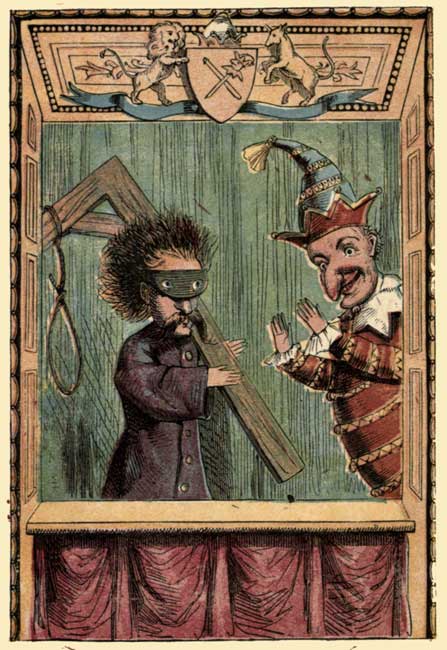
(c) image from Peter Herring, used with permission. Also see this illustration

The “Jack Ketch” character from a Punch and Judy puppet show: traditionally, Punch gets the better of their meeting and hangs Jack Ketch.

The Irish immigrant Ketch is the first name in English executioners. Indeed, you can call any of his successors right down to Pierrepoint a “Jack Ketch” and be perfectly understood.

The immediate successor, however, was Ketch’s own assistant — who inherited top billing after Ketch went to jail for “affronting” a sheriff.

Jack Ketch had been trodding the scaffold-boards, hanging, beheading, and drawing-and-quartering for two-plus decades at that point: he’s thought to have been appointed in 1663, and he’d inserted himself into those performances rather more prominently than an executioner ought by botching some of Restoration England’s most high-profile executions.

There’s little reliable information about these early executioners, but it seems Ketch’s reputation for clumsiness had forced him to issue an “Apologie” justifying himself.

But the man unquestionably had longevity in his favor, which is more than Paskah Rose could say.

Within months of becoming the chief London executioner, Rose and another man were chased down in the act of burgling clothes from a house, “the Goods found in Rose’s Breeches.”

Rose and his co-defendant Edward Smith accordingly hanged along with three others at Tyburn this date — by Jack Ketch, now returned from his carceral retirement for one last tour.

Ketch died late that same year of 1686, but has lived on in any number of ballads, doggerels and broadsides immortalizing the name. He was surely aided in this by the less impressive caliber of many who succeeded him: it wasn’t long after Ketch dispatched Pascha Rose that another “Jack Ketch” — an ignoble profession that wouldn’t until centuries hence be drawn from the country’s respectable classes — also met Pascha Rose’s same fate.

There’s a now-public-domain Autobiography of Jack Ketch by 19th century English writer Charles Whitehead.

On this day..

1776: Benjamin Harley and Thomas Henman, Smugglerius?

On this date in 1776, smugglers Benjamin Harley and Thomas Henman were hanged at Tyburn for murdering a customs-house officer who had intercepted them trafficking tea on the Deptford turnpike.

One of these two gentleman might well be the flesh-and-bones person behind the ghoulish ecorche sculpture known as “Smugglerius”.

This beautifully ghastly item was commissioned of sculptor Agostino Carlini by the anatomist William Hunter: it is the cast of a hanged man, meticulously flayed of his skin to reveal the musculature for the convenience of future students’ sketches. Those students gave their subject the jocular nickname, since in life it was thought to be a smuggler.

For good measure, Carlini posed the corpse in the manner of the Hellenistic marble Dying Gaul.


Dying Gaul (known in the 18th century as Dying Gladiator), one of the world’s best-known classical sculptures. (cc) image from Tom Magliery.

Of the “Dying Gladiator”, Byron wrote:

He recked not of the life he lost, nor prize,
But where his rude hut by the Danube lay,
There were his young barbarians all at play,
There was their Dacian mother, — he their sire,
Butchered to make a Roman holiday; —
All this rushed with his blood; — Shall he expire,
And unavenged? — Arise! ye Goths, and glut your ire!


A copy of Agostino Carlini‘s bronze cast of “Smugglerius”, displayed in Edinburgh. (cc) image from Chris Hill.

So that is Smugglerius, an astonishing artifact. For decades, it (actually a copy of Carlini’s original, which is long lost) has been parked at the Edinburgh College of Art, translating thence into countless students’ anatomical sketch pads.


William Linnell‘s 1840 drawing of Smugglerius.

To trace the ecorche‘s origin, we have, to start with, this letter from John Deare … not the tractor guy, but a noteworthy Liverpool sculptor. At time of writing in 1776, he was a 15-year-old matriculating art student:

One of the men bid me tell you, that Mr. Carter would give me half-a-guinea, at least, a week, for the first part of my time, and fifteen shillings for the latter part; but you will write to him, and ask him what he proposes: he is, just as they say, a blustering fellow, but a good man. I have seen two men hanged, and one with his breast cut open at Surgeons’ Hall. The other being a fine subject, they took him to the Royal Academy, and covered him with plaster of Paris, after they had put him in the position of the Dying Gladiator. In this Hall there are some casts from Nature that are cut from the middle of the forehead down to the lower part of the body, one part excoriated, and the other whole.

With the direct reference to the Dying Gladiator/Dying Gaul pose, we seem very clearly to have a bead on the creation of Smugglerius, and the letter suggests that it was one man taken from a pair of hanging subjects. Conveniently (or inconveniently) there were just two such pairs of executions at Tyburn in the spring of 1776: those of Benjamin Harley and Thomas Henman on May 27; and, those of Samuel Whitlow and James Langar on April 12.

Now, artist Joan Smith and anthropologist Jeanne Cannizzo have recently, and very publicly, argued that Smugglerius is not Harley or Henman, but James Langar — a man from the earlier hanging pair. This claim even teased an exhibition carrying the perhaps unfortunate title Smugglerius Unveiled.

The case for Langar basically has two components:

  1. Deare dated his letter about the “Dying Gladiator” on May 1, so the executions must precede that date — which means that it’s one of Langar or Whitlow.
  2. It’s more likely that Langar, a soldier, would have had the outstanding physique to attract Hunter’s interest. (Whitlow was a domestic servant who robbed his master in an unrelated crime.)

Headlines aside, this sleuthing obviously falls well shot of airtightness.

Historian Tim Hitchcock, incidentally a moving spirit behind the creation of the invaluable Old Bailey Online database, doesn’t find James Langar a persuasive candidate. In private communication with this site (4 April 2012), he remained “still very much of the opinion that [Smugglerius] is either Thomas Henman or Benjamin Harley … I am even more convinced now than before.” Here’s the case for one of the Harley/Henman pair:

  1. Harley and Henman were smugglers. You know … like Smugglerius?
  2. Trial records indicate death-sentenced prisoners also condemned to anatomization, and they do not say that about Whitlow and Langar, who were merely thieves
  3. Harley and Henman, by contrast, had killed; they were therefore subject to the Murder Act, and accordingly sentenced “to be afterwards dissected and anatomized; which sentence was executed upon them”*

All things equal outside of the date on Deare’s letter, Harley and Henman look much the likelier source of Smugglerius. (If so, we seem to lack any good reason to prefer Harley as the Smugglerius model as against Henman, or vice versa. Flip a coin.)

The historiography for Langar depends inordinately upon the present-day interlocutor’s confidence in the “1 May” date a Georgian-era teenager slapped onto a bit of personal correspondence with, one can be sure, nothing resembling academic gravity. May 1 could be mistaken outright (maybe it was June 1, and he wrote “May” out of the previous 31 days’ habit); or, it could be only a reference to when Deare began a letter that he might have composed over several weeks; or, it could be that the author had some trivial reason of personal expediency to backdate.

Maybe so, maybe not. But who would have thought anyone would be interested in Harley or Henman (or Langar) going on two and a half centuries after their deaths.

Executed Today had occasion to discuss this fascinating object d’art and its discomfiting origin with one of Hitchcock’s collaborators, IUPUI Professor of British History Jason M. Kelly.

ET: What’s the background? Why is Smugglerius being produced at all in 1770s Britain?

JK: Well, 1768 marked the establishment of the Royal Academy of Arts. It took over 20 years to create.

The idea was to give Britain a school of art — of painting, sculpture, and architecture — to rival its continental peers. The French had established art academies in the previous century; they were among the premier art schools in Europe, if not the premier schools.

The British didn’t have anything comparable. And, in an age of rivalries, both political and cultural, artists and patrons alike saw the Royal Academy as central to British national identity.

The Academy hired William Hunter to be the professor of anatomy. He was an anatomist — a doctor — by training, not an artist, so he was very interested in teaching things like musculature, skeletal structure, and the circulatory system.

Smugglerius was not William Hunter’s only ecorche. He had made at least one other as a teaching aid, and he was proud to associate himself with it. He even poses for a portrait with a miniature version of it.


Miniature portrait of William Hunter holding a miniature bronze from Michael Henry Spang‘s reduction of an earlier ecorched figure. (The full-sized figure can be seen in the background of this sketch.)

What actually goes into producing an ecorche?

They had to get the body from the gallows to the art academy. Then they flayed it. In this case, somebody decided to pose the corpse as the Dying Gladiator.

They had some time prior to rigor mortis to get everything situated. in this case, they flayed him, posed him, then let him dry out, possibly overnight, so that they could make a mold of his body.

Beyond its immediate use as a teaching device, it’s also an art object for appreciation in its own right. How do you read that phenomenon?

This is very much a representation of the power of the state, the unrestrained power.

The execution itself is a display of power, but the government went further when in 1752 it passed the Murder Act allowing the College of Surgeons to get six bodies a year to dissect.

Ordinary people had no desire to have their remains used in this way. In the example of Smugglerius, the criminal was executed. Then, the body was desecrated — transformed into an art object for elite connoisseurs.

The sculpture was meant to represent ideal beauty as well as the terrifying strength of the state. The very people who were meant to appreciate the model of the Dying Gaul were the same people holding the reigns of power. In a sense, this image reinforced the elites’ view of the world, both aesthetically and politically.

Why pose the figure in this way, as the Dying Gaul or Dying Gladiator?

There’s one reading of Smugglerius to the effect that it was very subversive because the Dying Gladiator was seen as emblematic of the decline of Rome: the sculpture represented Rome’s decadence and corruption.

an inveterate abuse, which degraded a civilised nation below the condition of savage cannibals. Several hundred, perhaps several thousand, victims were annually slaughtered in the great cities of the empire; and the month of December, more peculiarly devoted to the combats of gladiators, still [in the early 5th century] exhibited to the eyes of the Roman people a grateful spectacle of blood and cruelty … which had so long resisted the voice of humanity and religion.

-Edward Gibbon in The Decline and Fall of the Roman Empire

So, you could speculate that this pose slyly represented contemporary executions under the Bloody Code in the same critical way.

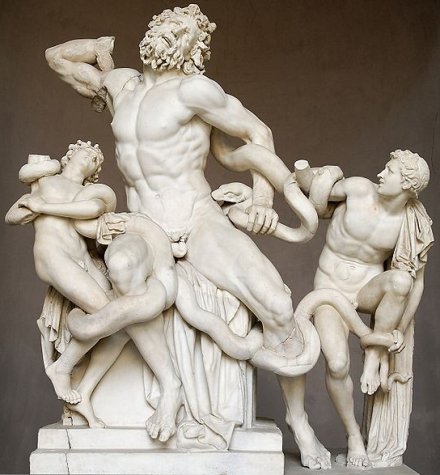
The Gladiator was also one of the best-known and -admired classical sculptures in all of Europe, along with the Laocoön.

In the 18th century they were compared as two examples of dignified dying. Contemporaries saw a certain stoicism in the sculptures — even though Virgil wrote that Laocoön cried out.

Ultimately, Smugglerius reminds us what happens when power is unrestrained. In a world where most people don’t have a voice, the state can ignore the rights and dignity of individuals. The real story here is the story of arbitrary authority and the importance of an enfranchised citizenry with the ability to put limits on those wielding power.

* Hanged felons not sentenced to anatomization could still wind up being taken apart in an operating theater, either as a result of their striking a direct bargain with the surgeons, or involuntarily via London’s growing trade in illicit corpses.

On this day..

1884: Mary Lefley, exonerated by a deathbed confession

On this date in 1884, Mary Lefley was hanged at Lincoln County Gaol for lacing her husband’s pudding with a lethal dose of arsenic.*

It was less than four months since William Lefley ate the rice pudding his wife Mary had left him in the oven while she called at a nearby town. This strange poisoning case is admirably covered by Capital Punishment UK, whose work we’ve featured here before. It’s one of the essential online sources on British execution history.

Shrieking in terror, Lefley had to be dragged to the gallows — still protesting her innocence. She’d never admitted to the crime, and they’d never been able to show that she purchased any arsenic.

There was some thought that William may have committed suicide: he’s known to have attempted it once before. But the more outlandish defense hypothesis that some unknown third party might have snuck in and poisoned the morsel gained unexpected credence in 1893 when a farmer made a deathbed confession to having done just that … over a wholly unrelated-to-Mary financial grudge.

* Mary Lefley knew the last notorious Lincolnshire poisoner, Priscilla Biggadyke — who hanged for poisoning off her husband in 1868. “They are hanging me for my past!” Lefley exclaimed when she was convicted. (Priscilla turned out to be innocent, too.)

On this day..

1892: Frederick Bailey Deeming, Bluebeard

(Thanks to Meaghan Good of the Charley Project for the guest post. -ed.)

On this day in 1892, Frederick Bailey Deeming was hanged in Melbourne, Australia for the murder of his second wife, Emily Mather. She was not his only victim; he’d also murdered his first wife, son and three daughters.

Deeming was born and raised in Ashby-de-la-Zouch in the UK. One of seven children, he was reportedly a “difficult” child. He later claimed he’d spent years in mental hospitals as a youth, something his brother disputed.

Deeming ran away to sea at sixteen and began committing crimes, mostly thefts. Wherever he went, he swindled and stole from people.

Deeming married Marie James in 1881 (his brother married Marie’s sister) and they moved to Australia. They went on to have four children.

In 1888, Deeming and his family moved to South Africa. His movements around that time are unclear, but he was definitely back in England by November 1889, and separated from his wife and children, who lived in another city.

Deeming bigamously married Helen Matheson in 1890, and deserted her shortly after the honeymoon. He visited his wife, gave her some money and told he was going to South America and would send for her and the children once he’d settled. Before he left he conned some jewelers in Hull; as a result, he was arrested upon his arrival in Montevideo, Uruguay and sent back to England to serve nine months in the clink.

In 1891, after his release from prison, Deeming took the name “Albert Williams” and leased a house in the village of Rainhill. A woman and several children were seen visiting him; he claimed they were his sister and her children.

The woman and children disappeared — off to an extended holiday, Deeming said. A short time later, complaining that the drains were defective, Deeming had the floor of his house re-concreted.

In fact, the “sister” was his first wife Marie and the “nieces” and “nephews” his own children — Bertha, 9, Marie, 7, Sidney, 5, and Leala, 18 months. And in fact, they were “vacationing” permanently, under the concrete floor. Authorities believe he killed them on or about July 26, 1891.

By that time, Deeming was already courting Emily Lydia Mather. They married on September 22 and by December 1891 had up and moved to Melbourne.

Emily didn’t make it past Christmas before Deeming had her entombed under the fireplace.

In January 1892, Deeming moved to Sydney. On the way he met a delightful young lady named Kate Rousenfell. He gave her several expensive gifts, including jewelry he’d stolen while he was in Melbourne, and proposed marriage. She agreed and said she would join him in Western Australia when he moved there.

But the course of true love never did run smooth, and Miss Rousenfell was cheated of her bridegroom by Deeming’s March 11 arrest for Emily’s murder.

Emily’s body had been discovered on March 3, after the house’s owner, investigating his new tenant’s complaints of a strange smell, raised the hearthstone. Her throat had been cut and her skull was fractured. When Deeming was taken into custody, he had some of her things with him, including her prayer book.

The murder case received extensive publicity and when those back in England heard of it, they decided to have a look at Deeming’s former home in Rainhill. There they dug up the bodies of Marie and the four children.

At his trial, Deeming claimed insanity and brain damage from epilepsy and tertiary syphilis, and said his dead mother’s spirit had ordered him to commit the murders.

He told the jury that Marie wasn’t dead and had, in fact, left him for another man. In the three weeks between the verdict and the hanging he penned his biography and some bad poetry. English publishers offered him £1,000 for the rights to his writings, but the Australian government had them all destroyed.

There have been suggestions, in Deeming’s time and ours, that he was the serial killer Jack the Ripper, who slaughtered and mutilated a handful of London prostitutes in 1888. The fact that evidence indicates Deeming was in South Africa at the time of the Jack the Ripper murders hasn’t stopped the speculation. He allegedly told his cellmates he was the Ripper, but when asked directly by the authorities, he refused to answer yes or no.

Deeming’s skull and death mask are still on display in the Old Melbourne Gaol Museum.

On this day..