1802: Joseph Wall

(Thanks to Meaghan Good of the Charley Project for the guest post. -ed.)

On this date in 1802, disgraced colonial administrator Joseph Wall was executed in London for crimes committed on the appropriately named island of Goree, off the coast of modern-day Senegal in Africa.

Paterson, who formerly kept a hatter’s shop in Catherine-street, Strand … was brought to the gangway by order of the Governor, without drum-head, or any other Court-martial, and flogged with a Boatswains cat, until his bones were denuded of flesh. Still the unfortunate man never uttered a groan. The Governor, who superintended the punishment, swore he would conquer the rascals [sic] stubbornness, and make him cry out, or whip his guts out … the flogging was continued until the convulsions of his bowels appeared through the wounds of his lacerated loins, when he fainted under the lash, and was consigned to the Surgeon’s care; but died in a few days.

“An Authentic Narrative of the Life of Joseph Wall, Esq., Late Governor of Goree” (pdf)

The Irish-born Wall came from an “ancient and respectable family.” He became a soldier and distinguished himself in Cuba during the Seven Years’ War, but as a civilian he wasn’t up to par: he allegedly assaulted a girl he was courting, and later killed a man in a duel. In 1779, he became Lieutenant Governor of Goree, where he quickly developed a reputation for brutality.

Over the next few years his health began to suffer and, in 1782, he decided to return to England.

On July 10, 1782, shortly before Wall’s departure, a deputation of his men approached him and asked to be paid their back wages. Outraged by the effrontery of the help, Wall ordered the petitioners arrested on charges of mutiny. Without benefit of court-martial, seven of the men were sentenced to flogging, four of them to an incredible 800 lashes each. Three died a few days after the beatings.

Wall was charged with cruelty on his return home, but the charges were initially dropped for lack of evidence. After more witnesses turned up, Wall had to flee to the Continent, where he lived under an assumed name for several years. He came back to England in 1797 and in 1801 he surrendered himself to stand trial.

Since all but two of the witnesses against him had died by then, Wall may have expected that the case against him had weakened. Instead he found himself convicted of murder and sentenced to be hanged.

His execution didn’t go well: it was a “short drop” hanging, and when the trap sprung, the knot on the rope slipped around to the back of his head. He strangled to death slowly over twenty minutes.

On this day..

1591: Arnold Cosbie, writing his own elegy

The manner of the death and execution of Arnold Cosbie, for murdering the Lord Burke, who was executed at Wanswoorth town's end on the 27 of January 1591. With certain verses written by the said Cosby in the time of his imprisonment, containing matter of great effect, as well touching his life as also his penitencie before his death.

ARNOLD COSBIE’S
ultimum vale to the vain world.

An Elegy written by himself
in the Marshalsea after his condemnation.

Break heart, be mute my sorrows past compare,
Cosbie complain no more, but sit and die,
Tears are no tokens of such dreriment,
As thy true grief pours to the angry heavens,
The heavens offended with thy foul misdeeds,
O great Commander of this glorious round,
The workmanship of thine immortal hand,
Thou that doest ride upon the Cherubins,
And tunest the deeps in dreadful harmony,
Cast down thine eye upon a wretched soul,
And from thy throne of grace great Jacob’s God
Rain mercy on me miserable man,
Fallen into snares of sin and shameful death,
From thee sweet Savior, Savior of the world.
O world, vain world, unconstant, & unkind,
Why hast thou bred me, nursed me, brought me up,
To see this day of sorrow and of shame:
Cosbie complain. Captains and men of war,
With whom I wholime spent my careless days,
Days dated but to this, to end in shame,
Farewell, adieu to you and all the rest
That follow armes, and armes and life adieu,
From armes and life I pass drenched in the pit
Digged by my desperate hands, hands full of blood.
Bleed heart to think what these accursed hands
Have perpetrated, Pardon heaven and earth,
And gentle Lord misled by my amis,
Foully by me sent to this longest home,
O pardon Cosbie’s cruel mind,
His mind enraged, and gentle blood by wrath
And fury tainted and empoisoned.
Why do I kill my doleful dying heart,
With sad rehearsal of this heavy chance.
O death rock me asleep, Father of heaven
That hast sole power to pardon sins of men,
Forgive the faults and folly of my youth,
My youth misspent in waste and wantonness,
And for sweet Jesus sake forgive my soul,
Foully defiled with this above the rest,
And lastly you whose fame I have defiled,
My kin, my Countrymen, friends, and allies,
Pardon, o pardon, such as men to men
Can give, I beg for wronging you in all,
For shaming you in this my wretched end,
The fruitless crop, the meed of my desert,
My bad, my base deserves, sweet Friends forget,
Friends, countrymen, and kinsfolks all forget,
My name, my face, my fact, o blot me out,
Out of the world, put me out of your thoughts,
Or if you think, o think I never was,
Or if you think I was, think that I fell,
Before some fort, some hold in Belgia,
With this suppose beguile your sorrows friends,
Think that I fell before the Canon’s mouth,
Even in mine honors heigth that blessed day,
When in advancement of my name, I left
My countries enemy in his base reuolie:
A wretched man to talk of honors high,
Fallen so basely into the pit of shame,
The pit of death: my God, my God forgive me,
Next to my God, my country pardon me,
Whose honor I have stained and laws infringe,
And thou my sovereign Mistress and my Queen,
Bright star of England’s globe, forgive my fact,
Nor let it touch thy Royal Princely heart,
That Cosbie hath misdone so heinously.
The circle of my time is compassed,
Arrived to the point where it began.
World, country, kin, and friends farewell farewell,
Fly thou my soul to heaven the haven of bliss,
O body bear the scourge of thine amiss.


More atmospheric Elizabethan movable type:

First pamphlet: 1 | 2 | 3 | 4 | 5 | 6 | 7 | 8 | 9

Second pamphlet: 1 | 2 | 3 | 4 | 5 | 6 | 7 | 8 | 9

… and, the source of the poem: 1 | 2 | 3 | 4

On this day..

1970: Three in Baghdad

One last coda to our recent Iraqi coup series occurred after a day’s pause in the hecatombs, as reported by the New York Times on Jan. 25, 1970:

BEIRUT, Lebanon, Jan. 24 — Three more men were executed in Baghdad at dawn today bringing to 44 the number shot or hanged since the leftist Baath Government in Iraq headed off a rightist plot on Tuesday.

The three-man special court that has sentenced 37 conspirators said the three were the last of those apprehended. Others, it added, are still at large.

An Iraqi military aircraft landed here this afternoon with a token gift of 30 submachine guns confiscated from the plotters. Iraq has promised to turn over all 3,000 submachine guns captured to the Palestinian commandos.

More blood was spilled in Baghdad this week than after any comparable attempted coup since World War II, and many Arab commentators expressed dismay and horror.

OTHER MASSACRES RECALLED

The nearest approach was 18, shot after a Nasserite rising against a Baathist Government in Syria in July, 1963.

The Baghdad executions fitted the context of Iraq’s violent history, which has led some historians to compare the current regime with that of the eighth-century Abbasid governor Al Hajjaj Ben Yussef, who declared, when he took office, that the Iraqis were a mean people and he was “going to wring their necks.” Great numbers of executions followed.

In more recent times the Iraqis in 1933 killed several thousand Assyrians who had volunteered for armed service with the British. In 1941 several hundred Jews were killed in a major pogrom in Baghdad.

In contrast to Egypt’s bloodless overthrow of King Farouk, the Iraqis in 1958 shot King Faisal and his family in the garden of their palace and went on to drag the bodies of Prince Abdul Illah and Premier Nuri al Said through the streets.

Part of the Daily Double: Saddam Hussein crushes a coup.

On this day..

1888: Danny Driscoll, Whyo

On this date in 1888, New York City crime lord Danny Driscoll went to the gallows in the Tombs.

(Co-)leader of the Irish gang the Whyos — so named for a distinctive signaling hoot that once echoed through the Five Points — Driscoll inherited power when his predecessor Mike McGloin hanged in 1884.

This band emerged after the disruptions of the Civil War as Manhattan’s most powerful criminal syndicate. The Whyos’ run in the 1870s and 1880s marks a transitional phase from the wild and woolly Gangs of New York street-brawling era into the more businesslike mafiosos of the 20th century.

Like the Mos Eisley cantina, the Whyos’ seedy tavern of choice (aptly named The Morgue) was notorious for over 100 recorded homicides in gang shootouts and drunken brawls; like Jabba the Hutt, the gang also took a methodical approach to extortion, racketeering, and murder that put the “organized” in their crime. One goon answering to the colorful name Piker Ryan (and old time New York crooks are nothing if not flamboyantly named) was once arrested with an actual ultraviolence menu from which budget-conscious clientele could custom-order thrashings for delivery.

Punching $2
Both eyes blacked $4
Nose and jaw broke $10
Jacked out (knocked out with a Blackjack) $15
Ear chewed off $15
Leg or arm broke $19
Shot in the leg $25
Stab $25.00
“Doing the big job” (murder) $100 and up

These 1884 selections perhaps already represent a moderation from earlier methods; a previous Whyo hoodlum, “Dandy” John Dolan, was noted for the copper eye-gouger he wore on his thumb just in case he needed to — well, you know. Dolan hanged back in 1876.


Wait til they get a load of the clamps.

Driscoll kept a house with his young wife, and was charitable enough also to share it with a whore named “Beezie” Bridget Garrity — with whom Driscoll often caroused in the rough Whyo territory. One night in 1886 their alcoholic peregrinations brought them up against a brothel run by a tough named John McCart(h)y, against whom Driscoll had an existing grudge — and as they entered, Driscoll and McCarty wound up in a threshold gunfight. Beezie Garrity had the bad luck to catch a fatal bullet in the crossfire. Both men would blame each other for firing the shot that killed Garrity, and produce numerous witnesses of variously impaired credibility, but for the city there was no confusion at all: between the two, Driscoll was the man worth getting rid of.

“I’ve got a bad name with the police and they say ‘give a dog a bad name and we’ll hang him,'” Driscoll complained to the court. His criminal record reached back to childhood.

Newspapers in the run-up to the hanging were rife with stories of escape attempts and Whyo menace, but police correctly prophesied that the gang had not the numbers or vigor to make any real disturbance. A cordon of 150 gendarmes around the Tombs saw “small groups of young men with hard, wicked-looking visages whom the police pronounced remnants of the Whyo gang … among them were some of the brazen-faced young women of the class to which Beezie Garrity” belonged. (New Haven Register, Jan. 23, 1888) Driscoll died game, his neck efficiently snapped by a noose of white Italian hemp … which seems by retrospection an apt instrument for his passing.

After Driscoll and his fellow alpha male Danny Lyons both hanged in 1888, the Whyos shrank into memory. They would be overtaken in the 1890s by Monk Eastman‘s gang, one last dinosaur from a fading era of hardscrabble toughs; Eastman was in turn supplanted by the Five Points Gang — a more recognizably sophisticated operation to key the 20th century, composed predominantly of the growing Italian-American emigre demographic that would define organized crime for the Godfather era.

The venerable Bowery Boys podcast of Big Apple history covered the Whyos way back in March 2009.

On this day..

1970: Nineteen in Baghdad

From the Jan. 23, 1970 Times of India:

Damascus, January 22.

Iraq’s execution mill worked without let-up today with 36 people put to death in 24 hours — all but seven of them accused of plotting to overthrow the Government.

Seven of the men, not connected with the plot, were convicted in November of spying for the U.S., Radio Baghdad said.

It identified one of them, Albert Nounou, as a Jew.

The 29 people who were accused of trying to overthrow the leftist regime of President Ahmed Hassan al Bakr on Tuesday night and early yesterday faced firing squads or hangmen.

Mr. Bakr addressed crowds outside the Presidential palace, saying that any plot against his Government would “only lead to the cutting of the plotters’ throats,” Radio Baghdad said.

DETAILS GIVEN

The executioners worked past midnight yesterday, carrying out death sentences given to 22 persons convicted of the coup attempt.

Then at dawn, the seven people convicted in November were put to death. A few hours later, Radio Baghdad said six Army officers and a civilian were doomed by a special court for taking part in the attempted coup. Shortly thereafter, the military men were shot by firing squad and the civilian was hanged.

The Government newspaper, “Al Thawra,” said firing squads were using the plotters’ own weapons for the executions.

The Baghdad broadcast said that in addition to the six military men and civilians executed this morning, the court had sentenced three other people to life imprisonment. –U.N.I.

From the Jan. 23, 1970 London Times, under the headline “Toll of executions in Iraq reaches 41”:

Baghdad, Jan. 22. — The abortive coup d’etat in Iraq on Tuesday was engineered with the assistance of the Israel, American, and Iranian secret services, the Iraq news agency said tonight. It made the accusation after the executions of two more soldiers and three civilians, bringing to 41 the total number of alleged plotters executed in Baghdad either by firing squads or hanging since yesterday morning.

Two more men were waiting execution after sentence.

Some 3,000 sub-machineguns, 650,000 rounds of ammunition, and a mobile radio transmitted had been seized, the agency stated.

Earlier today Iraq accused the Iranian Ambassador and four members of his Embassy staff of being implicated in the coup attempt, and ordered them to leave the country within 24 hours.

In Teheran, Iran retaliated by giving the Iraq Ambassador, the military attache, and his three assistants 24 hours to leave Iranian soil. It also ordered the closure of all Iraq consulates in Iran. — Agence France Presse and Reuter

Part of the Daily Double: Saddam Hussein crushes a coup.

On this day..

1970: Twenty-two in Baghdad

From the Jan. 22, 1970 London Times:

Baghdad, Jan 21. — Twenty-two people were executed in Baghdad today for plotting to overthrow the Iraq Government.

First of all three retired Army men and two serving officers were executed by firing squad. Seventeen more executions were carried out tonight and Baghdad radio said a special three-man tribunal set up to try the plotters was still meeting.

The radio had interrupted its programmes to announce the discovery of a plot, crushed by tanks last night, against the ruling Baath Party. All the plotters were arrested, it said.

Two Government soldiers had died in putting down the conspiracy, the radio said. An official funeral for them will be held in Baghdad tomorrow, and the radio called on the people to attend in thousands.

Although there were no details of how many plotters were arrested, the fact that clashes occurred suggested to observers that an actual attempt had been made against the Government when the Army moved in. Tanks from Rashid Army camp, on the fringes of the capital’s suburbs, foiled the plot, according to the official Iraq news agency.

The radio claimed that the United States, Britain and West Germany were behind the attempted coup.

The Middle East News Agency said some Army officers pretended to join the conspirators and then reported them to the authorities.

The executed men were accused of plotting against the socialist regime of President Ahmed Hassan al-Bakr in the interests of “imperialism and Zionism”. –Reuter, A.P. and U.P.I.

Part of the Daily Double: Saddam Hussein crushes a coup.

On this day..

1922: Eleuterio Corral and Rumaldo Losano, escapees

(Thanks to Meaghan Good of the Charley Project for the guest post. -ed.)

On this day in 1922, Eleuterio Corral and Rumaldo Losano were hanged in New Mexico’s Grant County Jail in Silver City for the 1921 murder of a prison guard.


Corral (left) and Losano (right).

Losano and Corral were serving time in the Grant County Jail for robbery (Corral) and attempted larceny (Losano) in the spring of 1921. Losano had only fifteen days days left to go on his sentence. Nevertheless, on April 2, 1921, the two young men decided to make a break for it. The jailer, sixty-year-old Ventura Bencoma, had been sick with the flu and during the early morning hours he decided to have a lie-down. While Bencoma slept, Corral and Losano were able to get out of the cell they shared.

A nearby cell was unoccupied and used for storing coal and firewood, and had an ax. The two convicts sneaked up on Bencoma and brained him with the ax, took his gun and keys, and threatened to shoot the other prisoners if they made any noise. They tried to use the keys to release another prisoner, Jesus Rocha, but weren’t able to get the lock undone and gave up. As soon as the pair had run off into the darkness, the others started screaming for help and woke up the sheriff, who was also enjoying a siesta of his own up on the second floor and had missed the entire jailbreak.

Bencoma died within a few hours, as the sheriff and a posse of men were searching for Losano and Corral. On April 5, after a brief exchange of gunfire, the fugitives were captured hiding in a shack. Their statements are summarized in West C. Gilbreath’s Death on the Gallows: The Story of Legal Hangings in New Mexico, 1847-1923:

Both Eleuterio and Rumaldo bragged out loud of their escape and short freedom. Both men told Sheriff Casey it was Jesus Rocha who planned the escape and was to have joined them. Sheriff Casey learned from the two that after Jailer Bencoma’s keys and pistol were removed, they were to unlock the steel cell door to Jesus Rocha. Once he was released, the three were to go up to the second floor where Sheriff Casey’s quarters were and call him to the door. Once the Sheriff opened the door, he would be shot and killed with the jail’s pistol. The three would then arm themselves with the Sheriff’s rifles and ammunition. They planned to saddle the horses in the Sheriff’s corral and flee to Mexico. The plan began to fall apart after both failed to unlock the cell door to Jesus Rocha.

In light of this information, Jesus Rocha was charged with murder alongside his criminal colleagues. At trial, Losano and Corral recanted their statements about his involvement and claimed Rocha had not been a part of the escape plan. All three were convicted and sentenced to hang, but the Supreme Court of New Mexico subsequently reversed Rocha’s conviction, leaving Corral and Losano to face the noose without him.

Their families in Mexico pleaded for mercy, claiming that at the time of the murders, Corral was just sixteen years old and Losano seventeen. However, three physicians who examined them judged Corral was least nineteen and Losano was probably older than twenty.

A few days prior to the execution, the deputy warden conducted a surprise search of the condemned men’s cell. Both of their mattresses contained hacksaws and makeshift knives: they’d been planning another violent escape attempt. Unsurprisingly, the state governor, Merritt C. Mechem, refused to commute the sentences, telling Sheriff Casey, “Every guard’s life out there would be in danger with those two in the penitentiary.”

Officials set up the scaffold only about fifty feet from where Bencoma was murdered. Corral went first, then Losano. Both of them were calm and offered the standard prayers, apologies for their crimes and pleas for forgiveness.

On this day..

1894: John Hardy, desperate little man

On this date in 1894, West Virginia hanged before a crowd of 3,000 for a mining camp murder three months before.

Hardy was reportedly already at odds with Thomas Drews, a fellow laborer in the booming Appalachian coal industry, over their mutual pursuit of the same woman when Hardy lost big to Drews in a craps game on October 13, 1893.
While it’s true that twenty-five cents doesn’t really seem all that “big”, this sum could represent a decent slice of a day’s pay in the coal mining game, and that in an industry where downward wage pressure had generated a ferocious national strike only months before. Hardy was profoundly nonplussed to have to fork over the sweat of his brow to a love rival and, with the added incitement of whiskey, shot Drews dead. (Ten more spectators at his hanging wound up in stir themselves for drunk and disorderlies.)

Hardy’s execution has pride of place in Americana as the inspiration for the tune “John Hardy Was A Desperate Little Man”. (Or simply, “John Hardy”; as a folk figure, he has occasionally been confused or conflated with John Henry)

One of the most popular folk ballads in American history, the song has foggy origins but amazing reach: it has been performed, covered, and reinterpreted by a scores of artists including the Carter Family, Lead Belly, Duke Ellington, Woody Guthrie, Pete Seeger, and Bob Dylan with the Grateful Dead.

On this day..

1678: James Mitchell, Covenanter assassin

On this date in 1678, Covenanter radical James Mitchell was hanged at Edinburgh for attempting to murder the Archbishop of St. Andrews.

Mitchell’s intended victim, James Sharp by name, is one of Scottish history’s great villains — tasked as he was to cheat Presbyterians of the religious reform they had spent a generation seeking. After Cromwell had King Charles I beheaded, his heir Charles II was nothing but an exile pretending to the throne his father had been deposed from.

Desperate for allies, he made a reluctant pact with Scottish allies to promulgate Presbyterianism throughout the realm should he regain the kingdom: this meant, in practice, bottom-up church governance as against the top-down authority of bishops characterizing Episcopacy. For a king, this would entail ceding considerable power over religious matters.

Such a promise was more readily given than honored. When Charles II regained the English throne in 1660, he instead restored Episcopacy in the north and everywhere else — selecting our man James Sharp, up until then a Presbyterian minister of the moderate faction, to boss Scotland’s most exalted ecclesiastical post. “The great stain will always remain, that Sharp deserted and probably betrayed a cause which his brethren intrusted to him,” Walter Scott wrote.

From this position, whose very existence was obnoxious to his former friends, our Judas* was Charles’s point man for reintroducing and enforcing all those ecclesiastical prerogatives of the monarchy that the Presbyterians had been so desperate to abolish.

He drove from the church irreconcilable Covenanter ministers — so named for their adherence to the objectives of those discarded covenants. That faction despised Sharp, and he returned the sentiment. On one occasion, he had to call for the militia to disperse an angry mob, only to be told that the militia’s members had joined the mob too. After a Covenanter rising was put down at the Battle of Rullion Green, Sharp okayed the withdrawal of quarter for surrendered foes with the taunt “You were pardoned as soldiers, but you are not acquitted as subjects” — putting his episcopal imprimatur on numerous ensuing hangings.

It was only a matter of time before someone tried to murder him.

On the 11th of July in 1668, James Mitchell — a zealous but unordained freelance preacher and dyed-in-the-wool Covenanter — stepped to a carriage the archbishop was embarking and took a shot at him. Mitchell missed, and pinged one of the prelate’s companions in the wrist, crippling the hand.

Mitchell managed to escape and live for several years with sizable sum on his head and nobody interested in claiming it** before Sharp’s own brother finally captured him in 1674. The proceedings against him are surprisingly protracted considering the famous vindictiveness of his target, and resolved by (as Mitchell said at his hanging) “an extrajudicial confession, and the promise of life given to me thereupon by the chancellor, upon his own and the public faith of the kingdom.” Given his party, he ought not have been surprised that the promise was not kept; as an added bonus, his retraction of the confession — which was the only evidence against him — resulted in his torture by the boot.

In 1679, a different bunch of Covenanters finally succeeded in assassinating the hated Archbishop Sharp.


The Murder of Archbishop Sharpe on Magus Muir near St. Andrews, 1679, by William Allen (c. 1840).

There’s a public domain biography friendly to Sharp (and perforce extremely hostile to the Covenanters) here.

* Cromwell met Sharp — still a Presbyterian minister at that time — in a negotiation during the Protectorate and allegedly rated him “ane Atheist, and of noe principles at all.”

** At one point Mitchell resided in Edinburgh with another man bound for the scaffold, Major Weir

On this day..

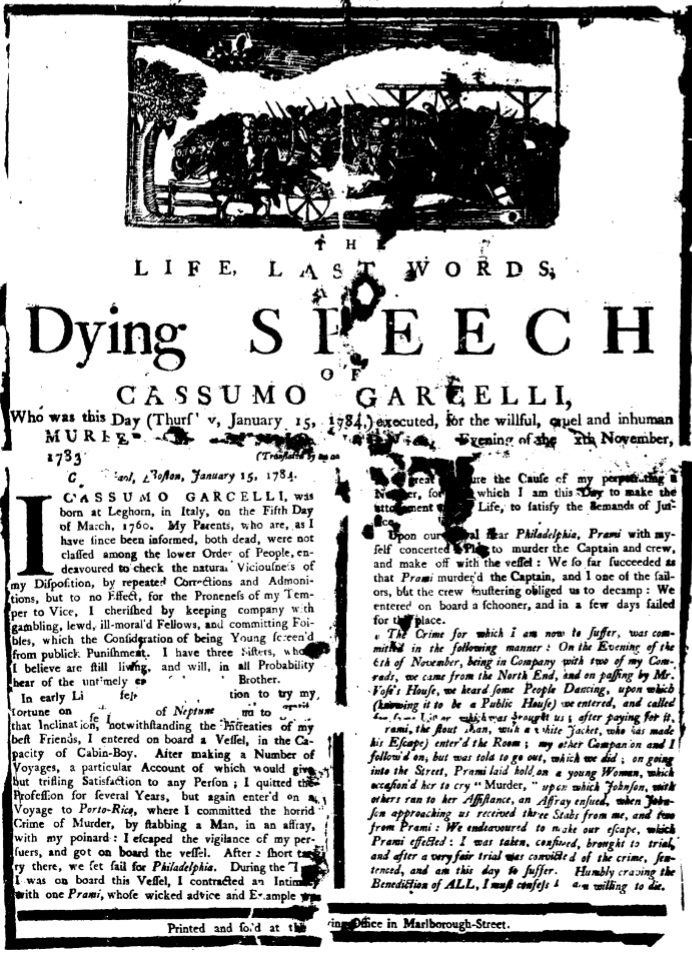
1784: Cassumo Garcelli, a Tuscan sailor on Boston Common

On this date in 1784, for a murder in a bar brawl he had committed with his hard-drinking cronies, Tuscan mariner Cassumo Garcelli was hanged on Boston Common.

To judge by the bog-standard broadsheet purporting to report the condemned man’s gallows’ shade contrition for his youthful vice and wicked examples, piratical Catholic seamen appear to have understood the spectacle of their public execution in a friendless foreign land in a manner quite suspiciously similar to the understanding likely to be held by a New England printer.

In the transcription that follows, I have made a few interpolations, and one outright elision, owing to sections of text obscured by printing faults on the preserved version of this document.


Click on the image to see the full original document.

Who was this Day (Thursday, January 15, 1784) executed, for the willful, cruel and inhuman murder of Mr. John Johnson on the evening of the sixth November, 1783.

I, Cassumo Garcelli, was born at Leghorn, in Italy, on the Fifth Day of March, 1760. My Parents, who are, as I have since been informed, both dead, were not classed among the lower Order of People, endeavoured to check the natural Viciousness of my Disposition, by repeated Corrections and Admonitions, but to no Effect, for the Proneness of my Temper to Vice, I cherished by keeping company with gambling, lewd, ill-moral’d Fellows, and committing Foibles, which the Consideration of being Young screen’d from publick Punishment. I have three Sisters, who I believe are still living, and will, in all Probability, here of the untimely [death of their] Brother.

In early Life […] to try my fortune … notwithstanding the Intreaties of my best Friends, I entered on board a Vessel, in the Capacity of Cabin-Boy. After making a Number of Voyages, a particular Account of which would give but trifling Satisfaction to any Person, I quitted the Profession for several Years, but again enter’d on a Voyage to Porto-Rico, where I committed the horrid Crime of Murder, by stabbing a Man, in an affray, with my poinard: I escaped the vigilance of my persuers, and got on board the vessel. After a short tarry there, we set sail for Philadelphia. During the Time I was on board this Vessel, I contracted an Intimacy with one Prami, whose wicked advice and Example was in a great Measure the Cause of my perpetrating a Number [sic], for [one of?] which I am this Day to make the attonement of my Life, to satisfy the demands of Justice.

Upon our arrival near Philadelphia, Prami with myself concerted a Platt to murder the Captain and crew, and make off with the vessel: We so far succeeded as that Prami murder’d the Captain, and I one of the sailors, but the crew mustering obliged us to decamp: We entered on board a schooner, and in a few days sailed for this place.

The Crime for which I am now to Suffer, was committed in the following manner: On the Evening of the 6th of November, being in Company with two of my Comrads [sic], we came from the North End, and on passing by Mr. Vose’s House, we heard some People Dancing, upon which (knowing it to be a Public House) we entered, and called for some Liquor, which was brought to us, after paying for it.

Vami, the stout man, with a white Jacket, who has made his Escape, enter’d the Room; my other Companion and I follow’d on, but was told to go out, which we did; on going into the Street, Prami laid hold on a young Woman, which occasion’d her to cry “Murder,” upon which Johnson, with others ran to her Assistance, an Affray ensued, when Johnson approaching us received three Stabs from me, and two from Prami: We endeavoured to make our escape, which Prami effected: I was taken, confined, brought to trial, and after a very fair trial was convicted of the crime, sentenced, and am this day to suffer. Humbly craving the Benediction of ALL, I must confess [and am] willing to die.

On this day..