509 B.C.E.: The Sons of Brutus

August 21 is the harvest-time feast of Consualia, honoring the Roman god of grain storage, Consus.

We mark on this occasion the legendary capital punishment inflicted by Lucius Junius Brutus when he was consul of the ancient Roman Republic upon two rebels — his own sons, Titus and Tiberius.

The great Brutus had been one of the leaders of the revolt that expelled Rome’s last king, Lucius Tarquinius — reputedly after the king’s son raped Lucius’s kinswoman Lucretia. (Brutus was also Tarquin’s nephew.)

Upon completing his coup, Brutus immediately summoned the populace to swear an oath that no king would ever rule Rome again. So potent was the civic memory of this event that even centuries later when the Republic was well gone, Rome’s emperors dared not appropriate such an incendiary title as “King”.

But that was for a later time, after the winners wrote the history.

The exiled Etruscan king, subsequent Romans’ eternal watchword for tyranny, got the boot about 510 B.C.E., and in 509 was still hanging about looking for an opportunity to re-seat his dynasty. The plot he hatched is known as the Tarquinian conspiracy, and Brutus, to his grief, would discover that his own children had adhered to it. The statesman’s willingness to put his own flesh and blood to death for the security of Rome would long stand as a parable of manful patriotism.

Our account here is from Livy (line breaks have been added for readability), and the excuse to approximate this undated execution to summer’s harvest-time is bolded therein.

liberty was well nigh lost by treachery and fraud, a thing they had never apprehended. There were, among the Roman youth, several young men of no mean families, who, during the regal government, had pursued their pleasures without any restraint; being of the same age with, and companions of, the young Tarquins, and accustomed to live in princely style.

Longing for that licentiousness, now that the privileges of all were equalized, they complained that the liberty of others has been converted to their slavery: “that a king was a human being, from whom you can obtain, where right, or where wrong may be necessary; that there was room for favour and for kindness; that he could be angry, and could forgive; that he knew the difference between a friend and an enemy; that laws were a deaf, inexorable thing, more beneficial and advantageous for the poor than the rich; that they allowed of no relaxation or indulgence, if you transgress bounds; that it was a perilous state, amid so so many human errors, to live solely by one’s integrity.”

Whilst their minds were already thus discontented of their own accord, ambassadors from the royal family come unexpectedly, demanding restitution of their effects merely, without any mention of return. After their application was heard in the senate, the deliberation on it lasted for several days, (fearing) lest the non-restitution might be a pretext for war, and the restitution a fund and assistance for war. In the mean time the ambassadors were planning different schemes; openly demanding the property, they secretly concerted measures for recovering the throne, and soliciting them as if for the object which appeared to be under consideration, they sound their feelings; to those by whom their proposals were favourably received they give letters from the Tarquins, and confer with them about admitting the royal family into the city secretly by night.

The matter was first intrusted to brothers of the name of Vitellii and those of the name of Aquilii. A sister of the Vitellii had been married to Brutus the consul, and the issue of that marriage were young men, Titus and Tiberius; these also their uncles admit into a participation of the plot: several young noblemen also were taken in as associates, the memory of whose names has been lost from distance of time. In the mean time, when that opinion had prevailed in the senate, which recommended the giving back of the property, and the ambassadors made use of this as a pretext for delay in the city, because they had obtained from the consuls time to procure modes of conveyance, by which they might convey away the effects of the royal family; all this time they spend in consulting with the conspirators, and by pressing they succeed in having letters given to them for the Tarquins. For otherwise how were they to believe that the accounts brought by the ambassadors on matters of such importance were not idle?

The letters, given to be a pledge of their sincerity, discovered the plot; for when, the day before the ambassadors set out to the Tarquins, they had supped by chance at the house of the Vitellii, and the conspirators there in private discoursed much together concerning their new design, as is natural, one of the slaves, who had already perceived what was going on, overheard their conversation; but waited for the occasion when the letters should be given to the ambassadors, the detection of which would prove the transaction; when he perceived that they were given, he laid the whole affair before the consuls. The consuls, having left their home to seize the ambassadors and conspirators, crushed the whole affair without any tumult; particular care being taken of the letters, lest they should escape them.

The traitors being immediately thrown into chains, a little doubt was entertained respecting the ambassadors, and though they deserved to be considered as enemies, the law of nations however prevailed.

The question concerning the restitution of the tyrants’ effects, which the senate had formerly voted, came again under consideration. The fathers, fired with indignation, expressly forbad them either to be restored or confiscated. They were given to be rifled by the people, that after being made participators in the royal plunder, they might lose for ever all hopes of a reconciliation with the Tarquins. A field belonging to them, which lay between the city and the Tiber, having been consecrated to Mars, has been called the Campus Martius. It happened that there was a crop of corn* upon it ready to be cut down, which produce of the field, as they thought it unlawful to use, after it was reaped, a great number of men carried the corn and straw in baskets, and threw them into the Tiber, which then flowed with shallow water, as is usual in the heat of summer; that thus the heaps of corn as it stuck in the shallows became settled when covered over with mud: by these and the afflux of other things, which the river happened to bring thither, an island was formed by degrees. Afterwards I believe that mounds were added, and that aid was afforded by art, that a surface so well raised might be firm enough for sustaining temples and porticoes.

After plundering the tyrants’ effects, the traitors were condemned and capital punishment inflicted. Their punishment was the more remarkable, because the consulship imposed on the father the office of punishing his own children, and him who should have been removed as a spectator, fortune assigned as the person to exact the punishment.

Young men of the highest quality stood tied to a stake; but the consul’s sons attracted the eyes of all the spectators from the rest of the criminals, as from persons unknown; nor did the people pity them more on account of the severity of the punishment, than the horrid crime by which they had deserved it.

“That they, in that year particularly, should have brought themselves to betray into the hands of Tarquin, formerly a proud tyrant, and now an exasperated exile, their country just delivered, their father its deliverer, the consulate which took its rise from the family of the Junii, the fathers, the people, and whatever belonged either to the gods or the citizens of Rome.”

The consuls seated themselves in their tribunal, and the lictors, being despatched to inflict punishment, strip them naked, beat them with rods, and strike off their heads. Whilst during all this time, the father, his looks and his countenance, presented a touching spectacle, the feelings of the father bursting forth occasionally during the office of superintending the public execution.


Bummer: Jacques-Louis David‘s 1784 painting, Lictors Bring Home the Sons of Brutus.

This Brutus was an ancestor of the Brutus who helped assassinate Julius Caesar, and that later et tu, Brutus is commonly represented as having been convinced to turn against his friend and patron by, in part, the example of his legendary namesake.

O, you and I have heard our fathers say,
There was a Brutus once that would have brooked
The eternal devil to keep his state in Rome
As easily as a king.

-Cassius to Brutus in Shakespeare’s Julius Caesar (Act 1, Scene 2)

* “Corn” meaning not American maize, of course — which was not available before the Columbian exchange — but the word’s earlier meaning of whatever was the local grain: wheat, barley, and millet in Rome’s case. (The word corn derives from the Latin granum.)

On this day..

1812: William Booth, forger

On this date in 1812, William Booth was hanged at Stafford for counterfeiting.

Booth might have murdered his brother John, who was found beaten to death in a Warwickshire stable in 1808. He defeated that charge for want of evidence.

But he would not be two times lucky before the bar.

As a “farmer” living on 200 acres, he enjoyed the privacy to build his own mint, complete with forged royal stamps for churning out banknotes — more than enough cause to hang a man should he be caught, which Booth was. He was a difficult fellow to arrest, the Bury and Norwich Post reported (Aug. 19, 1812), because his farmhouse turned out to be “a little fort, full of trap-doors, and barred and bolted like a bastile.”

Booth’s engineering acumen might have come in handy for his executioners. As a broadside notes, the gallows Booth

ascended with a firm and steady step, but turned his back upon the populace almost immediately; after some time spent in prayer, the rope was adjusted, and a signal being given by the malefactor, (throwing his handkerchief from him that he was ready to submit to his fate,) the drop sunk, when, shocking to relate, by the cord slipping from the fatal tree, the unfortunate man fell from the top of the gallows upon the platform, a distance of eight or ten feet, where he remained motionless and insensible for some minutes.

The stunned prisoner was gradually revived, and redoubled his pieties. The fall must have rendered the noose unusable, because for some reason a delay ensued sufficient to stretch out the proceedings to two full hours, all of which Booth spent in the shadow of the gallows. Even when they finally had him trussed up and ready to hang again, they needed a do-over: Booth once more dropped his handkerchief, but the drop embarrassingly failed to dislodge. Booth, who had twice prepared himself to walk to the brink of death only to twice survive, asked for his handkerchief back once the apparatus had been fixed so that he could re-drop it.

Having faced two capital trials, and two executions, Booth couldn’t even get buried right on the first time. Apparently a re-drawing of the county line required his remains to be exhumed and re-interred, giving rise to a ballad, “Twice Tried, Twice Hung, Twice Buried”.

(Although this version proposes twice hanged and once drowned: suffice to say, Booth lived an interesting death.)

On this day..

1703: Tom Cook, Ordinary’s pet

On this date in 1703,* Thomas Cook was hanged at Tyburn.

Cook — or the Gloucester Butcher, to use the sobriquet that advertised his prize fights — was convicted of giving a constable a fatal rapier thrust during a mob affray.

As he faced execution in prison, Cook continued to insist that he didn’t do it. But he still gratified the ministrations of the Newgate Ordinary Paul Lorrain by admitting to a life of sinfulness:

that he had frequently stoln [sic] Sheep, and done many ill things … He acknowledg’d he had been a grievous Sinner, a great Swearer and Drinker, an Adulterer, a Prophane and Lewd Wretch, and a sworn Enemy of those who were employ’d in the Reformation of Manners; and that for some years past he had made it his great Business to Fight for Prizes; an Exercise which the Pride of his Heart carry’d him to, which he now looks upon as most Heathenish and Barbarous, and which, with all other the wicked Practices of his Life, especially his slight of Religion, he does detest and abhor … and in the Words of a Dying-Man (who by the just Providence of God, came to suffer a shameful and untimely Death, in the primer of his years) he exhorts all those of his Acquaintance, and others that live loosely and particularly that follow this Wicked Sport of Prize playing, to reform betimes, and apply themselves to that which is virtuous and laudable, lest if they cdo continue any longer in their ill way, the Wrath of God fall upon them, and they come to the same, or worse Punishment thatn himself.

But still, he didn’t kill the cop, he said. (This, actually, was a common enough dodge among the Ordinary’s patients: it enabled them to satisfy the confessor, and the weight of social conventions he pressed on them, while also persisting with a denial of this crime one might be invested in maintaining. Whether true or no, Cook must have been unusually persuasive to pass off a story that would ordinarily be held to characterize an “obstinate” prisoner.)

Paul Lorrain, who held the Ordinary of Newgate office from 1700 to 1719, absolutely adored a good conversion story; his profession after all was ministering to prisoners. Lorrain ate all this reform-themselves-betimes stuff right up.

Two days after Cook’s execution, Lorrain compared the hanged pugilist to the Biblical patriarch Enoch at an overwrought funeral sermon (titled “Walking With God”): proof positive that even the most wretched sinner could taste God’s redemption. Cook’s “Soul is now enjoying an honourable and happy Life in God’s Glorious Kingdom,” Lorrain averred.

This was mainstream theology, but not a universal opinion.

Cook’s fellow convicts in Newgate regarded the repentant condemned as an unctuous hypocrite and didn’t share the Ordinary’s susceptibility to the actual-innocence claim Cook smuggled into his big confession of general lifelong sin.**

One of those fellow convicts in 1703 was Daniel Defoe, who met Lorrain while incarcerated and took a violent personal dislike to the prelate.

Defoe (who would later put a dismissal of the Ordinary in the mouth of his great heroine Moll Flanders) retorted to Lorrain’s published sermon with a scathing pamphlet titled “A Hymn to the Funeral Sermon”. In it, he mocks Lorrain’s racket peddling the public† broadsheets which almost invariably celebrate the gallow’s-foot conversions of his innumerable malefactors. After all, when

Men of Infamy should rise,
By Ladders to Ascend the Skys …
What need we Mortifie and Pray
If Gibbets are the Shortest Way?
In what disguise Religion may be drest,
The crooked Paths of Priest-craft Paint?
Where lies the Secret, let us know,
To make a Sheep-stealer a Saint?
Or bid me tell them that ’tis all a Jest;
What need they point out other ways,
Since Earthly Rogues can Merrit Holy Praise?
If this Wise Precedent the World receives,
Newgate shall ne’re be call’d a Den of Thieves.


Not related to Cook or to Defoe, this 1882 Puck cartoon (via the Library of Congress) makes Defoe’s same discomfiting point graphically: the soul of the hanged murderer ascends into angelic choirs, his crimes literally wiped away by his confessor — while that of his victim, slain unawares while unpurged sin weighs his conscience, wallows in hell. “The Murderer’s Straight Route to Heaven — Bringing Religion into Disrepute,” runs the caption.

* Cook had had a last-minute reprieve from joining a July 21 hanging date; in his account for that date, Paul Lorrain called out Cook by name to take “a happy Warning” from the right conduct of those gallows-birds.

** In 1706, two other men coming up for hanging made a point of insisting to Lorrain that the fighter who “with such an Air of seeming Repentance to his last breath deny’d his crime” did commit the murder.

† According to Lincoln Faller (“In Contrast to Defoe: The Rev. Paul Lorrain, Historian of Crime”, Huntington Library Quarterly, Nov. 1976), Lorrain left an estate of £5,000 at his death in 1719. His salary as Ordinary was something in the neighborhood of £35 per annum. Defoe overtly accuses Lorrain in “Hymn” not merely of profiteering but of taking payola to frame a gratifying obituary for a hanged criminal: “Pulpit praises may be had / According as the Man of God is paid.”

On this day..

1786: Tom, “faithful, industrious, healthy slave”

(Thanks to Meaghan Good of the Charley Project for the guest post. -ed.)

On August 9, 1786, in the state of Franklin (in what is now eastern Tennessee), a black slave named Tom was hanged for murder.

Tom had poisoned John Fuller Lain, a white man. The circumstances of the murder and Tom’s motive for it have been lost to history; all we know is that Lain was not his owner. Tom’s owner, William Evans, actually hired counsel to defend him, but the court refused to hear it.

Tom was imprisoned in July of that year, tried and convicted on August 8 and put to death the next day.

Aptly for a man of Franklin, Evans was concerned about the Benjamins. He filed a lawsuit against the sheriff for wrongful destruction of his personal property, but this was dismissed. Doggedly, on May 2, 1799 — nearly thirteen years after Tom’s death — Evans petitioned the General Assembly asking to be reimbursed for the value of the dead man, whom he described as “faithful, industrious, healthy slave … in the prime of life.”

Edwards reckoned Tom was worth £100. A hundred people signed the petition, but the General Assembly — by now the Tennessee General Assembly, since “Franklin” had failed as an independent entity — refused to cough up the funds.

On this day..

1846: John Rodda, nobody chokes baby on acid

John Rodda was hanged on this date in 1846 behind York Castle on “a charge so unusual and so repugnant to the ordinary feelings of human nature.”

Rodda murdered his 18-month-old daughter Mary by pouring sulphuric acid down her throat.

The motive: as a member of a burial society — a sort of community insurance pool for defraying funeral costs — Rodda stood to pocket two pounds, 10 shillings for the death of his little girl. (Was that a lot of money in those days? Not really.)

The most complete account of this event The Criminal Chronology of York Castle, and it underscores what a rum job Rodda did of cashing in on Mary.

On April 18th of that year, while the baby was on the mend from some routine affliction of infancy, John Rodda bought a penny’s worth of vitriol from a druggist.

The next day, Mary’s condition took an abrupt turn for the worse after being left a few minutes in her father’s care, and the acid was found in her stomach. Hmmmmm.

A few days previously to his execution, he made a full confession of his guilt, and stated that avarice was his only motive for sacrificing his innocent and unoffending child, whom it was his duty as a parent to have succoured and protected; but whom he coolly, deliberately, and cruelly murdered for the sake of filthy lucre. But the day of execution at last arrived, and the greatly erring young man’s earthly hopes and fears were soon to terminate. At an early hour on Saturday morning, August 8th, the workmen commenced erecting the drop in front of St. George’s Field, and the solemn preparations for the awful ceremony were speedily completed. At the usual hour the wretched man, with blanched cheek and dejected look — his arms pinioned — appeared on the scaffold, attended by the regular officials; after spending a few minutes in prayer, the executioner proceeded to perform the duties of his office, by drawing the cap over his eyes and adjusting the rope, when the fatal bolt was withdrawn — the drop fell — a convulsive struggle ensued — and the unhappy mortal ceased to exist.

There was a large concourse of spectators assembled in St. George’s Field, and the intervening road, to witness the appalling spectacle, amongst whom were a great number of the lower orders of the Irish, who had congregated to witness the last moments of their fellow-countryman.

On this day..

1899: Three in the Klondike Gold Rush

On this date in 1899, the gallows of gold rush boom down Dawson City, Yukon strained for three murderers.

The 1896 gold strike in the Klondike triggered a huge rush of prospectors warming sub-Arctic climes with visions of sudden wealth. “When the world rang with the tale of Arctic gold, and the lure of the North gripped the heartstrings of men,” as put by that lure’s great muse Jack London, who himself had already come and gone from the Dawson City by this time, and struck his own variety of fortune in the process.

Miners pouring into the Yukon did not, of course, enter virgin territory. Native peoples had occupied it for thousands of years.

In May 1898, two prospectors, Christian Fox and William Meehan, camped near the mouth of McClintock Creek were only mildly uneasy about the arrival of the Nantucks, Tagish brothers who set up an adjacent camp. Relations were amicable for a while, but when returning one afternoon from the day’s work the prospectors were suddenly fired upon from ambush by their neighbors.

Meehan was slain in the fusillade. The injured Christian Fox managed to float away, get to land, and reach a miners’ settlement. He described the attack thus:

I was lying on the sacks against the side of the boat … and I saw Joe standing with his gun like this … and all the boys went into the brush, and I says to myself “Now they have shot us for our outfit, and are hurrying down to the next bend in the river to catch the boat … My only show is to get to the opposite side of the river and try to make for a white habitation” … I took the paddle in my hand and tried to paddle the boat but I was too weak, so I … used it as a pry … The boat ran up to a nice little level place where it was grassy and as I stepped out I stepped over the leg of my partner as he was stretched out over the boat with his head back and his mouth open and I saw that he was dead, and I said “Good by Billy old boy, I can do nothing for you here.”

By Fox’s report, the four Nantucks were soon taken into custody.


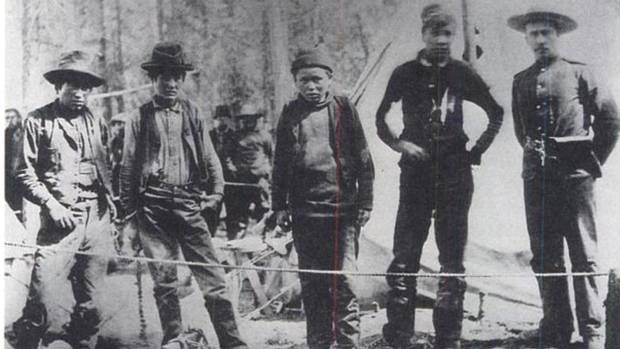
The four Nantuck brothers, shackled after arrest.

The trial unfolded in a court at the territorial capital of Dawson City. A compelling chapter in Strange Things Done: Murder in Yukon History does wonderful work with the cultural disconnections, including a two-page exchange between judge and interpreter (and, off-camera, Frank Nantuck) in which the court struggles to get the accused sworn “so help me God” since Frank’s cosmology has no idea of an afterlife. “He says, when he is dead he is dead — that is all I can get out of him,” the helpless middleman reports.

Q Has he any knowledge of God at all or any idea about a future state of rewards and punishments?

A No sir.

Q Or any clear belief in religion of any kind?

A No sir.

Q Will you say to him that we want him to tell us the truth and not to tell us anything that is not the truth; that he may be punished if he tells us anything that is not the truth; that we are going to ask him some questions and that he must tell us just the truth; ask him if he will agree to do that.

The outcome of the trial will not surprise and there was no question but that the Nantucks had done the shooting. What the Dawson court only barely noted was that brothers had been detailed to avenge two Tagish deaths. An old woman had previously been given or found some “baking powder” and proceeded to make bread with it: in fact, it was arsenic, which was used in mining. Here again is the cultural dislocation; the Nantucks living next to Fox and Meehan were trying to feel out whether those two prospectors were of the tribe that had provided this poison, and of equivalent social rank to the two men who died eating the arsenic-bread. Basically, neither side in this subarctic tragedy had any concept of what the other was on about.

There’s a play about this case, Justice. Peruse the play’s pdf companion study guide on the real historical case here.

In the end, all four Nantucks were condemned to die; Frank was probably still a minor, and he had cooperated with the investigation, so his sentence was commuted to life imprisonment … which did not turn out to be very long at all, since Frank and his condemned brother Joe both died in jail of tuberculosis during the 1898-99 winter.

Dawson Nantuck and Jim Nantuck remained to hang.

Momentarily sensational, the case was long forgotten among whites; it has, however, remained in the oral tradition of Yukon First Peoples. Both communities, however, saw the case brought to the fore when excavations accidentally turned up their remains — along with those of two other hanged men.

One of the other two was the third man to hang this date, a fellow by the name of Ed Henderson. Henderson was an American prospector whose fate might be a bit less instructive for posterity. He suffered from a horrible bladder infection that caused him to pass bloody water every 15 or 20 minutes. “The tortures of the damned,” he described it to court. Wincing yet?

The fact that Henderson suffered from it meant his two prospector-mates suffered from it as well — call it purgatory-level suffering; a member of their party had to relieve himself constantly and thrashed about in his sleeping bag all night for the agony it caused him.

Their empathy for his situation was overturned along with Ed Henderson’s inside-the-tent piss-bowl one night. The drenched and vengeful Tomberg Peterson started an immediate brawl, but Henderson’s leaky plumbing didn’t impair his ability to shoot Peterson dead. Henderson himself reported the incident when the prospectors reached their destination, possibly thinking that no jury would convict him.

The trio comprises the first men hanged by the Yukon Territory, which was only separated from the Northwest Territory in 1898. In fact, there was a bizarre procedural deficiency for the Nantucks (but not for Henderson): they were condemned by the court of the wrong, former territory since word of the territories’ separation had not reached Dawson City at the time of the trial. Nobody saw fit to remedy this blunder, however.

On this day..

1556: Joan Waste, in Windmill Pit

On this date in 1556, Derby hosted the incineration of a young blind woman who refused to renounce her Protestantism.

The ascendance of Queen Mary briefly restored Catholicism as England’s official religion. The previous decades’ Protestant reforms, however, had been achieved with bloodshed and could only be undone with more bloodshed. (That’s why she’s “Bloody Mary”: because she executed a bunch of people, and because the Protestants who executed a bunch of people won out and got to do the naming.)

In the wrong place at the wrong time was Joan Waste, who though blind proved a deft hand at knitting ropes to support her poor family. Inspired by hearing Scripture in the Queen’s English during Anglican services shaped by Cranmer, Joan scrimped and saved the earnings of her poor profession until she could afford a Bible … specifically (and problematically for the new old faith), one printed in English rather than Latin. Being blind, she then had to recruit friends, townspeople, or other parishioners to read it to her.

This made her a pretty easy target when England reinstated Catholic heresy laws in 1555, although presumably not one selected by the public relations department. Pious Joan preferred the stake to renouncing her heresies.

After enduring an execution sermon from the Catholic churchman Anthony Draycot, Foxe’s martyrology describes the fate of “the poor, sightless object” — which doesn’t look the most felicitous build of a noun phrase — who “was taken to a place called Windmill Pit, near the town, where she for a time held her brother by the hand, and then prepared herself for the fire, calling upon the pitying multitude to pray with her, and upon Christ to have mercy upon her, until the glorious light of the everlasting Sun of righteousness beamed upon her departed spirit.”

The old Windmill Pit execution site can still be found in Derby today. There’s a local legend, of Victorian manufacture, that Joan cursed the location with the words: “never shall this pit, of which ye are about to make a pit of fire, hold drop of water more.”

On this day..

1812: Hölzerlips, Blood Court prey

On this date in 1812, the German bandit Hölzerlips — that’s just “Philip of the Woods”, despite what your dirty mind was thinking — was beheaded with three compatriots at Heidelberg.

They were part of a gang of six vagrant souls (the other two were spared on account of youth) who, finding everything displaced in the time of the Napoleonic wars, made their daily bread robbing around the Spessart in southern Germany.

In this capacity they racked up at least 15 known incidents of highway robbery, going so far as to kill a Swiss merchant on the road in 1811.

Captured shortly thereafter, Heidelberg grandees considered them (in)famous enough to merit a staged Blutgericht (“Blood Court”) followed by beheading this date, a spectacle that drew 30,000 gawking spectators in its day.


Friedrich Rottmann: Blutgericht über Hölzerlips Bande, 1812

On this day..

1888: One Newfoundland, for Thomas Alva Edison

(Thanks to Meaghan Good of the Charley Project for the guest post. -ed.)

On this date in 1888, a 76-pound Newfoundland was electrocuted before a crowd in a lecture hall at the Columbia College School of Mines (now the School of Engineering and Applied Science at Columbia University) in New York City. The pooch was an innocent bystander who’d fallen victim to the War of Currents between Thomas Edison and his electrical adversary, George Westinghouse.

Edison was a proponent of direct current (DC), where the electricity flows in one direction from source to receiver. Westinghouse, one the other hand, favored AC, alternating current, where the electrical current will reverse direction from time to time and electricity doesn’t flow from the source to the receiver so much as in between them.

In the late 1800s, as electrical systems were spreading all over America, Westinghouse’s company and Edison’s company were duking it out as to which system would prevail over the other. Westinghouse’s AC, being far more efficient, was usually the system of choice for providing electricity to houses, businesses and streetlights, which was where most of the profits lay. (DC was better for things like batteries.)

Desperate to hold onto eroding market share, Edison saw an opportunity to do Westinghouse dirty when New York State adopted the electric chair as their means of execution. Some notable botches had rendered hanging unpalatable, but industrial electrification was still such a newfangled concept that at the time the law was passed, the chair had yet to be built. Edison figured that a propaganda blitz to make sure the device used AC would help convince the public that the rival current was too deadly to be used in private homes and city streets.

Edison hired Harold P. Brown to help him in his campaign to prove AC’s dangerousness: which brings us to this day’s event, as described in Craig Brandon’s detailed book The Electric Chair: An Unnatural American History.

In private experiments, Brown and his assistant, Arthur E. Kennelly, “attached electrodes to dozens of stray dogs and tried various combinations of volts and amperes before announcing that it took only 300 volts of alternating current to kill a dog, but 1,000 volts of direct current.”


Seriously?*

Satisfied that they were ready to go public, Brown scheduled a demonstration at Columbia on July 30, inviting electricians, scientists and the press to watch. Kennelly and Dr. Frederick Peterson, a member of the Medico-Legal Society of New York, assisted him.

Book CoverBrown opened his demonstration by insisting that he had been drawn into the controversy not out of any self-interest but because of his concern that alternating current was too dangerous to be used on city streets. He denied charges that he was in the pay of any electric light company and had “no financial or commercial interest” in the results of his experiments. Of course, the fact that he was using Edison’s equipment and was assisted by Edison’s chief of research spoke of itself.

Brown then brought in the first experimental subject: a 76-pound Newfoundland dog in a metal cage. The dog had been muzzled and had electrodes attached to one foreleg and one hind leg.


SERIOUSLY?! (cc) image from DanDee Shots.

Brown connected the dog to the DC generator that Edison had loaned him and starting with 300 volts gradually increased the voltage to 1,000 volts. As the voltage increased, the observers noted, the dog’s yelping increased but it remained alive.

Having proven the safety of DC current, Brown disconnected the suffering animal from the DC generator and connected it to the AC generator with the remark, “We shall make him feel better.” (No word on whether he was twirling his mustache as he said so.)

Brown turned the voltage to 330, and the dog collapsed and died instantly.

The viewers were impressed, but Brown wasn’t done yet and brought in another dog. He said he was going to connect this one to the AC generator first. This, he said, would prove that the animal didn’t die because the shocks from the DC generator had weakened it.

Before he could accomplish this, however, an agent from the American Society for the Prevention of Cruelty to Animals arrived and asked Brown to stop the experiment and spare the poor dog’s life. It took some convincing, but in the end Brown agreed to stay of execution. The second dog would die another day.

Although the regular newspapers loved this bit of theater, the trade magazine The Electrical Engineer claimed the experiment was unscientific. The magazine offered a terrible little poem about the proceedings:

The dog stood in the lattice box,
The wires around him led,
He knew not that electric shocks
So soon would strike him dead…
At last there came a deadly bolt,
The dog, O where was he?
Three hundred alternating volts,
Had burst his vicerae

Although the ASPCA might have brought his first experiment to a premature end, Brown was not deterred. He toured New York State for months, giving dog and pony shows before fascinated crowds, where he would electrocute cats, cows, calves, and well, dogs and ponies, using both direct and alternating currents. He paid young boys twenty-five cents apiece to round up stray animals to get fried.

The public watched — but wasn’t fooled, and continued to use alternating currents. Even the 1890 execution of William Kemmler in New York’s brand-spanking new AC electric chair failed to convince anyone that they were going to drop dead if they installed AC electricity in their homes. (Brown helped design the chair.) AC won the War of Currents hands-down.

The poor Newfoundland, having laid down its small life for the greater prosperity of Edison’s investors, died, unmourned, in vain.

* This shock-a-dog diagram is from “Death-Current Experiments at the Edison Laboratory,” an article that Harold Brown published in the New York Medico-Legal Journal, vol. 6, issue 4. He remarks therein, just by the by, on alternating current’s “life-destroying qualities,” and how the august committee carrying out these electrocutions “were not a little startled when I told of them results of recent tests for leakage made by me not long since on the circuit of one of the alternating current stations in this city.” Brown was, he said, indebted to “Mr. Thos. A. Edison, through whose kindness I was allowed the use of apparatus.”

As noted, the thorough Brown put said apparatus to use on a variety of fauna. In the interest of science, he also includes in this same article diagrams on the electrocution of a calf and a horse; we enclose them here for your edification.

On this day..

1781: Francois Henri de la Motte, French spy

On this date in history, the French spy Francois Henri de la Motte was hanged at Tyburn — and, only after hanging, his head was cut off and his heart carved out. Old Blighty was going a bit soft: it didn’t do actual drawings and quarterings at this late enlightened date. (Well, just one.)

Those old enemies Britain and France had renewed hostilities over the American Revolution, which France backed to twist the neighboring lion’s tail.

De la Motte was a French expat living in England, in which capacity he supported the statecraft of his native realm by coyly picking up British army and naval dispositions and sending word home of who was going where, when. His intelligence allegedly enabled the French navy to turn an unusually aggressive gambit against the British in an engagement in the East Indies, with the loss of 207 souls.

“In the whole history of mankind, an instance was not to be produced of a more ingenious, able, and industrious spy than Mr. De La Motte,” his prosecutors charged. (There’s an account of the trial here.)

Perhaps this was flattery, since the operation was not defeated by counterintelligence except de la Motte’s own counter-intelligence. The guy dropped a bunch of incriminating notes he had taken on naval movements in a staircase, and they were there snatched up by King George’s true subjects and forthwith sent their owner to Newgate. His English accomplice quickly turned Crown’s evidence

Days after the spy’s ignominious end, General Cornwallis’s army in the American south arrived from Charleston at Yorktown, Va., a deep-water port from which he meant to command the Chesapeake. There, Cornwallis was surrounded by an overwhelming force of both American rebels and their French armies. The British defeat at Yorktown that October clinched independence for the colonies.


De la Motte’s trial — accused perfidious Frenchman in danger of barbaric old-timey punishment — appears to be the model for the London trial against Charles Darnay depicted at the start of A Tale of Two Cities. See if this sketch by noted death penalty skeptic (but also death penalty obsessive) Charles Dickens doesn’t essentially depict Francois de la Motte’s situation:

“What’s coming on?”

“The Treason case.”

“The quartering one, eh?”

“Ah!” returned the man, with a relish; “he’ll be drawn on a hurdle to be half hanged, and then he’ll be taken down and sliced before his own face, and then his inside will be taken out and burnt while he looks on, and then his head will be chopped off, and he’ll be cut into quarters. That’s the sentence.”

“If he’s found Guilty, you mean to say?” Jerry added, by way of proviso.

“Oh! they’ll find him guilty,” said the other.

Charles Darnay had yesterday pleaded Not Guilty to an indictment denouncing him (with infinite jingle and jangle) for that he was a false traitor to our serene, illustrious, excellent, and so forth, prince, our Lord the King, by reason of his having, on divers occasions, and by divers means and ways, assisted Lewis, the French King, in his wars against our said serene, illustrious, excellent, and so forth; that was to say, by coming and going, between the dominions of our said serene, illustrious, excellent, and so forth, and those of the said French Lewis, and wickedly, falsely, traitorously, and otherwise evil-adverbiously, revealing to the said French Lewis what forces our said serene, illustrious, excellent, and so forth, had in preparation to send to Canada and North America.

Darnay is acquitted, obviously, as Dickens was only three chapters in and being paid for a novel-length serial.

On this day..