1578: Thee Bruges Minnenbroder

During the Dutch Revolt — a proto-nationalist conflict pitting the Low Countries against the Habsburg Empire, overlaid with a religious conflict pitting Calvinist against Catholic — the Low Countries principals came to an expedient arrangement to lay off fighting with one another in order to concentrate on controlling their respective internal revolts.

As we’ve previously discussed, this truce helped set up now-unmolested local religious majorities to do some internal purging.

Whereas Calvinist Ghent went after some Catholic monks on accusations of homosexuality, Catholic Bruges (today in Belgium) … went after some not-Catholic-enough monks on accusations of homosexuality.

The results, as described in Same-Sex Desire in the English Renaissance: A Sourcebook of Texts, 1470-1650, were depressingly similar.

In [illustrator Franz] Hogenberg‘s Scenes an engraving dated May 18, 1578, shows a lengthy procession of monks being marched out of a monastery in Bruges under armed guard. The title and verses explain that two Franciscans of Calvinist leanings were whipped and then interrogated (probably on account of their Protestantism). But they revealed that many in their order were tained by sodomy (Sodomi). The other monks admitted this (under torture?), and “they were all taken prisoners and led away to the gate for their godlessness.” Presumably depicting a result of this … [is] Execution for Sodomitical Godlessness in the City of Bruges … Three monks are about to be burned in a public square while two are being beaten. Underneath, the verses state, “in well-known Bruges in Flanders three Franciscans (Minnenbroder) have been burned. Also two others were well beaten with switches and two had to be banished. For they were young and inexperienced and had been seduced by the old ones, so that they unjustly practiced sodomy (unzuchtt) upon their bodies.” Though the circumstances of the monks’ trial are as yet unclear, such sentences were carried out by secular authorities. Minnenbroder (Franciscans) may be a satiric pun on the word minne (which had come to mean debauchery), suggesting “brothers in lust” as opposed to brotherly love. Hogenberg connects sodomy with “godlessness,” as was common.

… The investigations, convictions, and punitive displays in these monastic cases [in Bruges and in Ghent] had special topicality for inclusion because they not only afforded titillations of sexual scandal, censure, and public punishment, but also added alleged religious transgression and appealed to Protestant-Catholic rivalries of the time. Although Hogenberg’s sodomites are ecclesiastics, his engravings indicate how these public spectacles were managed, while also providing us one contemporary view of the attitudes attendant crowds displayed.

Detail view (click for the full images) of Hogenberg prints from this British Museum collection. Also see this slightly different version of the arrest print.

On this day..

1635: Hans Ulrich Schaffgotsch, man in the middle

On this date in 1635,* the German aristocrat and general Hans Ulrich [von] Schaffgotsch lost his head in Regensburg.

Schaffgotsch (German Wikipedia entry: most information about him online is in German) would have appeared to have won the birthright lottery. Sure, he was no king, but being born to a hereditary Silesian baron of distinguished blue-blood lineage, and being dynastically married to a princess, put him squarely within the 1 percent’s 1 percent.**

Schaffgotsch caught one very bad break: he was born to come of age during the Thirty Years’ War.

The Schaffgotsch family had different branches going, but Hans Ulrich’s was Protestant — and this was also the predominant faith in early 17th century Silesia. (It adhered to the unsuccessful Bohemian Revolt.)

Doctrinal differences aside, Schaffgotsch had favorable terms from the Catholic emperor. He also made himself good friends with a fantastically wealthy duke named Albrecht von Wallenstein. Wallenstein was a little shaky on the religion question himself; he’d been raised Protestant and converted to Catholicism for unknown reasons.

When the Thirty Years’ War came calling again late in the 1620s, Wallenstein used his capacious wealth to field a large army in service of Ferdinand, and Schaffgotsch went right along as the generalissimo’s able adjutant. But Ferdinand, who was short on both cash and troops to call his own, soon came to fear this capable general upon whom he overmuch depended. When the opportunity arose, the sovereign abruptly relieved Wallenstein of command in 1630 — only to have to reinstate him in 1632† when his replacement got killed.

It turns out Ferdinand did have good cause for suspicion. Wallenstein was dissatisfied with the emperor’s treatment as well, and covertly treated with the Protestant league to switch sides or overthrow the emperor and rule in Bohemia. The detection of these plans in Vienna led Ferdinand to have Wallenstein judged by a secret court, then assassinated in 1634.‡

As his aide, Schaffgotsch too was soon dealt with. Unlike the dangerous Wallenstein, Schaffgotsch was a small enough target to arrest and prosecute in the conventional way — which happened in 1635. Schaffgotsch obstinately refused under torture to admit any involvement in treason, but he was condemned to death all the same.

The Silesian aristocrat might have felt hard done by, but he relieved some annoyance with an old-fashioned shopping spree. Schaffgotsch went out in style (German link) by plumping for black drapings for the scaffold, ordering a custom coffin, doing up all his servants in black mourning garb, and bribing the executioner of Regensburg to behead him seated in a chair. (The lord rooted himself so firmly in his seat that his head flew off at the sword’s stroke without his body toppling over.)

Afterwards, Schaffgotsch’s body was laid out for last respects for two days in Regensburg Blauen Krebs inn, which still exists to this day. (And has the story on its website.)

* Gregorian date. With Catholic and Protestant powers both going at it, dating gets confusing in this period; it would have been July 13 per the Julian calendar still in use by most Protestants, and this date is also sometimes attributed.

** Click here for some appealing views of Kynast (Chojnik), one of Schaffgotsch’s castles.

† Wallenstein commanded Habsburg forces at the Battle of Lutzen in November 1632, where Sweden’s King Gustavus Adolphus was killed.

‡ Wallenstein’s treachery and death are the topic of Schiller’s play Wallenstein.

On this day..

1909: Dervish Vahdeti, for the 31 March Incident

EXECUTIONS IN CONSTANTINOPLE

(From our own correspondent.)

CONSTANTINOPLE July 19.

Cherkess Mehmet Pasha, popularly known as Kaba Sakal — i.e., “twisted beard,” the torturer and former aide-de-camp of [Sultan] Abdul Hamid, Yusuf Pasha, Commandant of Erzerum, the Dervish Vahdeti, chief of the Jemiyeti Mohammadeieh, Hakki Bey, the notorious spy, and eight officers and soldiers who took part in the recent mutiny, were publicly executed at dawn.

London Times, July 20, 1909

The Ottoman Empire in 1908 experienced the Young Turk Revolution, curbing the power of the sultan in a brief constitutional-monarchy era that would take the foundering state through the First World War.

Unsurprisingly, the reigning, formerly-supreme monarch was nonplussed at this brake on executive authority.

He backed the 31 Mart Vakasi, or 31 March Incident,* a counter-coup by conservative and Islamist elements in Istanbul to overthrow the Young Turks and re-establish the sultan’s power. Already the Porte was resorting to an assertion of Islamic political identity to hold the “sick man of Europe” together — and already that had resulted in some appalling atrocities.

For a few days the rightists, incited by Dervish Vahdeti, had Istanbul in hand. Vahdeti was a 40-year-old Cypriot who published Volkan, an Islamist newspaper in Istanbul; the 31 March Incident is sometimes also known as the Revolt of Dervish Vahdeti. (Biographical details source)

Once again, Armenian blood flowed. News of the revolt triggered an attack by Turks in the Anatolian city of Adana upon that city’s Armenian Christians. The resulting Adana Massacre claimed 15,000 to 30,000 lives throughout the Adana province.

Indeed, the Adana massacre quite outlasted the counter-coup, resulting in going debate over the extent to which the Young Turks themselves blessed the pogroms. These guys had their own fraught relations with Turkey’s Armenians; of course, they’d eventually have the Armenian genocide to answer for.

As for the event at hand, Second Army Corps and Third Army Corps dispatched Dervish Vahdeti’s revolt with ease. These units still loyal to the Young Turks reached Istanbul from Salonika within days of the uprising. (Among their number was the 27-year-old Mustafa Kemal — later known as Ataturk, the founding statesman of modern, post-Ottoman Turkey.)

The mutiny collapsed with little effective resistance upon this Macedonian intervention, and the military had the run of the place — not for sack but for a severe clamp-down on the Islamic party. According to Nader Sohrabi, “some two hundred movement participants were hanged en masse, on row after row of scaffolds erected in public space by the order of military courts” in the crackdown.

The 74 constitutionalist soldiers who died to put down the 31 March Incident are honored at a Monument of Liberty in Istanbul.

* The Ottomans were on the Julian calendar-based Rumi calendar, so March 31 in Istanbul corresponded to April 13 in western Europe. Similarly, this date’s hangings took place on July 6, not July 19, per the local Turkish date.

On this day..

1793: Joseph Chalier, Jacobin martyr

On this date in 1793, Joseph Chalier was guillotined in Lyon(s).

Chalier (English Wikipedia entry | French*), a knockabout silk merchants’ agent from Lyon, oddly became that city’s exemplary Jacobin fire-eater and the leading spirit in its Jacobin clubs. He was elected to the Lyon municipal council in 1792, and while in Paris even took part in the August 10, 1792 insurrection deposing Louis XVI.

Lyon, France’s “second city” and the hub of a considerable silk-weaving industry, was not nearly so amenable as Paris to the French Revolution’s radicals: indeed, the wartime anathema most of Europe had laid upon regicidal France devastated the weaving trade, and the particular grievances of established silk weaver artisans were here advanced but there complicated by the advent of the Revolution.**

Consequently, liberal Girondins, merchant elites, some craftsmen, and even outright royalists made a formidable coalition checking radical Jacobins in municipal politics. (Chalier even warned the National Assembly of this dynamic.)

Jacobins could never quite get political control of the city, until political crisis toppled the Lyon government in March 1793 and finally put Chalier et al in the saddle. (They immediately erected a public guillotine, of course.)

Their brief ascendancy expired 80 days later, when a municipal revolt put Chalier and his allies in chains, and reasserted more moderate control — just as the moderate Gironde was being expelled from the National Convention. After terse negotiations between Lyon and Paris hit a quick impasse, Lyon guillotined Chalier. “My death will cost this city dear,” Chalier warned his tribunal.

The next month, it lay under a terrible siege by the central government.

In the aftermath of that conquest, the Committee of Public Safety ruthlessly suppressed the seditious Lyonnaise, even going so far as to decree (without effect) the forfeit of the city’s very name — henceforward to be known as Ville-Affranchie, the Liberated City.

Hastening to the city and then hastening back to make political hay of the bloodbath, Committee of Public Safety member Collot d’Herbois “sent to Paris — over and against Robespierre‘s religion — quite another god, a horrible fetish, the head of Chalier, thrice crushed by the Girondin blade.”† This ghastly relic was then paraded in triumph in Paris for Collot d’Herbois’s heroic homecoming, its former owner apotheosized into the Revolution’s martyrs’ pantheon alongside Marat.

As a result, one can still today see porcelain busts of Chalier, of the type widely manufactured in early 1794 for posturing in churches, homes, civic clubs, and anywhere else a display of conspicuous patriotic sentiment might be advisable.


Chalier’s bust. By David Monniaux (self photo) [GFDL (http://www.gnu.org/copyleft/fdl.html), CC-BY-SA-3.0 (http://creativecommons.org/licenses/by-sa/3.0/) or CC-BY-SA-2.5-2.0-1.0 (http://creativecommons.org/licenses/by-sa/2.5-2.0-1.0)], via Wikimedia Commons.

* One of the best biographical resources on Chalier is an 1887 French scholarly article available (for free) from JSTOR.

** See David Longfellow, “Silk Weavers and the Social Struggle in Lyon during the French Revolution, 1789-1794” in French Historical Studies, Spring 1981. Despite the title, this article also explicates the background of labor dynamics in the Lyon silk industry and its history of class conflict going back to the 17th century.

Jules Michelet, quoted by Chantal Thomas and David F. Bell in “Terror in Lyon”, SubStance, Vol. 27, No. 2, Issue 86: Special Issue: Reading Violence (1998).

On this day..

1584: Balthasar Gerard, assassin of William the Silent

“If you succeed in your enterprise, the King will fulfill all his promises, and you will gain an immortal name besides.”

Christoffel d’Assonleville, to Balthasar Gérard

After 4 days of torture, on this date in 1584, Balthasar Gérard (Geeraerts) finally met his end by beheading on the wheel.

Gérard managed to be both historically important and wholly forgettable: an assassin working for Spain against the Netherlands, his regicide was met with a predictably stiff punishment. Then, no fault of his own, the subsequent course of history** pushed the assassin into obscurity while elevating his prey.
A lawyer by trade, Gérard was a fervent Catholic and supporter of the Spanish crown, which controlled the territory up the coast through the present-day Netherlands. At the peak of its power, Spain’s monarchy — led by King Philip II — had significant cause for concern at the rise in Protestantism.

The Spanish were Europe’s paladins of staunch Catholicism, and the sight of her troops did little to endear Spain to her colonized neighbors to the North.

For both religious reasons and political ones, the Dutch were looking for a way out from under the Spanish thumb, and a former noble named William, Duke of Orange, was a major instigator in the struggle. In his collected letters and addresses from the period, An apology or defence of William the First of Nassau, William states that, starting in 1559, he became increasingly concerned with plans against Protestants by the Spanish monarchy.

That also happens to be the year William was bestowed with stadtholdership of Holland, Zeeland, and Utrecht; in effect, he controlled the Dutch coast.

Though he was known as William the Silent, the Duke was endowed with both financial resources and widespread popularity, and he didn’t keep his mouth shut when it came to Inquisition courts in his realms.†

When the head enforcer of that policy, Cardinal Antoine Perrenot de Granvelle, left town, William got even noisier — declaring before the Council of State that Spanish policies were squelching religious freedom.

In 1566, the nobleman signed onto the Compromise of Nobles and began funding insurgencies across the northern provinces. As religious unrest grew, Calvinists and Protestants in the French and Germanic portions of Spain’s holdings quickly formed up behind William. An early attempt in 1568 to invade the Netherlands using German mercenaries and French Huguenots failed, but the resultant executions of Egmont and Hoorn put Spain on a long and winding road toward defeat.

The Dutch War was afoot, with William leading the way.

It would take and dozens of small-scale military victories over the next 15 years (during which William declared himself a Calvinist and fully broke his Spanish ties) for the Dutch to move to independence. The 1580 Union of Utrecht and 1581 Act of Abjuration officially ousted King Phillip II from the Netherlands and installed a new government.

Needless to say, Phillip reciprocated William’s love.

In 1580, Spain’s top man put a price on William’s head. Juan de Jáuregui tried to collect two years later by shooting the stadtholder, but the man holding the new title of Prince William I of Nassau recovered, while de Jáuregui was killed on the spot.

With 25,000 crowns at stake, there were bound to be other takers.

Our man Balthasar Gérard started looking for a close encounter with William the Target. At first, he joined the army in Luxembourg, which didn’t get him very far. It was time to gin up a real plot, which Gérard shopped to the Duke of Parma, Alessandro Farnese, in April 1584. Though the Duke offered no funding for the operation — Gérard ponied up the startup money he needed for the trip — and held out little hope that the lawyer would be successful, he gave Gérard assurances that his family would be taken care of in case of disaster.

Gérard first presented himself to William in June as the son of a martyred Calvinist from France. On 8 July, he returned and, badly in need of new clothes, managed to beg 50 crowns for a new set.

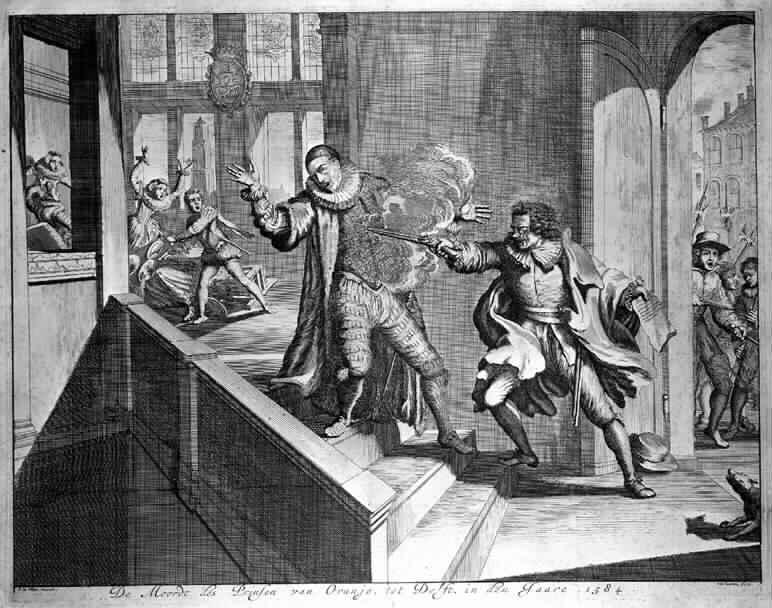
Instead, he bought a pair of pistols and, on 10 July, made history with a point-blank shot to William’s chest.


Detail view (click for the full image) of William the Silent’s 1585 assassination at the hands of Balthasar Gerard.

This assassination attempt didn’t fail. William became the second head of state to be killed by an assassin’s bullet,† — and his shooter the first such man to be juridically punished for the deed.

And, oh, how he was punished.

The regicide was beaten immediately after his capture, then subjected to a variety of cruelties, from wet leather boots which, when heated, both crushed and burned the feet, to daily floggings while hanging on a post outside the jail.

But on this day, his time of torture was up, and Gérard was finally put to death. You know, the usual:

It was decreed the right hand of Gerard should be burned off with a red-hot iron, that his flesh should be torn from his bones with pincers in six different places, that he should be quartered and disembowelled alive, that his heart should be torn from his bosom and flung in his face, and that, finally, his head should be taken off.


Gerard’s execution.

For all that he suffered as a regicide, Gérard left his family an impressive inheritance. Making good Parma’s assurances, King Phillip II gave them William’s former lands in three French provinces and took his siblings and their issue into his peerage.

Gérard’s cause carried on for another 60 years, until it was finally extinguished by the signing of the Peace of Münster by the Republic of the Seven United Netherlands and Spain.

* Foucault mistakenly identifies the torture as lasting 18 days, and the additional details he lays down for Gérard’s time on death row may be less-than-believable. However, all sources indicate that the tortures Gérard endured were quite spectacular, even by the standards of the day.

** See Dissident identities in the early modern Low Countries for a complete treatment of this period in The Netherlands and Belgium.

† For example, the city of Antwerp (Belgium), then under possession of the Spanish crown and considered the mercantile center of Europe for its vast sugar trade, featured over 100 executions for heresy from 1557-1562, twice as many as in all of Spain during that time.

‡ The first was James Stewart, 1st Earl of Moray, then Regent of Scotland. Stewart’s shooter, James Hamilton, escaped into exile, though others of the Hamilton clan answered for the murder.

On this day..

1644: Joost Schouten, LGBT VOC VIP

On this date in 1644, Joost Schouten, the able merchant and diplomat of the Dutch East India Company, “was strangled and burned to ashes in my presence in Batavia [Jakarta] because of his gruesome sodomy.”

That’s the report of Gijsbert Heeck who, like Scouten, left a noteworthy memoir. Heeck allowed that Schouten “was a man of unusual knowledge and extraordinary intellect,” but despite his gifts remained “in his heart … a hypocritical villain and seducer of many, secretly using his prominence and great authority to force them away from the path of decency into the way of his shameful foulness, seeking thereby to satisfy his devilish lechery.”

Before all that devilish lechery stuff came to light, Joost Schouten (English Wikipedia link | Dutch) had enjoyed a brilliant two-decade career in the Far East, most notably in Siam. There, Schouten ingratiated himself with the Siamese king Prasat Thong,* winning lucrative trade concessions, personal honors, and a seat for himself on the East India Company’s executive organ, the Council of the Indies.

A report that Schouten initially wrote for that company surveying Siam’s geography, people, and politics was published in 1638 and translated into many tongues: he was the first general account of Siam for Europeans. While several others would follow (pdf) in the 17th century, Schouten’s Description remains an essential source for the period.

Schouten himself was no mere observer in the ferocious scramble for colonial position and trade leverage in East Asia. It’s for this august person that the explorer Abel Tasman (as in Tasmania) named Schouten Island (off the coast of Tasmania). That was on the voyage that Tasman undertook to circumnavigate Australia, and discover (for Europeans) New Zealand — a voyage outfitted by Joost Schouten. Given another decade, with Dutch commerce on the come, who knows what heights he might have attained.

But the envoy’s scintillating service record did him little good when a handsome French halberdier repulsed by Schouten’s advances entrapped him in June 1644. This was an offense the Company took incredibly seriously.

Schouten confessed the crime voluntarily, and the only consideration the judges showed him was a pre-burning mercy strangulation. Their verdict, according to Peter Boomgaard, evinced “fear for the punishing hand of God if those who ruled did not take drastic measures.” Schouten was an educated man; indeed, he himself had been a judge. All the worse that, where he had wrought his best service for the Dutch Republic, he had also consciously invited its undoing in a hail of fire and brimstone.

One could, on the other hand, say that it was the Company itself that tempted divine wrath. After all, those in its service routinely spent months in overwhelmingly male environments: ships at sea, and trading outposts that were by now barred to European women. (Local women were a different story, of course.) Nor was Schouten’s particular stomping-grounds of Siam near as virulent in its attitude towards homoeroticism as the Calvinists back home; Schouten’s own travelogue noted that “their Priests, as well as many of the Gentry, are much given to Sodomy, that unnatural passion, being esteemed no sin, nor shameful thing amongst them.” Abroad on the blooming East, coinpurse bursting with the commerce of nations: it must have been a heady experience.

Whether coming around to the Siamese “esteem” or having nurtured it from the start, Schouten had, he said, indulged same-sex encounters** with some 19 different men since putting to sea from a return visit to the mother country in 1637. At least three of those partners — a boatswain’s mate, a soldier, and a burgher — were to their sorrow alive and conveniently identifiable in the Indies.

“Those who were known [to have taken part in his deeds] were, either with him, or later … smothered under water since they were unworthy to continue living among humans,” concluded our eyewitness Gijsbert Heeck. “Which is a fitting recompense and retribution for their gruesome life on earth. In the hereafter, however, the worst is still to come. But it is not for us to judge.”

* Prasat Thong, a law-and-order type, is alleged by the account of another 17th century Dutchman to have personally conducted some executions.

** Schouten, 40ish at his death, said that he was always the “passive” (penetrated) partner in these affairs with much younger men. (This, and all the text that follows it in the post, is also as per Boomgaard.)

On this day..

1771: Henry Stroud and Robert Campbell, for revenge

On this date in 1771, Henry Stroud and Robert Campbell were hanged at Bethnal Green Road — a pointed message to the Spitalfield working class.

Their hanging was tit for tat in an exchange of deadly violence between the state and laboring Londoners.

Two years before, an anti-union law making it a capital crime to cut silk out of looms had actually been put to use with the hanging of two as part of the suppression of a Spitalfields weavers riot.

This execution provoked in the following months a horrifying mob vengeance against the independent weaver who had testified — falsely, it was suspected — against those hanged men. When said informer, name of Daniel Clark, was recognized walking in the area one day, an angry crowd formed and “stript him, tied his hands behind him, took him to a pond, threw him in, and then threw stones and brickbats at him for some time; then took him out, tied a cord round his neck, and threw him in the pond again, and then threw stones and brickbats at him till they beat out his brains.”*

Snitches get … brickbats.

Justice David Wilmot** determined to hunt out some of this lynch mob he could make an example of, not disdaining to resort to arm-twisting and witness-buying.† Wilmot’s advertisement for leads drew anonymous threats, which the justice scornfully published in newspapers to up the ante.

The writers of these letters … [are] pursuing with insatiable & heart felt revenge, their designs against you should any one person suffer from your busy concern. & know farther that having such connections at all your haunts, and free access at most time to your person, ’til not the whole third regiment of guards that can protect you from the well concerted plan for your destruction.

The result was a chaotic five-day trial, at which witnesses openly flinched at the prospect of popular vengeance waiting outside the Old Bailey doors.

Henry Stroud, nevertheless, was identified by several witnesses as having taken a prominent part in visiting popular justice upon Clark, in the form of two or three hurled bricks that knocked the victim down — while Robert Campbell was reputed to have thrust the bloodied Clark’s head into the pool.

They were pointedly put to death behind a heavily armed cordon near the very spot of the homicide. Stroud, at least, went to his death still vigorously protesting his innocence.‡

“Thus did the alternating pageants of ritual murder come to an end,” writes Peter Linebaugh of this exclamatory execution in The London Hanged. “A hundred bayonets from the War Office protecting the hangman and the magistrates. The scapegoating of the class antagonism concluded with this powerful, official display of power in the streets, where usually the trill of [weaving] shuttles would fill the air.”

* Quoted in Norma Landau’s “Gauging crime in late Eighteenth Century London,” Social History, 35:4.

** Not to be confused with Justice Wilmot, then the sitting Chief Justice of the Common Pleas. Justice David Wilmot’s credentials from this affair and otherwise established him as a hated enemy of the London working class, and consequently his home was torched during the proletarian Gordon Riots.

† viz., testimony of one witness among the several in the Old Bailey transcript who openly discuss payola: “another gentleman offered me fourscore pounds; a gentleman that brought me the summons; he said, you know one Bob Campbell; I said, I did not by name; he said, he would give me fourscore pounds; I was frightened, he said, I see you are a stranger; if you will but swear to the man I will give you fourscore pounds.”

‡ After the days-long prosecution, Stroud’s entire defense case ran two sentences: “I am as innocent of the affair as ever was a child in the world. I neither handled brick, stone, tile, nor anything, so help me God.”

On this day..

1584: Anna Peihelsteinin, beheaded by Franz Schmidt

On this date in 1584, Nuremberg executioner Franz Schmidt beheaded Anna Peihelsteinin (Peyelstainin) for “lewdness and harlotry.” (Despite the image above, Schmidt notes that she was beheaded standing, not sitting.)

The married woman had been intimate with 21 other men, even including a father and a son. But Anna’s own husband was more understanding of her than the cruel law of the time; as the executioner recorded in his diary, the lonely widower Jerome — whipped out of town for countenancing her whoredom — left behind a miserable reproach scrawled on the wall of a church:

Father and son should have been treated as she was, and the panderers also. In the other world I shall summon and appeal to emperor and king because justice has not been done. I, poor man, suffer though innocent. Farewell and good night.

On this day..

1631: Giles Broadway and Lawrence Fitzpatrick, for consistency

On this date in 1631, Giles Broadway and Lawrence Fitzpatrick hanged at Tyburn.

Although the evidence against them was extremely questionable, their trial just nine days prior could hardly have turned out otherwise, for these men were the servants implicated in conniving with the Earl of Castlehaven in the scandalous debauch of his household.

This notorious case had that May resulted in Castlehaven’s execution (wonderfully guest-blogged in these pages by Courtney Thomas). The Earl appears to have run his household as a veritable den of sexual iniquity, but the actual facts upon which a capital conviction had been secured were sketchy and subject to no little public controversy. Castlehaven himself declared on the scaffold that he was a victim of a conspiracy by other members of his family to lay hands on his inheritance.

Manservants

Crucial to the Earl’s condemnation was the testimony of the servants Giles Broadway and Lawrence Fitzpatrick. Broadway owned, under pressure, that he had raped Castlehaven’s wife at the Earl’s direction. Fitzpatrick copped to having sexual relations with the Earl — but crucially claimed that those acts had not entailed actual penetration.

The whole scandal inspired no end of bodice-ripping broadsides and warring doggerel arguing the Earl’s perspective or his wife’s. Crude as this one is, it gets at the key legal issues at stake in the trial — to wit, whether the actual acts that took place in Castlehaven’s Sodom met the legal definition of buggery or of rape:

The prisoner nowe
had leave to shewe
concerninge the rape of his wife

How that hee did it not
but conceived it a plott
to take away him and his Life

But alas twas in vayne
himselfe for to straine
since the Judges delivered it Plano

that to knowe by the tuch
was eaven just as much
as if it had beene in Ano

Its thought their trunke hose
did alsoe suppose
that in concubilu cum faeminis

ther might bee a rape
if lust made an escape
per ejectionem seminis

Book CoverGiven that the court had found the ejectionem seminis here sufficient to lop off the head of a peer of the realm, the man’s low-born servants could hardly be acquitted in the same matter without undermining the verdict’s already tenuous public confidence. As the judges in the servants’ case put it, “We for our parts thought it to stand with the honor of common justice, that seeing their testimony had been taken to bring a peer of the realm to his death, for an offense as much theirs as his, that they should as well suffer for it as he did, lest any jealousy should arise about the truth of the fact, and the justness of the proceedings.” (Quoted in A House in Gross Disorder: Sex, Law, and the 2nd Earl of Castlehaven, a recent book on the scandal.)

Law Orifices

Broadway was the easier condemnation.

Desperately, he tried insisting that his “rape” of the Countess had not achieved actual penetration: the scare quotes here because the boundaries of a body constituted the bright line establishing whether the capital crime of rape had been committed. (Compare for instance this close call from the 18th century.) As the poem implies, Broadway suggested that he suffered premature ejaculation before he crossed the coital, and legal, threshold.

This circumstance required the victim to testify against him. Anne Stanley, fruit of an ancient and powerful family — she had once upon a time had a case as the heir to the throne of England — therefore had to present herself to attest that this mean person “had known her carnally, and that he did enter her body” while her late beheaded husband sadistically held her down. In court she could not bear to look at Broadway, she said, “but with a kind of indignation, and with shame, in regard of that which had been offered unto her, and she suffered by him.”

Fitzpatrick was a tougher trick.

Castlehaven himself had only been convicted by a bare majority on the sodomy charges, and that only by the dubious expedient of expanding the reading of the sodomy statute to compass all same-sex contact: previously, as with rape, penetration had been understood to constitute the crime.

When it came to Fitzpatrick’s trial, he argued vehemently that he could not be made his own accuser. Moreover, as he said in his dying address at the scaffold, “my lord Dorset had entrapped and ensnared him to his destruction; for saying upon his honour, and speaking it in the plural number (as the mouth of the whole [Privy Council]) that whatsoever he delivered should no ways prejudice himself, he thereby got him to declare the earl guilty of the sin of Buggery; wherein himself being a party, was the only cause he came now to suffer death.” That’s a right dirty trick, just another one of many compelling reasons never to talk to cops.

Broadway, for his part, charged under the gallows that his victim Anne Stanley — who remained in the twisted marriage for five-plus years despite having the means to escape it — was herself a principal despoiler of the household’s virtue, “the wickedest woman in the world.” Two other servants, he said, “lay with her commonly,” and one of them had “gotten a child upon her, which she, like a wicked woman, had made away,” leading that vengeful servant to rape at the Earl’s instigation Anne’s 12-year-old daughter by her previous marriage — for which purpose the Earl himself had to apply “oil to open her body.” Home sweet home.

(Young Elizabeth Barnham was dynastically married to her stepbrother James, who himself initiated the complaint against his father. Castlehaven appears to have hated his own son, and the son feared that the Earl’s largesse with his favorites and his apparent attempt to have his servant father on Elizabeth an heir that was not of the family’s own blood would destroy the Touchets. Castlehaven was not indicted on this specifically and the other charges against him were sufficient to the purpose. But it was surely a sensitive offense for his fellow-bluebloods. In his exhortation to the condemned Castlehaven, the Lord Steward scarcely mentioned the rape and sodomy stuff. “Although you die not for that,” he intoned, “you have abused your own daughter! And having both honour and fortune to leave behind you, you would have had the impious and spurious offspring of a harlot to inherit!” This quote, like all the quotes from the trials and scaffold, can be found here; this volume, however, proposes not “harlot” but the seemingly more suitable word varlet.)

On this day..

1655: Grete Adrian, Ruethen witch

On this date in 1655, Grete Adrian heard her final condemnation as a witch, then was ushered to the marketplace of Ruethen where she was beheaded and burned.

A remarried widow, Grete was the daughter of a woman who in her own day had been suspected of witchcraft; Grete had lost siblings to witch-hunts during the recent Thirty Years War.

The family history with devilry would help to implicate her when allegations arose that she had produced milk by conjuration and turned into a wolf to kill a neighbor’s horse. Grete didn’t stand up to the torture very long; within a couple of days she agreed that she had taken the devil as a lover, cast malevolent spells, attended witches’ covens, and all the usual Hexenprozesse stuff. All she asked was for quick execution.

In 2011, schoolchildren from Ruethen’s Friedrich-Spee-School — its namesake was a noted critic of torture and witch trials in the 17th century — successfully petitioned local authorities to issue a blanket posthumous pardon for 169 men, women and children executed for witchcraft between 1573 and 1660 … Grete Adrian included.

On this day..