1868: Michael Barrett, the last public hanging in England

England held its last-ever public execution on this date in 1868, and made it big game indeed: Fenian Michael Barrett, whose Clerkenwell Prison bombing long remained one of the most infamous atrocities of the Irish nationalist cause.

The bill certifying the end of that distinctive institution, the public hanging, would be finalized three days hence, so the occasion’s milestone was anticipated in advance. Elites increasingly disdained the boorish carnivals that unfolded under the gallows, like Dickens who complained that “no sorrow, no salutary terror, no abhorrence, no seriousness; nothing but ribaldry, debauchery, levity, drunkenness, and flaunting vice in fifty other shapes” redeemed the 1840 hanging of Courvoisier.


“The Great Moral Lesson at Horsemonger Lane Gaol”, Punch magazine’s view of the notoriously rowdy mob at Frederick and Marie Manning execution.

“The crowd was most unusually orderly,” ran the Times‘ report of Barrett’s death — a sort of dual eulogy — “but it was not a crowd in which one would like to trust.”

It is said that one sees on the road to the Derby such animals as are never seen elsewhere; so on an execution morning one see faces that are never seen save round the gallows or near a great fire. Some laughed, some fought, some preached, some gave tracts, and some sang hymns; but what may be called the general good-humoured disorder of the crowd remained the same, and there was laughter at the preacher or silence when an open robbery was going on. None could look on the scene, with all its exceptional quietness, without a thankful feeling that this was to be the last public execution in England. Towards 7 o’clock the mass of people was immense. A very wide open space was kept round the gallows by the police, but beyond this the concourse was dense, stretching up beyond St. Sepulchre’s Church, and far back almost, into Smithfield — a great surging mass of people which, in spite of the barriers, kept swaying to and from like waving corn. Now and then there was a great laughter as a girl fainted, and was passed out hand over hand above the heads of the mob, and then there came a scuffle and a fight, and then a hymn, and then a sermon, and then a comic song, and so on from hour to hour, the crowd thickening as the day brightened, and the sun shone out with such a glare as to extinguish the very feeble light which showed itself faintly through the glass roof above where the culprit lay. It was a wild, rough crowd, not so numerous nor nearly so violent as that which thronged to see Muller or the pirates die. In one way they showed their feeling by loudly hooting a magnificently-attired woman, who, accompanied by two gentlemen, swept down the avenue kept open by the police, and occupied a window afterwards right in front of the gallows. This temporary exhibition of feeling was, however, soon allayed by coppers being thrown from the window for the roughs to scramble for. It is not right, perhaps, that a murderer’s death should be surrounded by all the pious and tender accessories which accompany the departure of a good man to a better world, but most assuredly the sight of public executions to those who have to witness them is as disgusting as it must be demoralizing even to all the hordes of thieves and prostitutes it draws together. Yesterday the assembly was of its kind an orderly one, yet it was such as we feel grateful to think will under the new law never be drawn together again in England.

Michael Barrett’s ticket to this last assembly was punched by a different execution six months previous — the hanging of the Manchester Martyrs. This trio of Irish patriots were part of a mob who liberated some comrades from a police van, shooting a policeman in the process — though it was far from certain that any of these three actually fired shots.

Of importance for our purposes today was the crackdown on other Fenians occasioned by the Manchester affair. In November of 1867, a Fenian agent named Richard O’Sullivan Burke was arrested with his companion Joseph Casey in London purchasing weapons for the movement. They were clapped in Clerkenwell Prison pending trial.

The bombing that brought Michael Barrett to the gallows was a bid to liberate these men … and it did not pause for subtlety. The conspirators simply wheeled a barrel of gunpowder up to the wall of the facility when they expected the inmates to be at exercise in the adjacent yard. The explosion blasted a 60-foot gap in the wall; the inward-collapsing rubble might easily have been the death rather than the salvation of the prospective beneficiaries, except that they weren’t actually in the yard at all — nobody was there, and nobody escaped Clerkenwell.

But numerous working-class families lived in little tenements opposite the prison and were there, and in fact Clerkenwell had a reputation for political radicalism and Fenian sympathy. This monstrous new “infernal machine” tore through Clerkenwell homes, leaving 12 people dead and numerous buildings near to collapse, while windows and chimneys shivered to pieces all up and down the block.


Improvised struts shore up damaged buildings opposite the wall of Clerkenwell Prison reduced to rubble by the December 13, 1867 Fenian bombing.

Karl Marx, a strong supporter of the Irish cause, despaired this counterproductive turn towards terrorism: “The London masses, who have shown great sympathy towards Ireland, will be made wild and driven into the arms of a reactionary government. One cannot expect the London proletarians to allow themselves to be blown up in honour of Fenian emissaries.”

English reformer Charles Bradlaugh agreed. “The worst enemy of the Irish people could not have devised a scheme better calculated to destroy all sympathy,” he wrote.


Punch magazine depicts the Clerkenwell bomber(s) as the “Fenian Guy Fawkes“.

Considering the magnitude of the crime, someone would have to pay for it. That Barrett was that someone did not sit well for many.

Five men and a woman stood trial at the Old Bailey in April for the Clerkenwell outrage, but Barrett was the only one of them convicted, a terribly inadequate investigation/prosecution outcome given the infamy of the crime.

That conviction stood on the basis of disputed eyewitness identifications: Barrett produced witnesses who said he was in Glasgow when the bomb went off, while the crown found others who would swear he was actually in London. (The length of Barrett’s whiskers on specific dates in late November and early December forms a running subplot of the dueling testimonies.)

The reliability and even the good faith of all such winesses might well be impugned. A highly questionable stool pigeon named Patrick Mullany who ducked prosecution by turning crown’s evidence, charged that Barrett personally set off the ordnance.

Despite his certain doom, Barrett eloquently vindicated himself at his sentencing

To give me credit for such an undertaking is utterly absurd; being, as I am, a total stranger to acts of daring, and without any experience which would in any way fit me for engaging in such an enterprise. Is it not ridiculous to suppose that in the City of London, where … there are ten thousand armed Fenians, they would have sent to Glasgow for a party to do this work, and then select a person of no higher standing and no greater abilities than the humble individual who now stands convicted before you? To suppose such a thing is a stretch of imagination that the disordered minds of the frightened officials of this country could alone be capable of entertaining.

If it is murder to love Ireland more dearly than life, then indeed I am a murderer. If I could in any way remove the miseries or redress the grievances of that land by the sacrifice of my own life I would willingly, nay, gladly, do so. if it should please the God of Justice to turn to some account, for the benefit of my suffering country, the sacrifice of my poor, worthless life, I could, by the grace of God, ascend the scaffold with firmness, strengthened by the consoling reflection that the stain of murder did not rest upon me, and mingling my prayers for the salvation of my immortal soul with those for the regeneration of my native land.

Benjamin Disraeli’s government could not in the end realistically entertain the agitation from liberal and radical circles for sparing Barrett, because that would mean that nobody would hang for Clerkenwell. But as the next day’s edition of Reynold’s News noted, “Millions will continue to doubt that a guilty man has been hanged at all; and the future historian of the Fenian panic may declare that Michael Barrett was sacrificed to the exigencies of the police, and the vindication of the good Tory principle, that there is nothing like blood.”

Three months after Barrett made that expiation, England officially began its era of fully private hangings behind prison walls.

* James Joyce hung out with a (much-older) Joseph Casey in Paris in the early 20th century. Yes, that’s in Ulysses too: “He prowled with Colonel Richard Burk, tanist of his sept, under the walls of Clerkenwell and crouching saw a flame of vengeance hurl them upward in the fog. Shattered glass and toppling masonry. In gay Paree he hides, Egan of Paris, unsought by any save by me.”

Part of the Themed Set: Terrorism.

On this day..

1865: Stanislaw Brzoska, Polish patriot priest

Freedom-fighting Polish priest Stanislaw Brzoska was hanged in the marketplace of Sokolow Podlaski on this date in 1865.

A young firebrand who had already served time in a Russian fortress because of his nationalist harangues, Brzoska (English Wikipedia entry | Polish) put his faith into deeds with the 1863 January Uprising against Russia’s domination of what was once the Polish-Lithuanian Empire.

He fought in several battles, and a 40-man mounted unit he had personally raised was in the field until the end of 1864 — well after Russia had quelled most other resistance.

Finally cornered in April 1865 and captured in a gunfight, he was executed before a crowd of thousands. Later generations, with an independent Poland to call their own, have garlanded Brzoska’s memory with various markers and statues.

Polish speakers might enjoy this presentation of the hero-priest’s life:

On this day..

1799: Simon Taylor, for indulging in drunkenness

From the public-domain An Account of the English Colony in New
South Wales From Its First Settlement, in January 1788, to August 1801
(pdf):


April 1799

On the first of this month the criminal court sat for the trial of a soldier belonging to the regiment, who had a few days before stabbed a seaman of the Reliance, who insulted him when centinel at one of the wharfs at Sydney. The man died of the wound; the soldier, being called upon to answer for his death, proved to the satisfaction of the court, that it had been occasioned by the intemperance of the seaman, and he was accordingly found to have committed a justifiable homicide.

This accident was the effect of intoxication, to which a few days after another victim was added, in the person of a female, who was either the wife or companion of Simon Taylor, a man who had been considered as one of the few industrious settlers which the colony could boast of. They had both been drinking together to a great excess; and in that state they quarrelled, when the unhappy man, in a fit of madness and desperation, put an untimely end to her existence. He was immediately taken into custody, and reserved for trial.

To this pernicious practice of drinking to excess, more of the crimes which disgraced the colony were to be ascribed than to any other cause; and more lives were lost through this than through any other circumstance; for the settlement had ever been free from epidemical or fatal diseases. How much then was the importation of spirits to be lamented! How much was it to be regretted, that it had become the interest of any set of people to vend them!

Several robberies which at this time had been committed were to be imputed to the same source.

May 1799

Several offenders having been secured for trial, it became necessary to assemble the court of criminal judicature; and on the 16th Simon Taylor was brought before it, accused of the murder of his wife [Ann Smith was her name -ed.]; of which offence being clearly convicted, he received sentence of death, and was executed on the 20th at Parramatta. This unhappy man was thoroughly sensible of the enormity of his guilt, and in his last moments admonished the spectators against indulging in drunkenness, which had brought him to that untimely and disgraceful end.

At the same court, one man, Robert Lowe, was adjudged corporal punishment, and one year’s hard labour, for embezzling some of the live stock of Government, which had been entrusted to his care. He was a free man, and had been one of the convicts who were with Captain Riou in the Guardian, when her voyage to New South Wales was unfortunately frustrated by her striking upon an island of ice; on account of which, and of their good conduct before and after the accident, directions had been given for their receiving conditional emancipation, and being allowed to provide for their own maintenance.

Few of these people, however, were in the end found to merit this reward and indulgence, as their future conduct had proved; and this last act of delinquency pointed out the necessity of a free person being sent out from England to superintend the public live stock, with such an allowance as would make him at once careful of his conduct, and faithful in the execution of his trust.

It should seem that the commission of crimes was never to cease in this settlement. Scarcely had the last court of judicature sent one man to the gallows, when a highway robbery was committed between the town of Sydney and Parramatta. Three men rushed from an adjoining wood, and, knocking down a young man who was travelling to the last mentioned town, rifled his pockets of a few dollars. On his recovering, finding that only one man remained, who was endeavouring to twist his handkerchief from his neck, he swore that no one person should plunder him, and had a struggle with this fellow, who, not being the strongest of the two, was secured and taken into Parramatta. A court was immediately assembled for his trial; but the evidence was not thought sufficient to convict him, and he was consequently acquitted. The want of any corroborating circumstance on the part of the prosecutor compelled the court to this acquittal.

On this day..

1616: Margaret Vincent, “Pitilesse Mother”


(Via)

A pitiless mother, that most unnaturally at one time murdered two of her own children, at Acton within six miles from London, upon Holy Thursday last 1616, the ninth of May. Being a gentlewoman named Margaret Vincent, wife of Mr. Jarvis Vincent of the same town. With her examination, confession and true discovery of all proceedings in the said bloody accident.

How easy are the ways unto evil, and how soon are our minds (by the Devil’s enticement) withdrawn from goodness. Leviathan, the archenemy of mankind, hath set such and so many bewitching snares to entrap us that unless we continually stand watching with careful diligence to shun them, we are like to cast the principal substance of our reputation upon the rack of his ensnaring engines. As for example, a gentlewoman, ere now fresh in memory, presents her own ruin amongst us, whose life’s overthrow may well serve for a clear looking-glass to see a woman’s weakness in, how soon and apt she is won unto wickedness, not only to the body’s overthrow but the soul’s danger. God of his mercy keep us all from the like wilfulness.

At Acton, some six miles westward from London, this unfortunate gentlewoman dwelled, named Margaret Vincent, the wife of Mr. Jarvis Vincent, gentleman, who by unhappy destiny marked to mischance I here now make the subject of my pen and publish her hard hap unto the world, that all others may shun the like occasions by which she was overthrown.

This Margaret Vincent before named, of good parentage, born in the county of Hertford at a town named Rickmansworth, her name from her parents Margaret Day, of good education, graced with good parts from her youth that promised succeeding virtues in her age, if good luck had served. For being discreet, civil, and of modest conversation, she was preferred in marriage to this gentleman Master Vincent, with whom she lived in good estimation, well beloved and much esteemed of all that knew her for her modesty and seemly carriage. And so might have continued to her old age, had not this bloody accident committed upon her own children blemished the glory of the same.

But now mark (gentle reader) the first entrance into her life’s overthrow, and consider with thyself how strangely the Devil here set in his foot and what cunning instruments he used in his assailments. The gentlewoman being witty and of a ripe understanding desired much conference in religion, and being careful, as it seemed, of her soul’s happiness, many times resorted to divines to have instructions to salvation, little thinking to fall into the hands of Roman wolves (as she did) and to have the sweet lamb, her soul, thus entangled by their persuasions.

Twelve or fourteen years had she lived in marriage with her husband well beloved, having for their comforts diverse pretty children between them with all other things in plenty, as health, riches, and such like, to increase concord and no necessity that might be hindrance to contentment. Yet at last there was such traps and engines set that her quet was caught and her discontent set at liberty. Her opinion of the true faith (by the subtle sophistry of some close Papists) was converted to a blind belief of bewitching heresy. For they have such charming persuasions that hardly the female kind can escape their enticements, of which weak sex they continually make prize of and by them lay plots to ensnare others, as they did by this deceived gentlewoman. For she, good soul, being made a bird of their own feather, desired to beget more of the same kind and from time to time made persuasive arguments to win her husband to the same opinion, and deemed it a meritorious deed to charge his conscience with that infectious burden of Romish opinions, affirming by many false reasons that his former life had been led in blindness, and that she was appointed by the Holy Church to shew him the light of true understanding. These and such like were the instructions she had given her to entangle her husband in and win him if she might to their blind heresies.

But he, good gentleman, over-deeply grounded in the right faith of religion than to be thus so easily removed, grew regardless of her persuasions, accounting them vain and frivolous, and she undutiful to make so fond an attempt, many times snubbing her with some few unkind speeches, which bred in her heart a purpose of more extremity. For having learned this maxim of their religion that it was meritorious, yea, and pardonable, to take away the lives of any opposing Protestants were it of any degree whatsoever, in which resolution or bloody purpose she long stood upon and at last (only by the Devil’s temptation) resolved the ruin of her own children, affirming to her conscience these reasons: that they were brought up in blindness and darksome errors, hoodwinked (by her husband’s instructions) from the true light, and therefore to save their soul (as she vainly thought) she purposed to become a tigerous mother, and so wolfishly to commit the murder of her own flesh and blood. In which opinion she steadfastly continued, never relenting according to nature but casting about to find time and place for so wicked a deed, which unhappily fell out as after followed.

It so chanced that a discord arose between the two towns of Acton and Willesden about a certain common bordering between them, where the town of Acton, as it seems, having the more right unto it, by watching defended it a time from the other’s cattle. whereupon the women of the same town, having likewise a willingness to assist their husbands in the same defence, appointed a day for the like purpose, which was the Ascension Day last past, commonly called Holy Thursday, falling upon the 9th of the last past month of May. Which day (as ill chance would have it) was the fatal time appointed for her to act this bloody tragedy, whereon she made her husband fatherless of two as pretty children as ever came from woman’s womb.

Upon the Ascension Day aforesaid, after the time of divine service, the women of the town being gathered together about their promised business, some of them came to Mistress Vincent and according to promise desired her company. Who having a mind as then more settled on bloody purposes than country occasions, feigned an excuse of ill at ease and not half well, desired pardon of them, and offering her maid in her behalf, who being a good, apt, and willing servant was accepted of, and so the townswomen, misdoubting no such hard accident as after happened, proceeded in their aforesaid defences. The gentlewoman’s husband being also from home, in whose absence, by the fury and assistance of the Devil, she enacted this woeful accident in form and manner following.

This Mistress Vincent, now deserving no name of gentlewoman, being in her own house fast locked up only with her two small children, the one of the age of five years, the other hardly two years old, unhappily brought to that age to be made away by their own mother, who by nature should have cherished them with her own body, as the pelican that pecks her own breast to feed her young ones with her blood. But she, more cruel than the viper, the envenomed serpent, the snake, or any beast whatsoever, against all kind, takes away those lives to whom she first gave life.

Being alone (as I said before) assisted by the Devil, she took the youngest of the two, having a countenance so sweet that might have begged mercy at a tyrant’s hand, but she regarding neither the pretty smiles it made nor the dadling before the mother’s face, nor anything it could do, but like a fierce and bloody Medea she took it violently by the throat, and with a garter taken from her leg, making thereof a noose and putting the same about her child’s sweet neck, she in a wrathful manner drew the same so close together that in a moment she parted the soul and body. Without any terror of conscience she laid the lifeless infant, still remaining warm, upon her bed and with a relentless countenance looking thereon, thinking thereby she had done a deed of immortality. Oh, blinded ignorance! Oh, inhumane devotion! Purposing by this to merit Heaven, she hath deserved (without true repentance) the reward of damnation.

This creature not deserving mother’s name, as I said before, not yet glutted nor sufficed with these few drops of innocent blood, nay, her own dear blood bred in her own body, cherished in her own womb with much dearness full forty weeks. Not satisfied, I say, with this one murder but she would headlong run unto a second and to heap more vengeance upon her head. She came unto the elder child of that small age that it could hardly discern a mother’s cruelty nor understand the fatal destiny fallen upon the other before, which as it were seemed to smile upon her as though it begged for pity, but all in vain, for so tyrannous was her heart that without all motherly pity she made it drink of the same bitter cup as she had done the other. For with her garter she likewise pressed out the sweet air of life and laid it by the other upon the bed sleeping in death together, a sight that might have burst an iron heart asunder and made the very tiger to relent.

These two pretty children being thus murdered, without all hope of recovery, she began to grow desperate and still to desire more and more blood, which had been a third murder of her own babes, had it not been abroad at nurse and by that means could not be accomplished. Whereupon she fell into a violent rage, purposing as then to shew the like mischief upon herself, being of this strange opinion that she herself by that deed had made saints of her two children in Heaven. So taking the same garter that was the instrument of their deaths and putting the noose thereof about her own neck, she strove therewith to have strangled herself. But nature being weak and flesh frail, she was not able to do it. Whereupon in a more violent fury (still animated foreward by instigation of the Devil) she ran into the yard purposing there in a pond to have drowned herself, having not one good motion of salvation left within her.

But here, good reader, mark what a happy prevention chanced to preserve her in hope of repentance, which at that time stayed her from that desperate attempt. The maid, by great fortune, at the very instant of this deed of desperation returned from the field or common where she had left most of the neighbours. And coming in at the backside, perceiving her mistress by her ghastly countenance that all was not well and that some hard chance had happened her or hers, demanded how the children did.

“Oh Nan,” quoth she, “never, oh never, shalt thou see thy Tom more,” and withal gave the maid a box upon the ear. At which she laid hold upon her mistress, calling out for help into the town. whereat diverse came running in and after them her husband, within a while after, who finding what had happened were all so amazed together that they knew not what to do. some wrung their hands, some wept, some called out for neighbours; so general a fear was struck amongst them all that they knew not whether to go nor run.

Especially the good gentleman her husband, that seeing his own children slain, murdered by his wife and their own mother, a deed beyond nature and humanity, in which ecstasy of grief at last he broke out in these speeches: “Oh Margaret, Margaret, how often have I persuaded thee from this damned opinion, this damned opinion that hath undone us all.”

Whereupon with a ghastly look and fearful eye she replied thus, “Oh Jarvis, this had never been done if thou hadst been ruled and by me converted. But what is done is past, for they are saints in Heaven, and I nothing at all repent it.”

These and such like words passed betwixt them till such time as the constable and others of the townsmen came in and according to law carried her before a justice of the peace, which is a gentleman named Master Roberts of Willesden, who, understanding these heinous offences, rightly according to law and course of justice made a mittimus for her conveyance to Newgate in London, there to remain till the Sessions of her trial. Yet this is to be remembered that by examination she voluntarily confessed the fact how she murdered them to save their souls and to make them saints in Heaven, that they might not be brought up in blindness to their own damnation. Oh, wilful heresy, that ever Christian should in conscience be thus miscarried. But to be short, she proved herself to be an obstinate papist, for there was found about her neck a crucifix with other relics which she then wore about her, that by the justice was commanded to be taken away and an English Bible to be delivered her to read, the which she with great stubbornness threw from her, not willing as once to look thereupon, nor to hear any divine comforts delivered thereout for the succour of her soul.

But now again to her conveyance towards prison. It being Ascension Day and near the closing of the evening, too late as then to be sent to London she was by commandment put to the constable’s keeping for that night, who with a strong watch lodged her in his own house till morning, which was at the Bell in Acton where he dwelled. Shewing the part and duty of a good Christian, with diverse other of his neighbours, all that same night they plied her with good admonitions, tending to repentance, and seeking with great pains to convert her from those erroneous opinions which she so stubbornly stood in. But it little availed, for she seemed in outward shew so obstinate in arguments that she made small reckoning of repentance, nor was a whit sorrowful for the murder committed upon her children but maintained the deed to be meritorious and of high desert.

Oh, that the blood of her own body should have no more power to pierce remorse into her iron natured heart, when pagan women that know not God nor have any feeling of his deity will shun to commit bloodshed, much more of their own seed. The cannibals that eat one another will spare the fruits of their own bodies; the savages will do the like; yea, every beast and fowl hath a feeling of nature, and according to kind will cherish their young ones. And shall woman, nay, a Christian woman, God’s own image, be more unnatural than pagan, cannibal, savage, beast, or fowl? It even now makes a trembling fear to best me to think what an error this unhappy gentlewoman was bewitched with, a witchcraft begot by Hell and nursed by the Romish sect, from which enchantment God of Heaven defend us.

But now again to our purpose. The next day being Friday and the tenth of May, by the Constable Master Dighton of the Bell in Acton, with other of his neighbours, she was conveyed to Newgate in London. Where lodging, in the master’s side, many people resorted to her, as well of her acquaintance as others and as before, with sweet and comfortable persuasions practised to beget repentance and to be sorry for that which she had committed. But blindness so prevailed that she continued still in her former stubbornness, affirming (contrary to all persuasive reasons) that she had done a deed of charity in making them saints in Heaven that otherwise might have lived to destruction in Hell, and likewise refused to look upon any Protestant book as Bible, meditation, prayer book, and such like, affirming them to be erroneous and dangerous for any Romish Catholic to look in. Such were the violent opinions she had been instructed in, and with such fervencies therein she continued that no dissuasions could withdraw her from them, no, not death itself, being here possessed with such bewitching wilfulness.

In this danger of mind continued she all Friday, Saturday, and Sunday. The Sessions drawing near, there came certain godly preachers unto her, who prevailed with her by celestial consolations, that her heart by degrees became a little mollified and in nature somewhat repentant for these her most heinous offences. Her soul, a little leaning to salvation, encouraged these good men to persevere and go forward in so godly a labour, who at last brought her to this opinion, as it was justified by one that came from her in Newgate upon the Monday before the Sessions: that she earnestly believed she had eternally deserved hellfire for the murder of her children, and that she so earnestly repented the deed, saying that if they were alive again not all the world should procure her to do it. Thus was she truly repentant, to which (no doubt) but by the good means of these preachers she was wrought unto.

And now to come to a conclusion, as well of the discourse as of her life, she deserved death, and both law and justice hath awarded her the same. For her examination and free confession needed no jury: her own tongue proved a sufficient evidence, and her conscience a witness that condemned her. Her judgment and execution she received with a patient mind, her soul no doubt hath got a true penitent desire to be in Heaven, and the blood of her two innocent children so wilfully shed (according to all charitable judgements) is washed away by the mercies of God. Forgive and forget her, good gentlewomen. She is not the first that hath been blemished with blood nor the last that will make a husband wifeless. Her offence was begot by a strange occasion but buried, I hope, with true repentance.

Thus, countrymen of England, have you heard the ruin of a gentlewoman who, if Popish persuasions had not been, the world could not have spotted her with the smallest mark of infamy but had carried the name of virtue even unto her grave. And for a warning unto you all, by her example, take heed how you put confidence unto that dangerous sect, for they surely will deceive you.

On this day..

1746: Three Catholic servants

All stories from issues of the Maryland Gazette, datelined Annapolis. (via) Though not explicit in any of these stories, the attack by Catholic servants upon their master while the Jacobite rising was still afoot must have been read by Maryland’s grandees as more menacing than your everyday domestic crime.


Tuesday, April 22, 1746

The following Particulars of the murder of Richard Waters, in Kent Co., on the 5th inst., having been transmitted to us, are here inserted:

About two months ago Hector Grant, a Highland Papist, and James Horney, an Irish one, both Servants to Mr. Waters, communicated to a West Co. convict woman (servant to Mr. Waters, and of the same communion with the other two), and an orphan apprentice girl, their intention to murder their Master; to which the women agreeing, they all swore on a Bible not to make any discovery.

Having been several Times disappointed in their Design to way-lay him on the Road, in order to perpetrate their Villainy, it happened that on Saturday the 5th Instant, Mr. Waters being at a Muster, and having drank too freely; he was conducted home by two of his Neighbours, who had put him to Bed, and left him about an Hour within the Night: When the Woman, having put his two Children to Bed with him, persuaded the Orphan Girl to go over with her to a Neighbour’s.

In the meantime the two Men murder’d the poor Man, overcome with Liquor and Sleep, by giving him a desperate Blow on the Head with an Axe; after which they dragg’d him out of Bed upon the Floor, repeating their Blows, tho’ any one of them would have proved mortal: The Children sleeping sound all the While; it is thought prevented their undergoing the same Fate; tho’ the Highlander proposed setting the House on fire, and burning the Children therein.

The Girls returning, found the Fellows rejoicing in their Villany, who then put the Deceased’s Cloaths on him, and throwing his Body across a Horse carried it to a Branch about half a Mile from the House, and there buried it; They afterwards burnt the bloody Sheets, clean’d away the Blood, and the next Morning gave out, that their Master set out for Annapolis by Day-break. Nobody had any Suspicion of what had been transacted ’til about the Middle of the Week, when one of the Deceased’s Shoes and Buckles were found; and their carousing, buying Rum, and idling about, and the Horse’s being seen at home, gave the Neigbours reason to suspect the Matter; whereupon the Men were apprehended, and a bloody Shirt found, but no further Discovery made ’til Sunday; when the Orphan Girl, after she had at a solemn Examination denied she knew anything of the Fact, privately confess’d that she had been sworn to the Secresy: On being told that her Oath, being extorted by the Fellows, could not be binding, she related all she knew of it.

The same Evening, the Irishman, finding the Girl had made a Discovery, confess’d every Circumstance told; as also where the body was buried, and where he had concealed his Master’s Watch, Ring, Clasps, &c. which were all accordingly found. The two Men and the Woman, were brought in, by the Coroner’s Inquest, guilty of Wilful Murder.

The Highlander received the Sacrament at Mass, the Sunday before this tragic scene was executed; and, notwithstanding his most obstinate denial of knowing anything of the fact, appears to have been the first proposer and principal actor in this tragedy.


Tuesday, May 6, 1746

Friday last was held, at Chester in Kenty County, a Special Court of Oyer and Terminer, for trying the Murderers of Richard Waters; when the two Men and the Woman were found guilty of the Indictment, and received Sentence of Death; Grant and Horney are to hang’d and the Woman (Esther Anderson is to be burnt.)


Tuesday, May 20, 1746

On Friday last, Hector Grant, James Horney, and Esther Anderson, were Executed at Chester in Kent County, pursuant to their Sentence, for the Murder of their late Master. The Men were Hang’d, the Woman Burn’d. They died penitent, acknowleging their Crimes, and the Justice of their Punishment.

On this day..

1895: Areski El Bachir, Algerian rebel

Algerian rebel Areski El Bachir was guillotined on this date in 1895 at Azazga with five of his companions.

Our man emerged in the 1880s bedeviling the French from Kabilya where the French had already had to suppress a rebellion. Collective punishment for that rising, onerous taxes, and the empire’s confiscations to benefit colonists all fired continuing resentment.

To French eyes, El Bachir was simply a bandit. But for periods of his nearly 15 years’ activity his word was next to law where the triclor could not reach. Kabilya’s colonial officials lived in fear of his revenge.

It required a dedicated military expedition mounted by the Governor-General of Algiers in order to capture El Bachir and disperse his band. Many of his followers were deported to the New Caledonia penal colony.

On this day..

1803: Peter Stout

Peter Stout hanged on this date at the courthouse of Monmouth, New Jersey for axing 14-year-old Thomas Williams to death when the youth, “the unhappy victim of my barbarity, had given me some abusive language.”

Moved to remorse by a post-arrest religious conversion, Stout pleaded guilty knowing it would incur a sure death sentence and admitted all. Oddly, he successfully prevailed upon the sheriff to leave his hands unbound for the hanging — promising with more confidence than a man might be thought to have in his strangulation spasms that he would not lay them upon the rope.

And according to the pamphlet here attached, Stout did fulfill this stoic pledge: “the shock [of the drop] was so great that he raised his right hand within two or three inches of the rope, as though to seize it, but apparently recollecting himself, took it down … closed it with the other, and thus left this world, it is hoped, for a better.”

On this day..

1543: Jakob Karrer, Vesalius subject

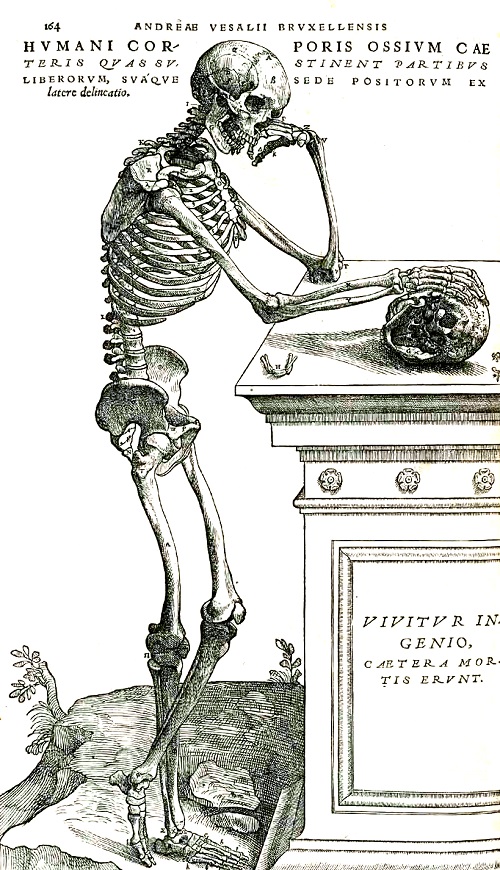
osing his head on May 12, 1543 made Jakob Karrer von Gebweiler’s name in the annals of art and and medicine.

The remains of the Basel felon — who attacked his wife with a knife when she discovered his bigamous marriage — were turned over after execution to Andreas Vesalius.

That brilliant Flemish doctor was in the midst of a proper Renaissance leveling up of medicine, lifting it past the centuries-long thrall of ancient Greek physician Galen.

Human dissection was essential to Vesalius’s project, as it was alike to many other medical men and to artists too. In his career, Vesalius’s cunning scalpel stripped numerous cadavers for students and urban grandees. With Karrer, Vesalius performed a public dissection, articulating Karrer’s skeleton.

Gifted to the university there, the skeleton was restored in 1985 and can be seen to this day at the Institute of Anatomy in Basel, Switzerland — one of the very earliest still-preserved articulated skeletons.

Why is it a Basel criminal who enjoys this distinction?


From Wikipedia’s library of De Humani illustrations.

Because in 1543, Vesalius was in that city* to work with printer Johannes Oporinus, even then publishing the physician’s magnum opus De Humani Corporis Fabrica. Vesalius personally transported to Oporinus the famously gorgeous and detailed woodcuts of Titian’s pupil Joannes Stephanus Calcarensis that made De Humani a smash hit in Vesalius’s own time and one of the most treasured artifacts of Renaissance scholarship.

* There’s still a street named for Vesalius in Basel.

On this day..

1945: Sudeten Germans, known but to God

JirĂ­ Chmelnicek shot this footage in just-liberated Prague on May 10, 1945 of Czechs celebrating the end of World War II by doling out mistreatment — including a chilling mass-execution — to Sudeten Germans. It was the presence of that population, the reader will recall, that Berlin invoked to justify its occupation of Czechoslovakia.

Chmelnicek’s video only surfaced publicly in 2010: its images were far too sensitive to air closer to the Great War, especially while Czechoslovakia was under communist control. As Der Spiegel reported.

Chmelnicek’s film shows how the Germans were rounded up in a nearby movie theater, also called the Borislavka. The camera then pans to the side of the street, where 40 men and at least one woman stand with their backs to the lens. A meadow can be seen in the background. Shots ring out and, one after another, each person in the line slumps and falls forward over a low embankment. The injured lying on the ground beg for mercy. Then a Red Army truck rolls up, its tires crushing dead and wounded alike. Later other Germans can be seen, forced to dig a mass grave in the meadow.

We do not know who these people are. Considering the indiscriminate revenge visited on Sudeten Germans after the war, it is not likely that these several dozen souls were selected for their fate with care.

On this day..

1726: Three molly-house sodomites

Nine men and one notorious women died at Tyburn on this date in 1726 at a more than usually raucous execution-day.

“At the Place of Execution, Map got himself loose, threw himself out of the Halter, and jump’d 3 or 4 Yards from the Cart, upon the Heads of the numerous Crowd of People, but the Officers following after him, wounded him with their Pikes, and the Executioner and some others soon brought him back again,” the Ordinary’s account remarked. “Vigous got himself free of the Halter also, which was immediately observ’d: Gillingham was the more desirous of Prayers, having the Night before taken Poyson, and conscious of his Guilt.”

And that’s just what was happening under the nooses.

Out in the audience,

Just before the Execution, a Scaffold that had been built near Tyburn, and had about 150 People upon it, fell down. A Snuff Box Maker in Castle-Street, and a Gentleman then not known, were, as ’tis believed, mortally Wounded; and about 12 other Men and Women, Maimed and Wounded in a most cruel Manner: Some having their Legs, others their Arms, &c. broke.

Some part of the Scaffold being left standing, the Mob gathered upon it again in Numbers; and in about Half an Hour more, that also fell down, and several were hurt. Soon after another Scaffold broke down, with about 100 Persons upon it; but the People that were damaged by it, being immediately carried off on Mens Backs, and in Coaches, we must defer the Particulars of that Mischief … (Daily Journal, May 10, 1726)

We will leave for a future May 9th the notorious fate of the woman, Catherine Hayes, and focus for this post on the fate of the notorious men: sodomites Gabriel Lawrence, William Griffin, and Thomas Wright.

A mere three months before, this trio had been among dozens of men rounded up in a raid on London’s thriving “molly house”.

These establishments catered to what we might anachronistically call the gay scene of Georgian London — or the molly scene, if you like, from the slang term for effeminate, cross-dressing, or homosexual men encompassing a panoply of alternate sexual identities and preferences. What these behaviors “among Christians not to be named” had in common, of course, was the opprobrium of the surrounding world.

Rictor Norton, who keeps the voluminous Homosexuality in Eighteenth-Century Enland site and wrote a book about Mother Clap’s Molly House, records a 1726 letter to the editor demanding an exemplary punishment to check the misuse of genitalia.

It being too notorious, that there are vile Clubs of Miscreants in and about this City, who meet to Practise and Propagate the detestable Sin of Sodomy, a Crime which drew down the flaming Vengeance of God upon the City of Sodom, in a Day when they had not that Light which we are bless’d with now, ’tis humbly propos’d that the following Method may not only destroy the Practice, but blot out the Names of the monstrous Wretches from under Heaven, viz. when any are Detected, Prosecuted and Convicted, that after Sentence Pronounc’d, the Common Hangman tie him Hand and Foot before the Judge’s Face in open Court, that a Skilful Surgeon be provided immediately to take out his Testicles, and that then the Hangman sear up his Scrotum with an hot Iron, as in Cases of burning in the Hand.

Old Blighty was never favored with courtroom scrotum-searings, but connoisseurs of same-sex love “must risque our necks for” it well into the next century.

But what pleasures welcomed the man who was ready to wager his life! An informant reported from that same Mother Clap’s that he

found between 40 and 50 Men making Love to one another, as they call’d it. Sometimes they would sit on one another’s Laps, kissing in a lewd Manner, and using their Hands indecently. Then they would get up, Dance and make Curtsies, and mimick the voices of Women. O, Fie, Sir! – Pray, Sir. – Dear Sir. Lord, how can you serve me so? – I swear I’ll cry out. – You’re a wicked Devil. – And you’re a bold Face. – Eh ye little dear Toad! Come, buss! – Then they’d hug, and play, and toy, and go out by Couples into another Room on the same Floor, to be marry’d, as they call’d it.

Several such informers were stalking the city’s molly-houses in the 1720s, goaded (or forced) by both police and private bluenoses. One of the resulting court records notes that “[t]he discovering of the Molly Houses, was chiefly owing to a Quarrel betwixt Mark Partridge and – Harrington: For upon this Quarrel Partridge to be revenged on Harrington, had blab’d something of the Secret, and afterwards gave a large Information of a great many others.”

Many lives hung on this lover’s spat. Mother Clap’s was raided in February 1726, but it was just the most famous of a whole series that forced into public awareness “a new, distinct molly ‘sodomite’ identity.”

The saving grace for the twoscore arrestees at Mother Clap’s was that even in Bloody Code England, a fairly high bar was required to execute for same-sex sodomy: penetratio, that is res in re (“thing in thing”)* — often quite difficult to prove.** As nobody had actually been caught in flagrante delicto, most of those initially arrested were simply released un-charged.

But the informants raise their scaly heads once more here: as they were themselves habitues of the molly circuit, they could provide firsthand eyewitness testimony about the acts of buggery several men had committed with them.

Five men were put on trial for their lives in April on the strength of accusations made by informants Mark Partridge, Thomas Newton, and Edward Courtney. The cases are described in some detail at Norton’s site: Gabriel Lawrence and William Griffin, both 43-year-old married men, were Mother Clap regulars who implausibly claimed to have no idea it was a molly house. (The place was a coffee shop/tavern.) Griffin actually lived there. Both these men were easily condemned but refused to the end to admit their proclivities to the Newgate Ordinary, and insisted that they had been framed.

Thomas Wright, seller of ale, had gone so far to set up his own molly house where he both slept with Newton, and procured Newton for his other customers. Wright, who “inclin’d to the Anabaptist-Way,” also said that Newton had perjured himself; nevertheless, he “could not deny his following this abominable Courses, only he refus’d to make particular Confessions.”

A third informant keyed two additional capital trials that didn’t end at Tyburn. George Kedger (Keger) and George Whittle (Whytle) both mounted much stronger defenses casting much greater doubt on the circumstances of their entrapment.

Charged with taking Courtney into his bed, Kedger contended that he had in fact resisted Courtney’s advances until the latter threatened to “swear my Life away”. Kedger was condemned, but pardoned. Whittle did still better by forcing his accuser to admit that he was a convict three times over and insinuating that rumors about his buggery were started by a disgruntled lodger. With a parade of character witnesses at his back, Whittle was acquitted outright.

* This was also the standard for same-sex rape; we’ve seen in these pages a man’s life hang on a question of just the tip.

** Attempted buggery — a charge which could result from making a sexual advance on another man that he rejected, or as a judicial punt when same-sex activity was afoot but no penetration could be proven — might land one a fine and a trip to the pillory. This was no mean sentence; the pillory could be quite a dangerous (sometimes lethal) ordeal for homosexuals or for anyone else.

Mother Clap herself, whose molly house we have referred to throughout this post, was also pilloried, not executed. Her eventual fate is not known; a marker in Holborn notes the former site of her famous establishment.

On this day..