1882: Sandy Mathews, in Memphis

From the June 3, 1882 Chicago Tribune:

Six Thousand People Present at the Execution of Sandy Mathews.

MEMPHIS, Tenn., June 2 — Sandy Mathews, colored, who murdered Essick Polk, colored, twele miles north of this city last October, was hanged in the county-jail yard this afternoon at 1 o’clock. The execution was witnessed by fully 6,000 people, a majority of whom were colored. The condemned man made a speech from the gallows, in which he confessed the killing, and implored his hearers to repent of their sins and go with him to Heaven. His neck was broken by the fall.

THE GALLOWS

had been erected in the southern portion of the jail-yard and was built high enough to give a full view to the ccrowd that jammed the streets running parallel with the jail. Matthews [sic] slept well last night, and partook of a hearty breakfast this morning. He bade farewell to his wife about 11 o’clock, and began making preparations for the hanging. A few weeks ago he embraced Catholicism, and was attended in his cell by the Rev. Father Lucius, of St. Mary’s Catholic Church. He called for his dinner at noon, and ate heartily, and afterwards smoked a cigar. At half-past 12 o’clock he was brought from his cell and conveyed to the scaffold, where he addressed the crowd for twenty minutes in

A DISCONNECTED SPEECH,

confessing to having killed Polk, and at the same time imploring his hearers to repent of their sins ere too late, and be forgiven, as he had done. He then knelt and repeated the Lord’s Prayer, after which the Rev. Father Lucius said the prayers for the dying. The condemned man was handcuffed, and his arms, and legs, and ankles strapped. The black cap was adjusted, and, as he uttered the words

“FAREWELL FRIENDS, FAREWELL WORLD,”

the drop was sprung, and his body shot down. His neck was broken by the fall, and ther was but very slight convulsions of the body. During the speech many of the colored people responded to his implorations by shouting, “Bless the Lord, Amen.” Sandy Mathews killed Essick Polk for having enticed his wife from him. He struck him three blows with an ax. Several hours afterwards he took the dead remains and buried them in a field near his house. The hole not being large enough, he chopped the dead body in pieces, and thus buried them. The crime was kept concealed for five months, but revealed by a stepdaughter of Mathews, who was the only witness to the killing, and upon whose testimony he was convicted. Gov. Hawkins was appealed to, but declined to interfere with the sentence of the lower court, which was afterwards confirmed by the Supreme Court.

On this day..

1741: Cuffee and Quack, “chained to a stake, and burnt to death”

This date in 1741 marked the first official execution for the alleged New York slave conspiracy of 1741.

Nineteen days before, two slaves named Caesar and Prince had hanged, nominally for theft but believed by the populace (and the court) primary instigators of a staggering plot to put New York to the torch, murder the city’s whites, and reign as kings on the ashes of their masters’ city.

Cuffee was, alongside those already-executed Caesar and Prince, part of a trio of slaves known to hang about together at the house of barkeep and fence John Hughson. Already notorious about town for a gin-robbing incident that had seen all three publicly whipped in 1738, they had again burgled a linen store that February. (That’s the crime for which Caesar and Prince were executed.)

The evidentiary chain linking these commonplace prowlers to a spate of fires whose intent must be the annihilation of the city leaves quite a bit to be desired, but the burning spring of 1741 helped solder them together in part thanks to a white New Yorker spying Cuffee in what he thought was a suspicious position during a fire and raising the alarm. Cuffee fled, back to the home of Adolph Philipse — his owner, and also the uncle of one of the judges who would eventually condemn him — where a crowd of incited freemen chased him down and hauled him to gaol, “borne upon the People’s Shoulders.” His skulking seemed to confirm a widening suspicion, spiced by the mother country’s going war against dusky Spaniards, that the city’s Negroes must surely lurk behind a fortnight’s infernos. From this point on it appears as if New Yorkers — or at least the city’s elites — determined by consensus that they “must necessarily conclude, that [the fires] were occasioned and set on Foot by some villainous Confederacy of latent Enemies amongst us.”

Now, this appearance of consensus is an impression nearly three centuries distant, and is heavily shaped by the circumstance that there’s one predominant voice surviving the ravages of years to document for us the official proceedings: Daniel Horsmanden, who both judged and investigated the case and is thus heavily invested in its outcome. His A Journal of the Proceedings in the Detection of the Conspiracy Formed by Some White People, in Conjunction With Negro and Other Slaves, for Burning the City of New-York in America and Murdering the Inhabitants is Horsmanden’s record of how the plot or “plot” was uncovered; it was assembled in 1742 and presents trial and deposition records curated by Horsmanden with a view to persuading “such as have a Disposition to be convinc’d, and have in Reality doubted, whether any particular Convicts had Justice done them or not” — for by this time such doubts were dogging Horsmanden’s court, having hounded 30-odd people to death on evidence that was already viewed as highly impeachable.

There had been some wanton, wrong-headed Persons amongst us, who took the Liberty to arraign the Justice of the Proceedings, and set up their private Opinions in Superiority to the Court and Grand Jury; tho’ God knows (and all Men of Sense know) they could not be Judges of such Matters; but nevertheless, they declared with no small Assurance (notwithstanding what we saw with our Eyes, and heard with our Ears, and every one might have judg’d of by his Intellects, that had any) That there was no Plot at all!

Whether the entire slave conspiracy to burn New York was a phantom, or whether it did indeed reflect in whatever distorted way a some real mode of resistance, is a factual question that is permanently unanswerable.* But the cases certainly took on a witch hunt quality, and they bore many hallmarks of wrongful conviction that are familiar even today.

Our first two hangings, Caesar and Prince, were doomed by the decision of John Hughson’s teenage serving-girl to turn state’s evidence and denounce them. As Cuffee and Quack would be the first people formally tried for the arson wave, her evidence was buttressed in this case by another common prosecutor’s cheat: the prison snitch.

A (white) petty thief named Arthur Price, who was being held in New York’s dungeon along with the growing ranks of suspected terrorists, helpfully began informing on the people around him. It’s likely he was a longstanding underclass crony of the purported plotters.

At any rate, the civic-minded Price, “having been found by experience to be very adroit at pumping out the Secrets of the Conspirators … was ordered to put Cuffee (Mr. PHILIPSE’s Negro) into the same Cell with him, and to give them a Tankard of Punch now and then, in order to chear up their Spirits, and make them more sociable.” What do you know but the next morning, Price was ready to report that his inebriated cellmate had admitted the conspiracy to him, and had implicated Quack as the man who actually fired the fort.

Quack was promptly arrested. Arthur Price would give evidence against both at their trial, but having made himself an obvious stool pigeon his use as an informant was at an end since nobody would go near him any longer.

More key information against Cuffee and Quack came from two other slaves, whose “Negro evidence” — a distinct class of (significantly derogated) proof in New York courts — would also have been controversial. The crown’s attorney prosecuting the case felt obliged to go out of his way to justify to the jury the unsworn testimony of “Pagan Negroes” on the grounds that without such, “the greatest Villanies would often pass with Impunity.” But pagan or no, both Sandy (a minor) and Fortune were also men who were suspect in the plot. Perhaps as black slaves their king’s evidence could not be as strong as that of the white servant Mary Burton — but it might still be strong enough to save their lives. Sandy spent a week in the dungeon amid his alleged confederates, after which he was hauled before the grand jury and leaned upon until he cracked.

They told him, if he would speak the Truth, the Governor would pardon him, though he had been concerned in them; and this was the Time for him to save his Life by making a free and ingenuous Confession; or in Words to this Purpose. He answered, That the Time before after that the Negroes told all they knew, then the white People hanged them. The Grand Jury assured him, that it was false; for that the Negroes which confessed the Truth and made a Discovery, were certainly pardoned, and shipped off: [which was the Truth] And upon this Assurance he began to open, and gave the following Evidence.

Quack, Sandy said, had solicited Sandy to help him burn down Fort George — and Cuffee “said, D–m him, that hang him or burn him, he would set fire to the Town.” Fortune was among the numerous other names he named — whose “Design was to kill all the Gentlemen, and take their Wives, and that Quack and Cuffee were particular Persons that talked so.”

Strangely, before they suffered at the stake Cuffee and Quack were suffered to conduct a hopeless defense of their own — “indulged with the same Kind of Trial as is due to Freemen, though they might have been proceeded against in a more summary and less favourable Way,” in the crown’s summing-up. This was more than they were entitled to as slaves, and they used the court’s liberality to summon ten witnesses in an attempt to establish good character and alibi; notably, Quack’s owner John Roosevelt avowed that “Quack was employed most Part of that Morning the Fort was fired, from the Time they got up, in cutting away the Ice out of the Yard; that he was hardly ever out of their Sight all that Morning, but a small Time while they were at Breakfast; and that they could not think he could that Morning have been [from] their House so far as the Fort.” But even from a white property owner, these words were far too little against a consensus that had been shaped seemingly from the belly of the conspiracy — from Mary Burton’s evidence and Arthur Price’s evidence and Sandy’s and Fortune’s evidence: that Quack’s were the hands that set the most damaging fire in the arson campaign, and that Cuffee’s, along with Caesar’s and Prince’s, were the hands that directed him.

Their condemnation was a mere formality, albeit one whose rhetorical opportunities the court did not mean to neglect.

You both now stand convicted of one of the most horrid and detestable pieces of villainy, that ever satan instilled into the heart of human creatures to put in practice; ye, and the rest of your colour, though you are called slaves in this country; yet you are all far, very far, from the condition of other slaves in other countries; nay, your lot is superior to that of thousands of white people. You are furnished with all the necessaries of life, meat, drink, and clothing, without care, in a much better manner than you could provide for yourselves, were you at liberty; as the miserable condition of many free people here of your complexion might abundantly convince you. What then could prompt you to undertake so vile, so wicked, so monstrous, so execrable and hellish a scheme, as to murder and destroy your own masters and benefactors? nay, to destroy root and branch, all the white people of this place, and to lay the whole town in ashes.

I know not which is the more astonishing, the extreme folly, or wickedness, of so base and shocking a conspiracy; for as to any view of liberty or government you could propose to yourselves, upon the success of burning the city, robbing, butchering, and destroying the inhabitants; what could it be expected to end in, in the account of any rational and considerate person among you, but your own destruction? And as the wickedness of it, you might well have reflected, you that have sense, that there is a God above, who has always a clear view of all your actions, who sees into the utmost recesses of the heart, and knoweth all your thoughts; shall he not, do ye think, for all this bring you into judgment, at that final and great day of account, the day of judgment, when the most secret treachery will be disclosed, and laid open to the view, and everyone will be rewarded according to their deeds, and their use of that degree of reason which God Almighty has entrusted them with.

Ye that were for destroying us without mercy, ye abject wretches, the outcasts of the nations of the earth, are treated here with tenderness and humanity; and, I wish I could not say, with too great indulgence also; for you have grown wanton with excess of liberty, and your idleness has proved your ruin, having given you the opportunities of forming this villainous and detestable conspiracy; a scheme compounded of the blackest and foulest vices, treachery, blood-thirstiness, and ingratitude. But be not deceived, God Almighty only can and will proportion punishments to men’s offences; ye that have shewn no mercy here, and have been for destroying all about ye, and involving them in one general massacre and ruin, what hopes can ye have of mercy in the other world? For shall not the judge of all the earth do right? Let me in compassion advise ye then; there are but a few moments between ye and eternity; ye ought therefore seriously to lay to heart these things; earnestly and sorrowfully to bewail your monstrous and crying sins, in this your extremity; and if ye would reasonably entertain any hopes of mercy at the hands of God, ye must shew mercy here yourselves, and make what amends ye can before ye leave us, for the mischief you have already done, by preventing any more being done. Do not flatter yourselves, for the same measure which you give us here, will be measured to you again in the other world; ye must confess your whole guilt, as to the offences of which ye stand convicted, and for which ye will presently receive judgment; ye must discover the whole scene of iniquity which has been contrived in this monstrous confederacy, the chief authors and actors, and all and every the parties concerned, aiding and assisting therein, that by your means a full stop may be put to this horrible and devilish undertaking. And these are the only means left ye to shew mercy; and the only rea­sonable ground ye can go upon, to entertain any hopes of mercy at the hands of God, before whose judgment seat ye are so soon to appear.

Ye cannot be so stupid, surely, as to imagine, that when ye leave this world, when your souls put off these bodies of clay, ye shall become like the beasts that perish, that your spirits shall only vanish into the soft air and cease to be. No, your souls are immortal, they will live forever, either to be eternally happy, or eternally miserable in the other world, where you are now going.

If ye sincerely and in earnest repent you of your abominable sins, and implore the divine assistance at this critical juncture, in working out the great and momentous article of the salvation of your souls; upon your making all the amends, and giving all the satisfaction which is in each of your powers, by a full and complete discovery of the conspiracy, and of the several persons concerned in it, as I have observed to ye before, then and only upon these conditions can ye reasonably expect mercy at the hands of God Almighty for your poor, wretched and miserable souls.

Here ye must have justice, for the justice of human laws has at length overtaken ye, and we ought to be very thankful, and esteem it a most merciful and wondrous act of Providence, that your treacheries and villainies have been discovered; that your plot and contrivances, your hidden works of darkness have been brought to light, and stopped in their career; that in the same net which you have hid so privly for others your own feet are taken: that the same mischief which you have contrived for others, and have in part executed, is at length fallen upon your own pates, whereby the sentence which I am now to pronounce will be justified against ye; which is,

That you and each of you be carried from hence to the place from whence you came, and from thence to the place of execution, where you and each of you shall be chained to a stake, and burnt to death; and the lord have mercy upon your poor, wretched souls.

That sentence came down on May 29.

It was implemented the very next day, amid a mob scene.

With Quack and Cuffee staked to their pyres, they were harried to admit the plot with the promise of a reprieve from their horrible sentence. Even if mercy would only amount to moderating death by burning into death by hanging, it would be well worth having — and the frightened slaves grasped at the small succor left them.

The spectators at this execution were very numerous; about three o’clock the criminals were brought to the stake, surrounded with piles of wood ready for setting fire to, which the people were very impatient to have done, their resentment being raised to the utmost pitch against them, and no wonder. The criminals shewed great terror in their countenances, and looked as if they would gladly have discovered all they knew of this accursed scheme, could they have had any encouragement to hope for a reprieve. But as the case was, they might flatter themselves with hopes: they both seemed inclinable to make some confession; the only difficulty between them at last being, who should speak first. Mr. Moore, the deputy secretary, undertook singly to examine them both, endeavoring to persuade them to confess their guilt, and all they knew of the matter, without effect; till at length Mr. Roosevelt [Quack’s owner, who testified for his alibi -ed.] came up to him, and said he would undertake Quack, whilst Mr. Moore examined Cuffee; but before they could proceed to the purpose, each of them was obliged to flatter his respective criminal that his fellow sufferer had begun, which stratagem prevailed: Mr. Roosevelt stuck to Quack altogether, and Mr. Moore took Cuff’s confession, and sometimes also minutes of what each said; and afterwards upon drawing up their confessions in form from their minutes, they therefore intermixed what came from each.

Thus induced by prevaricating confessors amid a mob baying for their blood, both Quack and Cuffee implicated Hughson as the originator of the plot, and themselves as early principals, and named a good many others besides. (Quack also at last claimed responsibility for firing Fort George, as the court had found.)

But the quid for their quo was not the promised abatement of their sufferings. As Sandy had worried to the grand jury in a different context, white men’s reassurances to slave rebels whom they meant to destroy could prove … unreliable.

After the confessions were minuted down (which were taken in the midst of great noise and confusion) Mr. Moore desired the sheriff to delay the execution until the governor be acquainted therewith, and his pleasure known touching their reprieve; which, could it have been effected, it was thought might have been means of producing great discoveries; but from the disposition observed in the spectators, it was much to be apprehended, there would have been great difficulty, if not danger in an attempt to take the criminals back. All this was represented to his honour; and before Mr. Moore could return from him to the place of execution, he met the sheriff upon the common, who declared his opinion, that the carrying the negroes back would be impracticable; and if that was his honour’s order it could not be attempted without a strong guard, which could not be got time enough; and his honour’s directions for the reprieve being conditional and discretionary, for these reasons the execution proceeded.

* For contrasting perspectives, Peter Linebaugh and Marcus Rediker present this as a real instance of working-class rebellion in The Many-Headed Hydra, while Jill LePore’s New York Burning approaches it as mostly a concoction.

On this day..

2013: Elmer Carroll, boogie man

On this date in 2013, serial child molester turned murderer Elmer Carroll was executed by lethal injection in Florida.

Paroled to a halfway house in 1990 from his child molestation sentence, Carroll within months attacked a fifth-grader who lived in a nearby house — in Carroll’s description to another halfway house resident, the girl was “sweet, cute, and liked to watch him make boats.”

One night while Christine McGowen’s mother was working and her stepfather sleeping in the next room, Carroll crept into their Apopka home, stopped the little girl’s mouth with his hand as he raped her, then strangled her to death. Robert Rank found the girl the next morning when he went to wake her for school … and also found missing the truck that Carroll had stolen to escape. One could hardly commit a crime more suited to the studied melodrama of a state’s attorney:

By your vote, tell Elmer Carroll you do not deserve to live. There is nothing good about you. There is nothing but evil in you and you must die.

A small child sometimes will cry out in the night frightened by a shadow or a piece of wallpaper that looks like a monster and its parents will come in and say it’s okay, you don’t have to be afraid. There’s no monsters under the bed. There is no boogie man. There is no creature which stalks the night searching out children. It doesn’t exist. Well, ladies and gentlemen, those parents lie because, ladies and gentlemen, that is the boogie man right there. That is the creature that stalked the night and murdered a ten year old girl and he must die.

The other things in Carroll besides evil were organic brain damage and a gamut of mental illness symptoms that Carroll’s appellate team would unsuccessfully argue had not been sufficiently explored at his trial. Estranged from most of his family for many years before the murder, Carroll had no visits from relatives before his execution.

Part of the Themed Set: The 2010s.

On this day..

1935: Tully McQuate, “If I hang, I hang”

On this date in 1935, one of the all-time great names in American gallows history hanged at California’s Folsom Prison for one of the all-time crimes of ingratitude.

Tully McQuate (or Tulley, or Tullie; the name means “peaceful”) entered the annals of criminology via a sack of dismembered human remains discovered in San Diego’s harbor in 1934.

These gory parts turned out upon examination to have formerly constituted a well-to-do 74-year-old widow named Ellen Straw. Mrs. Straw, it transpired, had taken a shine to an Ohio-born drifter thirty years her junior after hiring him to do her yard work, and finally invited said McQuate to live with her.

Period reportage describes her as his “benefactress” but it appears the favors were reciprocal.

“She took a liking to me and I took a liking to her,” he explained in a matter-of-fact confession. (Los Angeles Times, May 28, 1934)

She took me into her home and we got along pretty well for about a year. Then she began to get jealous of me and we began to quarrel.

One night we went down to a mission — neither of us was very religious, but we used to get a kick out of it. We quarreled on the way home. She went to her room and I went to mine. She kept on quarreling with me — I could hear her through the wall.

Finally I got up to get a drink of water. I found a clawhammer that I had been using around the house. I took it and went in and hit her over the head with it. I guess I hit her twice. [The court would find that he hit her six or seven times. -ed.]

I never had any intention of killing her, but when I saw she was dead, I just covered her up and went back to bed.

“Well, if it’s done, it’s done,” I said to myself. I knew it was all up with me then. I knew they would find me some time. But I didn’t care. When I lost my family I had nothing left to care about. [McQuate’s wife had divorced him years before. -ed.]

I left the body there for six days. I never did see her face again. Then I decided I’d better get rid of it, so I took the knife and a saw — I couldn’t get the body into the sack.

McQuate projects a pragmatic matter-of-factness about the situation that’s equal parts disarming and blood-chilling. One can at least say for him that he faced the consequence with the same equanimity.

Well, I guess my time has come. I’ve confessed — told the whole truth — and I’ll plead guilty. There’s no use putting the State to the expense of a trial. I’ve paid taxes myself.

McQuate was as good as his word. Indeed, when the legal proceedings required two days — perhaps anticipating appeal avenues, the District Attorney successfully insisted that McQuate, who had intended to represent himself, must have an attorney in a death penalty case — the murderer griped on the second day, “It’s so foolish. I did it; let ’em sentence me and get it over with. If I hang, I hang.” (Los Angeles Times, June 5, 1934)

On this day..

1873: John Devine, “The Chicken”

Purple prose for a broken neck from the San Francisco Bulletin of May 14, 1873. Transcribed below is only the first third of the article — the remainder being dedicated to accounts of various other previous San Francisco executions.

This day has been marked by an event of signal import in the history of this city, wherein the slow hand of justice, after a lapse of many years, has overtaken one of the class of reckless criminals who have reveled in rapine and bloodshed, bringing reproach on the fair fame of San Francisco, and red-handed murder has expiated its guilt by the righteous penalty of ignominious death upon the scaffold.

Whatever may be the abhorrence of capital punishment commonly experienced by a portion of the people, while contemplating the events of the past few years, the tardy and uncertain sway of justice, a sense of satisfaction and increased security will be inspired in the whole community by the announcement of John Devine, “The Chicken,” has met the fate which the law prescribes for the destroyer of human life, and there is one murderer less in San Francisco.

From the infamous character of this man, and the terror which his deeds of violence excited through a long course of comparatively unpunishable crime, ere consigning him to oblivion, the public will be interested in a brief sketch of the

Career of the Murderer.

The man who has now paid the penalty of his last dark crime, leaves a record which has no parallel among the many depraved wretches who have figured in the brief but terrible criminal history of San Francisco, and perhaps the half has not been told.

The police officials considered him the most dangerous and unscrupulous criminal that infested the city, and hint at mysterious deeds of blood, never unravelled by the minions of justice, with which he is believed to have been connected. In truth, he was a fellow by the hand of nature marked, quoted and signed to do a deed of shame — apt, liable to be employed in danger with neither pity, love nor fear.

Devine was a native of Waterford, Ireland, where he was born in the year 1840, and was accordingly 33 years old at the time of his death.

He was of medium size, sharp features, dark-blue eyes, a low forehead, and generally repulsive expression of countenance.

He arrived in San Francisco in the year 1863, as a seaman on the clipper ship Young America.

On the voyage hither he distinguished himself as a quarrelsome fellow, and was frequently confined in irons to restore the discipline of the ship.

After squandering the wages he received in a short spell of carousing on shore, he was driven to the sea again and made a voyage to China, returning in the spring of 1865. He then obtained employment as a runner for sailor boarding-houses, in which capacity he perpetrated innumerable deeds of ruffianism in the “shanghaing” of sailors and citizens on outward bound ships. Shortly after engaging in this vocation he received the title of

“The Chicken.”

Which was endearingly conferred by one of his fellows, as significant of his prowess in a prize-fight.

Devine had four notable encounters of this order, in the city and vicinity, and displayed remarkable endurance and determination, though not always successful.

His career from the time of setting himself on shore was one continuous round of crime, and he is well suspected of having a knowledge of the manner in which many a corpse found floating in the bay, with fractured skull and rifled pockets, yielded up i[t]s life. His record on the police register shows

Seventy-Nine Arrests!

Up to May 16, 1871, when his final arrest for the crime of murder was made.

The charges against him embraced all manner of crimes, principally robberies and assaults with deadly weapons, it being his custom to assault his victims with slung-shot and brass-knuckles. His recorded crimes, however, are not supposed to embrace any near approach to the ull measure of enormities that were charged upon his guilty soul.

He was capable of the most savage treachery, and on one occasion attempted the murder of a prize-fighter named Tommy Chandler, by springing upon him from behind a door with a heavy iron bar. Being foiled in this, he subsequently shot Chandler, but not inflicting fatal injury, he got off with a short term of imprisonment on conviction of assault to murder.

A Characteristic Exploit.

On the 8th of June, 1867, about 6 o’clock in the morning, Devine assailed an aged German lady, named Mary Martin, as she was walking along Merchant street, near Battery, tore the pocket from her dress, and robbed her of a purse containing a check for [obscure] and $25 in coin.

For this robbery he was arrested, and released on bail, for notwithstanding the character he bore, he was usually enabled to find friends to go upon his bond in a certain part of the city.

When the case came up for trial officers went in search of Mrs. Martin, who had resided at a house on Powell street, as the important witness for the prosecution of Devine. The lady had disappeared.

What became of her was never known; but it was possible that Devine might have told. Passing over a list of comparative minor offences, such as knocking down and robbing people, the next noticeable affair in which this remarkable criminal figured was the

Attempted Murder of Miss McDonald.

On the night of the 9th, October, 1867, Miss Martha McDonald was standing in front of her place of residence, at the Mission, when she was suddenly seized by two men who were masked.

She was gagged by a handkerchief being forced into her mouth, and prevented from giving any alarm. In this condition the men dragged her a distance of two blocks and a half, to the bridge which crosses Mission Creek at Sixteenth street.

One of the two then started, according to the directions of his companion to “get the carriage.”

Being left in the custody of one only, Miss McDonald made a desperate effort to release herself. The fellow attempted to chloroform her; but the drug being spilled from the bottle, he then endeavored to secure her with a strap.

At this juncture the other man returned, and she heard the exclamation, “kill her, kill her!” A moment after she was pushed off the bridge, and fell into the muddy waters of the creek, while the two men who had abducted her ran away.

Slowly and surely she was sinking into the muddy bottom, with no assistance at hand, until the water was about her neck. Fortunately an alarm of fire started some person past the locality, and her cries of distress being heard, she was discovered and rescued.

Devine was arrested as one of the participants in this crime, and Miss McDonald positively identified him by his voice. Devine extricated himself from the affair by proving an alibi, it appearing that he was serving a term in the County Jail at the time of the attempted murder.

It subsequently transpired, however, that he held the privileged position at the County Jail of “outside trusty,” and was permitted to travel to all parts of the city at will in the performance of errands for prisoners in more restricted limits. And more than this, he was abroad at the very time the abduction of Miss McDonald was made.

The Loss of a Hand.

In the month of May, 1868, Devine was indulging in one of his periodical carousing spells, and often bringing terror to several of the resorts on his beat at the city front, he entered a boarding house kept by William Maitland, on Battery street.

Here he flourished a huge knife with the recklessness of a savage, and caused a precipitate retreat of all who happened to be in the place.

The proprietor had been asleep in the second story of the house, and hearing the uproar, came came down for a reconnaissance. Devine immediately started for him when he made his appearance, but Maitland was not of so yielding a disposition as to be driven from his own castle, and closing with Devine, he succeeded in disarming him.

The latter then made an attempt to recover the knife, when Maitland with a powerful stroke cut him across the wrist. The blade, by wonderful chance, entered the wrist joint, and the completely severed hand fell to the floor.

Devine was appalled for once in his life, and hurriedly departed; but presently he returned and demanded his lost hand, which Maitland kicked out upon the sidewalk to him. Devine took the severed member and hastened to a drug store, where he implored a clerk to try and sew it on again. But the injury was irreparable.

Devine as a Merchant.

After a season of retirement in the County Hospital, Devine emerged as far repaired as medical science would permit, and being a cripple, his condition excited the pity of boarding-house masters and others at the city front with whom he had been associated.

A contribution was made among them, amounting to $800, to enable Devine to establish himself in business by keeping a cigar stand.

He took the money, but instead of following the advice of his benefactors he squandered the whole sum in a few weeks of dissipation, and again returned to the pursuit of crime with all his previous energy.

He was associated with a woman named Mary Dolan, as bad as himself, and who was punished by terms of imprisonment in the County Jail and Penitentiary.

From the time of losing his hand up to his final arrest, he perpetrated numerous larcenies, some of considerable amounts, and was always busily engaged in thieving when not confined in jail.

A complete history of this man and his offenses would be one of the most appalling in the annals of crime. Such was John Devine, and rarely has the slow grip of justice overtaken a criminal more richly deserving of the severest penalty known to the law.

Murder of August Kamp.

The crime which John Devine has now expiated with his life, was one of the most cruel and wanton ever recorded in a civilized community, and could only have been accomplished by one utterly depraved.

It was in perfect keeping with the whole life and character of Devine, who had become callous to every impulse that elevates a man above the merest savage.

August Kamp was an unsuspecting young German, without relatives in the country. On the 10th of May, 1871, he arrived in the city from Antioch, where he had been employed, bringing with him his savings, to the amount of about $120.

He started immediately in search of employment, and while making his inquiries along the city front, he was met by Devine, who offered to procure him a situation on a fishing vessel.

Elated with this promise, young Kamp was persuaded to loan $20 to Devine, on the understanding that it would be repaid him the following day. The money was not returned as agreed, and Kamp finally suspecting the true character of his debtor, importuned him earnestly for his pay. Devine put him off repeatedly, at one time pretending that he had nothing but greenbacks on hand, and again making some other excuse.

On the 15th of May, Kamp having again demanded his pay, Devine told him that if he wanted the money very bad, he must go with him to his mother’s ranch, beyond Bay View. Accordingly the two started for the imaginary ranch, walking as far as Long Bridge, when they boarded one of the Bay View cars. On reaching the terminus of the railroad, the two got off the car and walked along the road. After passing the Five-Mile House, Devine pointed off to one side, saying that his mother’s ranch was in that direction, and by striking off across the fields instead of following the road they might save a distance of one mile out of two. Young Kamp assented and the two started across a lonely stretch of land, through vales and over hills, until a point was reached which the murderer thought sufficiently secluded for carrying out his design.

Kamp stooped down to crawl between the rails of a fence, Devine walking behind him, when the latter suddenly drew a pistol and fired the fatal shot, the ball entering Kamp’s skull behind the right ear.

Devine then ran away, supposing he had effectually dispatched his victim, and was seen hastening back alone to the railroad terminus.

Kamp was shortly after discovered by a Spaniard, who was herding sheep in the locality, and being still able to walk, he was assisted to a saloon on the road, and from thence brought in to the city and given in charge of the authorities.

From the representations which the mortally wounded youth could make, and other circumstances, the police were immediately confident that Devine was his murderer, and measures were at once instituted for his arrest.

He was traced to various places in the city, where he had boasted of obtaining money by an easy method, admitted to several that he had shot a man and endeavored to dispose of a revolver.

He was finally captured on board a steamer at Meiggs’ wharf, which was just about crossing over to Marin county, and the revolver, with two chambers discharged, was still in his possession.

At the City Prison he was placed in the midst of fifteen or twenty persons, and Kamp, who was yet rational, readily singled him out as the murderer. He walked up and placed his hand on Devine, saying, “You are the man that shot me.” Kamp was taken to the County Hospital, and every effort made to save his life, but without avail.

Just before his death, which occurred on the 5th of May, an effort was made to take his ante-mortem deposition, but unfortunately the Coroner arrived too late, and the important evidence of the murdered man was not secured in the case.

The chain of circumstances presented in the several trials, however, made out a case against the accused as strong circumstantial evidence could be drawn, and a doubt of his guilt was hardily admissible.

The First Trial

Was brought in the Twelth District Court, before Judge McKinstry, on the 20th of February, 187, and occupied eight days, resulting in a verdict according to the indictment of “murder in the first degree.” The Court sentenced Devine to be executed on the 25th of April, 1872.

Judge Tyler, counsel for the condemned, appealed to the Supreme Court for a new trial on mere technical grounds, his principal point having reference to a minor discrepancy of evidence of one witness as taken before the Coroner at the trial. Although the several points did not affect the merits of the case in the least, the appeal was successful, and to the efforts of most indefatigable counsel the wretched man was indebted to an extension of his lease of life a full year.

The case was brought to a second trial in March last, in the same court. In the meantime an important witness had died, and the prisoner and his counsel were exceedingly hopeful of founding complications on this circumstance equal to another successful appeal to the Supreme Court.

After another tedious trial the inevitable verdict of “guilty” fell upon the ear of the doomed man for the second time, and he was again sentenced to be executed on Friday the 9th of May.

Hope was still buoyant in his breast, relying upon the determined goal of his counsel, until the 7th, when the announcement was made that the Supreme Court affirmed the judgment of the lower court, and his fate was sealed beyond the further probability of human interference.

By the earnest intercession of the spiritual adviser of the condemned prisoner, the Governor was persuaded to grant a brief reprieve of five days, in the hope that the guilty wretch, with the certainty of speedy death before him, might finally yield to the ministrations of his anxious spiritual adviser, Rev. Father Spreckles, and meet his end in a penitential spirit.

During his long term of imprisonment Devine manifested a bearing of bravado, never believing that merited retribution would finally overtake him, and on several occasions he laughed to scorn kindly persons who ought to impress him with a realization of his terrible position, and turn him to preparation for another life. By a

Remarkable Coincidence

His execution occurred two years to a day from the commission of the murderous act that consigned him to death at the hands of justice, and in his case it may be said, “God’s mills grind slow but sure.”

After receiving his brief reprieve from the Governor, Devine realized that no earthly interference could avail him further, and he relinquished all hope of life.

At his own solicitation all visitors were ecluded from his cell with the exception of his spiritual advisers, and he gave himself earnestly to preparations for the awful change that awaited him, in the few hours that still remained.

At times he wept bitterly when exhorted to a contemplation of his guilty life and true repentance, and the consolations of religious faith seemed to reconcile him to his fate, and enable him to await his end with fortitude.

On Monday he received the Sacrament of Communion from Rev. Father Spreckles, and Archbishop Alemany conferred upon him confirmation in the Roman Catholic Church.

On the succeeding days Devine assumed an air of cheerfulness. On Tuesday he asked permission of the Sheriff to be shaved, which was granted, the precaution first being taken to bind him securely to guard against any suicidal designs. His ostensible wife, Mary Dolan, was in jail at the time of the execution, having been committed a few weeks since for her common offence of habitual drunkenness.

Parting With His Son.

Devine also had a son, a child of six years of age, whom he had not seen for several years, and he expressed an earnest desire to see him before his death.

The Sheriff and his deputies were anxious to gratify this last request, and visited the various charitable institutions in the city yesterday, endeavoring to find the child.

Devine last heard of him at the Protestant Orphan Asylum, where he had caused him to be placed immediately after his arrest for murder, the mother, Mary Dolan, being unfit to care or provide for him in consequence of her continual drunkenness and frequent detentions in jail.

The lad had been removed from the Orphan Asylum, but the Sheriff happily discovered him in charge of the Ladies’ Relief Society, comfortably provided for.

When the child arrived at the cell of his wretched father last evening, Devine was much affected, and exhibited instincts of humanity he had never known before. He embraced his offspring tenderly, wept over him, and implored him to shun the evil ways that had brought his father to ignominious death, and when the lad was finally removed, he clung to him with convulsive throbs, as if parting with the only object that had ever awakened the emotion of affection in his breast.

Last Hours of the Doomed Man.

Devine retired at about 10 o’clock last night after devotion with his spiritual adviser. He slept soundly through the night until 5 o’clock this morning, when he was awakened by the Jailor.

In reply to the inquiries of the officer, he said that he had enjoyed refreshing slumber, as one could who had a clear conscience. He dressed himself with care, and gave much attention to combing his hair neatly and arranging his toilet, having been provided with a new suit of black and a pair of slippers.

At 8 o’clock he ate a hearty breakfast, and shortly after his spiritual adviser, Rev. Father Spreckles, Archbishop Alameney [sic] and two Sisters of Mercy arrived. The doomed man devoted the remaining few hours of his life to fervent supplications for mercy.

As the hour for the execution approached, the wickets in all the cells were closed, the “trustees” allowed the limits of the Jail were locked up, and the condemned murderer Russell was taken to a remote part of the jail and locked in the room formerly occupied by Mrs. Fair.

At 11 o’clock the reporters of the press were admitted and allowed to inspect the preparations for the execution.

The Scaffold

Was laid across the railings of the upper corridor at the north end, the trap in the centre permitting the body to drop to the lower corridor within about three feet of the floor, the rope allowing a fall of six feet.

The gallows beam was extended above under the skylights, the ends resting in the ventillating apertures on either side.

On the west side of the scaffold an iron rod run up, to which was attached a cord, secured to a ring in one of the cell doors, the slipping of which drew the bolt by a weight and allowed the trap to fall. The gallows was the same used in previous executions, the last murderer who had stood thereon being the Chinaman, Chung Wong, who was executed in 1865.

At twenty minutes to 12 the Sisters of Mercy took their leave of Devine, and shortly after, attended by the Sheriff and the priests, Devine was conducted from the No. 1 cell near the entrance of the lower corridor, which he had occupied since his fate became sealed, to No. 41 cell in the second corridor, which was located nearly opposite the steps leading upon the scaffold. He looked pale and haggard, but a smile rested upon his countenance as he passed the group of reporters at the foot of the stairway.

He ascended the stairway with a light elastic step, and seemed to look car[e]lessly at the gallows as he tripped along the gallery.

At half past 12 o’clock an immense crowd had gathered in the street in front of the jail, and on all sides of the building where a position might be obtained to observe even the grim walls within which the dread scene of violent death was being enacted.

The Sheriff then admitted all those who had received permission to be present, to the number of about two hundred. The spectators included several Sheriffs from adjoining counties, members of the Board of Supervisors, physicians, city officials, and upwards of thirty reporters of the press, among the latter being representatives of some of the Eastern papers, and artists for the New York illustrated journals.

The reporters were assigned a position directly in front of the scaffold, in the west gallery of the upper corridor, and the physicians took their places within the line on the floor of the lower corridor.

The prisoner remained in his cell engaged in his final devotions, while the tramping of many feet and the subdued murmur of voices without, reminded him of the relentless hand of Justice, eager to close his career.

The corridors, above and below, were greatly crowded, while the side openings, below the sky lights, in either, were completely occupied, their appearance suggestive of the private boxes of a public exhibition.

The Execution.

At a quarter to 1 o’clock, the Sheriff directed his deputies to their positions upon the scaffold, and immediately after he entered the cell of the doomed man for a parting interview of brief duration.

On emerging, Sheriff Adams mounted the scaffold and stated to the spectators that it was the wish of Devine that all should preserve silence and ask him no questions.

At two minutes before 1 o’clock the Sheriff opened the door of the cell and Devine emerged, carrying a crucifix in his hand and followed by Father Spreckles. He ascended the steps to the scaffold with closed eyes, manifesting symptoms of weakness, and though bearing up with great power of nerve, the expression of his countenance and the twitching muscles of his throat indicated the welling up of inexpressible agony of soul.

While standing upon the scaffold his eyes remained closed, while Father Spreckles, taking the crucifix, continued whispering the consolations of the Church in his ear.

The death-warrant was hurriedly read by Deputy Lamott, but Devine gave no heed thereto, attending closely to the ministrations of Father Spreckles and frequently kissing the crucifix with much fervor as it was placed to his lips.

At the conclusion of the reading of the warrant, ailor McKenzie bound the doomed man with straps. One was passed round his breast and pinioned the arms at the elbows, another at the waist pinioned the wrists, and two other straps were secured about the knees and the ankles. The rope was then placed about his neck, the large knot of the noose fixed under the left ear.

Last Scene of All.

The murderer now stood upon the verge of the unknown. He opened his eyes for the first time upon the scaffold ere quitting the warm precincts of the cheerful day, and cast one longing, lingering look behind.

The bright sunshine shimmered through the skylights into the gloomy corridor, and wrought the shadow of the gallows-beam before him.

Loud laughter and the murmur of the thoughtless crowd without disturbed the awful stillness that reigned within.

Nerving himself for the last moment, Devine exclaimed with a loud voice, “Oh, my sweet Jesus, unto thy hands I commend my spirit. Amen.” He kissed the crucifix again, and the black cap was drawn over his head.

The spectators awaited with bated breath.

A moment more and a dull grating sound lie the swinging of a gate, broke the solemn stillness, and the soul of the murderer had passed out.

As the trap swung, Devine dropped about six feet, a sharp snap indicating that his neck was broken. A few convulsive throes succeeded for a moment with drawing up of the knees, and death resulted speedily with little pain. The physicians made the usual observations, and pronounced life entirely extinct in less than 15 minutes. The execution was most successfully carried out in every detail.

The spectators commenced leaving the jail immediately after the fall of the drop, excepting the few whose presence was required to sign as witnesses of the due execution of the sentence. The large crowd without lingered until the afternoon was well advanced, in morbid curiosity, discussing the death and career of the departed murderer.

On this day..

1741: Caesar and Prince, leaders of a plot to burn New York?

The first executions for New York’s 1741 fires took place on this date in 1741, several weeks before any others. They were two slaves of regal name: Caesar, the property of a baker named John Vaarck, and Prince, who was owned by the merchant John Auboyneau.

The first thing to know about these two men is that they were arrested in the first days of March … more than two weeks before fire consumed Fort George and initiated Gotham’s burning season. Though Prince was out on bail (as were the tavern owners John and Sarah Hughson, also arrested at the same time), Caesar and his white lover Peggy Kerry had been under lock and key throughout the supposed arson spree, awaiting trial for burglary.

Days prior to their arrest, they had contrived to unlock a window and steal coins plus £60 of linen merchandise from the shop of Rebecca Hogg. These men were indeed thieves, and they had a reputation in a town still intimately small (12,000 or so). Back in 1738, Caesar and Prince — along with Cuffee, who in 1741 would again be esteemed their third triumvir — had been carted shirtless through a Manhattan winter’s day, “attended by a Number of Spectators of all Degrees Ages and Sizes, and were continually complimented with Snow Balls and Dirt, and at every Corner had five Lashes with a Cowskin well laid on each of their naked black Backs.” (New York Gazette) The reason was that, in a celebratory mood, the three had broken into a pub and stolen its gin, thereafter toasting themselves the Geneva Club in celebration. They used the liquor as part of a mock initiation ceremony, travestying for their own fraternity the outlandish rites of New York’s white Freemasons. This in turn had led to them christening themselves as Black Masons.

As Jill Lepore notes in New York Burning: Liberty, Slavery, and Conspiracy in Eighteenth-Century Manhattan, the existence of this mock secret society would be conflated for the prosecutors of the 1741 burnings with a three-year plot to destroy New York.

This alliance of minor crooks was so obvious a target that the bailed-out Prince was re-arrested two days after Fort George burned, at the order of New York’s mayor. Round up the usual suspects!

They are also, collectively, the Patient Zero for that city’s epidemic of incendiary accusations. We can even date the first onset: April 22, 1741. That’s the day the Hughsons’ servant Mary Burton provided to Daniel Horsmanden‘s grand jury the crucial testimony that would cast their society as not merely deviant, but menacing. After making a great show of refusing to give evidence, Burton sang when threatened with the prospect of joining Caesar, Prince, Peggy Kerry, and the Hughsons in city hall’s cellar jail. Mary was no fool: far better the star witness in court than the undercard attraction at the gallows.

And when she started talking, she had a shocking story to tell them — one that would firmly fix upon the accused the city’s rampant rumors and speculations about a black plot.

Accordingly, she being sworn, came before the grand jury; but as they were proceeding to her examination, and before they asked her any questions, she told them she would acquaint them with what she knew relating to the goods stolen from Mr. Hogg’s, but would say nothing about the fires.

This expression thus, as it were providentially, slipping from the evidence, much alarmed the grand jury; for, as they naturally concluded, it did by construction amount to an affirmative, that she could give an account of the occasion of the several fires; and therefore, as it highly became those gentlemen in the discharge of their trust, they determined to use their utmost diligence to sift out the discovery, but still she remained inflexible, till at length, having recourse to religious topics, representing to her the heinousness of the crime which she would be guilty of, if she was privy to, and could discover so wicked a design, as the firing houses about our ears; whereby not only people’s estates would be destroyed, but many persons might lose their lives in the flames: this she would have to answer for at the day of judgment, as much as any person immediately concerned, because she might have prevented this destruction, and would not; so that a most damnable sin would lie at her door; and what need she fear from her divulging it; she was sure of the protection of the magistrates? or the grand jury expressed themselves in words to the same purpose; which arguments at last prevailed, and she gave the following evidence, which however, notwithstanding what had been said, came from her, as if still under some terrible apprehensions or restraints.

Deposition, No. 1. — Mary Burton, being sworn, deposeth,

1. “That Prince and Caesar brought the things of which they had robbed Mr. Hogg, to her master, John Hughson’s house, and that they were handed in through the window, Hughson, his wife, and Peggy receiving them, about two or three o’clock on a Sunday morning.

2. “That Caesar, Prince, and Mr. Philipse’s* negro man (Cuffee) used to meet frequently at her master’s house, and that she had heard them (the negroes) talk frequently of burning the fort; and that they would go down to the fly and burn the whole town; and that her master and mistress said, they would aid and assist them as much as they could.

3. “That in their common conversation they used to say, that when all this was done, Caesar should be governor, and Hughson, her master, should be king.

4. “That Cuffee used to say, that a great many people had too much, and others too little; that his old master had a great deal of money, but that, in a short time, he should have less, and that he (Cuffee) should have more.

5. “That at the same time when the things of which Mr. Hogg was robbed, were brought to her master’s house, they brought some indigo and bees wax, which was likewise received by her master and mistress.

6. “That at the meetings of the three aforesaid negroes, Caesar, Prince, and Cuffee, at her master’s house, they used to say, in their conversations, that when they set fire to the town, they would do it in the night, and as the white people came to extinguish it, they would kill and destroy them.

7. “That she has known at times, seven or eight guns in her master’s house, and some swords, and that she has seen twenty or thirty negroes at one time in her master’s house; and that at such large meetings, the three aforesaid negroes, Cuffee, Prince, and Caesar, were generally present, and most active, and that they used to say, that the other negroes durst not refuse to do what they commanded them, and they were sure that they had a number sufficient to stand by them.

8. “That Hughson (her master) and her mistress used to threaten, that if she, the deponent, ever made mention of the goods stolen from Mr. Hogg, they would poison her; and the negroes swore, if ever she published, or discovered the design of burning the town, they would burn her whenever they met her.

9. “That she never saw any white person in company when they talked of burning the town, but her master, her mistress, and Peggy.”

This evidence of a conspiracy, not only to burn the city, but also destroy and murder the people, was most astonishing to the grand jury, and that any white people should become so abandoned as to confederate with slaves in such an execrable and detestable purpose, could not but be very amazing to everyone that heard it; what could scarce be credited; but that the several fires had been occasioned by some combination of villains, was, at the time of them, naturally to be collected from the manner and circumstances attending them.

By the summer, Mary Burton’s credibility was shot. But for months before her fall from public confidence, the town fence’s 16-year-old servant sent many slaves and some whites too scrambling to protect themselves, unfolding a warren of defensive silences, opportunistic denials, and pay-it-forward name-naming that would flesh out the “twenty or thirty negroes” and more.

Caesar and Prince were just the low-hanging fruit. Languishing in jail and already charged with a theft that could be constructed as a capital crime, their now-certain doom became the leverage used against their white co-accused. Before they died, they would see Caesar’s lover Peggy Kerry, the mother of his son,** “admit” the plot — desperate gambit that would not in the end save her, either.

The court did not bother to keep them around for the arson trials that would come, but it was clear at Caesar and Prince’s sentencing (May 8, 1741) that it wasn’t the stolen linens that were on Judge Philipse’s mind.

I have great reason to believe, that the crimes you now stand convicted of, are not the least of those you have been concerned in; for by your general characters you have been very wicked fellows, hardened sinners, and ripe, as well as ready, for the most enormous and daring enterprises especially you, Caesar: and as the time you have yet to live is to be but very short, I earnestly advise and exhort both of you to employ it in the most diligent and best manner you can, by confessing your sins, repenting sincerely of them, and praying God of his infinite goodness to have mercy on your souls: and as God knows the secrets of your hearts, and cannot be cheated or imposed upon, so you must shortly give an account to him, and answer for all your actions; and depend upon it, if you do not truly repent before you die, there is a hell to punish the wicked eternally.

And as it is not in your powers to make full restitution for the many injuries you have done the public; so I advise both of you to do all that in you is, to prevent further mischief’s, by discovering such persons as have been concerned with you, in designing or endeavouring to burn this city, and to destroy its inhabitants. This I am fully persuaded is in your power to do if you will; if so, and you do not make such discovery, be assured God Almighty will punish you for it, though we do not:† therefore I advise you to consider this well, and I hope both of you will tell the truth.

The condemned slaves did not gratify their persecutors with any such discoveries.

MONDAY, MAY 11

Caesar and Prince were executed this day at the gallows, according to sentence. They died very stubbornly, without confessing any thing about the conspiracy; and denied they knew any thing of it to the last. The body of Caesar was accordingly hung in chains.

These two negroes bore the characters of very wicked idle fellows; had before been detected in some robberies, for which they had been publicly chastised at the whipping-post, and were persons of most obstinate and untractable tempers; so that there was no expectation of drawing any thing from them which would make for the discovery of the conspiracy, though there seemed good reason to conclude, as well from their characters as what had been charged upon them by information from others, that they were two principal ringleaders in it amongst the blacks. It was thought proper to execute them for the robbery, and not wait for the bringing them to a trial for the conspiracy, though the proof against them was strong and clear concerning their guilt as to that also; and it was imagined, that as stealing and plundering was a principal part of the he1lish scheme in agitation, amongst the inferior sort of these infernal confederates, this earnest of example and punishment might break the knot, and induce some of them to unfold this mystery of iniquity, in hopes thereby to recommend themselves to mercy, and it is probable, that with some it had this effect.

* Frederick Philipse, also one of the judges in this case. As already noted, the city was intimately small.

** An infant at the time events unfold here, the child presumably died as it disappears from the record about the time Peggy Kerry was arrested.

† Many other slaves burned for the purported conspiracy instead of “merely” hanging; this surely would have been the fate of Caesar and Prince had they been formally convicted of leading a plot to fire the city. But it’s still not quite the case that they weren’t punished for the fires: slaves being valuable property, it’s rather doubtful that they would have been executed for the linen thefts absent the subsequent security panic.

Part of the set Corpses Strewn: New York’s Slave Conspiracy of 1741.

On this day..

1756: Owen Syllavan

Colonial counterfeiter Owen Syllavan (Sullivan) was executed in New York on this date in 1756.

An Irish runaway, Syllavan followed an indenture to the North American colonies and wound up enlisted in the army during the French and Indian War. As a militia armorer, he picked up the smithing skills with which he would later turn out plates to to clone the colonies’ bills of exchange.

Anthony Vaver, author of Bound With An Iron Chain: The Untold Story of How the British Transported 50,000 Convicts to Colonial America, tells the charming crook’s story on Vaver’s blog Early American Crime; click onward to find out whether Syllavan’s gallows appeal for his 29 confederates to get out of the currency fraud game saved their necks.*

* Anthony Vaver has also guest-blogged for Executed Today.

On this day..

1800: Three Canadian pirates in Philadelphia

On this date in 1800, French Canadiens Joseph Baker (anglicized from Joseph Boulanger), Peter Peterson (LeCroix), and Joseph Berouse hanged in Philadelphia for a murderous mutiny.

That trio had seized control of their schooner Eliza, slaying three men in the process. They had a view to selling off the cargo but none of the three knew how to navigate the vessel — so they were obliged to bargain with the deposed captain William Wheland to sail them to Spanish territory. Eventually Wheland was able to get the drop on his mutineers, locking up LaCroix and Berouse in the hold while Baker was at the helm, then surprising the Canadian ringleader to get his ship back.


Norwith Courier, July 30, 1800

Whelan turned the naughty help over to a U.S. Navy ship, and in the consequent trial back at Philadelphia “his narrative alone was sufficient to carry conviction with it. The facts were too strong to admit a doubt of the commitment of the horrid crime with which the prisoners stood charged, and the jury, with very little hesitation, gave in their verdict guilty.” (Maryland Herald, May 1, 1800.)

The men died, penitent, at an execution island in the city harbor, “in the view of an immense concourse of spectators, who crouded the wharfs and the shipping.” A sorrowful confession purportedly taken down from Baker himself survives and can be read in full online.

On this day..

1945: Pvt. George Edward Smith, on VE Day

(Thanks to Robert Walsh for the guest post. Mr. Walsh’s home page has a trove of articles about historical executions, including another American serviceman hanged at Shepton Mallet. -ed.)

VE (Victory in Europe) marked the official end of hostilities in the European theatre of operations and quite possibly the largest and most joyous celebration in human history.

Unless, of course, you happened to be former US Army Air Forces Private George Edward Smith.

While most of the rest of the world basked in the joy of victory and the relief of the European war being over, Private Smith had a rather more pressing engagement to think about. The rest of the population might be about to enter a brave new world, but Smith was about to depart rather suddenly from the old one.

It was his execution day.

Smith, previously serving at RAF Attlebridge in Norfolk with the US Air Force’s 784th Bombardment Squadron, wouldn’t be celebrating the end of the European war. He’d be watching the clock tick relentlessly down to 1 a.m. when he’d be escorted from the Condemned Cell at Her Majesty’s Prison, Shepton Mallet, Somerset (loaned to the US military for the duration of the war). He’d be sat near the gallows pondering a past that was about to cost him his life while hoping for a reprieve that wouldn’t arrive and a future that was already lost.

While most of the world celebrated, George Edward Smith was going to die.

Smith’s guilt wasn’t in any doubt. Near RAF Attlebridge lay the sleepy Norfolk town of Honingham and the stately home named Honingham Hall (demolished in the 1960s).

Honingham Hall and the adjoining land were home to distinguished diplomat Sir Eric Teichmann, a long-serving figure vastly experienced in the Far East and serving as advisor to the British Embassy at Chungking. He’d noticed, as so many country gentlemen do, that he had a problem with poachers. December 3, 1944 would be the last time he had a problem with anything. It was in the small hours of the morning that he met George Edward Smith.

Smith and his accomplice Private Wijpacha had ‘borrowed’ a pair of M1 carbines from the base armoury and decided to do a spot of illicit hunting. Teichmann, familiar with the fact that poachers aren’t usually violent offenders and will usually run if challenged, heard gunshots from nearby woodland and went out to investigate. He went out unarmed, challenged Smith and Wijpacha — and Smith promptly shot him once through the head with his M1. Both men fled hurriedly back to their base, hoping that their absence wouldn’t be noticed.

Of course, a senior British diplomat lying murdered in the woodland was noticed.

Before long both men were arrested and questioned, during which Smith confessed, a confession he later retracted claiming that it was made under duress. That, not surprisingly, cut no ice whatsoever with either the American military or the British authorities. Smith and Wijpacha were court-martialled at RAF Attlebridge and Wijpacha (who hadn’t fired a shot) received a lengthy prison sentence. Smith, the triggerman, drew the death penalty.

Under the Visiting Forces Act, 1942 the Americans were free to try, imprison and condemn their own criminals independent of the British system of justice, not that it would have made any difference to Smith’s case. Murder was then a capital crime in Britain regardless of the criminal’s nationality. If Smith hadn’t been condemned by an American court-martial then a British trial would have seen the judge don the legendary ‘Black Cap’ and pass what British reporters once called ‘the dread sentence’ especially given the status of the victim.

Smith was promptly shipped to the prison at Shepton Mallet in the county of Somerset to await a mandatory review of his case and, if clemency was refused, execution.

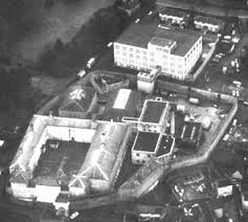
View of Shepton Mallet (left) and its execution shed (right)

Shepton Mallet had been a civilian prison for centuries before being turned over to the British military, who then lent it to the Americans as part of the Visiting Forces Act. Until its final closure a few years ago Shepton Mallet remained the oldest prison in the UK still operational, a dubious distinction now belonging to Dartmoor. There were, however, a few difficulties with the arrangement.

The Americans carried out 18 executions at Shepton Mallet during their tenure between mid-1942 and September, 1945. Two (Alex Miranda and Benjamin Pyegate) were by firing squad, upsetting local people, who knew very well what it meant to live next to a military prison and hear a single rifle volley at 8 a.m. The American military also preferred hanging common criminals to allowing them to be shot like soldiers.

The problems were simple. The locals didn’t like firing squads made no secret of it. Not surprisingly, there were complaints. The US military felt being shot was too good for most of its condemned and the British didn’t like the methods and equipment used by American hangmen, who had acquired a nasty and thoroughly-deserved reputation for using badly-designed scaffolds, the wrong type of rope and the antiquated standard drop instead of a drop length scientifically calculated by the prisoner’s weight.

The British also regarded American hanging equipment as outdated, while American military hangmen John Woods and Joseph Malta were entirely unfamiliar with the British kit. And British hangmen had evolved hanging to almost an art, needing mere seconds to complete the procedure.

Another problem was that the gallows at Shepton Mallet hadn’t been used since March, 1926. By 1942 it was considered unfit for service and needed replacing. A compromise had to be reached, and was.

The Americans could continue executions at Shepton Mallet, but the vast majority (16 out of 18) were performed by British hangmen using a British gallows in an extension built onto the end of one of the cellblocks. The Americans were permitted their usual practice of having the condemned stand strapped, noosed and hooded on the gallows while their death warrant and charge sheet were read out and then being asked for any last words. This caused executioner Albert Pierrepoint, master of the speedy hanging, to complain at what seemed to him a cruel, unnecessary delay in ending the prisoner’s misery.

Pierrepoint also complained about overcrowding in the gallows room during executions. At a British hanging there would be the prisoner, the hangman, his assistant, the prison Governor, the Chief Warder, the doctor, the Chaplain and two or four prison officers. At an American military hanging there were usually twenty or so people clustered around the trapdoors and lever. He felt a hanging should be both quick and perfect and that a crowded gallows room invited disaster.

Hangman Thomas Pierrepoint.

By VE Day the arrangement was well-established. Thomas Pierrepoint, uncle of Albert and brother of Henry (both of whom were also hangmen) performed 13 of the 16 hangings at Shepton Mallet while Albert performed the remaining three when he wasn’t busy elsewhere.

Their assistants were Steve Wade, Herbert Morris and Alexander Riley. Tom Pierrepoint had performed the last hanging at Shepton Mallet in 1926 (that of murderer John Lincoln) assisted by Lionel Mann. While the two firing squads were performed at 8 a.m., the hangings would be carried out at 1 a.m. which was discreet enough not to arouse neighbors’ ire.

Smith’s case was reviewed. Not surprisingly, his appeal was denied as were other requests including (most generously, under the circumstances) one from Lady Teichmann, widow of his victim. His date was set for 1 a.m. on what turned out to be the very day Europe’s guns fell silent. Tom Pierrepoint would do the job assisted by Herbert Morris. Smith was transferred to the Condemned Cell a few days prior to the execution date where he was granted free access to the military Chaplain.

When the time came, while the rest of the population celebrated the arrival of a new world and Smith contemplated his departure from the old one, it went as smoothly as could be expected. Smith was taken from his cell wearing standard military uniform, from which any badges or flashes marking him as a soldier were deliberately removed. Paperwork was completed signifying his dishonourable discharge from the US military as a common criminal and the US military were determined that he should die like one.

Given the delays caused by the reading of the charge sheet and death warrant and Smith being asked for his last words (he apparently had none) it took 22 minutes between Smith being taken from his cell and being certified dead by the prison doctor. Compare this with a standard British execution (minus the bureaucracy and speechifying) where 22 seconds would have been considered twice as long as was needed to do the job. Smith’s punishment, however, wasn’t done yet. Executed American servicemen were initially buried at Brookwood cemetery, but then moved to the notorious ‘Plot E’ of the Oisne-Aisne Military Cemetery in France. Plot E is deliberately hidden from the rest of that cemetery. Its residents have no names on their graves, only numbers. They have no headstones or crosses, only flat stone markers. No American flag hangs in their plot. It doesn’t appear on the plan of the cemetery even today and the markers are placed facing away from the graves of other Americans. Visits to Plot E are still discouraged and it wasn’t until a Freedom of Information request in 2009 that the names of those buried there were released.


A view of the “Dishonored Dead” in Plot E, Oise-Aisne American Cemetery. (cc) image by Stranger20824.

Whatever they may have done, and some committed truly dreadful crimes, it seems distasteful to virtually deny their existence and shame them even after death. It also denied their families and friends the chance to visit and grieve, despite the fact that they themselves had committed no crime.

That said, it’s no different to the routine imposed on condemned British criminals. In fact, the British death sentence expressly demanded that inmates be buried in unmarked graves within the prison walls inflicting the same suffering on their friends and relatives. The British hanged were officially designated ‘Property of the Crown,’ many of whom were not properly reburied until after abolition. At many British prisons they still remain in unmarked graves according to the following sentence:

Prisoner at the Bar, it is the sentence of this Court that you be taken from this place to a lawful prison and thence to a place of execution where you shall be hanged by the neck until you are dead, and that your body be afterwards cut down and buried within the precincts of the prison in which you were last confined before execution. And may the Lord have mercy upon your soul.

Remove the prisoner …

On this day..

2004: Nick Berg, by Abu Musab al-Zarqawi

Twenty-six-year-old American communications contractor Nick Berg was beheaded a hostage in Iraq on this date in 2004 — allegedly by the personal hand of Al-Qaeda in Iraq chief Abu Musab al-Zarqawi.

A veteran of the mujahideen who drove the Soviets out of Afghanistan in the 1980s, Zarqawi spent most of the 1990s in a Jordanian prison but was amnestied just in time to rejoin militant Islam before it became a post-9/11 boom industry.

Zarqawi’s Jordanian terrorist group Jama’at al-Tawhid wal-Jihad, founded in 1999, transitioned with the American invasion of Iraq into the Al-Qaeda franchise in that country, a feared prosecutor of the sectarian civil war there, and the lineal forbear of the present-day Islamic State (ISIS or ISIL).

It also became a lusty early adopter of the emerging beheading-video genre: an ancient penalty perfectly adapted for the digital age.

This ferocious group was a severe mismatch for Berg, a Pennsylvanian freelance radio tower repairman (and pertinently, a Jew) who set up his Prometheus Methods Tower Service in the northern city of Mosul* in the months following the 2003 U.S. invasion. This was also around the time that American occupation forces’ abuse of Iraqi prisoners at Abu Ghraib came to light — a powerful excuse for blood vengeance.

Berg vanished from Baghdad in April 2004, and was not seen in public again until the whole world saw him: the unwilling feature of a May 11 video titled Sheik Abu Musab al-Zarqawi slaughters an American infidel with his hands and promises Bush more.

“We tell you that the dignity of the Muslim men and women in Abu Ghraib and others is not redeemed except by blood and souls,” a voice says. “You will not receive anything from us but coffins after coffins … slaughtered in this way.”

Warning: Mature Content. This is both a political document of our time, and a horrifying snuff film. Notice that Berg appears in an orange jumpsuit, a seeming allusion to Muslim prisoners being held by the United States at Guantanamo Bay.

Twenty-five months later to the day, Zarqawi was assassinated by a U.S. Air Force bombing.

* As of this writing, Mosul is occupied by Zarqawi’s creation, the Islamic State.

On this day..