On this date in 1858, youthful delinquent James Rodgers was hanged in New York City.
The 19-year-old Irish immigrant Rodgers, according to the New York Herald‘s Nov. 13 post-hanging review, was one of a gaggle of ne’er-do-wells “well known to the police of the Sixteenth precinct as loungers about the corners.”
Corner-loungers evidently share behavioral DNA with the common high school meathead, for Rodgers (drunk on rum) precipitated his trouble by carrying “his arms a-kimbo, so that one elbow hit [John] Swanston violently as he went by him.” Swanston, a respectable burgher returning from market with his wife, didn’t take kindly to this territory-marking, and exchanged words with Rodgers until the punk terminated the conversation by planting a knife between Swanston’s ribs. The unfortunate gentleman, perhaps second-guessing his decision to make such a big deal over the elbow, expired painfully in the street as witnesses rushed to the scene.
If the Herald is to be believed, a concerted clemency push (including author Caroline Kirkland, who called personally on Gov. John King) went begging owing to a general public outcry against corner-lounging Irish hoodlums and their a-kimbo elbows.
Even though Rodgers was hanged in private in the Tombs, New Yorkers strained the roofs of nearby buildings (at ten to fifty cents per head) just to get a glimpse of him being walked to the gallows with the rope picturesquely around his neck and whatever else they could peep over the walls.
Reportedly contrite (he slept on the stone floor of his cell and ate bread and water by way of self-mortification), prayerful, handsome, and at the gallows unflinching, the youthful Rodgers died game … and also harrowingly.
The Tombs was already by this point employing a gallows that jerked the condemned upward rather than dropping him through a trap: the idea was that this method would humanely kill the wretch on the first strike of the knot.
That was not the case for James Rodgers.
By the time the executioners axed through the rope restraining the counterbalance and the fall of a 250-pound lead weight yanked Rodgers into the air, the noose’s knot had slipped to the nape of the culprit’s neck where it would fail to deliver a lethal fracture. The killer twisted and fought horribly for some eight minutes as he strangled to death, even freeing his right hand from its restraint and with it tearing at his heart. “Sickening to behold,” reported the New York Times.
So, that was James Rodgers. Like many murderers of the time, and especially those who could be constructed as sympathetic people led astray by drink, the man got himself a hanging ballad, “The Lamentation of James Rodgers.”
This ditty appears to have been appropriated, meter and lyrics alike, a generation later for the ballad “Charles Guiteau” — whose subject is the nutter assassin of President James Garfield. Guiteau hanged in 1882.
It’s pretty striking, really, even if not unusual for the genre; the lyrics show a line-for-line lift.
Lamentation of James Rodgers
Come all you tender Christians,
I hope you will draw near,
And likewise pay attention
To those few lines I have here:
For the murder of Mr. Swanston
I am condemned to die,
On the twelfth day of November
Upon the gallows high.
My name is James Rodgers
The same I ne’er denied,
Which leaves my aged parents
In sorrow for to cry,
It’s little ever they thought
All in my youth and bloom,
I came into New York
For to meet my fatal doom.
Charles Guiteau
Come all you tender Christians
Wherever you may be
And likewise pay attention
To these few lines from me.
For the murder of James A. Garfield
I am condemned to die
On the thirtieth day of June
Upon the scaffold high.
My name is Charles Guiteau
My name I’ll never deny,
To leave my aged parents
To sorrow and to die.
But little did I think
While in my youthful bloom
I’d be carried to the scaffold
To meet my fatal doom.
Here’s the Garfield version … as the guilt-ridden young tough James Rodgers is not much remembered on YouTube.
On this date in 2009, D.C. sniper John Muhammad was executed by lethal injection in Virginia.
Muhammad — born John Allen Williams; he renamed himself after joining the Nation of Islam — authored with Lee Boyd Malvo, a juvenile collaborator under his sway, a spree of random sniper attacks around the Washington D.C. suburbs that terrified the nation’s capital in October 2002.
The two were captured together sleeping out in their sniper-mobile — a Chevy Caprice with a hole drilled in the trunk for taking concealed potshots at gas stations and mall parking lots and the like. Although arrested initially in Maryland, the U.S. Attorney General forced their case to the more aggressive death penalty jurisdiction of Virginia. (The two killed people in both states, tallying 10 dead and three wounded all told.)
From the time of his Oct. 24, 2002 arrest until the very end, Muhammad was frustratingly tight-lipped about how and why the carnage took place. Was it personal pique? Religious terrorism? Just a regular criminal racket?
In 2006 testimony, a now-contrite Lee Malvo — at one point he addressed Muhammad directly, saying “You took me into your house and you made me a monster” — outlined a plan that constituted a fearsomely nutty combination of motives: use the mayhem to extort millions of dollars, then take the money and set up a Canadian camp for 140 homeless black youth and rear them as terrorists. It’s just possible that this proposed enterprise pushed every single button in the collective American id.
(Malvo himself pled out to the murders, accepting six life sentences.)
Though executioners don’t quite bat 1.000 — who does, at any human endeavor? — the field on the whole succeeds more often than not.
On this date in 1864, the Confederate guerrilla John S. Mosby had seven Union prisoners executed, but he only managed to kill three of them — an efficiency very well below the Mendoza Line for the executioner’s trade.
It was a rare competence gap for the brilliant cavalryman.
The irregulars Mosby commanded in the Shenandoah Valley had frustrated for six months the consolidation of rampant northern armies, thereby preserving the Confederate capital of Richmond and extending the Civil War.
The situation had quick become intolerable for the Union, and Gen. Ulysses Grant emphasized (pdf) to Gen. Phil Sheridan the cruel anti-insurgent tactics he would countenance for “the necessity of clearing out the country so that it would not support Mosby’s gang. So long as the war lasts they must be prevented from raising another crop.”
Incensed, the Confederate “gray ghost” began stockpiling blue bodies from the offending command of George Armstrong Custer — yes, the Little Bighorn guy; he was perceived by Mosby to be responsible for the atrocity, although the actual paper trail on the execution order seems to be a little sketchy.
Mosby, who fancied himself the genteel sort who would closely abide the laws of war when fighting for the right to maintain human chattel, sent a lawlerly appeal up the chain of command seeking permission “to hang an equal number of Custer’s men.” General Robert E. Lee and Confederate Secretary of War James Sedden granted it.
The preparations began innocently enough on a quiet Sunday morning (November 6, 1864) when 27 Union prisoners of war were ushered with no explanation about what was happening out of a brick storehouse located in Rectortown, Virginia …
[They] were then marched to the banks of Goose Creek, about half a mile away. some, but definitely not all, of this specially selected pool of 27 prisoners belonged to Custer’s commands both past and present … [but] of the seven men eventually selected to die on Mosby’s orders only two were actually members of the Michigan Cavalry Brigade.
All 27 of the prisoners were lined up along Goose Creek and then made to draw slips of paper from a hat. Twenty of those slips of paper which were part of the macabre lottery were simply that, blank pieces of paper. The other seven — one for each of Mosby’s men executed at Front Royal and in Rappahanock County — were marked with a number …
Of the men who were forced to draw those slips of paper, some of them simply stared into space. Others, once they understood what was happening, prayed. There were a few of them who simply broke down.
Among the prisoners was a young drummer boy … who broke down completely, sobbing … He drew a blank slip and immediately proclaimed: “Damn it, ain’t I lucky!” When a second drummer boy was found to be unlucky enough to have drawn one of the marked slips of paper, upon the request of the men who had been spared, Mosby personally ordered the boy to be released from the seven condemned prisoners and the 18 remaining prisoners (excluding the first drummer boy) drew from the slips of paper for a second time.
Then one of the seven adults also got himself swapped out of the scrap by flashing a Masonic sign at a Confederate lodge member. The things that stand between life and death.
Out of the nine to come under death’s pall and the seven who were actually marched overnight to the place of execution (as close to Custer’s camp as Mosby dared) only three were there successfully ushered past death’s threshold.
At 4 a.m. on Monday, November 7, 1864 (the day before the election which would give Abraham Lincoln his second term in the White House and would therefore become the signature on the death warrant of the Confederacy), the Rangers and their prisoners reached the execution site in Beemer’s Woods, a mile west of Berryville, and the executions were carried forward. However, everything did not go exactly according to plan.
In the pre-dawn darkness and confusion (either through carelessness or lack of caring for their orders, since none of the prisoners had actually been involved in depredations against Confederate civilians) the Rangers allowed two of the seven prisoners (one of whom, G.H. Soule, 5th Michigan Cavalry Regiment, punched out a guard) to escape outright. Two other prisoners were apparently shot in the head, but surviving, having only been grazed, also escaped since they pretended, and were apparently believed, to be dead. The remaining three prisoners were hanged. The identities and whether or not these three prisoners were members of either Custer or Powell’s commands are unknown. Lt. Thompson, in accordance with his orders attached a placard to one of the hanged men (just as similar placards had been attached to the bodies of all three of Mosby’s hanged men). Mosby’s placard read: “These men have been hung in retaliation for an equal number of Colonel Mosby’s men hung by order of General Custer at Front Royal. Measure for Measure.”
Believing his purpose accomplished, or at any rate close enough for rebel government work, Mosby then wrote to Union General Sheridan justifying the action and assuring him that future “prisoners falling into my hands will be treated with the kindness due to their condition, unless some new act of barbarity shall compel me, reluctantly, to adopt a line of policy repugnant to humanity.”
The letter, and the 3-out-of-7 reprisal, actually worked — with no further measures exacted for measure or tits given for tat. For the waning months of the war the rival forces confined themselves to killing one another on the battlefield, and not in the stockade.
Well, mostly: one of the conspirators in the plot to assassinate Abraham Lincoln in April 1865 — which did assassinate Lincoln, but was really a wider attempt to decapitate the entire northern government — was a former Mosby’s ranger named Lewis Powell aka Payne. Lincoln killer John Wilkes Booth also seemed to flee in Mosby’s direction (Mosby’s units were still in the field, not covered by the April 9 Appomattox surrender.) There exists an unproven but delicious speculative hypothesis that the hand of John Mosby was among those behind an exponentially more ambitious “line of policy repugnant to humanity.”
Be that as it may, Mosby actually became a Republican after the war — for which he received some Southern death threats — and lived fifty eventful years. Among other things, the aged Mosby regaled the young George Patton (whose father Mosby knew) with Civil War stories.
On this date in 2005, Brian Steckel was executed by lethal injection for a Delaware rape-murder.
Steckel got 29-year-old Sandra Lee Long to let him into her apartment on the pretext of making a phone call. (This was 1994, pre-cell phones.) Then he throttled her, sodomized her, raped her with a screwdriver, and set her bedroom on fire. Then he fled. (Long survived the immediate attack; she would die of smoke inhalation from the arson.)
Hours later, he called The News Journal identifying himself as the “Driftwood Killer” and threatening his next prospective victim by name. Police took that woman into protective custody and traced harassing calls she’d been receiving to Steckel, who obligingly confessed when arrested.
And investigators took Steckel’s threats at their word — as well they might with Long’s ghastly murder already under his belt — and counted themselves lucky to have nipped a potential spree killer in the bud. Steckel “thought about committing a murder for a long time,” New Castle County detective John Downs said. “We got him relatively early in his career. This was something he’d worked at.”
Fond of the drink and none too stable, Steckel menaced his own attorneys, spat at prosecutors, soaked up the media attention, and sent dozens of letters from prison, including Long’s autopsy sent to Long’s mother with a scribbled taunt reading “Happy, Happy. Joy Joy. Read it and weep. She’s gone forever. Don’t cry over burnt flesh.” He also made and retracted various dubious confessions to various murders in various states, and alternated between slandering his (known) victim and calling himself an “animal” for killing her.
If the evil was unfeigned, so was the remorse. At the end of his trial, he surprisingly addressed the the jury with an assent to his own execution.
I didn’t know how to say I’m sorry. How do you tell someone’s family you’re sorry for strangling them? … How do you do such a thing? I don’t know. I ask you people to hold me accountable for what I did. I’ve gotten away with so much in my life that I stand here today … I know I deserve to die for what I did to Sandy. … I’m prepared to give up my life because I deserve to.
He carried a like sentiment to the gurney, where he was apologetic to the victim’s mother he had once mocked.
I want to say I’m sorry for the cruel things I did. I’m not the same man I was when I came to jail. I changed. I’m a better man … I walked in here without a fight, and I accept my punishment. It is time to go. I love you people … I’m at peace.
At this point where the repentant felon ought to close his eyes and exit, an awkward 12-minute delay followed while the lethal injection machine clicked several times and Steckel remained lucid, appending his last statement with observations like, “I didn’t think it would take this long.”
While state officials denied there was any problem with the exceedingly slow lethal injection, Steckel did not appear to have been rendered unconscious, and was awake when he finally snorted and convulsed into death.
Attorney Michael Wiseman, pursuing a later lawsuit against the state’s death penalty procedure, claimed that the main IV line was blocked and when executioners switched to the backup line, they didn’t bother (pdf) re-administering the anesthetic sodium thiopental that forms the first drug of the basic three-drug lethal injection cocktail. That omission meant that Steckel would have been conscious when he was hit with a paralytic dose of pancuronium bromide, and still conscious when that was followed with an excrutiating heart-stopping shot of potassium chloride. (More on the process.)
Wiseman even got a member of the execution team to testify that he was “okay with” causing Steckel suffering owing to the bestial nature of Steckel’s crimes. (The source for this is the January 29, 2009 News Journal; the article is no longer available online.)
A federal circuit court rapped Delaware for “occasional blitheness” and “isolated examples of maladministration,” but rejected the lawsuit.
After a five-plus year hiatus following Steckel’s execution, the Blue Hen State resumed executions in 2011, switching for the occasion to the trendy new anesthetic drug pentobarbital since execution chambers can no longer get hold of sodium thiopental. Just like Brian Steckel.
That’s far and away the most for governors under the modern US death penalty regime. But is it an all-time record?
Rick Perry is number one.
The answer appears to be “yes”: a review of state execution data reveals no other governor throughout the U.S. constitutional era who even approaches Perry’s body count, at least not when it comes to peacetime civilian cases. Only two other men — Perry’s predecessor George W. Bush, and Depression-era New York chief executive Herbert Lehman* — appear to have signed off on as many as one hundred executions.
In attempting to explore this question, I compiled this rough list of the U.S. governors who have overseen a large number (35+) of executions. Emphasis on rough. The method I’ve used here is just a quick manual comparison of the historical U.S. executions recorded in the Espy file to U.S. governor terms as reported on Wikipedia. Then, I backed out known federal executions, which for most of U.S. history took place in various state prisons. (For instance, Ethel and Julius Rosenberg were electrocuted at Sing Sing in New York … but not by authorities of the Empire State.)
I would not suggest sourcing anything one depends on to the figures in this chart without further investigation and qualification; the list is certain to contain errors, including:
Omissions or mistakes by the Espy file itself.
Miscalculations or misdating on my part.
Governors who served non-consecutive terms who I’ve failed to identify.
Any consideration of governors who might have been temporarily incapacitated or absent during their term with another party exercising the relevant powers in their stead
Civil War executions, which I simply steered around
Beyond attributing numerical counts to date ranges, this list reflects essentially no state- or period-specific research: it’s worth bearing in mind that the legal context and gubernatorial authority relative to the death penalty vary over time and between states. A name and a number on this list is not the same as judging a governor personally “responsible” for all or any of those executions, not even necessarily to the extent of having signed off on a death warrant. It’s only in the late 19th century and into the early 20th century that states centralized all executions away from localities and into state penitentiaries, with the familiar appeal-for-clemency ritual. A given governor’s personal involvement in a given local execution prior to that (and particularly in antebellum America) is not to be assumed. Even now, some states (present-day Texas included) limit the ability of the governor to extend clemency, or vest that power in an agency.
Caveats aside, here’s that rough (rough!) list:
The large numbers here predictably map to large states (with lots of people to commit lots of crime and generate lots of death cases) and/or long-serving governors. Rick Perry is about to start his 13th year as Texas governor, and this is actually a remarkably long tenure. Most governors in U.S. history have held the office for surprisingly brief periods, just 2-4 years.
For example, post-Reconstruction Jim Crow Georgia executed at a terrific pace (routinely ten or more executions per year, for decades on end) and several of its governors therefore appear on this list … but those governors had what you might call limited upside, as they were term-limited to two consecutive two-year terms. Had Georgia ever put an executive kingpin in the governor’s mansion for a decade or more, that person would easily rank up there with Bush and Lehman. (Not with Perry, though.)
Typical office tenures have somewhat lengthened into the 20th and 21st centuries, but this is just when the execution rate itself has fallen off. Many of the larger (50+) execution totals come from the period when those two trends crossed in the first half of the 20th century, with men (Ann Richards, George W. Bush’s predecessor, is the only woman to show) running large states for five-plus years.
This confluence also leads to the interesting appearance of liberal lions among the 20th century’s most prolific American executioners:
Liberal “Rockefeller Republican” Thomas Dewey, with 95 executions as New York’s governor.
Dewey’s running mate in the “Dewey Defeats Truman” presidential election, Earl Warren: he sent 82 to the gas chamber in a decade as California governor before he was appointed to leave his lasting legacy heading a left-leaning Supreme Court
Franklin Delano Roosevelt, who okayed 51 executions as governor of New York (and then 16 more federal executions as president)
Gifford Pinchot, who’s best known as the progressive-era father of the Forest Service, but also spent eight years as Pennsylvania’s governor and oversaw 81 executions.
Feel free to chime in with corrections, data points, musings, and bootless speculations in the comments.
* Herbert Lehman was the son of one of the founders of Lehman Bothers investment bank. Bush was the son of the founder of the inexplicable Bush political dynasty. We’re guessing nobody thought of their prolific-executioner connection when the Bush administration let Lehman Brothers go bankrupt in 2008.
On this date in 1858, a slave named Henry — property* of a local farmer named William Jackson — was hanged in Decatur, Georgia for attempted rape.
We have of this occasion a first-person account from a 16-year-old white neighbor of the Jackson farm, Catherine Hewes, and the impressions she recorded of it that evening are reprinted by John C. Edwards in “Slave Justice in Four Middle Georgia Counties” in the Summer 1973 Georgia Historical Quarterly. A few additional paragraph breaks have been added for readability, and [sic] notations where necessary either by myself or by Edwards; however, there are many other minor language irregularities not worth individually noting, and simply presented as-is.
The Execution of Henry Jackson a slave of William Jackson at Decatur Ga. at an early hour this morning I dressed myself and prepared to accompany my brother and Sister to Decatur, a beautiful village an [sic] the County site of DeKalb county Ga. As we lived four miles south of Decatur we crossed the Georgia R Road in sight of the village, where we stopped a few moments to enquire where the gallows had been located and were infomed that it was situated one mile north of the Court-house on the Shallow ford road.
By ten Oclock a great many people throned the streets, and clustered around the old weather beaten jail. Our little company had beome quite a respectable crowd before we reached the Public Square where we drove slowly through the immense mass of living beings. All along the way form the Court-house to the gallows Carriages, Wagons and carts were seen bearing on their living freight to the scene of the execution. The high and low the rich and the poor the free and the bond alike pressing forward to the gallows their desires of seeing the law enforced and crime meet its own reward.
After a slow tedious drive we arrived at the appointd place where the rough benches had been erected in an old field whos [sic surroundings were on the amphitheater order. For several hours I had been pleasantly situated and with good company which caused thime [sic] to pass by almost imperceptibly but when I was confronted by a “gallows,” the simple construction of which was two upright posts and a cross beam from the top of the posts I viewed it with horror.
My reflections gushed forth when my eye took in the surroundings. On one side of the gallows were the colored people and on the other side the white people who had gathered on the little hillock. It was quite gratifying to the feelings to see the willingness of slave owners to teach their Slaves an important lesson by sending them here to day. The gallows, yes here on this gallows ill-fated Henry, will have to give up his life for crime and go to his long home with God in eternity.
In the midst of my reflections I saw a vast crowd of people coming from Town toward the gallows[.] It was announced that “They are a coming.” and I looked and saw on [sic] Ox-cart coming on which rode the unfortunate Henry dressed in a suit of white sitting by the coffn which was to incase his lifeless form. They drove the Ox-cart near the gallows, then the drive unhitched the Sturdy oxen and proceeded to direct the cart by hand.
The Sheriff plased [sic] his guard and when the cart stopped under the gallows by the platform a negro man ascended the stand and sang Hymns. Many joined in singing aloud the praises of God, while I stood gazing on in amazement. At the conclusion of the Hymn he offered a very appropriate prayer which seemed to affect a great many. When he raised up from prayer he began exhorting the people from Acts 6-23 — “For the wages of sin is death, but the gift of God is eternal life through Jesus Christ our Lord.” [sic — she means Romans 6:23] When he had ended his discourse, the Rev. Jns. W. Yarbough got up and made a short, but very appropriate exhortation.
They closed the religious services, but the convict desired to speak to the people. His discourse was very affecting, so much so that some of the black women shouted praises to their immortal King. The mother of Henry screamed aloud and shouted with vehemence while her son stood on the platform speaking to the auditory. At the conclusion of his remarks the Officers began to fix for his execution. The Sheriff, Capt John Jones, a capital man, was very much affected during the Scene. They first tied his feet together, then his hands, and then adjusted his clothing. The Sherff then permitted him to look over the vast multitude which surrounded him for a few moments and then tied a white handkerchief over his face which excluded it from view.
The hangmans Knot was adjusted around his neck then the rope was passed over the cross-bar of the gallows[.]
All things read at 12 N the Sheriff descended the steps to the ground and with help drew the Cart on which the Convict stood from under him — leaving the dangling form of the poor victim suspended in the air by a rope. When the form dropped from the Cart, a loud groan went up from the people and then they people [sic] began to disperse.
After the untwisting of the rope and the shrugging of the shoulder had ceased the Dr. E N Calhoun (I believ [sic]) approached and took hold of the hand and after a few moments announced that life was extinct. We came back to town and staid [sic] a few hours, and while at the Old Washington Hotel Kept by Mr. Banks George, I saw the Sheriff Mr Jones bring the corps [sic] back and carry the coffin up a flight of rickety steps to the door of the second story of the jail and deposit it therein. Doubtlessly the Doctors will take advantage of this subject for anatomical investigation, and be found with sleeves rolled up chatting over the mortal remains of this deluded victim. We left town with Mrs Parker, masters Bob and Miss Betsy, and got home before night.
Cottage House DeKalb Ga.
Catherine M. Hewey
November 3, 1858
* Henry was William Jackson’s only slave, and the latter was not compensated by the state for Henry’s execution: it was a substantial loss to the master.
On this date in 1912, investigative reporter Emile Gauvreau saw George Redding hanged at the Connecticut State Prison in Wethersfield.
“When I left the prison to write my story,” Gauvreau later wrote in his memoir My Last Million Readers,* “I found out why newspapermen drank and I had my first half tumbler of cognac.”
Gauvreau was 21 years old, and he wasn’t a pup any longer.
This hard-charging journo from a rough-and-tumbler age would later make a name for himself pioneering the lowbrow Big Apple tabloid style with his New York Graphic. (“The PornoGraphic”, it was nicknamed.)
And he made his bones for that classic career in newsprint — from high school dropout to cub reporter to the heights of the profession — by making bones of George Redding.
The case was the mysterious February 1912 murder of a Hamden produce peddler by the name of Morris Greenberg. Greenberg was lured to a wooded area en route to buy from a local farmer and shot dead there for his cash. Police were stumped.
Gauvreau at the time was busting hard at the police desk of the New Haven Journal-Courier (since merged into the New Haven Register). He took a page from Sherlock Holmes and went to work on the sensational case freelance … painstakingly eliminating Hamden residents until he was left with George Redding.
Redding was a young man on the make himself, a charming 21-year-old playwright who’d been throwing a lot of money around lately and was known to carry a sidearm.
Circling his friends and paramours, Gauvreau sealed the young man’s fate by laying hands on a damning confessional that Redding had sent a friend. Gauvreau even stage-managed the arrest so that he could shock rival papers and police detectives by breaking the whole story in his paper. All that was left for police was extracting Redding’s confession.
This date in 1885 saw the hanging in Grand Forks, North Dakota* of 19-year-old farmhand George Miller for butchering his employer’s wife and child in order to loot the farmhouse while the patriarch was away.
For this terrible American Gothic crime, we turn to the American Press.
Miller was the first person hanged in North Dakota and the local Grand Forks Herald marked the date with a voluptuous recounting (occupying an entire page, plus two more columns on the next page) of the late scandal all the way to the felon’s scaffold accusation. Here it is, in its entirety …
In the middle of last January when all the earth was wrapped in a mantle of purity, an esteemed minister of the gospel, the father of a bright family of children and a devoted husband with a loving wife, resided on his prosperous farm in the township of Inkster, this county, surrounded with the 320 broad and fertile acres, horses and cattle and improved farming implements he called his own. His earthly possessions he had acquired by industry, thrift and economy, with the wifely assistance and the aid of the little boys and girl that had blessed their union. This gentleman was Rev. C. Y. Snell at one time minister of the Baptist church in Grand Forks, but who had, like nearly all settlers in Dakota taken advantage of his rights and acquired a farm, which had brought a handsome return. His summer’s work done, his grain garnered, he had sent three of his children to Grand Forks to acquire a good education in her public schools, and remaining at the farm, was his wife Abbie and little son Herbie, aged eleven, and the hired man George Miller, a young man of quiet demeanor, aged about 19 years, who had helped to garner the summer’s fruits and whom both Mr. and Mrs. Snell had implicitly trusted.
Thus situated on the 16th of January, Rev. Snell bade his wife and son good-be, little dreaming that the
SHADOW OF THE DEMON
was in his door and before another fortnight his loved ones would be prone, stark and mangled in the icy embrace of blood and horrid death. He went on his errand of good will to Mayville where he was engaged in missionary labor for his Lord and Master. On the 31st of January, two weeks after his absence, he received a telegram informing him of the doleful event — the murder of his wife and boy, and he hastened with bowed form and bleeding heart to the spot where the light of his joy had been ruthlessly extinguished.
OH RUEFUL SCENE!
The demon had done his worst! Have not the details of that heartless butchery been told again and again? Why not draw the veil upon the foul deed? The ghastly corpses of the innocent and unsuspecting sleepers — mother and son, hurled into eternity in a moment while taking the repose of the righteous — as found there by the neighbors a week after the tragedy — divulged the heartlessness of the assassin whoever he might be, and the thorough depravity of the soul that could impel the ruthless ax to deeds of death.
THE VILLAINOUS SHREWDNESS
with which the murderer had avoided suspicion was manifest in the fact that so long a time had elapsed before the discovery of the crime, and will be further apparent as the story progresses. He had been a companion of Henry Rutherford and to avoid immediate discovery, Miller the confessed criminal, had told the nearest neighbors that he intended to give Mrs. Snell a drive on Sunday and that he would haul wood the following week. Thus no suspicion was aroused until late in the week. Friday, Rutherford a simple, untutored laborer who lived alone at Bennett’s place about 60 rods from the Snell residence, thought it strange that there was no stir or animation about the place, and after finding the stock nearly famished, and watering it, alarmed the neighbors and the dreadful truth was discovered. The neighbors H.P. Reiton, Simeon, Miller, C.G. Gordon, Mr. Vietch, Henry Blakely and others found the dead bodies undisturbed and the rifled trunk with its empty money box and the robbed children’s bank just as the murderer had left them. Thus it was plain
THE MOTIVE WAS MONEY —
the sordid lust for gold that causes men to imperil their souls and makes of earth a probationary sheol for evil minds. Mr. Snell had sold considerable grain and when he left he took $300 with him, leaving some money, together with some keep-sakes and the children’s savings in the cash-box in the trunk. After he had gone, Miller sold more wheat and received from agent Holden $205, which he may have turned over to Mrs. Snell or not. But that the robbery of Mr. Snell in some way, was in his mind for a week before the crime was committed is shown by the testimony of Mr. Holden to the fact that Miller asked him a week before, whether he could deliver a load of wheat unknown to Mr. Snell and it further shows that the idea of robbery did not originated with Rutherford at a dance on the 20th of January, only four days before the murder as Miller claimed in his statement before the judge. It shows that the robbery was in contemplation by him without an accomplice and, being ignorant of the fact that Mr. Snell had taken $300 with him to Mayville, he doubtless committed the crime for more money that he received —
FLEEING FROM JUSTICE
After committing the crime, he hastily placed the ax beneath the bed, threw up the bedclothes over the faces of the dead, robbed the trunk of its keep-sakes, harnessed the best pair of horses in the stable, took Snell’s driving gloves and drove forty miles over the cold bleak prairie with the thermometer at 30 degrees below zero, arrived in Grand Forks at break of day Sunday morning in front of the Northwestern Hotel and ordered the team put away and his breakfast prepared. In the sled-box was an overcoat of the boy he had murdered which had probably been left there when the unsuspecting youth last accompanied him in the delivery of the wheat the proceeds of which he contemplated stealing. There was also left there the overalls which Miller had worn and upon which bright specks of blood had been discovered and whose dumb voices cry out testimony against the last black lie of the series which the obdurate murderer coined in the cell against poor simple Rutherford. With the team was Snell’s faithful dog, which followed the fleeing assassin. Upon his arrival here, he commenced a series of ingenious but
BASE COINAGES TO EVADE PURSUIT.
He told Powery, the clerk at the Northwestern Hotel, that he had come to meet his brother at the train and he might go to Winnipeg for a week. He also exhibited some gold pieces which he wanted changed, but the clerk had no change. The design of this story was too evidently to direct pursuit towards Winnipeg, if the team were soon identified as Snell’s. He soon walked off seemingly unconscious of any obligation to pay for his breakfast and next called at the Chicago clothing house, rousing Mr. Ephraim out of his late Sabbath repose. He told Mr. Ephraim a different tale. He was thrown of[f] his guard by the sharp questioning of Ephraim, while selling him the buffalo overcoat, black valise, pocket book, and other out-fit that later led to the capture and identification. He explained the possesion of his roll of bills, amounting to several hundred dollars by saying that he had sold a team of horses receiving $275 for it and intended to go to Turtle Mountain, thus evading the true objective point. He also got rid here of the tell-tale keep-sakes, the gold dollars which Mr. Snell had treasured for years, and the nickles, dimes and quarters which the little Snells had perhaps been years in gathering. Being shown the way to the barbershop of Mr. Kruger by Mr. Ephraim, after he had bought his disguise, he further changed his apperance by getting his hair cut close and his face shaved. Here he left the only clue to the direction in which he was intending to go, by inquiring whether a train left for Crookston, and up to the discovery of this fact by a HERALD representative, the officers seemed to be impressed with the fact that he had really gone to Winnipeg to which point as well as others they telegraphed as soon as it was learned that the team was left in this city. It must be remembered that it was not until the following Saturday that the tragedy was made known and in that time the murderer might have left the country, if he had not been paralyzed by his own wickedness and depravity. Learning at the barbershop that no train left for Crookston on Sunday, he walked to the station on the railroad track and bought a ticket for Fargo, displaying the new red pocket book to the agent. After spending a few days at Fargo among variety women, and having had his picture taken by a photographer, he went to Brainerd, Minn., where he stopped at the house of Malcolm McLaren for a few days more.
I’d be very surprised if our suspect was from Brainerd.
While at Brainerd, he associated with women of loose character and spent considerable money lavishing presents upon them. It seems that he met a female there whom he had formerly known in Iowa. At first he talked to Mr. McLaren about going into business. He wanted to do chores, when he learned that his money was nearly all gone. The St. Paul papers on Sunday morning following the discovery contain accounts of the murder with description of the hired man of Snells, but imperfect, as his disguise was not known, but when the statement of the Northwestern clerk about the gold pieces was published, Mr. Ephraim at once reported the Sunday morning transaction and it was thus that
HIS SIN FOUND HIM OUT.
His new outfit together with the way he had disguised himself were immediately telegraphed to the associated press by the HERALD and with it a statement of the reward offered. When the papers arrived at Brainerd, Miller had quietly decamped, realizing that he was too near the scene of the tragedy. But McLaren, an old detective immediately concluded that the fellow who had staid [sic] at his house was the person sought, and securing a deputization from the sheriff, he drew money for an indefinite trip, learned that Miller had boarded the train with a ticket for Anoka, and followed him up. On the same train went Hartley and another, bent on the same errand and watching McLaren. At Anoka, McLaren happened to strike the bus for the very hotel at which Miller was stopping and he now felt certain of
ARRESTING HIS MAN.
Miller was in his room and armed. McLaren knew the character of the brute better than the inexperienced who put any faith in his pretences during his last days. He concluded to wait till Miller came down, and while McLaren was at breakfast, he heard the murderer’s foot-falls on the stairs and entering the washroom. McLaren immediately left the table and coming up behind Miller with his pistol cocked arrested him, but as he did so, Miller laid his hand on the revolver in his hip-pocket, but the gun of the sheriff had the desired effect and he was disarmed. His attempt to get away from McLaren on various pertexts [sic] and his denial of all knowledge at the start are remembered. It was not until they were in the cars and coming back to Brainerd, that he
CONFESSED HE DID IT ALONE.
The way he happened to weaken was this, McLaren said to him, “Now you may as well tell all about it. I can tell you of a place in the forests where you will never be found, if you get away at the next station.” Miller then told his first story about how he was crazed with drink after being chid by Mrs. Snell, and killed her and the boy, and after getting over his stupor, and seeing what he had done, he stole the money and tried to get away. He reiterated this oft-told tale to Sheriff Jenks and others at Brainerd and again to reporters of Fargo papers, who managed to get up a considerable maudlin sentimentality for him. For prudential reasons, there having been a great deal of feeling that he should be given short shrift and a stout rope, he was kept at Fargo for several days, and finally brought here very quietly and lodged in jail. When it was known that he was in jail and likely to be tried speedily and executed according to law, popular excitement over the enormity of the crime subsided. The Rev. J.T. Davis and Rev. Snell, at an early day obtained an interview with Miller, and he reiterated the intoxication story as before in their presence, calling upon God to strike him dead if his story was not true. He also as positively stated to the gentelemen that he alone did the crime and no one was concerned with him in it.
It was not until after the Grand Jury had found a bill that this mild, child-like and bland assassin,
CHANGED BASE.
He then asserted that Henry Rutherford was with him, concocted the idea of robbery and urged it against his wishes, until he was finally persuaded to connive and assist, although Rutherford he said, actually did the horrible deed, while he did the running away to South America. In the face of his former statements this story only seemed to aggravate his villainy. However, able counsel, Judge C.B. Pratt, was assigned him and every thing that legal subtlety and experience could avail, was rallied to save his neck from the law’s penalty. The people, however, were fortunate in having so learned and able a coadjutor as District Attorney W.A. Selby and so just and firm a judge as Hon. W.B. McConnell; for, notwithstanding the able, artful and persistent defense made by Judge Pratt, justice was vindicated. Upon the defendant’s own plea of “guilty,” ascertained, verified and corroborated by all the witnesses, who fully and completely exonerated Rutherford from the suspicions cast upon him, and satisfied the conscience of the court, sentence of death was passed upon him and his appeal to the higher court sent back with an approval of the action of the District Court. His statement to the Judge, when informed of this action, suggesting some new matters not before mentioned, is still fresh in the recollection of everybody.
The last few days of his life seemed to have passed by him in a happy, careless, indifferent and easy frame of mind. He talked freely about his own execution, expressed no great sorrow or penitence for, at least the part he played in the atrocious crime, but pretended that he was glad the end was so near. His spiritual advisor, Rev. F. Doran conversed and prayed with him and did all in his power to turn his thoughts towards that awful Judge who hath decreed that “whoso sheddeth man’s blood, by man shall his blood be shed.”
HIS LAST NIGHT
on earth was uneventful. About eight o’clock he was left alone for a time in his cell and was seen from Bruce avenue to perform various antics, rising suddenly from his chair and jesticulating wildly with his arms as if again swinging the baleful ax which brained his helpless victims. He was restless and this has been observed that when left to himself and his thoughts, he was not the calm, self-possessed person he appeared to be when in the presence of visitors. During the evening, Rev. Snell had an interview with him for about an hour and a half. The prisoner claimed to others that he had succeeded in persuading Mr. Snell of the correctness of his last story. He was set up with by Deputy Sheriff Ackerman and others until after midnight. At one o’clock he retired and at 7:30 this morning he arose apparently refreshed. He ate a hearty breakfast consisting of beefsteak, potato, cake, etc. His cell has a window pane out and the wind being in the south, Miller was cold and was brought down into the office where he smoked a cigar, one of a number left him some days ago by some women who called upon him and were recognized by the prisoner as old acquaintances. The district attorney was present and inquired further about portions of Miller’s statement made to Rev. Doran. Presently Sheriff Pierce of Nelson county and friends came in, also County Commissioner Steele, Henry Rutherford and Mr. Vietch. Rutherford was told that Miller still insisted upon his story and was asked what he thought of it. He said, “then Miller lies. That is all.” Soon after an interview was had between
MILLER AND RUTHERFORD
in the presence of District Attorney. Miller said to Rutherford: “You know you had a hand in this thing as I have said.” Rutherford, without any trepidation replied: “It is a lie and you know it. I don’t like to be lied about.” Subsequently the statement in the nature of a history of his career and the crime was read in the presence of Rutherford who said nothing. When asked about it, he said it was “no such thing. It was all a dang’d lie!” When asked about the part in which Miller alludes to the false mustache, Rutherford said he had such a mustache but did not think Miller had ever seen it. He said he kept it in his trunk and described it to the district attorney corresponding with the description given by Miller. This circumstance and one in respect to changing wagon boxes, also a statement now made that the Snell stock was not famished, although the witnesses testified that it was, were industriously emplyoed [sic] last night and this morning to weaken the district attorney and cause him to apply for the respite of Miller. Mr. Snell himself after his interview with Miller last night seemed to have been influenced by his story and urged and begged the district attorney to intercede for Miller. Mr. Selby said he could do nothing unless Mr. Snell or some one on his behalf, would swear that Rutherford was an accomplice, when he would take such action as was proper in the cause of justice. Up to noon, Snell had done nothing of the kind. There was also pressure brought to bear from various sources to effect the same purpose, but none were willing to assume any responsibility.
THE LAST HOUR
was spent in the parlor of Sheriff Jenks with Revs. Currie and Doran who administered all the Christian consolation the solemnity of the occasion could afford. They talked to him, prayed for him and he himself made a fervid prayer. His nerve maintained his head erect to the end, which did not seem to fear.
ASCEND THE SCAFFOLD.
At 1:30 accompanied by Sheriff Jenks, he ascended the scaffold. The Sheriff suggested that if he had anything to say he should speak. Miller stood with the rope almost danging in his face, his hands clasped, and his body slightly bent. About two feet in front of him stood Henry Rutherford who, during Miller’s 15 minute talk, kept his gaze firmly fixed on Miller’s face. Rutherford looked like a person suffering great mental strain and slightly changed color at times while Miller was speaking, but his eyes never flinched. Rev. Mr. Snell occupied a position to the left of Rutherford, almost touching him and when Miller alluded to Rutherford’s alleged connection with the murder, Mr. Snell gazed almost fiercely into Rutherford’s face, Rutherford meanwhile keeping his eyes fixed on the doomed man. C.B. Pratt, Miller’s counsel, during the recital of the murderer’s statement, watched Rutherford closely.
Miller spoke with apparent effort and several times during the recital of his story had occasion to put his handkerchief to his eyes.
HIS LAST WORDS.
Gentlemen: — I am accused of the crime of murder which I did not commit. I have not committed murder. I was in company with the party and gave my consent, but gentlemen, I never committed the murder myself.
On the 30th day of January I was in Inkster with Mr. Rutherford. He and I sold 100 bushels of Mr. Snell’s wheat and we divided the money. That night we got home between eight and nine o’clock and Rutherford asked me how much wheat Mr. Snell had and I told him over 200 bushels besides a few loads which I had drawn. He wanted to know how much money was in the house and I told him as near as I could. He wanted to know how we could get it and I told him we could chloroform the folks and get it and he said he would do it. The 22nd, 23rd and 24th we were hauling grain to town and we talked again about getting the money. That night I went down to his house to supper and Mr. Blakely came in and that stopped our talk there. I went to Mr. Snells and that night I had a long conversation with Mrs. Snell and when it got about bed time I went to my room with my lantern and sat down on the bed and pulled off my rubbers when I heard a knock at the back door and went and opened it and Rutherford sad, George are you ready to do that? I said no, I hae had a long talk with Mrs. Snell and she is so good and kind to me that I cannot do it. He says you said you would do it and now you got to do it. He said dead folks tell no tales. He said he would do it and handed me a mustache to put on so folks would not know him and took the axe and went in and I went to the barn and harnessed one horse and was just putting one collar on the other when he came out and said, hurry up George I have done it. I tied the horse and I went in and found them dead. He says hurry up let us get away before anyone happens to catch us moving around so he hurried and got the team hitched up and I went to the house and got the money and gave him an even $100 and took $115 mysel and got what clothes I wanted. I wanted to change my clothes and put on a white shirt, but he said hurry up for I could get what clothes I wanted at Grand Forks. He brought the team up and tied them and I got what things I wanted and he helped me fasten up the storm door. He wanted me to go direct to South America and go right through. Said for me to write him when I got there and he would write me the circumstances here. At this ponit Miller was overcome with emotion and stopped a while.
Now gentlemen, every word hat I have told you is true and now as dear as that family was to me, I never could have consented to murder them as I was used there as their son. I was always treated well; they thought the world of me and I did of them but by the hands of another man’s deed I am to be hung and I am going to my grave and I am thankful that I can trust in God and feel that my sins have been pardoned.
And now I feel that the other party shall receive the same punishment that I have. It is not because I am down on him and it is not for malice but it is just what should be done. As dear and as good as that family was to me I could not go in and murder them. But thank heaven I am willing to die. This world would be no pleasure to me after this and I do not want to go to penitentiary. I am better satisfied to go to my grave. I am fully satisfied and feel that what has been done is just, as that family always used me like a son, always good, always dear in every shape, never refused me money, never refused me anything.
Now, gentlemen, I want you all to remember that this is the truth and nothing else. I won’t meet you any more in this world face to face but I hope we can all meet in the world to come.
When Miller had finished Henry Rutherford turned to District Attorney Selby and asked that he might make a statement of denial.
ADJUSTING THE ROPE.
Sheriff Jenks, who occupied a position on the scaffold just behind Miller, then approached and commenced binding the wretche’s [sic] hands and limbs with straps, and while placing the cap, which was of brown worsted, Miler again commenced to speak, and even while the sheriff was placing the noose around his neck Miller asked his executioner to say “good bye” for him to his friends.
THE DROP.
Barely a second’s time had elapsed from the moment the noose was adjusted before the trap was sprung, so adroitly and neatly did Sheriff Jenks do his work. Miller’s body shot down at 1:45 o’clock with a sickening thud, his neck being broken by the fall. A few moments after the drop the body quivered and the legs were slightly drawn up several times. Life was pronounced extinct 15 minutes after the fall by Coroner Roundwell and at 2:10 the body was cut down and carried into an adjoining cell, where the straps were removed. Shortly afterwards undertaker Caswell took charge of his remains which were interred this afternoon in the cemetery among the unknown sleepers. Thus ends this chapter of the bloodiest and most heartless murder in the annals of Dakota and the murder’s just doom, should be a warning to all evil-doers that there is no mercy for the slayers of the innocent.
MILLER’S STATEMENT.
Following is a statement prepared by Miller and given to Rev. Doran several days since. He swore to it this forenoon before Judge Cochrane, in presence of several gentlemen.
TERRITORY OF DAK.
GRAND FORKS, Oct. 30, 1885.
The last statement and confession of Geo Miller, before his execution in Grand Forks, Oct. 30, 1886.
TERRITORY OF DAK.,
COUNTY OF GRAND FORKS.
I, George Miller, was born in Toledo, Ohio February 17, 1866. My father and mother are both dead; about 12 years ago my mother died and my father 2 years later; have one brother, four years older than myself named Frank, two sisters both younger than I, two and four years; father was Bohemian; mother French; came from Iowa to Casselton last June, 1884, remained there 2 days; from Casselton to Larimore, arriving about the 13th of July, 1884, left there on the 11th, arriving at Mr. Snell’s that evening; at the expiration of four months hired to him for $30.00 a month; never refused to pay me; liked the family; first got acquainted with Henry Rutherford in Mr. Snell’s harvest field. He and I thrashed wheat together in August, 1884; often I met him at Mr. Bennet’s place in the evenings and was with him all through thrashing. Had hauled wheat once or twice before the dance by Brothrs [sic?] Bogs and also by Rutherford; went from Rutherford’s house; I furnished the cutter and he the horse; went together; he and I began to drink together; on the 1st of January took four or five drinks together that day in three different saloons and each took a pint of liquor home with us. The next day Rutherford went to Inkster; came back to “Vietches” where Mrs. Vietch was doctoring him, when Mrs. Snell and Essa Vickery saw him and told me that he was drunk; drank almost every time we went to Inkster; on the 20th of January, 1885, we sold five sacks of Mr. Snell’s wheat; I had 35 sacks of Mr. Snell’s wheat; Rutherford had 20 sacks of his own, we called it 10 bushels; spent most of it for liquor and cigars; changed sacks between the livery stable and saloon; he gave me half the money.
The dance was on Tuesday, the 20th of January; got to the dance about 8 or 9 o’clock, left about 3:30 a.m.; Rutherford asked me how much wheat I had hauled off; told him over 2000 bushels; he asked how much money there was about the house; I told him 6, 7, 8 or 9 hundred dollars; he said can’t we get it; I did not think we could, the trunk was too near the bed; he said we could kill the folks and get it; I did not want to do that, I said wait until we go to town and get some chloroform; Rutherford did not want to do this for fear we would be caught; nothing more was said about it for two days; coming from town I rode with him; he asked me what I thought about what we had talked about; told him it was not right to kill them for a little money;
And for what? A little bit of money.
he said we must work some plan to get it; I told him nothing must be done at this time. Nothing more was said until the Saturday it was done; we went to town together and on returning, when about to separate to go to our homes he asked me to come over that afternoon and help him sack up wheat, I told him I would; he said we would talk over this other thing, referring to the money of Snell’s.
In the afternoon I went over and we worked at the wheat and made all the arrangements to kill the folks; I was to leave with the team either for Larimore or Grand Forks and then take the first train for South America, we were both to go in and do the killing, I stayed at Rutherfords for supper, Harry Blakely came to call on Rutherford, we stayed and talked until eight or nine o’clock, then I started hom and Rutherford and Blakely started to go to Abner Veitches. I went to Mr. Snell’s and did the chores, Mrs. Snell was pleasant and talked pleasant, the last thing I did was to bed the horses and nail up the granary, that was about ten o’clock at night, I then went to the house and whittled my shavings and left them by the stove, pulled my rubbers off my felts and went into my room and set down on the front side of my bed, and was just going to pull of[f] my felts when Rutherford knocked at the kitchen door, I went to let him in, he says are you ready to do that, I told him no I was not, he said it had to be done, you gave your consent at the granary, “dead folks tell no tales.” I said if you want to do it you can, I won’t, he says all right, get me the ax, I went out and got it and when I gave it to him he pulled a false mustache out of his pocket and told me to put it on him, it was black and fastened in the nose with two wires, he had on woolen mittens. I think I got my coat, cap and mittens from the dining room and went to the barn while he did it and had one horse harnessed when he came out and said hurry up I have killed both of them, let us [get out of] the place before anyone sees us moving around, he led out one horse and took the other and hitched on to the sleigh, drove to the front door to hitch both horses, we both went in the house, I went into the bed room and got the money and took it into the dining room and divided it. He had $100, two $20, one $10 and one $50 bill, I had one hundred and fifteen dollars, he put his in his pocket and I put mine in my coat pocket, then I went into the bed room and changed coat and vest, then I got my overcoat and scarf and a large pair of mittens, fine boots and overshoes and handed them to him to carry to the sleigh for me. I took two or three blankets off my bed and took them with me. I got the key and locked up the door, he held up the storm door while I put the blocks against it, we got into the sled and rode up to his corner, he told me to go to South America, I told him I would, when he got to the corner we stopped and bid each other good-bye by shaking hands, he said as soon as I got there I was to write to him and he would let me know how things were, I told him I would.
GEO. MILLER.
Signed in the presence of
JAMES A. JENKS.
GEO. B. WINSHIP
TERRITORY OF DAK.,
COUNTY OF GRAND FORKS.
I, George Miller being first duly sworn on his oath says that I have heard read the foregoing statement by me subscribed and know the contents thereof and the whole thereof and that the statements therein made are true of my own knowledge.
GEO. MILLER.
Subscribed and sworn to before me this 30th day of October, 1885.
J. M. Cochrane,
Judge of Probate.
* At the time, not North Dakota but the Dakota Territory; North and South Dakota would attain statehood four years later.
During the first week of classes in August 1990 at the University of Florida’s city of Gainesville, five college students were brutally murdered during a terrifying burglary-rape-murder spree.
On this date in 2006, serial killer Danny Rolling finally paid for the murders.
“The face of evil in our community” and Florida college towns’ most infamous serial killer since Ted Bundy made the FSU Chi Omega sorority his last port of call, Rolling was a 26-year-old with sociopathy born of an abusive home life. (Here’s a pdf profile of the guy.)
After shooting his hated father in the face — the Shreveport, La., policeman lost an eye but lived — Rolling headed east to Florida. He would later say that he aspired to become a “superstar” criminal — just like Bundy.*
Little did anyone know that Rolling was already a murderer. Only after his grisly turn in Gainesville was he linked back to a theretofore unsolved 1989 Shreveport triple homicide that saw a man, his daughter, and his son stabbed to death. Rolling had posed young Julie Grissom for investigators.
It was a signature behavior the Gainesville police were about to know all too well.
Out of nowhere, the horror murders leaped onto Florida front pages: 18-year-old Sonja Larson and 17-year-old Christina Powell, stabbed to death on August 24, 1990 (Larson was raped, too): both girls’ bodies theatrically posed.
The very next day, 18-year-old Christina Hoyt raped, stabbed to death, and decapitated — the severed head positioned as if scrutinizing its former torso.
Terrified students began taking what protective measures they could against the hunter in their midst, but just two days later 23-year-old Tracy Paules was raped, knifed, and posed … after Rolling also killed the boyfriend that she had staying over for safety.
Arrested soon thereafter on an unrelated burglary, Rolling’s campsite turned up the evidence linking him to the Gainesville Ripper’s predations. Superstardom was on the way: Rolling’s murders helped inspire the Wes Craven slasher classic Scream.**
When the much-delayed case finally came to trial in 1994, Rolling unexpectedly pleaded guilty without any deal to avoid the death penalty. Why dilute his infamy by denying it? “There are some things you just can’t run from, this being one of those,” Rolling told the judge in his singsong drawl.
Maybe had he come of age just a few years later, the Gainesville Ripper might have scratched that itch for notoriety holding forth on the coming age of new media channels instead of butchering humans.
Certainly Danny Rolling, arranger of mutilated corpses, had the character of a performer; recordings of his own renditions of folk songs were among the artifacts police recovered from the killer’s campsite. Later, in prison, Rolling became a prolific death row artist and his “murderabilia” art can be found for sale on the Internet.
Whatever charms people perceived in Danny Rolling have understandably been lost on those who survived the victims. And Rolling’s wicked “superstardom” remains yet a sensitive subject in Gainesville, where many residents still remember those days of panic the Gainesville Ripper sowed in 1990.
* There was a more direct link between Bundy and Rolling as well: (non-death-row) murderer Bobby Lewis, who became Bundy’s friend while the latter was in prison, later also befriended Danny Rolling, even acting as a go-between for Rolling’s dealings with investigators.
At 12:09 a.m. this date in 1934, Harry Pierpont — a partner of notorious gangster John Dillinger — was electrocuted at the Columbus, Ohio penitentiary.
This Indiana-born criminal helped Dillinger transition from local malcontent to FBI’s Most Wanted* in prison in Michigan City, Indiana. Pierpont was a professional armed robber and the leader of a gang that knocked over several Indiana banks in the mid-1920s before his capture.
That was right about the time that fellow Hoosier Dillinger was catching an absurdly harsh 10-to-20-year sentence for robbing a local grocer in Mooresville — a sentence Dillinger helped bring on himself when he took his father’s advice to plead guilty and take responsibility and blah blah blah.
The court threw the book at him.
“I will be the meanest bastard you ever saw when I get out of here,” 21-year-old Dillinger is supposed to have said. He’d prove infamously true to his word … with the help of Harry Pierpont.
The two crossed paths in the penitentiary system in 1925. Pierpont was only eight months older, but was a much more seasoned criminal and mentored the young Dillinger in the arts of bank robbery. Both also cribbed from two former associates of the German robber Hermann Lamm, who broke new ground in the larceny game with his disciplined, systematic approach to the job: casing the bank, organizing the crime, plotting and practicing the getaway route.
Dillinger finally made parole after nine long years in the stir on May 22, 1933. The years-long show of rehabilitation that won him his liberty immediately proved to have been a facade: in a pre-arranged plan, Dillinger committed several bank robberies that summer to raise funds to orchestrate a prison break for Pierpont et al.
Pierpont and seven others, who would form the first Dillinger gang (Pierpont reportedly encouraged the branding fronting his charismatic former apprentice), and their escape conveniently occurred just after Dillinger himself had been arrested. His once-and-future associates returned the favor by liberating Dillinger from the Lima, Ohio jail — gunning down Sheriff Jess Sarber in the process.
Dillinger would be dead within the year and Pierpont not much outlive him. But in those months pillaging banks (wildly unpopular at this moment, the very pits of the Great Depression) from the open-road freedom of zooming Terraplanes that could outrace police cars, wielding spectacular Tommy guns that could outgun police, the Dillinger gang staked its social bandit bona fides.**
They robbed several more banks with the discipline and precision that would make them famous; notably, Dillinger and company rarely drank and never when planning heists, evaluating targets with all the businesslike sobriety of corporate raiders.
They weren’t caught in the act, but while trying to lay low in Arizona.
Dillinger and had one more escape in his bag, and that a spectacular one: brandishing a fake wooden “gun”,† Dillinger busted out of the allegedly “escape-proof” Lake County Jail in Crown Point, Ind. and joined up with another gangster.
Dillinger had four months and change yet to go, a cavalcade of Midwestern robberies, an alleged appearance-altering plastic surgery, and a running battle with the young HerbertJ. Edgar Hoover and his star agent Melvin Purvis. Dillinger was finally shot dead in Chicago that summer of 1934. His robbery spree had lasted only 15 months, but it made him a worldwide celebrity.
Three others arrested with Dillinger in Arizona, however, were not with Dillinger when he escaped Crown Point.
Instead, they were destined for Ohio to answer for that sheriff they’d murdered freeing Dillinger the year before. Harry Pierpont and a fellow gang member, Charles Makley, caught capital sentences.
It’s more than likely that they were anticipating another rescue from their famous confederate, but Dillinger’s end in Chicago sealed Pierpont’s and Makley’s fate, too.
On September 22, with death dates looming, those two attempted to replicate Dillinger’s “fake gun” escape gambit with bars of soap carved like pistols and painted with bootblack. (Woody Allen paid it homage.) It was a desperate try, and it ended in a fusillade from an un-bluffed squad of prison guards as Pierpont and Makley tried to spring the gate to their prison block.
Makley, perhaps the luckier of the two, died of his injuries. The hobbled Pierpont lived long enough to make it to the electric chair.
A few books about John Dillinger
* Dillinger was the first person designated as the fledgling Federal Bureau of Investigation’s Most Wanted.
** Anecdote: the Dillinger gang wouldn’t steal from bank customers, telling them “we only want the bank’s money.”
† Or maybe a real gun subsequently replaced with a fake gun, maybe with the connivance of bribed guards or the like … there’s a good deal of unresolved speculation about this escape.


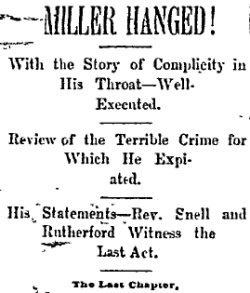 In the middle of last January when all the earth was wrapped in a mantle of purity, an esteemed minister of the gospel, the father of a bright family of children and a devoted husband with a loving wife, resided on his prosperous farm in the township of
  “
“
