On this day in 1889, 60-year-old John F. Gilman was hanged in Oregon for the murders of William and Elizabeth Eationhover (Eatenhoover, Etenhover).
Elizabeth and her husband Christopher were German immigrants. They arrived with their five-year-old son William in Coquille, Oregon in July 1888 and signed a five-year lease on farmland belonging to Gilman and his wife.
The Eationhovers built a small house forty yards from John Gilman’s house. They hadn’t lived there long before they began having disputes with Gilman about just what they could do on his land. Gilman wanted them to move and offered to cancel the lease, but the Eationhovers refused to budge.
Less than a year had passed before Gilman had decided the only way out of the situation was to cancel his tenants’ lease … on life.
He tried subtlety first, poisoning their food. That didn’t work and he was forced to use a more direct form of homicide.
On Saturday, July 12, 1889, Christopher was returning home after working all week at another, distant farm. When he reached the river, he noticed Gilman on the other side and asked him to row over and give him a ride. Gilman obliged and Christopher continued his journey home — but when he reached the corral, Gilman came up behind him and hit him in the head with one of his boat’s oars. He then pulled out a knife and stabbed him multiple times.
Gilman had made a miscalculation, though — one that saved Christopher Eationhover’s life. He’d been carrying two knives in his pocket, and one had a broken blade. He’d mistakenly pulled out the broken one, and it could not inflict fatal wounds.
As the two men struggled, ElizabethGilman’s wife came out of the house to break up the fight. Christopher then took the opportunity to get away. He staggered down to the river, rowed the boat across and went to get help.
By the time he returned with a posse, however, his wife and child had disappeared. The kitchen table was set for breakfast, and little William’s plate still had food on it, long since grown cold.
When the authorities arrived at the Gilman house, they found John Gilman in bed asleep. He hadn’t even bothered to change his bloodstained clothes. Arrested, he insisted he had no idea where the Eationhovers were or what had happened to them. He suggested that perhaps they’d followed after Christopher and got lost.
A search party found them the next afternoon, poorly concealed in a shallow grave. Nearby was another, empty grave, presumably for Christopher.
The two had died horrible deaths.
Elizabeth had been beaten on the arms, hips and face, and had a bad cut on the back of her head, but the actual cause of death was strangulation. Medical evidence indicated she’d remained alive for a time after the beating.
Five-year-old William had tried to run away, but his killer was too fast for him. He’d been strangled with a rope and his neck was broken.
Gilman would later confess to the crimes. He said he had beaten Elizabeth and then ran off, leaving her semi-conscious and helpless, to kill the child. He then returned to finish off Elizabeth. He claimed he’d strangled the victims (actually hanging William from a tree) because he didn’t want to leave blood evidence in the house.
While clearing out his conscience in this rummage sale (which sorely tempted lynch law), Gilman also confessed to another murder, that of George Morras in 1888. He later recanted his statements, but law enforcement believed he had in fact committed the crime.
John Gilman was indicted for two counts of murder. His wife, Fidelia, was charged as an accessory, but later acquitted. John’s insanity defense failed, and there was no appeal or executive clemency.
One final tragic detail in this very tragic story: on October 21, 1892, nearly three years after the hanging of the man who killed his family, Christopher Eationhover hanged himself.
Tim Kaine, who governed the Commonwealth of Virginia from 2006 to 2010 and was just last month elected to the U.S. Senate, had a different service to perform on this date in 1996.
Kaine saw his client, double-murderer Lem Tuggle, to the Virginia execution chamber on December 12, 1996.
In 1983, fresh off parole for a 1971 homicide, Tuggle raped and shot 52-year-old Jessie Geneva Havens.
“From past experience, I would like to talk to an attorney,” he told the officer who arrested him. “I’ll probably tell you the full story later.”
In this selfsame spring of 1983, 25-year-old Timothy Michael Kaine was receiving his J.D. from Harvard Law. He moved to Richmond, Va., with his classmate Anne Holton, daughter of the state’s former governor.
Kaine and Holton married in 1984.
This was also an eventful year for the now-twice-convicted killer Lem Tuggle: together with five other condemned inmates, Tuggle sensationally busted out of Mecklenburg Correctional Center — capturing several prison guards, making up a phony bomb threat, and simply strolling out the gates in their stolen uniforms during the confusion.
The “Mecklenburg Six”* cast a terrifying pall in the headlines of June 1984; it took weeks to recapture them all. Tuggle, sensibly, made a bid for Canada’s death-penalty-free soil, only sparing Ottawa a major diplomatic headache when he stopped to rob a Vermont diner for gas money and got arrested.
Kaine’s path was destined to cross with this notorious convict, but not for some years yet. In the meantime, the idealistic young J.D. in his first year at the bar was getting acquainted with death row when he accepted a pro bono legal appointment to represent condemned killer Richard Lee Whitley.
A lifelong Catholic who had spent a youthful finding-himself year working at a mission in Honduras, Kaine was (and remains) a death penalty opponent. This would later prove a sticky wicket, but mid-1980s Kaine didn’t have a career in politics on his radar, as evidenced by his distinctly impolitic remark that “murder is wrong in the gulag, in Afghanistan, in Soweto, in the mountains of Guatemala, in Fairfax County … and even the Spring Street Penitentiary.”
Later, when he was in politics, Kaine would tell a reporter profiling him during the 2005 gubernatorial campaign that he didn’t want the assignment but would have felt like a “hypocrite” to refuse it. The Commonwealth was less easily overcome than Kaine’s scruples, and Whitley died in Virginia’s electric chair on June 6, 1987.
“I just remember sitting on my back step late and just having a couple of beers and just staring out at my backyard,” Kaine recalled of the night he lost his client.
Having had this first taste of failing with a man’s life on the line while being publicly vilified for his work, Kaine signed on to represent Tuggle in 1989.
By the time Tuggle’s legal rope ran out in 1996, Tim Kaine was a 38-year-old Richmond city council member — the trailhead for his new and now-familiar career in politics.
As Kaine elevated himself into a statewide figure in the early 2000s, his death penalty position came in for some controversy which Kaine finessed by taking the position that while he himself opposed capital punishment, he would enforce the state’s death penalty law in his capacity as governor.**
Death penalty stuff has ample third-rail potential, but especially in Kaine’s gubernatorial race, his own personal legal work at the defense bar became fodder for some truly repellent attack ads by the mouthbreather lobby who tried to put Kaine personally on the hook for Tuggle’s crimes by virtue of having represented the man in court.
* The other five were Linwood Briley, James Briley, Earl Clanton, Willie Leroy Jones, and Derick Peterson. All of these men were also executed.
** That was indeed the case. Gov. Kaine commuted only one death sentence, that of Percy Walton, while allowing 11 others to go forward. D.C. sniper John Muhammad was the most notorious man with Kaine’s signature on his death warrant.
Christopher Alexander (“Alex”) Haun was perhaps the finest potter in antebellum Tennessee. He never had the chance to become the finest in post-bellum Tennessee because he was hanged in Knoxville this date in 1861 as an incendiarist.
While Tennessee seceded with the Confederacy in the U.S. Civil War, East Tennessee was a Union stronghold. This was the native soil of pro-Union “War Democrat” (and future U.S. President) Andrew Johnson.
Besides being good fun, the conspiracy promised an effectual blow against the Confederacy inasmuch as the East Tennessee & Virginia and East Tennessee & Georgia lines constituted the South’s most reliable rail and telegraph link between its capital at Richmond, Va., and the Deep South. This plan’s author, Rev. William Carter, went to Washington and had his scheme personally approved by President Abraham Lincoln, Secretary of State William Seward, and Gen. George McClellan.
The rest of the plan called for the Union army to invade East Tennessee on the heels of the bridge-burnings and occupy the area. Just a few months before, McClellan’s troops had similarly occupied the pro-Union western mountains of secessionist Virginia, which is why there’s a state of West Virginia today.
But there’s no state of East Tennessee, is there?
The bridge-burning conspiracy would go down as one of the great, failed guerrilla operations of the war.
Burning Your Bridges
With authorization straight from the top, the conspirators got going. A Captain David Fry** was tasked with targeting the Lick Creek bridge, located in northeastern Tennessee† near the settlement of Pottertown, so named for the ceramics craftsmen attracted to the area’s excellent clay.
After dark fell on Nov. 8, 1861, the local Union sympathizers recruited to the plot — Christopher Haun among them — gathered at the house of a local landowner, Jacob Harmon, Jr. There they took a dramatic lantern-lit oath on the Union flag, each to “do what was ordered of him that night and to never disclose what he had done.”
Then a party of some 40 to 60 mounted raiders stole out for the Lick Creek bridge two miles distant.
Around 2 a.m., they overpowered the small Confederate sentry detail assigned to Lick Creek, and forced the sentries to watch as they fired the bridge. That same night, several other parties elsewhere along the line all the way down to Alabama also burned, or tried to burn railroad bridges and cut telegraph lines.
These “deep-laid schemes … by an organization of Lincolnite traitors” (as the Knoxville Register accounted matters) brought a predictably furious Confederate response — and the audacious saboteurs would discover only after the fact that the planned East Tennessee invasion had been aborted by William T. Sherman without alerting his pyrotechnic fifth-column allies.
A Bridge Too Far
Within three days of the “treason,” East Tennessee had been clapped under martial law. A number of bridge-burners were also arrested (although many others escaped), and here the Lick Creek men would pay dearly for their recklessly humane decision to release their captured sentries. (pdf) As a result, several of them were captured in the days following their attack.
I now proceed to give you the desired instruction in relation to the prisoners of war taken by you among the traitors of East Tennessee.
First. All such as can be identified in having been engaged in bridge-burning are to be tried summarily by drum-head court-martial, and, if found guilty, executed on the spot by hanging. It would be well to leave their bodies hanging in the vicinity of the burned bridges. [emphasis added]
Second. All such as have not been so engaged are to be treated as prisoners of war, and sent with an armed guard to Tuscaloosa, Alabama, there to be kept imprisoned at the depot selected by the Government for prisoners of war.
Two men, William Hinshaw (often called “Hensie” in the period’s reports) and Henry Fry, were condemned by such a tribunal on Nov. 30 and immediately hanged — their bodies left exposed at the Greeneville Station for a day or more, until the stench became overpowering.
Haun was condemned on Dec. 10.‡ Confederate Brigadier General William H. Carroll telegraphed Benjamin for Jefferson Davis‘s confirmation of sentence.
The court-martial has sentenced A.C. Haun [sic], bridgeburner, to be hung. Sentence approved. Ordered To be executed at 12 o’clock tomorrow. Requires the approval of the President. Please telegraph.
Benjamin replied within hours, telling Carroll to make with the noosing.
Execute the sentence of your court-martial on the bridge-burners. The law does not require any approval by the President, but he entirely approves my order to hang every bridge-burner you can catch and convict.
Haun takes leave of his pregnant wife and four children before execution. Illustration from this 1862 propaganda volume by the Unionist publisher of the Knoxville Whig.
Six days after Haun hanged at Knoxville, the landowner who hosted the conspirators, Jacob Harmon, also went to the gallows, along with his son Henry. It seems someone in the incendiary party had carelessly dropped the name “Harmon” in conversation while the bridge sentries were in custody within earshot.
(Several others only narrowly avoided execution, or lynching, for the conspiracy. Given hundreds of other arrests of even merely suspect East Tennesseans and the very nasty feelings engendered by the Unionists’ attempt, it’s something of a wonder that only five were executed.)
Water Under the Bridge
Today, the Harmons are buried at Pottertown Harmon Historic Cemetery in rural Green County, Tenn., where a hexagonal monument commemorates all five executees (with an extra panel for summary text). There’s an annual ceremony there to commemorate the East Tennessee bridge burners.
All the hanged incendiarists were posthumously enrolled in Company F of the 2nd Tennessee by Congress in 1862, a gesture of appreciation which also conferred on their heirs the right to survivors’ benefits.
In addition to the resources linked here, see Donahue Bible’s “Shattered like earthen vessels,” Civil War Times, Dec. 1997.
**The intrepid Captain Fry would escape immediate capture, gather a few hundred Unionists as a guerrilla band, and eventually get caught, sent to Georgia, and condemned to death as a spy. Fry escaped by breaking out on the eve of his Oct. 15 hanging, in the company of some of the men arrested for the Great Locomotive Chase. He rejoined Union forces, was captured again, and survived the war, finally dying in 1872 … when he was hit by a train.
† The other bridges successfully torched by the conspiracy included two over the Chickamauga in southeastern Tennessee, and the theme of Civil War bridge-burning in that sector can’t help but suggest Ambrose Bierce’s “Occurrence at Owl Creek Bridge”. (The other details are nothing alike, so Bierce’s story clearly isn’t about this incident.)
‡ The railroad bridge at Lick Creek was back in action by this time.
On this date in 1989, with the last words “I want to say I hold no grudges,” Carlos DeLuna died by lethal injection in Texas
At the time, not many people took seriously DeLuna’s claim that a different Hispanic man named Carlos — one Carlos Hernandez — was the man who actually slashed Wanda Lopez to death in a Corpus Christi gas station on February 4, 1983.
“I didn’t do it. But I know who did.” That’s what he’d told a police officer soon after his arrest.
A generation later, it’s increasingly clear that Carlos DeLuna really didn’t do it … and that he knew who did it, knew he was going to the gurney for the crime of a man whom the state claimed was just a “phantom” invented by the defendant. Just a few months before DeLuna went to his death, that “phantom”, still on the streets, had knifed a four-inch gash in another woman’s abdomen. Carlos Hernandez had even bragged to others that his “stupid tocayo” — namesake — “took the blame for” a murder he’d committed. (Hernandez died in 1999.)
DeLuna was arrested suspiciously hiding under a truck near the scene of a grisly knife slaying at a gas station. A Hispanic man had been reported as the suspect, and the eyewitness was able to identify DeLuna as that man, just moments after his arrest. Case closed.
Except everyone was wrong.
He was hiding because he’d been violating his parole by drinking at a strip club across the street. He chanced to look just like another Hispanic man from the area, a fellow who just happened to be a violent thug. And he didn’t have a spot of blood on him even though the murder scene looked like the set of a slasher film.
“It was an obscure case, the kind that could involve anybody,” Columbia Law Prof. James Liebman said. “Maybe those are the cases where miscarriages of justice happen, the routine everyday cases where nobody thinks enough about the victim, let alone the defendant.”
The facts of the case have been extensively documented elsewhere, including a 2006 Chicago Tribune series* and an entire 2012 issue of the Columbia University Human Rights Law Review, culmination of a years-long project organized by Liebman.
The latter investigation, complete with original source documents, video, and photographs, is preserved for public use at the magnificent Los Tocayos Carlos site. Its intensively-sourced book-length treatment comes highly recommended, but you might need to clear your schedule.
Executed Today is pleased to welcome one of the coauthors of Los Tocayos Carlos, Andrew Markquart — a 2012 graduate of Columbia Law who collaborated with Prof. Liebman on the DeLuna investigation and now practices in New York.
ET: How did you come to focus on this case, and what went into the investigation?
AM: I got involved after my first year at law school. I started out as a research assistant for Prof. Liebman, and he had been working on this project for years in one form or another when I got involved. I had already had quite a bit of interest in death penalty issues, so I jumped on it.
The initial investigation that Prof. Liebman did was back in 2004. He had done a previous study called “A Broken System” in which they found a shockingly high rate of reversals in capital cases. And basically the question that came out of that for him was, what does that mean?
Does that mean that the courts are doing their jobs and there are a lot of reversals because they’re being very diligent?
Or, is that high number indicative of some big systemic problems?
He started out looking at cases in Texas, for obvious reasons, and particularly focused on cases involving single eyewitnesses. This one came out fairly early on, but there wasn’t much about it initially to suggest this was a strong case. But Prof. Liebman was having someone going down to Corpus Christi anyway and had him check it out, and within one day this investigator was able to track down a lead and figure out exactly who this Carlos Hernandez person was who DeLuna claimed was the actual killer. From there the floodgates opened.
This case reads like something out of Dumas … your doppelganger, who looks just like you and also shares your name, commits a crime and you take the rap. Speaking as a layperson, it’s astonishing that Carlos DeLuna explicitly made the very argument you’re making, that this guy Carlos Hernandez was the real killer. But it wasn’t so much that DeLuna’s allegation was considered and rejected as that it was never taken seriously at all, even by his own defense. Why was that?
It’s a good question and it’s one of the major points we tried to make.
At first DeLuna was a little hesitant, with good reason: Hernandez was well-known in Corpus Christi; he was a terror in the town and had been known to use violence against people who threatened to expose him. Eventually the threat of execution overcame that.
His defense team did very little to research what could or would have been his saving argument, and on the flip side the prosecution said Carlos Hernandez didn’t even exist, which is just a mind-blowing claim. This guy had a rap sheet a mile long. He had been a major suspect in 1979 in another murder case involving one of the prosecutors in the DeLuna case.
The defense lawyer in that case did what DeLuna’s lawyer should have done: he called Carlos Hernandez to the stand and basically prosecuted Carlos Hernandez as his defense. He got his client off, and we’re pretty confident from our research that Hernandez was actually guilty of that murder, too.
Hernandez was definitely no “phantom”: he was known to law enforcement, known in the neighborhood. Can you explain why the prosecuting attorneys would make such a claim?
It’s hard to explain. I suspect they probably thought they had the right guy, they probably thought he was making up a bogus story … and they cut a few corners. But that’s speculation.
Your report writes, “Central to DeLuna’s obscurity was the failure of lawyers on the defense as well as the prosecution side to have the curiosity and gumption to look just an inch or two below the surface.” It seems like there just wasn’t much of any work done by any actor to pursue evidence that could defend DeLuna.
Carlos DeLuna’s defense lawyer had trouble getting any kind of funding to do investigation. And this was his first criminal case of any kind, let alone capital case.
The police only investigated for a couple of hours before turning it over to the store manager to clean up to open the next morning. It was a simple case of tunnel vision: they had arrested Carlos DeLuna, they got a quick eyewitness ID, and they thought they were done.
There’s all kinds of evidence at the scene. In the police photos, which are available at our website, there’s a footprint in blood that has to be the culprit’s shoeprint, and they never even saw it. It was that sloppy. You can also see the detective, Olivia Escobedo, literally standing on evidence — a nice metaphor for the investigation.
Yes, he did. For reasons I can’t make sense of, he either was just severely misremembering, or just made up, some story about hanging out with these girls earlier in the evening that was completely untrue. But the thing about it is that the story as he gave it didn’t even help his case. It didn’t give him an alibi. But it hurt his case, because then they could bring in these girls to testify and destroy his credibility.
It’s hard to figure out what was in his head to say that. DeLuna wasn’t the most intelligent person; his IQ tested just barely above the threshold for cognitive impairment.
The original trial was in 1983, and Carlos was executed in 1989. How representative are the circumstances of this case still, relative to new death penalty trials today or to death row prisoners whose appeals are being handled now?
“[DeLuna]’s lying. He won’t admit it. I hope this is the day he gets it. He’ll lie like he’s been lying and now he’ll have to pay for what he did to my daughter.”
-Wanda Lopez’s mother Mary Vargas, quoted in Dec. 7, 1989 Dallas Morning News
“After carefully reviewing the information recently uncovered and printed by Steve Mills and Maurice Possley in the Chicago Tribune, I am convinced that Carlos DeLuna did not kill my sister and that Carlos Hernandez was the real murderer.”
-Wanda Lopez’s brother Richard Vargas, June 2006
You see these kind of cases and issues come up even today. That’s one point we try to make: yes, this case was from 29 years ago, but a lot of things remain the same.
There was no physical evidence, despite all the blood at the scene: it was just based on eyewitnesses.** And you kind of have a casebook bad eyewitness identification. They didn’t use a lineup; it was nighttime; it was a cross-racial identification, which we know are highly error-prone; he [DeLuna] was in the squad car, at the scene, handcuffed, under a highly stressful environment. You have these kinds of show-up identifications happen all the time, all over the country. They’re rife with error.
And there’s a lot of good public defenders out there who really work hard and do good work, but also a lot of underexperienced and overburdened public defenders who are just being crushed. There’s always systemic pressure for cops and prosecutors to cut corners. I certainly don’t think the lessons of Carlos DeLuna’s case have been learned.
In your view, what are the most important of those lessons?
The fallibility of our criminal justice system. Carlos DeLuna wasn’t convicted and executed in some third world country — he was given a trial and a lawyer and appeals and all the other protections and yet he still slipped through the cracks.
And the other lesson is the widespread nature of the factors involved, like the unreliable eyewitness ID. People go to prison on that basis every day. It seems highly likely there are more Carlos DeLunas.
The way that we found this story and developed it was enormously labor-intensive. The number of man-hours that went into this, between authors, investigators, research assistants, and the whole staff of the Columbia Human Rights Law Review … you just can’t do this for every case where there’s some kind of colorable suggestion of the possibility of wrongful execution.
I’d be very surprised if there aren’t more like him.
* The Tribune series on DeLuna began on June 25, 2006 … the day before Supreme Court crank Antonin Scalia taunted in Kansas v. Marsh that there was “not one” case of a “clear” wrongful execution. “The innocent’s name would be shouted from the rooftops by the abolition lobby,” Scalia wrote.
** Eyewitness (mis)identification is also at the heart of the Ruben Cantu case, another suspected wrongful execution in Texas.
On a summer’s day in 1991, Richard Stokley and Randy Brazeal picked up two 13-year-old girls from a fair in Cochise County, Arizona and drove them to the desert. There they raped them, then stomped, strangled and stabbed the two to death and dumped their naked bodies in a flooded mineshaft.
Today, Richard Stokley is set to bewas executed for that double homicide.
His accomplice Randy Brazeal is a free man living in Arkansas.
And little but the chance progress of justice and the human judgment calls that officers of the court make every day will distinguish the fate of two men, even though their trial judge has said that he “didn’t have a feeling that one was less culpable than the other.”
Brazeal, a 19-year-old troublemaker new to the area, and Stokley, a local brute twice his age, would spin different stories about exactly what happened in the desert that night to Mandy Meyers and Mary Snyder: about how the attacks began, and who particpated in what.
Long story short: Stokley’s version had both men as full participants, raping at least one girl apiece and each strangling a different victim. Brazeal’s version had him basically just giving people a ride and Stokley committing the crimes. (It’s not clear whether the victims were abducted from the fair, or went along willingly only to be attacked later.)
Forensic DNA testing was only just emerging in 1991, and it required months to process … months that the state did not have before Brazeal’s murder trial was set to begin. Even then, the state’s attorney worried that “the status of the law is in some question as to whether the DNA evidence would be admissible.”
This uncertainty set the parameters for a plea deal in which prosecutors took the guaranteed conviction and Brazeal dodged the needle. He was released in 2011 after serving concurrent 20-year sentences for second-degree murder.
But weeks after that deal was sealed (and before Stokley’s trial) DNA tests on semen retrieved from Mandy Meyers showed that both men had indeed raped her.
The DNA evidence helped seal Stokley’s conviction, even though it and other forensic evidence around the scene also tended to buttress Stokley’s “equal partners in the crime” story to the detriment of Brazeal’s version.
The net outcome* doesn’t necessarily look like justice. Mandy’s devastated mother, Patty Hancock, has been vocal in the run-up to Stokley’s execution about her disgust with the sentencing disproportion.
“With the evidence that they did have, Randy Brazeal should be sitting right next to Richard Dale Stokley,” she told one reporter. “And I will say that until the day I die.”
Stokley, for his part, filed a similar appeal in the courts as grounds for reducing his own sentence. But even though he’s availed every legal avenue possible, he didn’t bother trying the long odds at a gubernatorial reprieve — instead writing the Arizona Board of Executive Clemency:
I am also sorry I was mixed up in those awful events that brought me to this. I have been sorry for the victims and the victims’ families. But no one wants to hear of my miserable sorrow, they just want for me to get dead, which is vengeance. They think it will bring ‘closure.’ But there is no healing in that. Ever.
I have decided to decline a clemency hearing. I don’t want to put anyone through that, especially since I’m convinced that, as things stand now, it’s pointless. I reckon I know how to die, and if it’s my time, I’ll go without fanfare. And if it ain’t, I won’t. God’s will be done.
God’s will is scheduled for 10 a.m. Mountain time today. (Update: Stokley was executed as scheduled.)
* It’s particularly striking that the man who was more forthcoming and cooperative with investigators ended up with the heavier sentence.
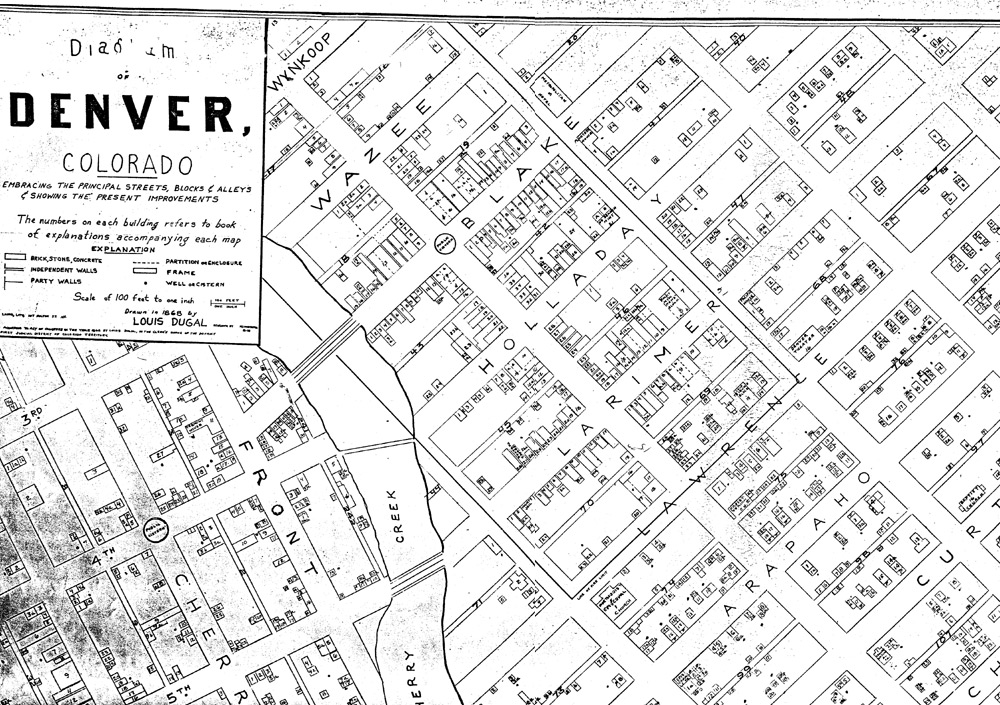
This date in 1868 marks the end of one of the guilty.
Sam Dugan, aka Sanfourd Dougan, is seen here lynched to a cottonwood tree at Cherry Street, midway between 4th and 5th streets, in Denver.
(Denver’s city plan has changed quite a bit since those days, but I believe the present-day location of this lynching would be approximately Speer Blvd. in a knot of paving the edge of the downtown University of Colorado campus.)
The photo, snapped by the morning light of Dec. 2, 1868, showed the previous night’s work of the Vigilance Committee.
Dug(g)an was a young (23 years old) knockabout in the territories with a blackhearted reputation, having been thought to have killed a man at a camp the year before.
In 1868, he and buddy Ed Franklin robbed a justice of the peace, one Orson Brooks, at gunpoint. As one can imagine, Brooks was one of the little town’s more prominent citizens and the crime outraged residents.
Denver lawmen chased Brooks’s assailants to nearby Golden, Colo., where Dugan’s accomplice Franklin — blind drunk — was shot dead resisting arrest. An innocent Golden citizen named Miles Hill also died when he was caught up in the the shootout to take Dugan … but Dugan himself escaped.
Public fury over this bloodshed (on Nov. 22) precipiated the Nov. 23 lynching of already-jailed outlaw L.H. Musgrove from a Cherry Creek bridge, not far from where Dugan would soon stretch hemp. (Musgrove had ridden in a murderous gang with the late unlamented Ed Franklin.)
Given the Musgrove lynching, Cook must have had an idea of the danger Dugan would face in Denver. Denver papers anticipating the party’s arrival said that Cook’s team “will bring the prisoners dead or alive. The former condition would be preferred by many.”
About 90 to 100 vigilantes made that preference into fact after dark on Tuesday, Dec. 1, stopping a police wagon moving Dugan between lockups, just as it was crossing a bridge over Cherry Creek.
The hijackers redirected the wagon around the corner to a copse of trees and “in a moment a rope was thrown over the limb, and in another moment, Dugan was standing in the wagon immediately under the fatal noose.”
That’s from a newspaper report that appeared in several publications; our cite is from the Milwaukee Daily Sentinel on December 21, 1868.
Dugan, “completely unmanned, crying and sobbing like a baby,” wheedled and stalled, begging for a Catholic priest and making various professions of innocence or mitigation that would cut no ice with his judges.
After he had said all that he had to say, the order was heard, “Drive on,” and the wagon which had served as his frail bulwark between life and eternity moved from under, and the spirit of Sanford S.C. Dugan took its flight into the presence of Him who shall judge us all according to the deeds done in the body. The fall, about eighteen inches, broke his neck. He was a man six feet two inches in height, and weighed 205 pounds.
Cook, in Hands Up!, says he “would gladly have prevented” the lynchings, “but it was useless for [lawmen] to fly in the face of an entire community, which had been outraged and which was aroused, not so much to vengeance as to the necessity of protecting itself against the rough element of the plains.”
On this day in 1828, a black slave named James Guild, also known as Little Jim, was hanged in Farmington, New Jersey.
His crime, though brutal, was commonplace enough. But his case was extraordinary for another reason: at the time of his offense, Little Jim was twelve years, five months and thirteen days old.
On September 24, 1827, Little Jim took a break from his work in his master’s cornfield and went to the home of Catherine Beakes, a white woman in her sixties who lived with her son and grandson. She was home alone at the time, and Jim wanted to borrow her rifle to go fowling.
Some time prior to this, someone had tampered with Mrs. Beakes’s livestock, releasing the pigs from their pen during the night and letting the chickens out of their coop. She believed the culprit was Little Jim and, though he denied this, she had told him to stay off her property or she would tell his master, Mr. Bunn.
So when he knocked on the door and asked for the gun, she refused to give it to him.
Jim was angry, he said later, that the “damned old bitch” had been “saucy” to him for no reason.
So, after Mrs. Beakes had her back turned and thought he was gone, he took up a metal horse yoke and sneaked up on her from behind. He bludgeoned her to death in her own house as she was tending the fire, crushing her skull, shattering her jaw and gouging out one of her eyes.
He left the gore-caked weapon next to her corpse.
Little Jim came under suspicion and confessed to the murder after someone told him liars went to hell. At his trial, he said he’d killed Mrs. Beakes because he was afraid she would inform on him to Mr. Bunn and get him in trouble.
“The trial became more of a debate over whether a 12-year-old killer should be punished like an adult,” Daniel Hearn writes in Legal Executions in New Jersey: A Comprehensive Registry, 1691-1963. “The presiding judge placed great emphasis on that issue, especially during his instructions to the jury.”
It is an issue that remains highly controversial even now, nearly 200 years later.
The jury convicted James Guild of first-degree murder, which meant an automatic death sentence … but the judge was reluctant to execute a preteen. He referred the case to the New Jersey Supreme Court for sentencing, as Hearn records:
Special hearings were held to probe all aspects of Jim’s mentality. It was found that he knew right from wrong as well as the consequences of murder. He knew about the sanctity of an oath. It was also clear that Jim had had the wherewithal to confess what he had done based on his own rationale. Moreover, the appellate judges found what they considered to be ample precedent for condoning the execution of preteen felons — especially those of precocious acumen … The use of his tender age alone as a pretext for sparing his life under such circumstances would “be of dangerous consequence to the public … by propagating a notion that children might commit atrocious crimes with impunity. So the New Jersey Supreme Court ruled that Jim Guild was “a proper subject of capital punishment.”
Jim Guild’s manner was of “stoic indifference” when he was hanged before a large crowd fourteen months after his crime, the last execution in Hunterdon County history. He was thirteen years old when he died.
No, not that Seven of Nine. We have no further details on offer about these poor souls, but we thought the assortment of crimes — a mother for murdering her bastard child; a highwayman; an overseer for whipping a slave to death — and the editorial rant about the governor‘s abus’d Clemency, made for a colorful slice of life.
As detailed in the 1991 essay “A Short History of Hawaiian Executions, 1826-1947” (pdf) by Joseph Theroux, a resource we’ve touched on before and which also includes a full list of 75 known legal executions in Hawaii during that period:*
[I]n the death of Gil Jamieson, who had been kidnapped by a mad youth who filled his ransom letters with quotations from the Shakespearen play [Macbeth]: “Life’s but a walking shadow, a poor player / that struts and frets his hour upon the stage / and then is heard no more …”
The victim had his skull chiseled in and was strangled and left near Seaside Avenue in Waikiki.
The murderer and author of the letters was captured some days later, tried, convicted, and sentenced to hang, all within three weeks. This feat was facilitated because his lawyers, Beebe and Huber, offered no defense and called no witnesses. The jury included members who were part of the search party and the victim’s bodyguard and gravedigger. A Navy psychiatrist offered to testify for the defense but was rebuffed. The medical examiner was also the prosecution psychiatrist, Doctor Robert Faus. He testified that past suicide attempts by Miles Fukunaga were “normal.” Despite protests and appeals, Fukunaga was hanged.
Ten years earlier, a well-known local haole athlete, David Buick, found himself down on his luck. He ordered a taxi driver, one Ito Suzuki, to drive out of Honolulu proper to a place called Red Hill. He ordered the man to stop the car and get out. He pointed a gun at the driver and robbed him of one dollar. When Suzuki turned to flee, Buick shot him in the back. Before he died, the taxi driver identified Buick a the gunman. The charge was eventually reduced to second degree murder, and Buick is said to have returned to the Mainland following his jail time.
In both cases, there was premeditation, kidnapping, murder, and flight. Fukunaga willingly confessed and indeed showed extreme remorse. Buick never confessed or showed the slightest regret over his actions. But Fukunaga had murdered a fine boy of a prominent haole family.** Buick had only murdered a middle-aged Japanese taxi driver.
This shocking crime — Fukunaga openly cited the notorious Leopold and Loeb murder and the more recent Hickman kidnapping as his models — ratcheted up ethnic tensions in Hawaii between whites, especially elite whites, and Japanese.
The Japanese community’s newspaper Hochi mounted a vigorous clemency campaign emphasizing sentencing differences like that vis-a-vis Buick. “If Myles Fukunaga is hanged it will not be because he killed a human being,” the paper editorialized. (pdf) “It will be because he killed the son of the vice-president of one of our big trust companies and because his victim was a white boy.”
* Ethnic data of those 75 executed: 24 Hawaiian; 24 Filipino; 9 Japanese; 6 Korean; 5 Chinese; 3 Puerto Rican; 3 unknown; 1 Caucasian.
** Gill Jamieson’s father, Frederick Jamieson, was a vice president of the Hawaiian Trust Company (since folded into the Bank of Hawaii). According to Kokugo Gakko in, the targeting of a bankster family by a frustrated working-class youth (Fukunaga was reportedly logging 80-hour weeks in menial jobs, having been forced to quit school in his teens to support his family) was no coincidence at all.
In terms of his motives he said that revenge had been foremost in his mind. In 1928 his parents had been unable to meet monthly rental payments. The Hawaiian Trust company served as the collecting agent for their landlord and had sent a rent collector to the Fukunaga family to demand full payment of back rent. Humiliated and ashamed, Fukunaga bitterly resented the bank’s action and, on learning that Vice President Frederick W. Jamieson had a son, he decided to seek revenge … by kidnapping and murdering the boy. Fukunaga also confessed to another motive. As the eldest son of seven children, Fukunaga stated that he had felt a filial obligation to help his poor parents … he had hoped to accomplish this filial act with the ransom money.
All this might tend to militate against the “insanity” defense, which Fukunaga himself energetically rejected.
A year ago today, Oba Chandler was executed by lethal injection in Florida for the brutal triple homicide of a Willshire, Ohio mother and her two teenage daughters.
Thirty-six-year-old Joan Mae “Jo” Rogers and her daughters Michelle, 17, and Christe, 14, were vacationing in Florida when they vanished on June 1, 1989. Three days later their bodies turned up in the Tampa Bay. All three were naked from the waist down and had their hands and feet bound, their mouths taped shut, and concrete blocks tied to their necks. Michelle had managed to free one arm before she drowned.
The victims (left to right): Joan, Michelle, and Christe Rogers.
The police initially suspected the girls’ uncle, John Rogers, even though he was in prison at the time.
Rogers had been incarcerated for rape; one of his victims was Michelle, and authorities theorized he had a third party kill her and her mother and sister. Eventually that gentleman was cleared, as was his brother Hal, husband and father of the victims.
The sexual abuse, which had gone on for years, had torn the family apart, and part of the reason for the Florida vacation was so that everyone could relax and get some distance from what had happened. Hal had wanted to join his wife and daughters on their trip, but he had to stay and look after the family’s dairy farm.
The murders and subsequent investigation were covered in heartbreaking detail in St. Petersburg Times reporter Thomas French‘s Pulitzer Prize-winning series here.
Characteristically, local gossip pursued Hal and John for years, particularly Hal. His neighbors in Ohio thought he didn’t appear traumatized enough,* noting that he never cried in public and that he continued to take care of his farm in the wake of the murders.
They didn’t care that the farm was Hal’s livelihood, that cows could not milk themselves. They didn’t care that there was no evidence that he’d left Ohio during the critical time period, and that the police had very quickly cleared Hal as a possible suspect in Jo, Michelle and Christe’s deaths. They didn’t know that he was too traumatized to sleep in his own home and spent months couch-surfing at friends’ houses. They didn’t know that he was devastated, that he’d tried to take his own life at one point so he could be with his family.
As Hal’s sister-in-law said, “There’s no protocol here. There’s no Murder 101 class. No Grief 101 that anybody thinks to give you.”
Stranger-on-stranger crimes are incredibly difficult to solve. It wasn’t until October 1989 that the police linked the Rogers family’s murders to the rape of a Canadian tourist that had happened in May, two weeks before the triple homicide. The rapist had lured the woman out onto a boat, threatened to kill her, and threatened to duct-tape her mouth if she didn’t stop screaming. After the rape he apologized to her, threw up over the side of the boat, took her to shore and let her go.
Police released a composite sketch of the woman’s attacker, whom they believed was the same man who killed the Rogerses. That got over 400 tips from the public, but none of them panned out.
Twice, the case appeared on the popular television show Unsolved Mysteries.
The authorities found some driving directions written on a brochure in Jo’s car which were not in her handwriting and which they thought were written by the murderer; they released samples to the public in the hopes that someone would recognize the writing.
Composite sketch of the suspect (top); Oba Chandler as he looked around the time of his 1992 arrest (bottom).
Finally they got a break: one of Chandler’s neighbors recognized the sketch of the rape suspect and turned his name over to the police. That same neighbor had hired Chandler to build out her porch, and she had a copy of the contract he’d written out for her. She turned the contract over to the authorities, and handwriting experts determined it was written by the same man who wrote the driving directions found in Jo’s car. Investigators also found Chandler’s palm print on the brochure.
In September 1992, convinced that they were on the right track, the police flew to Canada to interview the rape survivor from May 1989. She picked Chandler’s photo out of a line-up. With that, the authorities finally had enough evidence to make the arrest.
Chandler, an Ohio native like his victims, gave the impression of an ordinary, mild-mannered sort, but he was in fact a career criminal: he went by many alias names and had an arrest record dating back to when he was fourteen years old, for a wide range of offenses including car theft, robbery, kidnapping, receiving stolen property, possession of counterfeit money, and various sex crimes. By the time of his 1992 arrest he had racked up six felony convictions.
Chandler testified at the murder trial, against the advice of his attorney, and admitted he had met the three victims and given them directions. He could hardly deny that, given the handwriting and fingerprint evidence.
He did deny having ever seen them again after that, and he swore he’d never taken them out on his boat and never harmed them. He called the very idea “ludicrous.” In fact, he maintained his innocence until his death.
But the prosecution eviscerated him during cross-examination. Chandler claimed that on the night of the murders he’d gotten stuck out in Tampa Bay when his boat’s fuel line sprung a leak and he ran out of gas. A boat mechanic employed by the Florida Marine Patrol examined the vessel and determined that this story was impossible: the boat had an anti-siphon valve that would have prevented a leak.
The Canadian rape victim was permitted to testify. She didn’t cry as she described what happened to her, but some of the jurors did. One of Chandler’s adult daughters (he had eight children by seven different women) also testified, saying her father had told her he’d raped a foreign tourist and also killed some women in Florida.
The judge who presided over the trial later said Chandler was “the vilest, most evil defendant I ever handled.” When the jury retired, they took an initial poll among themselves and discovered that all twelve believed he was guilty. For form’s sake, however, they waited an hour and a half before returning with their verdict.
There’s some speculation that Chandler was involved in other murders besides those of the Rogers family.
Linda Lois Little, a Daytona Beach woman, disappeared on his birthday in 1991 and was never found. One of Little’s sisters thinks saw him at her apartment complex a few days before Little disappeared. Chandler refused to answer law enforcement’s questions about Little’s disappearance and his involvement has never been proved one way or the other.
During his seventeen years on death row, Chandler never had a single visitor, not even any of his own relatives. The execution, which went smoothly, was attended by Michelle and Christe’s cousin, as well as a reluctant Hal Rogers. He remarried more than a decade after his family’s murder and became a stepfather of four, but wasn’t able to have any more children.
When asked if he had any last words, Chandler simply answered, “No.” He did leave a written statement that simply said, “You are killing an innocent man today.”
No one believed him.
* “Didn’t display the right kind of grief in the right kind of way for the right amount of time” was also one of the raps on wrongly executed “arsonist” Cameron Todd Willingham.

 In 1983, fresh off parole for a 1971 homicide, Tuggle raped and shot 52-year-old Jessie Geneva Havens.
 At the time, not many people took seriously DeLuna’s claim that a different Hispanic man named Carlos — one Carlos Hernandez — was the man who actually slashed Wanda Lopez to death in a Corpus Christi gas station on February 4, 1983.
 And little but the chance progress of justice and the human judgment calls that officers of the court make every day will distinguish the fate of two men, even though their trial judge has said that he “didn’t have a feeling that one was less culpable than the other.”