2001: Lois Nadean Smith

On this date in 2001, Lois Nadean Smith was executed by lethal injection in Oklahoma for the murder of her son’s ex-girlfriend.

By the standards of the 1,099 executions in the “modern” death penalty in America — those since the 1972 Furman v. Georgia Supreme Court decision — very little especially distinguished Smith‘s case.

Sentenced some 19 years before her death, she had committed a single horrifying and rather tawdry kidnapping and murder. Her guilt was in no question, although she stood trial along with her son — who received a life sentence — and would later argue on appeal that their lawyer had pursued a defense intentionally shifting blame onto her in order to save him.

As a woman, though, Smith was inherently an oddity. This date completed a remarkable year in which Oklahoma, having not put any woman to death since 1903, emptied its women’s death row with three such executions.

Including those three, only eleven women have been executed in the United States since Furman — or, indeed, since the Kennedy administration. There had been no calendar year in which three women were executed in the entire country since 1953 … and no single state had executed three women in one year since Virginia when the women in question were property.*

According to the Death Penalty Information Center:

Death sentences and actual executions for female offenders are also rare in comparison to such events for male offenders. In fact, women are more likely to be dropped out of the system the further the capital punishment system progresses. Following in summary outline form are the data indicating this screening out effect:

  • women account for about 1 in 10 (10%) murder arrests;
  • women account for only 1 in 50 (2.1%) death sentences imposed at the trial level;
  • women account for only 1 in 70 (1.4%) persons presently on death row; and
  • women account for only 1 in 90 (1.1%) persons actually executed in the modern era.**

At the end of a chain of improbabilities, Smith apparently met her death with composure. “To the families, I want to say I’m sorry for the pain and loss I’ve caused you,” she said from the gurney. “I ask that you forgive me. You must forgive to be forgiven.”

* See charts of female executions through 1962 and since 1900, both courtesy of the comprehensive Espy file of all executions in American history.

** This calculation appears to be slightly dated, with women currently accounting almost exactly 1 in 100 persons actually executed. The last 117 American prisoners executed have all been men.

(All stats are as of publication date in December 2007)

On this day..

1910: Hawley Harvey Crippen

On this date in 1910, the notorious wife-murdering doctor Hawley Harvey Crippen was hanged at London’s Pentonville Prison.

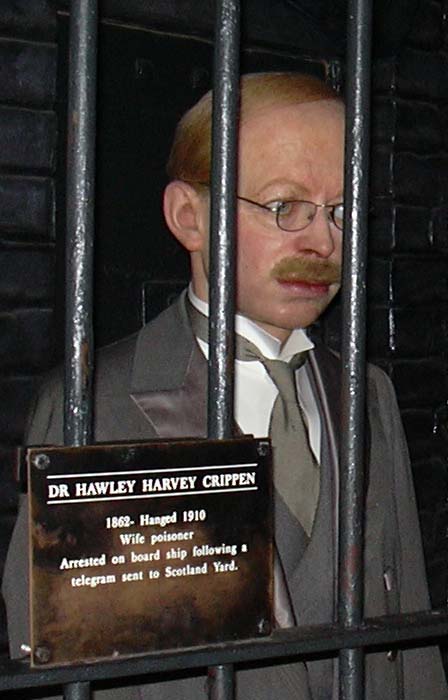
The sensational trial, which saw the American-born homeopath convicted for dismembering his shrewish and unfaithful wife Cora in an attempt to take up with his young mistress, fitted Crippen for both a noose and a likeness at Madame Tussaud’s. (More trial background here.) It has also made his case twice a landmark in the history of crime and technology: once at the time of his arrest, and again just last month as of this writing.

The core of a case a jury found so open-and-shut as to require just 27 minutes to convict was the poorly explained disappearance of Crippen’s wife, followed by the discovery of a considerably mutilated female corpse under the Crippens’ home.

Although much of the crown’s evidence was speculative and circumstantial — to say nothing of the bodice-ripping gossip of nymphomania and infidelity — a corpse under the floorboards tends to be a compelling circumstance to a jury.

Presumably that anticipation prompted Crippen to flee the Scotland Yard investigation with his mistress Ethel le Neve under assumed names on an ocean liner bound for Canada. The case made criminological history as the first use of wireless communication to apprehend a suspect when the ship’s alert captain telegraphed Crippen’s presence to land as the ship steamed away — enabling a policeman to board a faster boat and arrest the pair as they docked in Quebec.

In the century since Crippen went to the gallows still maintaining his innocence, the case has endured in popular notoriety. The killer’s life has been novelized, meditated upon and borrowed for fiction, offering a draught of inspiration to Alfred Hitchcock along the way.

Books inspired by the Crippen case …

Given his suspicious behavior, scant had been the credence given Crippen’s protestation of innocence.

Until now.

In a meeting of Edwardian crime and cutting-edge technology, two scientists from Crippen’s home state of Michigan stunningly announced in October that DNA testing proves the body was not Cora Crippen after all.

If true, it would appear to void Crippen’s conviction in its particulars without quite exonerating the hanged man from the natural question: whose was the corpse? The manufacture of clothes on the body dated it to the Crippens’ occupancy of the house.

One of Crippen’s modern sleuths, in a wholly speculative vein, thinks it might harken to an altogether different sort of crime: a botched back-alley abortion, just the sort of thing a financially struggling physician might have been involved in.

Maybe.

But if the test invites a modern investigator to look 97 years backwards, it also suggests a posture of epistemological humility. It’s just possible that the light this test casts on our own time is as searching as that it shines on 1910.

The Prejudice of Science

The Crippen case was a classic 19th century-style detective job — the inspector who made the arrest cut his teeth as a younger man on a Jack the Ripper murder — but it took place on the brink of a revolution in forensic science.

Just a few years before, fingerprinting had been embraced by British and American law enforcement and begun its march towards total institutionalization. On the heels of fingerprinting came a multiplicity of biometric approaches to crime scenes — hair and fiber analysis, blood typology, and most recently and dramatically, DNA.

And they, in turn, have brought a rising faith in science to adjudicate the law.

While the “CSI Effect” — jurors’ expectation of case-breaking scientific evidence — conventionally plays as a hindrance for prosecutors who usually have no such thing, the excess deference given to less-than-conclusive forensic evidence can likewise cut against the defense. Evidence mishandled at crime labs, even cooked outright, factors into numerous recent post-conviction exonerations. The once ironclad credibility of fingerprint evidence has itself been undermined by subsequent forensic advances.

In short, for all its undoubted contributions to criminal justice, forensic science packs along its own set of pitfalls, caveats and blinders reflexively privileging evidence of the laboratory.

This is not a reflex to indulge uncritically. History grants the benefit of hindsight, but rarely the luxury of certitude.

A waxwork Dr. Crippen at Madame Tussaud’s. Image used with permission.

So if the prospect of Crippen’s innocence intrigues, that unexplained body — that sudden flight for Canada — that (permanent) failure of Cora Crippen to resurface — nevertheless remain. They might lead us to question our implicit faith in the finality of DNA’s verdict on history rather than the other way around.

Are we certain that an unbroken line of blood relations really connects Cora Crippen to the modern DNA donors of her “family”?

Are we certain that a reliable chain of custody has preserved the original tissue samples unsullied across a century?

And if we are certain, what do we make of that body after all?

It is humans who must ultimately interpret and contextualize even the firmest forensic science. Whatever we might believe of Dr. Crippen we retain the burden of that belief, with all its intrinsic potential for grievous wrong.

The tales Hawley Crippen has yet to unfold from the grave might or might not shed still another different light on our understanding of what happened at 39 Hilldrop Crescent a century ago.

The gentleman’s place as a continuing attraction at Madame Tussaud’s, however, seems assured.

On this day..

1799: Judith van Dorth

On this date in 1799, Judith van Dorth was shot on the outskirts of Winterswijk for supporting an attempted restoration of the House of Orange to the Dutch throne against the Batavian Republic.

Although the Netherlands had been a Republic for two centuries, it was torn by revolutionary conflict from the mid-1780’s — predating the French Revolution, but finally coming to power in 1795 when its neighbor’s mass conscript armies drove William V of Orange to England.

The 52-year-old van Dorth, an impoverished noble of Orangist sympathies, recklessly tried to raise an internal revolt [linked page in Dutch] backing an English-Russian invasion to restore William in 1799.

The uprising came to nothing, and after the invasion — a footnote in the sweep of Revolutionary Wars — was repelled, van Dorth was condemned for treason by a military tribunal to set an example. [linked page in Dutch]

She was shot within 24 hours near Winterswijk’s Jewish cemetery, and apparently survived the barrage. One of the firing squad had to shoot again when he saw her move — legend has it that this occurred when she had already been packed into her coffin.
She remains the only woman in history executed by a Dutch military court. A biography of her life is available in Dutch.

The House of Orange, one of the most successful of European dynasties, regained power in the Netherlands following the Napoleonic Wars. William V’s great-great-great-great-granddaughter Queen Beatrix reigns there today.

On this day..

1914: Carl Hans Lody

On this date in 1914, German spy Carl Hans Lody was put to death in the Tower of London during the opening months of World War I.

Lody‘s was the first execution in the Tower since its heyday as the chopping-block of disfavored nobility had passed in the mid-18th century. Times had changed by the era of trench warfare: Lody was not beheaded, but shot inside a wooden shed erected for the purpose in the Tower yard. Ten more German spies, who seem to have had a harder go of infiltrating Britain than their English counterparts had in Germany, would suffer the same fate by war’s end.

A Berlin-born naval officer, Lody had no experience spying but was tapped for the job because he had traveled abroad and spoke English well enough to pass for an American tourist. He was dead scarcely three months after he entered the Isles, though his work may have helped a U-boat sink a British warship.

According to A.W. Brian Simpson in Domestic and International Trials 1700-2000, the case was a legal landmark as the first espionage trial in England held partly in camera — outside the public view. The outcome, however, was a foregone conclusion, and Lody himself didn’t bother to contest his guilt — seemingly fixated on going to his grave with nothing short of the utmost in romantic gentlemanly decorum.

Part of the Themed Set: Spies.

On this day..

1783: John Austin

On this date in 1783, highwayman John Austin was hanged at Tyburn for robbing and murdering John Spicer on the road to London.

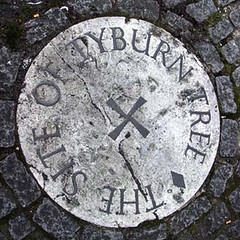
The village Tyburn on the outskirts of London had been used for public hangings dating to the 12th century. Though not the only site of executions in London, it was the iconic one. Situated at the modern intersection of Edgware and Bayswater Roads on the northeast corner of Hyde Park, the distinctive “Tyburn tree” — a triangular gallows capable of hanging over twenty prisoners simultaneously — made a foreboding landmark round which teemed thousands of spectators on execution days. Some 1,200 people were executed on this singular device.

Public executions typically began four kilometers away at Newgate Prison, where the condemned were loaded into ox carts for a two-to-three-hour procession through public streets now at the very core of London, perhaps including stops at public ale houses.


View Larger Map

While Tyburn carved its niche during England’s age of religious bloodletting, its social role had changed significantly by the 18th century. Most of the doomed were offenders against property, often executed for stealing negligible sums or else reprieved for transport to the New World or, later, Australia. Peter Linebaugh’s The London Hanged intriguingly suggests that hangings of this era were an assertion of nascent capitalism, violently throwing off the remains of feudal labor relations. (Summarized more thoroughly in this friendly review.)

Even that formative age was receding. Once a neighboring village, Tyburn had been swallowed up by the city; a generation before Austin’s death, residents of the now-upscale neighborhood had successfully pushed for the removal of the macabre “Tyburn tree”.

Austin was hanged, instead, on a portable gallows, a typical penitent imploring heavenly mercy and taking 10 minutes to strangle to death — the very last execution at that somber and storied crossroads.

Here’s the story of the Tyburn hangings from London writer Peter Ackroyd:

On this day..