1516 and 1530: Autos de fe in the Spanish Canary Islands

From The Inquisition in Spanish Dependencies, available free from Google books here:

That Columbus, on his first voyage, took his departure from Gomera indicates the importance assumed by the Canaries in the development of trade with the New World and this, conjoined with their productiveness, as they became settled and cultivated, rendered them a centre of commerce frequented by the ships of all maritime nations, as well as an object of buccaneering raids, in an age when trade and piracy were sometimes indistinguishable. Their proximity to Morocco and the Guinea coast moreover exposed them to attacks from the Moors and gave them an opportunity of accumulating Moorish and negro slaves, whom the piety of the age sought to convert to Christians by the water of baptism. In various ways, therefore, there came to be abundant material for inquisitorial activity, although the Judaizing New Christians, who furnished the Spanish tribunals with their principal business, appear to have been singularly few.

There was no haste in extending the Spanish Inquisition to the Canaries … It is not until the time of Diego de Muros [Spanish link], who was consecrated in 1496, that we have any evidence of such action … [and even then] every act, from the preliminary arrest to the final decision, was regulated from Seville …

Irregular and imperfect as may have been the organization of the tribunal, it yet managed to accomplish some convictions. In 1510 there was held an auto de fe in which there were three reconciliations for Judaism and one, of a Moorish slave, for reincidence in Mahometan error, while a fifth culprit was penanced for Judaism. Then in 1513 occurred the first relaxation, that of Alonso Fatima, a native Morisco, who had fled to Barbary. This was always deemed sufficient evidence of relapse to former errors, and he was duly burned in effigy. It was probably also to 1516* that may be attributed the first relaxation in person — that of Juan de Xeres of Seville, for Judaism. It shows that the tribunal was indifferently equipped that, when he was sentenced to torture, the physician whose presence was obligatory on such occasions, Doctor Juan Meneses de Gallegas, was required personally to administer it. It was exceedingly severe, extending to eleven jars of water; the accused was unable to endure it; he confessed his faith, was sentenced to relaxation as a relapsed and for fictitious confession, and was executed on Wednesday, June 4th. …

on June 4, 1530, another oblation was offered to God, in an auto celebrated with the same ostentation as the previous one [in 1526, with seven executions]. This time there were no relaxations in person, but there were six effigies burnt of as many Moorish slaves, who had escaped and were drowned in their infidelity while on their way to Africa and liberty. There were also the effigy and bones of Juan de Tarifa, the husband of the Ynes de Tarifa who had denounced herself in 1524; he was of Converso descent and had committed suicide in prison, which was equivalent to self-condemnation. There were three reconciliations, of which two were for Judaism and one for Islam and five penitents for minor offences.

This use of religious terror in service of slavery — the burning of those effigies who had been “drowned in their infidelity on their way to Africa and liberty” — was an overt policy of the tribunal.

Pious zeal for the salvation of these poor savages led to their baptism after capture; they could not be intelligent converts or throw off their native superstitions, and no one seemed able to realize the grim absurdity of adding the terrors of the Inquisition to the horrors of their enslaved existence. When a negro slave-girl was bemoaning her condition, she was kindly consoled with the assurance that baptism preserved her and her children from hell, to which she innocently replied that doing evil and not lack of baptism led to hell. This was heresy, for which she was duly prosecuted.

Under the inquisitorial code the attempt to escape from slavery thus was apostasy, punishable as such if unsuccessful, and expiated if successful by concremation in effigy. This is illustrated in an auto, held by Zayas and Funez, June 24, 1576, in which among sixteen effigies of absentees were those of eight slaves, seven negroes and one Moor. They had undergone baptism, had been bougt by Dona Catalina de la Cuevas and were worked on her sugar plantation. They seized a boat at Orotava and escaped to Morocco, for which they were duly prosecuted as apostates and their effigies were delivered to the flames — a ghastly mockery which does not seem to have produced the desired impression in preventing other misguided beings from flying from their salvation.

Related: Jews in the Canary Islands: Being a calendar of Jewish Cases extracted from the records of the Canariote inquisition in the collection of the Marquess of Bute.

* A footnote in the text of our source notes that “in the record concerning Juan de Xeres, the year is omitted, but as Wednesday fell on June 4 in 1511, 1516, 1533 and 1539, the probable date is 1516.”

On this day..

1606: Caravaggio murders Ranuccio Tomassoni

This site is occasionally prepared to stray outside its execution-anniversary beat to cover especially fascinating manifestations of the death penalty in history.

So for this date, we observe the anniversary not of a punishment, but of the crime itself: a capital homicide in the capital of the world that changed art forever.

NNDB summarizes Caravaggio as a “temperamental painter,” but a less generous interlocutor might prefer a descriptor like “lowlife.”

Painter, he certainly was.

Caravaggio’s pioneering realism and flair for the dramatic …


Caravaggio’s Judith Beheading Holofernes, 1598-1599. Though the young painter on the make would hardly want for models of public decapitation in 16th century Rome, the gendered intimacy with the act invites consideration of Caravaggio’s likely attendance at the execution of Beatrice Cenci.

… made him a rock star on the canvas.

Though the papacy in its dogmatic counter-reformation aspect may have viewed Caravaggio’s eye-catching chiaroscuro with suspicion, there were scudi enough to burst the coinpurse of a talent who could grace a chapel with awe-inspiring stuff like this:


Caravaggio’s Crucifixion of St. Peter, painted in 1601 for Rome’s Santa Maria del Popolo.

However many souls his stark brushwork won for the Church, Caravaggio’s reverential fare belied the creator’s own distinctly profane pastimes: gambling, boozing, brawling, and whoring around. He needed the intervention of well-placed patrons to duck prosecution on several occasions.

May 29, 1606 finds our “temperamental” antihero encountering a wealthy scoundrel by the handle of Ranuccio Tomassoni and a problem that would outstrip any political pull the artist could muster.

Allegedly, the two met to settle a paltry tennis wager, although this may have been a cover story for a rivalry over a courtesan.*

On whatever pretext, the young hotheads fell into a melee. Caravaggio won … and Tomassoni bled to death from the gash his foe dealt to his femoral artery.**

Caravaggio now had mortal blood on his hands. Homicides were treated very harshly by the authorities. Caravaggio was about to have a price put on his head, and if he were caught, that head would be summarily removed from his body and hung on a public street. Allies of Ranuccio bent on revenge were likely to be after him as well. … Caravaggio, the celebrated Italian painter, was now a notorious wanted killer. (Source)

Condemned an outlaw by Pope Paul V — himself fruit of Rome’s Borghese family, great patrons of art in their own right — Caravaggio fled the Eternal City. His brilliance went with him, perhaps even amplified by the exile.

“The fall from grace was huge,” a curator of late Caravaggio works argued. “It had a profound impact. He started expressing the psychological essence of the stories he is telling.”

The painter and killer had four years left to him — an exile spent sleeping clothed and armed, forever looking over his shoulder. But what his jangled nerves could still spare for the canvas would help launch the baroque artistic epoch and still influences us today.

Flight, fancy, and fortune took Caravaggio to Malta and to Sicily, but the year or so he spent as Naples’ visiting genius would make his artistic legacy: that city’s succeeding generations of painters took enthusiastic inspiration from Caravaggio’s Neapolitan offerings — like a Seven Works of Mercy that must have carried a very personal meaning for the hunted man.

He was reportedly as arrogant and hot-tempered on the run as he had been in Rome, but Caravaggio’s art in exile also traces his desperate attempts to undo the consequences of his bad behavior.

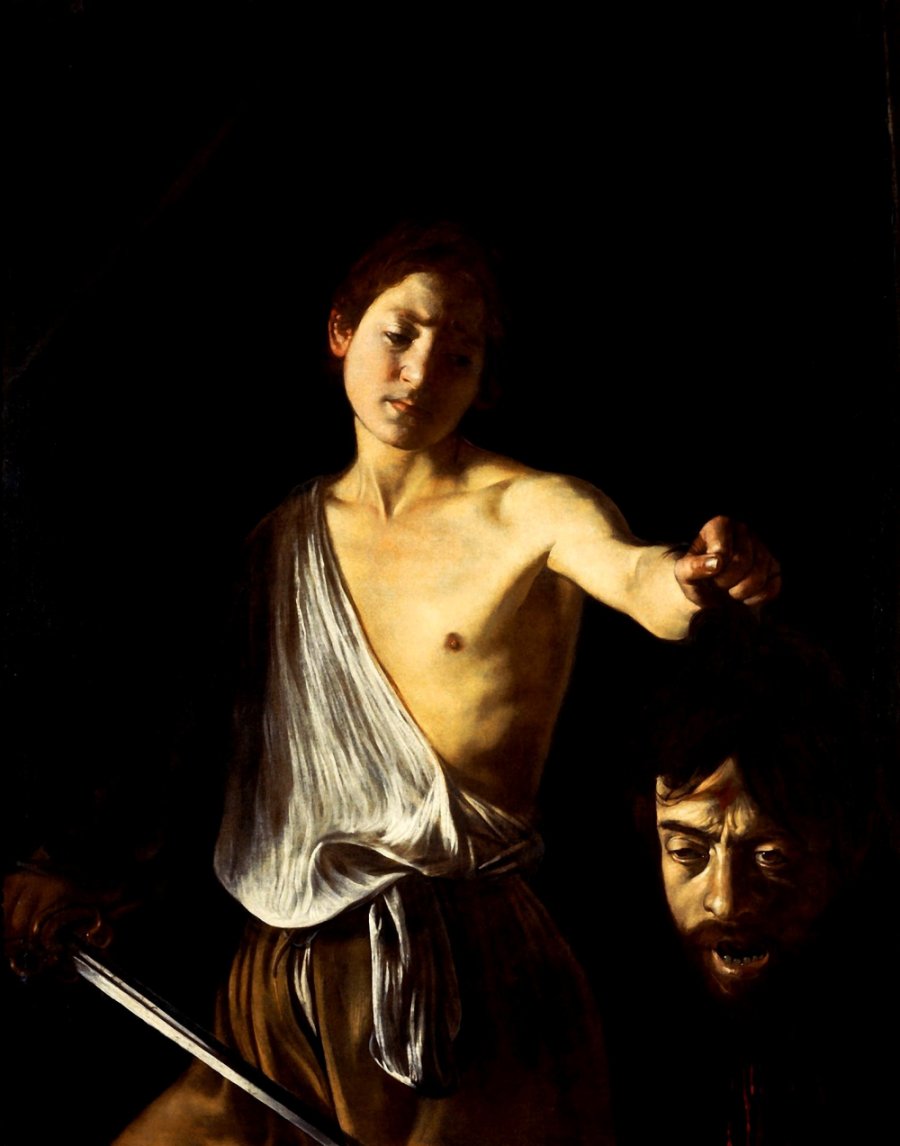
Exploiting his apparent affinity for the sawing off of heads, Caravaggio rendered his own head in a severed state in at least two apparently penitential paintings during this vulnerable period.

This Salome with the Head of John the Baptist was made for the Grand Master of the Knights of Malta after the latter had in 1608 booted Caravaggio from that island refuge:

While David with the Head of Goliath seems to have been created shortly before Caravaggio’s own death for the pope’s art-hounding “Cardinal Nephew” Scipione Borghese, in a bid to earn a pardon. Caravaggio’s self-portrait as the dead man, and Latin inscription “humility kills pride” on the Israelite hero’s sword, suggest an attempt to effect through his creative virtuosity his own execution in effigy.

That would be, at any rate, the only execution Caravaggio ultimately had to endure. He died in the summer of 1610 under unclear — and inevitably suspicious — circumstances while attempting to return to Rome.

A few biographical books about Caravaggio …

… and some Caravaggio art books

* Ranuccio Tomassoni was the pimp and lover of a prostitute named Fillide whom Caravaggio had painted years before, and become enamored of. This Fillide was also Caravaggio’s model for Judith in the arresting painting of the Biblical heroine in mid-decapitation above.

** Possibly, if you like the love triangle angle, in a botched attempt to castrate his rival.

On this day..

1872: Franks survives Fiji’s first hanging

On this date in 1872, the Melanesian realm of Fiji was favored with its first official public hanging.

It’s not as easy as it looks.

Enjoy this comprehensive botch from the firsthand account relayed by the New York Times:


A Fiji Execution.

The first attempt made in Fiji to carry a capital sentence into effect brought about one of the most remarkable incidents to be found in the annals of public executions. The Fiji Times of June 1 furnishes the following account:

“A horrible and brutalizing scene was witnessed last Tuesday morning by a number of persons who went to see the execution of the man Franks for the murder of Mr. Thomas Muir on board the Marion Rennie. He had been sentenced to suffer the extreme penalty of the law, and was to have been hanged on Monday, the 27th ult., but a gross miscarriage of justice was allowed to occur.

“The time appointed came and went, but the execution did not take place, for the simple reason that it did not suit the private convenience of the Sheriff. The poor wretch, who had by anticipation suffered the horrors of death, was then left in all the harrowing and unimaginable anxiety and uncertainty as to his fate from hour to hour until late in the evening, when he was informed that he must be hanged in the morning at 6 o’clock.

“Every preparation was made the previous night, the rope was fixed, and the noose adjusted. Rain fell, however, and wetted the rope, which was a very thick one, and in the morning it had to be dried before a fire. The time came, the rope was again fixed, the culprit and the hangman were on the scaffold, and before slipping the noose over the wretched man’s head the hangman had to sit down and place one of his feet in and pull with all his might to make the knot run; then after placing it over Frank’s head he had the utmost difficulty in making it fit anything like tight, but not nearly so tight as it should have been.

“Then the drop fell, and when the rope tightened with a slow dull thud, Franks was apparently dead for about three minutes, when his limbs began to move and he gave several groans, and then spoke. He prayed of those around him to put him out of his agony, to ‘let him meet his Maker in peace.’

“Then, through being improperly pinioned, he raised one arm and got hold of the rope, and so partly relieved himself from the fearful strain upon his neck. He still continued to beg to be put out of his misery, telling them he forgave them for the ‘black job’ they had made of it.

“But the frightful scene was not yet over.

“One of the officials, (the deputy was not to be found,) on the impulse of the moment, ran and cut the man down, when he fell heavily to the ground, there not being any attempt to catch him in his fall. Franks was then removed to the prison.

“Thus ended this ‘black job,’ which for horror is almost unparalleled. Its effect upon the spectators was such that one strong man actually fainted away.

“Thus the majesty of the law in Fiji has been asserted. Its most terrible sentence, death, has been attempted to be inflicted, and signally failed.

“The wretched man, after the terrible ordeal through which he passed, has been reprieved. Had another attempt been made to hang him, so strong was the feeling of indignation on the beach, we fully believe there would have been a riot.

“The question arises as to what should be done with the man. He has to all intents and purposes suffered the penalty of the law. Twice he has experienced horrors the like of which no man can imagine, and after being hanged and cut down by the officials, surely his punishment has ceased.

“The sentence was that he be hanged until ‘dead,’ but instead of being so hanged the officers of the law cut him down before death. The man should be free, for it must be clear that the law cannot punish him twice for the same offense.

“The best way to do now would be to pay his passage out of the country, and be rid of such a fellow from among us.

“Franks states that when the bolt was drawn and he fell, he thought he felt something break at the back of his neck, and he was praying and thinking of God and heaven. Then the memory of a wreck from which he was rescued passed before his mind. He saw himself cling to the chains till washed away; then seizing a rope attached to a floating spar, and clinging to it until washed back again on deck by a heavy sea. All the details of the wreck passed through his mind, and then came the thought, ‘Why do I not die?’ And finding he could breathe he suspected foul play and an intention to torture him by prolonging his sufferings. Then he spoke and clutched the rope, willing and wishing to die, but not a prolonged death.”

On this day..

1730: James Dalton, Hogarth allusion

On this date in 1730, career criminal James Dalton was executed at Tyburn.

Detail view (click for full image) of James Dalton’s wig box depicted in the boudoir of prostitute Moll Hackabout in Hogarth’s A Harlot’s Progress.

Crime ran in the family for young master Dalton; his father hanged upon the information of notorious (and himself eventual gallows-bird) Jonathan Wild. According to the Ordinary of Newgate’s report, our day’s principal “went between his Father’s Legs in the Cart, to his fatal Exit at Tyburn.”*

Who knows but what naughty urchins (or parents) in the throng were deterred by that affecting spectacle. For the Daltons, it was more like Take Your Child to Work Day.

While the elder Dalton’s skills ran towards card-sharping, young master James went in for the more conventional varieties of larceny — both those practiced by stealth, and those practiced by force.

These pursuits saw him twice transported to America, for which we have to thank the English judiciary on account of Dalton’s resultant biography at Early American Crime.

(In)famous for his many dalliances, Dalton’s exploits could move copy in their day — and their author transgress the lines between the underworld and “legitimate” celebrity.

“In the height of all our Robberies” [Dalton] and his companions “used to go to the Playhouse, dressed like Gentlemen,” and that once, while watching The Beggar’s Opera, “Captain Macheath’s Fetters happening to be loose,” one of them “call’d out, Captain, Captain, your Bazzel is undone.” The real thieves, having shown up the actors with their superior knowledge of both irons and cant, then retired in style to an alehouse, “in four Chairs, with six Lights before each Chair.”**

Just another hanged thief.

Except, also not — because while his career in malefaction would undoubtedly have added up to a death sentence, his condemnation was secured upon the word of a perjurer upon a very doubtful charge.

A character named John Waller, an “affidavit man” whose profession was supplying bogus testimony to hang whomever could be hanged where a reward was available, insisted that Dalton had robbed him upon the roads. Dalton vigorously denied (and even rebutted with evidence) this charge even while admitting his general life of crime, but it was upon this dubious offense against Waller that he stretched his neck. Dalton died at Tyburn with three others, though a fifth member of their party, one Hugh Norton or Haughton, managed to cheat the executioner by hanging himself in his cell.†

It was the rough justice of the 18th century, a time frequently admitting opportunity to repay tit for tat.

In this case, the professional perjurer who hanged Dalton was two years later convicted himself after making a bogus accusation of highway robbery. Waller was condemned by the court to stand in the pillory at the Seven Dials — a dangerous punishment cousin to the era’s death penalty, inasmuch as the mob violence thereby invited not infrequently proved fatal.


John Waller bombarded with refuse in the pillory.

Waller had quite a reputation, but the fury of the crowd was nothing next to that of James Dalton’s brother, Edward — who, with a confederate, brazenly climbed onto the platform, wrenched the “assize man” out of his pillory, and savagely beat him to death.

* Cited in this impressive compendium of Dalton-related primary sources.

** Andrea McKenzie, “The Real Macheath: Social Satire, Appropriation, and Eighteenth-Century Criminal Biography,” Huntington Library Quarterly, Vol. 69, No. 4 (December 2006), with the quotes supplied by a 1730 publication called “The Life and Actions of James Dalton (the Noted Street-Robber)”

† Norton/Haughton was posthumously hanged in chains the next day.

On this day..

1720: A deserter, by fellow-deserters

The sentence of death was often pronounced by courts-martial and not unfrequently carried out, a deserter convicted for the third time rarely escaping with his life. Many a man was shot in Hyde Park during the twenty years of peace, and no opportunity was lost to enhance the terror of the penalty, the firing party sometimes consisting solely of fellow-deserters, who were spared in consideration of the warning given by the ghastly body which their own bullets had pierced

John Fortescue, A History of the British Army, vol. 2

Fortescue’s notes on this passage draw attention to the following account in the May 7, 1720 Weekly Journal.

On Thursday Morning the four Men, sentenced by a Court-Martial for Desertion, were brought hand-cuff’d to the Tilt-Yard Guard, from whence they marched with the Grenadiers at the Head of the Detachment to Hyde-Park; at the Place of Execution they were met by the Chaplain of the second Regiment of Guards, who prayed with them for a while; then three of the Prisoners, having before received the King’s Pardon, were restored to the Regiment, and ordered immediately to load their Pieces, and fire at their Comrade, which they obey’d; the Man was observed to give a little Spring after the Discharge of their Pieces, and a Corporal, who was kept, as usual, in Reserve, shot him through the Head; the other three Shot were lodged in his Breast. This is the third Time of his deserting.

On this day..

1689: Patrick O’Bryan, like a dog to his vomit

From the Newgate Calendar:


PATRICK O’BRYAN

Hanged once for Highway Robbery, but lived to rob and murder the Man for whom he had been executed. Finally hanged 30th of April, 1689

The parents of Patrick O’Bryan were very poor; they lived at Loughrea, a market-town in the county of Galway and province of Connaught in Ireland. Patrick came over into England in the reign of King Charles II, and listed himself into his Majesty’s Coldstream Regiment of Guards, so called from their being first raised at a place in Scotland which bears that name. But the small allowance of a private sentinel was far too little for him. The first thing he did was to run into debt at all the public-houses and shops that would trust him; and when his credit would maintain him no longer, he had recourse to borrowing of all he knew, being pretty well furnished with the common defence of his countrymen — a front that would brazen out anything, and even laugh at the persons whom he had imposed on to their very faces. By such means as these he subsisted for some time.

At last, when he found fraud would no longer support him, he went out upon the footpad. Dr Clewer, the parson of Croydon, was one of those whom he stopped. This man had in his youth been tried at the Old Bailey, and burnt in the hand, for stealing a silver cup. Patrick knew him very well, and greeted him upon their lucky meeting; telling him that he could not refuse lending a little assistance to one of his old profession. The doctor assured him that he had not made a word if he had had any money about him, but he had not so much as a single farthing. “Then,” says Patrick, “I must have your gown, sir.” “If you can win it,” quoth the doctor, “so you shall; but let me have the chance of a game at cards.” To this O’Bryan consented, and the reverend gentleman pulled out a pack of the devil’s books; with which they fairly played at all-fours, to decide who should have the black robe. Patrick had the fortune to win, and the other went home very contentedly, as he had lost his divinity in such an equitable manner.

There was in Patrick’s time a famous posture master in Pall Mall; his name was Clark. Our adventurer met him one day on Primrose Hill, and saluted him with “Stand and deliver.” But he was mightily disappointed, for the nimble harlequin jumped over his head, and instead of reviving his heart with a few guineas, made it sink into his breeches for fear, he imagining the devil was come to be merry with him before his time, for no human creature, he thought, could do the like. This belief was a little mortification to him at first; but he soon saw the truth of the story in the public prints, where Mr Clark’s friends took care to put it, and then our Teague’s qualm of conscience was changed into a vow of revenge if ever he met with his tumblership again; which, however, he never did.

O’Bryan at last entirely deserted from his regiment, and got a horse, on which he robbed on the highway a long time. One day in particular he met Nell Gwyn in her coach on the road to Winchester, and addressed himself to her in the following manner: “Madam, I am a gentleman, and, as you may see, a very able one. I have done a great many signal services to the fair sex, and have in return been all my life long maintained by them. Now, as I know you are a charitable w— —e, and have a great value for men of my abilities, I make bold to ask you for a little money, though I never have had the honour of serving you in particular. However, if an opportunity should ever fall in my way, you may depend upon it I will exert myself to the uttermost, for I scorn to be ungrateful.” Nell seemed very well pleased with what he had said, and made him a present of ten guineas. However, whether she wished for the opportunity he spoke of, or no, cannot be determined, because she did not explain herself; but if a person may guess from her general character, she never was afraid of a man in her life.

When Patrick robbed on the highway he perverted several young men to the same bad course of life. One Claudius Wilt in particular was hanged at Worcester for a robbery committed in his company, though it was the first he was ever concerned in. Several others came to the same end through his seducements; and he himself was at last executed at Gloucester for a fact committed within two miles of that city. When he had hung the usual time, his body was cut down and delivered to his acquaintance, that they might bury him as they pleased. But being carried home to one of their houses, somebody imagined they perceived life in him; whereupon an able surgeon was privately procured to bleed him, who by that and other means which he used brought him again to his senses.

The thing was kept an entire secret from the world, and it was hoped by his friends that he would spend the remainder of his forfeited life, which he had so surprisingly retrieved, to a much better purpose than he had employed the former part of it. These friends offered to contribute in any manner he should desire towards his living privately and honestly. He promised them very fairly, and for some time kept within due bounds, while the sense of what he had escaped remained fresh in his mind; but the time was not long before, in spite of all the admonitions and assistance he received, he returned again to his villainies like a dog to his vomit, leaving his kind benefactors, stealing a fresh horse, and taking once more to the highway, where he grew as audacious as ever.

It was not above a year after his former execution before he met with the gentleman again who had convicted him before, and attacked him in the same manner. The poor gentleman was not so much surprised at being stopped on the road as he was at seeing the person who did it, being certain it was the very man whom he had seen executed. This consternation was so great that he could not help discovering it, by saying: “How comes this to pass? I thought you had been hanged a twelvemonth ago.” “So I was,” says Patrick,” and therefore you ought to imagine that what you see now is only my ghost. However, lest you should be so uncivil as to hang my ghost too, I think it my best way to secure you.” Upon this he discharged a pistol through the gentleman’s head; and, not content with that, dismounting from his horse, he drew out a sharp hanger from his side and cut the dead carcass into several pieces.

This piece of barbarity was followed by another, which was rather more horrible yet. Patrick, with four more as bad as himself, having intelligence that Lancelot Wilmot, Esq., of Wiltshire, had a great deal of money and plate in his house which stood in a lonely place about a mile and a half from Trowbridge, they beset it one night and got in. When they were entered they tied and gagged the three servants, and then proceeded to the old gentleman’s room, where he was in bed with his lady. They served both these in the same manner, and then went into the daughter’s chamber. This young lady they severally forced one after another to their brutal pleasure, and when they had done, most inhumanly stabbed her, because she endeavoured to get from their arms. They next acted the same tragedy on the father and mother, which, they told them, was because they did not breed up their daughter to better manners. Then they rifled the house of everything valuable which they could find in it that was fit to be carried off, to the value in all of two thousand five hundred pounds, After which they set the building on fire, and left it to consume, with the unhappy servants who were in it.

Patrick continued above two years after this before he was apprehended, and possibly might never have been suspected of this fact if one of his bloody accomplices had not been hanged for another crime at Bedford. This wretch at the gallows confessed all the particulars, and discovered the persons concerned with him; a little while after which, O’Bryan was seized at his lodging in Little Suffolk Street, near the Haymarket, and committed to Newgate; from whence before the next assizes he was conveyed to Salisbury, where he owned the fact himself, and all the other particulars of his wicked actions that have been here related.

He was now a second time executed, and great care was taken to do it effectually. There was not, indeed, much danger of his recovering any more, because his body was immediately hung in chains near the place where the barbarous deed was perpetrated. He was in the thirty-first year of his age at the time of his execution, which was on Tuesday, the 30th of April, in the year 1689.

On this day..

1705: Captain Thomas Green and two of his crew on the Worcester

On this date in 1705, another century’s supposed terrorist was hanged on Leith Sands with two of his “pirate” crew by a Scottish court “drunk with patriotic prejudice.”*

This execution took place in the feverish run-up to England and Scotland’s Acts of Union welding the neighboring realms into Great Britain in 1707.

Arising as it did from the same causes that animated that national marriage of convenience, Green’s execution also endangered it: Daniel Defoe, who was at this time a pro-Unionist mole (and prolific pamphleteer) for English pol Robert Harley, described this hanging as one of the six crises that had to be overcome en route to the Union.

A Man, A Plan, A Calamity

Panama.

That’s where it all started, for Green and Union alike.

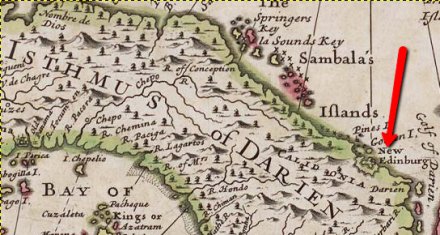
Mired in economic backwardness as neighboring European states carved up the world, Scotland made a bold, doomed bid for a chit in the empire game: the Darien scheme. One part visionary and (at least) two parts daft, this venture attempted to establish a Scottish colony on the Isthmus of Panama (aka the Isthmus of Darien) with a view to porting freight across the narrow strip of land separating Atlantic and Pacific, and dominating the dramatically more efficient east-west trade route that would result.


The intended Scottish colony in Panama; map from this University of Glasgow exhibit.

Students of the Panama Canal project will be aware that this malarial tropic would not be described as especially hospitable; to the natural disadvantages of the climate were added the political interpositions of England herself, whose hostility to the advent of her Caledonian neighbor as a New World rival was expressed in legislation choking the Darien adventure of foreign aid.

(Also a problem: Spain. The colony was abandoned at last under Spanish siege.)

So Scotland went it intrepidly, injudiciously alone in this last bid for real independent muscle in Europe. The hyperbole of the Isthmus’s publicists eventually sucked in 20 percent or more of the capital circulating in Scotland. And when Darien-dot-com went bust by 1700 at the cost of a couple thousand lives, it cratered the Scottish economy too. That set the stage for Edinburgh’s partnership in a different scheme: Great Britain.

Green with Envy

In the years following the Darien catastrophe, the Scottish corporation chartered to undertake it was still throwing stuff against the wall in the world trade game, trying to get something to stick to at least take the edge off the losses.

This company (theoretically a potential rival of England’s own East India Company) had suffered the further national indignity of having one of its ships, the Annandale, seized in the Thames for infringing the East India Company’s royal monopoly. Its appeals for redress falling on deaf ears, the Darien company apparently induced Scottish authorities to undertake the retaliatory seizure of an English merchant ship, the Worcester, that had the ill luck to weather a storm at the Firth of Forth.

Rumor soon connected this ship to another vanished Darien company vessel overdue from its return trip from the East Indies … and, as it quickly became understood by all right-thinking Scots, overtaken in the Indian Ocean by this same Worcester and its crew butchered.

Captain Thomas Green and his English crew were hailed before an Admiralty court** on piracy charges on this extremely fantastical connection in a virtual mob atmosphere.

It never was clearly established that an act of piracy had been committed as a distinct fact, but by putting certain circumstances together it was inferred that Green was guilty of piracy. The very shape in which the accusation is set forth, shows that the accusers could not point to the specific act of piracy which had been committed …

[There] was no specification as to the vessel taken, which might enable the accused to prove that it had not been taken; no names of parties murdered, who might be shown still to be alive; no ownership of cargo, which might admit of proof that the owner’s goods had arrived safe. As Green himself is made justly to say in the document published as his dying speech, “We are condemned as pirates and murderers on a coast far distant from this place — is there any of you who wants either a friend whom we have murdered, or whose goods we have taken?”

Worcester Sauce

The Worcester‘s Malabari cook provided a highly dubious charge — dubious, for he was not yet among the crew when it last called at the location he claimed the crime took place — of Green and crew hatchet-murdering approximately ten English-speaking mariners on an unnamed vessel off the Indian coast.

Upon this evidence, 14 or more members (the ready sources are a little loose on the total number) of the Worcester crew were condemned for piracy, and initially slated for three batches of hangings. Queen Anne‘s personal intervention managed a stay,

The Scottish Privy Council unto the very last hours debated what to do with the diplomatic appeals, with evidence forwarded from London to the effect that the crew these Worcester men had supposedly slaughtered were alive, their vessel having been hijacked in another place, by another man.

But a surging Scottish mob aggrieved by the preceding years’ misadventures and the impending shotgun marriage to Westminster rather than anything Green himself had really done was already engorged on the blood of the supposed English corsairs. Most of the Council thought better than to deny them their sacrifice.†

The Streets fill’d with Incredible Numbers of Men, Women and Children, calling for Justice upon those ENGLISH Murtherers. The Lord Chancellor Seafield‘s Coach happening to pass by, they stop’d it, broket he Sashes, haul’d him out, and oblig’d him to promise Execution should speedily be done before he could get from ’em … According to the Chancellors promise, soon after, on the same Day, being Wednesday, Captain Green, Madder [the mate], and Sympson [the gunner] were brought out, and convey’d to Execution, which was at Leith Road upon the Sands, and all the way was Huzza’d in Triumph as it were, and insulted with the sharpest and most bitter Invectives. Being come to the place of Execution, Good God! what a moving sight was it to see those Men stand upon the very Varge of Life, just launching in to Eternity, and at the same time see the whole Multitudet ransported with Joy!”

-From an anonymous Letter From Scotland To a Friend in London, quoted by James Kelly, “The Worcester Affair,” The Review of English Studies, Feb. 2000

In the event, these three were the only ones actually hanged; passions cooled enough for the other “pirates” to be quietly released.

But the wider, national passions unleashed by this date’s executions would long provide fodder for intemperate patriotic recrimination, and specifically anti-Unionist propaganda — on both sides of the border.

Competing propagandistic broadsides framed and re-framed the events, as the affair of unscrupulous English buccaneers or perfidious highland barbarians. (Defoe, maneuvering for Union, wrote to chill such bad-for-business hostility: “Nothing could be more horrid, than that the Scots should Execute these Men on a meer Pique at the English Nation. Nothing can be more like it, than to conclude rashly, that it is so, and improve it on purpose to Exasperate our People against the Scots.” (Kelly))

And that, of course, is precisely the viewpoint that prevailed.

While the hemp neckties issued to Green et al this date threatened to (ahem) scotch the Union project, that very danger might have ultimately hastened its completion — as elites recognized, in Defoe’s words, that Union represented “the only way to preserve the publick Tranquillity, and prevent the certain Mischiefs that threatened the whole Body,” (Kelly, again) and rammed it through with dispatch.‡

* English historian G.M. Trevelyan.

** A lengthy account of the trial can be found in this Google books freebie

† In their very scanty defense, the Scottish magistrates had reason to fear Scottish citizens.

‡ The ebb and flow of national resentment continued long after the Acts of Union, of course; continuing Scottish support for the restoration of the Stuart monarchy was one expression of Scottish nationalism and anti-Union sentiment.

On this day..

1942: Not Hersh Smolar, saved by Genesis

(Thanks to Meaghan Good of the Charley Project for the guest post. -ed.)

On this day in 1942, the Nazis issued an ultimatum to the Judenrat of the Minsk Ghetto in Belarus: turn over Hersh Smolar for torture and execution by noon, or they would all face execution themselves.

Smolar, a dedicated Communist who was a writer and editor in civilian life, had been a problem for the Germans for quite some time. He was a leader in the resistance of the Minsk Ghetto, and that resistance was a force to be reckoned with. Smolar and others like him formed an underground organization that printed leaflets about Soviet successes in the war, occasionally hid non-Jewish Communists and escaped Russian prisoners of war within the ghetto (the infectious disease ward of the hospital was a great hiding place: the Germans never went there), and above all tried to save the lives of as many Jews as possible.

The Minsk Ghetto underground formed links with underground resistance organizations on the outside and they worked together. Unlike the rest of Eastern Europe, the general population of Belarus was as a whole sympathetic and helpful to the Jews. The result was that Jews were able to escape the ghetto and join partisan groups in the forest by the thousands, surviving and taking out Nazis at the same time.

The Minsk Ghetto leaked like a sieve. By the time it was liquidated, 10,000 of its residents had joined partisan groups in the forest.

Smolar, of course, had tried to keep his activities a secret from the Nazis, but he couldn’t avoid their attention forever. Unfortunately the Minsk Ghetto Underground wasn’t very good at keeping itself a secret and twice it was decimated by mass arrests.

By the spring of 1942, Smolar was a hunted man, and in hiding. On April 1 he was in the hospital’s infectious disease ward, disguised as a typhus patient, meaning his face could be covered. (Typhus patients suffer extreme sensitivity to light.) The Judenrat paid him a visit and told him about the Nazis’ ultimatum.

Some of the Judenrat members were prepared to turn Smolar in, so only one person would have to die. Of course, the ideal solution would be where no one would die. They turned to the Tanakh for guidance, specifically the story of Joseph. When Joseph’s brothers sold him into slavery in Egypt and told their father he had died, they dipped his coat in the blood of a kid and presented this as proof of his death.

Displaying the sincerest and brassiest form of flattery, one of the Judenrat members took a blank passport, filled it out with Smolar’s photograph and details, smeared it with blood from a recent Nazi victim, and took it to the Gestapo officers. He explained that they had apparently gotten Smolar in a random shooting, as the passport had just been found on a mutilated body at the cemetery.

And the Germans actually fell for this. April Fools!

Barbara Epstein’s excellent book The Minsk Ghetto 1941-1943: Jewish Resistance and Soviet Internationalism records the rest of the story: Smolar remained in hiding in the hospital for another four months. Eventually he left the infectious disease ward and moved to a specially constructed hiding place in the attic chimney, which was only large enough to stand in.

Presumably he was very happy in August 1942, when the time came for him to leave the ghetto and join a partisan group in the forest. He survived the war … as did about 4,500 other Jewish partisans from the Minsk Ghetto.

Smolar wrote a memoir about his experiences and the Minsk Ghetto Underground in general, titled The Minsk Ghetto: Soviet-Jewish Partisans Against the Nazis. He died in Israel in 1993, age 88.

On this day..

1716: Lords Kenmure and Derwentwater but not Lord Nithsdale

This date in 1716 saw the beheading of two Jacobite lords, but it was more famous for the third who ducked the executioner in one of the Tower of London’s greatest escapes.

Lord Nithsdale, Escape from the Tower by Emily Mary Osborn(e)

Three were doomed to the block this date:

They were the fruit of Parliament’s impeachment of Jacobite leaders. Six of these fellows threw themselves upon the mercy of the Commons, and were rewarded with a death sentence by William Cowper. Only half managed to wrangle mercy from the crown.

On the eve of this date’s execution, Lord Nithsdale received a visitation of his wife, Winifred … who helped him swap clothes with one of her maids, in which garb he audaciously marched out the Tower gates in the train of his spouse.

The king whom Nithsdale had purposed to dethrone was a good sport about it. “It was the best thing a man in his condition could have done,” he declared.

The fugitives managed to cross the channel — that required another bit of dress-up, in the livery of the Venetian ambassador — and absconded to Rome. William Maxwell, Lord Nithsdale, outlived his appointment with the headsman by 28 years.

They are gone — who shall follow? — their ship’s on the brine,
And they sail unpursued to a far friendly shore,
Where love and content at their hearth may entwine,
And the warfare of kingdoms divide them no more.

“The Dream of Lord Nithsdale”

A letter detailing the escape from the pen of the intrepid Lady Nithsdale herself is well worth the read.

Her reputation as a romantic heroine (only enhanced by the romantic futility of the Jacobite struggle itself) has lent itself to all manner of literary expropriation, like this 19th century historical novel.

All very well for these two lovebirds. But the remaining 67% of the day’s scaffold carrion did not escape the Tower in women’s clothing, or men’s, and paid with their heads as scheduled.

Derwentwater went out with a peevish scaffold a ballad, “Lord Derwentwater” (or “Lord Allenwater”, or several similar variants), and another aptly titled “Derwentwater’s Farewell”.

His partner at the chop, Lord Kenmure,** also made the folk playlist in “O Kenmure’s On And Awa, Willie”, one of the ditties gathered by Robert Burns.

Having beheld all these various exemplars, Derwentwater’s brother and fellow Stuart supporter Charles Radclyffe decided to emulate them all.

Later that same year, Charles Radclyffe also made a successful prison break and got to the continent.

As a result, he was still around to participate in the 1745 Jacobite rising … and finally get executed for that.

(All part of God’s mystical plan for Radclyffe: look sharp and you’ll find him succeeding Isaac Newton as CEO of the legendary Holy Grail-keeping secret society Priory of Sion in Holy Blood, Holy Grail and its pulp novel knockoff The Da Vinci Code.)

* It’s impossible not to notice that this cross-dressing escape foreshadows that of Bonnie Prince Charlie when the Jacobite cause flamed out for good thirty years later.

** And like Lord Nithsdale, he was also blessed with a perspicacious wife — albeit one who wasn’t able to extricate him from the Tower.

On this day..

1799: Heshen forced to commit suicide

It was on this date that notoriously corrupt Chinese minister of state Heshen or Ho-Shen was forced to commit suicide in lieu of execution.

The able child of a Manchu military officer, Heshen came of age in the long reign of the emperor Qianlong.

That Heshen rose above his modest station with this monarch’s favor was the source of no small resentment. Rumors circulated that the attractive young former bodyguard reminded the emperor of a lost, beloved concubine — with all that implies.

“Elegant in looks, sprucely handsome in a dandified way that suggested a lack of virtue,” a Korean diplomat described Heshen.

Whatever there might have been to the homosexuality angle, Heshen exploited the imperial protection to gorge himself on the state’s revenues; he’s reported to have filled the bureaucracy with clients who saw to it that Heshen got a yuan out of every tael that passed through state business in the last quarter of the 18th century. He even dynastically married his own son to one of Qianlong’s daughters.

It was the peak of the Qing dynasty’s glory, and the dawn of its imperial stagnation. Heshen — resplendent, omnipotent, and sunk in vice* — remains to this day its persona par excellence.

As long as the emperor lived, Heshen had a virtual free hand.

But as soon as the emperor died — on February 7, 1799, at the age of 87 — the successor** Jiaqing destroyed him.

Citing Heshen’s inability to suppress the nettlesome White Lotus and Miao rebellions, Jiaqing arrested and tortured the former retainer into copping to all manner of offenses both mortal and venial.

My thoughts dwell ever on the Confucian precept: ‘For three years after a parent’s death none of his former surroundings should be changed.’ …

But as regards Ho Shen, his crimes are too grave to admit of possible pardon … Ho Shen is a deep-dyed traitor, lost to all moral sense, who has betrayed his Sovereign and jeopardised the State. As self-constituted dictator he has usurped supreme authority.

Seeing the man’s abrupt change of fortunes, Heshen’s people in the bureaucracy fell over each other to denounce him.

He was condemned to the horrific expiation of “slow slicing”; however, given “the undesirability of executing the chief Minister of State like a common felon in the public square,” Jiaqing “allowed him the privilege of committing suicide, as a mark of high favour and out of regard to the dignity of the nation.”

A principal accomplice was made to witness Heshen ceremonially hanging himself; then the accomplice was reprieved of his own death sentence and sent into exile.

The new sovereign found his nation’s dignity sufficiently upheld by the doomed man’s melancholy inventory of loot destined (of course) for the re-appropriation of the Qing … and sufficiently outraged that, upon discovering weeks after the some artifact Heshen had failed to enumerate,

Had these facts come to Our knowledge before the 18th day of the 1st Moon [i.e., February 22], we should assuredly have decreed Ho Shen’s decapitation, even if We had spared him the lingering death and dismemberment.

However, he has already been permitted to commit suicide, and thus luckily escaped the extreme penalty of public execution. We do not, therefore, insist on his corpse being hacked to pieces.

Jiaqing had better to worry about his own now-declining state, which was about to be hacked to pieces by encroaching European powers.

Having made an example of Heshen and a handful of his most visible allies, he was still saddled with the endemic structural corruption Heshen had fostered in the institutions of Qing governance.

“Historians have tended to see Jiaqing’s failure of nerve in purging the bureaucracy of all tainted officials as something of an original sin whose commission predetermined the dynasty’s steady decline,” writes William T. Rowe of this turning point. “But given the need for at least some continuity in routine administration, it is not at all clear that he could have acted otherwise.”

(Hey, at least he did make the few examples. Not everyone even does that much.)

And so Jiaqing struggled in vain to maintain China’s fading prestige; his reign would witness economic erosion and a burgeoning opium trade that eventually led it to war with the British and humiliating western domination.

Since a sclerotic bureaucracy at once crushing in its expanse, helpless in its effect, and riven with self-dealers, is a timeless theme (especially in China), Heshen persists as a lively emblem of corruption.

Heshen’s luxurious mansion — which was also among Jiaqing’s indictments — still stands; today, it’s a museum.

* It bears remembering that it is principally by the testimony of Heshen’s enemies that we know him.

** Technically, Jiaqing had been ruling since Qianlong symbolically “abdicated” in 1796; in reality, Qianlong continued to run the realm until his death.

On this day..