On this date in 1896, the not-yet-a-state of New Mexico executed four convicted murderers in three separate towns.
Actually, six men had been scheduled to swing, but two got reprieved. New Mexico wasn’t trying to win some kind efficiency contest … it just worked out that way.
The unlucky four were Dionicio Sandoval in Albuquerque, Antonio Gonzales in Roswell, and Perfecto Padilla and Rosario Ring in Tierra Amarilla. Their stories are told in R. Michael Wilson’s Legal Executions in the Western Territories, 1847-1911. All four were convicted of quite ordinary murders.
Sandoval, a sheep herder, shot another sheep herder who accused him of stealing animals from his flock. The sheep didn’t even belong to either one of them: both men were tending herds owned by the Bernalillo County commissioner.
Gonzales had a buddy named Eugenio Aragon who asked him to help kill someone who was threatening to prosecute Aragon for the theft of some lumber. Always eager to help out a buddy, Gonzales assisted in the homicide, only to find himself arrested and then deserted by his so-called friend. (Aragon slit his own throat in jail, leaving Gonzales to face the noose alone.)
Padilla supposedly killed a miner with his own pick for two burros, a hat and a $30 watch. The evidence at his trial was very shaky and many people believe he was an innocent man, perhaps deliberately railroaded for mysterious reasons.
Ring had come to New Mexico from the Colorado territory, which had gotten too hot for him; he was a suspect there in the murder of his wife and baby, and if he did that crime the near brush with the law did not teach him caution in his new environs: one night during a drunken spree he broke a beer bottle over another man’s head, then shot him in the back. The victim died in his mother’s arms. Ring had a friend who was with him that night and started the fight, and they were tried together for the murder, but the friend was acquitted.
Padilla and Ring were not actually hung together side by side as is sometimes done; instead, Padilla went first while Ring waited his turn beside the scaffold. After they cut Padilla’s body down, Ring stepped up.
That’s all, folks.
In 1897, New Mexico would repeat their “four executions in one day” trick by hanging four men, two of them brothers, for a single murder.
Core to the experience of capital punishment is the dramatic last-minute reprieve.
As drama, you can’t do a lot better than a last passport to life delivered seconds ahead of the reaper. Or even seconds after! We’ve seen in these pages the paper of record bemoaning the the very prospect of a late stay as a “refinement of cruelty,” but something tells us that neither party to the transaction will opt to forego it.
This date in 2006 offers the anniversary of the (un-stayed) execution of a man who was making his second visit to the gurney — courtesy of one of those last-gasp reprieves eight months before.
And when it was time to go, Hill had the rare benefit of experience.
He’d already been all strapped down on January 24 of that same year, with the IV hooked up and ready for someone to drop the plunger, when Supreme Court Justice Anthony Kennedy issued the last-secondest of last second stays.
The purpose of that stay was to allow Hill to pursue an (ultimately unavailing) suit against the constitutionality of Florida’s lethal injection procedures.
Though Hill got no legal traction — literally, the courts declined to act on Hill’s petitions, and then the Supreme Court ruled 5-4 against taking any further action — the whole situation foreshadowed the juridical and procedural dog’s breakfast that lethal injection has become five years hence.
Twelve weeks after Hill’s (“successful”) lethal injection, the Sunshine State badly botched the lethal injection of another man, leading to a yearlong hiatus in American executions while the courts attempted to sort out that lethal injection stuff for real.
On this date in 1861, Vermont private William Scott of the new-formed Army of the Potomac, then fortifying Washington D.C. for the unfolding Civil War in the aftermath of Bull Run, was led out for execution for having fallen asleep at his post.
The so-called Sleeping Sentinel took a sick comrade’s watch even though he himself was bushed, and … well, you know the rest.
Condemned for a dereliction of duty which “may endanger the safety of a command, or even of the whole army” (the words of the army’s commander Gen. McClellan), Scott still attracted widespread sympathy due to the obviously sympathetic nature of his situation. He was a youth new to war, with an exemplary military record outside of his forty winks.
“The American people,” reckoned the New York Times, “are quite unprepared to hear of a measure of such fearful and unwarned rigor as that which was awarded private SCOTT.”
Appeals went straight to the White House, which was conveniently located in the Army of the Potomac’s back yard, and freshman president Abraham Lincoln magnanimously spared the lad.
Still, wanting to use the case to impress military discipline upon the rabble of corn-fed conscripts, that clemency was delivered with a terrifyingly dramatic flourish. Scott was left to contemplate his last hours on the earth, and, Dostoyevsky-like, marched out to the stake ostensibly to face the firing squad. Only then did he and his fellow-soldiers hear the commutation order.*
This exhilarating climax did not long stay the hand of the Reaper, as it transpired.
Scott died in battle the following spring. In death he lives on, as befits the habitues of these pages: fellow Vermonter Lucius E. Chittenden, who was serving in the U.S. Treasury when all this sleeping sentinel stuff went down, commemorated William Scott for posterity in a subsequent entry to the merciful-Lincoln mythology, a postwar volume titled Lincoln and the Sleeping Sentinel.
The story was also made into a 1914 silent film, which sadly doesn’t seem to be available online: but never fear, this syrupy poem will amply represent our Sentinel’s contribution to the canon.
But God is love – and finite minds can faintly comprehend
How gentle Mercy, in His rule, may with stern Justice blend;
And this poor soldier, seized and bound, found none to justify,
While war’s inexorable law decreed that he must die.
‘Twas night. In a secluded room, with measured tread and slow,
A statesman of commanding mien paced gravely to and fro.
Oppressed, he pondered on a land by civil discord rent;
On brothers armed in deadly strife: it was the President!
The woes of thirty millions filled his burdened heart with grief;
Embattled hosts, on land and sea, acknowledged him their chief;
And yet, amid the din of war, he heard the plaintive cry
Of that poor soldier, as he lay in prison, doomed to die!
‘Twas morning. On a tented field, and through the heated haze,
Flashed back, from lines of burnished arms, the sun’s effulgent blaze;
While, from a somber prison house, seen slowly to emerge,
A sad procession, o’er the sward, moved to a muffled dirge.
And in the midst, with faltering step, and pale and anxious face,
In manacles, between two guards, a soldier had his place.
A youth, led out to die; and yet it was not death, but shame,
That smote his gallant heart with dread, and shook his manly frame!
Still on, before the marshalled ranks, the train pursued its way,
Up to the designated spot, whereon a coffin lay-
His coffin! And, with reeling brain, despairing, desolate-
He took his station by its side, abandoned to his fate!
Then came across his wavering sight strange pictures in the air:
He saw his distant mountain home; he saw his parents there;
He saw them bowed with hopeless grief, through fast declining years;
He saw a nameless grave; and then, the vision closed-in tears!
Yet once again. In double file, advancing, then, he saw
Twelve comrades, sternly set apart to execute the law-
But saw no more; his senses swam-deep darkness settled round-
And, shuddering, he awaited now the fatal volley’s sound!
Then suddenly was heard the sounds of steeds and wheels approach,
And, rolling through a cloud of dust, appeared a stately coach.
On, past the guards, and through the field, its rapid course was bent,
Till, halting, ‘mid the lines was seen the nation’s President!**
He came to save that stricken soul, now waking from despair;
And from a thousand voices rose a shout which rent the air!
The pardoned soldier understood the tones of jubilee,
And, bounding from his fetters, blessed the hand that made him free!
A few letters from Scott’s own hand are preserved here. A (defunct) mini-blog exploring the case in detail can be perused here.
* There was actually American precedent for this sort of stagey non-execution in a case from the War of 1812.
** Obviously, Lincoln did not actually bring his presidential person to the execution grounds to issue this pardon in the flesh: in fact, the presiding officer on-site simply read out the pardon: “the President of the United States has expressed a wish that as this is the first condemnation to death in this army for this crime, mercy may be extended to the criminal.”
This “greatest American short story … a flawless example of American genius” (according to Kurt Vonnegut) was 1890 product of puissant wordsmith Ambrose Bierce.
In this non-chronological story, Peyton Farquhar, “a well to do planter, of an old and highly respected Alabama family,” is entrapped by a Union spy purporting to be a Confederate agent to attempt an act of sabotage in the face of a hanging warning issued by the Union army.
It can be ballparked in late August or early September based on its location in northern Alabama, which essentially didn’t see Civil War activity until the very end of the war. Except, that is, for the maneuvering building up to the Battle of Chickamauga fought just over the border in southeastern Tennessee September 19-20, 1863.* That also squares with seasonal indicators in the text pointing to summer, e.g.: “the flood of last winter had lodged a great quantity of driftwood against the wooden pier at this end of the bridge. It is now dry and would burn like tinder.”
At any rate, the story begins with Farquhar stationed on Owl Creek Bridge awaiting execution … but the rope snaps as he falls, giving him a bid for freedom. As for what happens next: read the story, or take in this economical screen adaptation by French director Robert Enrico aired for American audiences on The Twilight Zone.
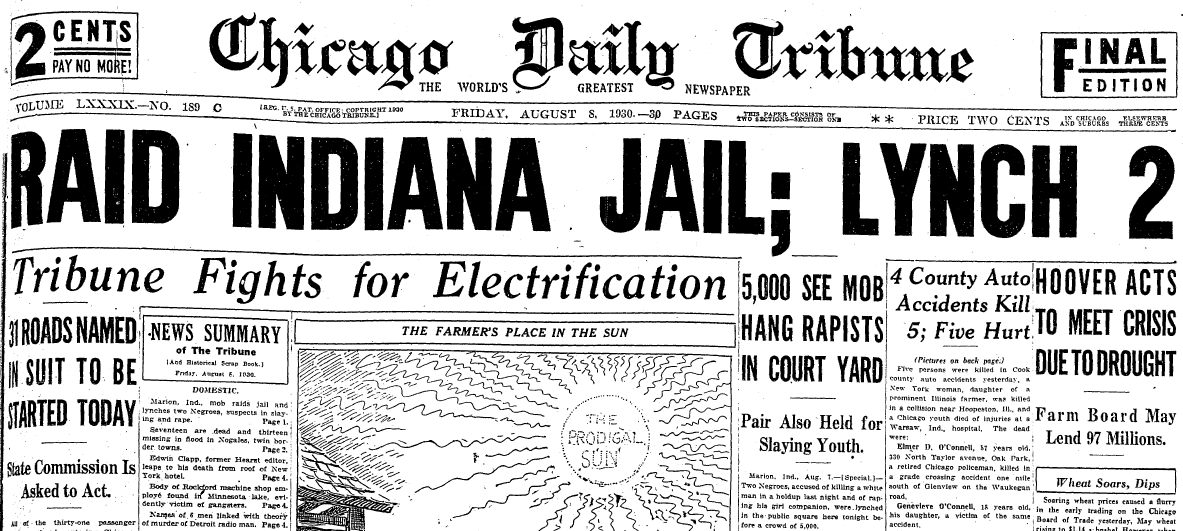
On this date in 1930, two black youths were lynched in Marion, Indiana for murdering a white man and raping his girlfriend.
(The rape allegation — although it, and not the homicide, seems to have been the thing that triggered the lynching — was subsequently withdrawn, and there were even rumors that the white girlfriend was a lover and confederate of one of the lynched men. It’s just one strand in the very human tapestry around the “last classic lynching north of the Mason-Dixon line” explored by Cynthia Carr in Our Town: A Heartland Lynching, a Haunted Town, and the Hidden History of White America.)
Shipp, who is said to have confessed killing the white man, Claude Deeter, 23, of Fairmount, Ind., was hanged from an elm tree in the courthouse yard. Smith, whom the girl identified as her assailant, was thrown from a third floor window of the jail with a noose around his neck and strangled.
…
Reports of the crimes and confessions, published in Marion newspapers this afternoon, stirred this quiet community of 23,000 to intense excitement. There was no hint of the impending violence, however, until 8:30 p.m., when a motorcade of Deeter’s fellow townsmen arrived from Fairmount.
The Fairmount delegation, numbering about 100, gathered in the public square, openly displaying their guns and shouting for a lynching … The sheriff led his deputies to the front door, argued a moment with the leaders of the mob and then ordered the tear bombs thrown. Blinded, the lynchers fell back for a few minutes, but returned and began the sledge hammer siege which forced the jail doors within ten minutes. No shots were fired on either side.
Following the lynching the mob gathered in the square for an hour, some proposing to drive the 2,000 members of the Negro colony from the city and burn their dwellings. Peace officers from Indianapolis, Kokomo, Fort Wayne, and other towns were arriving however, and gradually the mob broke up.
The corpses hung in the square for hours, attracting throngs of gawkers — including a photographer able to snap this picture:
Teacher/poet Abel Meeropol ran across this photo of the Shipp-Smith lynching a few years later in a magazine, and it so “haunted” him — his word — that he penned the anti-lynching poem “Strange Fruit”. You know it from Billie Holiday‘s arresting vocal rendition.
Southern trees bear strange fruit
Blood on the leaves
Blood at the root
Black bodies swinging in the southern breeze
Strange fruit hanging from the poplar trees
Pastoral scene of the gallant south
The bulging eyes and the twisted mouth
The scent of magnolia sweet and fresh
Then the sudden smell of burning flesh
Here is a fruit for the crows to pluck
for the rain to gather
for the wind to suck
for the sun to rot
for the tree to drop
Here is a strange and bitter crop
Abel Meeropol was no passing sentimentalist himself, but a prolific left-wing activist. During the McCarthy years, he adopted the children of the Rosenbergs when the latter were electrocuted as Soviet spies. As faithfully as those two orphaned boys have carried the torch for their lost birth parents, they also still carry an adoptive surname: Michael Meeropol and Robert Meeropol.
A third person was almost lynched in the same Marion, Ind., incident, but 16-year-old James Cameron (sometimes called “Herbert” or “Robert” in the 1930 news reports) managed to convince the mob that he wasn’t involved. Just how he managed this feat and what he’d really been up to is another strand of Carr’s tapestry: many of the Marion blacks as well as whites she interviewed overtly mistrusted Cameron.
At any rate, the crowd let him off with a beating, and Cameron served time as an accessory to the crime.
After release, he became an anti-lynching activist in Indiana and, later, Wisconsin — where he founded a (since-shuttered) Black Holocaust Museum. He started several NAACP chapters.
In the more immediate aftermath, it was far from a given that this date’s effusion of summary justice wouldn’t cascade into a generalized racial pogrom.
As the Tribune article notes, the lynch mob mulled attacking the black community, ultimately dissuaded by the gradual arrival of lawmen. By the next day, the Indiana national guard had occupied Marion. The Tribune on Aug. 10 reported the town “peaceful to all outward appearances but acutely aware of an undercurrent of racial antagonism that it feared might flame into open warfare at any moment.”
Lest this seem a bit over-the-top, recall that all this went down just a few years since a lynch mob in Tulsa had metastasized into one of America’s most notorious race riots. The prospect of wholesale bloodletting was very real.
When the local attorney general and grand jury waved away the small matter of punishing mob leaders, several of whom were publicly known by name, Indianapolis attorney general (and Marion native) James M. Ogden drove up to town and personally filed indictments, to the fury of white residents.
“It was astonishing to see and feel the mob atmosphere that still prevailed nearly seven months after the murder,” wrote a correspondent for The Nation. Ogden’s deputies were “looked upon as enemies of the community, not only by the mob, but also by most of the court officials.” After all-white juries acquitted the first two people tried, the state dropped its remaining indictments.
The maelstrom of race and politics and history that emerged from that first fatal transaction — a brutal but banal Lover’s Lane heist — grew so far beyond the original cast of criminal and victim that they practically became secondary to the story.
On August 8, 1930, a wire story datelined Fairmount, Ind., ran in the Indianapolis Star (but not the Marion papers):
Deep regret that the negro slayers of their son Claude, were lynched in Marion last night by a mob, was expressed today by Mr. and Mrs. William Deeter, members of the Apostolic faith, a sect similar to the Quakers.
“God should have been the judge,” said the elderly Deeter. “They had no right to do it,” his wife assented.
Both are opposed to capital punishment and did not want to see the negroes put to death for their crime.
Sometime in July 1943, a lucky accident saved the lives of thirteen-year-old Halina Birenbaum and a group of other girls and women, all of them inmates at the Majdanek Concentration Camp outside of Lublin, Poland.
Halina’s mother was sent to the gas chambers immediately upon their arrival at Majdanek. The daughter was spared to work and endure the torture that was daily life in the camp. “We were tormented day after day by roll calls, starvation, slave labor, beatings and vermin,” she recalled later in her memoir, Hope Is the Last to Die. “Lice devoured us at night.”
After two months of this, Halina was selected and sent along with her sister-in-law, Hela, and other female inmates to an empty hut in the men’s camp. The women had no idea what the Nazis wanted them for; there was nothing to do but wait.
When it was dark outside, the Storm Troopers locked the hut and switched off the light. I nestled up to Hela, and we both fell asleep on the floor, dreaming of a better camp, easier work, tolerable living conditions…
In the middle of the night, the SS noisily threw open the hut door, arousing us with their shouts and beatings; they began herding us out, making sure that no one hid or escaped. A fearful confusion ensued.
Sleepy, frightened to death, we crowded to the door, pushing and trampling one another in the darkness and panic. The Storm Troopers ran around like mad dogs. They made us form fours, lit electric lamps and counted us, swearing.
“They are taking us to the crematorium!” The terrible news fell on us like a thunderbolt and spread like lightning through the ranks.
My heart beat rapidly. I could not believe it. Once again I could not believe that death was possible, as months earlier, on the WarsawUmshlag, when the Nazis set up a machine-gun in front of us … And I did not yield to the general panic and despair.
The SS gave an order and we moved off … in the direction of the crematorium. Some women were weeping, others tearing their hair, praying, or bidding farewell to mothers or sisters.
They herded us into a hut, the interior of which resembled a bathhouse. Despite the darkness, we observed stacks of empty gas containers on the ground in front of the hut. There was a strange sweetish odor in the air. There was no doubt now that they were taking us to execution. The women went out of their minds … They groaned, wailed, had convulsions.
They herded us into the bathhouse, and barred the door behind us. Now we had to carry out an order given previously: undress and hang out clothes up on hooks on the wall. Obediently we undressed in silence. We knew there was no way out. We hung out clothes up, then sat down on benches along the walls, waiting in extreme agitation … When and how would death come?
Time passed. Hour followed hour. But nothing happened. No one came. It was silent both inside and outside the bathhouse. Perhaps they had forgotten us? A faint hope slowly began emerging … Toward morning they came back; after the nightmare of waiting for death in the gas chamber, we went outside. They counted us again (as though anyone could have escaped from that locked building!), and took us back to the men’s camp, to the same hut as the day before. There we learned from the prisoners that the supplies of gas has unexpectedly run out during the night … We had been spared on account of this accident.
Later that day, Halina and her fellow inmates were put on a truck and taken to Auschwitz.
Several times more she escaped death by the skin of her teeth. She would survive the war, move to Israel, and become a writer, poet and translator.
Where the rail splitter failed, fortune prevailed.
“A few days — or nights rather — before that set for his execution,” we read,
a friendly auger passed to him afforded the means of escape. Just then delays were dangerous to poor drunken Bill Weaver, for Sheriff Lewis had the rope and scaffold ready, so he did not await a farewell word from friends, but sped away to the North, as the winds go. At that time the tangled forests and the untramped prairies afforded unexcelled means for seclusion and escape, and the condemned man, once a mile from town, might well bid farewell to every fear of being caught and hanged, as he doubtless did. Years afterward Weaver was heard from in far Northern Wisconsin, a useful, law-abiding citizen. No effort was ever made to bring him back from his delicious exile.
This date in 1786 offers us the fine legal salami-slicing of how to stanch a race war with a noose.
Our salami’s name is David Nelson, a furloughed veteran of the Queen’s Rangers in the late American Revolution relocated to the environs of Fredericton, New Brunswick.
There, he and a fellow veteran named William Horbord or Horboard shot dead a native Maliseet for stealing their hog.
This brought neighboring peoples to a deadly tense standoff. The Maliseet demanded justice for their victim; white Canadians demanded … well, the right to shoot Maliseet without fear of their own neck.
Nelson and Horbord went right on trial, but how to finesse the situation?
According to an exhibit that unfortunately seems to have vanished from the Virtual Museum of Canada, natives “camped out around the presiding Judge Kingsclear’s home.” That must have got his commute off to an awkward start each day.
So a Solomonic compromise obtained: after the two were duly convicted and doomed to hang, Nelson, the principal offender, was measured for his coffin … while Horbord, deemed less culpable, received a pardon.
On this date in 1924, a group of Japanese Oomoto* sect members was lined up for execution by a Manchurian warlord — only to be saved at the last moment by the intervention of the Japanese consulate.
These inordinately lucky folk were the remnants of a bizarre “spiritual army” under Onisaburo Deguchi, who set out to plant a utopian colony on the Mongolian steppe.
Onisaburo (left) and Ueshiba, shackled together for deportation after their near-execution. Onisaburo’s part of this image looks a little touched-up.
Oomoto got started as a splinter sect from Shinto with an illiterate peasant woman named Nao Deguchi, who began receiving spiritual visions in the in the 1890’s. Onisaburo was her follower, and then her son-in-law, and certainly the foundling cult’s greatest exponent.
With his guidance, it blossomed as one of the early 20th century’s most successful “new religions”, a term encompassing the dizzying array of novel religious movements in Japan after the Meiji Restoration.**
A born showman and innovative communicator, Onisaburo was a natural to
[mediate] between traditional and modern Japan in a time of national transformation.
… he was no less a master at what Eric Hobsbawm termed the “invention of tradition.” …
Onisaburo’s imaginative rituals and personal presentation (he loved to star in movies, and to dress as a shaman or Shinto deity) combined enough folk tradition to seem familiar, yet always with a new twist suggesting up-to-date modernity and “scientific” awareness to boot.
In private communication with this site, Ellwood compared the advent of new religions like Oomoto to the roughly contemporaneous advent in the west of movements like Christian Science and Religious Science. Both of these, like Oomoto, explicitly aimed to yoke tradition and modernity together.
“In Japan the leap from a closed-off feudal society to a modern industrial powerhouse was particularly profound, and naturally disturbing to a lot of ordinary people,” Ellwood said. “The new religions tried to combine old and new, giving people baffled by change and the breakup of traditional peasant communities and ways of life something to hold on to. They said in effect, ‘We understand your problems; we can show how it all makes sense, how it will come out good in the end, and how you can fit in, be part of exciting times, and gain power in the process.'”
Onisaburo’s brand of evangelical, grassroots millenialism hit the big time in the 1910s and 1920s.
It also attracted official censure from authorities wary of deviation from the official Shinto religion.
Onisaburo did a short stint in prison for subversion in 1921, and shifted his attentions abroad.
“Onisaburo considered himself strongly internationalist in an idealistic way, and therefore was led to challenge the increasing nationalism of his time and even the Emperor himself, whereas many of the other new religions accommodated themselves to the prevailing political currents,” Ellwood observed. Later, Onisaburo would actually be prosecuted for lese majeste for his insufficient accommodation to imperial authority.
At any rate, as part of feeling out the proper spiritual direction after his first stint as a ward of the state, Onisaburo and some followers quietly slipped out of Japan in early 1924.
They made for Manchuria, then a de facto independent principality under the Tokyo-allied warlord Zhang Zuolin.
There, they recruited one of Zhang’s subordinates on a mission to form up a “spiritual army” to invade Outer Mongolia.
According to Stalker, this adventure initially had Zhang’s blessing — but he quickly soured on the freelance militia, a leader now calling himself the Dalai Lama, and the gang’s escalating aspiration to unite all of Mongolia on his borders. Zhang surrounded and suppressed the expedition, summarily executing most of the Chinese personnel.
On this day, the Japanese too were about to be disposed of. Onisaburo was reciting death poetry.
Even if my body is exposed
on the plains of Mongolia
I will still keep the dignity of a Japanese
Farewell!
I will ascend to Heaven and protect
not only Japan but the whole world
Far away from Japan
I will now join the gods
in the sky of Mongolia
But the execution was dramatically aborted when Onisaburo was fortuitously able to hail a Japanese consular official who protected his countrymen.
Scarcely chastened — indeed, the adventure with its miraculous escape drew romantic media coverage back home — Onisaburo returned to Japan to rebuild Oomoto. He would continue dabbling in both internationalism (Oomoto adopted the sometimes-persecuted artificial language Esperanto) and Japan’s right-wing fringe (Stalker says that Onisaburo wisely declined Ikki Kita‘s invitation to finance a disastrous right-wing revolt).
Oomoto was violently suppressed in the 1930s, but retained many adherents and still exists today.
Martial artist Morihei Ueshiba was one of Onisaburo’s disciples to escape execution this date. Upon returning to Japan, the man parted ways with Oomoto and instead created the martial art form aikido.
* Alternatively, Omoto, or Omotokyo.
** And continuing to the present day. While Oomoto is also a going concern, the “new religion” most widely familiar to most readers will be the Aum Shinrikyo sect — notorious for carrying out the 1995 sarin gas attack on the Tokyo subway.
This master’s thesis (pdf) sets the scene for new religions (and specifically Oomoto) in early 20th century Japan.
It’s at dawn on this date in 1800 that the republican Mario Cavaradossi is shot at Castel Sant’Angelo in the climax of the Puccini opera Tosca.
This opera was adapted from the play La Tosca, by Victorien Sardou. That author does this site the considerable favor of exactly dating the action; a character at the end of Act 1, Scene 1 announces, “this evening, 17 June, a celebration at the Palazzo Farnese in honor of this victory.” The remaining story unfolds over that night and into the next morning.
En route to Marengo: Jacques-Louis David‘s heroic picture of Napoleon crossing the Alps comes from this campaign.
“This victory” worth the proposed palazzo party is the Austrian defeat of Napoleon at the Battle of Marengo during Bonaparte’s 1800 invasion of Italy.
But there’s a minor problem. Said seesaw battle went not to Austria but (decisively) to Napoleon, after a late French rally.
The action of Tosca takes place in a Rome which has received an initial, incorrect notice of Austrian victory. This is of particular import in the Eternal City because it’s under the temporary receivership of the Hapsburg Queen Maria Carolina, a virulent foe of the French Republic as befits a sister of Marie Antoinette.
(France-supported Italian revolutionaries had already deposed Maria Carolina once; the Corsican’s reappearance on her peninsula gave her good cause to fear that it would happen again.*)
At any rate, “Queen Caroline” and her husband Ferdinand were not above spilling blood to hold down the republican elements in Rome. Harold Acton pegged their harvest at “8,000 political prisoners … 105 were condemned to death, six of whom were reprieved.”
Our date’s fictional principal would reckon among those.
We meet him as a painter with subversively liberal inclinations, in love with the titular heroine as she with him — but opposed by police chief Scarpia: his profession is to pursue revolutionaries; his passion, to pursue Tosca.
Scarpia captures, and tortures, Cavaradossi for aiding an escaped official of the recently destroyed Roman Republic, and forces Tosca to yield herself to him in exchange for her lover’s life.** This is Tosca’s aria lamenting her position:
One thing: because Scarpia doesn’t want to be implicated in the release of a dangerous radical, he insists on a mock-execution in which the prisoner will appear to be shot and feign death, the better to spirit Cavaradossi away and on to happily-ever-after.†
And because Scarpia is a villain, he arranges for his rival’s “mock” execution to be not so mock after all … to the suicidal horror of Tosca.
Aaaaaand curtain.
There are scads more Tosca excerpts on YouTube. Here’s an Italian-English libretto, and here a handy summary.


 This date in 2006 offers the anniversary of the (un-stayed) execution of a man who was making his second visit to the gurney — courtesy of one of those last-gasp reprieves eight months before.
 The so-called
  This “greatest American short story … a flawless example of American genius” (
 Halina’s mother was sent to the gas chambers immediately upon their arrival at Majdanek. The daughter was spared to work and endure the torture that was daily life in the camp. “We were tormented day after day by roll calls, starvation, slave labor, beatings and vermin,” she recalled later in her memoir,