1785: Horea and Closca, Transylvanian rebels

On this date in 1785, two of the three leaders of Transylvania’s great peasant uprising were broken on the wheel in the city of Alba Iulia — the third having cheated the executioner by hanging himself in his cell.


Left to right: Vasile Ursu Nicola, known as Horea; Ion Oarga (Closca); and, the suicide, Marcu Giurgiu (Crisan).

The Revolt of Horea, Closca and Crisan (English Wikipedia entry | the far more detailed Romanian) featured the usual grievances of feudal serfs, who in this case were Orthodox Christians governed by a Hungarian Catholic nobility. The heavier exactions of the region’s magnates in this period had led to several peasant delegations petitioning for relief from the Habsburg crown, among whose rosters appear this day’s eventual executees, Horea and Closca.

Those grievances were transmuted into rebellion, paradoxically as it might seem, by the 1780 death of Maria Theresa and the consequent ascent to sole rulership of Emperor Joseph II. Remembered as one of history’s great progressive “enlightened despots,” Joseph would surely have thought himself a friend to the peasantry with measures like rolling back serfdom and a broadened mandate for education.*

But the careless injuries his modernizing edicts visited on a precarious dominion of his polyglot empire would help beat ploughshares into swords in the regions of present-day Romania.

Imperial demands for fresh (rationalized, as the empire saw it) cash taxation had excited the countryside’s nobility and peasantry alike, since little specie flowed through their traditional agrarian arrangements, and an attempted census had met widespread resistance as a likely harbinger of the revenue man; but, these rebels from the soil still mostly hated their traditional local overlords and in due course would direct their blades and torches accordingly. Demands they presented to a besieged city on November 11 of 1784 underscore their perspective:

  1. The nobility should be abolished; each noblemen, if he could get a job in the imperial administration, should live on that income.
  2. The noble landlords should leave once for all their nobiliary estates.
  3. The noblemen should pay taxes like any common taxpayer.
  4. The noblemen’s estates should be divided among the common people

Source

The most immediate spark to set all this tinder ablaze would be the apparent prospect of widespread military recruitment — a desideratum for the peasantry, as it offered the prospect of social mobility and an escape from the magnate’s lash — which was then apparently withdrawn or blocked, a cruel trick to put the servile class in mind of its many abuses. In early November, beginning in Zarand, thousands of peasants Romanian, Saxon, and Hungarian alike rose in arms and began putting manors and churches to the sack.

“Letters from Transylvania continue to talk of excesses committed by rebels there,” one bulletin reported.

Not content to kill the feudal lords, they set fire to the habitations of their vassals if these refuse to embrace the party of the insurgents. At Kerespaya they broke into the coffers of the royal treasury and took away all the money. The evangelical pastor of that place, after having seen the throats of his wife and children cut, was taken to the church and decapitated at the foot of the altar. Some Franciscans met the same fate, those who had taken refuge in the bell towers were strangled and thrown into the streets. But they respect the officials of the emperor, as long as they are not nobles … Major Schultz asked one of them the motives for their cruel conduct, he answered: “Do not believe, Sir, that we have joined this party without reason; we were forced into it by the most pressing necessity. Here are authentic copies of several royal orders given out for our benefit that have not been carried out. All our remonstrances in this matter have been useless, and we have been sent away without receiving justice. It is thus only to break the yoke of the most insufferable slavery that we have resolved to vindicate ourselves. We know well that our conduct will be disapproved of, but we pride ourselves at the same time that it will serve to force examination of the conduct of those who have so cruelly deceived us. At any event, we prefer death to a miserable life, and will die content so that our example might guarantee the rights of humanity to our descendants and give the state contented subjects.”

Nuove di diverse corti e paesi, Dec. 27, 1784 (quoted by Franco Venturi)

The tragic aspirations of this rebellion — which lasted only two months, but had managed to assume a proto-national character** — were amply fulfilled once it was crushed and its three principal leaders betrayed to the government. The two who faced the horrors of the breaking-wheel, and Crisan as well, had their corpses quartered and their limbs distributed to the major thoroughfares by way of intimidation. Dozens of others of less eternal fame were also put to death during this period, to add to the innumerable killings in the course of suppressing the rebels.†


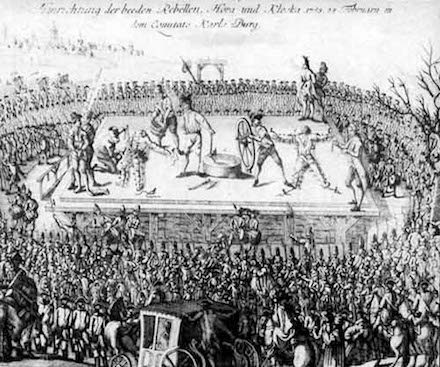
Above: detail view (click for the full image) of an 18th century print illustrating the execution. Below: another take on the scene.
But there was, too, that examination they desired forced upon the emperor, who promulgated a decree abolishing serfdom in 1785, eliminated noble control over marriages, and expanded the peasantry’s grazing rights. These reforms were at best only partially successful (the true end of serfdom still lay decades in the future) but they betokened on parchment just as the rebels had done in fire and blood the crisis striking at the ancien regime — for, alongside condemnations of the peasantry, there were during those revolutionary years also vindications of them, written in the language of the Enlightenment:

The Walachian uprising is an important lesson for sovereigns. It confirms the observation that the human spirit is mature for a general ferment, that it yearns for laws that respect equality, justice, and the order corresponding to its nature. How could it have been that under the most beneficent and mild government in the world, that of Joseph II, such an event could occur? It is because the principles of liberty, justice, and equality are woven into our hearts; they are a part of our natural destiny.

Wilhelm Ludwig Wekhrlin

* Joseph also abolished the death penalty in 1787. (He died in 1790, and the abolition with him.)

** And even more so in hindsight; see, for instance, this 1937 tributary obelisk.

† “I will leave you to judge the excesses they committed. Among others twenty-seven peasants were arrested, whose heads were cut off by nobles in one day without any kind of procedure.” One reported decree — we hope never effected in reality — threatened to impale a random citizen of any town that gave sanctuary to the “villainous low people.” (Both nuggets from Venturi, op. cit.)

On this day..

1329: The effigy of Pope John XXII, by Antipope Nicholas V

On this date in 1329, as Wikipedia puts it, Antipope Nicholas V “presided at a bizarre ceremony in the Duomo of Pisa, at which a straw puppet representing Pope John XXII and dressed in pontifical robes was formally condemned, degraded, and handed over to the secular arm (to be ‘executed’).”

Despite the show of force, Nicholas V was on his last legs at this moment as antipope.

He’d been elevated to the putative papacy by Holy Roman Emperor Louis IV. In this, Nicholas was a throwback to an old rivalry between popes and emperors compassing both authority within the church, and authority on the Italian peninsula, a conflict which had generated several German-backed antipopes in centuries previous. Though not the last antipope in history, Nicholas has the distinction of being the last imperial antipope.

Louis (or Ludwig) had a pique of long standing with Pope John XXII dating back to John’s unwelcome intervention in his, Louis’s, disputed accession as emperor: back in 1314, a divided imperial electorate had wrought a “double election” of the Wittelsbach Louis and the Habsburg Frederick the Fair, a circumstance that resulted in civil war within the empire.

While officially neutral in the fight, the pontiff exploited the opportunity to claw back ecclesiastical authority by asserting that the imperial throne was vacant and its edicts null until the papacy had blessed the claimant. Louis told John to pound sand.

Certain persons, blinded by avarice and ambition, and totally ignorant of the Scriptures, have distorted the meanings of certain passages by false and wicked interpretations, and on this basis have attacked the imperial authority and the rights of the emperors, electors, and other princes and subjects of the empire. For they wrongfully assert that the emperor derives his position and authority from the Pope, and that the emperor elect is not the real emperor until his election is confirmed and approved, and he is crowned by the pope … We now declare … that the emperor holds his authority and position from God alone … he has full power … without the approval, confirmation, authorisation or consent of the pope or any other person.

-Sachsenhausen Appellation, 1324 (as translated here)

John excommunicated Louis, and Louis, well, he did the same to John — seizing on the pope’s hostility towards the movements for clerical poverty as excuse to declare put a Spiritual Franciscan into St. Peter’s Throne on his own say-so as imperial armies smashed through Italy.* If a pope was going to crown Louis, it was going to be his pope.


Antipope Nicholas V crowns Louis IV in May 1328.

Peter of Corbara (Pietro Rainalducci) had barely two years to deny himself the emoluments of antioffice before Louis’s withdrawal required his own submission to the man he had executed in effigy. John XXII didn’t go nearly that hard on the former “Nicholas V”: merely absolved him after confession and kept him comfortably imprisoned at the papal palace in Avignon until the would-be usurper’s peaceful death in 1333.

* This conflict forms the backdrop for Umberto Eco’s The Name of the Rose, set in late 1327. The narrator-monk Adso refers in his epilogue to having heard of the antipope’s elevation soon after leaving the monastery where the bulk of the novel’s action occurs.

On this day..

1641: Not Manuel de Gerrit de Reus, chosen by lot, saved by hemp

Dutch New Amsterdam’s council minutes give us today’s remarkable story, of the chance condemnation and chance deliverance of an Angolan

Our Manuel — his “de Reus” surname came from his Dutch owner — appears to have been among the very earliest slaves imported into New Amsterdam when the Dutch West India Company first introduced this institution in 1626.

By every indication apart from this brush with the scaffold he was a respected man who prospered about as well as his situation permitted. Manuel received (partial) freedom in 1644 along with nine other slaves, prominently including several others charged in this same fracas. These freedmen and their families would thereafter form the nucleus of Manhattan’s first black community by settling (post-manumission) neighboring farming plots north of Fresh Water Pond.*

We can continue to track Manuel, fleetingly, through colonial records as late as 1674 — by which time his place was no longer New Amsterdam at all, but New York.


Anno 1641. In the Name of God

On Thursday, being the 17th of January, Cornelio vander Hoykens, fiscal, plaintiff, vs. little Antonio Paulo d’Angola, Gracia d’Angola, Jan of Fort Orange, Manuel of Gerrit de Reus, Anthony the Portuguese, Manuel Minuit, Simon Conge and big Manuel, all Negroes, defendants, charged with homicide of Jan Premero, also a Negro. The plaintiff charges the defendants with manslaughter committed in killing Jan Premero and demands that Justice be administered in the case, as this is directly contrary to the laws of God and man, since they have committed a crime of lese majesty against God, their prince and their masters by robbing the same of their subject and servant.

The defendants appeared in court and without torture or shackles voluntarily declared and confessed that they jointly committed the murder, whereupon we examined the defendants, asking them who was the leader in perpetrating this deed and who gave Jan Premero the death blow. The defendants said that they did not know, except that they committed the deed together.

The aforesaid case having been duly considered, it is after mature deliberation resolved, inasmuch as the actual murderer can not be discovered, the defendants acknowledging only that they jointly committed the murder and that one is as guilty as another, to have them draw lots as to who shall be punished by hanging until death do ensue, praying Almighty God, creator of heaven and earth, to designate the culprit by lot.

The defendants having drawn lots in court, the lot, by the providence of God, fell upon Manuel of Gerrit de Reus, who shall be kept in prison until the next court day, when sentence shall be pronounced and he be executed.

On the 24th of January, being Thursday The governor and council, residing in New Netherland in the name of the High and Mighty Lords the States General of the United Netherlands, his highness of Orange and the honorable directors of the Chartered West India Company, having seen the criminal proceedings of Cornelio vander Hoykens, fiscal, against little Antonio, Paulo d’Angola, Gracia d’Angola, Jan of Fort Orange, Manuel of Gerrit de Reus, Antony the Portuguese, Manuel Minuit, Simon Conge and big Manuel, all Negroes and slaves of the aforesaid Company, in which criminal proceedings by the fiscal the said Negroes are charged with the murder of Jan Premero, also a slave, committed on the 6th of January 1641, which said defendants on Monday last, being the 21st of this month, without torture or irons, jointly acknowledged in court at Fort Amsterdam that they had committed the ugly deed against the slain Premero in the woods near their houses; therefore, wishing to provide herein and to do justice, as we do hereby, in accordance with the Holy Scriptures and secular ordinances, we have, after due deliberation and consideration of the matter, condemned the delinquents to draw lots which of them shall be hanged until death ensue. And after we had called upon God to designate the culprit by lot, finally, through the providence of God, the lot fell upon Manuel of Gerrit de Reus, who therefore is thereby debarred from any exceptions, pleas and defenses which in the aforesaid matter he might in any wise set up, inasmuch as the ugly murderous deed is committed against the highest majesty of God and His supreme rulers, whom he has deliberately robbed of their servant, whose blood calls for vengence before God; all of which can in no wise be tolerated or suffered in countries where it is customary to maintain justice and should be punished as an example to others; therefore, we have condemned, as we do hereby condemn, the afore­said Manuel of Gerrlt de Reus (inasmuch as he drew the lot) to be punished by hanging until death follows, as an example to all such malefactors.

Thus done and sentenced in our council and put into execution on the 24th of January of this year of our Lord and Savior Jesus Christ anno 1641.

On the 24th of January 1641 Manuel of Gerrit de Reus having been condemned to be executed with the rope so that death would follow, standing on the ladder, was pushed off by the executioner, being a Negro, having around his neck two good ropes, both of which broke, whereupon the inhabitants and bystanders called for mercy and very earnestly solicited the same.

We, therefore, having taken into consideration the request of the community, as also that the said Manuel had partly under­gone his sentence, have graciously granted him his life and pardoned him and all the other Negroes, on promise of good behavior and willing service. Thus done the day and year above written, in Fort Amsterdam in New Netherland.

* Also (and better) known as Collect Pond. Although the body of water itself has long since gone the way of urban infill, we touched on its interesting proximity to Gotham’s criminal history in a footnote to this post.

On this day..

1639: The auto de fe of Lima, Peru

Lima, Peru on this date in 1639 celebrated a huge auto de fe featuring 72 prisoners. Of these, 12 were executed at the stake, one of whom had the consolation of being already dead by his own hand. (He was punished in effigy.)

Their crime, per the Inquisition, was Judaizing — but we might better consider it today in the vein of terrorism, an idee fixe crawling from a swamp of public insecurities both real and projected: race, religion, geopolitics, and crass opportunism all vying for precedence under the Inquisitor’s cowl.

This post will speak of “Jews” but it’s important to remember that the Spanish empire at this point officially had no Jews: it had forced its Jewish population into exile or conversion. That latter set, Jews who had converted to Christianity under that very Catholic realm’s pressure, thereafter became suspected down the generations of sustaining their Hebraic rites in secret, sapping the Church from within while looking for the odd opportunity to sacrifice a Christian child.

It is uncertain in the end in what proportions these forced converts and their descendants did maintain Jewish devotions versus absorbing themselves into Christianity. But by whatever opinion, these are our “Jews”, conflating as the word often does both faith and race; the terms “New Christians” or “conversos” or “crypto-Jews” are also widely used in the literature and all refer to the same universe of suspected and former (at least somewhere up the family tree) Jews who presented themselves publicly as Christians.

No matter the loyalty of individual converso, the suspicion each was born under placed them in an obvious practical difficulty, and it was compounded in the 17th century as Jewry, that eternal bugbear, also came to stand in for a host of other worries dogging the Spanish state.

To begin with, many Jews had in their day fled from Spanish conversion to Portugal, but had recently become re-absorbed when the Spanish crown added Portugal as an unwilling bride to its imperial conquests in 1580. So, the Portuguese, and the tensions thereto, became equated with the Jew in the Spanish imagination.*

In the New World, the already onion-layered specter of the secret Jew further aligned with the menaces of an unknown frontier, where unfamiliar opportunities abounded and dangers too.**

Spain’s rival on the Caribbean coast was its very own disobedient former possession, the Netherlands, and the latter offered Jews a liberal grant of toleration. Spanish conversos’ loyalty to their own crown, already doubted on principle, was doubly suspect for the proximity of rival settlements with unconcealed synagogues — no mere paranoid fantasy, as Jews on Spanish soil were prominent among the collaborators who aided Dutch incursions in the 17th century.

Jews also came to be credited more generally with a scary affinity for the subject populations of conquered Indians and imported African slaves — their pagan magicks, their inscrutable tongues, and their frightful potential for revolt. And of course, there was all that odious money-handling.

“For the past six to eight years, a great number of Portuguese [read: Jews] have entered the kingdom of Peru and there were a great number already there,” Don Leon de Alcayaga wrote of Lima in 1636. “They came to rule over all commerce, which from the brocade to the sackcloth, and from the diamond to the cony, all run through their hands. The Castilian without a Portuguese partner could expect no success in trade.”

Commerce is cutthroat, and the evident power of Jews among the colonies’ emerging mercantile elites — and not just in Lima, but in Cartagena, Buenos Aires, and elsewhere — seems to have co-evolved with appeals from New World Castilians for the Inquisition’s scrutiny of this potentially disloyal element. Strictly out of piety and patriotism, you understand.

Juan de Manozca became Archbishop of Mexico in 1643.

The arrival from Cartagena of Inquisitor Juan de Manozca, who had prosecuted crypto-Jews in that city as well as native “witches”, set the scene for one of the Spanish colonies’ bloodiest purges.

In 1635, a great wave of arrests seized upwards of 100 of these “Portuguese” for La Complidad Grande, a supposed grand conspiracy among the heretics whose contours are little described in the documentation that survives for us. Was the “conspiracy” essentially Judaism itself? Or did Inquisitors perceive a more daring and tangible plot?

“Apropos of the famous auto de fe of the Portuguese, Pelliza y Tovar, the famous chronicler of Aragon, says that on the day the Spanish authorities took possession of the letters and correspondence of the resident Portuguese they found keys and letters in code and they discovered that the synagogues of America were in intimate relations with the Jews of Holland.”† Manozca apparently communicated to the mother country that the Hebrews were stockpiling munitions.

They were bound ultimately for the auto this day — years afterwards — via the Inquisition’s cumbersome judicial machinery. The two most famous of them mark the entire futile spectrum of choices available to the New Christian whom the Old Christian was sufficiently motivated to destroy:

  • Francisco Maldonado da Silva, a Jewish physician who had been imprisoned since 1627 for returning to Judaism, and been completely unapologetic about it, even evangelizing other prisoners held near him. “This is the doing of the Lord God of Israel, so that I may now look upon Him face to face,” he said at the stake.
  • Manuel Bautista Perez, a powerful merchant reputed to be the wealthiest man in Lima — his fortune built on mining, shipping, and the slave trade.‡ Perez hailed from a New Christian family but unlike da Silva he insisted on his fidelity to the Church and refused to admit any heresy. Indeed, he had always been conspicuous in his devotions, and (his words) “never let it be known, either to persons from his household or outside it, that he was a New Christian … because he always tried to be taken for an Old Christian.”

This purge devastated not only New Spain’s Jewish populace but her economy too; with many of the wealthiest magnates clapped in irons from 1635 and their assets suddenly demobilized, other operators be they ever so devout immediately faced an epidemic of financial reversals and bankruptcies.

* Even though a Portuguese Inquisition also existed, predating the 1580 union of the two realms.

** See Irene Silverblatt, “New Christians and New World Fears in Seventeenth-Century Peru,” Comparative Studies in Society and History, July 2000, who notes that

The colony’s take on the Jewish menace, then, elaborated a familiar but divergent set of charges: New Christians had usurped trade and merchandising to the detriment of Castilians; New Christians, with international ties, were not loyal to the Spanish empire; New Christians — merchants and traitors — aligned themselves with potentially subversive groups within the Colony (namely, indios and negros) …

† The comment is that of Peruvian historian Ricardo Palma, quoted by Seymour Liebman in “The Great Conspiracy in Peru,” The Americas, October 1971.

‡ For a detailed exposition of Perez’s career in slaving, see From Capture to Sale: The Portuguese Slave Trade to Spanish South America in the Early Seveacnteenth Century.

On this day..

1884: Not Crow Dog, saved by an ex parte

January 14 was supposed to be the hanging day in 1884 for the Sioux Crow Dog — but instead of being executed he was busy making caselaw.

A sub-chief of the Brule Lakota, Crow Dog on August 5, 1881, met — intentionally? — the tribal chief Spotted Tail on a road in the Rosebud Reservation and shot him dead with a rifle.

The killing was adjudicated the very next day within the Brule community, at a council where the killer and the survivors of his victim agreed together on the appropriate compensation, and paid up.* But the U.S. Indian agent on the scene also arrested Crow Dog a few days later, and had him tried for murder in a non-Indian court in the the frontier town of Deadwood.

Sidney Harring, who would expand this review to book length with Crow Dog’s Murder: American Indian Sovereignty, Tribal Law, and United States Law in the Nineteenth Century, argued in a 1988/1989 paper** that the needless white court’s trial was staged from the outset as a test case by the Bureau of Indian Affairs, angling for new legal tools to break the doctrine of tribal sovereignty which dated back to Worcester v. Georgia (1832). Although that anti-sovereignty cause would suffer a tactical setback in this case, it would very soon carry the day.

Condemned to death early in 1882, Crow Dog had various appeals, respites, and delaying actions that stretched the case out for nearly two years until the U.S. Supreme Court at last stepped in ahead of a scheduled January 14, 1884 execution to adjudicate the question of whether a murder within a tribe, on that tribe’s own reservation, was within the proper jurisdiction of non-Indian courts like the one that tried Crow Dog. Its Ex parte Crow Dog resoundingly answered in the negative, a milestone in the legal framework around Indian sovereignty in the U.S. To execute Crow Dog under the white court’s verdict, the justices ruled, would require Anglo law to be

extended over aliens and strangers; over the members of a community, separated by race, by tradition, by the instincts of a free though savage life, from the authority and power which seeks to impose upon them the restraints of an external and unknown code, and to subject them to the responsibilities of civil conduct, according to rules and penalties of which they could have no previous warning; which judges them by a standard made by others, and not for them, which takes no account of the conditions which should except them from its exactions, and makes no allowance for their inability to understand it. It tries them not by their peers, nor by the customs of their people, nor the law of their land, but by superiors of a different race, according to the law of a social state of which they have an imperfect conception and which is opposed to the traditions of their history, to the habits of their lives, to the strongest prejudices of their savage nature; one which measures the red man’s revenge by the maxims of the white man’s morality.

The legal doctrine at work here holds that although conquered, native tribes still possess internal sovereignty. And with Ex parte Crow Dog it became clear and settled American jurisprudence that one attribute of that remaining sovereignty was plenary — that is, absolute — power over purely internal affairs.

At least, for a year.

White America was discomfited by the abrogation of its morality-maxims over the revengeful red man, and the situation invited moral panic around any malfeasance in Indian country. The Washington D.C. Evening Star would complain months later (June 5, 1884) that Ex parte Crow Dog “has had the effect of creating the idea among the Indians that there is no law to punish an Indian for a crime committed on a reservation.” And the Supreme Court itself had slyly noted that it was obliged to make such rulings absent “a clear expression of the intention of Congress” to take a bite out of Indian sovereignty — an intent “that we have not been able to find.”

So in 1885, the U.S. Congress decided to express that intent and voted the Major Crimes Act placing Indians under federal, not tribal, jurisdiction for seven major types of crimes — including, of course, murder. “We all feel that an Indian, when he commits a crime, should be recognized as a criminal,” Michigan Congressman Byron Cutcheon urged on the legislation’s behalf. “It is an infamy upon our civilization, a disgrace to this nation, that there should be anywhere within its boundaries a body of people who can, with absolute impunity, commit the crime of murder, there being no tribunal before which they can be brought for punishment.”

This briefest interim between Ex parte Crow Dog and the Major Crimes Act was in a sense the high water mark for tribal sovereignty. Following the Major Crimes bill, white politicians began almost systematically reaching onto the reservations to legislate, picking away at tribal sovereignty until another much more infamous case, Lone Wolf v. Hitchcock, disastrously declared that plenary power now resided in Congress.

Crow Dog went on to become a major figure in the ghost dance movement. Present-day American Indian Movement activist Leonard Crow Dog is a descendant; he’s written a book connecting back to his famous ancestor called Crow Dog: Four Generations of Sioux Medicine Men. Meanwhile, South Dakota’s Sinte Gleska University is named for Spotted Tail.

* The price was $600, eight horses, and a blanket.

** Sidney Harring in “Crow Dog’s Case: A Chapter in the Legal History of Tribal Sovereignty,” American Indian Law Review, Vol. 14, No. 2 (1988/1989) — also the source of the preceding footnote.

On this day..

1864: Richard Hale, but not Cecilia Baker

(Thanks to Meaghan Good of the Charley Project for the guest post. -ed.)

On December 27, 1864, Richard Hale was hanged at the Stafford Gaol for the murder of his eight-year-old daughter, Eliza Silletto.

Little Eliza’s body had been found in a cornfield in Coseley in the West Midlands region of England on August 2 that year. Her body was so badly decomposed that at first it was impossible to determine the gender, but it was assumed to be a girl because it was wearing girls’ clothing. Although authorities couldn’t determine the precise cause of death due to the decomposition, they believed the child’s throat had been cut. The body was eventually identified as Eliza. Her father had reported her missing on July 20.

Richard Hale was known in the area as a bit of a hard case: he had recently done time for manslaughter. The victim in that case was his wife, Eliza’s mother, who had starved to death.

After his release, he shacked up with Cecilia Baker and, although not legally married, they lived as man and wife. He had been heard to say he wished his daughter was “out of the way.”

Both Hale and his girlfriend were both arrested and charged with murder, but Baker had to be released for lack of evidence.

However, a witness came forward and said he thought he might have seen the murder. According to John Jones, he was walking near the cornfield when he saw a man and a woman pushing a little girl back and forth between them, harder and harder until the woman actually threw the girl at the man and then turned and started walking away. The little girl started crying loudly, then the sobs stopped abruptly.

Jones hadn’t reported the incident at the time because he didn’t find it suspicious. After all, who commits a murder in broad daylight right in front of a witness?

Jones identified Eliza’s father and his paramour as the man and the woman he had seen that day. His statement gave the authorities the evidence they needed to re-arrest Cecilia Baker for her role in the crime.

Given Jones’s identification and Hale’s criminal history, it wasn’t hard to convince a jury of the couple’s guilt. Hale was sentenced to death, but Cecilia’s death sentence was respited because she was pregnant. Her sentence was eventually commuted and she served a life term at the Knaphill Female Convict Prison in Surrey — the same place where the notorious poisoner Florrie Maybrick did time decades later.

For his part, Hale suffered a public double execution alongside an unrelated murderer, Charles Brough. The visibly nervous Hale pled his innocence all the way to the gallows.

On this day..

1915: Cordella Stevenson lynched

(Thanks to Meaghan Good of the Charley Project for the guest post. -ed.)

On this date in 1915, a mob visited Cordella Stevenson’s cabin, dragged her out, and lynched her.

The good citizens of Columbus, Mississippi, found her body the next day, hanging from a tree limb. The site of her lynching was only 50 yards north of the Mobile and Ohio Railroad, and rail passengers who came in and out of the city that day saw her corpse thus displayed. She had been “maltreated” (that is, raped) and stripped naked before being strung up.

Several months before, Gabe Frank, a local white man, lost his barn to fire. Although there was no direct evidence to implicate him and he had not been seen in the area for months prior to the fire, Cordella and Arch Stevenson’s son came under suspicion of arson.

The parents were respectable people who had worked for the same white employer for over a decade, but the son had a “worthless” reputation. Frank tried tracking the young man with bloodhounds, but was unsuccessful. The local police arrested Cordella and kept her locked up for several days, hoping she might know something of her son’s whereabouts, but they eventually released her without charge.

The Stevensons thought or hoped that would be the end of the matter.

Arch and Cordella had already gone to bed that Wednesday night in December when, at about 10:00 p.m., they heard someone pounding on their door. Before they could get to the door to answer it, the vigilantes had broken it down. They seized Cordella, pointed their rifles at Arch, and threatened to shoot him if he moved. At some point he managed to flee, bullets whizzing miraculously past him in the dark, and he ran to town for help. Arch knew what was good for him; after reporting what happened to the authorities, he fled the area for parts unknown. Meanwhile, somewhere out there in the night, the mob fell on his wife.

Kerry Segrave recorded in his book Lynching of Women in the United States: Recorded Cases, 1851-1946:

Sheriff Bell telephoned to Justice of the Peace McKellar to hold an inquest. He was out of town and did not return until Thursday night. As a result, the naked body was left hanging in view of the “morbid” crowd that came to see it until Friday morning when it was cut down and the inquest was held. That inquest jury returned a verdict that Cordella Stevenson came to her death at the hands of persons unknown.

The Chicago Defender, a (still-extant) black newspaper noted for its accurate reporting of Jim Crow era violence, bitterly editorialized, “This these southern culprits did. No law below the Mason and Dixon line that would cause them to fear. No officer in the police department that would dare to do his duty. No man in the government circles in Washington that has enough backbone to enforce the Constitution of the United States. This mob knew and they went on with their ghastly work.”

A century later, Cordella Stevenson’s ghastly death has still not been forgotten. In 2013, a poem for her, titled “What the Dark Said”, was published in the collection Ain’t No Grave, by Tennessee poet TJ Jarrett.

On this day..

1646: The effigy of Jean de Mourgues

According to a note in the memoirs (French, natch) kept by Le Puy master tanner Antoine Jacmon, “the portrait and effigie of the noble Jean de Mourgues” was publicly beheaded in place of the flesh of the noble Jean de Mourgues, as penalty for the latter’s attempt to murder his own uncle.

According to the author’s note, this punishment had so little effect that Jean de Mourgues successfully carried out the assassination in a hail of gunfire two years later.

On this day..

1554: A false coiner and a masked dummy

From the diary of Felix Platter, a Swiss youth studying in Montpellier, France. It is not completely evident from context (“afterwards …”) whether the masked dummy was “executed” on the same occasion as the coiner, or whether that effigy was punished on a different day.

On the next day [after a September 28 execution] a false coiner was hanged in the same place. The gibbet was not vety high and had only one arm.

Afterwards a masked dummy was brought on a hurdle, and was laid on the cross and its limbs broken, as I have described. This dummy represented a Greek who had studied at Montpellier and had been accounted one of the keenest blades of the town. He had married Gillette d’Andrieu, a girl of doubtful reputation, who had neither beauty nor fortune. She had a very long nose, and her lover could scarcely manage to kiss her on the lips, especially since he too had a nose of respectable size.

The Greek was insulted by a canon, Pierre Saint-Ravy, who taunted him, at the moment when he was about to relieve himself, of having had intercourse with his wife. The husband at once stabbed the canon and fled; he could therefore be executed only in effigy. His wife continued to live in Montpellier, and was often in Rondelet’s house she was a relative of his.*

She often came there to dance, and one day I danced with her, all booted and spurred, on my return from Vendargues. As I turned, my spurs entangled themselves in her dress, and I fell full length on the floor. Some tablets I had in a breast pocket were broken into pieces, and I was so stunned that I had to be helped up.

* Guillaume Rondelet was one of Platter’s instructors, a professor of medicine. He had been friends with Rabelais and has the distinction of appearing in Gargantua and Pantagruel under the name Rondibilis.

Part of the Daily Double: Felix Platter’s Diary.

On this day..

1736: Captain John Porteous, riotously lynched

Hated Edinburgh gendarme Captain John Porteous was lynched on this date in 1736.

September 7 was the date of Porteous’s own scheduled hanging, for triggering a mob scene at a previous execution we have already visited: Porteous, commanding the guard detail at that hanging, reacted insanely when

some unlucky boys threw a stone or two at the hangman, which is very common, on which the brutal Porteous (who it seems had ordered his party to load their guns with ball) let drive first himself amongst the inocent mob and commanded his men to folow his example which quickly cleansed the street but left three men, a boy and a woman dead upon the spot, besides several others wounded, some of whom are dead since. After this first fire he took it in his head when half up the Bow to order annother voly & kill’d a taylor in a window three storys high, a young gentleman & a son of Mr Matheson the minister’s and several more were dangerously wounded and all this from no more provocation than what I told you before, the throwing of a stone or two that hurt no body.

Nowadays Porteous might cite officer safety and be back on the job in a week’s time. Edinburghers in 1736 gave their law enforcement a bit less latitude, and the city magistrates were obliged to box Porteous up in the Tolbooth lest a baying mob “would have torn him, Council and Guard all in pices.”

Five months remained to Mr. Porteous, a span in which he must have died a thousand deaths as he watched fortune toss his prospects to and fro from within his dungeon. The temper of the city would admit no other result than his conviction and death sentence but officers of the law have strings to pull with the state their muskets uphold. With King George II out of hand,* Queen Caroline granted Porteous a reprieve (not yet an outright clemency) from an intended September 8 date with his own hangman. That intervention was soon overruled by a higher sovereign, for as the Newgate Calendar puts it, “when the populace were informed, such a scheme of revenge was meditated as is perhaps unprecedented.” This was no sudden spasm of public rage; five calculating days had elapsed from the arrival to Edinburgh of the queen’s mercy when

On the 7th of September, 1736, between nine and ten in the evening, a large body of men entered the city of Edinburgh, and seized the arms belonging to the guard; they then patrolled the streets, crying out, ‘All those who dare avenge innocent blood, let them come here.’ They then shut the gates and placed guards at each.


Illustration of the Porteous mob, from Sir Walter Scott’s Heart of Midlothian — which dramatizes the lynching.

The main body of the mob, all disguised, marched in the mean time to the prison; when finding some difficulty in breaking open the doors with hammers, they immediately set fire to it; taking great care that the flames should not spread beyond their proper bounds. The outer door was hardly consumed before they rushed in, and, ordering the keeper to open the door of the captain’s apartment, cried out, ‘Where is the villain, Porteous?’ He replied, ‘Here I am, what do you want with me?’ To which they answered, that they meant to hang him in the Grass Market, the place where he had shed so much innocent blood.

His expostulations were all in vain, they seized him by the legs and arms, and dragged him instantly to the place of execution.

On their arrival, they broke open a shop to find a rope suitable to their purpose, which they immediately fixed round his neck, then throwing the other end over a dyer’s pole, hoisted him up; when he, endeavouring to save himself, fixed his hands between the halter and his neck, which being observed by some of the mob, one of them struck him with an axe, which obliging him to quit his hold, they soon put an end to his life.

When they were satisfied he was dead they immediately dispersed to their several habitations, unmolested themselves, and without molesting anyone else.

Such was the fate of Captain John Porteous, a man possessed of qualifications which, had they been properly applied, might have rendered him an honourable and useful servant of his country. His undaunted spirit and invincible courage would have done honour to the greatest hero of antiquity. But being advanced to power, he became intoxicated with pride, and instead of being the admiration of his fellow citizens, he was detested and hated by all who knew him. The fate of this unhappy man, it is hoped, will he a caution to those who are in power not to abuse it; but, by a humane as well as diligent discharge of their duty, to render themselves worthy members of society.

Porteous did get a solemn memorial stone in Greyfriars Kirkyard once passions cooled … 237 years later.

* The Hanoverian king spent most of 1736 away taking a visit (quite unpopular with his English subjects) back to the family’s namesake German principality, which George II also ruled in a personal union.

On this day..