1822: The audacious Denmark Vesey

On this date in 1822, white South Carolinians hanged the most terrifying slave insurrectionary who never rose — and breathed a sigh of relief as they clamped the shackles ever tighter upon their groaning servile class.

Inspired by slave revolts shaking the Caribbean, the Denmark Vesey plot was the South’s worst nightmare: Nat Turner, multiplied by about nine thousand.

That’s the size of the slave and free black network Vesey is said to have recruited — ready to undertake a coordinated uprising to seize Charleston, slaughter the white populace, and possibly then to sail for a Haiti whose own slave revolt had recently established it a black-governed republic. The mind boggles at such a scheme’s bravado … but in an age when horseshoes and mizzenmasts could outrun information, Vesey’s plot could have been past any prospect of obstruction before anyone in a position to obstruct it even knew what happened. Had they not flown but defended Charleston, the event would have ignited a conflagration to outshine every other slave uprising.

The weak point, of course, were those 9,000 — or however many — slaves who had to act ruthlessly and in unison, and keep their peace until they struck. It is incredible enough that such a secret kept among so many for up to four years.

The plot finally leaked mere days before it was to have been attempted when a middling player attempted the unnecessary freelance recruitment of a house slave — a class Vesey had intentionally (and rightly, events would prove) excluded for dangerously excessive personal loyalty to their masters’ families.*

Melancholy Dane

A well-educated and well-traveled man on account of his years as the personal property of a slaver — Joseph Vesey, who bequeathed his purchase both a surname and the given name Telemaque, subsequently corrupted into “Denmark” by Charlestonians — the plot’s signature hero/villain had managed to purchase his freedom and establish himself in the anomalous position of free black artisan/entrepreneur in the slaveholding South.

His successful carpentry business (apt choice, for a martyr) had given him the prestige and the werewithal to start an independent African Methodist Episcopal church where he poured out a hatred of chattel slavery undiminished by his own liberty.

For several years before he disclosed his intentions to any one, he appears to have been constantly and assiduously engaged in endeavoring to imbitter [sic] the minds of the colored population against the whites. He rendered himself perfectly familiar with those parts of the Scriptures which he could use to show that slavery was contrary to the laws of God; that slaves were bound to attempt their emancipation, however shocking and bloody might be the consequences … (Source)

His judges were later incredulous that he’d be so hung up about it:

It is difficult to imagine, what infatuation could have prompted you to attempt an enterprise so wild and visionary. You were a free man, comely, wealthy, and enjoyed every comfort compatible with your situation. You had, therefore, much to risk and little to gain.

An American Spartacus?

Denmark Vesey blurs into myth as he approaches his end, together with lieutenants: among them, Peter Poyas, the organizational maven of the operation who was hanged along with Vesey and four others; and Gullah Jack, an African priest among the 29 more who would die in the weeks ahead.

Most of the principals held their tongues before interrogators; the tribunals were held secretly; their records were censored against the apprehension by other slaves of the potential for such designs as “a bottle with poison to put into my master’s pump & into as many pumps he could about town.”

But there was enough known to shatter forever any illusion of paternal congeniality more liberal masters might have fancied. One planter was incredulous that his agreeable charge might be involved in such nefarious doings until he asked the man directly and was astonished to hear from his trusted coachman’s lips the frank intention “to kill you, rip open your belly and throw your guts in your face.” (Both quotes are from this book review.)

Whites were scared. “I have never heard in my life, of more deep laid plots or plots more likely to succeed,” wrote Anna Haynes Johnson, niece to Gov. Thomas Bennett. (Source) Another concluded that “our NEGROES are truly the Jacobins of the country.” (Source)

But as initial panic (and federal troop deployments) gave way to a more pervasive undertow of security paranoia, the affair was self-consciously downplayed and records intentionally destroyed for fear that too-careful documentation of its particulars could map the way for a revival. An 1861 piece in The Atlantic — an excellent read on the progress of the conspiracy — grapples with what was even then a gaping evidentiary vacuum.

The intense avidity which at first grasped at every incident of the great insurrectionary plot was succeeded by a distaste for the memory of the tale; and the official reports which told what slaves had once planned and dared have now come to be among the rarest of American historical documents. In 1841, a friend of the writer, then visiting South Carolina, heard from her hostess for the first time the events which are recounted here. On asking to see the reports of the trials, she was cautiously told that the only copy in the house, after being carefully kept for years under lock and key, had been burnt at last, lest it should reach the dangerous eyes of the slaves. The same thing had happened, it was added, in many other families. This partially accounts for the great difficulty now to be found in obtaining a single copy of either publication; and this is why, to the readers of American history, Denmark Vesey and Peter Poyas have been heretofore but the shadows of names.

Antebellum September 11

Even as a nonstarter, the insurrection was an antebellum 9/11 that spurred a reactionary crackdown on perceived liberalities in the system — most vividly symbolized by the construction of the fortress that became the still-extant military academy The Citadel, but more systematically impinging blacks’ everyday freedom to assemble and worship, and even requiring (until the Supreme Court overruled the law) free black sailors be detained whenever a northern ship called at port. Pro-slavery southerners blamed open disapprobation for slavery voiced in Congress during the recent Missouri Compromise wrangling, and even similar sentiments expressed in the British parliament, for emboldening the terrorists.

All this yielded a rich political harvest from the fruit of the gallows — like Charleston mayor James “there is nothing they are bad enough to do, that we are not powerful enough to punish” Hamilton, who rode his timely suppression of the plot to Congress later that year.

Such political profiteering, combined with the sketchiness of primary sources, has licensed a revisionist take on the orthodox history — that there was never any conspiracy, but that reactionary white elites concocted the plot from a tissue of loose liberation talk, false confessions, and latent white fear in order to win political power. This contested minority interpretation has been a recent topic of academic dispute, since Michael P. Johnson floated it in 2001 (an account is required to read Johnson’s original essay; here’s a synoptic article that appeared subsequently in The Nation).

Markers of historiography around these competing versions of Vesey, bearing directly on the question current in today’s Charleston of whether and how to memorialize this episode, are ripe with controversial modern-day implications.

Consider: if Vesey is a rebel indeed, the silence of (most of) the plotters is a noble acceptance of torture to protect their confederates; if they’re framed, they’re silent because there’s nothing to confess. Either way, the modern reader’s sympathies are likely to lie with the blacks, but Johnson’s interpretation removes the locus of action from them to white elites. If he’s right, would that derogate an entire narrative of black resistance to slavery, drain the martyrdom from their deaths? Or would it correct an overstated romantic mythology of armed resistance, and color this day’s hanging with a different heroism: refusing to purchase their lives with a false accusation?

* For his timely betrayal, Peter Desverneys received his liberty and a state pension; he later became a slaveholder himself. See Black Slaveowners.

On this day..

1997: Henry Francis Hays, whose crime cost the Klan

On this date in 1997, an Exalted Cyclops of the Ku Klux Klan went to Alabama’s “Yellow Mama” for lynching a black teenager.

Henry Francis Hays, son of a top Klan officer in Alabama, had vented dissatisfaction with a jury’s failure to convict a black defendant for a white policeman’s murder by grabbing and stringing up a random black, 19-year-old Michael Donald.

Hays and his 17-year-old accomplice skated for more than two years because Mobile’s finest figured a publicly hanged black man probably had it coming from some drug deal.* Only through the victim’s mother’s persistence — she got Jesse Jackson involved, which helped involve the FBI — did the real murderers feel the heat.

Before long, the Klan would wish it had stayed out of the kitchen.

After Hays’ conviction, Michael Donald’s mother brought a civil action against the United Klans of America with the help of the Southern Poverty Law Center. The $7 million liability verdict she won financially destroyed the United Klans — perpetrators of some of the 1960s’ most infamous anti-civil rights terror — and Donald was awarded its national headquarters building in Tuscaloosa, Ala.

This novel keys on the Michael Donald lynching as part of a (fictional) Mobile teen’s coming of age.

Hays wasn’t through making the sort of history he’d rather not have made.

When his turn in the electric chair finally came in 1997, he became the first white in Alabama put to death for an offense against a black in 84 years.**

Seemingly less cocksure in answering for his crime than he had been in committing it, Hays had always maintained his innocence. A few days before walking his last mile, he finally confessed to the Mobile chapter head of the NAACP.

* Michael Donald was not, in fact, involved in drugs.

** There haven’t been any other executions for white-on-black crime since Henry Hays, a span of 11 more years and 22 more executions as of this writing. (via the Death Penalty Information Center’s Execution Database)

On this day..

1962: Adolf Eichmann

On this date in 1962, the architect of the Final Solution received such justice as could be meted to him on earth at Israel’s Ramla Prison.

Adolf Eichmann, the vacuum cleaner salesman turned SS Obersturnbannfuhrer, remains the only person judicially executed in the history of modern Israel, whose intelligence services kidnapped him from Argentina where he had settled after the war.

Other Nazis had used the “only following orders” defense with little success in the Nuremberg Trials shortly after World War II. On trial years later (and at the hands a Jewish state) Eichmann — a bookish, unmenacing man who invoked Kant — posed the questions of individual responsibility and human psychology in starker terms.

To be sure, he was no anonymous functionary. Neither, however, had he dirtied his nails at the stomach-churning business end of the Holocaust: rather, he had engineered the stupendous logistical project of deporting Eastern Europe’s Jews for extermination, an (impressive) accomplishment worth exponentially more lives than any Einsatzgruppe could ever account for, yet simultaneously abstract from the upshot.

Eichmann said he did it without ill-will towards its subjects — simply to obey and to achieve.

The Banality of Evil

[I]f it was of small legal relevance, it was of great political interest to know how long it takes for an average person to overcome his innate repugnance of crime, and what exactly happens to him once he has reached that point. To this question, the case of Adolf Eichmann supplied an answer that could not have been clearer or more precise.
-Hannah Arendt

Hannah Arendt took him at his word* and saw in Eichmann the abyss gazing back into us, into his judges — not a monster but a man unsettling in his normalcy, whose job was not TPS reports or quarterly sales results but turning humans into ash.

The company man. The career man. Every man, standing in for countless thousands more who pushed the papers that drove the trains to Auschwitz.

What for Eichmann was a job, with its daily routine, its ups and downs, was for the Jews quite literally the end of the world.

Not everyone accepts her conclusions, but Arendt’s characterization of “the banality of evil” has become the man’s epigraph. And Eichmann disturbs us precisely because we seem to be able to meet him on his terms, even sympathize with him when the horror of his crimes begs for a monster like Streicher or Goebbels we could safely consign to the Other.

Arendt’s turn of phrase has a certain breezy (hackneyed, even) life in the public discourse, but her analysis of Eichmann’s careerism remains a challenging and deeply relevant one for we heirs of the world that hanged him.

The complete transcript of Eichmann’s trial is available online here. Video of his trial has been posted online here (in English) and here (original languages).

* Albeit with some reservations; others have argued that Eichmann was considerably more personally invested in his mass-murder project than his demeanor at trial admitted. Certainly he had an interest in showing the mellower Eichmann when he was on trial for his life.

On this day..

1987: Valery Martynov, betrayed by Aldrich Ames and Robert Hanssen

On this date in 1987, a once-promising American intelligence asset was executed with a single gunshot to the head in Moscow — his treachery exposed by two of the most infamous Soviet moles in U.S. intelligence history.

A Lieutenant Colonel in the KGB posted to the Soviets’ official Washington, D.C. offices in 1980, Martynov had turned in 1982 and begun funneling intelligence to the CIA and FBI under the cryptonym “Gentile”. Truth be told, he was a mediocre source, but he was a younger officer with the chance to grow into a more important asset in the years ahead.

Fate had sized him up as an extra in someone else’s story instead.

In 1985, “the year of the spy” to those in the know for the volume of important cloak-and-dagger work, the Soviets landed two highly-placed moles in the American intelligence world — Aldrich Ames of the CIA and Robert Hanssen of the FBI.

Both those notorious turncoats shopped Martynov (among others); duly informed, Russian spymaster Victor Cherkashin conned Martynov into returning to Moscow where he could be arrested.

Here’s a 2001 New York Times account on how it went down:

[Soviet counterintelligence officer Vitaliy] Yurchenko, unhappy with his lot as a defector [after coming over to the Americans in August 1985], suddenly redefected back to the Soviet Union in early November [1985, still]. Mr. Cherkashin has said in a previous interview that Mr. Yurchenko’s redefection presented an opportunity to lure Valeriy Martynov, a K.G.B. officer in the Washington station working for the F.B.I., back to the Soviet Union: The K.G.B. arranged for Mr. Martynov to serve as a member of an honor guard escorting Mr. Yurchenko back to Moscow.

When they arrived back in the Soviet Union, it was Mr. Martynov who was arrested; Mr. Yurchenko was given a job at the K.G.B. again.

No honor among thieves.

Martynov left a widow, Natalia, and two children. But he is remembered and written about exclusively in the context of the men who sold him out, who taken separately or together rate among recent history’s most catastrophic intelligence failures. (Or triumphs, depending on your point of view.)

Martynov’s ultimate tragedy, of course — one he shares with his more infamous American betrayers in this shadowland chess match — is that not by all the information he provided, and neither by his life nor his death, was the Cold War protracted or abbreviated by one single hour.

Books about the Ames and Hanssen cases

On this day..

1917: Dr. Arthur Waite, the Playboy Poisoner

On this date in 1917, a 29-year-old former dentist took a seat in Sing Sing’s electric chair — his poisoning career nipped in the bud by woman’s intuition.

Here’s the scenario, as sketched in the rip-roaring Criminal Poisoning: Investigational Guide for Law Enforcement, Toxicologists, Forensic Scientists, and Attorneys (I’ve added paragraph breaks for ease on the eyes):

The first dentist in our collection, Dr. Waite, was a good looking raconteur, who most likely preferred playing tennis to practicing dentistry. He grew up in Grand Rapids, Michigan, and after graduating from dental school went to South Africa to practice. Waite eventually left Africa under some suspicious accusations and returned to Michigan, where he wooed and married the daughter of John and Hannah Peck.

John Peck was a millionaire pharmacist who owned a reputable drug company in the city. The newlyweds were furnished with posh accommodations in New York City by the grateful Pecks. There, Arthur spent much of his time dabbling in the area of bacteriology, and also took on a mistress.

In January 1916, shortly after Hannah Peck arrived to visit the Waits in New York, she suddenly became ill and died. Her body was immediately cremated and returned to Michigan for burial. In March of the same year, John Peck also went to New York to console his daughter and her husband over the death of his wife. He too soon became ill and died. However, before his body could be cremated an anonymous telegram was received in Grand Rapids stating “suspicion aroused, demand autopsy.” Surprisingly, the autopsy indicated that John Peck was loaded with arsenic, and an investigation ensued.

The accusing finger eventually pointed to the playboy dentist, and he was taken in for interrogation. A search of his dwelling revealed numerous bacterial cultures, as well as texts dealing with toxicology. Under interrogation, Dr. Waite changed his story numerous times. First he stated that he had obtained arsenic for his father-in-law, who wanted to commit suicide to end his grief over the loss of his wife. Then Dr. Waite claimed his own body was inhabited by the spirit of an evil Egyptian priest, who had instructed him to kill his in-laws in order to gain their wealth. Eventually, Dr. Waite felt if he told what had actually happened the courts would find him insane, so he revealed the whole story of administering typhoid, pneumonia, diphtheria organisms, and arsenic while the Peck’s [sic] were undergoing work in his dental chair.

It did not take the jury long to see through the manipulations of Dr. Waite, and they convicted him of the murders. Dr. Waite was electrocuted at Sing Sing Prison on May 24, 1917.

That decisive anonymous tip, it emerged, came from a New Jersey schoolteacher named Elizabeth Hardwick, whose father, one Dr. Cornell, was cousin to the victim. Here’s how the New York Times reported it (pdf) a few years later, ruminating on the chancy breaks that sometimes solve criminal cases:

The day after Mr. Peck’s death, Dr. Cornell called at the Waite apartment to pay his respects. Waite, with the Peck millions almost in his hands, forgot his suavity for a moment and greeted his father-in-law’s cousin so rudely that Dr. Cornell was hurt. At home that night the doctor expressed his amazement at the demeanor of the erstwhile gracious Waite.

This set the seal on the suspicions which Miss Hardwick had always harbored. Saying nothing to any one she hurried to the telegraph office and sent a telegram to Percy Peck, the murdered man’s son, in Grand Rapids.

“This case,” said Commissioner Faurot, “was interesting because a woman’s intuition seized upon a moment’s carelessness on the part of one of the most fiendish murderers in police records to undo the criminal. Without her, the authorities never would have investigated the case. Waite certainly would have murdered his wife and perhaps others before he got through.”

Long forgotten now, Waite — who had smooth-talked his way into New York society seemingly with designs of cutting a swath of bodies through it* — made quite the infamous figure in his day. This Times article (pdf again) from days after his arrest suggests a whiff of the case’s sensation to contemporaries.

* The authorities, who naturally had no incentive to downplay the menace of their killer, figured his wife, his mistress and his mistress’ husband were next in line — though there was also no obvious way Waite could have cashed in on the latter two.

On this day..

1622: Antonio di Nicolo Foscarini

(Thanks to Melisende at Women of History and Historic Biography for the guest post -ed.)

As dawn broke over the Piazzetta San Marco in Venice, the body of a man hung from the gallows between the columns. There were no witnesses to this execution — it was a quiet affair carried out under the veil of night. The citizens of the Serenissima were understandably worried. This man was not common criminal — he was a man from a distinguished noble family.

What events had led to a man of such stature becoming victim of such a fate?

Antonio the Ambassador

Antonio Foscarini was the third son of Nicolo di Alvise de ramo di S.Polo and Maria Barbarigo di Antonio.

Antonio began his diplomatic career as one of the representatives of the Republic of Venice to the Court of King Henri IV of France (1601) and was there, at Paris, in this capacity to celebrate Henri’s wedding to Marie de Medici. Despite being elected as Ambassador to France — “Ambasciatore ordinario in Francia” — (26th May 1607), he did not actually take up his position until February of the following year.

When he was elected Ambassador to England — “Ambasciatore ordinario in Inghilterra” — (July 1610), he again did not take up his position until the following year (4th May 1611). Unfortunately, Foscarini’s position came under question in Venice. One of Foscarini’s secretaries denounced his to the Council of Ten, accusing him of selling state secrets to Venice’s mortal enemy at the time — Spain.

Foscarini was summoned to return to Venice immediately. Upon his arrival he was imprisoned, where he remained for three years whilst in inquiry into the allegations took place. Foscarini was duly released upon being found “not guilty” (30th July 1618) — there was no blemish on his service record. Two years later he was elected Senator (1620).

The Council of Ten

The Council of Ten was formed in 1310 “to preserve the liberty and peace of the subjects of the republic and to protect them form the abuses of personal power”. In effect, the Council of Ten was actually made up of 17:

  • the Doge – who presided over all and was elected ruler for a specific term.
  • the Prime Minster – elected chairman of the government
  • the Signoria – comprised of three Capi (three chiefs of the Great Council); six Savii Grandi (modern-day Cabinet); three Savii da Terra Firma and three Savii agli Ordini or da Mar (Ministers of War, Finance and Marine).

These men, for there were no women, were elected for a specific term, depending upon their position. In effect, this ensured that any attempt on the part of one person or a family or a group to gain sole power was neutralized. Even the Church was excluded from taking any part in the government of the Republic.

The Countess of Arundel

At the age of 35, this formidable woman arrived in Venice in 1621.

Alatheia Talbot was the granddaughter of the infamous Bess of Hardwick (goddaughter of Queen Elizabeth I of England) and the wife of Thomas Howard, 2nd Earl of Arundel, and a leading figure at the court of King James I of England. Both Alatheia and Thomas were passionate art lovers, and used their boundless wealth to amass the first great private art collection in England. And this was the reason for Alatheia’s journey to Venice – that and the education of their sons. Alatheia left her children at the villa in Dolo whilst she continued onto Venice and settled in Palazzo Mocegnigo on Grand Canal.

The Senator & the Countess

It was whilst situated in the Palazzo Mocegnigo, that the Senator possibly renewed his acquaintance with the Countess. In his position as Ambassador to England, Foscarini would have come into contact with both the Countess and her husband, who was, we must remember, a prominent official of the royal Court. As to the true nature of this acquaintance, it has been suggested that the two were not particularly close.

Whatever the suggestion, on the evening of 8th April 1622 as Foscarini was departing the Senate, he was arrested on the orders of the Consiglio dei Dieci and charged with:

… having secretly and frequently been in the company of ministers of foreign powers, by day and by night, in their houses and elsewhere, in this city and outside it, in disguise and in normal dress, and having divulged to them, both orally and in writing, the most intimate secrets of the Republic, and having received money from them in return …

Less than a fortnight later, Foscarini was strangled in prison and the following morning found hung between the two columns in Piazzetta San Marco.

Aftermath

The news of Foscarini’s execution spread like wildfire throughout the length and breadth of Europe. Many rulers, upon hearing the news, were shocked.

Countess Alatheia was perturbed for her name had been linked with that of Foscarini. It was in her house that Foscarini had been accused of passing state secrets to Venice’s enemies — notably Spain (via the Secretary of Emperor Ferdinand) and the Church (via the Papal Nuncio).

Sir Henry Wotton, England’s Ambassador to Venice, notified Alatheia by letter that the Council of Ten would be passing a sentence of banishment upon her, and that it would be in her best interests to leave immediately.

But Sir Henry had greatly underestimated this woman — for she was aggressive adversary (they had crossed swords many times). Instead, Alatheia went immediately in person to Sir Henry, vigorously denying the charges and informing him of her intentions to seek an audience with the Doge, Antonio Priuli. Alatheia laid the blame for Foscarini’s death firmly at his doorstep, and let him know in no uncertain circumstances that she intended to bring about his dismissal.

Alatheia was granted her audience with the Doge. She was warmly received and assured that there was never any question of neither her banishment not implication in the recent tragic events. She generously accepted his assurances, but requested a public exoneration in writing in both Venice and London; this duly occurred. She was given lavish gifts by the Doge and with her wagons heavily laden with, left Venice six months later.

Exoneration

Murray Brown begins his “The Myth of Antonio Foscarini’s Exoneration” (.pdf) thus:

In January of 1623, a unique event occurred in Venice: Antonio Foscarini was posthumously exonerated by the Council of Ten. Ten months previously, it had unanimously found him guilty of treason and had him executed. King James I’s ambassador to the Serenissima, Sir Henry Wotton, characterized the event: “…surely in 312 years that the Council of Ten hath stood, there was never cast a greater blemish upon it.”

And so, after much investigation, Antonio Foscarini was officially exonerated of all charges (16th January 1623).

Throughout the summer, proof of Foscarini’s innocence gathered momentum, and was such that none could ignore it. Those who had accused Foscarini of the act of treason were brought before both the Inquisitors of the State and the Council of Ten themselves to answer certain questions. It was determined, during the course of events, that both accused had perjured themselves by making false accusations against Foscarini. Why they did so is not known, but Murray Brown presents a number of credible scenarios in his “The Myth of Antonio Foscarini’s Exoneration”.

The Council of Ten publicly confessed its error — copies were given to Foscarini’s family and were also distributed throughout Europe. Foscarini’s body was exhumed and he was given a state funeral. A statue of Foscarini is in Foscarini Chapel of the Church of S.Stae.

On this day..

1936: Bruno Richard Hauptmann, The Most Hated Man in the World

On this date in 1936, a German immigrant went to New Jersey’s electric chair for kidnapping and murdering the infant son of famed aviator Charles Lindbergh.

Snatched

The kidnapping of the Lindbergh boy in 1932 had touched off an outpouring of public compassion matched only by the clumsiness of the investigation. The circus that formed around a father desperate to retrieve his boy — and prone to rash decision-making thereto — pulled in underworld figures, military intelligence officers (including the founder of the CIA’s forerunner and the father of Gulf War General Norman Schwartzkopf), a meddlesome schoolteacher, and queer characters like “Cemetery John,” who somehow managed two meetings with Lindbergh’s intermediaries, making off with a box full of ransom cash without anyone so much as tailing him, much less having to fork over the hostage.

The boy, in fact, was dead, and would be discovered weeks later, a few miles from the Lindbergh house, in such a state of decomposition as to suggest that, by accident or intention, he had suffered a fatal head injury almost at the moment of his abduction.

Two years’ fruitless investigation ensued, with leads that frustratingly faded away and at least two suspects who committed suicide. The police job had been a hash from the start, between amateurish cock-ups like failing to measure footprints found on the scene and security breaches in the chaotic weeks following the kidnapping. Most damagingly, a newspaper laid hands on an early ransom note and printed it, making it impossible subsequently to positively discern the kidnapper’s real notes from hoaxes.

But John Law had done one thing right: paid the ransom in soon-to-be-obsolete gold certificate. As they’d hoped, someone was finally caught spending this distinctive currency: Bruno Hauptmann.

Hauptmann actually went by “Richard”, but with its unerring sense of the Zeitgeist, the press played up his menacing alien moniker. After two and a half years, the public was ready to hate someone, and an illegal immigrant with a criminal record* from the late war’s great enemy was pretty much made to order.

Trial of the Century

The one thing Hauptmann didn’t do was confess — and that necessitated the “Trial of the Century,” or in Mencken’s coinage, “the greatest story since the Resurrection.”

It was O.J. before 24-hour cable. Journalists packed the small-town courtroom of Flemington, N.J.; for six weeks early in 1935, an aggressive prosecutor vied with a flamboyant (but cripplingly dissolute) defense attorney hired for the penurious defendant by the Hearst newspaper empire in exchange for inside information.

This newsreel footage of the trial consists mostly of Hauptmann’s own testimony, and even at seventy-plus years’ distance it crackles with drama — and with the persecutorial atmosphere that sealed Hauptmann’s fate, guilty or not. (The defendant often sounds uncertain and evasive in these clips — it cannot have helped his standing with the jury, but it is worth recalling that English was not his native language.)

History’s Verdict

The case was circumstantial, the most powerful circumstance, of course, being Hauptmann’s possession of ransom money — thousands of dollars worth, as it turned out, stashed in his garage. Hauptmann said a friend had left it when returning to Germany; the alibi didn’t convince many, but Hauptmann stuck to it to the end, even refusing to accept a commutation in exchange for a confession. This audio of a convicted Hauptmann still maintaining his innocence comes from the New Jersey Star-Ledger blog.

[audio:Bruno_Hauptmann.mp3]

Much other evidence against him — shaky eyewitness testimony, doubtful courtroom forensics — seems less damning, especially from the perspective of time. Unexplored problems — why would a professional carpenter build such a shoddy ladder? How could he have known the (rare) night the Lindberghs would actually be home? — gesture emptily towards other suspects never pursued, though they are very far from authoritatively exonerating Hauptmann. Ultimately, it’s a case with many unclear data points, whose importance and configuration invite dispute. (Here‘s a site dedicated to Hauptmann’s innocence, including this article (.pdf) outlining the main arguments his partisans make.)

Even the verdict’s defenders, and there are many, concede that portions at trial were exaggerated or outright perjured in an atmosphere hardly conducive to dispassionate review. Whether that makes Hauptmann “guilty but framed” or plausibly innocent (of the kidnapping, if not of opportunistic extortion) has been the subject of far more rumination than this blog can hope to assay.

A few of the many books about the Lindbergh case

An enigmatic criminal tied to an enigmatic icon in a painfully public four-year drama that transfixed the nation and still inspires debate: that “Trial of the Century” marquee holds up pretty well.

* In Germany; Hauptmann’s record was clean stateside — apart, that is, from Charles Lindbergh, Jr.

On this day..

1582: John Payne, snitched out

On this date in 1582, the Jesuit priest John Payne suffered drawing and quartering at Chelmsford for his forbidden faith.

This blog tips its cap to any fellow who prefers that awful punishment to a timely change of doctrine. Payne (or Paine) is accordingly one of the Forty Martyrs of England and Wales recognized by the Catholic church.

But at our present distance, Payne hardly stands out from the slew of 16th century Catholic martyrs in the way an Edmund Campion does.

We pause instead to take note of a small continuity between Payne and Campion, a secondary character whose shadow we observe but fleetingly, but whose presence suggests the condition of a community under siege — and whose character seems not unknown to our time.

Campion was apprehended by a police informant named George Eliot (“Judas Eliot”, Protestants as well as Catholics would call him).* A Catholic himself, Eliot took to collecting bounties on fugitive priests — to relieve himself, the Catholics said, of a murder charge pending against him. Eliot attended Campion’s last service, excused himself, and returned with a posse.

Later, he would meet his prize in prison:

“If I had thought that you would have had to suffer aught but imprisonment through my accusing of you, I would never have done it,” [Eliot] said, “however I might have lost by it.”

“If that is the case,” replied Campion, “I beseech you, in God’s name, to do penance, and confess your crime, to God’s glory and your own salvation.”

But it was fear for his life rather than for his soul that had brought the informer to the Tower; ever since the journey from Lyford,** when the people had called him “Judas,” he had been haunted by the specter of Catholic reprisal.

“You are much deceived,” said Campion, “if you think the Catholics push their detestation and wrath as far as revenge; yet to make you quite safe, I will, if you please, recommend you to a Catholic duke in Germany, where you may live in perfect security.”

But it was another man who was saved by the offer. Eliot went back to his trade of spy; Delahays, Campion’s jailer, who was present at the interview, was so moved by Campion’s generosity that he became a Catholic.

In fact, not long after Campion met his death, Eliot testified against Payne:

The said priest Payne went about once to persuade me to kill (Jesus preserve her) the Queen’s Majesty, and said that there were divers matters from the Pope published against her, that it was lawful to kill her Highness without any offence to Godward … the Pope would yield as much allowance of money as would fully furnish fifty men, to every man a good horse, an arming sword, a privy coat, and a pocket-dagge.

Which Payne answered:

For Eliot I forgive his monstrous wickedness and defy his malicious inventions; wishing that his former behaviour towards others being well known, as hereafter it will, were not a sufficient reproof of these devised slanders.

Reviled to posterity — to the extent he is not utterly obscure — Eliot enjoyed the material rewards of his labors. The Catholic source we have been citing reports that “he had been made a yeoman of her Majesty’s guard, and had come flaunting into court with his red coat.”

On this date, when John Payne was hanged, drawn and quartered still professing his innocence of treason and adherence to the Roman church, Eliot pocketed £4 for his service.

* The informants themselves became public figures who not only had to defend their integrity from the impeachments of their victims but contend with one another for pride of place. Eliot and fellow-informant Anthony Munday, later to make himself a name less blackened as a minor playwright, wrote competing pamphlets each asserting (and justifying) their own contributions to Campion’s arrest. (Source)

** Eliot arrested Campion at Lyford; on the journey to prison, Catholic tradition has it that Campion was supported by the crowd and Eliot openly jeered.

On this day..

1720: Charles Vane, an unsinkable pirate

On this date in 1720, Charles Vane’s resilient pirate career finally came to the end of a noose.

Like his onetime lieutenant Calico Jack Rackham, Vane plundered the American coast and the Caribbean during the twilight heyday of the buccaneer.

The man had a gift. From 1716 to late in 1718, Vane looted dextrously, even boldly spurning a royal pardon the better to keep his loot and mounting a flamboyant escape from the armada subsequent sent to detain him.

If he had a weakness, it was not as a mariner but as a manager. A notoriously tyrannous captain, Vane saw one aide turn on him and escape with a ship and a second — the aforementioned Rackham — mount a seaborne coup after Vane judiciously refused to engage a larger French man-o-war.

Nothing daunted by the loss of his command, Vane set about rebuilding his fortunes by resuming the conquest of prizes. Little could he see that the day of piracy was fast drawing to a close, and his own hourglass running faster still.

For all the catastrophes visited on him by his confederates, it required the connivance of nature to do him in. Early in 1720, a hurricane obliterated his ship (and most of his crew); tough old Vane managed to wash up on a deserted island* … but was recognized by his “rescuers” and delivered up to the British governor of Jamaica, who strung him up within the week.

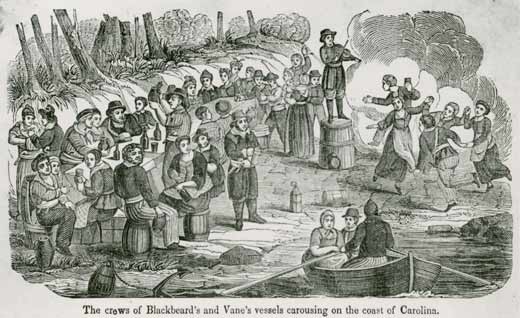
* Straight out of piracy central casting, no? Would you also believe his crew had a renowned “pirate party” rendezvous with Blackbeard’s?

On this day..

1680: La Voisin, poisoner to the stars

On this date in 1680, Catherine Monvoisin was burned at the stake in the Place de Greve, a casualty of the “Poison Affair”.

The Poison Affair was rooted in a spate of (suspected) poisonings in France during the later part of the 17th Century. In 1670, the Duchasse d’Orleans, nee Princess Henrietta Anne Stuart the daughter of deposed and executed King Charles I of England, died suddenly. Some years before, the Duchasse, a great friend, and possibly lover, of her brother-in-law King Louis XIV, had convinced the king to exile her husband’s paramour, her rival for power. Although the results of an autopsy suggested that the duchasse died from an infection resulting from a perforated ulcer, popular opinion held that she had been poisoned by her husband’s exiled lover. Five years later, Marie-Madeleine-Marguerite d’Abray, Marquise de Brinvilliers, was executed for the murder of her father, brother and two sisters by poisoning (to gain control of their inheritances). These high-profiled murders, coupled with several other mysterious deaths at the time, heightened the aristocracy’s already considerable fear of poisoning.

In response to the aristocracy’s rising fear, Louis XIV instructed his chief of police to identify poisoners and neutralize the threat they posed. Accordingly, in 1679, a commission was established. The commission promptly began investigating, and arresting, fortune tellers, alchemists, and other purveyors of potions and powders. The police chief also re-established the Chambre Ardente (“burning court”) to try alleged witches and poisoners.

The most famous prisoner tried and convicted by the Chambre Ardente was Catherine Monvoisin. Known as La Voisin, she took up fortune telling, potion-making and midwifery when it became clear that her husband would not make a living in his chosen profession. Unlike her husband’s, her business thrived. Well-positioned women of the aristocracy flocked to her, seeking potions to secure the love of powerful men or to eliminate rivals (one such target of her craft was Louise de la Valliere, then-mistress of Louis XIV).

During the Poison Affair, La Voisin was named as a witch and a poisoner and sentenced to death. Before she died, however, she named many members of the aristocracy who had used her services. They clients she implicated included the king’s mistress Francoise-Athenais, the Marquise de Montespan, whom La Voisin said purchased aphrodisiacs and performed black masses with her to gain the king’s favor, and Francois Henri de Montmercy-Bouteville, the duc de Luxembourg. Although there was no evidence to corroborate La Voisin’s stories, her confession ruined the reputations of the people she named.

The Chambre Ardente was disbanded in 1682 under the weight of the growing scandal, as it began to involve more and more members of the aristocracy.

On this day..