2004: Cameron Willingham, for an accidental fire?

(Thanks to David Elliot at Abolish the Death Penalty for the guest post -ed.)

Update: Heartbreaking New Yorker article shreds the state’s case.

Polling data reveals interesting things about U.S. public opinion and the death penalty. If you ask an open-ended question about the death penalty –- for example, “Do you feel the death penalty is appropriate for certain egregious crimes?” –- then you usually see somewhere around a 65 to 35 percent split in favor. On the other hand, if you ask which is preferred – the death penalty or life in prison without parole, the results tend to be closer to 50-50.

Upon occasion, another question is asked: Do you feel an innocent person has been put to death in the U.S.? The results are pretty emphatic: Americans don’t trust their government to get it right, and they do believe innocent people have been executed, by a ratio of about three to one.

So the question fairly arises: Have innocent people been executed in the U.S. in what we sometimes refer to as the “modern era,” i.e., since executions were allowed to resume in 1976?

Enter Cameron Todd Willingham.

On Feb. 17, 2004, Cameron Todd Willingham was strapped to a gurney in a Texas death chamber as he declared his innocence for the last time. Minutes later, he was executed by lethal injection. In December of the same year, the Chicago Tribune uncovered secrets behind the Willingham case, addressing questions left unanswered and raising doubts left unacknowledged.

The Fatal Fire

Cameron Todd Willingham with one of his purported victims — his daughter, Amber.

On Dec. 23, 1991, Willingham was at home with his three daughters. His wife, Stacy, left their home in the morning to pay the bills and shop for Christmas gifts at a Salvation Army store. The family had been struggling that year; Todd, as everyone called him, had recently been laid off, and Stacy was supporting the family with her wages from a bar. The Willinghams were two months behind on rent, and they had even stopped paying some bills in order to save money for Christmas.

Willingham recalled waking up briefly as his wife was leaving the home around 9 a.m. When he heard their one-year-old twins, Karmon and Kameron, crying, he woke up to feed them and went back to sleep. About an hour later, his two-year-old daughter Amber woke him with her cries, and the house was already full of smoke. Willingham remembers not being able to see “anything but black” toward the front of the house.

The circuits were popping throughout the home as Willingham frantically went to his daughters’ bedroom. At this point, his hair caught on fire, and he was able to see little more than the glowing of the ceiling. Willingham called out for his children and felt along the floor and bed for them, but he could not find them. This is when debris began falling from the ceiling, causing him to burn his shoulder. He fled the home through the front door.

After fleeing his house, he asked his neighbors to call the fire department and screamed to them, “My babies is in there and I can’t get them out.” A neighbor, Mary Barbee, then asked other neighbors to place the call because her own telephone was disconnected. Willingham reported that, while this was happening, he tried to re-enter his home, but it was too hot. Then, he knocked out two bedroom windows with a pool cue, but could not get into the bedroom.

Buvin Smith arrived on the scene after hearing the neighbor’s call over a radio scanner. Smith remembered restraining Willingham from going onto the porch, and heard him yelling that his “babies were in the house” and noticed that he was “acting real hysterical.”

A Circumstantial Case

Almost immediately, Willingham became a suspect. According to the Chicago Tribune, prosecutors often are able to rely on circumstantial evidence in cases when a child dies and the parent survives. In this case, the prosecution convinced the jury that Willingham killed his children because they interfered with his beer-drinking, dart-throwing lifestyle. The jury believed it.

Neighbors told investigators that they did not believe Willingham tried hard enough to save his children. In fact, Barbee said that she saw Willingham standing by the fence as heavy smoke came out of the windows. Also, she told investigators that Willingham seemed more concerned with moving his car away from the burning house as the windows blew out than with saving his children.

Willingham’s wounds were treated shortly after the fire. Firefighters did not think that his burns were severe enough had he indeed searched for his daughters in the manner he described. His shoulder, back, and hair were burned, but his bare feet were not burned at the bottom.

Police stated that, the day after the fire, Willingham complained about not being able to find a dartboard in the wreckage of his home. Others mentioned hearing loud music and laughter in the following days as the couple attempted to salvage their belongings.

A police chaplain grew suspicious that Willingham’s hysterics during the fire were not genuine. The chaplain, George Monaghan, noted that Willingham seemed “too distraught.”

In addition to these evaluations of Willingham’s behavior, fire investigators reported over 20 indicators of arson. These include the “crazed glass,” or the web-like cracks in the glass. Until more recent research was completed, arson specialists believed this to be a clear indication that an accelerant had been used in the fire. The fire experts also noted that the fire had reached a stage known as flashover, when a fire reaches such a high temperature that an explosion results. This further supported their reasoning that an accelerant had been used.

Willingham was charged with murder on Jan. 8, 1992, just two weeks after the fire. In August of the same year, his trial began, after Willingham turned down a deal from the prosecution and insisted that he was innocent. During the trial prosecutors presented inmate Johnny E. Webb as a witness. He testified that Willingham confessed at the county jail to killing his children in order to cover up the fact that his wife, Stacy, had been physically abusing them. Webb, a recovering drug addict, was taking psychiatric medication to relieve post-traumatic stress syndrome. The prosecution also presented as witnesses the neighbors who claimed that Willingham should have done more. Fire investigators Doug Fogg and Manuel Vasquez also testified at Willingham’s trial. Both of these investigators testified in court that the fire was caused by arson.

Both of these investigators testified to assumptions about fire that have been scientifically proven to be wrong.

Forensic Evidence Reconsidered

When the Chicago Tribune investigated the case, several experts reviewed documents, trial testimony, and video documentation of the fire scene and concluded that the original investigation was terribly flawed. Gerald Hurst, a Cambridge University-educated chemist, and John Lentini, John DeHaan, both private consultants specializing in fire investigation, along with Louisiana fire chief Kendall Ryland, examined the materials. They suggest that this fire may have been simply accidental.

After the Chicago Tribune investigation, Lentini worked with the Innocence Project to assemble an independent, peer-review panel of arson experts. The five-member panel –- with a combined 138 years in high-level fire investigation experience –- issued a 44-page report (.pdf) on the case.

They determined that “each and every one” of the forensic interpretations made by the state’s experts at Willingham’s trial was not scientifically valid. For example, the original investigators determined that an accelerant was used because wood cannot burn hot enough to melt aluminum. In fact, according to these leading experts, it can.

The 1991 investigators also claimed that the brown rings on the Willingham’s front porch indicated accelerant usage. Experts called this “baseless speculation,” explaining that fire-hose water often leaves brown rings on surfaces after evaporation.

Was it Known Before the Execution?

This information didn’t only come to light recently. Shortly before Willingham was executed, Hurst reviewed the case and issued a report that dismissed every single indicator of arson Fogg and Vasquez had originally cited. What was done with this report? Texas judges and Gov. Rick Perry turned it aside, confident of Willingham’s guilt.

Jury members are less confident now. One jury member asked, “Did anybody know about this prior to his execution? Now I will have to live with this for the rest of my life. Maybe this man was innocent.”

In fact, a similar debunking of arson forensics by the same expert resulted in another Texas death row inmate’s exoneration and release — just seven months after Willingham was put to death.

Have innocent people been executed in the U.S.? Indeed they have. You can read more about other cases at www.InnocentAndExecuted.org


Update: After a 2009 New Yorker expose made Cameron Todd Willingham a byword for wrongful executions, our guest author’s former shop, the National Coalition to Abolish the Death Penalty, took a cue from Justice Antonin Scalia‘s scornful dismissal of the prospect.

There has not been “a single case—not one—in which it is clear that a person was executed for a crime he did not commit. If such an event had occurred in recent years, we would not have to hunt for it; the innocent’s name would be shouted from the rooftops.”

On this day..

1606: Guy Fawkes and other Gunpowder Plot conspirators

On this date in 1606, Guy Fawkes, “the only man to ever enter parliament with honorable intentions,” was hanged, drawn and quartered in London with three conspirators for attempting to blow up the Houses of Parliament … and the government with it.

Fawkes, a soldier, was part of the Gunpowder Plot, a Catholic attempt to assassinate the new king James I when it became clear the House of Stuart would continue its Tudor predecessors’ intolerance of the Roman church.

The conspiracy was crowded, so it was something of a miracle the secret kept for over a year while the plotters filled a rented room under the House of Lords with 36 barrels of gunpowder and waited for parliament to open. The explosion would have slain not only James, but numerous officials of the government; the conspirators’ “then what?” plan seems a little vague, but with a modern recreation confirming that the gunpowder packed under Westminster was sufficient to blow the place to smithereens, it’s safe to say something dramatic would have ensued. That “something” might easily have been a savage crackdown against Catholics.

All that remains safely in the domain of the speculative — because as the date approached, one of the conspirators felt moved to warn a Catholic Lord in writing not to attend the opening.

My lord out of the love i beare to some of youere frends i have a care of youer preseruasion therefor i would advise youe as youe tender youre life to devise some excuse to shift of youre attendance at this parliament for god and man hath concurred to punishe the wickedness of this time and think not slightly of this advertisement but retire youre self into youre contri where youe may expect the event in safti for thoughe there be no appearance of any stir yet i saye they shall receive a terrible blowe this parliament and yet they shall not see who hurts them this councel is not to be condemned because it may do youe good and can do youe no harme for the dangere is passed as soon as youe have burnt the letter and i hope god will give youe the grace to maketh good use of it to whose holy protection i commend youe.

Subtle.

Fawkes was not the leader of the conspiracy, but his wartime siege experience made him an important participant in an operation similar to undermining a castle. The affair became remembered to history under his name because he was the one caught when, once the incriminating letter was turned over to the government, yeoman guards searched the cellars.

Fawkes was tortured by express permission of the king for his conspirators’ identities, but held his tongue; those conspirators, however, went ahead with the desperate uprising that was supposed to follow the explosion, and within days they had been apprehended or killed.

Four lesser conspirators were hanged, drawn and quartered on January 30; the remainder suffered that dreadful fate today. Fawkes himself, however, managed to avoid the worst of it by leaping from the scaffold when he was strung up to be half-hung — so he was dead of a broken neck when disemboweled.

The fortuitous abortion of this stupendous act of terrorism (if we can call it “terrorism”) made November 5 Guy Fawkes Night on the English calendar, still a day of fireworks and bonfires in many of the Commonwealth countries.

Remember, remember the Fifth of November,
The Gunpowder Treason and Plot,
I know of no reason
Why Gunpowder Treason
Should ever be forgot.
Guy Fawkes, Guy Fawkes, t’was his intent
To blow up King and Parli’ment.
Three-score barrels of powder below
To prove old England’s overthrow;
By God’s providence he was catch’d
With a dark lantern and burning match.
Holloa boys, holloa boys, let the bells ring.
Holloa boys, holloa boys, God save the King!

The opening lines of this 17th century poem celebrating the king’s miraculous deliverance introduce the 2006 film V for Vendetta

… in which Fawkes’ subversive persona is pitted against a theocratic dictatorship in the dystopian near future. It’s notable for a forthright celebration, in a mass-market film, of the liberatory power of terrorism.

Today’s well-known victim also left a less obvious but more ubiquitous cultural artifact. The practice of marking Guy Fawkes Night with effigies of the traitor — “Guys” — caused the word to enter the general lexicon as slang for a strangely-dressed man, eventually coming to mean any man (or, arguably, any person regardless of gender) at all.

The House of Commons has a fact sheet (.pdf) on the affair.

Part of the Themed Set: The English Reformation.

On this day..

1663: Nathaniel Greensmith, Rebecca Greensmith and possibly Mary Barnes, Connecticut “witches”

On this date in 1663,* a husband and wife were hanged for witchcraft in colonial Connecticut.

Salem, Mass. gets the publicity — and the tourism — but it was actually the Constitution State where the colonies’ first witch hangings took place, only a few years after the earliest European settlements were established.

As in the Old World, witch purges in New England took place episodically. It had been nearly a decade since any (documented) witchcraft execution when the witch-hunt erupted in Hartford that would claim this day’s victims.

The persecutions began with the deathbed ravings of an 8-year-old girl, who accused a certain Goodwife of the town, the latter preserving herself only by escaping detention and fleeing the colony with her husband.

A familiar cycle of indictments, denunciations, and extracted confessions ensued, as narrated by a 19th century historian.

The reasons for witch persecutions have been extensively and inconclusively debated. As the indispensable Walking the Berkshires blog observes, “Feuds, gossip, and a culture that demanded conformity to rigid social norms certainly played their part, but these secular explanations are easier for us moderns to accept than the sacred, and the two were inextricably linked in 17th-century New England.” It is achingly pitiable to suppose that when Rebecca Greensmith denounced her husband in her confession, she might have been in earnest:

I speak all of this out of love to my husband’s soul, and it is much against my will that I am now necessitate to speak against my husband. I desire that the Lord would open his heart to own and speak the truth.

Nathaniel Greensmith did not “own and speak the truth,” but he shared his wife’s fate this day. They may have been executed with a third accused witch as well, but the documentary trail for Mary Barnes’ case seems less certain. Though she, and perhaps another woman, may have been hanged after the Greensmiths in this particular spasm of supernatural paranoia, the Hartford witch trials of 1662-63 would mark the last witchcraft executions in Connecticut.

The Greensmiths left behind 15- and 17-year-old daughters, a modest estate, and community lore of the miraculous post-execution recovery of the party they were supposed to have been afflicting.

Noted colonial pietist Increase Mather would subsequently retail this latter point further to the fraying credibility of witch-hunting:

After the suspected Witches were either executed or fled, Ann Cole was restored to health, and has continued well for many years, approving her self a serious Christian.

The instance of the witch executed at Hartford, considering the circumstances of that confession, is as convictive a proof as most single examples that I have met with.

David Hall’s Witch-Hunting in Seventeen-Century New England reprints many of the original documentary fragments relating to the Connecticut witch trials, as does an acerbic century-old volume in the public domain, The Witchcraft Delusion in Colonial Connecticut, 1647-1697.

* Sometimes recorded as 1662 or 1662/3, since January 1 was not the legal beginning of the new year.

Update: A resolution officially clearing Connecticut’s “witches” is being mooted, thanks to the pressure of 8th- and 9th-generation descendants of one of the victims. The bill expired in committee in 2008, but could come up again in future sessions. (Thanks to Melisende for the story.)

On this day..

1936: Albert Fish

On this date in 1936, serial killer Albert Fish was electrocuted in New York’s Sing Sing Prison for a cannibalistic murder.

The deeply troubled Fish“deranged, but sane”, the doctors thought him — was condemned for murdering and eating a 10-year-old girl.

He was free and clear of the crime until, seven years later, he sent the child’s parents a grotesque taunting letter* that ultimately led police back to its author.

From posting that note to riding the lightning was a bare 14 months, but Fish found time to confess to additional murders (and deny others — the doubtful relationship of any Fish statement to reality makes it difficult to pin down his criminal career exactly).

The newspapers called him “The Werewolf of Wysteria” and “The Brooklyn Vampire”; if as a serial killer he was far from the most prolific, the thoroughgoing strangeness of his mind has made him, at least to some, enduringly fascinating** — as this documentary trailer suggests:

A 2007 feature film, The Grey Man, is also based on Fish’s exploits.

* The mother was illiterate, and her son had to read aloud to her Fish’s descriptions of cannibalism.

** Others find him less than interesting

Part of the Themed Set: The Spectacle of Private Execution in America.

On this day..

1951: Albert Guay

On this date in 1951, Albert Guay was hanged in Canada for one of the earliest commercial airline attacks — bombing a Canadian Pacific Airline flight to murder his wife.

Stuck in a loveless marriage with little recourse to divorce, Guay‘s loins burned for a young mistress.

He engaged a watchmaker colleague, Généreux Ruest, to make a bomb, and the latter’s sister, Marguerite Ruest-Pitre, to air freight it on the doomed plane. Both would maintain their innocence of the plot, but after Guay’s own conviction, he implicated both — possibly in an attempt to delay his own hanging.

A time bomb in the luggage hold of this airplane took 23 lives on September 9, 1949, for which three people were executed — and inspired a copycat crime with 44 more deaths and one more execution.

Guay had intended the plane to explode over the St. Lawrence River, eliminating the forensic evidence, but a slight delay before takeoff laid the damning debris over the land. The flight’s entire complement of four crew and nineteen passengers — including three top executives of the Kennecott Utah Copper Corporation — perished.

The crime had ample media attention both north and south of the Canada-U.S. border — flight still being something of a terrifying novelty for the general public. Guay’s purchase of life insurance for his wife on the day of the trip was not especially inculpatory, but a standard procedure for air travelers.

Guay’s last words caught the irony of his celebrity: “Au moins, je meurs célèbre” (“At least I die famous”).

A few years after this day’s events, an American attempted a similar crime, with similar results.

On this day..

1594: Alison Balfour

On this date in 1594, Alison Balfour was burned as a witch on the strength of a confession extracted under the hideous torture of her family.

Balfour had been implicated in a plot — probably entirely fictitious — to poison the tyrannical young Earl of Orkney, with some misshapen blob of wax appearing as evidence of her communion with the infernal.

She was tortured, but she denied the charges.

Her 81-year-old husband was tortured in front of her, but she denied the charges.

Her son’s feet were crushed in front of her, but she denied the charges.

When at last her seven-year-old daughter was put to thumbscrews in front of her, she broke down and “confessed.”

Before her execution, she renounced her confession in heartbreaking words to be read in the original records:

sche … declarit and tuik upoun hir saull and conscience, as sche wald ansuer att the day of judgement … that sche wes als innocent and wald die als innocent on ony point of Wichcraft as ane barne new borne … the tyme of hir first Depositioun sche wes tortourit diverse and severall tymes in the Caschielawis, and sindrie tymis takin out of thame deid,* … as lykewyis hir guidman being in the stokis, hir sone tortourit in the Buitis, and hir dochtir put in the Pilliewinkis, quhairwith sche and thay wer swa vexit and tormentit, that pairtlie to eschew ane gretar torment and pwneischement, and upoun promeis of hir lyffe, and guid deid be the said Personne, falslie, aganis hir saull and conscience, sche maid that Confessioun, and na uthirwyis.

Just two years later, another supposed perpetrator of this same plot was acquitted in Edinburgh — the evidence of Balfour’s case thrown out as unreliably obtained under torture.

* “taken out of them dead” — i.e., unconscious

On this day..

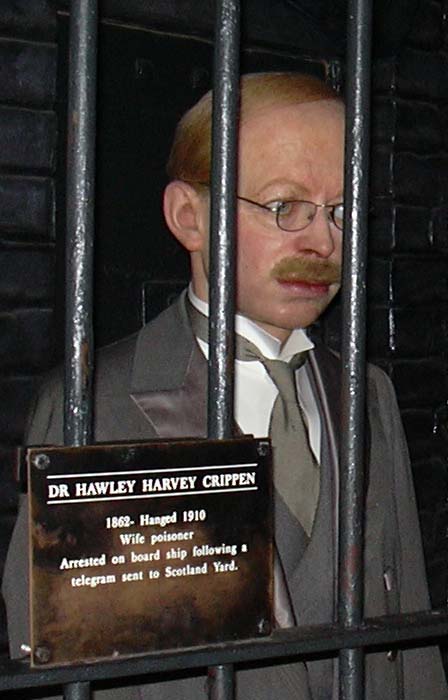
1910: Hawley Harvey Crippen

On this date in 1910, the notorious wife-murdering doctor Hawley Harvey Crippen was hanged at London’s Pentonville Prison.

The sensational trial, which saw the American-born homeopath convicted for dismembering his shrewish and unfaithful wife Cora in an attempt to take up with his young mistress, fitted Crippen for both a noose and a likeness at Madame Tussaud’s. (More trial background here.) It has also made his case twice a landmark in the history of crime and technology: once at the time of his arrest, and again just last month as of this writing.

The core of a case a jury found so open-and-shut as to require just 27 minutes to convict was the poorly explained disappearance of Crippen’s wife, followed by the discovery of a considerably mutilated female corpse under the Crippens’ home.

Although much of the crown’s evidence was speculative and circumstantial — to say nothing of the bodice-ripping gossip of nymphomania and infidelity — a corpse under the floorboards tends to be a compelling circumstance to a jury.

Presumably that anticipation prompted Crippen to flee the Scotland Yard investigation with his mistress Ethel le Neve under assumed names on an ocean liner bound for Canada. The case made criminological history as the first use of wireless communication to apprehend a suspect when the ship’s alert captain telegraphed Crippen’s presence to land as the ship steamed away — enabling a policeman to board a faster boat and arrest the pair as they docked in Quebec.

In the century since Crippen went to the gallows still maintaining his innocence, the case has endured in popular notoriety. The killer’s life has been novelized, meditated upon and borrowed for fiction, offering a draught of inspiration to Alfred Hitchcock along the way.

Books inspired by the Crippen case …

Given his suspicious behavior, scant had been the credence given Crippen’s protestation of innocence.

Until now.

In a meeting of Edwardian crime and cutting-edge technology, two scientists from Crippen’s home state of Michigan stunningly announced in October that DNA testing proves the body was not Cora Crippen after all.

If true, it would appear to void Crippen’s conviction in its particulars without quite exonerating the hanged man from the natural question: whose was the corpse? The manufacture of clothes on the body dated it to the Crippens’ occupancy of the house.

One of Crippen’s modern sleuths, in a wholly speculative vein, thinks it might harken to an altogether different sort of crime: a botched back-alley abortion, just the sort of thing a financially struggling physician might have been involved in.

Maybe.

But if the test invites a modern investigator to look 97 years backwards, it also suggests a posture of epistemological humility. It’s just possible that the light this test casts on our own time is as searching as that it shines on 1910.

The Prejudice of Science

The Crippen case was a classic 19th century-style detective job — the inspector who made the arrest cut his teeth as a younger man on a Jack the Ripper murder — but it took place on the brink of a revolution in forensic science.

Just a few years before, fingerprinting had been embraced by British and American law enforcement and begun its march towards total institutionalization. On the heels of fingerprinting came a multiplicity of biometric approaches to crime scenes — hair and fiber analysis, blood typology, and most recently and dramatically, DNA.

And they, in turn, have brought a rising faith in science to adjudicate the law.

While the “CSI Effect” — jurors’ expectation of case-breaking scientific evidence — conventionally plays as a hindrance for prosecutors who usually have no such thing, the excess deference given to less-than-conclusive forensic evidence can likewise cut against the defense. Evidence mishandled at crime labs, even cooked outright, factors into numerous recent post-conviction exonerations. The once ironclad credibility of fingerprint evidence has itself been undermined by subsequent forensic advances.

In short, for all its undoubted contributions to criminal justice, forensic science packs along its own set of pitfalls, caveats and blinders reflexively privileging evidence of the laboratory.

This is not a reflex to indulge uncritically. History grants the benefit of hindsight, but rarely the luxury of certitude.

A waxwork Dr. Crippen at Madame Tussaud’s. Image used with permission.

So if the prospect of Crippen’s innocence intrigues, that unexplained body — that sudden flight for Canada — that (permanent) failure of Cora Crippen to resurface — nevertheless remain. They might lead us to question our implicit faith in the finality of DNA’s verdict on history rather than the other way around.

Are we certain that an unbroken line of blood relations really connects Cora Crippen to the modern DNA donors of her “family”?

Are we certain that a reliable chain of custody has preserved the original tissue samples unsullied across a century?

And if we are certain, what do we make of that body after all?

It is humans who must ultimately interpret and contextualize even the firmest forensic science. Whatever we might believe of Dr. Crippen we retain the burden of that belief, with all its intrinsic potential for grievous wrong.

The tales Hawley Crippen has yet to unfold from the grave might or might not shed still another different light on our understanding of what happened at 39 Hilldrop Crescent a century ago.

The gentleman’s place as a continuing attraction at Madame Tussaud’s, however, seems assured.

On this day..

1491: Eight current and converted Jews at an auto de fe

On this date in 1491, the murder of the Holy Child of La Guardia was punished with an auto de fe and the public execution of eight Jews — some practicing, some converted to Christianity (who enjoyed the mercy of strangulation before being burnt) — and three others already dead but exhumed for the occasion.

The auto de fe — literally, “act of faith” — was a public ritual of religious penance for the condemned. Though its performance did not always precede the execution of its participants, it became closely associated with the savagery of the Spanish Inquisition.

In the hysteria of the Holy Child of La Guardia case — one of history’s better-remembered instances of “blood libel” implicating Jews in the ritual murder of Christian children — the result was foreordained.

Knitting together (inconsistent) confessions obtained under torture, the famed Inquisitor Torquemada proved a conspiracy of Jews had kidnapped and crucified a child further to the concoction of a magic potion that depended on the heart of an innocent Christian — despite a fruitless high-and-low search for some missing child who might have been the actual victim.

After this day’s gaudy public slaughter, a cult sprang up around the supposed martyr, adored in a chapel erected where one of the prisoners had once had a home — the very spot, it was said, where the Jews conspired. The Holy Child was a staple of Spanish literature down to the 20th century and is still venerated in La Guardia.

But Torquemada aimed for results well beyond Christendom’s martyrology, and the wretches at the stake would not be this day’s only victims.

John Edward Longhurst argues in The Age of Torquemada that the Inquisitor seized on the Holy Child case to orchestrate “his heart’s desire — the expulsion of all Jews from Spain.”*

Early the next year, the Spanish monarchy obliged, permanently remaking Spain:

If Ferdinand and Isabella were hesitating over expelling the Jews from Spain, the discovery of this latest Jewish plot would surely resolve all doubts. The Auto de Fe of November, 1491, exploited the affair to its fullest, emphasizing not only all the gruesome details of the Murder but the Jewish menace to Christians intended by it. The sentence against the Jew Juce Franco, read aloud to the great crowd at the Auto de Fe, identifies him as a seducer of Christians to the Law of Moses in language that clearly foreshadows the Edict of Expulsion four months later

We may be sure that Ferdinand and Isabella were treated to a lengthy account of this case. It also is clear, from their own observations in the Edict of Expulsion, that Torquemada impressed on them the determination of the Jews to persist in their efforts to seduce Christians to Judaism. As long as they were permitted to remain, the danger of infection would never be eliminated, no matter how harsh the measures employed against them.

* Or, their forcible conversion … which would then keep the Inquisition in business for years to come.

On this day..