On this date in 1739, famed desperado Richard “Dick” Turpin rode through York on an open cart, saluting his admirers, then sat upon his gallows at the York raceway for half an hour, chatting with spectators and executioners, until he “with undaunted courage looked about him, and after speaking a few words to the topsman, he threw himself off the ladder and expired in about five minutes.”
Turpin was the ultimus Romanorum, the last of a race, which (we were almost about to say, we regret) is now altogether extinct. Several successors he had, it is true, but no name worthy to be recorded after his own. With him expired the chivalrous spirit which animated successively the bosoms of so many knights of the road; with him died away that passionate love of enterprise, that high spirit of devotion to the fair sex, which was first breathed upon the highway by the gay, gallant Claude Du-Val, the Bayard of the road — le filou sans peur et sans reproche — but which was extinguished at last by the cord that tied the heroic Turpin to the remorseless tree…
Turpin, like the setting sun, threw up some parting rays of glory, and tinged the far highways with a lustre that may yet be traced like a cloud of dust raised by his horse’s retreating heels.
The cloud hasn’t settled since William Harrison Ainsworth wrote those words.*
The “knight of the road”, one understands, is an artifice — a romantic construct. One name to bear its lustre to the present may be as good as another. Even so, in Dick Turpin, it has an exponent who bore very scant resemblance to the archetype … save for celebrity.
Turpin washed out of his apprenticed career as a butcher and took to the road, where he joined the “Essex Gang”. Far from dashing post-road stickups, this troupe specialized in invading domiciles where they would torture women into revealing the household stashes of valuables.
The Newgate Calendar captions this image, “Dick Turpin placing an old woman on the fire, to compel the discovry [sic] of her treasure”Turpin’s highwayman career commenced when the gang was busted — our principal leaping out a window to evade capture — and he had a profitable couple of years plundering the traffic around Epping Forest.
Many are the colorful tales of Turpin’s career; the one of most moment for his legacy may be this chance encounter with a fellow outlaw, as related in the Newgate Calendar.
On a journey towards Cambridge, he met a man genteelly dressed, and well mounted: and expecting a good booty, he presented a pistol to the supposed gentleman, and demanded his money. The party thus stopped happened to be one King, a famous highwayman, who knew Turpin; and when the latter threatened destruction if he did not deliver his money, King burst into a fit of laughter, and said, “What, dog eat dog? — Come, come, brother Turpin; if you don’t know me, I know you, and shall be glad of your company.”
The well-mannered Tom King — “the gentleman highwayman” — seems to have had his courteous mien conjoined in legend with his much more villainous partner’s prolific career.
Nor is King the only fellow-outlaw whose exploits Turpin has absorbed.
Our anti-hero’s days pillaging the environs of London came to an end in an escapade that saw Turpin shoot his accomplice while trying to rescue him — a klutzy critical miss not usually associated with the swashbuckling rogue character kit. The dying King is supposed to have repaid this bit of friendly fire by revealing to the authorities the pair’s Epping Forest hideouts.
Escaping capture once again, Turpin changed his address, and it is said that the highwayman shed his pursuers with a marvelous 200-mile ride north to Yorkshire in 15 hours.
This feat was not Turpin’s originally, but ascribed to the 17th-century robber John “Swift Nick” Nevison, although even that might be folklore.
Ainsworth, bless his heart, fabricated (pdf) the Turpin ride in the interest of his yarn — “they were distancing Time’s swift chariot in its whirling passage o’er the earth … [Turpin] rode like one insane, and his courser partook of his frenzy. She bounded; she leaped; she tore up the ground beneath her; while Dick gave vent to his exultation in one wild prolonged halloo.” (Picturesquely, he rides his famous steed Black Bess to death on the trip.)
The story has been fixed ever since in the firmament, and licenses every pub along the route to claim Turpin’s patronage.
His end, if not heroic, was certainly attention-grabbing. Turpin settled in Yorkshire under the alias “John Palmer” and passed as a gentleman farmer … with a larcenous side business rustling stock.
His career, in a sense, had come full circle: ’twas a youthful cost-cutting practice of abducting animals that had put the kibosh on his legitimate butcher’s business.
His cover was blown most ingloriously, when he was detained as a possible horse thief and sent a pseudonymous letter to his brother in London asking for help. The brother was too cheap to pay the postage due, so the letter returned to the post office where Turpin’s schoolmaster chanced to see writing in a hand he recognized, and journeyed to York to identify the wanted man and pocket the reward.
So it was not housebreaking, highway heists, or his homicide that hung Turpin, but horse-rustling … although Turpin’s celebrity career attracted curiosity-seekers from far and wide when word of his capture got out. Whatever Ainsworth may have made of Turpin, he did not fabricate the man’s fame; Dick Turpin earned his own ballad sheets and made his own legend possible playing the man at his death.
This man lived in the most gay and thoughtless manner after conviction, regardless of all considerations of futurity, and affecting to make a jest of the dreadful fate that awaited him.
Not many days before his execution, he purchased a new fustian frock and a pair of pumps, in order to wear them at the time of his death: and, on the day before, he hired five poor men, at ten shillings each, to follow the cart as mourners: and he gave hatbands and gloves to several other persons: and he also left a ring, and some other articles, to a married woman in Lincolnshire, with whom he had been acquainted.
On the morning of his death he was put into a cart, and being followed by his mourners, as above-mentioned, he was drawn to the place of execution, in his way to which he bowed to the spectators with an air of the most astonishing indifference and intrepidity.
When he came to the fatal tree, he ascended the ladder; when his right leg trembling, he stamped it down with an air of assumed courage, as if he was ashamed of discovering any signs of fear, Having conversed with the executioner about half an hour, he threw himself off the ladder, and expired in a few minutes.
The spectators of the execution were affected at his fate, as he was distinguished by the comeliness of his appearance … The grave was dug remarkably deep, but notwithstanding the people who acted as mourners took such measures as they thought would secure the body: it was carried off about three o’clock on the following morning; the populace, however, got intimation whither it was conveyed, and found it in a garden belonging to one of the surgeons of the city.
Having got possession of it they laid it on a board, and carried it through the streets in a kind of triumphal manner, they then filled the coffin with unslacked lime, and buried it in the grave where it had been before deposited.
* LibriVox has a well-done free reading of Rookwood.
[audio:http://ia360943.us.archive.org/0/items/rookwood_pc_librivox/rookwood_26_ainsworth.mp3]Part of the Themed Set: Selections from the Newgate Calendar.
On this day..
- 1733: Samuel Partridge, very stupid and unconcern'd
- 1595: Henry Walpole, martyred at York
- 1995: Nicholas Ingram
- 1900: William Pepo, the first hanged in Teton County, Montana
- 1836: Maria del Rosario Villa and Gervasio Alipas lynched in Alta California
- 1764: John Nelson, Liverpool robber
- 1979: Amir-Abbas Hoveyda, Iranian Prime Minister
- 1933: The "killers" of Pavlik Morozov
- 1903: George Chapman, Ripper suspect
- 1590: Anne Pedersdotter, Norwegian witch
- 1520: Gaspar Quesada, Magellan's expedition mutineer
- 2007: Du'a Khalil Aswad, honor killing victim
1699: William Chaloner, Isaac Newton’s prey
(Thanks to Thomas Levenson of the Inverse Square Blog. Prof. Levenson is head of the Graduate Program in Science Writing at MIT, and author of the forthcoming Newton and the Counterfeiter.)
Early in the morning of March 22, 1699, William Chaloner raged.
Chaloner, a convicted coiner, refused the Newgate Jail Chaplain’s plea to show proper penitence, shouting with “more Passion than Piety,” of his wronged state and unmerited destination (according to his anonymous biographer in the one surviving account of his life). In time, he calmed sufficiently to accept the sacrament, and so proceeded to the execution convoy to be borne from Newgate to the hanging tree at Tyburn (now Marble Arch, just to the west of the old City of London).
There Chaloner’s fury mounted again, and he shouted to the crowd, drawn as always to the spectacle of public hanging days, that “he was murder’d … under pretence of Law.” He mounted the ladder to the top of Tyburn’s gibbet. He prayed, and then pulled the hood over his eyes without aid. When the moment came, the executioner’s men pulled the ladder out of the way and Chaloner dangled, twitching and jumping (the “hangman’s dance”) as long as it took –- minutes, at least — for life to choke out of him. Richer men often paid the hangman to pull on their legs to speed death. Not the destitute Chaloner. He had to choke till he drooped, to the greater amusement of the crowd.
The investigator who had sent Chaloner to the noose was not present; or at least nowhere in his copious notes and letters did he admit to curiosity about the fate of a man whose pursuit occupied him for almost three years. The Warden of His Majesty’s Mint had more pressing duties to perform, and so Isaac Newton allowed the date of Chaloner’s death to pass unmarked.
Isaac Newton? That Newton?
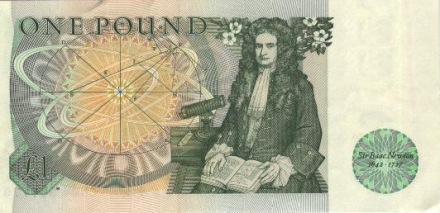
Appropriately, Newton himself wound up on the currency.The accidents of place and time that brought the man who was recognized in his own day as the greatest mind of the age into conflict with Chaloner, an uncommonly gifted common criminal have fascinated me since I first learned of them through reading Chaloner’s last, piteous letter to the implacable Newton, written days before the hanging. In it Chaloner begged, writing “O dear S[i]r nobody can save me but you O God my God I shall be murderd unless you save me.”
What I wanted to answer was the obvious question: how and why did Isaac Newton come to pass judgment on the life of any other man? I had always thought of him as the nearly cloistered scholar of Trinity College, Cambridge, his home for more than thirty years. It was there he performed the experiments and the calculations that led him, in 1687, to write his masterwork, Philosophiae naturalis principia mathematica the Mathematical Principles of Natural Philosophy — better known simply as the Principia -– as well as pursuing his decades-long program of alchemical research.
So how, I wondered, did he end up in London, wallowing in the muck with the capital’s criminal underground?
Not to put too fine a point on it, finding out has turned into a book Newton and the Counterfeiter, published by Houghton Mifflin Harcourt and scheduled for release on June 4. But, to anticipate that longer story, here is the gist: Newton, after Principia found himself an international celebrity, and, as one of Cambridge University’s representatives to the Convention Parliament of 1689 that legitimized William of Orange‘s seizure of the English throne from the deposed Stuart King James II, he had nearly a year to enjoy the acclaim of London and Europe’s thinking and political elites before returning to the quiet of Cambridge, then a small town of about 5,000 inhabitants. It was an intellectual backwater too, especially compared to the big city in which he encountered figures like Robert Boyle, John Locke, Robert Hooke (whom he despised), Samuel Pepys (whom he did not) and so on. So he started, with Locke’s help, to seek a patronage appointment that would allow him to live comfortably in London. It took six years to find the right one, but ultimately he was offered the Warden’s post at the Mint. That job was supposed to be a sinecure, a nearly no-show position that would pay him a very comfortable wage.
And so it would have turned out were it not for the terribly debased state of England’s silver coinage, which had deteriorated to about half its legal weight for a whole host of reasons. So Newton arrived at a time when (a) the Mint was attempting to recall and recoin the entire stock of silver money for the entire country –- all the smaller units of money essential to everyday transactions –- and (b) coining, counterfeiting, was flourishing as enterprising men and women set out to get rich by filling in the gaps in the money supply with coins that never felt the stamp of an official Mint die. As Warden, it became Newton’s duty to see that legal money was produced fast and fairly, and to pursue all those who set up on their own.
Of those who did none were more technically skilled or ambitious than William Chaloner. His is a fascinating story, told at much greater length in my book, in which you see the currents of rapid economic change, class and ambition all converge within this one, barely remembered life. He was born desperate poor, a weaver’s son in Lincolnshire. He ran from his first apprenticeship to London, where he started out at the very bottom of the criminal ladder, hawking porn on street corners. He rose rapidly, first with his clearly impressive gift of gab, and then, after falling in with someone who knew how to gild surfaces, as the central figure in a series of ever grander schemes to counterfeit gold and silver money. He had sidelines as an informer, betraying conspiracies that he would himself set up, but his central gift and fascination was in the creation of fakes. Ultimately, he was one of the first to recognize the power of paper, and he started to counterfeit a variety of the early experiments with paper money and bank instruments.
In this sense Chaloner’s career –- and Newton’s urgent pursuit of him –- offer a window into the birth of the modern idea of money, of finance. And one of the things that fascinated me about this case is the degree to which this old story tracks some of our immediate problems. England’s and Europe’s economies were in rapid revolution in the late seventeenth century. The old idea of money as a chunk of metal with a pretty picture on it could no longer come close to accommodating the kind of enterprises governments and individuals wanted to undertake, from war to the funding of global webs of trade. And so people came up with all kinds of different ways of trying to represent value and exchange and even the idea of the changing worth of an investment over time. And the people making these experiments did not fully understand the implications of each expedient they tried. The last piece of paper Chaloner counterfeited was called a Malt Lottery Ticket, and it was at once simply paper money, a bond, and a gamble. Traders attempted to value these kinds of things in embryonic financial markets -– which would in a couple of decades blow up in a financial collapse that possess some striking similarities to our current predicament. Newton himself would lose a considerable fortune in that collapse, a sum worth a couple of million pounds, maybe more, in 21st century money.
It was that sense of precariousness that made the pursuit of counterfeiters so urgent in the midst of the late 17th century; England’s money supply was genuinely at risk, and no one had a good grasp of what it would take to make both the daily experience of small transactions and the high finance of war and trade go smoothly. So anyone threatening either or both levels of money was public enemy number one.
Of those who tried their hand at currency crime, Chaloner was the most accomplished, and notorious. By his own admission he counterfeited on the order of 30,000 pounds worth of currency over a seven- or eight-year career, an enormous fortune for the day. His big mistake, though, was to challenge Newton directly, accusing him in public of incompetence or fraud in his management of the recoinage of silver money between 1696 and 1698. He laid that charge both in testimony to Parliament and in a pamphlet he had printed for public distribution, and the scandal could genuinely have wounded Newton, were it not for the influence of his friends in power in Parliament at the moment.
It was enough, certainly, to propel Newton into an extraordinary investigation, an exercise of what may be seen as true non-fiction scientific detection. He set up a net of agents and informers throughout the worst neighborhoods and pubs in London, tracking any instance of coining he could find, interrogating suspects at the Tower or in jail, trying to build a web of connections around Chaloner. That story is contained within a collection of several hundred depositions and summaries of interrogations, all signed by Newton, that have survived, largely unexamined until now. Those records show that it took Newton almost two years in all, but aided in the end by listeners whose lives he held at his disposal inside Chaloner’s cell at Newgate, he managed to collect a sufficient weight of testimony to ensure that he could convict a prisoner clever enough to have escaped several previous attempts at prosecution.
The trial itself was something of a sham. Chaloner had feared being charged on the Malt Lottery Ticket forgery, (as we know from the accounts in Newton’s files of informers in the cells) but Newton actually presented evidence of a coining spree that almost certainly did not take place as described. Among other confounding facts, Chaloner was supposed to have made six different denominations of both silver and gold coins in a single day, which would have involved an enormous confusion of tools and materials that ran counter to basic counterfeiting practice.
No matter: the sheer volume of precise detail that Newton’s witnesses were able (or convinced) to provide produced a conviction within a very short time –- the whole trial took no more than an hour or so on March 3, 1699. There was a truncated appeal process -– really just a request for clemency from the crown, which was denied, and Chaloner’s sentence came down.
Formally, he had been found guilty of high treason, an assault upon the crown in the form of the king’s likeness and authority represented on the face of England’s coins. The punishment for high treason was essentially that suffered by William Wallace of Braveheart fame: to be strangled to the point of death, to be disemboweled whilst still living, to be beheaded and then quartered. By the date of Chaloner’s execution, the punishment had eased this far: convicted coiners were drawn to the place of execution on a rough sledge, subject to all the filth and abuse London’s open-sewered streets possessed; then hung until dead, and then, on rare occasions, to suffer post-mortem dismemberment. Chaloner himself was not, so far as any records revealed, actually cut into pieces. (As a gesture to public decency, women convicted of coining or other capital crimes were not supposed to be hung, lest their twitching at rope’s-end seem lewd. So they were burnt instead – though by the eighteenth century it was common to strangle them to death before lighting the pyre. Mercy, after the fashion of the times.)
Levenson lectures on his book at the MIT Writer’s Series.One last note in a post gone much too long: Newton was involved in a number of counterfeiting investigations, and by some reckonings at least two dozen people went to their deaths as a result. Some historians, notably Frank Manuel, have speculated that Newton pursued this work with implausible eagerness, out of a kind of frustrated blood lust born of his abandoned and unhappy childhood.
This seems to me to be nonsense. The specific historical context matters here: Newton did not author the bloody code, nor did he send everyone he could to the gallows. Rather, the record of his depositions shows him to be simply a relentless practical man doing his job. He used little fish to catch big fish, and at least some of those low on the ladder received their escape from the gibbet. What you can see here, surprisingly, is the birth of a modern idea of a civil service. The Warden -– even Isaac Newton — was simply a man in a job doing the functions of that job, which included organizing the investigation and prosecution of counterfeiters.
What’s striking, of course, is that this civil servant, this bureaucrat, happened to possess the greatest scientific mind in history. And that’s the real sting in this tale. There is a connection between Newton’s pursuit of counterfeiters and his attempts to understand nature. He did employ the same resources of concentration and logical organization in his criminal investigations that he did when he tackled any problem. But more than the commonality of work habits, there is, I think this link: Newton can be seen as many people: the mathematician, the theoretical physicist, the empirical experimentalist, the alchemical mystic, the heretically devout religious thinker –- and the government functionary too.
And yet he was, of course, a single man, one with many interests, but ultimately with a consistent ambition, to reduce to order the complexity of any problem which was posed to him. Newton did not expect as Warden to have to chase crooks; when he found out that was part of the job he wrote a rather whiny letter to the Treasury to see if he could wriggle out of the duty. When he found he could not, he responded as he always had to the job at hand.
As one consequence, on this day three hundred and ten years ago, William Chaloner died.
On this day..
- Feast Day of Saint Octavian, martyred by the Arian Vandals
- 1540: Hans Kohlhase, horse wild
- 1844: Samuel Mohawk
- 1945: Eliyahu Bet-Zuri and Eliyahu Hakim, Lord Moyne's assassins
- Themed Set: More like Drop-shire
- 1824: Richard Overfield, wicked stepfather
- 1864: Kastus Kalinouski, Belarus revolutionary
- 1819: Hannah Bocking, 16-year-old poisoner
- Themed Set: Arsenic
- 1881: George Parrott, future footwear
- 1686: A man and a woman broken on the wheel in Hamburg
- 1733: John Julian, pirate and slave
- 1803: Thomas Hilliker, teen machine wrecker
- 1796: Mastro Titta's first execution of many
1934: Marinus van der Lubbe, for the Reichstag fire
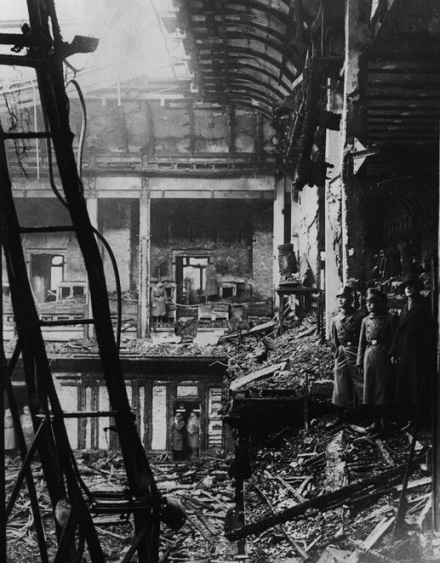
On this date in 1934, Dutch bricklayer Marinus van der Lubbe was beheaded by guillotine in Leipzig for setting the Reichstag Fire.
A watershed event* in the formation of the Nazi dictatorship, the Reichstag fire days before a parliamentary election enabled Hitler to stampede voters, suspend civil liberties, suppress left-wing parties on grounds of a suspected Communist plot, and seize “emergency” powers he would never relinquish.
Heil Hitler.
This clip from an American miniseries on Hitler with the characters chattering in unaccented English portrays the fascists’ opportunistic use of the attack on a national symbol … something not exactly unknown to later generations.
Van der Lubbe, who was arrested on the scene, suffered the predictable fate. Four other Communists charged as accomplices were acquitted, in a trial with the gratifying spectacle of Hermann Goering personally testifying, and being undressed on cross-examination by one of the reds. One is reminded here that Hitler did not yet have everything in the state apparatus at his beck and call … although he did have a great deal already, inasmuch as the arson law under which van der Lubbe died was passed after the Reichstag fire and made retroactive.
If the big-picture outcome of the Reichstag fire is pretty clear-cut, its real origin and the corresponding rightness of the judicial verdicts have remained murky ever since. The fact that the scene of the crime became Nazi ground zero for the next decade sort of obscures the evidence.
Van der Lubbe confessed, so his participation is generally taken as a given.
Whether he was really able to start the blaze acting alone, as he insisted, and the Nazis “only” exploited this fortuitous calamity; whether he was part of a larger leftist plot, as his prosecutors claimed; or whether, as Shirer and many others since have viewed him, he was a patsy in a false flag operation set up by the Nazis with an eye towards creating a politically advantageous national emergency — these possibilities remain very much up for debate.
For what it’s worth, postwar West German courts reversed and un-reversed the sentence before officially rehabilitating van der Lubbe last year on the non-specifically indisputable grounds that the legal machinery brought to bear on the Reichstag fire “enabled breaches of basic conceptions of justice.”
* From Defying Hitler: A Memoir by a writer who would soon emigrate:
I do not see that one can blame the majority of Germans who, in 1933, believed that the Reichstag fire was the work of the Communists. What one can blame them for, and what shows their terrible collective weakness of character … is that this settled the matter. With sheepish submissiveness, the German people accepted that, as a result of the fire, each one of them lost what little personal freedom and dignity was guaranteed by the constitution, as though it followed as a necessary consequence. If the Communists had burned down the Reichstag, it was perfectly in order that the government took “decisive measures”!
Next morning I discussed these matters with a few other Referendars. All of them were very interested in the question of who had committed the crime, and more than one of them hinted that they had doubts about the official version; but none of them saw anything out of the ordinary in the fact that, from now on, one’s telephone would be tapped, one’s letters opened, and one’s desk might be broken into. “I consider it a personal insult,” I said, “that I should be prevented from reading whichever newspaper I wish, because allegedly a Communist set light to the Reichstag. Don’t you?” One of them cheerfully and harmlessly said, “No. Why should I? Did you read Forwards and The Red Flag up to now?”
On this day..
- 1848: Thomas Sale, game
- 1868: Heli Freymond, the last beheaded by sword in Switzerland
- 1917: Marguerite Francillard, seamstress and spy
- 1870: John Gregson, drunk and disorderly
- 1946: Laszlo Bardossy, former Prime Minister
- 1430: Ten men beheaded, and an eleventh man married
- 2013: Zhang Yongming, cannibal corpse
- 1879: Benjamin Hunter, in the Hunter-Armstrong Tragedy
- 1937: Martemyan Ryutin, for his affair
- 2010: An al Shabaab rebel commander
- 1645: William Laud, given to the devil
- 1775: Yemelyan Pugachev
1878: John Kehoe, king and last of the Molly Maguires
On this date in 1878, John “Black Jack” Kehoe was hanged in Pottsville — as Pennsylvania’s anthracite trusts took a victory lap around the corpses of the Molly Maguires.
Even to say what the Mollies were is to take a side in their life-and-death struggle. Irish immigrants fleeing the potato famine had poured into Pennsylvania’s coal mining country in the mid-19th century, where life in the mines was nasty, brutish and short, and the pay wasn’t anything to write home about either.
In a time when capital ruthlessly hunted any intimation of labor organizing and the Irish were a distinctly second-class people, the (apparent, or at least alleged) response of the Mollies was natural: form a secret society, and wring by threat of bodily harm the concessions it could not pursue by collective bargaining. For the recent Irish transplants, the tableau of a Catholic underclass working for a Protestant landlord who owned (and gouged on) everything in sight had a certain familiar feel.
Terrorists? They certainly used violence to achieve political objectives, at least if the testimony of their foes is credited. But they weren’t the only ones.
Mine owners turned public and private violence on Irish radicals pushing for things like the eight-hour day. The notorious strike-breaking Pinkerton Detective Agency was detailed to infiltrate the Mollies.
The main blow against the Mollies was struck over a period of (extrajudicial) vigilante justice in the mid-1870’s, culminating in “Pennsylvania’s Day of the Rope” in 1877, when ten supposed members were (judicially) hanged around the Keystone State.
Kehoe, a power broker in mining country with some sway at the capital who was reputed to call the shots among the Maguires, faced the hangman singly a year later for an 1862 cold-case murder so doubtfully ascribed to Kehoe that the governor hesitated to sign the death warrant.
He signed it just the same, marking a sort of ceremonial “end to Molly-ism.” The New York Times exulted two days hence “that the widely-extended and long-continued tyranny and terror of this association is at an end,” and all because the resolute executive had gone and sent a hempen message to “the savage and benighted population of the coal region.”
The lesson taught by the punishment of the Molly Maguires would have been shorn of much of its terror and impressiveness if the energetic and persistent efforts made in behalf of KEHOE, the reputed king of that organization, had resulted in rescuing him from the gallows. If they had even so far succeeded as to have caused his punishment to be commuted to imprisonment for life, the admonitory influence of his fate upon the murderous clain of whom he was the last surviving chief would have been greatly lessened, and the snake of Molly Maguire-ism, of which he was the forked tongue and fangs, might haply have been only scotched, not killed. … The law has shown that it has subtlety enough to hunt [the Molly Maguires] through every possible labyrinth of refuge and strip from them every artifice of disguise, and power enough to wring them out of the desperate grasp of sympathizing constituencies and crush them.
Florid.
Like we said, violence wasn’t the exclusive resort of one side. But the monopoly of violence … that was held, as always, by the same hands that held the monopolies. Sean Connery as Kehoe reflects on the uneven contest while awaiting his fate in a (fictional) exchange with the Pinkerton mole who condemned him from the 1970 film The Molly Maguires.*
Pennsylvania Gov. John Hartranft left office a few weeks later, and reflected in his outgoing address on the lessons “the manufacturers and operators” ought to draw from the late unpleasantness.
The Mollie Maguire murders, like the agrarian murders in Ireland, and the trades-union outrages, arsons, and machine-breakings in England, were not the work of the so-called criminal classes. They were essentially class murders … If some of the leading spirits of the class had been members of a board of arbitration as representatives of labor, with some of the employers or their agents as representatives of capital, it is not unreasonable to suppose that most of the disagreements that have kept the coal regions in a state of turmoil might have been amicably adjusted, and many of those who were assassinated and of those who have been hanged living to-day.
101 years later, Kehoe received what was thought to be the first and only posthumous pardon in the state’s history. The Mollies’ true extent, purpose and actual actions — even their very existence as anything but a stalking-horse for the more thorough conquest of surplus labor — remain hotly debated to this day, since the public record of this tight-lipped society consists of little beyond the courtroom testimony of a handful of parties thoroughly prejudiced to hostility by class interest or payoffs.
* Written by Walter Bernstein, who had only recently emerged from the Hollywood blacklist for his Communist proclivities.
On this day..
- 1953: Carl Hall and Bonnie Brown Heady
- 1591: Marigje Arriens
- 2009: Gerald Dube, from Cell 10
- 1942: Six aspiring escapees from Dulag-205
- 1946: One sex killer and four POW camp murderers
- 1939: Fifty-six Poles shot in retaliation at Bochnia
- 1894: John Cronin, by an automated gallows
- 1691: Eleven at Tyburn
- 1529: Desle la Mansenee in the Luxeuil Trial
- 1789: The Canadian Burglars
- 1609: Vicente Turixi, King of the Moriscos
- 1838: Seven perpetrators of the Myall Creek Massacre
1874: William Udderzook, because a picture is worth a thousand words
On this date in 1874, William Udderzook was hanged in West Chester, Pennsylvania for an insurance scam gone horribly macabre — accidentally making judicial history in the process.
Udderzook and his brother-in-law Winfield Scott Goss had contrived to pick up some easy scratch by insuring Goss’s life and having him “burned to death” in a laboratory fire; Udderzook procured a medical cadaver for the purpose, and duly identified its charred remains the late lamented Goss, who was in fact laying low in Newark under an assumed name.
An amateurish stunt by today’s standards, but forensic science was still in its infancy. During the Civil War just a decade before, the majority of the dead had been buried unidentified. Personal recognition was still the best way available in most cases to tell who was who.
Udderzook and Goss’s wife therefore collected on their say-so, but insurance adjusters smelled fraud. It was through their pressure that the “Goss-Udderzook tragedy” unfolded, and became an object lesson and test case in the science of establishing identity.
Goss was the first hoisted on his own petard, for his faked death meant that Udderzook could not afford to have investigators find him alive. So Udderzook murdered Goss, this time for real — real gruesome, that is. When the body was discovered, it had been dismembered, disemboweled, and repeatedly stabbed.
When Udderzook faced trial, Goss’s identity with “Wilson” (his assumed name) was the central question, and it was established using photography. (The same way they identified the body, actually, per a contemporary New York Times account here. (pdf))
Udderzook fought the photographic identification all the way to the Pennsylvania Supreme Court — which turned aside the appeal with a landmark ruling whose embrace of the photographic science would unlock its forensic potential:
That a portrait or a miniature painting from life and proved to resemble the person may be used to identify him cannot be doubted, though, like all other evidences of identity, it is open to disproof or doubt, and must be determined by the jury. There seems to be no reason why a photograph, proved to be taken from life and to resemble the person photographed, should not fill the same measure of evidence. It is true that the photographs we see are not the original likenesses; their lines are not traced by the hand of the artist nor can the artist be called to testify that he faithfully limned [sic] the portrait. They are but paper copies taken from the original plate, called the negative, made sensitive by chemicals, and printed by the sunlight through the camera. It is the result of art, guided by certain principles of science. . . .
It is evident that the competency of the evidence in such a case depends on the reliability of the photograph of a work of art, and this, in the case before us, in which no proof was made by experts of this reliability, must depend upon the judicial cognizance we make of photographs as an established means of producing a correct likeness. The Daguerrean process was first given to the world in 1839. It was soon followed by photography, of which we have nearly a generation’s experience. . . . We know that its principles are derived from science; that the images on the plate, made by the rays of light through the camera, are dependent on the same general laws which produce the images of outward forms upon the retina through the lenses of the eye. The process has become one in general use, so common that we cannot refuse to take judicial cognisance of it as a proper means of producing correct likeness.
On this day..
- 1941: Ivan Sullivan
- 1863: Angel Vicente Peñaloza, "Chacho"
- 1717: The witch-children of Freising
- 1963: Four CIA saboteurs in Cuba
- 1886: William Wilson
- 1800: Thomas Chalfont, postboy
- 1964: Louis Drouin and Marcel Numa, Jeune Haiti
- 1969: Liu Shaoqi dies under torture
- 1858: James Rodgers, lamented
- 1793: Jean-Sylvain Bailly, moonstruck
- 1977: Atnafu Abate, Mengistu's last rival
- 1679: The hot-blooded Lady Christian Nimmo
- 1755: Rowley Hanson
1560: Arnaud du Tilh, alias Martin Guerre
On this date in 1560, a French peasant was hanged outside the home he had made with another man’s wife in the southwestern French village of Artigat (or Artigues).
A poignant, perplexing tale of identity and social place — and possibly even of love — the story of Martin Guerre is at once exactingly local to its time and place, and timeless in its principals’ humanity.
As told in Natalie Zemon Davis’ captivating social history The Return of Martin Guerre, the restless (or ill-tempered) young titular peasant — impotent with his wife Bertrande, tense living with his father-in-law, chafing in rural Artigat — got out of town in 1548, joined one of the soldiering companies crisscrossing Europe, and was heard of no more.
In the centuries before fingerprints, credit cards, cell phones and Facebook, Guerre just disappeared. Constrained by Catholic law not to remarry without proof of his death, Bertrande just had to wait.
Until “Martin” returned in 1556 simply by reappearing at Artigat — moved in with Bertrande — resumed the vanished man’s name and with it his place in the village. There were suspicions from the first that he wasn’t quite right … but this man had Martin’s stories, and the villagers didn’t have so much as a photograph to test him against.
Martin was accepted in Artigat for three-plus years, fathered two children with Bertrande, and managed the estate as head of household. In Davis’s telling, he appears much the better husband and father than the pre-1548 version, and this bolsters her case that Bertrande must have been complicit in the fraud that unraveled in 1560.
Property and inheritance conflicts with Martin Guerre’s uncle (now married to Bertrande’s widowed mother) brought to the courts the novel case: was this man really Martin Guerre?
The inconclusive tools for establishing identity and a deft defense by “Martin” must have made for a riveting legal drama (French link) — with villagers taking up competing sides and the man put to the test of his memory of Martin’s life, which he impressively aced. So thoroughly did the man command the role that
the gesture, deportment, air, and mode of speaking of the prisoner were cool, consistent, and steady; while those who appeared in the cause of truth were embarrassed, hesitating, confused, and on certain points contradictory in their evidence. (Source)
On the point, perhaps, of acquittal, the case was resolved like any legal potboiler should be: with the dramatic reappearance of the real Martin — for so all the conflicting witnesses quickly agreed him to be, and so confessed the imposter husband, Arnaud du Tilh (or Arnaud du Tilb), a peasant from a nearby village also nicknamed “Pansette”. A onetime army buddy of Guerre’s, the enterprising du Tilh had been mistaken for Guerre, and had pieced together enough of the absconded husband’s life that by dint of total recall and superhuman audacity, he made for his own the place in the world that Martin Guerre disdained.
The sentence of the court was that
MartinArnaudmake amende honorable in the marketplace of Artigat, in his shirt, his head and feet being bare, a halter about his neck, and holding in his hands a lighted torch; to beg pardon of God, the king, and the justice of the nation; of the said Martin Guerre, and de Rols his wife; and this being done, the said du Tilh shall be delivered into the hands of the executioner, who after making him pass through the streets, and other public places in the said town of Artigat, with a rope about his neck, at last shall bring him before the house of the said Martin Guerre, where, on a gallows set up for that purpose, he shall be hanged and strangled, and afterwards his body shall be burnt. (Source of the translation, slightly tidied up based on the French version here)
Arnaud du Tilh, and Martin Guerre with him, passed thereupon into the historical memory, for in assigning names to bodies, had the court really sorted out who was who? What does it mean to drop out of one’s society … and what rights can one expect to command upon returning? What did it mean to be Martin Guerre but to live in the house of Martin Guerre and manage the affairs of Martin Guerre? And the characters: Arnaud with his mysterious spark of bravado; Martin and his sudden and unexplained reappearance; the two of them as if cast for one another’s roles in life and crossed up by the gods.
And the mysterious Bertrande — what did she do, and what did she want?
A bit of Rorschach history, then, which accounts for the still-robust liveliness the tale enjoys four and a half centuries later. And let’s admit: a bit of wistfulness for the time you could start on a clean sheet just by changing your name. (Although illiterate 16th century peasants had achieved TSA-quality security protocols in this respect.)
Natalie Zemon Davis, whose own account has been criticized for overclaiming Bertrande’s role and motivations, also consulted as she was writing it for a Gerard Depardieu film of the same title.
The same story transplanted to the Civil War United States yielded the 1993 film Sommersby:
And if you must, you can see Martin Guerre in show tunes.
(This medley sequence has second and third parts as well.)
On this day..
- 1599: Celestino da Verona
- 2011: Li Lei, of whom much was expected
- 1581: Peter Niers
- 1996: Youssouf Ali, the first in independent Comoros
- 1776: Robert Harley and Edward George, tea smugglers
- 1723: Hermann Christian von Wolffradt, Chancellor of Mecklenburg-Schwerin
- 1846: Andrew Kim Taegon, the first Korean priest
- 1931: Omar Mukhtar, Libyan revolutionary
- Feast Day of St. Euphemia
- 1938: Albert Dyer, sex killer (presumably)
- 1870: Jacob Wallace, Henry Coston, and Moses and Peter Newby
- 1961: Fatin Rustu Zorlu and Hasan Polatkan
- Daily Double: Turkey's "left-wing coup"
1850: Prof. John Webster, for the timeless conflict between donors and academics
On this date in 1850, a 57-year-old Harvard professor expiated upon a gallows at Boston’s Leverett Square the murder of one of the university’s donors.
The buzz of Boston in 1849-50, the Parkman-Webster murder case began with the disappearance of one of the crimson’s great benefactors, George Parkman, a Boston Brahmin known for his Ministry of Silly Walks gait about town (see right). According to Oliver Wendell Holmes, Sr. (who appeared as a witness at the trial of Parkman’s accused murderer), “he abstained while others indulged, he walked while others rode, he worked while others slept.”
Also, he inherited a ridiculous sum of money, and was tight with the debtors to whom he lent it.
Back before collection agencies, Parkman disappeared in November 1849 while making the rounds to shake down his borrowers. Within days, suspicion settled on Harvard anatomy and geology professor John Webster, who had squandered his own pile of money buying rock collections and maintaining appearances and such, and sank into desperate hock to the jutting-chinned ambulator who had helped him land the Ivy League appointment in the first place.
A weighty circumstantial case soon formed against Webster, with the invaluable aid of a snoopy janitor who turned up human remains in the office and testified to incriminating-sounding conversations.
Elites-on-elite crime epidemics always churn the scandal mills. Henry Wadsworth Longfellow’s wife Fanny wrote a friend,
You will see by the papers what dark horror overshadows us like an eclipse. Of course we cannot believe Dr. Webster guilty, bad as the evidence looks. … Many suspect the janitor, who is known to be a bad man and to have wished for the reward offered for Dr. Parkman’s body. … I trust our minds will be soon relieved, but, meanwhile, they are soiled by new details continually.
“Harvard professors do not often commit murder,” or so they say. (This was still a century before Robert McNamara.)
Boston high society was about to see a whole different side of Harvard.
Although perhaps individually explicable — anatomists had plausible reasons to have human remains at work, and other anatomists than Webster could have had access to his office — the cumulative weight of Webster’s ham-handed attempts to declare that he had paid up his debts to Parkman just before the latter’s mysterious disappearance, of the discovery of what (disputed) dental forensics declared to be Parkman’s dentures, of the ghastly appearance of a torso (disputedly) declared to be Parkman’s stuffed in a tea chest at Webster’s offices started to really make the man look guilty.
In view of a mediocre defense, the jury convicted Webster of whacking his own professional benefactor, in the university building erected on said benefactor’s donated plot of land.
While the prof’s seeming post-conviction acceptance of guilt — in a plain strategem to secure clemency — and generally shifty demeanor have cemented him as the definitive perpetrator in the standard historical reading,* Fanny’s snobbish take on the “bad man,” janitor (and moonlight body-snatcher) Ephraim Littlefield, has not been entirely lost to the tradition.
At the end of the day, everything about the case is circumstantial — indeed, besides being historically noteworthy for the first use of dental forensic evidence in a murder trial (forensics we might find rather speculative and unconvincing today), Webster’s case generated a landmark ruling from the judge’s jury instruction establishing “reasonable doubt” as the threshold for criminal conviction rather than the “absolute certainty” Webster’s prosecutors had no hope of attaining; that ruling influences American jurisprudence down to the present day.
And one cannot but notice how many of the circumstances — creepily playing Sherlock Holmes with a freelance dig into the professor’s furnace to discover charred bones, for instance — were provided by the fellow-suspect-turned-star-witness Littlefield, who niftily reaped the $3,000 reward for his offices in substituting Webster for himself under the pall of suspicion.
According to peripatetic crime blogger Laura James, a forthcoming (2009) book promises to revisit the sensational trial, “to examine all the intricacies for ourselves — not aided by the eager voice of the janitor.”
* Bemis, one of the prosecutors, wrote the go-to source on the Webster trial, available from Google Books; another contemporaneous account is here.
On this day..
- 1588: St. Margaret Ward, the Pearl of Tyburn
- 1694: Mette Jensdatter, Viborg infanticide
- 1894: Abbe Albert Bruneau
- 2000: Gary Lee Roll, pained
- 1721: Janet Hutchie, repentant infanticide
- 1587: Thomas Conodale, A Sea Faringe man
- 1878: Sevier Lewis, a family affair
- 1535: Guillaume Husson, colporteur
- 1481: Michal Olelkowicz and Iwan Holszanski, Lithuanian princes
- 1867: Bridget Durgan, "hardly human"
- Themed Set: Americana
- 1996: Ebbisaa Addunyaa, extrajudicially executed
- 1946: Grigory Semenov, anti-Bolshevik
2007: Frank Duane Welch, a cold case CSI caught
One year ago today, justice was served better late than never, courtesy of the crime lab.
The 1987 rape and murder of Jo Talley Cooper, a pregnant 28-year-old Norman woman killed while her infant son lay unharmed in the next room, had stood unsolved for a decade.
Coincidentally — unluckily for Frank Duane Welch — forensic DNA testing was just coming online during that decade. A match in another case led the database to its culprit, in the Cooper murder and a similar crime around the same time.
Apart from the manner of his capture — and the incidental minor distinction of being the last person killed in Oklahoma’s busy death chamber before the 2007-2008 execution moratorium due to court challenges to lethal injection — Welch is an almost wholly unremarkable character, central casting for the modern American death row, a paragon of the banality undergirding appalling, life-shattering crimes.
The penpal site of the Canadian Coalition to Abolish the Death Penalty still preserves Welch’s c. 1999 appeal for correspondence:
My name is Frank Duane Welch, I am a 38 yr. old white male who is confined on Death Row within the Oklahoma Department of Corrections. I enjoy watching numerous sporting events, such as football, baseball, tennis and rodeo. Here on Death Row we have only two options of exercise, basketball or handball. I try and take advantage of both in order to stay in shape. Besides sports, I enjoy a good book, novels mostly. My tastes in music are first country and then some light rock, no heavy metal. My educational background consists of a bachelors degree in Animal Science. Now as for what I am looking for in a pen pal. I am looking for a friend, age not important. One who is willing to be straight forward with me, no games. For I will be straightforward with them. I need someone who is willing to help me both emotionally and financially. Someone who, when I am having a bad day, is willing to listen and give support. I am a proud man, but it is hard being alone in this place, no one to share your thoughts and feelings with. For this is the reason I have written this letter. If you are willing to accept me as I am and not hold my faults against me, I would love to hear from you.
According to the macabre* blog Dead Man Eating, Welch checked out with a belly full of pizza and a two-liter Coke, tritely last-wording:
There is nothing that can change the horrible thing I done. There is nothing that can change that. I take full responsibility for what I done. I am truly, truly sorry for all the hurt and pain I have caused you. I take full responsibility for what I’ve done. There’s no excuse for it. There never was. It was just me.
I love y’all. God bless y’all. I’m ready.
Maybe that’s as much closure as one can have in this world. That infant child who survived the horror had grown into a 20-year-old man who had never known his mother. Travis Cooper’s testimony at the clemency board hearing helped seal Welch’s fate.
It would be different if my mother would have died of natural causes. It would be different if it was God’s will, but the truth is that an evil man named Frank Welch took her life … And the unspeakable things he did to her, my mother, is what fills me with anger, the pain, and the loneliness that I feel to this day.
“None of this will ever bring my mom back,” Cooper told reporters after the execution. “I miss my mom.”
* Pot. Kettle. Black.
On this day..
- 1497: Lorenzo Tornabuoni, Florentine nobleman
- 1647: Thomas Boulle and the remains of Mathurin Picard, for the Louviers possession
- 1650: Four condemned and one reprieved on appeal from the Wiltshire Assizes
- 1789: Francois Bordier, Harlequin
- 2016: 36 for ISIS's Camp Speicher massacre
- 1811: Barbara Zdunk, the last witch (sort of)
- 1851: John McCaffary, the last hanged by Wisconsin
- 509 B.C.E.: The Sons of Brutus
- 1887: Israel Lipski
- 2010: Four in Equatorial Guinea
- 1938: Margarita Arsenieva, the explorer's widow
- 1915: Eleven Arab nationalists
1978: Antonina Makarova, Nazi executioner
On this date in 1978, a young Soviet girl’s desperate collaboration with the Wehrmacht caught up with a 55-year-old mother.
A village girl and the first in her family to go to school, young Antonina Parfenova was dubbed “Makarova” (after her father, Makar) by a teacher when the girl forgot or was too shy to say her surname. This childhood switcheroo would follow her into adulthood and ultimately buy her half a lifetime and a family to mourn her.
At 19, she had moved to Moscow when the German onslaught against the Soviet Union erupted, and like many young people in similar straits, she volunteered to help fight the Nazis. But as the front swept past her, she found herself in enemy territory, and was nabbed by the SS and persuaded to become the Germans’ executioner of Russians at Lokot, a village near the Ukrainian and Belarussian borders for which a short-lived Nazi-controlled “republic” was named.
A 2005 Pravda article (with a somewhat prurient concern over the young woman’s sexual incontinence) delves into her activities:
Usually Antonina Makarova was ordered to execute a group of 27 people, the number of partisans which a local prison could house. Death sentences were carried out on the edge of a pit half a kilometer from the prison. She never knew people whom she executed and they had no notion who the executioner was either. Antonina executed the first group of partisans being absolutely drunk and the girl could hardly realize what she was doing. She often kept clothes of those whom she killed if the things were good; she carefully washed them and heaped them in her room.
In the evenings after work Antonina loved to dress up and enjoy her time dancing with German officers together with other girls who came there as prostitutes. Antonina boasted she used to live in Moscow that is why other girls kept aloof from her.
At dawn, Antonina often came to the prison and peered into the faces of people whom she was to execute in the morning. The woman just did her job when executing people and believed that the war would write her crimes off.*
“Antonina Makarova” was implicated in some 1,500 executions, and formally charged in around 200 cases with identifiable victims. The KGB turned up scores of women of the right age with the right name, but none of them fit the bill: the real Makarova’s passport said “Parfenova.”
Not until 1976 did the case break, when a relative applying for a travel visa named her in a routine list of relatives. Now named Antonina Ginsburg — she had married a veteran and taken his name — she was living quietly in Belarus, but hardly in hiding: the pair attended parades and town functions in the honor accorded World War II survivors.
Viktor Ginsburg would be in for a bit of a shock.
Even 35 years after her spell with the Germans ended, the wounds of the Great Patriotic War were raw enough to spell her death in very quick order in Briansk, the capital of Lokot’s district. She was the last World War II traitor of any note executed in the Soviet Union, and according to this page, the only Soviet woman ever judicially executed by shooting. (I’d take that claim cautiously without more corroboration.)
The Pravda article cited above is about the only original English source readily available online; Russian speakers (or people prepared to grapple with an online translator’s inelegance) can read much more at her Russian Wikipedia page as well as here, here and here.
Update: Courtesy of Executed Today’s own Sonechka, a translation from this Russian story of Makarova’s daughter’s heartbreaking remembrance of a woman she only knew as a mother:
Pain, pain, pain … She spoiled the life of four generations … You would like to know whether I would take her back if she returned? I would. She is my mother after all… I really don’t know how to remember her — as if she’s alive or dead. According to the tacit law, women were not shot. Maybe she’s alive somewhere? And if not, tell me — I’ll finally light a candle for her soul.
(Candles in Orthodox churches are lit for “zdravie” — literally “good health, well being” — or “upokoi” — “peace of a soul.” The former is intended for living beings, the latter for dead ones.)
* This, at least, is what she told her interrogators.
On this day..
- 979: Gero, Count of Alsleben
- 1264: Not Inetta de Balsham, gallows survivor
- 1853: Hans McFarlane and Helen Blackwood, married on the scaffold
- 1944: Eliga Brinson and Willie Smith, American rapists abroad
- 1869: Charles Orme, rambler
- 1849: Konrad Heilig and Gustav Tiedemann, Baden revolutionaries
- 1838: The slave Mary, the youngest executed by Missouri
- 1703: Tom Cook, Ordinary's pet
- 1908: Khudiram Bose, teenage martyr
- 1828: William Corder, for the Red Barn Murder
- 1916: Private Billy Nelson
- 1997: Zoleykhah Kadkhoda survives stoning
1993: Mohamed Mustafa Tabet, serial rapist with a badge
On this date in 1993, the police chief of Casablanca was shot in Kenitra Central Prison for abuse of power.
Mohamed Mustafa Tabet (or Tabit) wasn’t exactly Captain Renault.
While Morocco still has prisoners on death row, Tabet’s was the first execution actually carried out in 11 years, and it’s the last execution in Morocco to date. He went on the rocket docket, just five months from his arrest to standing up against a wall.
To earn that rare distinction, Tabet exploited his official power to rape or sexually exploit hundreds of women. Tabet confessed to some 1,500 victims over 13 years; the minimum figure matches the 518 personal identity cards found in his apartment. (Also found: 118 video cassettes — many of them violent — and a computer list of his crimes.)
The “Tabet Affair” — actually called “Tabetgate,” proving that the United States retains the power of exporting ideas — opened a discomfiting window on gender and power in Morocco.
Webster University Prof. Don Conway-Long was in Morocco at the time researching gender and masculinity for his dissertation. His paper “Sexism and Rape Culture in Moroccan Social Discourse” (pdf) is probably the most illuminating readily-available English* document on the affair — and the many contradictory reactions it drew from contemporaries, and the pressure it put on the government to contain the fallout as “a morals case, instead of looking further into overall police corruption.”
Prof. Conway-Long was good enough to spare Executed Today a few minutes to explore power and gender in Morocco, then and now.
ET: The scale of the crime spree seems just unimaginable, that he could get away with victimizing hundreds upon hundreds of women.
DCL: And not that many came forward! It was just a couple of women. If it’s difficult to talk to rape and sexual assault survivors here [in the U.S.], it’s exponentially harder in Morocco.
You were in Morocco in the years leading up to this trial. What was the country like in terms of its gender outlook?
It’s more like our 1950’s in terms of the attitudes towards women. Some educated professors at one point were laughing at the idea that a man could be charged with raping his wife in the West. In some ways, attitudes in Morocco are maybe 20 years behind what we see in the West. We had that same conception in the 1950’s — Missouri actually finally changed that law in 1993. [See here and here -ed.]
Morocco was also probably one of the most liberal countries of the Muslim world in the sense of being more closely connected to the West. Morocco has had more openness, more tourism.
How did the Tabet case impact women’s position?
[In 1995,] about a year after I left, a battered women’s shelter was set up in Casablanca, the first one in Morocco. By comparison, our first shelters in the U.S. and U.K. were set up in 1971, 1972.
In 2004, they passed a new family law that changed a lot of the freedoms that women have — e.g., women can ask for divorce, and don’t have to obey their husbands.
But I have no idea if you can claim there’s any causal relationship between the discovery of Tabet’s crimes and these later events. At the time, some men thought he was this great sexual hero, very virile.
So what lies ahead?
The old king died in 1999; his son Mohammed VI is in there now and he’s young and more aware and one of the rising stars of the monarchs of the middle east, like the king of Jordan. His [Mohammed’s] head is on the right way, but running a country like this with so much variation — there’s 50% illiteracy, the Western Sahara conflict, a certain level of Islamist opposition, and around twenty political parties all the way out to the Communists.
So there’s no certain future, absolutely not.
As far as cases like Tabet’s — let’s hope it’s not happening still, but Morocco when I was there was a place where you pass six different kinds of uniforms walking down the street with Uzis that would be pointed at your body as you passed.
* There’s more in French and Arabic.
On this day..
- 1956: Andreas Zakos, Charilaos Michael, and Iakovos Patatsos, Cypriots
- 1909: Mir Hashim, Persian monarchist
- 1870: William Dickson, the last in Kansas for a lifetime
- 1941: Sheyna Gram and the Jews of Preili
- A Day in the Death Penalty Around the Martyrology
- 2000: Brian Roberson, "Y'all kiss my black ass"
- 1849: Friedrich Neff, 1848 Revolutions radical
- 1786: Tom, "faithful, industrious, healthy slave"
- 1934: Anna Antonio, enough for a million men
- 1961: José Isaías Constante Laureano, the last executed in Mexico
- 1856: Elizabeth Martha Brown, Tess of the D'Urbervilles inspiration
- Themed Set: Thomas Hardy
- 1943: Blessed Franz Jagerstatter, conscientious objector