1944: The Massacre of Tulle

On June 9, 1944, the 2nd SS Panzer Division hanged 99 habitants of the French town Tulle as revenge upon the French Resistance.

On June 7, the Communist Francs-Tireurs et Partisans (FTP) guerrillas launched a pre-planned attack on German and milice positions in Tulle. By the 8th, the FTP had liberated the town* … temporarily.

Come the evening of the 8th, the 2nd SS Panzer Division — which had been stationed in southern France but was rumbling north to fortify the German position in the wake of the Allied landing at Normandy — arrived at Tulle and re-occupied the city.

On the morning of the 9th, the Germans went door to door and detained nearly all the men in Tulle over the age of 16, an estimated three to five thousand potential hostages. By the afternoon these had been efficiently culled to 120 semi-random targets for exemplary revenge to cow the populace, people who looked too scruffy to the Germans and didn’t have an alert contact with sufficient pull to exclude them from the pool. The count was determined, as a poster announcing the executions explained, as the multiple of 40 German soldiers estimated lost* during the FTP action.

Throughout the afternoon, that threat was enacted with nooses dangled along lampposts and balconies on the Avenue de la Gare — although not to the full 120 but rather to the odd number of 99. It remains unclear why the hangings stopped early; certainly it was no excess of sentiment on the part of the Panzer division, which had been redeployed to France after giving and getting terrible casualties on the far bloodier eastern front.

“In Russia we got used to hanging. We hanged more than 1,000 at Kharkov and Kiev, this is nothing for us here,” a Sturmbannführer Kowatch remarked to a local official.

And so in batches ten by ten, before an audience of other prisoners and frightened townspeople peeping through shuttered windows and mirthful SS men, the hostages were marched to their makeshift gallows, forced up ladders with rifle-butt blows, and swung off to publicly strangle to death. The avenue’s unwilling gibbets were not suffered to discharge their prey until the evening, when the 99 were hurriedly buried in a mass grave. Afterwards, another 149 were deported en masse to Dachau, most of whom would never return.

The never-repentant commander who ordered the mass execution, Heinz Lammerding, was condemned to death in absentia by a French court; however, West Germany refused extradition demands,** and Lammerding died in 1971 without serving a day in prison.

This event remains a vivid civic memory in Tulle, as well as the namesake of the Rue du 9-Juin-1944; travelers might peruse a guide to the numerous memorials in the vicinity available here (pdf).

The 2nd SS Panzer Division proceeded the next day on its northerly route to Oradour-sur-Glane, and there participated in the mass murder of its inhabitants, an atrocity that is much better remembered today than that of Tulle. The journey and operations of this division are the subject of a World War II microhistory titled after the unit’s nickname, Das Reich: The March of the 2nd SS Panzer Division Through France, June 1944.

* The 40-to-50 German dead in Tulle include some summarily executed. For example, nine officers of the SD were shot in a graveyard after capture.

** Lammerding’s comfortable liberty became headline news in the 1960s, which was not long after Israeli commandos had kidnapped the fugitive Nazi Adolf Eichmann. France allegedly mulled such an operation to bring Lammerding to justice.

On this day..

1946: Chen Gongbo, puppet president

On this date in 1946, Chen Gongbo, president of China under the Japanese occupation, was shot for treason.

Briefly a Communist in his youth, Chen was Kuomintang state minister, then was pulled into the Japanese puppet government.

He served from 1940 as Mayor of Shanghai and speaker of the legislature, and late in 1944 became Acting President and soon actual President when ailing President Wang Jingwei traveled to Japan for medical treatment and died.

It was not long before Chen too had to relocate to Japan — in his case, as a fugitive. He was arrested and extradited back to China, where he defended himself from charges of collaboration arguing that he had acted only out of personal loyalty to his friend Wang. “Soon I will be reunited with Wang Jingwei in the next world,” was his tragic and filial sentiment upon learning his fate.

On this day..

1813: A Nez Perce thief, by the Pacific Fur Company

On this date in 1813, Anglo-American fur trader John Clarke had an indigenous Nez Perce summarily hanged for stealing a goblet … dangerously poisoning relations between the respective communities in the Pacific Northwest.

We lay our day’s scene in the Oregon Territory, far frontier of then-only-prospective American continental expansion, beyond even the fathomless reaches of the Louisiana Purchase. The Stars and Stripes had penetrated there courtesy of the Lewis and Clark Expedition, but British, Spanish, and Russian expeditions had planted their own flags too, to say nothing of the claims of its native inhabitants.

And all these claimants had one common desire: the pelts of the beavers swarming that verdant sector.

The New York businessman John Jacob Astor bought a stake in the fur trade in the form of the Pacific Fur Company, and set down the outpost of Astoria, Oregon. (Astor was destined to become one of the republic’s early homegrown plutocrats, a fact which is merely incidental for our purposes. It was the fur business that propelled him to wealth.)

One agent of the P.F.C. was a singularly undiplomatic trader aged about 31 summers, John Clarke. Calling on a mixed Nez Perce-Palouse village to trade his canoes for horses to make an overland journey, Clarke was irritated to find that prices weren’t to his liking and the locals enjoyed pilfering his baubles.

American scribbler Washington Irving recorded the ensuing events:

[Clarke] was a tall, good-looking man, and somewhat given to pomp and circumstance, which made him an object of note in the eyes of the wondering savages. He was stately, too, in his appointments, and had a silver goblet or drinking cup, out of which he would drink with a magnificent air, and then lock it up in a large gardevin, which accompanied him in his travels, and stood in his tent. This goblet had originally been sent as a present from Mr. Astor to Mr. M’Kay, the partner who had unfortunately been blown up in the Tonquin. As it reached Astoria after the departure of that gentleman, it had remained in the possession of Mr. Clarke.

A silver goblet was too glittering a prize not to catch the eye of a Pierced-nose. It was like the shining tin case of John Reed. Such a wonder had never been seen in the land before. The Indians talked about it to one another. They marked the care with which it was deposited in the gardevin, like a relic in its shrine, and concluded that it must be a “great medicine.” That night Mr. Clarke neglected to lock up his treasure; in the morning the sacred casket was open—the precious relic gone!

Clarke was now outrageous. All the past vexations that he had suffered from this pilfering community rose to mind, and he threatened that, unless the goblet was promptly returned, he would hang the thief should he eventually discover him. The day [May 31st, 1813] gassed away, however, without the restoration of the cup. At night sentinels were secretly posted about the camp. With all their vigilance a Pierced-nose contrived to get into the camp unperceived, and to load himself with booty; it was only on his retreat that he was discovered and taken. At daybreak the culprit was brought to trial, and promptly convicted. He stood responsible for all the spoliations of the camp, the precious goblet among the number, and Mr. Clarke passed sentence of death upon him.

A gibbet was accordingly constructed of oars; the chief of the village and his people were assembled and the culprit was produced, with his legs and arms pinioned. Clarke then made a harangue. He reminded the tribe of the benefits he had bestowed upon them during his former visits, and the many thefts an other misdeeds which he had overlooked. The prisoner especially had always been peculiarly well treated by the white men, but had repeatedly been guilty of pilfering. He was to be punished for his own misdeeds, and as a warning to is tribe.

The Indians now gathered round Mr. Clarke and interceded for the culprit, They were willing he should be punished severely, but implored that his life might be spared. The companions, too, of Mr. Clarke, considered the sentence too severe, and advised him to mitigate it; but he was inexorable. He was not naturally a stern or cruel man; but from his boyhood he had lived in the Indian country among lndian traders, and held the life of a savage extremely cheap. He was, moreover, a firm believer in the doctrine of intimidation.

Farnham, a clerk, a tall “Green Mountain boy” from Vermont, who had been robbed of a pistol, acted as executioner. The signal was given, and the poor Pierced-nose, resisting, struggling, and screaming, in the most frightful manner, was launched into eternity. The Indians stood round gazing in silence and mute awe, but made no attempt to oppose the execution, nor testified any emotion when it was over. They locked up their feelings within their bosoms until an opportunity should arrive to gratify them with — a bloody act of vengeance.

Having made his grand gesture, Clarke quickly realized that he had enacted it while his small party was alone in an Indian village where they were at the mercy of their far more numerous hosts. Fearing a backlash, the white traders accordingly hightailed it back to Astoria, and then evacuated Astoria itself.

On this day..

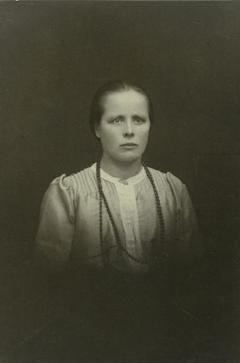
1918: Edla Sofia Hjulgrén, Finnish parliamentarian

One hundred years ago today, former Member of Parliament Edla Sofia Hjulgrén was shot during the Finnish Civil War.

A labor activist for many years, Hjulgrén (English Wikipedia entry | the vastly more detailed Finnish) won election to the Eduskunta in 1913 as a Social Democrat.*

At the time, Finland was still a Grand Duchy within tsarist Russia. When the Russian revolutionaries who conquered power in St. Petersburg in 1917 proved reluctant to agree to Finnish independence, the Finns just declared it, and a civil war ensued in the first months of 1918 — between Soviet-backed Red Guards and German-backed White Guards.

The Whites won a nasty war thick with atrocities on both sides. Although she was a pacifist, our Sofia Hjulgrén was among hundreds of Red supporters swept up after the decisive Battle of Vyborg clinched White victory. She was shot there — it’s Viipuri to the Finns, and Vyborg to the Russians — in the cemetery. The Soviets got Vyborg back in a subsequent war with Finland, and erected a monument there to the hundreds of victims of the Whites’ April-May 1918 Vyborg Massacre.


(cc) image by Olga.

* Finland boasts of being the first legislature in the world with full gender equality — meaning that, as of 1906, women enjoyed full equality both to vote and to stand for office. Women comprised above a tenth of its parliamentary delegates on the eve of Finland’s independence.

On this day..

1863: Zygmunt Padlewski, January Uprising rebel

On this date in 1863, Zygmunt Padlewski was shot for rebelling against the Russian empire.

A young St. Petersburg-trained tsarist officer with a patriotic bent — his father had taken part in the November [1830] Uprising against Russian domination — Padlewski (English Wikipedia entry | German | the surprisingly least detailed Polish) spent the early 1860s organizing revolutionary exiles in Paris.

He then put his neck where his mouth was by returning to Warsaw to agitate and, eventually, to assume the leadership of Polish rebels in that area during his own generation’s doomed revolution, the January [1863] Uprising.

Padlewski’s carriage was detained at a checkpoint when he tried to sneak back to Warsaw after a defeat, and his too-liberal bribes excited the suspicion of the Cossack sentries — who searched the traveler and discovered they had a man well worth the capturing.

He was shot at Plock, where a street and a school today bear his names (numerous other cities around Poland also honor Padlewski).

On this day..

1835: Four slaves, for the Malê Rebellion

On this date in 1835, four African slave rebels were shot at Salvador.

The Malê Revolt acquired its name from the local designation for Muslims … which was the predominant religion of the slaves harvested from West Africa* who were pouring into Brazil. (It’s also known as the Muslim Revolt, or simply the Great Revolt.) Ethnically, these were mostly Yoruba peoples, known in Brazil as Nagôs; Nagôs constituted the bulk of the slave sector whom the Portuguese had nicknamed “Minas” — Gold Coast imports who had embarked their slave ships at the notorious Elmina Castle.

Under whichever designation, this population was particularly thick in the agrarian Atlantic province of Bahia; there, “slaves constituted the majority of Bahia’s population in the 1820s and 1830s, [and] the maority of slaves were African-born.” And African-born slaves proved over the years to share a vigorous spirit of resistance. Slave risings and plots had emerged in Bahia in 1807, 1809, 1814, 1816, 1822, 1824, 1826 1827, 1828, 1830, and 1831, spanning the periods of Portuguese colonialism and Brazilian independence. Scottish botanist George Gardner, recalling his travels in Brazil in the late 1830s, opined that

The slaves of Bahia are more difficult to manage than those of any other part of Brazil, and more frequent attempts at revolt have taken place there than elsewhere. The cause of this is obvious. Nearly the whole of the slave population of that place is from the Gold coast. Both the men and the women are not only taller and more handsomely formed than those from Mozambique, Benguela, and the other parts of Africa, but have a much greater share of mental energy, arising, perhaps, from their near relationship to the Moor and the Arab. Among them there are many who both read and write Arabic. They are more united among themselves than the other nations, and hence are less liable to have their secrets divulged when they aim at a revolt.

Here, in secret madrassas and an underground tongue, these people cultivated a shared religion that naturally fused with the religious to the political and eventually germinated a revolutionary conspiracy. Two elderly, enslaved Muslim teachers seems to have been particular nodes in this community of resistance.**

On the night of January 24-25 of 1835, some 300 of these African-born slaves (with a few African-born freedmen) rebelled and attacked the city of Salvador. The fighting spanned only a few midnight hours; rumors of a rising had reached white ears on the 24th and as a result the masters stood halfway prepared and rallied quickly enough to crush the revolt — killing around 80 rebels in the process.

Nevertheless, it was perhaps the largest and most frightening servile rebellion in Brazil’s history. And although not all participants were Muslim, they very distinctively were all African-born: second-generation, Brazil-born blacks (whether slave or free) as well as mulattoes, who occupied a higher caste rank more in simpatico with whites, were deeply distrusted by African natives as liable to betray the plot — and rightly so. This turned out to be the very channel by which advance warning of the imminent rebellion reached white ears on the night of January 24. It was a great, if last-minute, victory for white Brazilians’ intentional stratification of the servile labor force: “The division among Africans is the strongest guarantee of peace in Brazil’s large cities,” the governor of Bahia had written in 1814.

Surprisingly, only four juridical executions are known to have resulted from this rising, although flogging sentences inflicted on others were so brutal that at least one person also died under the lash. Records, however, are patchy, and as João José Reis notes in his essential text on the Malê revolt (Slave Rebellion in Brazil: The Muslim Uprising of 1835 in Bahia) it is scarcely apparent why these particular men came in line for the law’s final extremity:

The president of the province, under pressure from influential members of Bahian society, felt that it was important to put on a public spectacle and hang prisoners as soon as possible so as to intimidate would-be rebels. With this in mind, on 6 March 1835 Francisco de Souza Martins wrote to the minister of justice:

It seems fitting, as has been suggested to me by many Citizens of this Capital, that the Government of His Majesty the Emperor, so as not to diminish the healthy effect of an execution as soon as possible after the crime, should have the sentences carried out on the two or three main leaders, at the same time declaring that these individuals should not have any recourse or appeal; that is, such a measure is thought to be both efficacious and necessary to the present circumstances.

In a decree dated 18 March 1835 the central government accepted this suggestion and ordered that the death sentences be “immediately carried out without being allowed to go before a Court of Appeal, after the remaining legal steps had been taken.” A month later, on 14 May, one day after the publication of the law on deportations, and without having taken “the remaining legal steps,” the government put four Africans to death.

There was only one freedman among those executed: Jorge da Cruz Barbosa, a hod carrier (carregador de cal) whose African name was Ajahi. Ajahi had been arrested on the day after the uprising, in the house of some fellow Nagô acquaintances, Faustina and Tito. Tito was also involved in the rebellion and had left home some days before the twenty-fifth, never to return. On the morning of the twenty-fifth, Ajahi showed up wounded and hid under a bedframe (estrado). Faustina turned him in to inspectors Leonardo Joaquim dos Reis Velloso and Manoel Eustaquio de Figueiredo, who arrested him. Under questioning Ajahi declared that he lived on Rua de Oracao and was a neighbor of Belchior and Gaspar da Cunha, whom he used to visit regularly. Concerning the meetings they had there, he claimed: “Everybody prattled on and on or just stopped in to say hello.” He denied being a Malê and having participated in the revolt. He tried to convince the judge and jury that the bayonet wound in his right leg “had been inflicted by soldiers … while he was at the window, [and] not because he was outside fighting with anybody.” Ajahi was apparently just an ordinary rebel. Indeed none of the Africans questioned in 1835 suggested he had played an important part in the Malê organization. Even so, on 2 March 1835 he was sentenced to death, along with other important prisoners. His sentence had been set by Francisco Goncalves Martins, the chief of police, now presiding over the jury as a judge: “In light of the previous declaration … on behalf of the Sentencing Jury I sentence prisoners: Belchior da Silva Cunha, Gaspar da Silva Cunha, and Jorge da Cruz Barbosa (all freedmen), as well as Luis Sanim, a slave of Pedro Ricardo da Silva, to natural death on the gallows.” With the exception of Jorge Barbosa (Ajahi), all those listed by Martins had their sentences commuted. Ajahi appears to have escaped from prison, but he was quickly recaptured. Perhaps the maintenance of his sentence comes from his being considered an incorrigible rebel.

Little is known about the others sentences to death. They were all Nago slaves. One of them was Pedro, a slave of Joseph Mellors Russell, the English merchant. It seems that all of this man’s slavees took part either in the rebellion or, at least, in the Malê conspiracy. On his own Russell had turned over to the justice of the peace a crate containing a great number of Malê objects belonging to his slaves — Necio, Joao, Joaozinho “the urchin,” Tome, Miguel, and Pedro. Of all these men Joao was the most militant, and his final sentence is not known. No one knows why Pedro was singled out for the death penalty. I could not find the records for his particular trial.

The other two slaves executed were Goncalo, whose owner appears in the records as Lourenco so-and-so, and Joaquim, who belonged to Pedro Luis Mefre. About them all that is known is that they were among the thirteen rebels wounded and taken prisoner during the confrontation at Agua de Meninos. It may be that they were both abandoned by their masters, since nothing suggests that they might have been leaders and none of the other eleven taken prisoner in the same circumstances received similar punishment.

These were, then, the four Africans put to death in 1835. Rodrigues began a tradition claiming that five Africans were executed, but there is no evidence for it. He names a freedman by the name of Jose Francisco Goncalves as the fifth victim. This African actually existed. He was a Hausa and lived in the Maciel de Baixo neighborhood. According to his testimony, he earned his living “bringing out samples of sugar from the warehouses for Merchants.” His name appears on the Roll of the Guilty with this observation: “sentenced and acquitted on 4 June 1835.” On that same roll the names of Jorge da Cruz Barbosa, Joaquim, Pedro, and Goncalo appear, with the following observation after each one: “sentenced to death and executed on 14 May 1835.”

Like all public executions, this one had its share of pomp and ceremony. The victims were paraded through the streets of Salvador in handcuffs. At Campo da Polvora new gallows had been constructed to replace the old ones, which had rotted from lack of use. At the head of the cortege marched the council “doorman,” Jose joaquim de Mendonca, who cried the sentence out to the ringing of bells. After him came Joao Pinto Barreto, the execution scribe, and Caetano Vicente de Almeida, a municipal judge. On both sides of the prisoners marched a column of armed Municipal Guardsmen. The Santa Casa da Misericordia was also presente, since the bylaws of that important philanthropic institution obliged its members, who were recruited from the local elite, to march along with people condemned to death as an act of Christian piety. The execution itself was to be witnessed by the interim chief of police (Martins had already gone to Rio de Janeiro as a congressional deputy), Judge Antonio Simoes da Silva, and by the commandant of the Municipal Guard, Manoel Coelho de Almeida Tander.

Much to the authorities’ disappointment, the new gallows could not be used to hang the prisoners. No one would act as executioner. On 13 May, one day before the execution, the vice-president of the province, Manoel Antonio Galvao, in response to a request from the chief of police, offered 20-30 milreis to any ordinary prisoner in Bahia’s many jails to act as executioner. Even though that was four months’ earnings for the average urban slave, no one came forward. The chief warden, Antonio Pereira de Almeida, expressed his disappointment in a communique to the chief of police that afternoon: “I have offered the job to the inmates, and no one will take it. I did the same thing today at the Barbalho and Ribeira dos Gales jails, and no one will take it for any amount of money; not even the other blacks will take it — in spite of the measures and promises I have offered in addition to the money.” Either because of prisoners’ solidarity or out of fear of retaliation from the African Muslims, an executioner could not be found. For this reason, still on 13 May, the president of the province had a firing squad formed to carry out the sentences. Then, on the fourteenth at Campo da Polvora, the four men were executed by a squad of policemen and immediately buried in a common grave in a cemetery run by the Santa Casa, next to the gallows. Without the hangings, the didactic value Bahian leaders envisaged in the spectacle was lost.

Less pomp surrounded floggings, although they too were public. Here, as well, the chief of police insisted (20 March 1835) that the “punishment should immediately follow the crime.” He argued that haste was necessary “so that the prisoners would not overflow,” a practical more than a political reason. The scenes of torture oculd not have been more degrading. The victims were undressed, tied, and whipped on their backs and buttocks. Floggings were held at two different sites: the Campo da Polvora and the cavalry garrison at Agua de Meninos, where the last battle of the uprising had been fought. At times the authorities worried that these public spectacles would themselves disturb the peace. Alufa Licutan’s sentence to one thousand lashes would be carried out in public, “but not on the street of the city.”


Illustration of a slave being publicly flogged in Brazil, by Johann Moritz Rugendas.

Prisoners received fifty lashes per day, “for as many days as it took to undergo the entire sentence … provided there was no risk to a prisoner’s life.” The victims’ suffering was closely watched by armed guards and carefully supervised by officers of the law, as well as by a court scribe who on a daily basis recorded the date, names, and numbers of lashes. From time to time, doctors visited the victims to check on their health and to advise whether the whipping should be continued or suspended for a while. These doctors’ reports are shocking testimony to the physical state of the tortured individuals. On 2 May 1835 Dr. Jose Souza Brito Cotegipe told Caetano Vicente de Almeida, the municipal criminal judge: “I have only found two who are well enough to continue serving their sentences. The rest cannot because of the enormous open wounds on their buttocks.” In a report on 19 September he said: “Having proceeded in the examination … of the Africans being flogged, I can inform Your Grace that the blacks [named] Carlos, Belchior, Cornelio, Joaquim, Carlos, Thomas, Lino, and Luiz (at the Relacao Jail) are in such a state that if they continue to be flogged, they may die.”

On that very day Luiz was admitted to the Santa Casa da Misericordia Hospital, where he stayed for two months. On 3 November he went back to the stocks, and two weeks later he completed his sentence of eight hundred lashes. Narciso, another slave, was less fortunate. He was caught red-handed during the uprising and did not survive the twelve hundred lashes of his sentence. He is the only African known to have died from that terrible punishment, but there may have been more.

After the Malê Rebellion, the signs and practices of Islam came under harsher surveillance than ever before. Brazil did not abolish slavery until May 13, 1888 — the very last nation in the western hemisphere to do so.

* Prisoners taken by all sides during the wars accompanying the formation and growth of the Sokoto Caliphate were a key source for the early 19th century slave trade.

** Neither teacher was directly involved in the rebellion: one, Ahuna, had alredy been exiled to another locale and the other, Bilal, languished in prison for debts. We have particularly poignant word of the latter’s devastation upon hearing word of what had transpired.

After the rebellion, Bilal, still in jail, received news of the fate of the rebellion. One of his cell companions said in a gripping testimony that Bilal lowered his head to weep and that he never saw him raise it again. Bilal wept as many of his cherished students were brought into the jail. When one of the surviving rebels, who was being incarcerated, passed Bilal a piece of paper with a message written on it, he read it and swiftly began to weep. The devastating fate of his students had brought Bilal to a perpetual trail of tears. His fate, however, was to be amongst the most devastating. Although he could not be charged with participation in the physical uprising that took place, it was clear to authorities that he had participated in the spiritual cultivation of the uprising. Bilal “was sentenced to 1,200 lashes of the whip, to be carried out in public, though not in the streets where everyone could see. The sentence was divided up into 50 lashes a day until completed.” We can imagine that this is how Bilal died.

On this day..

1916: Thomas Kent

On this date in 1916, Thomas Kent was shot in Cork, Ireland — the only person executed that May for the Easter Rising outside of Dublin.*

The Kents were were prominent nationalists of several generations’ standing in County Cork and were all set to join the Easter Rising until the last-minute countermanding order went out.

When the Rising happened anyway in Dublin — a day later and numerically much smaller than originally intended — the constabulary was preventively dispatched throughout the island to arrest known fellow-travelers … like the Kents.

The constabulary’s attempted raid on the Kent property May 2 met armed resistance that became an hours-long siege; Constable William Rowe was shot dead, as was Richard Kent.

The surviving Kent brothers, William and David,** along with our man Thomas, were all tried for affair: William was acquitted, David condemned but the sentenced commuted, and only Thomas actually executed.

Cork’s main railway station was in 1966 re-christened Kent Station in his honor.

* In August of that year, Roger Casement hanged in London for treason in connection with the Easter Rising. Casement had not taken any direct part in the fighting, but had worked to arrange the (attempted) support of Britain’s wartime enemy, Germany.

** Both David and William Kent later sat in the Irish parliament.

On this day..

1916: Eamonn Ceannt, Michael Mallin, Con Colbert, and Sean Heuston

On this date in 1916 — following a Sunday respite — executions in the aftermath of the Irish Republican Easter Rising against British power resumed with four more shootings at Dublin’s Kilmainham Gaol.

Eamonn Ceannt was an Irish Republican Brotherhood leader and was the fifth of the seven men who signed the Proclamation of the Irish Republic to be executed. (The remaining two, James Connolly and Sean Mac Diarmada, were shot on May 12th.) On the night before his execution, he wrote a ferocious although arguably counterproductive summons to future Irish revolutionaries

never to treat with the enemy, never to surrender at his mercy but to fight to a finish. I see nothing gained but grave disaster caused by the surrender which has marked the end of the Irish Insurrection of 1916 — so far at least as Dublin is concerned. The enemy has not cherished one generous thought for those who, with little hope, with poor equipment, and weak in numbers, withstood his forces for one glorious week. Ireland has shown she is a nation. This generation can claim to have raised sons as brave as any that went before. And in the years to come, Ireland will honour those who risked all for her honour at Easter in 1916 …

I wish to record the magnificent gallantry and fearless, calm determination of the men who fought with me. All, all, were simply splendid. Even I knew no fear, nor panic ,nor shrank fron no risk [sic], even as I shrink not now from the death which faces me at daybreak. I hope to see God’s face even for a moment in the morning. His will be done.

His firing squad failed to kill him cleanly, necessitating a gory coup de grace.

Michael Mallin was the co-founder with the pacifistic Francis Sheey-Skeffington of the Socialist Party of Ireland, and the second-in-command for the aforementioned James Connolly of the socialist union militia Irish Citizen Army. In the latter capacity Mallin led the detachment which seized St. Stephen’s Green during the Easter Rising.

A devout Catholic as well as a revolutionary militant, Mallin’s last letter to his family urged two of his children to take up holy orders. They indeed did so, and his youngest son, Father Joseph Mallin SJ, died only days ago as of this writing at the age of 104.

Con Colbert was another deeply religious rebel; an Irish Republic Brotherhood officer, he commanded rebels at several locations including the Jameson’s whiskey distillery at Marrowbone Lane.

The youngest of the group — who were, like all the Easter Rising rebels, shot sequentially rather than en masse — was 25-year-old Sean Heuston, also known as Jack or J.J. James Connolly had dispatched him to hold the Mendicity Institution for a few hours to delay the British advance; Heuston’s garrison of 26 ended up defending it for two days against several hundred enemy troops until, food and ammunition exhausted, they surrendered at British discretion.

His confessor cast the young patriot in a positively beatific light at the end:

A soldier directed Seán and myself to a corner of the yard, a short distance from the outer wall of the prison. Here there was a box (seemingly a soap box) and Sean was told to sit down upon it. He was perfectly calm, and said with me for the last time: ‘My Jesus, mercy.’ I scarcely had moved away a few yards when a volley went off, and this noble soldier of Irish Freedom fell dead. I rushed over to anoint him; his whole face seemed transformed and lit up with a grandeur and brightness that I had never before noticed

Never did I realise that men could fight so bravely, and die so beautifully, and so fearlessly as did the Heroes of Easter Week. On the morning of Sean Heuston’s death I would have given the world to have been in his place, he died in such a noble and sacred cause, and went forth to meet his Divine Saviour with such grand Christian sentiments of trust, confidence and love

On this day..

1864: Utuwankande Sura Saradiel, Ceylon social bandit

Ceylon social bandit Utuwankande Sura Saradiel (or Sardiel) was hanged by the British on this date in 1864.

Saradiel fled a barracks servant’s life to take the road as a bandit. He’s alleged to have gallantly shared his proceeds with the poor; what he unquestionably did was tweak the tail of the powerful (and in this case, colonial) overlords. As is often the case with social bandits, it is difficult to know for certain whether it is for reason the latter that he enjoys the reputation of the former.

The indefatigable brigand was captured multiple times and made at least two escapes — inherently a winning public relations move — eventually maintaining himself from a picturesque mountain cavern and authoring throwback knight-of-the-road exploits to earn the nickname “Robin Hood of Ceylon”.*

Naturally, there is always a Sheriff of Nottingham.


Reward notice for the capture of our man, from the Ceylon Gazette of January 13, 1864.

Saradiel cinched his fate by shooting dead a constable in the course of his arrest. Considering that circumstance, we here at Executed Today are officially skeptical of the legend that a misplaced comma — “kill him, not let him go” when “kill him not, let him go” was intended — decided the man’s fate.

* The best one is that, having robbed from a father what he later learned to be the dowry for a bride-to-be, the robber found his victim again to return the sum, compounded by gambling winnings. Heart of gold, this guy!

On this day..

1916: Not Constance Markievicz, “I do wish your lot had the decency to shoot me”

On this date in 1916, the British field court meting out death sentences to Irish Easter Rising rebels announced eighteen commutations — most notably including Countess Constance Markievicz.

Markievicz has long been one of the most remarkable and compelling personalities of the Irish independence struggle. As her biographer noted, many other women of that cause are best-known “mainly because of their connection with more famous men.” Markievicz, notably, “stood alone, self-driven and self-confident. She was more than a muse or an enabler or a facilitator, the preferred roles for women to play.”

She was the privileged daughter of a baronet turned polar explorer who came to her distinctive name by marrying a Polish nobleman.** In her girlhood, she’d been presented at court to Queen Victoria.

She trained as a painter and her material circumstances put within her reach that charmed state of comfortable avant-garde consciousness. The Countess gave that up, for Ireland. The abhorrence of the daughter of the Provost of Trinity College Dublin is perhaps her most definitive epitaph: “the one woman amongst them [Irish republicans] of high birth and therefore the most depraved … she took to politics and left our class.”

By the late 1900s and into the 1910s she was a mainstay of hydra-headed radicalism: nationalist, suffragist, socialist. (She was a close friend and comrade of James Connolly.) In those years she could have spent in a pleasant Left Bank garret, she walked picket lines, burned flags, faced arrest, and sold jewelry to fund the soup kitchen she worked in.†

Markievicz co-founded the Fianna Eireann youth organization as a response to Baden-Powell‘s imperial scouting project. It would become an essential feeder for the republican organs (like the Irish Volunteers); Fianna itself was also well-represented among the Easter Rising fighters, and contributed that conflagration’s youngest martyr.

Bust of Constance Markievicz on St. Stephen’s Green, where she served in the Easter Rising.

But for her sex Markievicz would probably have been among the martyrs herself for her role on the St. Stephen’s Green barricade, and perhaps she wished it were so; she greeted the news of her May 6 commutation with the retort, “I do wish your lot had the decency to shoot me.” She’s been slated with having personally shot a constable during the Rising, although her defenders consider this a baseless smear.

While again in prison — she’d been amnestied from the Easter Rising stuff, but was arrested anew for anti-war activism — Markievicz successfully stood for election to Parliament, and in fact has the distinction of being the first woman elected a British M.P. … although she complied with Sinn Fein policy and refused to take the seat. She was also a member of the First Dail (parliament) of the revolutionary Irish Republic and was the first Irish female cabinet minister (Ministry of Labour).

Constance Markievicz died in 1927 at the age of 59, penniless in a public ward having disbursed the entirety of her wealth. A quarter-million of her fellow peoples of the Irish Free State thronged the streets of Dublin for her funeral.

* The other commutations (with their associated non-capital sentences) as published by the London Times of May 8, 1916:

Penal servitude for life. — Henry O’Hanrahan.

Ten years’ penal servitude. — Count George Plunkett, John Plunkett (his son).

Five years’ penal servitude. — Philip B. Cosgrave.

Three years’ penal servitude. — R. Kelly, W. Wilson, J. Clarke, J. Marks, J. Brennan, P. Wilson, W. Mechan, F. Brooks, R. Coleman, T. Peppard, J. Norton, J. Byrne, T. O’Kelly.

** It turned out that although Casimir Markievicz went by “Count Markievicz” there wasn’t actually any such title. But “Count” and “Countess” stuck nevertheless.

† She does perhaps forfeit some wokeness points for complaining of her post-Easter Rising imprisonment at Aylesbury that she was lodged with “the dregs of the population … no one to speak to except prostitutes who have been convicted for murder or violence. The atmosphere is the conversation of the brothel.”

On this day..