On this day in 1843, 84-year-old Allan Mair was hung in Stirling, Scotland.
He was condemned for the murder of his wife. Mair is notable not only for being the oldest person ever executed in Scotland, but also for his unusually long, bitter scaffold speech, as recorded in Alex Young’s book The Encyclopaedia of Scottish Executions 1750 to 1963.
The meenister o’ the paarish invented lees against me. Folks, yin an’ a, mind I’m nae murderer, and I say as a dyin’ man who is about to pass into the presence o’ his Goad. I was condemned by the lees o’ the meenister, by the injustice of the Sheriff and Fiscal, and perjury of the witnesses. I trust for their conduct that a’ thae parties shall be overta’en by the vengeance of Goad, and sent into everlasting damnation. I curse them with the curses in the Hunner an’ Ninth Psalm: “Set thou a wicked man o’er them” — an haud on thee, hangman, till I’m dune — “An’ let Satan stand at their richt haun. Let their days be few, let their children be faitherless, let their weans be continually vagabonds”; and I curse them a —
At this point, the executioner drew the bolt, but Allen wasn’t done raging against the dying of the light. The old fella got his hands free and grabbed the rope, delaying his strangulation; the slipshod executioner had to fight off his prey’s clutches to hang him.
There’s an original broadside from this execution here.
Thanks to Undine of the blog The World of Edgar Allan Poe for breaking her posting hiatus with this guest entry. -ed.
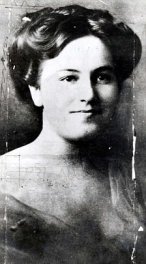
When reflecting upon the life and times of Edgar Allan Poe, Edward Wagenknecht once wrote that “One might also say of Poe that he lived in a Gothic novel. Hardly anybody behaves normally in this history.” Of all the names one finds in Poe’s biographies, no one better illustrates these words than Marie Louise Barney Shew Houghton. While there were many players in Poe’s life story who undoubtedly deserved to be put in the dock, (the Reverend Rufus Wilmot Griswold being merely the most famous example,) Mrs. Houghton was the only one of the lot who faced the prospect of being tried, and very possibly convicted and executed, of first-degree murder.
This was the date in the year of the nation’s centennial that Houghton slipped the noose.
Mrs. Houghton is known to history as having been the nurse of Poe’s wife Virginia during her final illness, as well as an all-around Poe family benefactor. This saintly reputation, unfortunately, comes largely from her own boasts on the matter, made many years after the poet’s death. In 1875, she began a correspondence with Poe’s early biographer John H. Ingram. Her avowed intent was to insure that she—as opposed to other ladies who were vying for the title—would be remembered as Poe’s dear friend and guardian angel. Unfortunately, at the time she contacted Ingram, she was clearly in appalling shape, mentally and emotionally. The numerous extant letters she wrote him—which date from January to June of 1875–are always rambling, usually incoherent, and occasionally quite insane. She related to Ingram many colorful stories about Poe that are completely uncorroborated, patently absurd, and often at complete variance with the known facts. Ingram privately acknowledged that Mrs. Houghton was mentally unstable, and he suspected as well that she was enhancing, or even completely inventing, many Poe anecdotes, in order to keep their correspondence alive. He wound up dismissing her with the euphemism, “imaginative.” In spite of all this, Ingram—who was desperately in need of original source material about the ever-elusive Poe—wound up relaying far too much of her dubious information in his 1880 biography, and, even more unforgivably, Poe’s modern-day historians repeat unquestioningly this same apocrypha to this day.
One wonders what Ingram’s reaction would have been if he had known anything about his pen-pal’s personal life. Marie Houghton was a predecessor to today’s “New Age” devotees. Her first marriage, to the “water-cure” practitioner Joel Shew, gave her an avenue into what were the more extreme circles of Transcendentalist faddism, which embraced alternative medicine, “free love,” “freethinking,” communal living, and disdain for established institutions. Ironically, she represented everything Poe most despised in contemporary society.
In the mid-1840s, Marie Louise separated from her husband and entered into an affair with another member of their circle, Dr. Ronald Houghton, although she continued to live with Dr. Shew. In 1849, she gave birth to a son, Henry, who was probably acknowledged as Houghton’s, although at least one historian has theorized that the father was a third man who was living with (and financially aiding) the Shews. The next year, the Shews divorced and she married Houghton. Although they had several more children, the marriage proved unhappy, and they too separated. She continued to work as a nurse, while indulging in a number of extremely complicated and very dodgy financial and property transactions on the side.
However, it was this son Henry who proved to be the catalyst that brought Mrs. Houghton serious trouble. After a varied and exciting career out west where he was charged with adultery, mule thievery, swindling, and “open and notorious lewdness,” Henry Houghton returned to the family home in New York, bringing with him his mistress, a Mary E. Stanley, who had evidently been Henry’s partner in crime as well. With them was a toddler who was understood to have been their child, even though Mary was at the time married to another man.
In 1876, the now-pregnant Mrs. Stanley was living with the Houghton family, although by this point Henry appears to have tired of her. Her common-law mother-in-law, Mrs. Houghton, acted as her sole medical attendant. Unfortunately, Mrs. Stanley died soon after giving birth. The Houghtons failed to summon a doctor until she was obviously at death’s door. Very curiously, she was quickly buried without a death certificate having been issued, apparently at the instigation of Marie Houghton. After her burial, the undertaker prevailed upon the physician who had been at her deathbed, a Dr. Bleecker, to provide him with some sort of certificate. Bleecker was reluctant to do so, as he had never actually treated the deceased, but finally issued one with the noncommittal statement that the cause of death appeared to be “congestive chills.”
Of all who hail thy presence as the morning–
Of all to whom thine absence is the night–
The blotting utterly from out high heaven
The sacred sun–of all who, weeping, bless thee
Hourly for hope–for life–ah, above all,
For the resurrection of deep buried faith
In truth, in virtue, in humanity–
Of all who, on despair’s unhallowed bed
Lying down to die, have suddenly arisen
At thy soft-murmured words, “Let there be light!”
At thy soft-murmured words that were fulfilled
In thy seraphic glancing of thine eyes–
Of all who owe thee most, whose gratitude
Nearest resembles worship,–oh, remember
The truest, the most fervently devoted,
And think that these weak lines are written by him–
By him who, as he pens them, thrills to think
His spirit is communing with an angel’s.
Mary Stanley’s death would have passed unremarked had it not been for a collection of letters she had written to a friend, which was soon brought to the attention of the authorities. In brief, these letters stated that Mrs. Houghton wished to perform an abortion on her. (It was alleged that Houghton supplemented her income as a professional—and, on occasion, fatally incompetent—abortionist.) When Mrs. Stanley refused, she attempted to give her patient certain “medicines” which Mrs. Stanley believed were intended to permanently rid the Houghtons of her as well. Faced with this uncooperative attitude, Mrs. Houghton “became cruel to her, and starved both herself and her child.” The question of why she remained in the household appeared to be answered by murky and never-clarified issues regarding the estate of Mrs. Houghton’s late estranged husband. It was said that she stubbornly stayed put in an effort to defend the interests of Mrs. Houghton’s other son, Frank, who was involved with a legal dispute with his mother over a certain piece of property. There was a good deal of nightmarishly complex litigation surrounding Dr. Houghton’s estate, and evidently Mrs. Stanley played some crucial role regarding the dispute over the distribution of Roland Houghton’s properties. According to these letters, Mrs. Stanley was attempting to act as some sort of a roadblock in schemes Henry and his mother were attempting in relation to the matter.
After the local coroner and District Attorney had read their fill of these missives, their first act was to have Mrs. Houghton arrested.
An inquest was soon held, and these letters, as well as testimonies of friends of the dead woman, were presented to the jury. A lurid picture was painted of Mrs. Houghton’s long career of poisoning (including two alleged attempts against her husband,) abortions both successful and fatal (Mrs. Stanley wrote of seeing “terrible things” in the Houghton’s cellar that related to this practice—other testimony agreed that she literally knew where the bodies were buried,) financial fraud, and all-purpose cruelty. Mrs. Stanley wrote that “I do not think there is another woman as bad as her living,” and if half of what was related about her at the inquest was true, this was a genteel understatement. Mrs. Stanley also declared that the Houghtons wanted her dead, not only for the fact that she “knew too much” about their depraved dealings, but because she was threatening to “swear her child” on Henry Houghton—i.e., hit him with a paternity suit. (The inquest also included testimony that Mrs. Houghton expressed great joy that Mary Stanley’s death freed her son from taking responsibility for his mistress and their child.)
When Mrs. Houghton took the stand in her defense, it was said that she gave her testimony “fairly and with much plausibility.” She simply denied everything the dead woman had written. Mrs. Stanley, she said, was a designing criminal who had robbed her son “not only of his money, but of his good name.” She had allowed the pregnant woman to live in her house out of pure Christian charity. Mrs. Stanley’s death, on September 12th 1876, was of a “congestive chill” that came on so suddenly there was no time to send for a doctor. She admitted that she had practiced medicine from 1851 until the previous year, when she was threatened with imprisonment if she did not cease her unaccredited ministrations. She also conceded that Mrs. Stanley had threatened to “crush” the Houghton family, and that “something disagreeable” had occurred several months before that had inspired Mrs. Stanley to write these accusatory letters. However, it was also revealed that at the time of Mrs. Houghton’s arrest, certain family papers were seized by the authorities which corroborated much of what the deceased had alleged.
When Dr. Bleecker testified, he could say only that an autopsy on the dead woman “could not determine the cause of death satisfactorily.”
After all this, it is quite startling to read that the jury ruled that Mary Stanley died of natural causes, “from hemorrhage and exhaustion while in labor.” The only way of explaining this conclusion (which seemed to have no evidence to back it up) is to note that from the newspaper reports, the jury was clearly on Mrs. Houghton’s side from the beginning. In fact, the jury attempted to halt the inquest very early on, claiming they had heard enough evidence to reach a verdict. The coroner and DA overruled them, insisting that they hear additional witnesses. Also, one of the jurors questioned a doctor who testified, asking if it wasn’t true that pregnant women were often prone to paranoid fancies, where they imagined dangers that did not exist. When the doctor admitted that such things were possible, this obviously sealed the deal for this panel. The reason for this obvious bias in favor of the defendant is, most unfortunately, unknown.
The case was left open for further investigation, but as far as can be ascertained by a search of contemporary newspapers, the matter was closed as far as the authorities were concerned. Marie Houghton left the court a free woman, if not exactly one without a stain on her character. She died less than a year later, at the age of fifty-five, on September 3, 1877.
One of the strangest things about this case is the fact that it has attracted so little attention, from that time to this. The only detailed contemporary accounts I have been able to uncover are a handful of articles from one newspaper, the Brooklyn Eagle, and two columns in the New York Herald which simply repeated some of the information published in the Eagle. Even though the story contained enough scandal to keep a platoon of yellow journalists in clover for years, it was otherwise ignored. Despite the fact that the central character was a figure well-known to anyone who has the slightest interest in Poe’s life, this odd little episode appears to be unknown to his biographers. It is a great pity deeper investigation in the matter appears impossible at this late date, as from what was reported, Marie Houghton was either the most viciously slandered woman of her era, or a monster Poe himself could not have created in his darkest fits of imagination.
Sources: Brooklyn Eagle, Sept. 21, Sept. 23, Sept. 25, Sept. 30, Oct. 3 1876 New York Herald, Sept. 22 and 23, 1876 Building Poe Biography, ed. John Carl Miller
On this date in 1896, the not-yet-a-state of New Mexico executed four convicted murderers in three separate towns.
Actually, six men had been scheduled to swing, but two got reprieved. New Mexico wasn’t trying to win some kind efficiency contest … it just worked out that way.
The unlucky four were Dionicio Sandoval in Albuquerque, Antonio Gonzales in Roswell, and Perfecto Padilla and Rosario Ring in Tierra Amarilla. Their stories are told in R. Michael Wilson’s Legal Executions in the Western Territories, 1847-1911. All four were convicted of quite ordinary murders.
Sandoval, a sheep herder, shot another sheep herder who accused him of stealing animals from his flock. The sheep didn’t even belong to either one of them: both men were tending herds owned by the Bernalillo County commissioner.
Gonzales had a buddy named Eugenio Aragon who asked him to help kill someone who was threatening to prosecute Aragon for the theft of some lumber. Always eager to help out a buddy, Gonzales assisted in the homicide, only to find himself arrested and then deserted by his so-called friend. (Aragon slit his own throat in jail, leaving Gonzales to face the noose alone.)
Padilla supposedly killed a miner with his own pick for two burros, a hat and a $30 watch. The evidence at his trial was very shaky and many people believe he was an innocent man, perhaps deliberately railroaded for mysterious reasons.
Ring had come to New Mexico from the Colorado territory, which had gotten too hot for him; he was a suspect there in the murder of his wife and baby, and if he did that crime the near brush with the law did not teach him caution in his new environs: one night during a drunken spree he broke a beer bottle over another man’s head, then shot him in the back. The victim died in his mother’s arms. Ring had a friend who was with him that night and started the fight, and they were tried together for the murder, but the friend was acquitted.
Padilla and Ring were not actually hung together side by side as is sometimes done; instead, Padilla went first while Ring waited his turn beside the scaffold. After they cut Padilla’s body down, Ring stepped up.
That’s all, folks.
In 1897, New Mexico would repeat their “four executions in one day” trick by hanging four men, two of them brothers, for a single murder.
On this date last year, four Equatorial Guinean men were executed immediately after they were convicted of treason in a military court in the tiny African nation’s capital of Malabo.
Fortunately for him, he wasn’t in residence that day.
The attack had originally been blamed on Nigerian militants; in the aftermath, seven Nigerian men were sentenced to prison for their alleged involvement, and dozens of Nigerian expatriates were expelled from the country.
International observers castigated the trials and executions as not meeting international standards of fairness. This is no surprise, seeing as how Equatorial Guinea has one of the worst human rights records in the world.
According to Amnesty International, the four men weren’t even in the country at the time of the attack, having been exiled to Benin some years before. President Obiang’s agents abducted them from Benin in January 2010. Because of the “chilling speed” of the executions, none of the condemned had the opportunity to appeal the verdict and sentences or seek clemency, as Equatorial Guinea’s own law is supposed to provide.
José Abeso Nsue, Manuel Ndong Anseme, Alipio Ndong Asumu and Jacinto Michá Obiang (no apparent relation to his alleged target) were the only Equatorial Guineans known to have faced the death penalty that year.
This date in 1692 was the third of four execution dates during the notorious Salem witch trials.
Five souls were dispatched at Gallows Hill this date. With the executioner’s due respect to John Willard, George Burroughs, George Jacobs, Sr. and The Crucible main character John Proctor, we’re elated this date to focus on the only woman among them — Martha Carrier.
Carrier is the subject of the recent historical novel The Heretic’s Daughter by her tenth-generation descendant Kathleen Kent, whom we’re delighted to welcome for an interview on this anniversary.
How did you first learn of your connection to Martha Carrier, and how does your family feel about this link?
I was very fortunate to have heard stories of the colonial Carriers from the time I was a young child. My first memory of hearing about the Salem witch trials was when I was eight years old, visiting my maternal grandmother. She was the first one to tell me that my grandmother back nine generations, Martha Carrier, had been hanged as a witch in 1692. When I asked her if Martha was in fact a witch, my grandmother said, “Sweetheart, there are no such things as witches, just ferocious women.”
She, along with the rest of my family, had a great sense of pride over Martha’s courage in standing up to her accusers. She was one of the few people, out of the 150 New Englanders accused of practicing witchcraft, who not only refused to admit to being guilty, but also never accused anyone else of being a witch, which most people did to save themselves.
Your book tells the story of Martha Carrier from the perspective of her 10-year-old daughter. As an author, how did you approach the research, especially when it comes to Martha as an individual? Is that something you were able to source pretty strongly or did it require a lot of filling in the blanks?
The Heretic’s Daughter was my first novel, and it took five years of research and writing to complete it.
Fortunately, there is a wealth of historical information about the colonies during that time. The courts where the witch trials were conducted kept very meticulous records so I was able to gather a lot of facts regarding the magistrates and deponents, as well as the accused. There are so many wonderful fiction and non-fiction books alike that have been written about the Salem witch trials, but I wanted to write a very personal story about the Carrier family; how they lived day to day, how they survived disease, Indian raids, hostility from their neighbors, and ultimately the witch trials. I was able to weave in a lot of my family’s stories — the cow that gave golden milk, Andrew’s near death experience in the prison — that have been passed down through 10 generations.
When I first began working on the book, it was written from Martha’s point of view, but I decided it would make more compelling reading if the narrator was one of the Carrier children, Sarah, and it is through her eyes that we see the growing hysteria over witchcraft, and her struggle with Martha’s strong, unyielding character. This theme of mother-daughter conflict is central to the book’s development.
So, who was Martha Carrier and why did she become one of the people caught up in the Salem witch trials?
Martha Carrier had evidently long been resented by the community in Andover, where the Carrier family lived during the Salem witch trials, because of her forceful nature. She argued over boundary lines with several neighbors (which was a common occurrence amongst the settlers), telling one neighbor, “I will stick as close to you as bark on a tree.” (source: Salem witch trial deposition; see this document) She was also married to a man who had fought in the English Civil War, and was widely rumored to be one of the executioners of King Charles I of England. Martha fell outside of the Puritan ideal of what a woman was supposed to be and was so vocal in her own defense during the trials that when she was asked by her judges if she had ever seen the Devil, she responded by telling them that the only devils she had ever seen were the men sitting in judgment before her.
Her own children accused her of witchcraft. Are you descended through those kids as well? And do we know anything about how they later dealt with or rationalized that act?
My family is descended from Tom, Jr., and I learned the full genealogy at an early age from my grandparents. Four of Martha’s five children were arrested to compel her to admit to being guilty. Her two oldest sons were arrested first, and they were tortured until they agreed to testify against their mother. Tom and Sarah were then arrested — the real Sarah being only 7 years old at the time, and the second youngest child to be imprisoned during the trials — and they quickly admitted that they, too, were complicit in witchcraft.
During the research, I discovered how truly awful the conditions were in the Salem jail. Nearly half of the 150 people arrested from towns all over New England were under the age of 18. The surprising thing was not that people died, but that anyone survived at all. The four children were kept imprisoned for months after their mother was hanged and they were finally released in the fall of 1692. Within a few years, their father, Thomas, collected his children and grandchildren and moved to the wilds of Connecticut to start a new life.
How did she try to defend herself?
Martha Carrier was so vocal in her own defense during the trials that Cotton Mather, one of the most famous theologians of his day, named her the “Queen of Hell.”
This Rampant Hag, Martha Carrier, was the Person, of whom the Confessions of the Witches, and of her own Children among the rest, agreed, That the Devil had promised her, she should be Queen of Hell.
When she was confronted by the accusing girls, she turned to her judges and said, “It is a shameful thing that you should listen to these folks who are out of their wits.”
By the time of her arrest, several women had already been sentenced to be hanged, and she knew that her refusal to confess would mean death. She never wavered in her testimony and never accused another person to save herself, even when her four children were arrested and two of her sons were tortured.
Do you feel like she’s an overlooked figure in this affair? She’s not, for instance, even a character in The Crucible.
Arthur Miller did extensive research for The Crucible, but he did make changes to the historical facts for fictional purposes: for example John Proctor was in his seventies during the trials; hardly the strapping figure played by Daniel Day Lewis in the film adaptation.
There were so many remarkable people and events during the trials that he had to choose selectively in order to illustrate his primary motivation in writing the play which was to shed light on the McCarthy era communist “witch” trials.
Nathaniel Hawthorne wrote about Martha Carrier, as did Cotton Mather, but her forceful character made her a difficult subject, especially when there were more motherly figures like Rebecca Nurse, or titillating young characters like Abigail Williams to explore.
At this distance of time, Martha Carrier must have a great many descendants. Are you in touch with other branches of the family?
Soon after publishing The Heretic’s Daughter, I started getting emails and letters from fellow descendents of Thomas and Martha Carrier telling me that they, too, had heard many of the stories that I had grown up with.
For the release of my second novel, The Wolves of Andover, about Thomas Carrier’s life, I decided it would be fun to invite some of these extended family members to Salem for a book launch. On November 5th, 2010, nearly 250 Carrier descendents, some of them flying in from as far away as Washington State, California and Arizona, came to Salem for a weekend of author talks, receptions and story swapping. A video on my web site captured some of the highlights from that remarkable weekend.
We came as strangers and left Salem as family.
Ultimately, what’s changed about you yourself from your literary encounter with this famous ancestor?
The Salem witch trials were a dark period in American history, but from researching those events I discovered that positive changes occurred over time in the judicial system, the penal system, and for religious tolerance. I am awe-struck by the courage and fortitude of the settlers who sacrificed so much for their children and grandchildren.
And I am especially proud of my heritage: that my 9x great-grandmother defended her principles and conscience, even in the face of death. An interviewer once asked if, having written the novel, I felt I was speaking for Martha Carrier, and I said that I felt she had been speaking for me. A ferocious woman indeed!
With your second book, The Wolves of Andover, you’ve written two about the Carrier family. What’s your next project?
Wolves is a prequel to Heretic, as it explores the life of Thomas Carrier during the English Civil War and his journey to the new world from London.
I am about halfway through my third novel, but this one is quite different from the first two. It takes place during reconstruction era Texas in 1870, and chronicles a particularly chaotic, violent time in Texas history.
There’s another fine interview with Kathleen Kent here. -ed.
On this day in 1915, serial uxoricide George Joseph Smith was hung by the capable John Ellis at Maidstone Prison in the UK.
Smith had committed three murders and various forms of larceny as well; he’d earned his noose several times over.
Two things tend to trip people up when they’ve seemingly committed the perfect crime: either they brag about it to impress others, or they repeat the crime using the same methodology as before, since it worked so well the first time. Either of those actions greatly increases the risk of the criminal’s getting caught.
Smith made the latter mistake. He was in a sense a victim of his own success.
Smith was born on January 11, 1872. His criminal record began when he was sent to a reformatory at nine and served a seven-year sentence. In young adulthood he was in and out of prison on theft- and fraud-related convictions.
His complicated marital career began when he married Caroline Beatrice Thornhill, a domestic servant, in 1898. Smith persuaded her to steal from her employers. Caroline served time in prison as a result, and implicated her husband, who got two years for his role in the thefts.
After George Smith’s release, Caroline thought it wise to put a few thousand miles between herself and her estranged husband, and so she left the UK for Canada. She never filed for divorce, however.
Smith remained legally married to her for the rest of his life, so none of his numerous other marriages were legal.
Unlawfully Wedded …
The guy wasn’t good-looking, but he could charm like any good con artist. A year after his marriage to Caroline, Smith bigamously married another woman. He cleaned out her saving account and then deserted her.
Between 1908 and 1914, he married no fewer than seven additional women, usually under an alias, and deserted most of them after a short time, sometimes only a matter of days — but not before he helped himself to their possessions and bank accounts.
Smith initially limited himself to scamming gullible spinsters out of their life savings by luring them into bigamous marriages … The moment Smith had his hands on his new bride’s money, he would disappear. Usually telling her he was going out on an errand — to pick up a newspaper or buy a pack of cigarettes — he would never return. On one occasion, he brought his newlywed wife to the National Gallery of Art and, after viewing some paintings, excused himself to go to the bathroom. She never saw him — or her life savings — again.
That particular bride was named Sarah Faulkner. Smith had already plundered £350 in cash from her and her jewelry as well, and while she was waiting for him to return from the loo he was back at their hotel, swiping her clothing and the rest of her money.
The only wife that didn’t fit this pattern was Edith Pegler.
Smith was away from her side for months at a time on “business trips” and when he returned it was always to ask for money, but he never left her for good and they remained together for seven years. As to whether he actually harbored some form of affection for her or whether he just didn’t want to kill his cash cow while it was still milkable, we can only speculate.
Yet all these women were, in a sense, lucky.
Smith may have broken their hearts and taken their cash, but he left them their lives.
… ‘Til Death Do Us Part
The first unlucky wife was Bessie Mundy, whom Smith murdered on July 13, 1912.
They’d married in August 1910, but he left her after persuading her to give him £150 in cash. On the way out the door, he accused her of giving him a venereal disease.
Eighteen months later, Bessie ran into Smith on the street. Somehow, the charmer got his ex to forgive him and resume their relationship.
In fact, Smith wanted to get his hands on Bessie’s £2,500 inheritance, but it was in trust and he couldn’t touch it.
After their reunion, the couple drew up mutual wills, naming each other as beneficiaries. Bessie willed her husband £2,579. Less than a week later, she was mysteriously dead.
Smith rented a house for them in Herne Bay and had a new cast-iron bathtub installed. Tragically, Bessie drowned in the bath. Her husband said he’d been out buying dinner and returned to discover the body.
Since Smith claimed his bride suffered from epilepsy and that she’d had a seizure the day before she died, it was easy to believe she’d simply had an unfortunate accident.
In spite of his newfound wealth, Smith had Bessie consigned to a pauper’s grave and even returned the slightly-used bathtub to the ironmonger for a £1 17s. refund.
This, perhaps, is where Smith might have counted himself lucky and checked out of the homicide business — or at least thought about a different m.o. Instead, hubris and habit got him hanged.
The Brides of Bath murder victims: from left to right, Bessie Mundy, Alice Burnham, and Margaret Lofty.
Next to go was Alice Burnham, who was making a goodly living as a nurse. Smith married on November 4, 1913, and became her widower on December 13.
Alice and her new husband were honeymooning at a seaside boardinghouse in Blackpool when she drowned in the bathtub while he was supposedly out getting eggs.
Smith, who claimed she had a weak heart, had insured her life for £500. She too was buried on the cheap.
Margaret Elizabeth Lofty died in her London home a little over a year later, on December 18, 1914. Newspapers reported she had drowned in the bathtub while her husband — identified as Robert Lloyd — was out buying tomatoes. He and the landlady found the body. Lofty and “Lloyd” had married only the day before and, appropriately enough, the ceremony was performed in the city of Bath.
Although it was initially classified as death by misadventure, Margaret’s murder ultimately lead to Smith’s downfall.
Rotten luck, it was: Alice Burnham’s father read an account of her death in the newspaper and, even though the husband had a different name, he couldn’t help but notice that Margaret’s death was suspiciously similar to his daughter’s.
Joseph Crossley, who was the couple’s landlord at the time of Alice’s death, noticed the same thing. Since both the Burnhams and Crossleys had taken a dislike to Smith from the get-go, they both wrote the police, asking them to open an investigation.
Authorities quickly determined that George Joseph Smith and Robert Lloyd were the same man. They sure had the same playbook.
Margaret had made out a will just hours before she died, naming her husband the sole heir to her estate. She had also withdrawn her life savings from the bank the same day, and three days before she had taken out a £700 life insurance policy on herself, with her husband as the beneficiary. Ka-ching.
When the grieving widower showed up at the insurance office to collect on Margaret’s policy, he was arrested. Lloyd/Smith was initially charged with putting a false name on a marriage certificate, but bigamy and murder charges would follow fast.
When news of the arrest was published, a police chief from Kent read the story and told the London police about Bessie Mundy’s death, which was strikingly similar to the other two.
Forever Hold Your Peace
But how could he could have drowned the women in the tub, without leaving marks of violence on their body?
Margaret had only a small bruise on her elbow. For answers, the police turned to renowned pathologist Bernard Spilsbury. The first thing he did was exhume the bodies to determine whether the women had, in fact, drowned. They had.
After experimenting with the very same bathtub Margaret Lofty died in, he determined how it might have happened. John Brophy, a crime writer, describes it chillingly:
With honeymoon playfulness he would enter the room where his bride was already in the bath, admire her naked beauty, bend over her fondly, and, still murmuring endearments, hold her feet. Suddenly, he would tug her feet upward, jerking her head at the end of the bath, below the water, so that in a few moments she would be drowned with no bruises on the body or other signs of assault or resistance.
Effective. Actually, you can see why he stuck to his system.
When Smith went to trial, it was only for the murder of Bessie; British law didn’t permit him to be tried for multiple murders in one go. However, the prosecution wanted to bring evidence in the Lofty and Burham deaths into the trial, arguing that they indicated a criminal “system.”
The judge allowed it, setting a precedent that would be used in later criminal cases.
In pretrial investigations later described in court, Spilsbury demonstrated his murder theory using Bessie’s bathtub and a female police officer in a bathing suit. It worked all too well: she lost consciousness immediately and they had to drag her out of the tub and perform artificial respiration to revive her.
No wonder the jury was only out for twenty-two minutes before it delivered a guilty verdict.
Caroline Thornhill, Smith’s legal wife, returned to Britain for his trial. She married a Canadian soldier the day after his execution.
The “Brides in the Bath” case has remained vividly alive in British memory.
The historian Harold Nicholson compared Smith’s behavior to Adolf Hitler’s in his 1939 book, Why Britain is at War; Smith was mentioned in novels by Evelyn Waugh, Agatha Christie and Dorothy Sayers, and in 1952 the case was made into an episode for the true-crime radio show The Black Museum.
On August 6, 1942, in the Warsaw Ghetto, Polish/Jewish hero Janusz Korczak marched with his orphans to the death trains and into legend.
The man, his activities in the ghetto, and above all his famed final walk to the Umschlagplatz, are mentioned in many books and memoirs about the ghetto.
Korczak’s real name was Henryk Goldschmidt. He took the name Janusz Korczak (pronounced “ya-nish kor-chok”) for his writing and it wound up taking over his entire life, a la Mark Twain.
Born in an observant Jewish household in Warsaw (which was then Russian Territory) in either 1878 or 1879,* he became man of the house after his father suffered a nervous breakdown in 1889 and eventually had to be hospitalized.
By thirteen, bored by school, he was writing poetry and learning foreign languages by himself. He went to medical school and served as a military doctor with the Russian Army in the Sino-Japanese War of 1905-1906. Eventually he was promoted to the rank of major.
Korczak’s true calling wasn’t in medicine, however, but in writing and in working with children. He found himself drawn to neglected and abused youngsters, and believed in treating every child with honesty and respect.
While he was in China with the military, his first book, Child of the Drawing Room, became famous in Poland. He didn’t realize he was a celebrity until he returned home.
He tried to distance himself from his writing and his fame and be an ordinary pediatrician, but people wanted to see him, to the extent that they would pretend their children were sick in order to entice him to their homes.
Korczak wrote later that one woman claimed her sons had the flu and, when he made a house call, insisted on serving him tea.
“Have you been writing anything lately?” she asked.
“Prescriptions,” he replied, and left, realizing he’d been had.
In 1910, he gave up his medical practice to start an orphanage for Jewish children age seven to fourteen. His institution was very different from most of that time and place, for Korczak had very democratic ideas: the children wrote their own newspaper and had their own parliament and court system.
If one child had a falling-out with another, the urchin could “sue” and bring a case to be decided before the orphanage court, which met once a week. (Even teachers and other staff members could be sued.) The orphanage court also held trials for children accused of violating one of the home’s rules.
Children were rewarded for good behavior, and spanked only as a last resort. Every child had a private, lockable drawer to hold their most precious belongings. Korczak carefully monitored the children’s health and also acted as a sort of informal therapist, encouraging them — most of them orphans from backgrounds of desperate poverty and abuse — to talk about their feelings. The children called him Pan (“Mister”) Doctor.
When World War I broke out, Korczak left the orphanage to serve in the Army again. He left it in good hands, however, in the care of teachers and staff he had trained himself.
“All the world is submerged in blood and fire, in tears and mourning,” he wrote sadly of his war experiences.
It was while in the trenches on the Eastern Front that he began writing a book on child development, titled For The Love of a Child. In 1918, the war finally ended, Poland became a free and independent nation, and Korczak returned to his orphans in Warsaw.
He stayed busy, setting up a second orphanage in 1919, and afterwards writing King Matt the First. The novel, a children’s story about a young boy who becomes king and puts the country’s children in charge, became a bestseller throughout the country in the wake of the calamity lately unleashed by the grown-ups. The sequel, King Matt on the Desert Island, was also a commercial success.
Korczak continued to work for his children, however; he consulted at Warsaw’s juvenile court, and in 1928 founded third orphanage, called Our Home, which had attached dormitories for teachers-in-training and was intended for Catholic children.
In 1925, Korczak wrote another book called When I Am Little Again, told from the point of view of a middle-aged teacher and meant to be read by both children and adults.
He started a children’s newspaper, the Little Review, in 1926. Saying he wanted to “defend children” in his new paper, he invited children from all over Poland to write and tell him the stories of their lives. The newspaper lasted until 1939.
He also hosted a hugely popular radio show, using the name “Old Doctor.” The program was terminated in 1937, however, after only a couple of years; Korczak’s employers with the radio station were reluctant to keep a Jew on the air. When his identity became known, the right-wing press castigated him, saying that as Jew he could never be a real Pole and shouldn’t be allowed to educate Polish children.
Like any public figure, Korczak had his critics. Anti-Semites called Our Home “a new nest of Masonry and potential Communism erected in the heart of the capital.” Communists said his institutions weren’t Communist enough; Zionists criticized him for not directing the children towards a life in Palestine; religious Jews said there wasn’t enough religion in the orphanages while assimilationist Jews said there was too much.
Yet Korczak’s methods worked.
In a follow-up study he conducted of all the former residents 21 years after the first of his institutions was opened, he found that only a few had turned to crime or prostitution as adults. The same could not be said for children who graduated from other children’s homes in Poland.
During the 1930s, many of Korczak’s friends encouraged him to move to Palestine to escape the growing problems in Poland. He actually visited a kibbutz there, but he couldn’t make up his mind whether or to go; he had trouble leaning Hebrew and wasn’t sure a man of his age could start a whole new life.
“I don’t have forty years to spend in the desert,” he wrote to a friend.
Germany’s invasion of Poland in 1939 settled the question for him; leaving the country was no longer an option. Korczak volunteered for the Army again, but was turned down due to his age.
As the Nazis tightened their strangehold around Poland and Poland’s Jews, Korczak did the best he could to shied his orphans from the chaos, suffering and bigotry around them.
He turned his pen to appeals for funds for the children. As a protest against the occupation, he walked around the city openly in his old Polish Army uniform as well as the required Star of David armband.
The uniform proved surprisingly useful: he told a friend that when he went door to door asking for money for the children, “Some people are generous, but not everyone. If they’re difficult, I just undo my coat and reveal my Polish uniform. They get so nervous about having someone in uniform in their place that they give me something just to make me leave.”
The Warsaw Ghetto opened in 1940, and the orphanage was outside its boundaries, so they had to move. (Later, the Germans reduced the size of the ghetto, and Korczak’s orphanage had to relocate again.)
The Warsaw Ghetto was a kind of hell for Jews; allotted rations of only 800 calories a day — if they could get that — people died in droves of starvation and related diseases, including typhus and tuberculosis, as well as deliberate murder by the Nazis and their collaborators.
As recorded in Betty Lifton’s biography, a gentile friend, Igor Newerly, offered to help Korczak escape this fate:
“Everyone’s worried about your going into the ghetto with the children,” Newerly told him. “Just say the word and we’ll get you false identity papers to live on our side.”
“And the children?”
“We’ll try to hide as many as we can in monasteries and private homes.”
Korczak put down his cigarette, took off his glasses in their cheap round metal frames, and began wiping them with his handkerchief as he always did when he was stalling for time.
Finally, he asked: “Do you realize how difficult it would be to hide one hundred and seventy Jewish children — that’s that’s how many we have now.”
“We’d try,” Newerlv repeated.
“But can you guarantee me that every child will be safe?”
Newerly shook his head sadly: “I’m afraid that’s impossible. We can’t guarantee anything” — he
paused — “even for ourselves.”
Korczak thanked his friend, but turned him down. He would take his chances in the ghetto. His decision was sensible for the time — the “Final Solution” had not been conceived of, and no one knew what the eventual fate of the ghetto residents would be.
Lifton records:
On the day they were scheduled to depart, November 29, the children lined up in the courtyard as rehearsed, while Korczak made a final inspection of the wagons filled with the coal and potatoes that he had so arduously procured on his daily rounds. The children waved goodbye sadly to the Polish janitor, Piotr Zalewski, who was staying behind to care for the house. His face was swollen almost beyond recognition from the beating he had received the day before when he and the laundress had applied to the Nazi police for permission to go into the ghetto with the orphans. The Germans had thrown the laundress out, but detained Zalewski for questioning. Didn’t he know that Aryans were no longer allowed to work for Jews? When the janitor replied that after twenty years of service he considered the orphanage his home, the Germans thrashed him with whips and rifle butts.
[…]
The orphans tried to sing as they marched out of the courtyard and into the street, clutching their few possessions. The green flag of King Matt, with a Jewish star on one side, flew over the little parade as it made its way through the teeming streets the short distance to 33 Chlodna Street. When they reached the place where the wall cut along Chlodna, slicing its “Aryan” half off from the ghetto, they found German and Polish police at the gate demanding identification, as if they were crossing a foreign border.
Within the ghetto, Korczak continued his activities for children’s welfare.
He tirelessly solicited aid for the orphanage to keep the children clothed and fed. He and others held benefit concerts and poetry readings, and put posters all around the ghetto saying “OUR CHILDREN MUST LIVE” and “A CHILD IS THE HOLIEST OF BEINGS.”
He took the job as director of a hopelessly underfunded shelter that housed a thousand children; in spite of his efforts, the mortality rate there was sixty percent.
Everywhere children were dying of starvation and disease on the streets or in filthy, overcrowded hovels; Korczak lobbied for the creation of a sort of hospice where they could at least breathe their last in clean, quiet surroundings.
For himself he functioned mostly on pure willpower. It was hard for him to eat when he knew the children were hungry. Five shots of pure alcohol a day, mixed with water, provided precious calories.
Yet his health was failing. His friends noticed how emaciated he had become: “ill, wasted and stooped.” He had a persistent cough and a doctor who examined him diagnosed him with pulmonary edema. Nightmares interrupted his sleep. “How hard it is to live,” he wrote, “how easy to die!”
Yet he carried on.
In the summer of 1942, it became increasingly apparent that the ghetto would be liquidated. Igor Newerly approached Korczak again and offered to help save whoever he could.
Korczak declined his offer again, but gave him his diary for safekeeping — a sign that Korczak, too, knew the end was coming. He had decided to throw his lot in with the children.
In July, the Nazis announced that there were “too many Jews” and they were sending away the children, the old, the sick and anyone else who could not work. Orphans, of course, would be at the top of the list. Resettlement meant death, and many of the ghetto residents knew it, although a substantial number clung to the hope that they would be placed in work camps and find someway of surviving a little longer.
Adam Czerniaków, the Warsaw Ghetto Chairman and Korczak’s personal friend, took his own life rather than supervise the deportations.
For the next few weeks, people were marched or dragged to the death trains, packed inside and driven off to the Treblinka Extermination Camp for gassing.
Many people tried to hide, for the most part unsuccessfully, to escape being deported. Some of the ghetto residents were so hungry that they volunteered to go, because the Nazis promised bread and marmalade to anyone who reported of their own accord.
Korczak’s orphanage’s turn came on August 6. He and the staff had made up their minds earlier: all of them would go together. And they would go quietly, in an orderly fashion, so as not to frighten the children.
Their walk to the death trains, witnessed by thousands, has passed into Holocaust legend.
Lipton records:
The Germans had taken a roll call: one hundred and ninety-two children and ten adults. Korczak was at the head of this little army, the tattered remnants of the generations of moral soldiers he had raised in his children’s republic. He held five-year-old Romcia in one arm, and perhaps Szymonek Jakubowicz…
Stefa followed a little way back with the nine- to twelve year-olds. There were Giena, with sad, dark eyes like her mother’s; Eva Mandelblatt, whose brother had been in the orphanage before her. Halinka Pinchonson, who chose to go with Korczak rather than stay behind with her mother. There were Jakub, who wrote the poem about Moses; Leon with his polished box; Mietek with his dead brother’s prayer book; and Abus, who had stayed too long on the toilet.
There were Zygmus, Sami, Hanka, and Aronek, who had signed the petition to play in the church garden; Hella, who was always restless; big Hanna, who had asthma; and little Hanna with her pale, tubercular smile; Mendelek, who had the bad dream; and the agitated boy who had not wanted to leave his dying mother. There were Abrasha, who had played Amal, with his violin; Jerzyk, the fakir. Chaimek, the doctor; Adek, the lord mayor. , and the rest of the cast of The Post Office, all following their own Pan Doctor on their way to meet the Messiah King. One of the older boys carried the green flag of King Matt, the blue Star of David set against a field of white on one side. The older children took turns carrying the flag during the course of their two-mile walk…
The young protagonist of Jerry Spinelli’s novel Milkweed described it this way:
The orphans were going by. They were marching. Their heads were high and they were singing the song I had learned. I sang along with them. Not one was dressed in rags. Everyone wore shoes. Doctor Korczak lead the way…
“The very stones of the street,” wrote Yehoshue Perle, another chronicler, “wept at the sight of the procession.”
As the group waited for the trains to leave, Korczak’s many friends were seeking out anyone with influence, desperately trying to get them out of Umschlagplatz and back to the orphanage to die another day.
It was said that a German officer, who had been a fan Korczak’s King Matt books as a child, offered him the chance to leave — without the children. Korczak refused.
His presence kept the children calm; if he left them they might panic. He knew what was coming, and he knew he could not force the children to face death alone. The fact that he was in such poor health and probably would not have survived the war in any case does not make his sacrifice any less.
Eventually the orphans and the staff boarded the train and were hauled away. There were no survivors. His name is listed on a memorial stone at the site where Treblinka once stood — the only such stone with a name on it.
Korczak’s legacy is not just in books; his name and image have been used in a lot of memorabilia over the years, and have appeared on stamps in Poland, Israel and Germany. In 1991, Polish filmmaker Andrzej Wajda made a film about Korczak and his last march. There are four statues of him in Warsaw, and a school for street children in Thailand is named after him.
From Andrzej Wajda’s Korczak.
* His year of birth is uncertain; Korczak himself may not have known it.
On this date in 1915, New York City cop and New York City mafioso Charles Becker was electrocuted at Sing Sing for engineering a hit on bookie Herman Rosenthal.
This case of police corruption and gangland gunplay owned the Big Apple’s headlines in the early nineteen-teens — it even gets a callout in The Great Gatsby. Whether it was rightly decided has been hotly contested ever since.
Sing Sing had already prepared for Becker’s death.
Invitations had been despatched in the middle of July to those chosen to witness the execution. There were three dozen in total, and they went to doctors and to a sanitary engineer, to representatives of the press, and to the operators of several wire services. One, scarcely surprisingly, was sent to Swope of the World, but the reporter — to his undoubted chagrin — was recuperating from a bout of rheumatic fever and his doctor had forbidden him to attend. Swope despatched another World reporter in his stead; the man arrived at Ossining bearing a large sheaf of handwritten instructions setting out in considerable detail exactly how the story should be covered. Preparations were also made to cater for the needs of the large body of newsmen expected to descend on Sing Sing without the benefit of invitations. Linemen spent several days installing additional telegraph wires and Morse code senders in a shack opposite the death–house.
Inside the condemned cells, white curtains were fitted across the bars of all the cells that Becker would have to pass on his way to the execution chamber, so that the other inmates would not be able to see him as he walked by. In the execution chamber, guards tested each piece of equipment. The lieutenant’s electrocution was scheduled to be the first at which a new system of signals would be used, as the New York Times reported:
Instead of the old method, by which the executioner signalled with his arm to the man in charge at the power plant, there is a little electric button behind the chair, and above it is tacked a placard bearing the following gruesomely suggestive instructions: “Five bells, get ready; one bell, turn on the current; two bells, turn on more current; three bells, turn on less current; one bell, shut off current; six bells, all through.”
New York’s newspapers remained predominantly hostile to the condemned man. The Times spoke for most of the Manhattan press when it observed that Becker’s death sentence was a punishment not just for Herman’ s death, but for the arrogance Rosenthal’s killer had displayed during his strong–arm days: ‘He paid for the times when “Big Tim” called him “Charlie”. He paid for his one–time power, that almost of a dictator, over the underworld of New York. And he paid for his pride in all this.’ Several dailies had issued their reporters with instructions to study Becker carefully for signs of weakness or incipient collapse; in the end, opinion seemed evenly divided between those who thought that the policeman continued to display an ‘iron nerve in the face of doom’ and those who discerned the onset of a nervous breakdown.
The lawyers were more generous. [Williiam] Bourke Cockran paid tribute to his client’s astounding self–control: ‘His hand is just as cool and his voice as steady as can be.’ John McIntyre said that he had never previously doubted the verdict of a jury in a murder trial. ‘But in this case I say that if Becker is executed tomorrow I will carry to my grave the conviction that at least one innocent man has suffered the death penalty.’ And Joseph Shay, another of the lieutenant’s old attorneys, released a statement of his own: ‘I believe that Becker is dying a martyr, and that his innocence will be established in time, perhaps by the deathbed confession of Vallon or Webber. Rose is too low to confess even on his deathbed.’
Becker himself was woken early on his last morning. At 8am his prison clothes were exchanged for special black cotton shirt and trousers, made without metal buttons or wire stitching; he was given black felt slippers instead of shoes. A guard shaved a spot on his temple, ready for the electrode. Another appeared carrying a pair of shears and neatly slit Becker’s trouser leg almost to the knee. When the time came this would allow the death–house guards to affix a second wire to the condemned man’s calf.
The next portion of the day was passed in writing: a love letter for his wife, a final statement for the press. At two in the afternoon the policeman saw his relatives for the last time. His brothers John, the detective, and Jackson, now a Wall Street broker, found him sitting in his cell, gazing at a small photograph of Helen that he kept on the wall. The meeting was so difficult that the two men were relieved when one of the other prisoners along death row broke the awkward silence by singing ‘Rock of Ages’. Becker joined in with the chorus.
Helen Becker reached Sing Sing, pale and breathless from her journey, soon after 11pm. Her husband had been waiting for her with increasing anxiety for most of the evening. Becker was so popular in the death–house that he had received special permission to spend more than an hour and a half with his wife in the warden’s room. The guards, who had been given strict instructions to keep their eyes on the prisoner at all times, turned their backs as the couple embraced for the final time. ‘No condemned man at the prison had ever had such sympathetic treatment,’ observed the World.
Helen left the prison at 1.30 in the morning, and Becker was returned to his cell. ‘I am tired of the world and its injustice to me,’ he told Father Curry, the New York priest. ‘My happy life has been ruined; I have not been given a chance a mere dog would get.’ Warden Osborne, coming to say good-bye at 2.30am, found his prisoner awake and sitting on the edge of his cot, ‘his chin sunk in his hands’. At four, Father Cashin heard Becker’ s last confession, which contained no admission of guilt and ended with the firm assertion: ‘I am sacrificed for my friends.’
The execution was set for 5.45am. Outside the walls, a double line of guards poked long sticks through the fence that marked the limit of the prison grounds to keep back the crowds assembling there. Inside, the executioner – a small, sharp-faced, balding electrician dressed in a baggy grey sack suit, a striped shirt, polka–dot tie and pointed patent leather shoes – checked his equipment for the final time.
Becker was the one hundred and sixteenth prisoner to die at Sing Sing since electrocution was first used to execute a man in August 1890. The victim on that occasion had been an axe-murderer named William Kemmler, who was accidentally subjected to ‘a far more powerful current than was necessary’ and died ‘in convulsive agony’, flames jetting from the base of his spine and purplish foam spewing from his lips. The technique for electrocuting a man had been refined somewhat since then, but it was still common for the death-house to fill with the odour of burning flesh and scorched hair as the moistened electrical conductors placed against the condemned man’s skin dried out. A lengthy electric shock could ‘turn blood into charcoal and boil a brain’. When a prisoner was ready to enter the chamber, he was issued with thick muslin underwear, and little wads of cotton would be forced into his ears and nostrils to prevent scalding brain fluids spurting forth uncontrollably when the current was applied.
Thomas Mott Osborne, who had vowed never to be present when a man in his charge was being executed, walked away from the death–house at 5am, leaving Deputy Warden Johnson to bring the policeman from his cell. Becker, who was still awake when Johnson came for him, went quietly to his death. A dozen steps took him from his cot to the door leading to the execution chamber. At 5.42 the witnesses clustering inside saw a narrow red door swing open, and the condemned man entered the room. He walked with a strange, hobbled gait, his knees locking involuntarily. His face was a mask. The chair, surprisingly insubstantial, stood on a thick rubber mat almost in the centre of the room. There was no glass and no partition to separate Becker from the witnesses who had come to watch him die, the nearest of whom sat only 10 feet away. The electric chair itself, the man from the American observed, ‘had had a double coat of varnish and its metal fixtures had been burnished for the occasion.’ Straps dangled loosely from its arms and legs, and a heavily–insulated wire hung from a goose-necked fixture above it. The policeman’s guards, anxious to spare the condemned man the agony of a lengthy wait, hurried so much with the buckles that they neglected to secure one of the restraints that stretched over his chest. Becker’s last words, uttered as another leather strap was fastened across his mouth, were a recitation of the Catholic litany: ‘Into Thy hands, O Lord, I commend my spirit.’
Five bells rang, then one. The executioner took his hands out of his pockets and threw a long wooden lever on the wall. The raucous drone of electricity filled the room, a green flash shot from the equipment and Becker’s muscular body lurched forward against the straps, his head twisting sideways and upwards as though attempting to escape the shock.
Charley Becker was the largest man ever brought into the execution chamber at Sing Sing, and it may be for this reason that his electrocution was horribly botched. Too little current was applied at first, so that the death agonies became protracted. The temperature within the dying man’ s body rose to 140 F, the loose strap across his chest burst open, flames were seen to spurt from his temple, and despite the administration of 1,850 volts for a full 60 seconds, Charles Farr, the death–house doctor, found Becker’s heart ‘not only still beating, but pounding strongly.’ In the end it took nine minutes and three separate jolts to kill the prisoner, though the representative of the World observed that ‘to those who sat in the grey-walled room and listened to the rasping sound of the wooden switch lever being thrown backward and forward, and watched the greenish-blue blaze at the victim’s head and feet and the grayish smoke curling away from the scorched flesh, it seemed an hour.’ The whole affair was described in later years as ‘the clumsiest execution in the history of Sing Sing.’
As the reporters gathered to witness the execution filed out of the chamber, they were handed copies of Becker’s final letters. The first was addressed to Governor Whitman:
You have proved yourself able to destroy my life. But mark well, Sir, these words of mine. When your power passes, the truth about Rosenthal’s murder will become known. Not all the judges in this State, nor in this country, can destroy permanently the character of an innocent man.
The second letter was a final testament. Becker had spent much of the night memorising it, in the hope of being allowed to deliver it himself, but the guards had not permitted this.
‘I stand before you,’ this statement began,
in my full senses knowing that no power on earth can save me from the grave that is to receive me, and in the presence of my God and your God I proclaim my absolute innocence of the crime for which I must die. You are now about to witness my destruction by the State … And on the brink of my grave, I declare to the world that I am proud to have been the husband of the purest, noblest woman that ever lived, Helen Becker. This acknowledgement is the only legacy I can leave her. I bid you all goodbye. Father, I am ready to go.
CHARLES BECKER
When most of the reporters had left, Becker’s corpse was removed to the autopsy room for the usual examination, arms dangling, head hanging back, legs swinging. Dr Farr stripped the black cotton shirt from the lieutenant’s hulking body, and was startled to discover that it concealed the little photo of Helen that Becker had kept on the wall of his cell. The dead man had pinned it to his undershirt, with the face turned inward, over his heart.
This date in 1300 saw the execution in Parma, Italy of Gerard Segarelli, the founder of the order of the Apostolic Brethren who are perhaps better known for Segarelli’s apocalyptic successor, Fra Dolcino.
Despite the tendency of his follower to eclipse his star, Segarelli was himself a formidable religious reformer in a time flowering with expressions of popular piety that regularly confounded the prelates.
Joined as Dolcino and Segarelli are in this fascinating period, Executed Today aptly welcomes back Dr. Jerry Pierce to talk Segarelli. He’s already shed some light on Dolcino in these pages.
Dr. Pierce is completing a forthcoming book on the Apostles.
You view Segarelli as a very different sort of character from Dolcino.
One of the big issues in studying Segarelli is that he’s always tied to Dolcino. I mean, Segarelli does die a heretic, but he’s always tied to the biggest heresy. He actually founds his order in 1260 and he’s not executed until 1300, so that’s 40 years.
Doctrinally, the reason Segarelli didn’t have any issues for so long is that as far as we can tell, he never had an anti-clerical agenda. Unlike Dolcino, he doesn’t go around calling the Church the “Whore of Babylon”.
Even at the end?
No. Basically, the reason he’s executed is that he refuses to renounce his movement, it’s not that he has any doctrinal errors or anything like that.
He’s basically like a Franciscan, just 50 years later. It’s this popular, penitential movement. They have tons of support throughout central Italy, support from the lay people who provide them with shelter and food. They’re basically doing the stuff that Francis and the early Franciscans did, wandering around exhibiting the ascetic lifestyle. And it’s okay for lay people to do this at this point. Everybody does this.
Why does everybody do this? This century has an explosion of penitential religious mass movements.
Personally, I think it has to do with economics — you have the growth of cities, growth of money economy. These are urban movements. Segarelli’s in Parma, the flagellants are in Parma and other cities.
It has to do with living in this world of growing wealth, growing towns, hearing this message of poverty preached from the pulpit and then they look around and say, “wait a minute.”
Different individuals come to this conclusion — Francis, Peter Waldo, Segarelli — I don’t think they had an idea about founding a movement. They were just trying to do something to preserve their souls.
And these other groups like the Franciscans also face an internal tension between the spirit of ascetic poverty and the institutional Church.
Even before Segarelli, the guy who’s the head of the Franciscans in one letter that he wrote said, “people wandering in Italy would rather run into robbers on the road than two begging Franciscans because at least they know the robbers’ intentions.”
A lot of authors say that Segarelli is an offshoot of the poor spiritual Franciscans. But he has no connection. He tried to join the Franciscan order, but the poor order founded by St. Francis says, “yeah, you don’t have the right pedigree to be a Franciscan,” which really goes to show how institutionalized and closed the Franciscans had already become.
Most of the stuff we have about Segarelli for his first 20 years or so is from a rival Franciscan named Salimbene who’s mad that he’s making such headway. He actually says that he can’t believe that his fellow citizens are giving more to Segarelli and his Apostles than they ever did to the Franciscans. And that colors how they talk about them: in his eyes, Segarelli is a rustic from the country.
Did Segarelli preach at all?
He goes around telling people to do penance, and the Franciscan chronicler makes fun of him because he doesn’t say the Latin version, he uses the vernacular: penitenziagite instead of the Latin penitentiam agite.
Most of it was by example. You don’t have access, really, to a Bible as a lay person; this was a way for people to sort of experience the religious life without becoming a nun or a monk.
So for these first decades of his career, if he’s attracting all this criticism, why is he still tolerated?
Because he’s not really a threat. It’s a good way to channel lay piety without it becoming a threat or anything.
Bear in mind, this is after the Waldensians, after the Crusade against the Albigensians — and both of those groups talked about poverty. This gives Church figures a pretty good idea that, hey, maybe we should be accepting of these movements.
The Bishop of Parma accepted Segarelli. There was apparently a group of Apostolic sisters who did the same thing, and the Bishop of Parma sort of wrote a document saying that you get a partial indulgence for giving to them.
Given this institutional semi-support, why wasn’t Segarelli’s movement also corrupted?
There are other leaders than Segarelli, and some do have this issue. One guy is the brother of the podesta of Bologna, a pretty wealthy dude. He takes over this movement and he’s basically using people’s donations to buy horses and ride around in nice clothes. There’s a huge civil war within the Apostles. At one point Segarelli himself gets kidnapped by rival members.
It’s not until the 1280s that they start really running into problems with respect to the Catholic hierarchy, and the problem is because of the general proliferation of the lay movements. Two different popes lay out guidelines saying unestablished religious orders need to join established orders or just disband. But then you see people in the Apostolic movement ignoring that, moving into actually preaching things, which is potentially heretical, and they start attacking the Franciscans, the Friars Minor, by referring to themselves as the Friars Minimi, “the least.” The Franciscans are pretty powerful and they start going against the Apostles.
But Segarelli himself stays clear of this?
Segarelli himself doesn’t really take a leadership role even though he’s the founder. He’s sort of hands-off.
You can argue that he has some issues because he won’t follow authority when they tell him to disband. But it was after the group had been around for so long, it’d be like telling the Franciscans 40 years on, “sorry.” Early in the movement, the Apostles had actually gone to different members of the hurch hierarhy asking for a rule under which they could operate. So they’re not trying to be insurrectionaries.
How does it all break down for the Apostles, then?
It’d be too easy to say that it’s just greedy Franciscans. I think the other part is you have people who are getting into the movement, people like Dolcino, who have other agenda. And the Church is worried that they’re unregulated and without control you get improper doctrine being preached.
When it comes to it, Segarelli just refuses to disband. The Apostles had really grown beyond his personal control anyway. But at one point he escapes from the bishop’s palace where he’s sort of under house arrest and resumes his preaching, and they’re like, “all right, enough.”
What do we know about Segarelli’s relationship with Dolcino?
We think that Dolcino may have joined the order around 1290, but it’s all hearsay. Dolcino talks some about Segarelli.
What’s Segarelli’s long-term legacy?
It’s not heresy to be associated with Segarelli after he’s executed. We have Inquisitional trial records for several years after Segarelli in places like Bologna and other areas. There’s even some evidence that there were followers in France and Germany.
As time goes on, there’s a lot of people in Italy itself like Dolcino who appropriate the movement, so you have modern writers who talk about Segarelli and Dolcino as proto-Communists, or Segarelli as the real Franciscans. Some of them have an axe to grind against the institutional Church.
On this day in 2010, at 10:38 a.m., at the Southern Ohio Correctional Facility in Lucasville, convicted arsonist and quintuple murderer William L. Garner got the needle for the crimes he had committed eighteen years earlier.
Garner had burglarized the Cincinnati, Ohio apartment of Addie F. Mack on January 26, 1992, after he stole her purse and keys while she was being treated in a hospital emergency room.
After taking some electronics, Garner set three fires within the residence, although he knew there were children asleep inside it. Markeca Mason and Richard Gaines, both 11, Denitra Satterwhite, 12, Deondra Freeman, 10, and Mykkila Mason, 8, all died of smoke inhalation. Addie Mack’s oldest child, 13-year-old Rodriczus Mack, escaped through a window; he was the only survivor.
Rodriczus, Denitra, Deondra and Mykkila were siblings, and Markeca was their cousin. Richard was a friend of Rodriczus who happened to be spending the night.
Thanks to a tip from an observant taxi driver, Garner was arrested the next day and quickly confessed. He considered the children’s deaths to be “accidental” because he only set the fires to obliterate his fingerprints and he believed the children would smell the smoke and be able to get out in time.
Unfortunately, the apartment’s smoke detector was inoperable.
Garner was nineteen years old at the time of the murders. He had a criminal record dating back to age eleven, and following his January 1992 arrest he racked up thirteen behavior infractions in prison … including a fire-setting incident.
A psychologist who interviewed him said he functioned at the level of a 14-year-old, and his IQ tested at 76, barely above the juridical cutoff mark for mental retardation. When asking for clemency, Garner’s attorneys cited these factors as well as his “extremely violent and dysfunctional” upbringing, and also argued that he was brain-damaged due to lead poisoning.
In June 2010, the parole board voted unanimously to reject Garner’s clemency request, stating in its report, (pdf)
Considerable weight was afforded the considerable mitigation presented. It is clear that Mr. Garner suffered developmentally and was raised in an exceptionally and horrendously abusive environment. However, we cannot conclude that the mitigating factors are significant enough to outweigh the aggravating circumstances of an offense resulting in the death of five innocent children.
Garner was executed a month later, using Ohio’s recently-adopted “one-drug” lethal injection protocol (most states use, as Ohio had previously, a cocktail of three). It didn’t go smoothly.
A Toledo Blade article provides a detailed account of his last moments. The prison had to open a second viewing room to fit all the people who came to watch him die.

 Mrs. Houghton is known to history as having been the nurse of Poe’s wife Virginia during her final illness, as well as an all-around Poe family benefactor. This saintly reputation, unfortunately, comes largely from her own boasts on the matter, made many years after the poet’s death. In 1875, she began a correspondence with Poe’s early biographer John H. Ingram. Her avowed intent was to insure that she—as opposed to other ladies who were vying for the title—would be remembered as Poe’s dear friend and guardian angel. Unfortunately, at the time she contacted Ingram, she was clearly in appalling shape, mentally and emotionally. The numerous extant letters she wrote him—which date from January to June of 1875–are always rambling, usually incoherent, and occasionally quite insane. She related to Ingram many colorful stories about Poe that are completely uncorroborated, patently absurd, and often at complete variance with the known facts. Ingram privately acknowledged that Mrs. Houghton was mentally unstable, and he suspected as well that she was enhancing, or even completely inventing, many Poe anecdotes, in order to keep their correspondence alive. He wound up dismissing her with the euphemism, “imaginative.” In spite of all this, Ingram—who was desperately in need of original source material about the ever-elusive Poe—wound up relaying far too much of her dubious information in his 1880 biography, and, even more unforgivably, Poe’s modern-day historians repeat unquestioningly this same apocrypha to this day.


 On this day in 1915, serial uxoricide


 The man, his activities in the ghetto, and above all his famed final walk to the Umschlagplatz, are mentioned in many books and memoirs about the ghetto.

 This case of police corruption and gangland gunplay owned the Big Apple’s headlines in the early nineteen-teens — it even gets a callout in The Great Gatsby. Whether it was rightly decided has been hotly contested ever since.
 Garner had burglarized the Cincinnati, Ohio apartment of Addie F. Mack on January 26, 1992, after he stole her purse and keys while she was being treated in a hospital emergency room.