1745: Martha Stracey, whore and reprobate-creature

Martha Stracey or Tracey hanged at Tyburn on this date in 1745 for assaulting a man named Will Humphreys and robbing him of one single guinea a few months before.

Stracey, about 18 or 20 years old, was a prostitute and pickpocket — “a perverse, vicious Girl, void of all good Dispositions, and wholly untractable and unadviseable, giving herself up to the vilest Company on Earth, both of Men and Women,” the Newgate Ordinary judged. The Ordinary’s accounts are a reliable feast of purple prose and do not disappoint in discoursing on the young bawd and her fall.

Having no interest in honest work and “renounc[ing] every thing resembling Goodness or Virtue,” she “went idling her Time away on the Streets with her hellish wicked Companions, who induc’d her to commence Whore, upon which she turn’d a meer reprobate-Creature” and “became known to all the Constables, and inferior Officers of Justice in that End of the Town.” Stracey, says the Ordinary, “own’d she was naturally inclined, and not over-persuaded by others, as some of them may or do alledge in Extenuation of their Guilt.”

During the night of Dec. 22-23, Humphreys testified, Stracey and Humphreys met on the Strand. According to Humphreys, she approached him unbidden, and when Humphreys insulted her, two men clobbered him as Stracey skillfully went through his pockets in a few seconds and plucked out the gold coin.

Stracey claimed the affair began when Humphreys “pulled me into an alley, and wanted to be concerned with me.”

No other eyewitnesses could testify to the substance of their rendezvous, but Humphreys’s story about the mysterious male accomplices who after thumping him went on their own way and left Stracey alone with him mid-robbery has the definite whiff of a cover story. The jury — perhaps searching for some grounds to avoid sending the woman to the gallows* — even asked the arresting constable, William Dunn, whether Humphreys’s clothes were really dirty, since he claimed to have been knocked down in the scuffle. (The constable didn’t know.)

But the simple fact was that Stracey did have Humphreys’s gold guinea, whether she achieved by main force or plucked it during a roadside assignation. With the convenient disappearance of her supposed goon squad, Humphreys was now able to seize the hustler on the spot and drag her to the watch. Constable Dunn had someone “search her behind and before (I ask pardon, my Lord)” and finally found the guinea under Martha’s profane tongue.

Before her execution, Stracey did confess that she had stolen the gold piece, under the circumstances that Humphreys’s shady account might lead one to infer:

Martha own’d the Fact she died for, that meeting a Man in the Street in the Evening, about Nine or Ten o’Clock, they speedily came to speak of an Agreement about a certain Affair; and as they were adjusting Matters, Martha thought fit to examine the Gentlemen’s Pockets, and amongst other Things, finding a Guinea, she robb’d him of it, as he Swore against her, and upon this she was convicted of a Street-robbery, one of the greatest Crimes in the Eye of the Law. She did not well remember the Circumstances of this robbery, as being very Drunk, which all of them generally are, when attempting to perpetrate so soul and black Crimes in an audacious manner.

Martha owned her committing of several robberies of this Kind before, she being a constant Street-walker , but did not well remember the Circumstances of the Robbery, she died for, nor the others which were conceal’d, it being impossible to recollect them, for the was always dead Drunk when they were committed. She was very ignorant of Religion, and what Things pertained to the state of her Soul; I endeavoured to instruct her, as the Brevity of Time allow’d, but she was of a mean Capacity and slow of Understanding, and had been so accustomed to do Evil, that she could scarce do any Thing that was good.

* The denomination of the stolen coin made “pious perjury” impossible.

On this day..

1715: Lips Tullian, outlaw and comic hero

On this date in 1715, the legendary outlaw Filip Mengstein was broken on the wheel in Dresden’s marketplace, along with four henchmen.

With the wiseguy nickname “Lips Tullian”, our cutthroat’s gangland derring-do cuts a truly timeless profile. But it happens that Lips did his cutting in the environs of Saxony and Bohemia, exploiting for many years lax domestic security in the Holy Roman Empire occasioned by the preoccupations of the Great Northern War. Legend has it that he was a former dragoon forced to take to the road around 1702 when he slew a comrade in a duel.

From wilderness haunts — there’s still a “Lips Tullian Hill” in Saxony’s Tharandt Forest — Tullian’s “Black Guard” gang sallied into towns to raid prosperous homes and churches. When caught, he had a knack for the dramatic breakout, returning again and again to his gang.

Alas, it was an unsuccessful escape attempt in 1713 that finally caused his captors of the day to realize who they had and put him to torture and, eventually, the brutal breaking-wheel execution.

Immortalized in subsequent folklore, especially in Bohemia, Lips Tullian is best noted recently as the subject of a popular 1970s Czech comic published (until Communist authorities suppressed it) by Mlady Svet. The illustrator Kaja Saudek based his Lips Tullian on the romantic 19th century interpretation of Kvidon de Felses — presenting him as a gold-hearted rogue with an impressively chiseled physique.

On this day..

2014: Amin Abdullah Mohammed Al-Mu’alimi, an American spy in the Arabian peninsula

On this day last year, Al-Qaeda’s Ansar Al-Sharia group (Partisans of Islamic Law) executed an alleged American spy in the town of Shahr, in southeast Yemen.

Al-Qaeda also released a video (titled “An American Spy in the Arabian Peninsula”) in which a man calling himself Amin Abdullah Mohammed Al-Mu’alimi denounced himself as a spy and saboteur, who had placed tracking chips that enabled the U.S. to target militants with drones.

His bullet-riddled body was found lashed to the goalposts on a dirt football pitch.

On this day..

1684: John Dick, Covenanter

Covenanter John Dick was hanged at the Grassmarket in Edinburgh on this date in 1684. He had been condemned for rebellion just the day before.

This divinity student had been due to swing the previous September, but broke out of Canongate Tolbooth with 24 others. Upon his re-arrest, the existing sentence was simply reinstated by the judges; Dick had only a single night between that sentence and his execution.

From the time the Protestant Reformation had launched 160-odd years prior to Dick’s death, the customary prerogative of the condemned to make a rostrum of the scaffold had become contested territory. Where once condemned thieves and murderers would make a last reconciliation with their fellows, now heretics made of their own deaths blazing confessional placards by seizing the language of martyrdom. (Paul Friedland addresses this phenomenon as part of the evolution of the execution “spectacle” in his excellent Seeing Justice Done: The Age of Spectacular Capital Punishment in France. We previously interviewed Friedland here.)

Scottish Covenanters too had this tradition — and likewise the authorities that put them to death the tradition of silencing the wrong message. All the more true given the intense partisan-religious alignments on the eve of the Glorious Revolution; the Whig party name derives from the Whiggamores — Covenanter raiders, whose association was meant to smear that faction.*

Dick, according to a friend who visited him in jail on the day of his hanging, was asked if he would pray at his gallows. “Yes, if ye permitt [sic] me,” he replied.

“You must not reflect upon authority in your prayers, so as there may be no offence taken,” one of Dick’s gaolers replied.

“I will pray no limited prayers; I will pray as Christ has taught me.”

Upon this response, there was a debate among Dick’s keepers. “Some were for suffering him to pray, and stopping him if he pleased them not,” our observer recorded, “but that was not thought fit, so he prayed none there [at the gallows].”

Although Dick had to be circumspect at his hanging, his fellow Presbyterians’ alignment with the soon-to-be-triumphant side in the Glorious Revolution would soon make Covenanter martyrologies a hot publication.

The 1714 A Cloud of Witnesses for the Prerogative of Jesus Christ, or The Last Speeches and Testimonies of Those Who Have Suffered for the Truth in Scotland since 1680 celebrates dozens of Presbyterian martyrs.


Illustration of Covenanter punishments (not Dick’s specifically) from A Cloud of Witnesses.

In Dick’s entry, we have a firm of heart last letter to his father penned on the morning of the devout youth’s execution.

Dear Sir, —

This hath been one of the pleasantest nights I have had in my lifetime. The competition is only betwixt it and that I got eleven years ago at Nesbit in Northumberland, where and when, in a barley ridge upon the Saturday’s night and Sabbath morning before the last communion I did partake of in Ford Church, the Lord firmly laid the foundation-stone of grace in my heart, by making me with my whole soul close with Him upon His own terms, that is, to take Him to be my King, Priest, and Prophet, yea, to be my all in all ; to renounce my own righteousness, which at best is but rotten rags, and to rest upon His righteousness alone for salvation; as also, to give myself entirely, without reserve, in soul, body, heart, affections, and the whole faculties of my soul and powers of my body, to be by Him disposed at His pleasure for the advancement of His glory, and the upbuilding of my own soul, and the souls of others; inserting this clause (being conscious to myself of great infirmity) that the fountain of free grace and love should stand open for me so long, and so oft as my case should call for it.

This my transaction with my ^whole soul, without the least ground of suspicion of the want of sincerity, which I found had been amissing in endeavours of that nature formerly, now my blessed Lord helped me to, or rather made in me, and solemnised that night and morning ere I came off that ridge.

I confirmed it no less than ten or twelve times, and the oftener I reiterated, the gale continued so fresh and vigorous, that I was forced to cry, Hold, Lord, for the sherd is like to burst: so that I hope my dearest Lord is now a-coming, and that the hands of Zerubbabel, who hath laid this foundation, is now about to finish it ; and, indeed, He is building very fast, for which my soul blesseth Him, desiring you may join with me in so necessary a work.

I hope, ere long, the copestone shall be put on, the result of all which shall be praises and shouting to Him that sits upon the throne, and to the Lamb throughout all the ages of eternity, of long-lasting eternity.

This, with my earnest prayers while in the body, that the Lord would help you to mind His glory, and your own soul’s eternal welfare, is all the legacy you can expect from him who is both,

Your affectionate son and Christ’s prisoner,

John Dick.

P.S. — I hope, ere I come home, to get another sight of you. Let none see this till I be in my grave. The Lord gave me to you freely, so I entreat you, be frank in giving me to Him again, and the more free this be, the less cause you shall have to repent.

* “Tories” comes from a word for an Irish (and Catholic) outlaw, and was conferred by the Whigs as a reciprocal calumny. It is not accidental that each term throws a non-English shade.

On this day..

1852: “Brown”, lynched in California

In extending [Cesare] Beccaria‘s views on capital punishment to the history of lynching in the West, one begins to see that the “violent passions” of the mob were regularly invoked to justify their actions, but as Beccaria predicted, these passions were often little more than a ruse to justify the cold-blooded — and often premeditated — lynching of an accused criminal. Taken as a whole, the case list demonstrates that by and large, lynching had as much to do with vengeance as with the pursuit of justice.

The frequent invocation of San Francisco’s vigilance committees in many of the case records is clearly intended to link extrajudicial execution to “tradition,” an essential element found in the Tuskegee definition of lynching.* On a formal level, well over 50 percent of lynching cases that give a time, record that the lynching took place between midnight and 2 a.m. when the accused was usually encouraged to confess his or her crimes before being strung up. Sometimes they were allowed to make a statement, to smoke a cigarette, or confess to a priest, and after it was over, the bodies would usually be left to hang through the night. This public display of the body can be found in every case, with the shortest times usually lasting around thirty minutes, and the longest, until the bodies decayed.

In one instance, in the small village of Newtown, an African American man known only as “Brown” was apprehended for stealing money. The evidence was completely circumstantial but he was found guilty and sentenced to be hung by the mob on March 4, 1852. Unfortunately for Brown, the rope was a little too long, and once he was hanged to the tree, the branch slowly gave way — until his legs dangled to the ground. Struggilng in agony, the poor man was cut down in order to be properly hanged. Once he was fully revived, he was tied to a higher branch and the whole process was repeated. When he was finally cut down, a physician was asked to examine the body, at which point he annunced that if Brown’s body was left above ground for five minutes that he would regain consciousness. As a result, “he was therefore hastily dumped into a grave that had been dug and was half full of water, and quickly covered from sight.” Whether completely true or not, it’s hard to imagine that anyone could argue that this killing really served the greatest good.

* The Tuskegee lynching definition: “there must be legal evidence that a person has been killed, and that he met his death illegally at the hands of a group acting under the pretext of service to justice, race, or tradition,” where “a group” connotes three or more persons.

On this day..

1882: Bob Jones and Billy Miller, murderers on the open road

Bob Jones and Billy Miller were hanged together on this date in 1882 for the murder of three sons of Judge J.P. Walker.

The Walker boys had been traveling together for an Arkansas plantation to which their prosperous Alabama father was relocating the family. They “encamped three miles west of Aberdeen [Mississippi], and on Sunday evening some persons passing by found them lying on mattresses, covered with quilts, each with his head split open as though with an axe.”

Miller, a black man, was picked up “under suspicious circumstances” and at the point of lynching he was forced to confess the crime. When he later attempted to disavow it, Judge Walker visited him in his cell, and (per the New Orleans Times-Picayune of Dec. 8, 1881) made the following chilling-but-practical appeal:

I am the father of these murdered boys. I can assure you that you will certainly be hung, if you don’t meet a worse death. It will do you no good to die with a lie on your lips about this matter. I came to get the truth, and you can gain nothing by telling me a lie, for your doom is sealed. Tell me all about the murder of my sons.

According to to the newsmen, Miller then proceeded to tell all. There’s just something persuasive about the grief of a father with a lynch mob at his back.

Per Miller’s confession, he happened by the camp of the Walkers, whose party was actually a foursome. The other white man with them, also just a chance fellow-traveler, pulled Miller aside as he rested by the campfire and indicated that the Walkers, schlepping a wagon full of effects from the Alabama plantation to the Arkansas one, were worth the trouble to put out of the way: “There’s big money in this.” They then axed the trio as they slept.

Miller said that the white man took all the money they could find, giving Miller only a bogus promise to meet him to divide it, and then absconded. The two would next lay eyes on each other in late December, when Jones was apprehended. It had been a job to get him; descriptions of him were shaky and Miller himself didn’t know anything about his accomplice — so random tramps, strangers, and solo sojourners were grabbed and interrogated willy-nilly for some weeks until Jones’s own brothers finally supplied the tip that he had met the Walkers and come back with a gold watch.

Once located, Jones too confessed — in his case, we are assured, “without a semblance of violence and by kind argument.” Surely there was some semblance of violence, since both men were reportedly “in great fear of lynching” even by that time, a month after the murders.


Columbus (Ga.) Daily Enquirer, Dec. 29, 1881.

Four thousand people were reported to have turned up in Aberdeen to witness these accidental confederates hang for their opportunistic crime. Jones fainted away as he was being arranged on the scaffold; Miller bore it better and swung off with a sad dirge on his lips.

On this day..

1401: William Sawtre, Lollard heretic

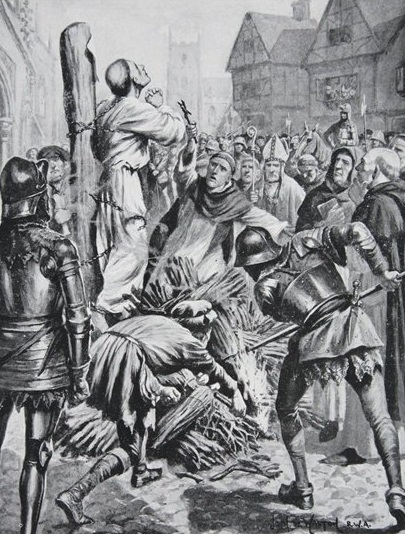
On this date in 1401, Lollard priest William Sawtre(y) was burned at Smithfield for heresy — the first known heresy execution in England.

The highlight of late 14th century English literature, Piers Plowman, was a great favorite of Lollards. Though this lengthy allegorical poem is not itself a Lollard text, it spawned a Piers Plowman tradition with many spinoffs that are overtly Wycliffite.

Witness Wycliffe, who told them the truth;
For in good nature he greatly warned
To mend their wickedness and sinful works.
Who these sorry men damned his soul
And overall lolled him with heretics’ works!

–Piers Plowman’s Creed*

Sawtre was a follower of John Wycliffe, the Biblical translator and church reformer 16 years dead as we lay our scene.

Wycliffe anticipated much of Luther’s later critique of the Catholic Church. His call to study Scripture directly without the intercession of doctors in Rome touched a spiritual thirst; his summons to apostolic poverty for the wealthy vicars of Christ was a message with a ready audience.

“From about 1390 to 1425, we hear of the Lollards in all directions,” notes this public domain history, “so that the contemporary chronicler was ale to say that of every two men found on the roads, one was sure to be a Lollard.”

Lollardy did not immediately manifest as an outlaw movement; it had many adherents among England’s elites and even the royal household. Although the papacy had declared various Wycliffe doctrines heretical in that prelate’s time, England had shown little appetite for calling an Inquisition — a step that would project papal authority into the kingdom.**

But with a ferocious ecclesiastical pushback and a change in the occupancy of the throne,† the English state gradually shifted over the course of the 1390s and 1400s towards recognizing Wycliffe’s principles as heresy — and towards treating that heresy into a capital crime. Through spectacles like Sawtre’s burning, Lollards were gradually made to understand that the price of their scruples might run all the way to martyrdom.

This was novel territory for English jurisprudence, and part of a centuries-long European transition towards treating doctrinal dispute as capital crime. There are only a bare handful of alleged quasi-precedents in English history, sketchily documented — like the unnamed apostate deacon burnt to ashes for Judaizing. It was only as late as William Sawtre that Old Blighty clearly established the practice and legal machinery for putting men and women to death for heresy.

Many Lollards capitulated as they came under pressure. This was true of our man Sawtre, a humble parish vicar. When put to questioning by the bishop in 1399, Sawtre initially recanted his unorthodox skepticism as to the transubstantiation of communion bread into Christ’s own literal body — a doctrinal mystery that would be a tougher and tougher sell to dissidents yet to come.

But upon moving from Lynn to London where he served at St. Osyth’s, Sawtre relapsed — and some stirring moved his soul to vindicate himself in the face of mortal peril.

Charged before Parliament, Sawtre now defended his heresies under close questioning by the Archbishop of Canterbury, Thomas Arundel. Arundel was even then pressuring this same Parliament for a statute, which he did indeed soon receive — one with the ominous title De Heretico Comburendo, at last elevating heresy to a death penalty offense and making the bishops themselves the decisive arbiters on the matter. It is overtly and all-but-explicitly aimed at the Lollards.

divers false and perverse people of a certain new sect, of the faith of the sacraments of the church, and the authority of the same damnably thinking and against the law of God and of the Church usurping the office of preaching, do perversely and maliciously in divers places within the said realm, under the color of dissembled holiness, preach and teach these days openly and privily divers new doctrines, and wicked heretical and erroneous opinions contrary to the same faith and blessed determinations of the Holy Church, and of such sect and wicked doctrine and opinions they make unlawful conventicles and confederacies, they hold and exercise schools, they make and write books, they do wickedly instruct and inform people, and as such they may excite and stir them to sedition and insurrection, and make great strife and division among the people, and other enormities horrible to be heard daily do perpetrate and commit subversion of the said catholic faith and doctrine of the Holy Church …

the diocesans of the said realm cannot by their jurisdiction spiritual, without aid of the said royal majesty, sufficiently correct the said false and perverse people, nor refrain their malice, because the said false and perverse people do go from diocese to diocese and will not appear before the said diocesans…

[let] none within the said realm or any other dominions subject to his Roval Majesty, presume to preach openly or privily, without the license of the diocesan of the same place first required and obtained, curates in their own churches and persons hitherto privileged, and other of the Canon Law granted, only except; nor that none from henceforth anything preach, hold, teach, or instruct openly or privily, or make or write any book contrary to the catholic faith or determination of the Holy Church, nor of such sect and wicked doctrines and opinions shall make any conventicles, or in any wise hold or exercise schools; and also [let] none from henceforth in any wise favor such preacher or maker of any such and like conventicles, or persons holding or exercising schools, or making or writing such books, or so teaching, informing, or exciting the people, nor any of them maintain or in any wise sustain, and that all and singular having such books or any writings of such wicked doctrine and opinions, shall really with effect deliver or cause to be delivered all such books and writings to the diocesan of the same place within forty days from the time of the proclamation of this ordinance and statute.

Any Lollard not so complying could be arrested on the say-so of the diocesan bishop and tried for the offending heterodoxy; if convicted, the clergy was then empowered to hand the unfortunate fellow over to the civil authorities who were obliged to carry out an execution without any further inquiry or say-so. Judge, jury, and (virtually) executioner … the same as the guy waiting for you in the confessional.

[I]f any person … do refuse duly to abjure, or by the diocesan of the same place or his commissaries, after the abjuration made by the same person be pronounced relapsed, so that according to the holy canons he ought to be left to the secular court … [then] after such sentence promulgate shall receive, and them before the people in an high place cause to be burnt, that such punishment may strike fear into the minds of others, whereby, nosuch wicked doctrine and heretical and erroneous opinions, nor their authors … be sustained or in any way suffered.

With such wicked doctrine and heretical and erroneous opinions afoot Sawtre was not suffered to live even the enactment of the law that killed him: De Heretico Comburendo was passed only on March 10, but Sawtre was eight days’ dead by that point. It’s a bit unclear how the sentence was legally effected, but it would seemingly have proceeded under canon, not civil, law.

Both the law and the execution were great victories for the Church. “The king and the archbishop hurried to burn their victim to show that they could send a heretic to the stake whenever they wished, without relying on statute” Leonard Williams Levy writes. “Parliament could neither give nor take the authority to burn a heretic. If the scepter supported the miter, canon law prevailed.”

Be that as it may, the victims of the Lollard-burning period were not nearly so numerous as the chilling language of De Heretico Comburendo might lead one to anticipate. The next Lollard to go to the stake was John Badby in 1410; two merchants were executed in 1415, and the Lollard rebel John Oldcastle was burnt “gallows and all” in 1417. Another handful suffered in the 1420s. It’s thought that about 50 people overall (Lollards and otherwise) were executed as heretics from the enactment of De Heretico Comburendo until Henry VIII broke with Rome 133 years later — an occasion that made heresy-hunting a whole different animal.

The History of England podcast covers Sawtre and Lollardy in episode 141.

* My artless rendering from the Middle English version given in D.A. Lawton in “Lollardy and the ‘Piers Plowman’ Tradition”, The Modern Language Review, Oct. 1981.

** Despite overall caution about the authority of Rome onto Albion’s soil, the English had no overall principled rejection of Inquisitors as such: they convoked such a tribunal to deal with Joan of Arc.

† The political situation in the realm was also been a factor: the usurper Henry IV had taken the crown only in 1399 by deposing, and later murdering, King Richard II. One readily supposes Henry’s keen interest in shoring up the loyalty of the church and keeping tabs on itinerant rabble-rousers, the latter of whom appear to have disproportionately skewed towards Richard’s faction. (All those heretics in the king’s household were in Richard’s household.)

On this day..

1786: Joseph Rickards, aspiring milkman

(Thanks to Meaghan Good of the Charley Project for the guest post. -ed.)

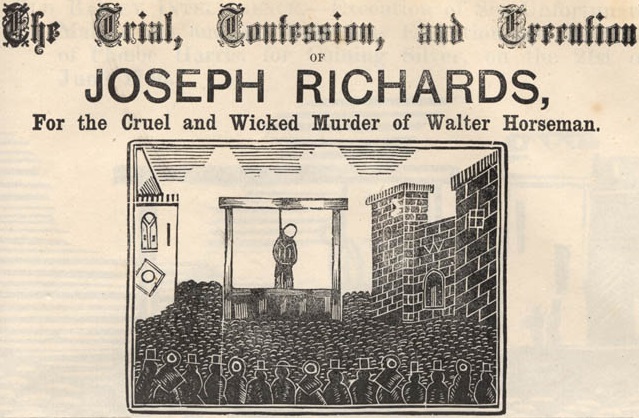
On this day in 1786, Joseph Richards or Rickards was executed in Kentish Town, London for the murder of his former employer, Walter Horseman, whom he attacked on February 11.

Graham Jackson and Cate Ludlow described the crime in the most graphic terms in their book A Grim Almanac of Georgian London:

At around 2:00 a.m., Mary Horseman of Kentish Town was woken by the sound of her ten-year-son calling out that his father, London milkman Walter Horseman, needed her… Mary found her husband sitting on his bed. By the light of the moon, which was flooding through the large bay windows, she could see that he was quite black with blood, which covered him from his face to his waist. “Lord bless me,” he said. “Something has run over my face!”

“Run over your face?” she responded. “Why, you are nothing but blood!” She ran for a candle, and when she returned, the light revealed a truly hideous sight: her husband was cut to pieces, his forehead, eyes and nose smashed. His skull, which was broken, was described in court as “cut and mangled in a desperate manner.” The two sections of the skull had broken apart, and his eye sockets had been smashed into shards.

There was nothing to be done for Walter, but amazingly, he lingered until the 19th, over a week after the assault. Due to his head injuries and the fact that he’d been attacked while he was sleeping, he wasn’t able to provide any useful information as to what happened.

The murder weapons were left behind at the crime scene: they proved to be a wooden hedge stake and an iron bar, which was “jellied” with gore.

Only a few farthings were missing from the house. The Horsemans’ four-year-old daughter, who was sleeping in the same room as her father, was not harmed. Suspicion quickly fell on Rickards, the Horsemans’ former apprentice, whom they’d recently sacked for laziness. He had no alibi for the night of the murder, a night watchman saw him near the Horsemans’ home about an hour after the attack, and Mary identified the hedge stake as one he had cut several days before the attack.

Nevertheless, he seemed confident and didn’t bother to leave the area. In fact, in an incredible display of chutzpah, he actually visited his ailing former master and shook his hand before Walter died. Perhaps his cockiness — or obliviousness — was a product of his immaturity; in an age of doubtful record-keeping, we can’t be sure of Joseph Rickards’s age but he was certainly quite young. Mary Horseman speculatively pegged the ex-apprentice as an 18-year-old; the London Times (Feb. 24, 1786) thought that he did “not appear to be more than sixteen years of age.” Although even 16 would be quite old enough to hang in Bloody Code London, the magistrate felt constrained on account of the boy’s age to caution his jurors against excess confidence in the confession he ultimately produced:

I should not for one, though he is very near the state of manhood, chuse to rest singly and merely on his confession, as he is not at full age, though he is above that age of discretion, which the law assigns to be at the age of fourteen years, and certainly it is near the time that human reason is supposed to be mature.

On the 20th, the day after Walter’s death, Rickards was arrested. Within a day he had admitted to concealing himself in a large cupboard in one of the bedrooms in order to beat his former boss to death in his bed. (The trial records are here.) He tried to shift some of the blame to Mary Horseman, claiming they had frequently kissed and he had “laid hold of” her breasts, and that she had told him she wished her husband was dead.

He was hanged in a field across the way from the Horseman family’s dairy — a pathetic spectacle, to judge by the account of the Public Advertiser (Feb. 28, 1786), during which he recanted his allegations against the milkman’s widow.

In his way to the place of execution, the convict appeared to be in a state of mind bordering upon stupefaction: He had no book, nor did he employ the short remnant of time in those preparations for eternity which his miserable situation rendered so indispensably necessary.

Before being turned off, the prisoner desired to see the widow of the deceased; she was sent for to her house, but was gone to London: he declared he had no accomplice in the fact, and that he was induced to the perpetration thereof by the supposition, that after the decease of his master he should succeed to his business as a milkman. Just before coming to the village, he burst into tears, and when he came to the place of execution wept bitterly; his expressions of sorrow and contrition being only interrupted by fervent appeals to Heaven for mercy till the last moment of his existence. He desired his hat might be given to one, and his buckles to another man; and he also made some other trifling dispositions.

One of the Sheriffs, and a great number of their officers on horseback and on foot, attended on the above occasion. Considering the nature of the criminal’s offence, and the disposition of the English to behold spectacles of horror, the crowd was not near so great as might have been expected, owing, no doubt, to the fall of snow, and going so early. The body of the malefactor was conveyed from Kentish Town to Surgeons Hall for dissection, without a shell, and covered only with a coarse cloth, which by the motion of the cart was frequently so removed, that the head and different parts of the body were frequently seen by the passengers on the road and in the streets.

The anatomization, and accompanying public lecture on the late Rickards’s thorax, was performed by a “Dr. Cooper” (General Evening Post, Feb. 28-Mar. 2, 1786); this would appear to be the budding anatomist Astley Cooper who was only 17 years old himself at this time — just at the outset of a scintillating medical career.


THE TRIAL.

Old Bailey, February 24th, 1786.

Joseph Richards was arraigned for the wilful murder of Walter Horseman, milkman, in Kentish Town. The deceased’s widow deposed, that the prisoner was formerly a servant to her husband; that he was discharged for negligence; that he had frequently threatened vengeance on the deceased; that on the morning the murder was committed, she was awakened by a noise, and on entering the room her husband slept in, she found him sitting up in the bed, and as far as his waist in blood; that a stick which the prisoner had cut some time before, lay in the room, and an iron bar, covered with blood; that her husband was mangled in a shocking manner: — he lingered a few days, and died a shocking spectacle.

Four other witnesses were examined, whose testimony proved certain corroborating circumstances; such as, being from his lodging the night the murder was committed, being seen to melt lead, and to pour it into the stick that was found in the deceased’s room, &c.

The prisoner confessed the murder to one of the magistrates who committed him for trial; but pleaded Not Guilty at the bar.

The jury, after a few minutes’ consideration, brought in their verdict Guilty.

Mr. Recorder pronounced judgment. He said the voice of innocent blood cried to heaven for vengeance. He dwelt upon the atrociousness of the crime of murder, observing, that the Divine Law had ordained, that whoever sheddeth man’s blood, &c., and then expatiated on the peculiar circumstances of the murder, the murder of an innocent master, to whom he owed duty and reverence.

The sentence was then passed as usual, that he be hanged till dead, and anatomized; and an order of Court was made out, to execute him on Monday, at Kentish Town, as near as possible to the house of the deceased.

THE EXECUTION.

Joseph Richards, a youth about eighteen, who was convicted on Friday last, for the wilful murder of Walter Horseman, with whom he lived servant, was executed at Kentish Town, opposite the house where the horrid fact was perpetrated. The malefactor came out of Newgate about twenty minutes before eight o’clock, and with some alertness stepped into the cart, which conveyed him through Smithfield, Cow Cross, and by the two small-pox hospitals to the spot, where he was removed from that society of which he had proved himself a most unworthy member, at a time of life when such atrocity of guilt as he possessed has been seldom known to degrade humanity. In his way to the place of execution, the convict appeared to be in a state of mind bordering upon stupefaction; he had no book, nor did he employ that short remnant of time in those preparations for eternity which his miserable situation rendered so indispensably necessary.

Before being turned off, the prisoner desired to see the widow of the decreased; she was sent for to her house, but was gone to London; he declared he had no accomplice in the fact, and that he was induced to the perpetration thereof by the supposition, that after the decease of his master he should succeed to his business as a milkman. Just before coming to the village, he burst into tears and when he came to the place of execution, wept bitterly; his expressions of sorrow and contrition being only interrupted by fervent appeals to Heaven for mercy till the last moment of his existence.

On this day..

1848: Harriet Parker, crime of passion

(Thanks to Meaghan Good of the Charley Project for the guest post. -ed.)

On this date in 1848, Harriet Parker was publicly hanged in front of the Debtors’ Door at Newgate for the murder of her lover’s two young children.

The sad story is described in Nicola Sly’s In Hot Blood: A Casebook of Historic British Crimes of Passion.

Harriet was a widow. Her partner, Robert Henry Blake, was legally married to another woman, but they were separated and he lived with Harriet and two of his children by his wife: Amina, age seven, and Robert Jr., age five.

Despite residing at Cupid’s Court in London, their relationship was far from blissful. Robert was an inveterate womanizer who openly flaunted his affairs. It all came to a head on New Years’ Eve, 1847, when Robert told Harriet he was going to the theater without her. He’d made plans with a friend, Stephen Hewlett, and she wasn’t invited.

Harriet was furious and suspected, rightly, that Robert was actually going to be with another woman. She followed him as he left their home and tagged along behind him wherever he went, telling him he’d better get used to it because she would be with him all night.

Robert did meet up with his friend Stephen and complained of Harriet’s jealousy. “If I was to kiss that post,” he said, “she would be jealous of it.” Eventually he was able to give Harriet the slip, though, and went immediately to a prostitute’s house, where he stayed the night.

Harriet, meanwhile, angrily searched for her errant lover for hours, saying darkly that Robert would regret his actions for the rest of his life.

“I will do something that he shall repent and will die in Newgate,” she told Stephen Hewlett. She added, “I have something very black in mind … You will hear of me before you see me.”

He didn’t take her seriously. He should have.

A few hours after midnight on New Years’ Day, witnesses saw Harriet walking the city streets with little Amina, still asking people if they’d seen Robert. The next time anyone saw her was at 4:00 a.m. She was alone, and knocked frantically at her neighbor’s door. The neighbor opened the bedroom window and looked out, and asked what on earth was wrong.

“Oh, Mrs. Moore, I have done it,” Harriet said. She added that Blake had “met a little strumpet” and left her last night, and hadn’t come home. “A pretty spectacle is there for him when he does come home,” she added. “I shall go and deliver myself up to a policeman.”

Her neighbor asked why and she replied, “I have murdered the two children.”

That got Mrs. Moore’s attention and she sent her husband to find a police officer. Harriet herself went looking and found one, and asked to be arrested, but she didn’t disclose the reason until they were on the way to the station house. Finally she unburdened her secret:

I have murdered the children to revenge their father. They were innocent — through my vindictiveness I have done the deed.

A look in at the Blake/Parker house showed Harriet was telling the truth: Amina and Robert Jr. were lying in bed, quite dead. They had been smothered and their bodies were still warm. Harriet’s clothes were stiff with dried blood, but it wasn’t the children’s; it was her own blood, from a beating Blake had given her a few days before.

Harriet had to be persuaded not to plead guilty to her crimes from the outset. At her trial, which was presided over by two judges, her defense was that of provocation. Her attorney argued that Robert’s horrible treatment of her had driven her out of her mind and she was not a “responsible agent” at the time of the murders.

The jury was out for only ten minutes before returning with a verdict of guilty of willful murder. The automatic sentence was death, but the jurors included a strong recommendation of mercy because of the provocation Harriet had received. (Even after the murders Robert had boasted of all the women he’d seduced during the time he lived with Harriet.)

Judge Baron didn’t agree with the jury, pointing out that “the children gave her no provocation at all.”

Nevertheless, he promised to pass the recommendation on to the Home Secretary. When the two judges passed their sentence on the convicted woman, they emphasized that she had no right to take her feelings about Blake out on two “unoffending children” who were “in a sweet, innocent sleep.”

Harriet cried out, before being lead from court, “God forgive you, Robert. You have brought me to this.”

The Home Secretary did receive the jury’s recommendation of mercy, but didn’t act on it. The widespread perception was that if Harriet had murdered her louse of a partner rather than his children, she would gotten off with a lesser verdict of manslaughter. But the deaths of two small children, killed for the actions of their father, could not be countenanced.

Harriet spent her last days dictating letters to people. In one of several letters sent to Blake, she wrote, “Awful as my fate is, I would rather die than live again the wretched life I have done for the last twelve months.” She sent him a Bible and a pair of cuffs she’d knitted, and advised him to return to his wife and forsake drinking, bad company and other women.

The crowd of persons assembled to witness the awful scene was immense, and far exceeded in number those present at any execution of late — their conduct, also, we regret to add, was worse than usual, the yells and hootings which prevailed for some time previous to the culprit making her appearance being perfectly dreadful.

–London Times, February 22, 1848

Mrs. Moore visited her in her cell and found her surprisingly at ease. “I have received more kindness in Newgate than ever since I left my mother’s home,” Harriet told her former neighbor.

Harriet was hanged by one of Britain’s most famous executioners, William Calcraft — although it was never the tidiness of his executions that he was famous for. Calcraft didn’t handle Harriet all that well, either: according to one account, Harriet’s “muscular contortions and violent motion of the hands and arms … were truly dreadful” as she choked to death. Her frame was so slight that the fall didn’t break her neck.

On this day..

1942: Max Hertz, chronicled by Oskar Rosenfeld

(Thanks to Meaghan Good of the Charley Project for the guest post. -ed.)

On this date in 1942,* a middle-aged man was hanged in the Lodz Ghetto in front of an audience of twenty thousand. His name was Max Hertz, son of Salli Hertz and Helena Hertz née Abraham. He was from Germany.

His death was recorded in heartbreaking detail by Oskar Rosenfeld, a resident of the ghetto. Rosenfeld was an Austrian-Jewish writer and translator who’d published six novels before the war. After the Anschluss in 1938, he and his wife emigrated to Prague in Czechoslovkia to escape Nazi aggression. Nazi aggression followed them, however, and the couple made plans to move to England.

Mrs. Rosenfeld left in 1939 and her husband was supposed to come later, but the war started and Rosenfeld found himself trapped in Prague.

Deported to the Lodz Ghetto in 1941, within a few months he secured a relatively cushy position as an archivist with the ghetto administration. He helped write the official Lodz Ghetto Chronicle, a diary of the day-to-day events of the ghetto.

Oskar Rosenfeld

Behind closed doors, Oskar Rosenfeld was keeping his own, personal diary, accumulating twenty-one notebooks in all. Sixty years later, the director of the Yad Vashem libraries described his style as “riveting. At times he is philosophical and literary, at others he is spare and raw. Often instead of full sentences, Rosenfeld writes strings of words words so packed with meaning that normal sentence structure is superfluous.”

The diary was mostly in German, with occasional parts in Hebrew, Yiddish and English.

Rosenfeld employed a simple, fairly transparent code to avoid trouble if his notebooks should come into the wrong hands. He refered to the Nazis, for example, as “Ashkenes.” When he wrote “Germans,” he meant only German Jews. The Ghetto Chairman, Mordechai Chaim Rumkowski, designated Eldest of the Jews, was often called “Praeses.” The words “Gestapo” and “Kripo” were written using the Greek alphabet.

His entries described in painstaking detail the grotesque land in which he was imprisoned: the religious and cultural life of the ghetto, the residents’ attitude toward the administration, the rumors flying around about the war front, the deportations, and above all everyone’s struggle to survive from day to day.

Starvation, overwork, disease and despair wore away at the Lodz Jews, like sand castles crumbling. The Nazis’ Jewish problem, Rosenfeld noted wryly, was being solved “in installments.”

During the frigid Polish winters—unusually harsh in those years—the coal ration was pitiful, and people chopped up their own furniture for firewood. When that was gone, they turned to the streets and stole whatever they could get their hands on: fences, even sheds and outhouses were dismantled for burning. In spite of this hundreds of people froze to death.

A bigger problem was food. Or rather, lack of food.

“According to German scientific findings,” Rosenfeld wrote,

the consumption of calories in normal times was 3,640 calories with 93 grams of albumen [protein] per person. The allocated ration in the fall of 1941 was 1,300 calories and 36 grams of albumen. Since the fall of 1941, the ghetto — with the minor exception of the workers in the factories — received a mere 900 calories and 25 grams of albumen per person. Not taking into account the lack of vitamins. This was no longer nutrition, this was a prescription for a slow death.

People traded everything they had, literally the clothes off their backs, for a few turnips or some sausage. During times when food was particularly scarce, a diamond necklace or a good pair of shoes might fetch a single loaf of bread. And sometimes one loaf was all a person could expect to get for an entire week.

When someone died — and there were deaths in nearly every family — their surviving relatives would often wait several days to report it, so they could claim the dead person’s rations. There were even reports of cannibalism, which Rosenfeld dutifully recorded.

The Lodz Ghetto was a work camp, not a death camp, and was designed to squeeze all the labor it could out of the inhabitants. People who were just too sick or weak to keep up were likely to find themselves on the next list for deportation to mysterious “labor camps in the East.”

Nobody knew for sure where the deportees were going, but the ghetto residents had reason to be suspicious and fearful and most of them did everything they could to stay out of the transports. No one who was deported ever returned to the ghetto. These were supposed to be long journeys and deportees were advised to pack several days’ worth of food, but like as not, the trains would come back empty the very next day.

In fact, the deportation transports usually traveled no more than forty miles outside of Lodz.

Their destination was Chelmno, the Germans’ first death camp. There they used gas vans to asphyxiate their victims. These were relatively primitive and inefficient; it wasn’t until later that they came up with the idea of gas chambers instead of vehicles.

The Lodz Ghetto had its own police force staffed by Jewish volunteers (who were universally despised as collaborators by the others) and a court that presided over criminal trials.

Violent crime, and for that matter most crimes against other persons, was rare: most of the court cases involved crime against the ghetto community as a whole. (Demolishing public fences and buildings for fuel, for example. See above.)

The rules were harsh. Kitchen workers caught sneaking even a spoonful of soup or some half-rotted beets were subject to prosecution. A carpenter could be brought up on charges of sabotage if he took some scrap wood home to burn. Jozef Zelkowicz, another employee in the Ghetto Archives, wrote about one case where a tailor forgot he’d draped a length of of thread over his shoulder for easy access during his work. After leaving at the end of his shift, he was arrested for “stealing” the thread.

Offenders usually got a short jail term of a few weeks or months. That was the least of the punishment, however: when they got out, they were often banned from working again and their families were banned from receiving welfare, essentially a death sentence. Convicted criminals and their families also had priority for deportation, however, and tended to get shipped out before they starved to death.

Not this time, however. For whatever reason, the Nazis decided to make a public example of Max Hertz.

It was the very first public execution in the ghetto. In fact, Rosenfeld said, they’d constructed the gallows just for this occasion:

At 5 p.m. on Friday, the building department had received the order for a gallows to be erected on Fischplatz by 7 a.m. the next morning. Precise specifications were given: wooden beams, heavy iron hooks, bent to a shape just this long and that wide. A man from Germany was entrusted with the job. He worked hard and long, and got it done on time. This worker was, it turned out, an intimate friend of the condemned man.

The Nazis were so pleased with the craftsmanship that they placed another for a set of gallows designed to hang twelve people at once.

Rosenfeld’s description of the execution is worth of being quoted almost in full:

Friday, collective, six o’clock in the evening, impersonal declaration to all members of the collective… Meet at nine o’clock at the Fish Market. Rumors: military parade, directives from the German military, the Eldest to speak. –Afterward some reported that they knew… The sick had express dispensation from attending the meeting. Shabbat from nine o’clock on a queue of men and women being led by room commandant through the almost empty streets across the “little bridge” at the Old Market Place between the ghetto and the city, past Hamburgerstrasse to the Fish Market. Along the way local passersby asked what was going on… Nobody had the answer. Frost. Clear. Biting wind. Terribly uncomfortable in the open air. The closerto the square, the clearer that something terrible was about to happen. The streets usually teeming with people on Shabbat — empty…

The rumor of the true drama seems to have gained credence in the ghetto, none of the local inhabitants want to risk being forced to participate and therefore remained at home.

Goaded by the sharp commands of the Jewish police, took their places, men in the front, women in the back, similar queues were streaming toward the square from other directions. It didn’t take long. Shortly before nine o’clock, Fish Square was filled with a human wall, was encircled, a horrifying silence, a few locals out of curiosity.

Finally the masses begin to understand. Sense of foreboding during the march that they were to attend an execution scene (or a witch burning); in the square, many for the first time, gallows. It had been erected early in the morning by the Jewish police. Several women fainted at the sight, others fell into convulsive sobbing; several of the men managed to send some of the women back home or took them (secretly!) to nearby apartments. Those who wanted to go back later found the street blocked off; then order to seal off the surrounding area of Fish Square.

Quite low on three steps, small podium, to the left across from the post office for newly settled rectangular trapdoor; above the trapdoor a vertical balcony, at the upper end a horizontal beam with a hemp cord.

A cold shudder went through the onlookers… No more illusions, no dream, raw reality, for everybody knew who was Ashkenes.

Several well-fed, field-gray SS officers. At the corner of the square, soldiers with mounted machine guns to keep the crowd in check. Nobody had the courage to flee. The transport leader warned of the most severe consequence for anybody who tried to leave. A few managed to get to the collective. An Ashkenes car was parked not far from the square.

Word making the round: cause and candidate. Cause: Jewish star; another variant: a Communist wanted for a long time, flight only a pretext. Left wife and child to take better care of them from Germany (name: Herz [sic], Cologne). The wife is said to be among the onlookers, unaware of what’s happening.

Men quite numb. Some of the women somewhat worried. The Ashkenes men are in a good mood, well fed, smoking, looking cheerfully at the crowd.

Almost an hour and a half. Cold is intensifying…rubbing to generate warmth, with hands on the knees. About ten-thirty suddenly complete silences. From the direction of Zgierz, probably from the Baluter Ring (Gestapo Headquarters, office of the Praeses — government square), appears a man without a hat, flanked right and left by field-gray soldiers, his gray hair in the wind, no collar, open neck, moving closer slowly, in a short winter jacket…directly to the gallows. Most onlookers, especially the women, avert their eyes, others turn their backs to the square; many look nevertheless sideways to the spot where the scene is to unfold. (Tragic irony…joke, perhaps to be released again!!!) Most of them after all witnessing for the first time such business and desire for sensationalism. Since none had ever attended a witch burning or torture or pillory, they didn’t know how to behave, didn’t find the right style; tugged embarrassed on their clothing, clenched the fists, and waited for a sign that was to tell them what it was they should do. Suddenly the silence was so horrifying that the healthy voices of the field-gray Ashkenes could clearly be heard in the square. A man of more than eighty suddenly remembered hearing from his room a strong voice by the wire around midnight, a song that began with la-la and ended with “and if the world were full of devils,” and began to make, quite unexpectedly, his own observations about this. Yes, this old man even rolled up the torn gloves for a moment to make sure that his fingernails were clean. A women her lipstick —

Not a word was heard. Silence. The candidate shivered in the cold. The field-grays in furs. His overcoat was taken from him. He folded his hands. Saw the entire scene, the crowd. Implacable. Mounted the steps to the podium. There was met by two Jewish policemen and a third man who busied himself callously with the cord.

It was said that a Jewish policeman, a well-known Communist, had been ordered to assist in this execution — as a deterrent. Completely dull expression of the crowd, who didn’t like to see Ben Israel [son of Israel] under the gallows. Sensationalism won out over disgust, women there with handkerchiefs over their faces but peering nevertheless, men completely dispassionate. The symbolism — a people pilloried — did not enter their consciousness. The bareheaded man shivered, folded his hands. Something was wrong with the cord. The Jewish policeman handled it very clumsily. The field gray standing next to him straightened it out, busied himself; the Jewish policemen in their excitement had made a wrong move, not well familiar with the executioner’s tool, more used to tefellin [phylacteries] (observation of an onlooker). The moment came when the crowd thought something was going to happen, a declaration or reading of the sentence or some other matter. But nothing. Continued silence. When the man saw that there was no escape, he again folded his hands and suddenly, with a lamenting voice: “Why don’t you let me live…”


A hanging (not necessarily this one) in Lodz Ghetto.

Many expected instead of this plea some kind of demonstration as a legacy from the crowd, some inspiring motto. But nothing of the sort. He was no hero in our sense. Now eyes averted from the gallows, dull thumping was heard of heavy material and wood, a few seconds for the convulsing body, dangling. The crowd was even able to look at it for some time—seconds (counting to thirteen). The corpse softly in the wind. Rigid features, rigid limbs.

The field grays gave a sign, Jewish police gave a sign, and the crowd quickly began to disperse, going home, the wife of the delinquent was present…

The body remained hanging the entire Shabbat. The Jews avoided the place.

The Lodz Ghetto Chronicle includes an entry on this execution, noting it took place in a large square at Bazarna and Lutomierska Streets. According to the chronicle, Max Hertz had escaped the ghetto and spent several days in Lodz proper. He was arrested at the train station when he tried to buy a ticket to Cologne. This was about three weeks before his execution.

The Polish writer and child Holocaust survivor Henryk Grynberg later honored him in a fragment of poetry:

Max Hertz brought from Cologne
on October 23, 1941
went back to the station
but when paying for his ticket
a star fell out of his pocket
right into the ticket clerk’s eye
and he hung over the bazaar
showing the shortest way back
to Europe

The spectacle of Max Hertz’s death had indeed left an unforgettable impression on its audience, just as the Nazis intended.

As for Oskar Rosenfeld: he continued working in the Ghetto Archives up until August 1944. His final diary entry was on July 28 of that year. He was well aware that the fate of the ghetto hung in the balance:

We are facing either apocalypse or redemption… There are plenty of skeptics, nigglers, who don’t want to believe it and still have doubts about that which they have been long and waiting for years… After so much suffering and terror, after so many disappointments, it is hardly surprising that they are not willing to give themselves over to anticipatory rejoicing. The heart is marred with scars, the brain encrusted with dashed hopes.

It turned out to be apocalypse: in August, before the Red Army liberated Lodz, the ghetto was liquidated and almost all of its inhabitants sent to Auschwitz. Like most of the others, Rosenfeld was gassed on arrival. He was sixty years old. But his notebooks survived him, and ultimately ended up in the custody of Yad Vashem. His diary was published in English for the first time in 2003, under the title In the Beginning was the Ghetto: Notebooks From Lodz.

* Rosenfeld places the date of the execution on Friday, February 20. All other sources, including the Lodz Ghetto Chronicle and Max Hertz’s Yad Vashem page of testimony, place it as Saturday, February 21, but I’m sure Rosenfeld is right. The execution seems to have taken place at the beginning of the Jewish Sabbath. The Sabbath is on Saturday, but to religious Jews it actually starts after sunset on Friday; Rosenfeld writes that the body “remained hanging the entire Sabbath” which implies it hung for some time. If it hung “for the entire Sabbath” starting Saturday night, that would have been for less than two hours.

On this day..