1941: Forty-eight French hostages

On “a beautiful autumn day” this date in 1941, four dozen French leftists were executed by that country’s occupiers as punishment for the murder of a German officer.

On October 20, 1941 — sixteen months into the German occupation — a pair of Communist commandos assassinated the Feldkommandant of Nantes, Lt. Col. Karl Hotz (French link).

News of this crime went straight to Adolf Hitler himself, who personally ordered a fearful reprisal.
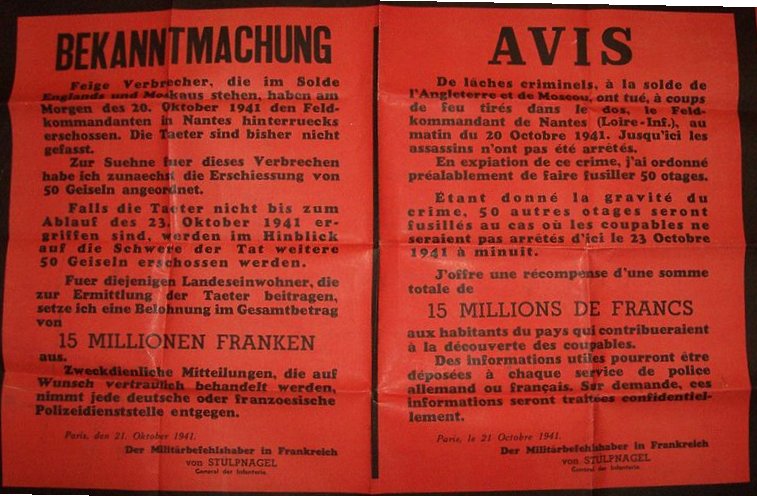
The list of the executed hostages as published Oct. 23 in L’oeuvre

Accordingly, the collaborationist Petain government was induced to select 50 persons from among the ranks of detained German political prisoners. Pierre Pucheu, who would later be executed himself,* intentionally selected Communist types in an effort to confine the retaliation to fellow-travelers.

On this date, those 50 — well, 48, but who’s counting?; the numbering can get dodgy in these mass-execution scenarios — were put to death at three different locations: five at Fort Mont-Valerien; sixteen at Nantes; and most notoriously, 27 internees of Choisel (French link) at Chateaubriant.**

In three different batches of nine, the 27 reds and trade unionists were fusilladed into the ranks of Gallic martyrdom. They remain among the most emblematic French martyrs of the occupation; there’s a cours des 50-Otages named for them in Nantes, and various streets that bear individual victims’ names — such as Rue Jean-Pierre Timbaud in Paris. (Timbaud was a Communist steelworker.)


Monument to the martyrs of Chateaubriant. Image (c) Renaud Camus and used with permission.

The youngest, 17-year-old Guy Moquet (you can find his name on the Paris Metro) was the son of an exiled Communist parliamentarian (French link).

He made headlines in 2009 when current French President Nicolas Sarkozy had added to the educational curriculum the reading of Moquet’s brave-but-sad last letter to his family: the decision drew some rather mean-tempered fire because of Moquet’s political persuasion. In the end, the text bore a fairly universal reading that could play inoffensively to posterity — like its postscript injunction,

“You who remain, be worthy of the 27 of us who are going to die!”

There’s a thorough roundup of the Oct. 22 executions (including poetic tribute) here.

* Vindicating Winston Churchill’s prophecy to the Times upon receiving news that “These cold-blooded executions of inocent people will only recoil upon the savages who order and execute them.” (Oct. 25, 1941, as cited in the The Churchill War Papers, vol. 3)

** Fifty more were supposed to be executed if the assassins weren’t promptly turned in, but that second batch never took place. (There was, however, a different batch of 50 executed on October 24 in retaliation for a different political assassination. Maybe they just all ran together.)

Part of the Themed Set: Illegitimate Power.

On this day..

2009: Four Tibetans

On this date in 2009, China executed four Tibetans widely considered political prisoners.

The previous year, widespread unrest over Chinese control had shaken the country, most notably riots in the capital, Lhasa that targeted Chinese persons and shops.

(There’s a BBC page preserving a good deal of the original coverage here.)

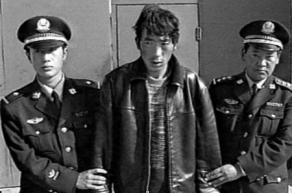
Loyak, one of those executed Oct. 20, 2009.

The two most prominent prisoners — in fact, the only two confirmed in some of the first media reports — were Lhasa residents Lobsang Gyaltsen and Loyak. A court spokesperson said both had been “given death penalties had committed extremely serious crimes and have to be executed to assuage the people’s anger.”

Specifically, both had been convicted of torching shops during the Lhasa riots, which arsons both led to deaths.

The other two executed, a woman named Penki (also for arson) and an unnamed man, received less comment, although they might have been executed despite having been condemned only to a “suspended” death sentence, which for China is generally no death sentence at all.

Executions in Tibet turn out to be relatively rare; these were the first known Tibetan executions since early 2003. Widely condemned abroad, this date’s events were barely or not at all reported internally by Chinese state media.

Part of the Themed Set: Illegitimate Power.

On this day..

1973: 14 during the Caravan of Death

Fourteen early-morning executions in Chile on this date in 1973 heralded the end of one of the Augusto Pinochet dictatorship’s most notorious human rights abuses: the Caravan of Death.

For this “caravan” picture not camel-borne spice traders but a helicoptering death squad. In the bloody aftermath of Pinochet’s September 11, 1973 coup against the elected socialist government, the new strongman’s buddy Gen. Sergio Arellano Stark took this evil-omened chopper on a south-to-north tour from prison to prison beginning September 30 — leaving its wares behind at each stop, in the form of spent shells and murdered men.


Arellano and Pinochet were all hugs hours before the caravan departed.

The intended consumer of this murderous spectacle, according to the human rights organization Memoria y Justicia, was as much the military itself as it was the political opposition. “One of the reasons,” said one officer at Arellano’s very first stop,

was to set a drastic precedent in order to terrorize the presumed willingness of the Chilean people to fight back. But without a doubt, it was also intended to instill fear and terror among the commanders. To prevent any military personnel, down to lowest ranking officers, from taking a false step: this could happen to you!

And indeed, several officers were also sacked along the way, a couple even imprisoned and tortured. Their lenient treatment of presumed subversives constituted “failure to fulfill military duties”: one can readily imagine the impression made upon junior officers in Pinochet’s armed forces.

Said subversives had it worst of all, of course.

These were people already in prison, many having voluntarily turned themselves in upon request after the coup; they were drug out of cells in the dark of night and machine-gunned, or worse. Close to 100 defenseless political detainees died this way over a three-week span.

The Caravan reached Antofagasta on October 18, where Gen. Arellano was received by the zone chief Gen. Joaquin Lagos.

Arellano’s unit did its dirty work overnight: the names of its 14 victims on this date’s early hours are recorded here. One was an 18-year-old student, one a 66-year-old “maritime worker”. Several were figures in local government.

Lagos was horrified the next morning when he discovered what his guests had been up to — and he immediately gave Pinochet his resignation.

I felt hurt, powerless and angry [Lagos later said] that a criminal action of this nature that had been committed in my jurisdictional zone and behind my back.

Lagos had the juice to make this sort of gesture without winding up in prison himself: indeed, he gave Pinochet his resignation (and the reason) personally.

Though Lagos has said that Pinochet seemed much more concerned about his (Lagos’s) attitude towards the atrocity than the atrocity itself, he (Lagos) also remembers Pinochet placing a call to Gen. Arellano and, not reaching him, leaving his nomadic deputy a message “not to do anything more.” The Caravan did stop on Oct. 22: maybe, Lagos’s resignation did the trick, at least to the extent one can attribute any cause to the cessation. This outcome will always rate a bullet point on the brief against the “superior orders” defense.

Relatively speaking, these unfortunates are only one puddle of blood among seas from the Pinochet years. Still, the Caravan of Death in particular was (and still is) a focus of the indictments handed down against him after the return of civilian government, thanks in no small part to Gen. Lagos’s willingness to go on the record about it — and as a result, many of the legal maneuvers around Pinochet in the last years of his life, both in Europe and Chile, concerned this horrible affair.

Pinochet finally died in December 2006 while under house arrest for two specific Caravan of Death murders. While alive, however, his legal team predictably attempted to blame local commanders for the Caravan’s atrocities; in response to this gambit, Lagos went public on television with his version (which human rights organizations also tend to credit) — along with horrifying descriptions (Spanish link) of the death squad’s activites that left him too “ashamed” to return the victims’ remains to their loved ones.

They were torn apart. They were no longer human bodies. I wanted to at least put the bodies back together again, to leave them more decent, but you couldn’t.

They cut eyes out with daggers. They broke their jaws and legs

They shot them to pieces, first the legs, then the sexual organs, then the heart, all with machine guns.


From an entire album that Dark Order devoted to the Pinochet dictatorship.

Part of the Themed Set: Illegitimate Power.

On this day..

1999: Chen Chin-hsing, Taiwan’s most notorious criminal

On this date in 1999, Taiwan put to death a man who, as the Reuters story about his case led it, “shook public confidence in law and government with the kidnap-murder of a TV celebrity’s daughter and a string of subsequent gun battles, killings, rapes and a hostage drama.”

Dramatic enough for you?

This operatic crime spree was the work of three men, Chen Chin-hsing, Lin Chun-sheng, and Kao Tien-min.

They punched their ticket to popular infamy when they snatched 16-year-old schoolgirl Pai Hsiao-yen in New Taipei City on April 14, 1997.

Her family received terrifying photos of the girl stripped naked and bound, a severed pinkie finger, and a demand for $5 million U.S. And they were in a position to get it, because Pai’s mother was celebrity singer and TV personality Pai Ping-ping. (Alternatively: Bai Bing-bing.)

However, despite multiple attempts to drop the ransom, the kidnappers kept not showing up, and the captive, who’d been brutalized and raped during her captivity, was eventually murdered and dumped in a drainage ditch.

Pai Hsiao-yen’s murder not only captivated media but crystallized public backlash against politicians and police who showed as ineffective in the midst of a massive crime wave. It helped cave in the government of Taiwan’s first democratically elected president.

The criminals themselves magnified the case by drawing out the initial public horror into a seven-month drama as they eluded police manhunts. At one point, they forced a plastic surgeon at gunpoint to alter their appearances, then murdered him after he was finished.

Chen Chin-hsing was finally captured (after the other two had judiciously committed suicide when about to be apprehended) after a televised standoff wherein Chen gave self-valorizing media interviews while holding a South African ambassador’s family hostage.

All this made Chen a dead man, and few in the Republic of China much pitied the serial rapist and spree killer’s fate of taking a magazine of automatic rifle ammunition in the chest. (Several others in this dreadful affair also got non-capital sentences for various forms of aiding and abetting.)

It also made Pai Ping-ping into a tough-on-crime social activist. Taiwan’s death penalty has been in the news recently with the government’s admission that it executed an innocent man in an unrelated case. Pai vehemently opposes the resulting abolition efforts that other case has helped along; in 2010, she helped to break a 52-month death penalty moratorium and force a resumption in executions when she threatened to commit suicide if Taiwan went through with abolition. That would be operatic indeed.

On this day..

1915: Thomas and Meeks Griffin, ancestors of Tom Joyner

On this date in 1915, a quintet of African Americans died in South Carolina’s electric chair during a 70-minute span.

Joe Malloy was put to death for killing two white men four years before; the other four executed on this date were convicted together of murdering 73-year-old Confederate veteran John Q. Lewis. They were John Crosby, Nelse Brice, and — our principal concern today — Thomas and Meeks Griffin.

The Griffins were among the wealthiest blacks around, and we’ve already seen where that’s a dangerous profile to keep in South Carolina.

In this case, and even though public opinion was predictably inflamed at the aged veteran, the Griffins weren’t lynched: indeed, prominent white people in the community, such as the mayor and the sheriff, rose to the Griffins’ defense to the extent of signing a petition for executive clemency. They didn’t believe then that the thief whose accusation condemned the brothers was credible.

More than likely they suspected Lewis’s 22-year-old black mistress, Anna Davis, and/or her husband — and undoubtedly, they would have known exactly why this scandalous angle was not pursued in court.

Still, South Carolina’s governor reckoned that they’d had their day in court, the victims deserved closure, and whatever other equivalents of the familiar modern-day rationales one might care to name.

Almost surely, this distant injustice would be lost to time were it not for the Griffins’ famous great-nephew, the radio host Tom Joyner.

Joyner only recently discovered (via Henry Louis Gates Jr.‘s research for a PBS documentary*) his kinship with these executed men; his grandmother had moved away to Florida to bury the family tragedy.

But the broadcaster exhumed it with gusto, and, two years ago, was able to secure a posthumous pardon from South Carolina based on the weakness of the original case. It’s thought to be the first official posthumous pardon the state has granted to any executed persons.

But we do want to extend the Palmetto State the credit due to all its sons whose signatures graced the disregarded clemency petition way back when. More than that: The State editorialized, confusedly but forcefully, against the manifest racial discrepancies in capital sentencing on the occasion of this quintuple-execution. (Oct. 1, 1915) These questions, ever present, are more sincerely grappled with in this column than we can manage today.

* You can watch the big reveal when a flabbergasted Joyner first hears about his ancestors: it’s quite a moment.

On this day..

2011: Troy Davis, doubts aside

The reader is likely aware that as of 7 p.m. this evening, Georgia Diagnostic and Classification State Prison local time, a man named Troy Anthony Davis will die by lethal injection — barring some sort of intervention that by this point would rate just this side of the miraculous.

Since Davis already had one of those, an extraordinary 11th-hour Supreme Court intervention the last time he was up for death, you’d have to guess he’s over quota as it is.

The controversial particulars of this case are too voluminously available for this space to hope to contribute much. As Scott Lemieux observes, the affirmative case for Troy Davis’s innocence is not a slam dunk: but the evidence as it exists, of unreliable eyewitness accounts from a nighttime scene, supplied under police pressure and later largely retracted, could today hardly approach the threshold of guilt beyond reasonable doubt. I don’t know if Troy Davis shot Mark MacPhail, and neither do you. Davis dies for it tonight just the same: all the paperwork is in order.

The “demon of error,” Illinois Gov. George Ryan called it, as he emptied that state’s death row. This unsettling matter demands one play bookmaker with a man’s life. Are you as much as 80% sure? Would that be sure enough? Maybe the uncertainties are unusually large here, but at some level this is the calculus for most criminal adjudications, death or otherwise.

“If a case like this doesn’t result in clemency, which is a discretionary process that calls a halt to an execution based on doubt surrounding the integrity of the verdict, then it suggests that clemency as a traditional fail-safe is not adequate,” criminologist James Acker told the Christian Science Monitor. “The Davis case raises doubts about the discretionary clemency process and ultimately raises doubts about whether the legal system can tolerate this potential error in allowing a person to be executed.”

Clemency as an inadequate, dead-letter procedure (Gov. Ryan aside) is familiar to any observer of the American capital punishment scene; Rick Perry thinks he can disdain it all the way to the presidency.

Perry’s state of Texas has something in common with Georgia: the clemency decisions are not directly in the hands of the governor. It’s an interesting arrangement that helps to scatter responsibility for that weightiest of decisions; every actor in the apparatus is in a position to say, “I alone did not have power of life and death.”

Georgia is one of just five states (not including Texas, where the governor has final say and exercises significant behind-the-scenes power over his advisors) where the clemency process is entirely vested in a committee.* The Georgia Governor is a fellow named Nathan Deal, and his autopen will spill much ink in the hours ahead signing form response letters explaining that he doesn’t have anything to do with pardons or clemencies in his state and thanks for writing.

It wasn’t always this way.

A predecessor of Deal’s in that mansion, one with a promising political career ahead, was bayed out of politics for exercising his prerogative to spare Leo Frank because “I cannot stand the constant companionship of an accusing conscience.” The modern office-seeker typically comes with this accusatory module helpfully un-installed, but one can see how there’d be advantages to removing from the office anything to invite experimentation with self-destructive scruples.

The roots of Georgia’s current system go back to the 1930s, when the notoriously corrupt Eurith Rivers held the governorship and used the solemn power of pardons like merchants in the temple — and every bit as lucratively.

The “pardons racket” continued under Rivers’s successor, until a young reformist captured the office and dramatically rewrote the way Georgia did business.

Among those reforms was the progressive concept of rooting out the pardons racket by removing the authority from the governor’s hands. No pardon power, no embarrassing Marc Rich cases. As Gov. Arnall himself explained,

There were those who used to say facetiously, “If you bring the governor a cow, he’ll get you a pardon for your kinfolks, or if you get him a bale of cotton if you do this, or if you get the right lawyer or if you get the right set-up, you can get pardons, pardons, pardons.” So they had gotten a lot of pardons, and the newspapers were after them day in and day out for granting these pardons.

Pardons, pardons, pardons. You can’t get hold of them for a bale of cotton any longer.

These institutions naturally have a life of their own, and what was forward-looking under Georgia’s 1943 constitution seems anything but to Troy Davis’s supporters this day. In the end, the board is still appointed by governors, and it predictably skews towards prosecutors and police — the latter of whom are out for Davis’s blood since Mark MacPhail wore a badge for his day job. It deliberates behind closed doors, and need not record or account for its considerations.

But this is really the lament against the decision itself more so than the process: individual governors are no more bound to broadcast their decision-making process, although some choose to do so. The rules of the game matter, but whatever they might be, it is humans who apply them — human judgment that makes the choices, whether as the first officers on the scene, as jurors, or as a panel of inscrutable bureaucrats with power over life and death.

* Here’s an example of a similar committee in Nebraska granting a pardon, in the relatively less-fraught circumstance of a man 100 years dead.

Part of the Themed Set: Americana.


Update: After a last-second reprieve that extended into a four-hour execution-night drama, the U.S. Supreme Court denied (pdf) Davis’s last appeal. He was executed at 11:08 p.m.

On this day..

1999: Double execution in Arkansas

On this date in 1999, Arkansas went retro with the double execution of Mark Gardner and Alan Willett.

Time was that the multiple-execution format was one of the standard guises of capital punishment in America as elsewhere in the Anglo world back to the Tyburn tree and well before.

Not uncommonly a party of malefactors — like the Lincoln assassination conspirators, the Rosenbergs, or Sacco and Vanzetti — would all get their deserts together, symbolically tying up the crime. So too the convenience of the state, or its interest in an impressive show of force, could put together a group hanging just for the whole effect.

The scaffold scaled up easily, of course, but even some more modern devices — like the two-seater California gas chamber — were constructed with committee sessions in mind.

For whatever reason, Arkansas really cottoned to this format in the Nineties. It carried out a double execution on May 11, 1994, and two separate triple executions on August 3, 1994 and January 8, 1997. Volume packages account for nearly half of the 21 Arkansan executions in that decade.*

But the operational efficiency of killing people in multiples inevitably bowed in the more deliberate modern era to the overriding inefficiency of its supporting judicial process. Rare would be the day — especially for a smaller state like Arkansas — when more than one prisoner exhausted remedies at the same time, even if they’d begun their legal journey as parties to the same crime.

In this late degenerate age, whatever rationales may once have existed for group executions have faded well away. The double execution this date in 1999 was at best a minor public relations flourish, and there wasn’t any symbolic import at all. The two culprits were completely unconnected:

  • Mark Gardner, a career criminal out on parole who had slaughtered a family in order to rape their daughter and steal their valuables (last meal: fried shrimp, grilled salmon, garden salad, and chocolate cake with a Coke);**
  • Alan Willett, a guy who killed his own son and mentally impaired brother, then dropped appeals to volunteer for execution (last meal: beef jerky, barbecue-flavored potato chips, onion dip, garlic dip, buttered popcorn, and Pepsi)

The volunteer aspect helped make the twofer scheduling happen, but to what end? A “double execution” here really means two individual executions back-to-back, each one with its own witness room, its own set of last-minute appeals, its own dose of poison. So why bother coordinating execution dates when there are already so many other moving pieces in the machinery of death? It’s just bad engineering

So this date’s exercise was the last multiple execution in the United States save one. In 2000, the absolute high-water mark for execution pace in the country’s busiest death chamber, Texas injected Oliver Cruz and Brian Robertson on the same day, Aug. 9. That’s the last multiple-execution to date in the U.S.

Arkansas actually made a bid to conduct another one in 2004. Condemned prisoner Karl Roberts, like Willett a volunteer, picked up his appeals at the last moment and remains on death row to this day; the state had to settle for one out of two.

* All these dates and figures per the Death Penalty Information Center’s handy searchable executions database.

** Gardner piously anticipated “a never-ending feast” at “the Lord’s supper” in his last statement, but his worldly appetites were less transcendental. He was accused of rape by his neighbor on death row: Damien Echols.

Echols was one of the West Memphis Three convicted for a supposedly occult triple homicide during the late gasps of America’s infantile Satanism panic. This case became a cause celebre (literally so: Eddie Vedder, Johnny Depp, and other glitterati were among his vocal supporters), and the convictions were debunked to such an extent that Echols and his two friends (both serving prison terms) were all released earlier this year.

Echols is not offically “exonerated” since ass-covering prosecutors negotiated an Alford plea as the price of his liberty. He remains a convicted killer in the eyes of the state and among some holdout defenders of the original verdict. This polarizing case is the subject of the HBO documentary Paradise Lost: The Child Murders at Robin Hood Hills and its sequel Paradise Lost 2. A third installment of the series is in post-production as of this writing.

Part of the Themed Set: Americana.

On this day..

2010: Four in Equatorial Guinea

(Thanks to Meaghan Good of the Charley Project for the guest post. -ed.)

On this date last year, four Equatorial Guinean men were executed immediately after they were convicted of treason in a military court in the tiny African nation’s capital of Malabo.

The defendants, all former military officers, reportedly confessed to attacking the presidential palace in February 2009, supposedly in an attempt to assassinate the president, Teodoro Obiang Nguema Mbasogo.

Fortunately for him, he wasn’t in residence that day.

The attack had originally been blamed on Nigerian militants; in the aftermath, seven Nigerian men were sentenced to prison for their alleged involvement, and dozens of Nigerian expatriates were expelled from the country.

International observers castigated the trials and executions as not meeting international standards of fairness. This is no surprise, seeing as how Equatorial Guinea has one of the worst human rights records in the world.

According to Amnesty International, the four men weren’t even in the country at the time of the attack, having been exiled to Benin some years before. President Obiang’s agents abducted them from Benin in January 2010. Because of the “chilling speed” of the executions, none of the condemned had the opportunity to appeal the verdict and sentences or seek clemency, as Equatorial Guinea’s own law is supposed to provide.

José Abeso Nsue, Manuel Ndong Anseme, Alipio Ndong Asumu and Jacinto Michá Obiang (no apparent relation to his alleged target) were the only Equatorial Guineans known to have faced the death penalty that year.

On this day..

2010: Two Afghan adulterers stoned

On this date last year, the Taliban carried out the public stoning of an adulterous couple who had attempted to elope in northern Afghanistan.

“Even family members were involved,” the New York Times reported, “both in the stoning and in tricking the couple into returning after they had fled.”

as a Taliban mullah prepared to read the judgment of a religious court, the lovers, a 25-year-old man named Khayyam and a 19-year-old woman named Siddiqa, defiantly confessed in public to their relationship. “They said, ‘We love each other no matter what happens,'” [local farmer Nadir] Khan said.

The executions were the latest in a series of cases where the Taliban have imposed their harsh version of Shariah law for social crimes, reminiscent of their behavior during their decade of ruling the country. In recent years, Taliban officials have sought to play down their bloody punishments of the past, as they concentrated on building up popular support.

“We see it as a sign of a new confidence on the part of the Taliban in the application of their rules, like they did in the ’90s,” said Nader Nadery, a senior commissioner on the Afghanistan Independent Human Rights Commission. “We do see it as a trend. They’re showing more strength in recent months, not just in attacks, but including their own way of implementing laws, arbitrary and extrajudicial killings.”

Apparent cell phone video of the execution later surfaced.

Warning: Mature Content. It’s two filmed stonings, after all.

On this day..

2008: Leon David Dorsey, the Blockbuster Killer

On this date in 2008, Leon David Dorsey IV died by lethal injection in Texas.

Dorsey was the “Blockbuster Killer.”

No, not Netflix. Just a small-time hood who robbed a Dallas Blockbuster (back when there was such a thing) of $392, and in the process wasted the two employees minding the till.* Something about it — the familiar ubiquity of video rental joints in the 1990s, maybe — really resonated. The Blockbuster murders were immediately notorious.

Though Dorsey was a suspect in this crime — because he told his girlfriend, and she ratted him out — police concluded that the man in the surveillance tapes was too tall. He wasn’t charged.

Dorsey actually got convicted (non-capitally) of a different murder and the Blockbuster homicides went unsolved — until a cold cases unit dug into the surveillance tapes, decided the telemetry fit Dorsey after all, and went knocking on his cell door. The guy was still foolishly willing to gab about it.

“They’re dead,” he would say dismissively of his victims in a pre-trial interview. “That’s over and done with. I could have came in here and been, ‘Oh, I’m sorry, I’m so bad.’ But I don’t feel like that. That’s not being honest with myself.”

One doesn’t doubt that sentiment is shared by many malefactors great and small, but blithe narcissism is not quite the pose calculated to win a lot of sympathy from a jury when you’re on trial for your life.

Dorsey stayed “honest with himself” on death row to the tune of 95 disciplinary violations, including a stabbing attack on a guard, and he vowed to fight the team that came to take him to the gurney. (Texas officials reported that he didn’t actually fight.)

And two years after the Blockbuster killer got his … so did Blockbuster.

* The Blockbuster Corporation’s outreach to the families of its slain employees was considered a model stroke of public relations (Dallas Morning News, Nov. 2, 1994).

Part of the Themed Set: Branded.

On this day..