Daily Double: 1945, and the legacy of Valkyrie

By February of 1945, Nazi Germany was in quite a fix.

Its last big offensive, the Battle of the Bulge, had been repulsed in the west to no lasting effect other than the thousands of squandered men; in the east, the Red Army was smashing its way through Poland and into the Reich itself, advancing within 70 kilometers of Berlin.* The war’s outcome was self-evident; everyone who was anyone was trying to cut the best deal possible with the soon-to-be-conquerors.

Old Adolf, though — he was determined to check out with all of Germany for his pyre. Götterdämmerung: the Twilight of the Gods. The man loved himself some Wagner.


Albert Speer said that this scene of Brunnhilde‘s immolation from Wagner’s Götterdämmerung was the last thing the Berlin Philharmonic performed before it evacuated Berlin in 1945.

Though one can’t speak for every single German, it’s safe to say that the Teutonic consensus at that moment would have trended quite a bit less pyromaniac. After all, they were the kindling.

The reason Der Fuhrer remained at liberty to enact this weird and destructive climax was his efficiency in scotching threats to his life or leadership from the upper echelons of the Reich.

And he was still at it even as the war slipped away: here, just weeks before the fall of Berlin, adherents of the previous year’s near-miss assassination attempt were still being shuffled off this mortal coil.

These next two dates are not literally the last of the Stauffenberg affair, but they’re a sort of metaphorical last — for these tragic, bumbling dissidents, and the regime they could not topple.

These dates have a fitting, entirely coincidental postscript: on February 4, 1945, the Yalta Conference opened — and Stalin, Roosevelt and Churchill set about shaping the postwar world.

* Liberating Auschwitz in the process.

On this day..

Themed Set: The Medical Gaze

“Open up a few corpses: you will dissipate at once the darkness that observation alone could not dissipate.”

Marie Francois Xavier Bichat

The condemned — those their fellows have marked for deliberate elimination — have always had a place as our emissaries into the darkness of that final, mysterious passage.

We gaze through that dead man walking — a ferocious criminal once upon a time, maybe, but now pinioned and defenseless, meat for sacrificial theater — we gaze through him into the abyss, and the abyss gazes also into us.

He does not merely confront us with our mortality, but with our still more terrifying duality. Awaiting the chop, his self has already been sundered from a corporeal form now appropriated — even by mere chance — to the edification of some foreign entity’s own purposes.


“The Reward of Cruelty,” the last plate of William Hogarth‘s Four Stages of Cruelty, depicts the cycle’s subject dissected in an anatomical theater (pdf) following hanging (note the noose) at Tyburn.
“His Heart expos’d to prying Eyes,
To Pity has no claim;
But, dreadful! from his Bones shall rise,
His Monument of Shame.”

The operation of the apparatus upon his form is his concern, the account he will make of himself on that stage (Henry VIII’s adulterous fifth wife, Catherine Howard, asked for the headsman’s block in her cell so she could practice how best to address it); the disposal of his flesh, yet living, may be reckoned in thus-and-such many hours. It was once not so rare to travel to the killing scene upon one’s very coffin — in fact, this was recent enough to be photographed. And more to the point, all this is our concern, we scaffold-ministers, for the doomed.

Everyone must grapple with the mysterious inevitability of death, but to be reduced to a cadaver while yet alive — that is a special form of horror. No wonder the undead make such spellbinding literature.

To another epoch, the line could as well blur in the other direction, the deceased remains be made to suffer for their former soul’s transgressions. Charles II could not best Oliver Cromwell in life, but finally made Cromwell’s bones suffer for regicide. As an object lesson, what difference whether the bones came to the halter breathing or no?

“A dead body,” writes William Bogard, “is not necessarily a corpse. It only becomes one in virtue of a social machine that needs dead bodies, and the flows of organs, tissues, and fluids they generate, to function.”


This Goya sketch, “Out Hunting For Teeth”, finds a woman prying out the dead criminal’s teeth for use as dentures.

In time that social machine evolved uses of tissue and fluid beyond bloodbath spectacle.

In the 18th and 19th century, Foucault contends, the “medical gaze” — a searching, scientific inquiry into the true foundations of bodily decay by following Bichat’s counsel to rip away the exterior and investigate the true form within. This is the literal definition and intent of autopsy: to see with one’s own eyes.

The medical gaze, “that absolute eye that cadaverizes life,” is likewise in Foucault’s reckoning a piece of the intellectual and ideological program that made the post-Enlightenment world.


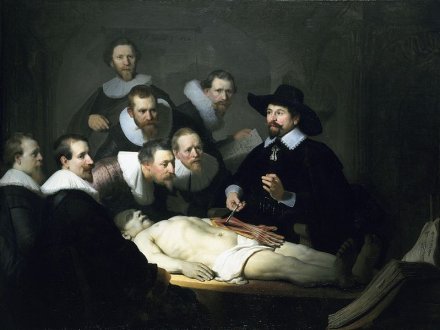
Rembrandt’s The Anatomy Lesson of Dr. Nicolaes Tulp (1632), whose subject was a prosperous surgeon later to become mayor of Amsterdam. The anatomized man is robber Aris Kindt, who had been executed earlier that same day.

No surprise that this revolutionary social machine found grist for its mill — commodified corpse-objects, the workers most literally alienated from their produce — at the foot of the scaffold.

That which hides and envelops, the curtain of night over truth, is, paradoxically, life; and death, on the contrary, opens up to the light of day the black coffer of the body: obscure life, limpid death, the oldest imaginary values of the Western world are crossed here in a strange misconstruction that is the very meaning of pathological anatomy.

Herewith, four who expired to open up their living fellows’ shambling carrion to that life-breathing medical gaze.

Highly recommended additional reading: Jai Virdi’s “The Criminalized Body” series: I, II, III, IV, V.

On this day..

Daily Double: The High Treason Incident

It’s a century since Japan extirpated its anarchist menace.

“Anarchists in Japan!” begins our (enthusiastic) source. “For many the very idea is surprising.”

Japan’s popular image is of a hierarchical and regimented society, while the Japanese are widely regarded as unswervingly loyal servants of the company and the state. Even within Japan there are many Japanese who are unaware of the anarchist movement’s existence, of the martyrs who have died for the cause, and of the sustained struggle that has been fought against the capitalist state and the inhumanity it has perpetrated over the years.

Now, sure, Japan’s modernizing Meiji government was challenged by the feudal rearguard.

But even “hierarchical,” “regimented,” “unswervingly loyal” Japan displayed the characteristically lethal conflicts of the early 20th century: Communist assassins, wartime moles, nationalist putsches.

In 1910, a bust of anarchists caught scheming an imperial assassination led to a guilt-by-association roundup known as the High Treason Incident, an in camera trial of 26 anarchists hysterically “connecting” people to friends to comrades to alleged inspirations like Glenn Beck’s blackboard. One of the accused (according to Shusui Kotoku) had been badgered into “admitting” having once talked admiringly about the Paris Commune.


Newspaper sketch of the High Treason Incident defendants. (From here.) Shusui Kotoku is on the left; Suga Kanno is in the center.

Where radicalism itself is treasonable, small surprise that a trial of 26 radicals resulted in 24 death sentences. The offended sovereign majesty generously commuted half of them.

Over January 24 and 25 in 1911, the less fortunate dozen faced death, just days after their convictions.

On this day..

Themed Set: 2010

At 1,100-odd posts as of this writing, we’ve chronicled a fair few historical executions in different lands and places since our launch.

But whatever our volume, the world’s [real] headsmen do more efficient work than its antiquarians.

Executions in the contemporary world have averaged several per day over recent years (conservatively, 714 total in 2009; 2,390 in 2008), and those are just the documented ones: observers have long believed the true tally to be several times any given year’s official count.

North Korea, for instance, is notoriously opaque on the point, but is believed to carry out at least hundreds per year; figures for China, the perennial global leader, are derived from counting those officially announced, but many occur that are not publicized and the real number is considered a state secret. And that’s leaving aside the annual harvest of semi-official, extrajudicial stuff.

The bottom line is that with each passing day’s Executed Today post, the shelves of tales yet untold only groan with still greater weight. It’s bound to bury us, sooner or later.

Before it does, we offer this next week a nod to the death penalty in the here and now … or at least, last year: seven different trips to seven countries’ scaffolds (or modern-day simulacra thereof), an insufficient but perhaps not unrepresentative look at the the modern executioner — inexorably at work day by day, faster than you read these words.

On this day..

Themed Set: Reputation

“A good name is rather to be chosen than great riches, and loving favour rather than silver and gold.”

Proverbs 22:1

In which our voyeuristic gaze is drawn, as so often, to the spectacle of English subjects once esteemed and now consigned to the lowest of the dead.

On this day..

Themed Set: Executions in Effigy

One of the weirder epiphenomena of death penalty history is the imposition in absentia not only of death sentences, but of executions themselves.

Executions in effigy, practiced in many European countries well into the 18th century, featured paintings or dummies of absconded malefactors which were “executed” in place of their flesh-and-blood models.

The belief that an effigy and the person ‘effigiated,’ to use an old word, were sympathetically identified, and that hurt done to the former reached the latter, lived on to a very late time in Europe. We are by no means sure that this belief is not at present being traded on by the hole-and-corner magicians and sorcerers who are at times dragged out into the light, and made to disgorge their robberies from simple servant-girls …

Execution by effigy seems to the practical minds of the English (as it did to the Romans) too puerile to be used by a serious nation.* We should find no satisfaction for our own indignation, and see no indication of the majesty of our law, in punishing a criminal’s picture, because we could not punish the criminal himself.


Hanging of Traitors in Effigy, by Jan Piotr Norblin de la Gourdaine – an incident during the Targowica Confederation.

The French, however, have always treated symbols with gravity … Execution by effigy was a solemn legal institution in France prior to the first Revolution …

The French law vindicated its outraged honour upon the effigy of a criminal in cases of contumacy, that is, when the criminal absented himself or took to flight. It is not impossible that the condemned sometimes secreted himself in the crowd, and saw with comical relief his picture or his doll suffering in his stead.

While rooted in medieval superstition, this bizarre practice (one thinks of self-conscious executioners conducting such farcical operations) had its benefits: “death” sentences could be carried out without the unedifying spectacle of actual mass bloodletting. One correspondent, lightly reflecting on a spate of executions-in-effigy reflected:

It was amusing to see such a number of pictures exhibited in the place of execution, all beheaded by the hangman — as many as thirty in one day. These bloodless executions and decent representations, which inflicted only a little disgrace, were a sight the more agreeable because there was justice without blood. These pictures were exposed for one day, and the people thronged to see this regiment of criminals — dead without dying. It is a device of the law to disgrace those it cannot punish, and to chastise the crime when it cannot reach the criminal.

For the next few days, Executed Today remembers the chastisement of such criminals, beyond the reach of the law.

* It’s not that clear-cut. And, of course, the English have an entire holiday built around re-executing effigies of their most famous traitor. These, however, are popular ceremonies rather than juridical outcomes. Like this:

On this day..

Themed Set: Thomas Hardy

English poet and novelist Thomas Hardy, whose gloomy cast of mind makes him particularly suitable for these pages, lived most of his nearly 90 years right next door to death.

Hardy’s work spans the English experience from the Napoleonic Wars to the First World War, ever haunted by tragedy and loss. This guy wrote “Dead Man Walking” before Dead Man Walking.

I am but a shape that stands here,
A pulseless mould,
A pale past picture, screening
Ashes gone cold.

Bummer.

For the next few posts, Executed Today catches a young Thomas Hardy as witness to public hangings … and an aged Hardy as witness to a world at war.

On this day..

Themed Set: The Empire Strikes Back

There’s a reason that all the brass of the evil galactic empire in the Star Wars trilogy* are Brits.

* Episodes IV-VI. Executed Today is not at home to the prequels.

On this day..

Themed Set: Executions for Abolitionists

This blog’s raison d’etre is not to carry a brief in the death penalty debate.

But whatever can be said of capital punishment in its modern American manifestation, the executioner mills into jagged, glass-sharp relief everything about crime and criminal justice, even about truth and redemption and matters even more fundamental to humanity than life and death.

The debate, however worn, is itself a part of the landscape of the death penalty Executed Today surveys, and like this site, it gravitates towards dates.

This week, we mark cases which have been marked by death penalty opponents: not necessarily because these cases are all themselves exemplars of infamous injustices, but because they cast into relief the humanity of the condemned, sitting paradoxically beside the humanity of those called upon to kill him.

As David Dow observed in his recent exploration of the personal toll exacted by Texas’s capital punishment regime, The Autobiography of an Execution,

[m]urder is perhaps the ugliest crime, which is why it is so shocking that most murderers are so ordinary in appearance. Average height, average weight, average everything. Even after all these years, some part of me expects people who commit monstrous deeds to look like monsters. I meet them, and they look like me.

There but for god …

On this day..

Daily Double: Revolutionary Justice

The revolutionary year 1794 has made unsurprisingly regular appearances in these pages.

The French Revolution was going great guns, and giving the National Razor near-daily workouts here at the height of the Terror. But France wasn’t the only revolutionary game on the continent.

On these next two dates, in Europes west and east, tribunals of the people soon to be overthrown by events meted out their revolutionary justice to their enemies.

On this day..