1694: Mette Jensdatter, Viborg infanticide

On this date in 1694, a young woman died an infanticide in Viborg, Denmark.

Denmark in the 17th century consolidated into an absolute monarchy and with this came a consolidation of the sovereign power of life and death. Once a local office comprising a variety of obligations and prerogatives, the executioner gig became in this period a state-level appointee answering to the governor, and charged with exercising his law enforcement aspect throughout a region.

According to a post formerly at the Viborg Museum site but now consigned to the digital oubliette, executioners so appointed soon began exercising their privileged labor position to gouge prices as well as limbs, eventually requiring (in 1698) a royal edict fixing their fees thusly (all prices are quoted in rigsdalers):*

Beheading with an ax 8 dlr.
Plucking off a hand or a finger 4 dlr.
Nailing up a severed head and hand (pair) 4 dlr.
Hanging 10 dlr.
Dismantling gallows 4 dlr.
Breaking someone on the wheel 14 dlr.
Mounting a broken body on the wheel 7 dlr.
Corpse burial 3 dlr.
Tearing flesh with red-hot tongs (per tear) 2 dlr.
Public whipping 5 dlr.
Burning a person 10 dlr.
Burning condemned books 3 dlr.

Hopefully Viborg was saving its rigsdalers accordingly for in the same era as this list we have — again via the Viborg Museum’s phantom post — a sad instance of a domestic tragedy that is all too familiar in these pages:

On 30 August 1694 was the executioner summoned to execute maid Mette Jensdatter. The story behind was tragic; Mette, who was in the house of Søren Kristensen Høeg in St Michael’s Street, secretly gave birth on the first of August to a boy. On the same day she killed her child and hid the body under the bed. Søren Høeg was classified as the child’s father, but apparently Mette alone was tried and convicted.

Høeg did not escape the opprobrium of his neighbors and his conscience, for a few months later he attempted suicide and in punishment was banished from Viborg.

* I’ve limited the list to the most grisly entries.

On this day..

1651: Christopher Love

(Thanks to English Presbyterian poet Robert Wild for the guest post in verse, celebrating the martyrdom of his coreligionist Christopher Love. Love died for seditious correspondence with the exiled Stuart then-pretender Charles II. Days after Love lost his head, Charles very nearly did likewise when he lost the decisive Battle of Worcester to Oliver Cromwell — famously escaping the rout by a harrowing, six-week flight that repeatedly came within an ace of landing him with his father in our deck of execution playing cards. -ed.)

THE TRAGEDY OF CHRISTOPHER LOVE AT TOWER HILL August 22. 1651.

Prologue.
New from a slaughtred Monarchs Herse I come,
A mourner to a Murthr’d Prophet’s Tombe:
Pardon, Great Charles his Ghost, my Muse had stood
Yet three years longer, till sh’had wept a flood;
Too mean a Sacrifice for Royall Blood.
But Heaven doe by Thunder call
For her attendance at Love’s Funerall.
Forgive Great Sir, this Sacriledge in me,
The Tear he must have, it is his Fee;
‘Tis due to him, and yet ’tis stol’n from Thee.

ARGUMENT.
‘Twas when the raging Dog did rule the Skies,
And with his Scorching face did tyrannize,
When cruell Cromwell, whelp of that mad Star,
But sure more firery than his Syre by far;
Had dryed the Northern Fife, and with his heat
Put frozen Scotland in a Bloody sweat:
When he had Conquered, and his furious Traine
Had chas’d the North-Bear, and pursu’d Charle’s waine
Into the English Orb; then ’twas thy Fate
(Sweet Love) to be a present for our State.
A greater Sacrifice there could not come,
Then a Divine to bleed his welcome home
For He, and Herod, think no dish so good,
As a Iohn Baptists Head serv’d up in blood.

ACT I.
The Philistins are set in their High Court,
And Love, like Sampsons, fetch’d to make them sport:
Unto the Stake the smiling Prisoner’s brought,
Not to be Try’d, but baited, most men thought;
Monsters, like men, must worry him: and thus
He fights with Beasts, like Paul at Ephesus.
Adams, Far and Huntington, with all the pack
Of foysting Hounds were set upon his back.
Prideaux and Keeble stands and cries A’loe;
It was a full Cry, and it would not doe.
Oh how he foyl’d them, Standers-by did swear,
That he the Judge, and they the Traytors were:
For there he prov’d, although he seem’d a Lambe,
Stout, like a Lyon, from whose Den he came!

ACT II.
It is Decreed; nor shall thy Worth, dear Love,
Resist their Vows, nor their revenge remove.
Though prayers were joyn’d to prayers, & tears to tears,
No softnesse in their Rocky hearts appears;
Nor Heaven nor Earth abate their fury can,
But they will have thy Head, thy Head, good Man.
Sure some She sectary longed, and in hast
Must try how Presbyterian Blood did tast.
‘Tis fit she have the best, and therefore thine,
Thine must be broach’d, blest Saint, its drink Divine.
No sooner was the dreadfull Sentence read,
The Prisoner straight bow’d his condemned Head:
And by that humble posture told them all,
It was an Head that did not fear a fall.

ACT III.
And now I wish the fatall stroke were given;
I’m sure our Martyr longs to be in Heaven,
And Heaven to have him there; one moments blow
Makes him tryumphant; but here comes his woe,
His enemies will grant a months suspence
If’t be but for the nonce to keep him thence:
And that he may tread in his Saviours wayes,
He shall be tempted too, his forty dayes:
And with such baits too, cast thy self but down,
Fall, and but worship, and your life’s your own.
Thus cry’d his Enemies, and ’twas their pride
To wound his Body, and his Soul beside.
One plot they have more, when their other fail,
If Devils cannot, disciples may prevail.
Lets tempt him by his friends, make Peter cry
Good Master spare thy self, and do not die.
One friend intreats, a second weeps, a third
Cries your Petition wants the other word:
I’le write it for you, saith a fourth; your life,
Your life Sir, cries a fift; pity your wife,
And the Babe in her: Thus this Diamond’s cut,
By Diamonds onely, and to terrour put.
Me thinks I hear him still, you wounding heart;
Good friends forbear, for every word’s a dart:
‘Tis cruell pity, this I do professe,
You’ld love me more, if you did love me lesse:
Friends, Children, Wife, Life, all are dear I know,
But all’s too dear, if I should buy them so.
Thus like a Rock that routs the waves he stands,
And snaps a sunder, Sampson-like these bands.

ACT IV.
The day is come, the Prisoner longs to go,
And chides the lingring Sun for tarrying so.
Which blushing seemes to answer from the skie,
That it was loath to see a Martyr die.
Me thinks I heard beheaded Saints above
Call to each other, Sirs, make room for Love.
Who, when he came to tread the fatall Stage,
Which prov’d his glory, and his Enemies rage.
His bloud ne’re run to his Heart, Christs Blood was there
Reviving it, his own was all to spare:
Which rising in his Cheeks, did seem to say,
Is this the bloud you thirst for? Tak’t I pray.
Spectators in his looks such life did see,
That they appear’d more like to die than he.
But oh his speech, me thinks I hear it still;
It ravish’d Friends, and did his enemies kill:
His keener words did their sharp Axe exceed,
That made his head, but he their hearts to bleed:
Which he concludes with gracious prayer, and so
The Lamb lay down, and took the butchers blow:
His Soul makes Heaven shine brighter by a Star,
And now we’re sure there’s one Saint Christopher.*

ACT V.
Love lyes a bleeding, and the world shall see
Heaven Act a part in this black Tragedie.
The Sun no sooner spide the Head o’th’ floore,
But he pull’d in his own, and look’d no more:
The Clouds which scattered, and in colours were,
Met all together, and in black appear:
Lightnings, which fill’d the air with Blazing light,
Did serve for Torches all that dismall night:
In which, and all next day for many howers,
Heaven groan’d in Thunder, and did weep in showers.
Nor doe I wonder that God Thundred so
When his Bonarges murthered lay below:
Witnesses trembled, Prideaux, Bradshaw, Keeble,
And all the guilty Court look’d pale and feeble.
Timerous Ienkins, and cold-hearted Drake
Hold out, you need no base Petitions make:
Your enemies thus Thunder-struck no doubt,
Will be beholding to you to goe out.
But if you will Recant, now thundring Heaven
Such approbation to Loves Cause hath given.
I’le adde but this; Your Consciences, perhaps,
Ere long, shall feele far greater Thunder-claps.

Epilogue.
But stay, my Muse growes fearfull too, and must
Beg that these Lines be buried with thy dust:
Shelter, blessed Love, this Verse within thy shroud,
For none but Heaven dares takes thy part aloud.
The Author begs this, least if he be known,
Whilst he bewailes thy Head, he loose his own.**

FINIS.

* A little wink by the author. The Saint Christopher was a supposed early Christian martyr depicted as either or both of a Canaanite giant or a dog-headed man — real tall-tale stuff. His historicity came under fire from iconoclastic critics of the Humanist and Reformation traditions; for example, Erasmus pooh-poohed this folklore in his In Praise of Folly.

** Wild usually worked anonymously in his time, for obvious reasons.

On this day..

1647: Thomas Boulle and the remains of Mathurin Picard, for the Louviers possession

In the Louviers case, a horrid record of diabolism, demoniac masses, lust and blasphemy, on 21 August, 1647, Thomas Boullé, a notorious Satanist, was burnt alive in the market-square at Rouen, and what is very notable the body of Mathurin Picard who had died five years before, and who had been buried near the choir grille in the chapel of the Franciscan nuns which was so fearfully haunted, was disinterred, being found (so it is said) intact. In any case it was burned to ashes in the same fire as consumed the wretched Boullé and it seems probable that this corpse was incinerated to put an end to the vampirish attacks upon the cloister.

From The Vampire: His Kith and Kin, by Montague Summers

On this date in 1647, Thomas Boulle, vicar of Louviers, France, was executed as a witch.

Reminiscent of the recent Loudun Possessions — and perhaps directly inspired by the lucrative pilgrimage trade earned by that recent witchcraft scam — the Louviers Possessions featured a similar cast of characters: possessed, fornicating nuns; performative public exorcisms; and a village priest as the demoniacal mastermind whose bonfire climaxed the whole show. (Said priest had, as Summers notes in the pull quote above, the substantial aid of a deceased confederate, the former director of the nunnery who did his supernatural mischief from the grave.)

As with Loudun and several other high-profile witch panics in 17th century France the tableau was thoroughly pornographic with a parade of nuns reporting being taken to Black Mass orgies and copulating with a demon named Dagon.

Magdelaine Bavent, the first accuser who started the fireball rolling, was interviewed for print a few years later. The resulting Histoire de Magdelaine Bavent, Religieuse de Louviers, avec son interrogatoir is one of the key primary documents on the affair.

On this day..

1661: Jin Shengtan, literary scholar

On this date in 1661, scholar Jin Shengtan — the “father of vernacular Chinese literature” — was executed.

Jin Shengtan (English Wikipedia entry | Chinese) had the misfortune of reaching his intellectual maturity amid the collapse of the Ming Dynasty and the ensuing chaotic transition to the Qing.

In those years he contributed a perspicacious literary commentary that resides to this day in the canon of Chinese letters; his criticism is credited with raising the stature of Chinese vernacular literature, for instance via his meticulous analysis of Water Margin — now rated as one of the four classic Chinese novels.

In 1661, Jin took part in a protest against official corruption whose violent suppression is remembered to Chinese history as the “Lamenting at the Temple of Confucius”. Jin’s particular lament — probably apocryphal but too good not to repeat — has been remembered as a jest from the edge of the grave: “Being beheaded is the most painful thing, but for some reason it’s going to happen to me. Fancy that!”

On this day..

1678: Thomas Hellier, “Groans and Sighs”

Thomas Hellier, a miserable New World indentured servant who murdered his master and mistress along with another servant to escape his Virginia plantation, was hanged on this date in 1678.

Desperate in London after frittering away the £12 he stole from his parents without successfully getting his barbering/surgeon business off the ground, Hellier was talked into signing into an indenture. To his recruiter, the skeptical Hellier remembered (in his gallows confession),

I replied, I had heard so bad a character of that Country, that I dreaded going thither, in regard I abhorred the Ax and the Haw. He told me, he would promise I should be onely employ’d in Merchants Accompts, and such Employments to which I had been bred, if they were here used.

Just get them to sign on the line which is dotted. Promises to the contrary, Hellier upon arrival got sold straightaway to a farm that calloused his surgeon’s hands with all the abhorrent tools. The place was literally named the Hard Labour Plantation.

Friend of the site Anthony Vaver (author of Bound with an Iron Chain and Early American Criminals) has a nice profile of this small bit of chum for the emerging Atlantic economy on his site Early American Crime.

It seems that after trying and failing to escape his farm once, Hellier loosed himself by busting into the master’s bedchamber with an axe and bashing to death Mr. Cutbeard Williamson — right hand to God, that’s the name — and his wife, plus the maid who also resided in the house. Although he fled the grounds, neighbors suspicious of his close-cropped hair — a scarlet letter imposed after his previous escape to mark him as a runaway — detained him and the law soon caught up.

Hellier took the opportunity of his execution to sting the Virginia planter class for its abuse of employees, although to some readers eyes it might equally appear a manifesto for laziness.

How much more consonant and agreeable were it to common Policy, Self-interest, as well as true Christian Charity, for all Masters in Virginia, Planters as well as others, to consider first their own Ability, and the Capacity of the Servants whom they designe to purchase, before they deal for them; sincerely at the same time imparting to them, What their Work must be, and what their Usage? And if, by enquiry into their former Condition, they discover them improper persons for their purpose; How much a wiser course were it, that such should seasonably pitch their choice on some others, more useful for them? Or if they will chuse no others, Conscience and Christianity sure ought to oblige them to use such Servants as their Christian Brethren, with Gentleness and Courtesie, content with their honest endeavours, not Tyrannizing over Christians, as Turks do over Galley-slaves, compelling them unmercifully beyond their strength.

For though Masters justly do expect and require Fidelity and painful Industry from their Christian Servants, and such Servants ought to put themselves forth to their utmost power for their Masters Benefit: Yet, the merciful Man exerciseth Mercy towards his Beast, much more toward a Christian Servant. And let cruel, tyrannical, Egyptian Task-masters know, that their Master is also in Heaven, whose Omniscience beholds and knows all persons dealings, and will judge according to Equity, without respect of persons, in his own due time, and listen to the Groans and Sighs of poor oppressed Wretches, vindicating the cause of injur’d Innocents, retributing crosses, vexations and troubles to all Wrong-doers.

And whereas this poor Penitent Wretch declar’d, That the bitterness of his ill-tongued Mistress was the main immediate provocation prompting and exciting him to give way to Satan’s suggestions, while he tempted him to perpetrate this horrid, execrable Outrage: I suppose, all will grant, that Bitterness in any case (especially to morigerous Servants of a gentle Temper, obediently willing to do their endeavours) is no way Christian-like nor commendable, but rather Patience and kinde usage … Also you that are Masters of Servants in this Country, have respect to them, to let them have that which is necessary for them, with good words, and not (Dam you dog, do such a thing, or such a thing.) They are not Dogs, who are professed Christians, and bear God’s Image; happily they are as good Christians as your selves, and as well bred and educated, though through Poverty they are forced to seek Christianity under thy roof; where they usually find nothing but Tyranny. Be good to your Servants, as you would have God be good to you. Servants, in all things obey your Masters according to the flesh, not with eye-service as man-pleasers, but with singleness of heart, fearing God. Masters, give to your Servants what is right and equal; know that you also have a Master in Heaven.

On this day..

1630: Guglielmo Piazza and Giangiacomo Mora, colonna d’infamia

On this date in 1630, a ludicrous disease panic sent two innocent men to the scaffold in Milan.

Terrified as their family and neighbors dropped dead around them of a raging bubonic plague outbreak, the surviving Milanese sprouted buboes on their brains.


1630 illustration of the plague-wracked Milanese doing the bring-out-your-dead thing.

Just days before the executions marked in this post, a city official named Guglielmo Piazza was noticed by some busybodies “strolling down the street writing from an ink-horn at his belt and wiping his ink-stained fingers on the walls of a house.” They promptly reported him not for misdemeanor property damage but for spreading plague poison, whatever that would be.

Investigators to their shame gave this accusation enough credence to interrogate Piazza under torture, a decision which obviously was tantamount to the execution itself. He broke he sealed his own fate when he broke and confessed, and sealed same for a misfortunate barber named Giangiacomo Mora whom Piazza was made to accuse.

Milan was proud enough of this obvious injustice to stand up an colonna d’infamia (“column of infamy”) denouncing both “poisoners” until a storm finally knocked the lying marble down in 1788. It read,

Here, where this plot of ground extends, formerly stood the shop of the barber Giangiacomo Mora, who had conspired with Guglielmo Piazza, Commissary of the Public Health, and with others, while a frightful plague exercised its ravages, by means of deadly ointments spread on all sides, to hurl many citizens to a cruel death. For this, the Senate, having declared them both to be enemies of their country, decreed that, placed on an elevated car, their flesh should be torn with red-hot pincers, their right hands be cut off, and their bones be broken; that they should be extended on the wheel, and at the end of six hours be put to death, and burnt. Then, and that there might remain no trace of these guilty men, their possessions should be sold at public sale, their ashes thrown into the river, and to perpetuate the memory of their deed the Senate wills that the house in which the crime was projected shall be razed to the ground, shall never be rebuilt, and that in its place a column shall be erected which shall be called Infamous. Keep afar off, then, afar off, good citizens, lest this accursed ground should pollute you with its infamy.

August, 1630.

Prior to the column’s overturning, the Milanese Enlightenment intellectual Pietro Verri wrote a meditation upon it titled Sulla tortura e singolarmente sugli effetti che produsse all’occasione delle unzioni malefiche, alle quale si attribui la pestilenza che devasto Milano l’anno 1630. Italian speakers can enjoy it here.

On this day..

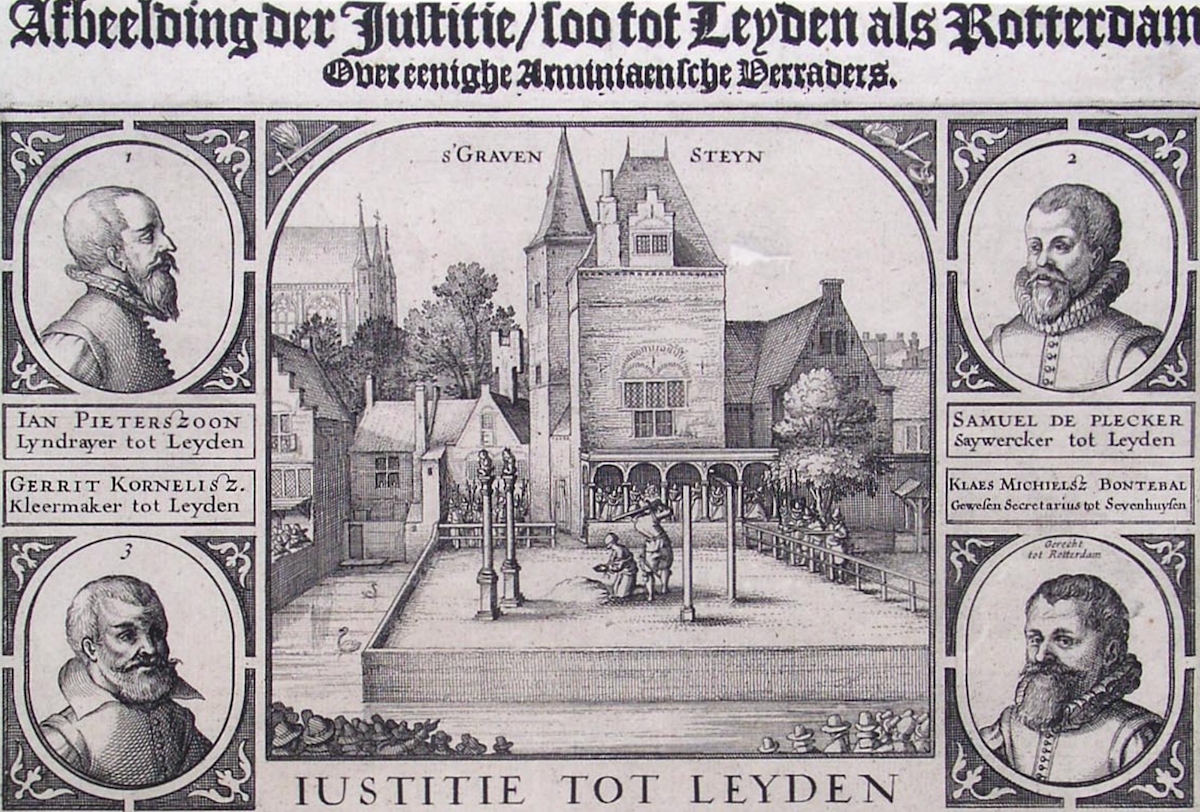
1623: Claes Michielsz Bontebal, Maurice murder moneybags

We’ve previously addressed in these pages the 1623 execution of Reinier van Oldenbarnevelt for attempting to assassinate Maurice, Prince of Orange in revenge for his, Maurice’s, 1619 execution of Oldenbarnevelt’s father.

Well, the scheme here was to hire a number of assassins for the attack, a plan which guaranteed that someone would blab and blow the whole deal. But before the blabbing and the blowing, the hiring required a vast cash outlay — 6,000 guilders to be precise.

Claes Michielsz Bontebal (English Wikipedia entry | Dutch) was one of the financiers who did the hiring, and got caught in the blowback after the blabbing. He was executed with three other conspirators


Detail view of a 1623 print reporting the beheading (click for a larger view with portraits of Bontebal and his collaborators).

On this day..

1685: Archibald Campbell

On this date in 1685, the 9th Earl of Argyll went the same way as the 8th.

We’ve addressed in these pages the travails borne by Archibald Campbell, 8th Earl of Argyll, whose once considerable power was overwhelmed by the Wars of the Three Kingdoms and came to an end under the blade of the Edinburgh maiden.

While imprisoned awaiting the chop, the 8th Earl composed for his much-reduced heir, also named Archibald Campbell, composed a volume titled Instructions to a son with a variety of foreshadowing maxims.

You have a great task to do, you must from the bottome climb up to the mount of Honour, a very abrupt and difficult ascent; which yet, nevertheless by observing the sure footings of some of your progenitors, and the slips of others, particu?larly those recent slidings of mine own, (for other they are not) you may at last attain the top, and by your own merit and your Princes favour, your House may be Culminant again.

If it shall so happen … have a care then of that Precipice; let no revenge or ambition blind you into destruction; you may poise your self with your wings of Honour and Greatness, but venture not, nor presume to fly.

Covet not with immoderate hast Lands, Riches, Honour, for it is seldom that men whose rash desires and designs are laid out that way, compass their full content, and for the most part meet with a destiny far other then they expected; and when they are once so disappointed, Fortune or rather Providence so much amazeth the judgment even of wise men, as in time of danger they know not what resolution is best to be taken. You will not be necessitated through the want of these three, so as to reach at them unlawfully, and endanger what you have in possession, and your self together

‘Tis folly to complain of life, more to be troubled at the end of it, by the reason we ought more to complain of our birth, that made and produced us mortal, then of our death, which will render us immortal.
To be long or short lived is no more then this, we come either sooner or later (no great choice) to our grave. He is very desirous of life, who is un?willing to dye when all the world is weary of him.

The kid did his late dad proud in the 1660s, regaining the attainted earldom and re-establishing the rank and wealth of their house. Argyll — and by this name henceforth we refer to Argyll fils — nurtured Presbyterian sympathies which told strongly against him when a failed Presbyterian rebellion touched off the fruitful-for-this-site era of the Killing Time.

From this point his position speedily eroded and his evasion of an oath of loyalty to Protestantism — when he finally took it he added his own unauthorized disclaimer, “only in as far as it is consistent with itself” — got him arrested, and a dubious charge of libeling the king was questionably stretched to compass a death sentence. That was around the end of 1681; on December 20 of that year, his daughter Sophia Lindsay visited him, accompanied by their page. When secluded in the dungeon, the page and the doomed man swapped clothes, and Argyll clattered away in servants’ livery to hiding in London safehouses and continental refuges.

Having already been taken for a traitor, this Argyll on the lam went all-in for unambiguous sedition. Ciphered communications of his were among the papers seized from Baillie of Jerviswood after the exposure of the Rye House Plot.

With the passing of King Charles II in 1685 and the long-feared succession of his Catholic brother James II, Scots in Holland mounted an invasion of their home country in an attempt to topple the government. Our man lent it both leadership and title: it’s known as Argyll’s Rising and was intended to complement/support the English Whig rising under the Duke of Monmouth.

Argyll’s expedition turned up in Scotland in May 1685 and instantly went sideways. Amid leadership conflicts and lukewarm recruitment, the rebellion collapsed. Argyll was captured by a militia who “would fain have concealed his rank, as they durst not release him; but he was recognised by their officer. He was led to Edinburgh, where he was treated with the same indignities as had formerly been the lot of Montrose. As the king had ordered him if taken to be put to death within three days, he was executed on his former iniquitous sentence (30th). He met his fate with piety and fortitude; embracing the instrument of death, he called it (in allusion to its name) the sweetest maiden he had ever kissed.”


The Last Sleep of Argyle (1860s) by Edward Matthew Ward: the man was reported to have slept so serenely on his last night on earth that he had to be awakened for execution.

The next generation of Campbell chiefs finally got the political calibration right, supporting the invasion of William and Mary to overthrow James II which elevated the Argylls to the dukedom which their heirs maintain to this day.

On this day..

1690: Tom Kelsey, royal robber

From the Newgate Calendar:


An audacious young Thief who robbed the Tent of King William in Flanders and stabbed a Newgate Turnkey. Executed 13th Of June, 1690

THOMAS KELSEY was born in Leather Lane, in the parish of St Andrew, Holborn; but his mother being a Welsh woman, and she having an estate of about forty pounds per annum, left her by an uncle at Wrexham, in Denbighshire, the whole family — which consisted only of the two old people, and this their son — went down thither to live upon it.

Tom was from his infancy a stubborn, untoward brat, and this temper increased as he grew up; so that at fourteen years of age he was prevailed on by one Jones, who has since been a victualler in London, to leave his father and come up to town, in order to seek his fortune. Having neither of them any money, they were obliged to beg their way along in the best English they were masters of. Going one day to a gentleman’s house with their complaint, he took a liking to the boys, and received them both into his house: Kelsey in the quality of a horsekeeper and Jones as a falconer. It may be supposed they were both awkward enough in their callings, but Tom’s place was the least difficult, so that he kept it the longest, the gentleman being soon weary of his falconer, and glad to send him about his business again.

It was not a great while after, before Tom Kelsey was detected in some little pilfering tricks, and turned out of doors after his companion, whom he could not find when he came to London. His being out of place till he could subsist no longer, and his natural inclination to dishonesty, soon brought him forward in the course of life for which he was afterwards so infamous. He fell into company with thieves, and was as bold and as dexterous in a little time as the best of them, if not even beyond them all.

Going one day by the house of Mr Norton, a silversmith in Burleigh Street, near Exeter ‘Change, a couple of his companions came by him like strangers, and one of them snatched off his hat, and flung it into the goldsmith’s chamber window, which stood open, running away as fast as they could. Tom, who had a look innocent enough to deceive anybody, made a sad complaint to Mr Norton, who stood at his door and saw all that passed. It happened that at that time there was nobody at home but himself, of which Tom had got intelligence before. “Poor lad!” says Mr Norton, “you shall not lose your hat; go upstairs and fetch it yourself, for I cannot leave the shop.” This was just what Tom wanted; he went up and took his hat, and with it a dozen of silver spoons that lay in his way, coming down in a minute, and making a very submissive bow to Mr Norton for his civility, who let him go without suspicion. This prize was divided between him and his two associates, as is common in such-like cases.

Tom was not, however, so successful in his villainies but that he was condemned to be hanged before he was sixteen years of age. The fact was breaking open the house of one Mr Johnson, a grocer in the Strand, and stealing from thence two silver tankards, a silver cup, six silver spoons, a silver porringer, and forty pounds in money. But he got off this time on account of his youth, and the interest his father made at court; for, hearing of his son’s condemnation, the old gentleman came directly up to town, and arrived before the day appointed for his execution, procuring a full pardon by the mediation of some powerful friends.

To prevent his following the same courses again, and exposing himself afresh to the sentence of the law, the old gentleman put his son apprentice to a weaver, but before he had served half-a-year of his time he ran away from his master, and took to his old courses again. It was his pride to make all whom he conversed with as bad as himself, an instance of which appeared in what he did by one David Hughes, a cousin of his by the mother’s side. This youth, going to Kingston Assizes along with Tom a few days after he came to town, was prevailed upon by him to pick a pocket in the court; in which action being apprehended, he was immediately tried, and condemned to be hanged upon a gibbet within sight of the Bench, as a terror to others. This week was fatal enough to young Hughes; for he came to London on the Monday, on Tuesday and Wednesday spent and lost ten pounds, which was all the money he had, along with whores and sharpers, on Thursday in the evening picked a pocket, was condemned on Friday morning, and hanged on Saturday. This was the end of one of Kelsey’s hopeful pupils, who had the impudence to boast of it.

Another of the actions of this extravagant was his robbing the Earl of Feversham‘s lodgings. This nobleman was General of the Forces in the reign of King James II, and consequently had a sentinel always at his door. Tom dressed himself in a foot-soldier’s habit one evening, and went up to the fellow who was then on duty, asking him a great many questions, and offering at last to stand a drink, if he knew where to get a couple of pots of good beer. The soldier told him there was very good a little beyond Catherine Street, but he durst not leave his post so long as to fetch it. “Can’t I take your place, brother soldier?” quoth Tom. “I am sure if somebody be at the post there can be no danger.” The soldier thanked him, took the sixpence, and went his way; meanwhile Tom’s associates got into the house, and were rifling it as fast as they could. They had not quite done when the soldier came back; whereupon Tom gave him twopence more, and desired him to get a little tobacco also. While the poor fellow was gone for this the villains came out, and Tom went with them, carrying off not only above two hundred pounds worth of plate, but even the soldier’s musket. The next day the sentinel was called to account, and committed to prison. At the ensuing court martial he was ordered to run the gauntlet for losing his piece, and then was sent to Newgate, and loaded with irons, on suspicion of being privy to the robbery, where, after nine months’ confinement, he miserably perished. Kelsey, after this, broke open the house of the Lady Grace Pierpont, at Thistleworth, and stole from thence a great many valuable things. But soon after one of his companions impeached him for this fact; whereupon, being informed that the officers were in search after him, he fled to the camp of King William in Flanders. Here he got a considerable booty out of his Majesty’s tent, and from other general officers, with which he got to Amsterdam, and sold it to a Jew, whom he also robbed afterwards, and sold what he had gotten to another Jew at Rotterdam, from whence he re-embarked for England.

He had not been long returned to his native country before he was detected in breaking open the house of a linen-draper in Cheapside, which put a final end to his liberty, though not to his villainy, for, being sent to Newgate, and having no hopes of ever getting out any more, unless to go to Tyburn, he grew desperate, and resolved to do all the mischief he could there. Mr Goodman, one of the turnkeys of that jail, being one day drinking in the common-side cellar, Kelsey privately stabbed him in the belly with a knife, of which wound he instantly died. For this murder he received sentence of death at the next session in the Old Bailey, and a gibbet being erected in Newgate Street, near the prison, he was thereon executed, on Friday, the 13th of June, 1690, being then no more than twenty years of age. As a terror to the other prisoners who were then in confinement, his body was suffered to hang on the gibbet the space of three hours.

On this day..

1627: Catlyn Fiermoing, village witch

The sorceress Catlyn Fiermoing was burned on this date in 1627 at the village of Wommersom.

A standard witch-hunt case, Fiermoing apparently got into hot water calling on the devil in a fight with her husband 19 years before her death, which summons Old Scratch duly answered and duly sealed the bargain with the usual promissory notes and carnal violations: this at least is the gist of what her interrogation records preserve us. (Dutch speakers can read a summary in here: part 1 | part 2.) She used her supernatural powers to get a little bit of money and kill some local rivals’ cows.

On this day..