1828: William Rice but not John Montgomery, who cheated the hangman with prussic acid

(Thanks to Meaghan Good of the Charley Project for the guest post. -ed.)

Just before 6:00 a.m. on July 4, 1828, prison officers arrived at the cell of disgraced ensign John Burgh Montgomery in Newgate Prison‘s condemned hold.

They were there to escort Montgomery to his hanging. The 33­-year-­old would have been one of the last in England executed for for the crime of uttering forged notes — except that his wardens instead found him lying stone dead. With the aid of prussic acid, the counterfeiter had cheated the hangman of half his day’s prey, leaving his prospective gallows partner, thief William Rice, to face the hemp alone.

Although his guards had confiscated his razor and penknife as a routine precaution against suicide, no one had expected Montgomery to take his own life. He had pleaded guilty before the court and seemed resigned to his fate. In custody he was a model prisoner, spent his last days writing to his loved ones, and “addressed himself with great anxiety to his religious offices.”

Nobody was able to figure out how the condemned man came by enough poison to kill thirty people and how he kept it hidden, given that he and his cell were regularly searched.

The Irish-­born Montgomery, Nicola Sly records in her book Goodbye, Cruel World… A Compendium of Suicide,

was said to be a very respectable, well­-educated man, who had once held a commission in the Army. However, after inheriting a considerable fortune, he frittered it away and resorted to passing phony banknotes to support his rather dissipated lifestyle. Given his pleasing looks, gentlemanly appearance and good manners, he was very successful, since nobody thought him capable of any wrongdoing. However, he was caught after becoming careless and making the mistake of committing frequent repeated offense in a small geographical area of London.

Montgomery left behind several letters, marked by expansive tragic romanticism but no hint of suicidal intent. One letter was for the prison surgeon, asking that his body be used for dissection. He said that by this he wanted to provide some positive contribution to the public to make up for his crimes. He asked that his heart be preserved in spirits and given to his girlfriend.

To the girlfriend he wrote,

My dear idolized L.,

One more last farewell, one more last adieu to a being so much attached to the unhappy Montgomery. Oh, my dearest girl. If it had been in the power of anyone to avert my dreadful doom, your kind exertions would have been attended with such success. Oh, God, so poor Montgomery is to die on the scaffold. Oh, how dreadful have been my hours of reflection, whilst in this dreary cell.

Oh, how tottering were all my hopes; the bitterness of my reflection is bitter in the extreme. This will be forwarded to you by my kind friend Mrs. D. I should wish you to possess my writing portmanteau. Oh, I wished to have disappointed the horrid multitude who will be assembled to witness my ignominious exit. Farewell forever,

P.S. Here I kiss fervently.

The jury on the inquest into Montgomery’s death recorded a verdict of felo de se, meaning that Montgomery had willfully and knowingly taken his own life whilst of sound mind. As such, his body was buried in the graveyard of St. Sepulchre­-without-Newgate at night, and without any memorial service.

On this day..

1865: Thomas King, heartstabber

From the public domain History of Siskiyou County, California Illustrated with Views of Residences, Business Buildings and Natural Scenery, and Containing Portaits and Biographies of its Leading Citizens and Pioneers.

THOMAS KING.

After lying in jail two years, and receiving two trials, hoping for a release from the extreme penalty of the law until a few weeks before his death, Thomas King was executed on the twenty-third day of June, 1865, for a heartless and causeless murder, for dealing a death-blow, unprovoked and unexpected. He was born in Ireland, and when about twelve years of age, left his home because his parents had punished him for some offense. For several years he roamed about the United Kingdom, the associate of bad characters, until for the commission of
some felony he was transported to Australia.

When the Crimean war was raging, a regiment was raised among the convicts, by order of Lord Raglan, the men being given their liberty at the close of the war. In this regiment King enlisted, and after the fall of Sebastopol received his discharge. He made his way to Halifax, and from there to California, and to this county. After mining at Humbug, Scott Bar and various other places, he went to the south fork of Scott river, where he committed the terrible crime, for which the law exacted the penalty of his life.

On the second of July, 1863, having already become considerably under the influence of liquor, he entered French’s saloon, and began flourishing a knife in a threatening manner, and was deprived of it by the barkeeper. Among others in the saloon was James Duffy, who had been drinking, and whom King accused of having his knife. The accusation was denied, and upon being informed where the knife was, King demanded it from the barkeeper and it was restored to him. Throwing the weapon upon the floor and striking a tragic attitude, he exclaimed: “There lays me dagger. Whoever picks it up, dies by me hand.”

Not dreaming of danger, Duffy stooped, picked up the weapon and laid it upon the counter, saying, “You wouldn’t kill me, your best friend, would you?” “Yes, I would,” he said, as he took up the knife and made several false motions, touching Duffy’s breast with the handle, while the victim stood there smiling, unconscious of danger. Suddenly King reversed the knife, and with a, quick, hard blow, buried it deep in Duffy’s heart, the murdered man sinking to the floor with the exclamation, “You have cut me.” King made a pass with the bloody weapon at the barkeeper, and then sprang to the door and fled. The horrified witnesses of the tragedy stood for an instant in blank amazement, and then hastened in pursuit of the murderer, whom they soon overtook and secured after a slight resistance.

He remained in jail until the following February, when, after a trial lasting three days, he was found guilty of murder in the first degree, and was sentenced by Judge E. Garter to be executed Friday, March 18, 1864. An appeal to the Supreme Court gained for the condemned man a new trial, based upon the construction of a statute, and not upon the merits of the case. He was again tried in September, and was sentenced to be hanged on Friday, November 4, 1864, but an application to the Supreme Court produced a stay of proceedings until the case could be reviewed by that body. While awaiting the decision of the court, on Saturday, the eighth of February, 1865, he made a bold, and for a time, successful attempt to regain his freedom. Confined in the jail, which was the old wooden building first erected by the county, were also George Foster and Robert Ferry, both under a sentence to the penitentiary for grand larceny, and McGuire, a deserter from the army. The last named was allowed in the corridor, and was in the habit of calling for water. About eight o’clock on the night in question Foster succeeded in getting out of his cell, and after releasing the prisoners from their cells, had McGuire call for water, as usual, and when Jailor McCullough opened the door he was seized, gagged, and bound, and the prisoners escaped, having their irons still upon them. They had been gone but twenty minutes when their flight was discovered. The town was aroused, and people started in all directions in search of the fugitives. About daylight Ferry was caught at Cherry creek by John Hendricks and others. having been unable to get rid of his irons. About two o’clock Sunday afternoon William Short and Charles Brown found King in a clump of manzanita bushes, near Deming’s old brickyard, but a short distance south-west of Yreka. His long confinement of nineteen months had so weakened him that he had been unable to proceed further or to remove the irons from his limbs, although one of them he had succeeded in sawing partially through. A party composed of Livy Swan, A.V. Burns, J. Babb, A.D. Crooks, Sherman, Stone, and Groots, in pursuit of Foster and McGuire, stopped Monday night at Cherokee Mary’s, a resort for thieves, nine miles from Yreka. About four o’clock Tuesday morning the two fugitives approached the house and were ordered to surrender, and upon attempting to escape were fired upon by Jesse Sherman, with a shot gun, and Foster was wounded in the head and captured, while McGuire escaped by flight. Foster had succeeded in removing his irons, and now, severely wounded, was conveyed again to jail, while McGuire went to Fort Jones, and, finding escape impossible, gave himself up. Foster and Ferry had the terms of their sentences increased, while McGuire, who would have been released in a few days, was sent to San Quentin for two years for his little exploit in jail-breaking.

George Foster, alias Charles Mortimer, alias Charles J. Flinn, was the leader in the jail delivery, a hardened and reckless felon, and ended his career upon the scaffold. He was first sent to San Quentin from San Francisco for three years, and when his term expired, went back, chloroformed a man and robbed him of $1,800, was arrested, and escaped from officer Rose, by knocking him senseless and nearly cutting his throat. He then came to Siskiyou county, and was soon sentenced to three years for grand larceny, which term was increased to seven years for his participation in the jail delivery. After his release he continued his career of crime, finally murdering a woman in Sacramento, September 19, 1872, for which act he paid the penalty upon the gallows, not, however, until his brother lost his life in a desperate attempt to release him from the jail in which he was confined while awaiting the day of his execution.

The Supreme Court having reviewed the case and sustained the decision of the lower court, King was brought before Judge Garter in May, and was sentenced to be hanged on Friday, June 23, 1865. Preparations were accordingly made by Sheriff A.D. Crooks by erecting a gallows in the jail-yard. King’s conduct during the trials had been one of bravado and defiance, and this he maintained to the last, being quite abusive while on the scaffold. He remarked as they were leading him from his cell to the place of his death, “I’m the handsomest man here, if I am going to be hung.” But few spectators were admitted within the jail walls to witness the last act of this terrible drama, which culminated at nine minutes to two o’clock. The murderer who thus received the just punishment for the crime, nearly two years after he had plunged the fatal knife into an innocent and unsuspecting bosom, was buried a little east of town, near the remains of Crowder and Sailor Jim, executed several years before.

On this day..

1894: William Whaley, “the horror of the situation”

This ghastly description of a botched hanging comes courtesy of the out-of-print The palace of death, or, the Ohio Penitentiary Annex: A human-interest story of incarceration and execution of Ohio’s murderers, with a detailed review of the incidents connected with each case by H.M. Fogle (1908):


Chapter 19

William Whaley
June 22, 1894

A negro robber who beat out the brains of Allen Wilson, near Yellow Springs, Ohio, with a dray pin. Hanged June 22, 1894

A Brutal Robber Meets a Just Fate


William Whaley, serial number 25,257, was executed in the Ohio Penitentiary Annex twelve minutes after the birth of a new day, June 22, 1894, for the brutal murder of Allen Wilson, a thrifty and hard working colored man.

The crime was committed near Yellow Springs, Greene County, Ohio, on the night of June 6, 1893. Robbery was the motive for the crime, and a dray pin the instrument of destruction. He sneaked upon his victim in the dark, and literally beat his brains out.

Whaley was a young man not over twenty-five years of age, and with perhaps one exception, was the most profane man that was ever incarcerated in the Ohio Penitentiary Annex. He refused all spiritual consolation, and cursed his executioners almost with his dying breath. He was a cowardly cur, and betrayed his cowardice while on the scaffold. Three times he sank to his knees as the noose was being adjusted. The attending Guards were compelled each time to assist him to his feet, and finally to hold him up by main strength until the rattle of the lever shot his body through the open trap. Being almost in a total state of collapse, the body instead of plunging straight through the opening, pitched forward, striking the side of the door, thus breaking the force of the fall. For this reason the neck was not broken, and death was produced by the slow and harrowing process of strangulation.

Reader, if you have never seen a sight of this kind you cannot understand or comprehend the horror of the situation. Time after time the limbs were drawn up with a convulsive motion, and then straightened out with a jerk. The whole body quivered and shook like one might with the ague; while the most hideous and sickening sounds came from the throat. This continued for eighteen minutes; but to one looking on it seemed an age. After eighteen minutes the sounds ceased; the body became perfectly still; the limbs began to stiffen; the heart-beats to weaken. In just twenty-six minutes after the drop fell the last pulsation was felt, and the doctor solemnly said: “Warden, I pronounce the man dead.”

The outraged law had been avenged, and a soul unprepared had been ushered into Eternity.

On this day..

1890: Elizabeth and Josiah Potts, wife and husband

On this date in 1890, an affectionate married couple hanged together in Elko, Nevada, for a murder they insisted they had not authored.

We obtain this headline and the associated (nationally circulated) story from the San Diego Union of June 26, 1890.

[Associated Press Dispatches.]

ELKO, Nev., June 20. — Elko is in a ferment of excitement, many parties pouring in to witness the execution of the Potts family for the murder of Miles Fawcett in January, 1888. Over sixteen women have already applied for permits to witness the execution, which were refused.

The conduct of Mrs. Potts during the past five days has been an alternation of hysterical crying, screaming and swearing at her husband, who mopes the time away in solitude. Yesterday morning at 5 o’clock she attempted to commit suicide, gashing her wrists and trying to smother herself. The vigilance of the death watch prevented further injury but she fainted from loss of blood. Both the Potts retired early last night in a nervous condition.

At 10:30 o’clock the Sheriff read the death-warrants to Josiah and Elizabeth Potts. The reading of the warrant took place in the doorway of the latticed cell, which Josiah has occupied for so long a period.

He stood in a despondent attitude, with his head bowed down against the iron bars, and not once during the reading of the warrant did he lift his head. His wife stood erect, clad in a neat muslin suit draped in black, with a red rose in her bodice. She was pale, but with a most determined aspect in every feature. During the reading of her own warrant only once did she show any emotion whatever, and she convulsively clutched her throat when her husband’s was being read, and when the words “hanged by the neck till you are dead” were reached, she gave a hysterical gasp and seemed to exhibit much feeling.

The reading of the warrants was finished at 10:30, and both the condemned people emerged from the jail, where they had been confined for eighteen months, and proceeded outside the door to the yard between the Courthouse and jail, in which the scaffold had been erected. The sunshine relieved in a measure the gruesome surroundings. During the readings of the warrants, and evidently owing to the intense nervous strain on every one, a Deputy Sheriff was so overcome that he had to call for a glass of water.

At the conclusion of the reading Mrs. Potts earnestly ejaculated:

I AM INNOCENT AND GOD KNOWS IT,

and Josiah Potts reiterated, “God knows we are innocent.” The gloomy procession led the way through a side door and with a bravery unexpected by the sixty-odd spectators, the condemned couple seated themselves on stools provided on the scaffold, while the deputies speedily proceeded to bind them with leather straps, Mrs. Potts helping to adjust them herself while Potts sat through it all in stolidity.

When everything had been properly adjusted, they were directed to rise and all of the attendants shook hands with the condemned unfortunates. The attendants held the strap attached to Mrs. Potts’ manacled wrists and Potts made several most earnest endeavors to clasp the hands of his wife but without accomplishing it. Finally a touch on her wrist caused her to turn her eyes toward his and a mute appeal of love caused their lips to meet. As the rope was stretched around Mrs. Potts’ neck she clasped her hands together, and lifting her eyes towards the sky, exclaimed “God help me; I am innocent.”

Her husband reiterated in a hollow tone, “God knows we are innocent,” as the black caps were drawn over their heads.

The words of the clergyman who had remained with them to the last broke the silence by saying: “Put your trust in God and He will see you righted,” and then the drop fell. Instantaneously,

MRS. POTTS WAS A CORPSE,

owing to her heavy weight. Her flacid [sic] flesh caused a rupture of the carotid artery and a stream of blood burst forth from under the chin of the dead woman, staining her white raiment. To the great surprise of all who had seen Potts’ emaciated condition his vitality was great, it being a fraction over fourteen minutes, as counted by the Associated Press reporter, before life was pronounced extinct by Drs. Meiggs and Petty.

At 11:08 the body of Mrs. Potts was cut down when it was seen that her excessive weight on the five foot and a half drop had almost dissevered her head from the trunk, the muscles in the back of her neck alone supporting the connection.

About nine minutes later Josiah Potts’ body was cut down and the body of himself and wife, in the absence of any claiming friends, were deposited in the potter’s field of the Elko grave yard half an hour later.

After the interment of the bodies of Mr. and Mrs. Potts, District Attorney Love, accompanied by an Associated Press reporter, placed in the potter’s field all the remains of the murdered Fawcett known to exist above the earth. The box of bones had been in the District Attorney’s office at the Courthouse from the time when he first started to search for the criminals.

THE CRIME

for which the couple was executed was the murder of Miles Fawcett, 70 years of age, at Carlin, January 1st, 1888, because he insisted on being paid some money due from Potts. He visited Potts and this was the last seen of him until his dead body was discovered some months after by a person who rented the house formerly occupied by Potts.


That’s the end of the Union article.

Despite the incriminating circumstances of Mr. Fawcett’s disappearance, many people found the Potts’s insistence upon their innocence persuasive … especially after a last message from Elizabeth Potts reached public ears.


Laramie (Wyoming) Daily Boomerang, June 24, 1624.

Innocent or guilty, Elizabeth Potts remains the first, last, and only woman ever legally executed in Nevada. As of this writing (mid-2018) the Silver State has not had any woman on death row since Priscilla Joyce Ford died in 2005.

On this day..

1866: Barthelemy Cellier, true sangfroid

Dying graciously is a — in that blessed space of unfeigned equanimity, in between fright and bluster — is a difficult art. On this date in 1866, the central France town of Riom guillotined an otherwise forgettable criminal who attained that Stoical condition.

By the account of La Petit Journal (French, obviously), double murderer Barthelemy Cellier was awoken at 3 a.m. on the morning of his beheading, with news of the rejection of his appeals. “Ah, ah,” said Cellier calmly, “it’s today!” Well, it’s as good today as it is tomorrow!”

Cellier listened to the curé “avec beaucoup de calme”, called for a glass of Bourdeaux wine and a cigarette, and then,

bare-headed, dressed in the prison outfit: gray trousers, white clogs, a gray jacket thrown over his shoulders, smoking his cigarette, walked with a firm step between the two ecclesiastics … Behind came the executioners and mounted gendarmes.

The course was about two hundred meters. Throughout this journey, Cellier’s face was marked by the most perfect serenity; a gracious smile wandering in his eyes and on his lips gave him rather the countenance of a man walking towards his deliverance than of a criminal going to execution.

The scaffold was surrounded by a large number of people from Riom and the surrounding area; but, thanks to excellent preparation, the dismal machine was separated from the crowd by fifty yards at least. Detachments of soldiers rigorously maintained this perimeter.

Arriving at the foot of the scaffold, Cellier raised his head and looked, without pallor, the fatal cleaver.

He threw out his cigarette and crushed it with his foot.

Then, turning to the honorable priests, he spoke for a few seconds with them, kissed both effusively and climbed alone with a sure stride the steps separating him from the platform.

There, with a sudden movement, he dropped the jacket which hid his shoulders, and having with a glance examined the crowd, without bravado, without affectation, always with the same calm and the same smile, he twice graciously greeted the apparatus. Not a single word was spoken. The hour had just tolled. A sudden noise, immediately accompanied by a few women’s comments and a shriek from the crowd, announced that the supreme act had been accomplished. Cellier’s spirit had not been broken for a moment. He died demonstrating true sangfroid. The crowd slowly went away, deeply moved by the dreadful drama which had just been broken up in a few seconds.

On this day..

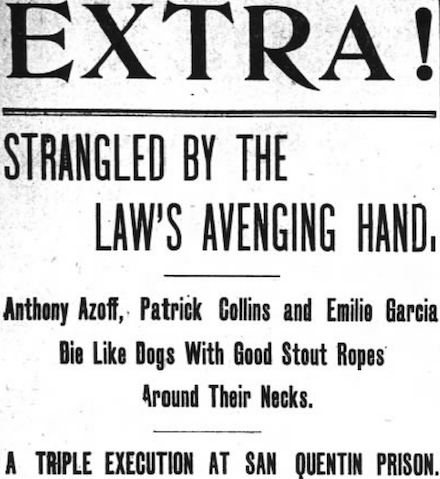
1895: A day in death penalty around the U.S. (McTeague edition)


Headline from the Tacoma (Wash.) Daily News, June 7, 1895.

On this date in 1895, the hangman noosed for the cycle with single, double, and triple executions in three different U.S. states.

Arkansas

In Morrilltown, William Downs or Downes for criminally assaulting a woman called Pauline Bridlebaugh.

“On the scaffold Downs declared that he was guilty of part but not all he was charged with,” according to multiple newspaper reports. The eight-foot fall failed to snap his neck, and Downs strangled to death over 15 agonizing minutes.

Alabama

“Lee Harris and Abe Mitchell, colored murderers, highwaymen and thieves, were hanged here [Birmingham] today before 2000 people for the murder of Grocerymen Merriweather and Thornton. Both bodies were turned over to the undertakers, who purchased them several weeks ago for $18 from the men themselves.”


From the Oakland Tribune, June 7, 1895.

California

Three Californians hanged, sequentially, at San Quentin prison on the morning of June 7 in an affair timed to ensue the arrival of the 7:40 train from San Francisco, carrying about 100 official witnesses.

Emilio Garcia stabbed and slashed to death a San Bernardino old timer whom he believed to possess a hoard of gold.

Anthony Azoff fatally shot a Southern Pacific detective in the course of a botched robbery of that railroad firm’s offices; he was balked of a suicide attempt in the hours before his execution.

And Patrick Collins acquired more lasting infamy than any of his scaffold brethren by sensationally stabbing to death his estranged wife at the kindergarten where she worked when she refused his demand to hand over her wages.

Collins’s guilt was very apparent, so his trial gave the horrified public ample rein to sketch the brute in terms of the era’s crackpot racist typologies. In one Examiner article tellingly titled “He Was Born for the Rope,” it was postulated that “if a good many of Patrick Collins’ ancestors did not die on the scaffold then either they escaped their desert or there is nothing in heredity … Seeing him you can understand that murder is as natural to such a man when his temper is up as hot speech is to the anger of the civilized.”


Various newspaper images of Patrick Collins, from The Construction of Irish Identity in American Literature.

Be they ever so headline-conquering in their time, such crimes are like to fade speedily from the public memory. Collins, the man who slaughtered his tightfisted wife, and Collins, the savage ethnic archetype, have improbably survived his moment of notoriety, by imparting to literature the inspiration for San Francisco novelist Frank Norris‘s 1899 offering McTeague.

In McTeague, a vicious husband murders the wife he has abandoned when she refuses him money. The murderer here presents as an overpowering ancestral beast within — attributable, says Christopher Dowd, to Norris’s “study of criminal anthropology, particularly the school of thinking developed by Cesare Lombroso regarding atavism, hereditary criminality, degeneration, and criminal physiognomy. According to Donald Pizer, by the time Norris wrote McTeague, he had developed a ‘preoccupation’ with the themes of atavism and reversion, and ‘particularly with the role of heredity in causing either an obvious physical or mental devolution or a return to an earlier family condition’. Suddenly, Norris had a way to explain the behavior of his murderous protagonist — he was born a criminal, having inherited the degenerate traits and predilections of his Irish ancestors. Combined with the newspaper reports of the Collins murder, criminal anthropology gave Norris all the tools he needed to write, what Pizer calls, ‘that mythical creature of literature, a naturalistic tragedy'”. For example, Norris zooms through the disordered mind of McTeague as he struggles to control himself on one occasion.

He was disturbed, still trembling, still vibrating with the throes of the crisis, but he was the master; the animal was downed, was cowed for this time, at least.

But for all that, the brute was there. Long dormant, it was now at last alive, awake. From now on he would feel its presence continually; would feel it tugging at its chain, watching its opportunity. Ah, the pity of it! Why could he not always love her purely, cleanly? What was this perverse, vicious thing that lived within him, knitted to his flesh?

Below the fine fabric of all that was good in him ran the foul stream of hereditary evil, like a sewer. The vices and sins of his father and of his father’s father, to the third and fourth and five hundredth generation, tainted him. The evil of an entire race flowed in his veins. Why should it be? He did not desire it. Was he to blame?

McTeague does not exit upon the gallows as did his real-life inspiration; instead, having murdered and robbed his wife, the fugitive flees to the scorching desert of Death Valley where he faces a fight to the finish with a friend/rival who has pursued him. McTeague overpowers this foe, but the man’s dying act is to handcuff himself to McTeague — condemning the latter to sure death.

McTeague has long been in the public domain; it can be perused here; a Librivox audio reading of the book is available here. It’s also been adapted to at least two films in the silent era — including one of the genre’s greats — plus a more recent PBS radio drama, an opera, and miscellaneous other media.

On this day..

1900: Guzeppi Micallef, Maltese felon

This tale of a dreadful Maltese wife-murder arrives via the Times of Malta’s roundup of sensational hanging crimes on that Mediterranean island. Now independent, Malta was still British-controlled at the time of the events in this excerpt.

A marker outside Corradino Prison records the people hanged on its gallows, including Guzeppi Micallef

The murder of 19-year-old Roza Micallef is undoubtedly the most sensational uxoricide of the 19th century. Roza was precious for her husband, Guzeppi, but he was fearful of losing her. This fear was the result of jealousy.

The couple, who had been married only for a few months, lived in a farmhouse at Maghtab. Roza’s parents objected to the marriage as Guzeppi’s brother was married to Roza’s sister and their marriage was not a happy one. However, Roza did not take heed her parents’ warnings and married Guzeppi.

Roza and her husband used to work in the fields with her parents. She was a lively woman and enjoyed talking to relatives and friends. Her husband objected to this behaviour and warned her to be less talkative. Two days prior to the murder, she was seen waving to her uncle, Alessandro. This affectionate gesture triggered off the quarrel Guzeppi had with his wife on the night of the murder.

After sunset on October 8, 1899, Roza’s brother, Teofilio, heard his brother-in-law crying for help as his wife had been hit by a shot accidentally fired by his shotgun. According to Guzeppi, the shotgun was resting against the wall when he accidentally hit it with his foot. The firearm slid to the ground and was discharged accidentally, hitting Roza in her breast.

When the police were called, Teofilio told them that some time before he heard the shot he called on his brother-in-law, Guzeppi, to give him some money. Teofilio said that when he was at his sister’s house he was sure that something wrong was afoot; however, he chose not to interfere.

Regarding the shot, Teofilio said that when he heard the firing of a shotgun he thought that Guzeppi had shot his neighbour’s dog which was barking at that time.

The post-mortem examination revealed that the shotgun had been discharged from a high position and not from the floor as Guzeppi had affirmed in his statement. Moreover, court experts appointed to investigate the case further confirmed that Roza did not die as a result of an accident.

Guzeppi was charged with his wife’s murder and his trial opened on May 28, 1900. The prosecution produced witnesses who testified that the accused was very jealous of his wife. However, Dr Etienne Micallef, the defence counsel, maintained that the accused was jealous because he feared he might lose his wife’s love and had no intention of killing her.

As the accused was found guilty with a unanimous vote, he was sentenced to death.

Representatives of the Chamber of Advocates, the president of the Chamber of Commerce and the Council of Government petitioned the [Lord] Grenfell [Governor of Malta] to commute the sentence but he refused the appeal.

Micallef was hanged on June 6, 1900. He was only 20 years old and the only man in Malta since 1800 to have been hanged for uxoricide.

On this day..

1806: Dominic Daley and James Halligan, hated foreigners

On this date in 1806, immigrants Dominic Daley and James Halligan were hanged at Northampton, Massachusetts. In the words of one widely reproduced report, “They persisted in their innocence to the last moment, although there were perhaps not a single one of the numerous spectators present, which was presumed to amount to nearly 15,000, who entertained a doubt of their guilt.”

Today, nearly everyone thinks them innocent.

The case began, as many wrongful convictions do, with a particularly outrageous crime — a young farmer, Marcus Lyon, found dead in a Massachusetts creek en route to his home in Connecticut. He’d been shot through the chest and his brains battered out of his skull. The motive: robbery.

In the absence of substantive evidence, some witnesses with vague reports of strangers on the fatal turnpike furnished tissue for an entire theory of the case, and through the misapprehended focus of tunnel vision the strangers became Irishmen, and the Irishmen became Dominic Haley and James Halligan.

In the close aftermath of American independence, New England was still overwhelmingly Anglo-Saxon and Protestant. Most of the Irish people about at this moment were also Protestants: large-scale Irish Catholic immigration into the region only began in the 1820s and it panicked the normies when it came, with preachers and politicians railing against the insidious incursions of idolatrous papists.

So in 1805, when the hunt for strangers settled on two Irish-born Catholic immigrants … well, what was left to know? Just days later, a North Wilbraham Congregationalist minister thundered from the pulpit,

We see the evil attending a continued influx of vicious and polluted foreigners in this country. Many of the outrages we suffer proceed from this source. Who break open our homes in the unsuspecting hours of sleep? Who set fire to our large cities and towns for the sake of plunder? And who rob and commit murder on our highways? We are far from exculpating all of our own native citizens; we regret, indeed, that so many of them disgrace themselves and injure society by evil deeds. But these things notwithstanding, we are doubtless justified in saying, that a great proportion of the crimes above mentioned, together with many others which might be named, are committed by foreigners. And that atrocious deed which has so recently congealed all our blood with horror, in this place, is supposed to have been perpetrated by foreigners. Look at the annual reports of the overseers of the prisons and you will find them be principally occupied by foreigners

The first planters of this country were, generally speaking, men of pure lives and good morals and they were induced to come here for the sake of religion. And, for a long time, they maintained a wholesome and orderly state of society. But since the rapid increase of our commerce with other nations, and the great ingress of foreigners, many of whom are said to come here for the sake of escaping the retribution of justice in their own country; we have ripened apace in all the arts of vice and depravity. Some, who come among us from abroad, we readily acknowledge to be worthy and good men, and we cordially welcome their approach. But the number of these is comparatively small. The best and most useful citizens are cautiously retained, while the worst are readily parted with. Hence the rapid influx upon us, of late, of the most violent and abandoned of the human race. The late and present disturbances in foreign countries have greatly increased the calamity. The prisons of Europe and the West Indies are now disgorging themselves upon our shores; and this country is thus becoming the general asylum of convicts. This is a sore evil, and will furnish an increasing number of inhabitants for our prisons and victims for the halter.

The case in court would comprise 24 witnesses not one of whom had witnessed the crime; at most they could suggest that two strangers had taken the same well-trafficked public road on the same day as the victim, who was also a stranger in these parts. Even this much was not certain among the witnesses; their renderings were vague, tentative, contradictory — but witness recollections and prejudicial readings of circumstance soon shaped themselves around the shared understanding of events, and from so much smoke they wove the hemp.

The friendless immigrants’ court-appointed attorney, Francis Blake, who had been tasked with this first capital case of his life a bare 48 hours before the trial opened, made a vehement, eloquent, and futile address to the jury against “this illiberal, this inhuman prejudice” closing around the throats of his clients.

That the prisoners have, however, been tried, convicted, and condemned, in almost every bar-room, and barber’s-shop, and in every other place of public resort in the county, is a fact which will not be contested. That the sentence of the law has not been anticipated, and that they have not already suffered the penalty of death, may be ascribed rather to defect of power, than to lenity of disposition, in many of their accusers …

There is yet another species of prejudice, against the influence of which it is my duty to warn you. I allude to the inveterate hostility against the people of that wretched country, from which the Prisoners have emigrated, for which the people of New-England are peculiarly distinguished …

Pronounce then a verdict against them! Condemn them to the gibbet! Hold out an awful warning to the wretched fugitives from that oppressed and persecuted nation! Tell them that although they are driven into the ocean, by the tempest which sweeps over their land, which lays waste their dwellings, and deluges their fields with blood; — though they float on its billows upon the broken fragments, of their liberty and independence; — yet our inhospitable coast presents no Ararat upon which they can rest in safety; that although we are not cannibals, and do not feast upon human flesh, yet with all our boasted philanthropy, which embraces every circle on the habitable globe, we have yet no mercy for a wandering and expatriated fugitive from Ireland. That the name of an Irishman is, among us, but another name, for a robber and an assassin; that every man’s hand is lifted against him; that when a crime of unexampled atrocity is perpetrated among us, we look around for an Irishman; that because he is an outlaw, with him the benevolent maxim of our law is reversed, and that the moment he is accused, he is presumed to be guilty, until his innocence appears! …

The lives of the prisoners are now consigned to your disposal. Before you proceed to the performance of this awful duty, let me borrow the language of one of their countrymen, not degraded by the ignominious reproaches against his nation, but elevated to the highest rank among the orators of the elder world by the most splendid talents, the purest patriotism, and the most unsullied integrity. Let me beseech you to “remember that there is another than a human tribunal, where the best of us, will, on one day, have occasion to look back on the little good we may have done. In that solemn trial may your verdict on this day give assurance to your bones and afford you strength and consolation in the awful presence of an adjudging God!”

The words fell on deaf ears.

Daley and Halligan maintained their innocence from arrest to execution, but in the end they would require the offices of another foreign refugee, Father Jean-Louis de Cheverus, a French-born priest in Boston, who had fled the anti-clerical paroxysms of his own homeland. (Later, he would become the first Catholic Bishop of Boston.) It’s said that he stayed in jail with his charges, as no one in Northampton would suffer the papist priest to sleep under their own roof — and that his ministrations to them included the first Catholic mass said in that city.

Folklore cropped up around the 1830s to the effect that a local man had given a deathbed confession exonerating the hanged Irishmen … and that this murderer was the kinsman of one of the witnesses against Daley and Halligan. I cannot establish that this is any more than a just-so story, a fable, but even so it speaks to the continuing injury done by this execution to the now-growing Irish Catholic community. In time that demographic’s maturing numbers and political muscle flipped the story of Daley and Halligan from one of foreigners ripened in depravity to a sobering caution against bigotry and rush to judgment.

We have no real way, now, to access a definitive assessment of guilt or innocence; we can certainly say with confidence that the evidence was appallingly flimsy to hang a man even for the time. Both Daley and Halligan were posthumously exonerated by a writ of Massachusetts Gov. Michael Dukakis in 1984. Dukakis discussed that action, and history’s view of the Daley-Halligan railroading, in a 2011 panel available in podcast form here.

For additional resources, check this Historic Northampton page (already linked several times within this post). Below, you can read the entirety of an 1806 publication reporting the trial, from which the defense lawyer’s remarks have been drawn.

On this day..

1813: A Nez Perce thief, by the Pacific Fur Company

On this date in 1813, Anglo-American fur trader John Clarke had an indigenous Nez Perce summarily hanged for stealing a goblet … dangerously poisoning relations between the respective communities in the Pacific Northwest.

We lay our day’s scene in the Oregon Territory, far frontier of then-only-prospective American continental expansion, beyond even the fathomless reaches of the Louisiana Purchase. The Stars and Stripes had penetrated there courtesy of the Lewis and Clark Expedition, but British, Spanish, and Russian expeditions had planted their own flags too, to say nothing of the claims of its native inhabitants.

And all these claimants had one common desire: the pelts of the beavers swarming that verdant sector.

The New York businessman John Jacob Astor bought a stake in the fur trade in the form of the Pacific Fur Company, and set down the outpost of Astoria, Oregon. (Astor was destined to become one of the republic’s early homegrown plutocrats, a fact which is merely incidental for our purposes. It was the fur business that propelled him to wealth.)

One agent of the P.F.C. was a singularly undiplomatic trader aged about 31 summers, John Clarke. Calling on a mixed Nez Perce-Palouse village to trade his canoes for horses to make an overland journey, Clarke was irritated to find that prices weren’t to his liking and the locals enjoyed pilfering his baubles.

American scribbler Washington Irving recorded the ensuing events:

[Clarke] was a tall, good-looking man, and somewhat given to pomp and circumstance, which made him an object of note in the eyes of the wondering savages. He was stately, too, in his appointments, and had a silver goblet or drinking cup, out of which he would drink with a magnificent air, and then lock it up in a large gardevin, which accompanied him in his travels, and stood in his tent. This goblet had originally been sent as a present from Mr. Astor to Mr. M’Kay, the partner who had unfortunately been blown up in the Tonquin. As it reached Astoria after the departure of that gentleman, it had remained in the possession of Mr. Clarke.

A silver goblet was too glittering a prize not to catch the eye of a Pierced-nose. It was like the shining tin case of John Reed. Such a wonder had never been seen in the land before. The Indians talked about it to one another. They marked the care with which it was deposited in the gardevin, like a relic in its shrine, and concluded that it must be a “great medicine.” That night Mr. Clarke neglected to lock up his treasure; in the morning the sacred casket was open—the precious relic gone!

Clarke was now outrageous. All the past vexations that he had suffered from this pilfering community rose to mind, and he threatened that, unless the goblet was promptly returned, he would hang the thief should he eventually discover him. The day [May 31st, 1813] gassed away, however, without the restoration of the cup. At night sentinels were secretly posted about the camp. With all their vigilance a Pierced-nose contrived to get into the camp unperceived, and to load himself with booty; it was only on his retreat that he was discovered and taken. At daybreak the culprit was brought to trial, and promptly convicted. He stood responsible for all the spoliations of the camp, the precious goblet among the number, and Mr. Clarke passed sentence of death upon him.

A gibbet was accordingly constructed of oars; the chief of the village and his people were assembled and the culprit was produced, with his legs and arms pinioned. Clarke then made a harangue. He reminded the tribe of the benefits he had bestowed upon them during his former visits, and the many thefts an other misdeeds which he had overlooked. The prisoner especially had always been peculiarly well treated by the white men, but had repeatedly been guilty of pilfering. He was to be punished for his own misdeeds, and as a warning to is tribe.

The Indians now gathered round Mr. Clarke and interceded for the culprit, They were willing he should be punished severely, but implored that his life might be spared. The companions, too, of Mr. Clarke, considered the sentence too severe, and advised him to mitigate it; but he was inexorable. He was not naturally a stern or cruel man; but from his boyhood he had lived in the Indian country among lndian traders, and held the life of a savage extremely cheap. He was, moreover, a firm believer in the doctrine of intimidation.

Farnham, a clerk, a tall “Green Mountain boy” from Vermont, who had been robbed of a pistol, acted as executioner. The signal was given, and the poor Pierced-nose, resisting, struggling, and screaming, in the most frightful manner, was launched into eternity. The Indians stood round gazing in silence and mute awe, but made no attempt to oppose the execution, nor testified any emotion when it was over. They locked up their feelings within their bosoms until an opportunity should arrive to gratify them with — a bloody act of vengeance.

Having made his grand gesture, Clarke quickly realized that he had enacted it while his small party was alone in an Indian village where they were at the mercy of their far more numerous hosts. Fearing a backlash, the white traders accordingly hightailed it back to Astoria, and then evacuated Astoria itself.

On this day..

1883: Not Alferd (sic) Packer, #nerdprom attendee

The National Press Club is probably best known for its White House Correspondent’s Dinner. This site prefers to think of it as the site of the Alferd Packer plaque, a memorial to a cannibal who avoided hanging.


(cc) image from Kurt Riegel.

The plaque is rather unassuming, its simple polished brass declaring: “The Alferd Packer Memorial Grill — In Memory of Stan Weston 1931-1984.” Weston was the public affairs officer at the U.S. Department of Agriculture, who came up with a 1977 contest to name the USDA’s new cafeteria. But hold that thought for now.

Packer was born in Pennsylvania in 1842. He made his way west and joined the Union Army in Minnesota, then ambled on into the Rockies as a pioneer after the Civil War. In a particularly stunning feat of incompetence, he and five others separated from a larger expedition and tried to make it across a mountain pass in January 1874. Three months later, Packer arrived on the other side, declaring that he got separated from the other five.

But Packer had taken money and effects from them, which made the remaining members of his expedition more than a little suspicious. Caught out in a lie, Packer confessed to a carnivorous progress through his comrades: Israel Swan froze to death, and he was eaten; James Humphreys died a few days later, and he was eaten; then Frank Miller was likely murdered and eaten; and George “California” Noon fell to the pistol of Wilson Bell. With Bell armed and dangerous, Packer claims to have killed him and taken a bit of a snack for the road.*

Packer was arrested shortly after his return, but he slipped his bonds and escaped to Wyoming. There the law finally caught up to him. He was returned to Colorado, where a judge sentenced the cannibal to death.

The hanging was not to be. Packer appealed the conviction, which was ultimately overturned by the Colorado Supreme Court; on retrial he was remanded for a 40-year prison sentence instead. He was paroled in 1901, took a job as a guard at the Denver Post (who had, incidentally, helped him make parole), and died in 1907.

Back to the memorial grill.

Why would the USDA honor such an odd historical figure? Politics.

In 1977, newly appointed Secretary of Agriculture Bob Bergland had a beef with the General Service Administration, which refused to terminate the Nixon-era contract award for cafeteria services and food. Bergland’s response? Let the disgruntled employees name** and shame. The USDA cafeteria became the Packer Memorial Grill,† and Bergland paraded the press through the facility, taking every opportunity to point out just how similar he felt the food was to the diet of the honoree.

The contract was rescinded later in 1977. The plaque, meanwhile, was taken off the wall just a week after its installation. Initially, the GSA claimed it was not approved prior to installation, but it turns out the building manager, a GSA employee named Melvin Schick, simply found the name distasteful.

All of which begs the question of how it ended up gracing the National Press Club’s bar, emblazoned with Stan Weston’s name. The answer probably lies in Wesley McCune, founding member of the “Friends of Alferd Packer” and member of the National Press Club. Schick returned the plaque to Weston after the goings-on at the USDA cafeteria, and Weston hung it in his office. McCune’s group met most Aprils to hold an Alferd Packer dinner at the National Press Club. Stanley D Weston died in July of 1984, and while it’s unclear when the plaque went up, by 1989, this unusual object had a permanent home.

* A memorial was placed at Cannibal Plateau in the 1920s.

** The plaque was originally purchased by Bob Meyer and Stan Weston.

† And it wasn’t the first! The University of Colorado has had an Alferd Packer Restaurant & Grill since 1968.

On this day..