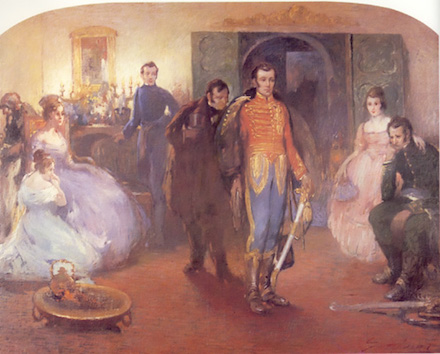
1863: Zygmunt Padlewski, January Uprising rebel

On this date in 1863, Zygmunt Padlewski was shot for rebelling against the Russian empire.

A young St. Petersburg-trained tsarist officer with a patriotic bent — his father had taken part in the November [1830] Uprising against Russian domination — Padlewski (English Wikipedia entry | German | the surprisingly least detailed Polish) spent the early 1860s organizing revolutionary exiles in Paris.

He then put his neck where his mouth was by returning to Warsaw to agitate and, eventually, to assume the leadership of Polish rebels in that area during his own generation’s doomed revolution, the January [1863] Uprising.

Padlewski’s carriage was detained at a checkpoint when he tried to sneak back to Warsaw after a defeat, and his too-liberal bribes excited the suspicion of the Cossack sentries — who searched the traveler and discovered they had a man well worth the capturing.

He was shot at Plock, where a street and a school today bear his names (numerous other cities around Poland also honor Padlewski).

On this day..

1835: Four slaves, for the Malê Rebellion

On this date in 1835, four African slave rebels were shot at Salvador.

The Malê Revolt acquired its name from the local designation for Muslims … which was the predominant religion of the slaves harvested from West Africa* who were pouring into Brazil. (It’s also known as the Muslim Revolt, or simply the Great Revolt.) Ethnically, these were mostly Yoruba peoples, known in Brazil as Nagôs; Nagôs constituted the bulk of the slave sector whom the Portuguese had nicknamed “Minas” — Gold Coast imports who had embarked their slave ships at the notorious Elmina Castle.

Under whichever designation, this population was particularly thick in the agrarian Atlantic province of Bahia; there, “slaves constituted the majority of Bahia’s population in the 1820s and 1830s, [and] the maority of slaves were African-born.” And African-born slaves proved over the years to share a vigorous spirit of resistance. Slave risings and plots had emerged in Bahia in 1807, 1809, 1814, 1816, 1822, 1824, 1826 1827, 1828, 1830, and 1831, spanning the periods of Portuguese colonialism and Brazilian independence. Scottish botanist George Gardner, recalling his travels in Brazil in the late 1830s, opined that

The slaves of Bahia are more difficult to manage than those of any other part of Brazil, and more frequent attempts at revolt have taken place there than elsewhere. The cause of this is obvious. Nearly the whole of the slave population of that place is from the Gold coast. Both the men and the women are not only taller and more handsomely formed than those from Mozambique, Benguela, and the other parts of Africa, but have a much greater share of mental energy, arising, perhaps, from their near relationship to the Moor and the Arab. Among them there are many who both read and write Arabic. They are more united among themselves than the other nations, and hence are less liable to have their secrets divulged when they aim at a revolt.

Here, in secret madrassas and an underground tongue, these people cultivated a shared religion that naturally fused with the religious to the political and eventually germinated a revolutionary conspiracy. Two elderly, enslaved Muslim teachers seems to have been particular nodes in this community of resistance.**

On the night of January 24-25 of 1835, some 300 of these African-born slaves (with a few African-born freedmen) rebelled and attacked the city of Salvador. The fighting spanned only a few midnight hours; rumors of a rising had reached white ears on the 24th and as a result the masters stood halfway prepared and rallied quickly enough to crush the revolt — killing around 80 rebels in the process.

Nevertheless, it was perhaps the largest and most frightening servile rebellion in Brazil’s history. And although not all participants were Muslim, they very distinctively were all African-born: second-generation, Brazil-born blacks (whether slave or free) as well as mulattoes, who occupied a higher caste rank more in simpatico with whites, were deeply distrusted by African natives as liable to betray the plot — and rightly so. This turned out to be the very channel by which advance warning of the imminent rebellion reached white ears on the night of January 24. It was a great, if last-minute, victory for white Brazilians’ intentional stratification of the servile labor force: “The division among Africans is the strongest guarantee of peace in Brazil’s large cities,” the governor of Bahia had written in 1814.

Surprisingly, only four juridical executions are known to have resulted from this rising, although flogging sentences inflicted on others were so brutal that at least one person also died under the lash. Records, however, are patchy, and as João José Reis notes in his essential text on the Malê revolt (Slave Rebellion in Brazil: The Muslim Uprising of 1835 in Bahia) it is scarcely apparent why these particular men came in line for the law’s final extremity:

The president of the province, under pressure from influential members of Bahian society, felt that it was important to put on a public spectacle and hang prisoners as soon as possible so as to intimidate would-be rebels. With this in mind, on 6 March 1835 Francisco de Souza Martins wrote to the minister of justice:

It seems fitting, as has been suggested to me by many Citizens of this Capital, that the Government of His Majesty the Emperor, so as not to diminish the healthy effect of an execution as soon as possible after the crime, should have the sentences carried out on the two or three main leaders, at the same time declaring that these individuals should not have any recourse or appeal; that is, such a measure is thought to be both efficacious and necessary to the present circumstances.

In a decree dated 18 March 1835 the central government accepted this suggestion and ordered that the death sentences be “immediately carried out without being allowed to go before a Court of Appeal, after the remaining legal steps had been taken.” A month later, on 14 May, one day after the publication of the law on deportations, and without having taken “the remaining legal steps,” the government put four Africans to death.

There was only one freedman among those executed: Jorge da Cruz Barbosa, a hod carrier (carregador de cal) whose African name was Ajahi. Ajahi had been arrested on the day after the uprising, in the house of some fellow Nagô acquaintances, Faustina and Tito. Tito was also involved in the rebellion and had left home some days before the twenty-fifth, never to return. On the morning of the twenty-fifth, Ajahi showed up wounded and hid under a bedframe (estrado). Faustina turned him in to inspectors Leonardo Joaquim dos Reis Velloso and Manoel Eustaquio de Figueiredo, who arrested him. Under questioning Ajahi declared that he lived on Rua de Oracao and was a neighbor of Belchior and Gaspar da Cunha, whom he used to visit regularly. Concerning the meetings they had there, he claimed: “Everybody prattled on and on or just stopped in to say hello.” He denied being a Malê and having participated in the revolt. He tried to convince the judge and jury that the bayonet wound in his right leg “had been inflicted by soldiers … while he was at the window, [and] not because he was outside fighting with anybody.” Ajahi was apparently just an ordinary rebel. Indeed none of the Africans questioned in 1835 suggested he had played an important part in the Malê organization. Even so, on 2 March 1835 he was sentenced to death, along with other important prisoners. His sentence had been set by Francisco Goncalves Martins, the chief of police, now presiding over the jury as a judge: “In light of the previous declaration … on behalf of the Sentencing Jury I sentence prisoners: Belchior da Silva Cunha, Gaspar da Silva Cunha, and Jorge da Cruz Barbosa (all freedmen), as well as Luis Sanim, a slave of Pedro Ricardo da Silva, to natural death on the gallows.” With the exception of Jorge Barbosa (Ajahi), all those listed by Martins had their sentences commuted. Ajahi appears to have escaped from prison, but he was quickly recaptured. Perhaps the maintenance of his sentence comes from his being considered an incorrigible rebel.

Little is known about the others sentences to death. They were all Nago slaves. One of them was Pedro, a slave of Joseph Mellors Russell, the English merchant. It seems that all of this man’s slavees took part either in the rebellion or, at least, in the Malê conspiracy. On his own Russell had turned over to the justice of the peace a crate containing a great number of Malê objects belonging to his slaves — Necio, Joao, Joaozinho “the urchin,” Tome, Miguel, and Pedro. Of all these men Joao was the most militant, and his final sentence is not known. No one knows why Pedro was singled out for the death penalty. I could not find the records for his particular trial.

The other two slaves executed were Goncalo, whose owner appears in the records as Lourenco so-and-so, and Joaquim, who belonged to Pedro Luis Mefre. About them all that is known is that they were among the thirteen rebels wounded and taken prisoner during the confrontation at Agua de Meninos. It may be that they were both abandoned by their masters, since nothing suggests that they might have been leaders and none of the other eleven taken prisoner in the same circumstances received similar punishment.

These were, then, the four Africans put to death in 1835. Rodrigues began a tradition claiming that five Africans were executed, but there is no evidence for it. He names a freedman by the name of Jose Francisco Goncalves as the fifth victim. This African actually existed. He was a Hausa and lived in the Maciel de Baixo neighborhood. According to his testimony, he earned his living “bringing out samples of sugar from the warehouses for Merchants.” His name appears on the Roll of the Guilty with this observation: “sentenced and acquitted on 4 June 1835.” On that same roll the names of Jorge da Cruz Barbosa, Joaquim, Pedro, and Goncalo appear, with the following observation after each one: “sentenced to death and executed on 14 May 1835.”

Like all public executions, this one had its share of pomp and ceremony. The victims were paraded through the streets of Salvador in handcuffs. At Campo da Polvora new gallows had been constructed to replace the old ones, which had rotted from lack of use. At the head of the cortege marched the council “doorman,” Jose joaquim de Mendonca, who cried the sentence out to the ringing of bells. After him came Joao Pinto Barreto, the execution scribe, and Caetano Vicente de Almeida, a municipal judge. On both sides of the prisoners marched a column of armed Municipal Guardsmen. The Santa Casa da Misericordia was also presente, since the bylaws of that important philanthropic institution obliged its members, who were recruited from the local elite, to march along with people condemned to death as an act of Christian piety. The execution itself was to be witnessed by the interim chief of police (Martins had already gone to Rio de Janeiro as a congressional deputy), Judge Antonio Simoes da Silva, and by the commandant of the Municipal Guard, Manoel Coelho de Almeida Tander.

Much to the authorities’ disappointment, the new gallows could not be used to hang the prisoners. No one would act as executioner. On 13 May, one day before the execution, the vice-president of the province, Manoel Antonio Galvao, in response to a request from the chief of police, offered 20-30 milreis to any ordinary prisoner in Bahia’s many jails to act as executioner. Even though that was four months’ earnings for the average urban slave, no one came forward. The chief warden, Antonio Pereira de Almeida, expressed his disappointment in a communique to the chief of police that afternoon: “I have offered the job to the inmates, and no one will take it. I did the same thing today at the Barbalho and Ribeira dos Gales jails, and no one will take it for any amount of money; not even the other blacks will take it — in spite of the measures and promises I have offered in addition to the money.” Either because of prisoners’ solidarity or out of fear of retaliation from the African Muslims, an executioner could not be found. For this reason, still on 13 May, the president of the province had a firing squad formed to carry out the sentences. Then, on the fourteenth at Campo da Polvora, the four men were executed by a squad of policemen and immediately buried in a common grave in a cemetery run by the Santa Casa, next to the gallows. Without the hangings, the didactic value Bahian leaders envisaged in the spectacle was lost.

Less pomp surrounded floggings, although they too were public. Here, as well, the chief of police insisted (20 March 1835) that the “punishment should immediately follow the crime.” He argued that haste was necessary “so that the prisoners would not overflow,” a practical more than a political reason. The scenes of torture oculd not have been more degrading. The victims were undressed, tied, and whipped on their backs and buttocks. Floggings were held at two different sites: the Campo da Polvora and the cavalry garrison at Agua de Meninos, where the last battle of the uprising had been fought. At times the authorities worried that these public spectacles would themselves disturb the peace. Alufa Licutan’s sentence to one thousand lashes would be carried out in public, “but not on the street of the city.”


Illustration of a slave being publicly flogged in Brazil, by Johann Moritz Rugendas.

Prisoners received fifty lashes per day, “for as many days as it took to undergo the entire sentence … provided there was no risk to a prisoner’s life.” The victims’ suffering was closely watched by armed guards and carefully supervised by officers of the law, as well as by a court scribe who on a daily basis recorded the date, names, and numbers of lashes. From time to time, doctors visited the victims to check on their health and to advise whether the whipping should be continued or suspended for a while. These doctors’ reports are shocking testimony to the physical state of the tortured individuals. On 2 May 1835 Dr. Jose Souza Brito Cotegipe told Caetano Vicente de Almeida, the municipal criminal judge: “I have only found two who are well enough to continue serving their sentences. The rest cannot because of the enormous open wounds on their buttocks.” In a report on 19 September he said: “Having proceeded in the examination … of the Africans being flogged, I can inform Your Grace that the blacks [named] Carlos, Belchior, Cornelio, Joaquim, Carlos, Thomas, Lino, and Luiz (at the Relacao Jail) are in such a state that if they continue to be flogged, they may die.”

On that very day Luiz was admitted to the Santa Casa da Misericordia Hospital, where he stayed for two months. On 3 November he went back to the stocks, and two weeks later he completed his sentence of eight hundred lashes. Narciso, another slave, was less fortunate. He was caught red-handed during the uprising and did not survive the twelve hundred lashes of his sentence. He is the only African known to have died from that terrible punishment, but there may have been more.

After the Malê Rebellion, the signs and practices of Islam came under harsher surveillance than ever before. Brazil did not abolish slavery until May 13, 1888 — the very last nation in the western hemisphere to do so.

* Prisoners taken by all sides during the wars accompanying the formation and growth of the Sokoto Caliphate were a key source for the early 19th century slave trade.

** Neither teacher was directly involved in the rebellion: one, Ahuna, had alredy been exiled to another locale and the other, Bilal, languished in prison for debts. We have particularly poignant word of the latter’s devastation upon hearing word of what had transpired.

After the rebellion, Bilal, still in jail, received news of the fate of the rebellion. One of his cell companions said in a gripping testimony that Bilal lowered his head to weep and that he never saw him raise it again. Bilal wept as many of his cherished students were brought into the jail. When one of the surviving rebels, who was being incarcerated, passed Bilal a piece of paper with a message written on it, he read it and swiftly began to weep. The devastating fate of his students had brought Bilal to a perpetual trail of tears. His fate, however, was to be amongst the most devastating. Although he could not be charged with participation in the physical uprising that took place, it was clear to authorities that he had participated in the spiritual cultivation of the uprising. Bilal “was sentenced to 1,200 lashes of the whip, to be carried out in public, though not in the streets where everyone could see. The sentence was divided up into 50 lashes a day until completed.” We can imagine that this is how Bilal died.

On this day..

1896: Five Persians by gatching

From the London Graphic, August 15, 1896:

An Execution in Pesia

From a corrspondent

A hideous form of execution, which has not been practiced for twenty years, was revived the other day to strike terror into the hearts of the people. The murder of the Shah was followed by a succession of robberies on the road between Bushire and Isfahan, the nomad tribes going out in large parties and looting villages and caravans, and an Englishman was even stripped naked and beaten with sticks. One hundred thousand pounds was estimated as the value of property that changed hands during one week. Every day individuals came naked into Shiraz, and the roads were strewn with merchandise that the robbers found unsuitable to carry off.

At this juncture H.R.H. Rukn-ed-Dowleh, Governor of Shiraz, marched out of prison five men, who, common report said, had been there for the last five months, and had had nothing whatever to do with the matter, but had merely been brought from the south, because they refused to pay the excessive taxes imposed on them.

These men were to be executed to frighten the people by being buried alive in plaster of Paris. This form of execution is called “Gatching,” and consists of a hollow pillar being erected over a hole about two feet deep, so that the whole forms a well into which the prisoner is put, sometimes (the most merciful method) head downwards, and at others with his head sticking out over the top; Plaster of Paris is then emptied in, and between each basketful water is poured down the well. The gatch then swells, and when it hardens it stops the circulation, causing the most excruciating agony.

About nine a.m. on Sunday, May 10th, the five prisoners, chained neck to neck, were marched out of prison, and slowly escorted by a large mob, who were kept from pressing too close by soldiers with fixed bayonets and others with long sticks, they were taken to the Koran Gate, near the Bagh-i-No, on the town side of which, alongside the road, their wells had been prepared. It took one hour to reach the Bagh-i-No, but the torture of this form of execution being unknown to the prisoners, they walked along without a sign of fear.

They were taken into a high-walled garden, a guard being placed at the entrance, and in a short time the first to be executed was brought out. Round his neck was a steel collar with a chain, which his guard held tightly in his hand. Someone offered him a pitcher of water, from which he eagerly drank, and then, not knowing to what awful death he was doomed, he walked calmly and without a word to his well.

It took nearly half an hour to fill the well with gatch, during all which time the sticks of the soldiers were in use to keep the crowd from pressing too close and hampering the movements of those employed with the gatch. After this, the second was brought out, and as the crowd moved to the well prepared for him I took the accompanying photograph, which shows the man buried up to the chin, his face covered with powdered gatch and his eyes closed, so as not to see the crowd standing round; the gatch has not begun to set, and the man is suffering no pain.

Having obtained a photograph of a form of execution which I hope has been resorted to for the last time, I hurried from the spot, and only just in time, as I afterwards heard, to escape the most heartrending scenes. When the gatch became solid and tightened on the poor prisoner, his yells were frightful to listen to, and as they were carried over the walled garden, those waiting their turn realised that the death to which they were doomed, so far from being the painless one they had hoped for, was instead of a terrible nature. As the fourth man was led from the garden he begged the executioner to take him to the Bazaar, where he would find some one to give him ten tumans (2 l.), after which he could cut his head off. The fifth man became even more frantic as the yells issued from the mouths of his companions. “Spare me! Spare me!” he cried, “and I will show you were 2,000 tumans (400 l.) lie hid,” but his offer came too late.

When, three days later I passed along the road, I found capitals had been added to the pillars, covering the heads of the poor men, who had thus horribly been done to death.

On this day..

1864: Utuwankande Sura Saradiel, Ceylon social bandit

Ceylon social bandit Utuwankande Sura Saradiel (or Sardiel) was hanged by the British on this date in 1864.

Saradiel fled a barracks servant’s life to take the road as a bandit. He’s alleged to have gallantly shared his proceeds with the poor; what he unquestionably did was tweak the tail of the powerful (and in this case, colonial) overlords. As is often the case with social bandits, it is difficult to know for certain whether it is for reason the latter that he enjoys the reputation of the former.

The indefatigable brigand was captured multiple times and made at least two escapes — inherently a winning public relations move — eventually maintaining himself from a picturesque mountain cavern and authoring throwback knight-of-the-road exploits to earn the nickname “Robin Hood of Ceylon”.*

Naturally, there is always a Sheriff of Nottingham.


Reward notice for the capture of our man, from the Ceylon Gazette of January 13, 1864.

Saradiel cinched his fate by shooting dead a constable in the course of his arrest. Considering that circumstance, we here at Executed Today are officially skeptical of the legend that a misplaced comma — “kill him, not let him go” when “kill him not, let him go” was intended — decided the man’s fate.

* The best one is that, having robbed from a father what he later learned to be the dowry for a bride-to-be, the robber found his victim again to return the sum, compounded by gambling winnings. Heart of gold, this guy!

On this day..

1827: Joseph Sollis, the sheriff unmanned

Joseph Sollis was executed in North Carolina on this date in 1827 for murder. It didn’t go so well, apparently leading a regular gawker to pierce the spectacle’s fourth wall and get involved in the action himself.

On this day..

1827: Blue Jimmy

(Thanks to Florence Dugdale-Hardy, wife of gallows aficionado and literary titan Thomas Hardy, for the guest post on horse thief “Blue Jimmy”, whom Thomas Hardy also referenced by name in a poem. We dug up the piece here. -ed.)

Blue Jimmy: The Horse Stealer

(written by Florence Dugdale-Hardy with Thomas Hardy)

Blue Jimmy stole full many a steed
Ere his last fling he flung.

The name of “Blue Jimmy” — a passing allusion to whose career is quoted above from Mr Thomas Hardy’s ballad “A Trampwoman’s Tragedy” — is now nearly forgotten even in the West of England. Yet he and his daring exploits were on the tongues of old rustics in that district down to twenty or thirty years ago, and there are still men and women living who can recall their fathers’ reminiscences of him.

To revive the adventures of any notorious horse-thief may not at first sight seem edifying; but in the present case, if stories may be believed, the career of the delinquent discloses that curious feature we notice in the traditions of only some few of the craft — a mechanical persistence in a series of actions as if by no will or necessity of the actor, but as if under some external or internal compulsion against which reason and a foresight of sure disaster were powerless to argue.

Jimmy is said to have been, in one account of him, “worth thousands,” in another a “well-to-do” farmer, and in all a man who found or would have found no difficulty in making an honest income. Yet this could not hinder him from indulging year after year in his hazardous pursuit, or recreation, as it would seem to have been, till he had reft more than a hundred horses from their owners, and planted them profitably on innocent purchasers.

This was in full view of the fact that in those days the sentence for horse-stealing was, as readers will hardly need to be reminded, death without hope of mitigation. It is usually assumed that the merciless judicial sentence, however lacking in Christian loving-kindness towards the criminal, had at least the virtue always of being in the highest degree deterrent; yet at that date, when death was the penalty for many of what we should now consider minor crimes, their frequency was extraordinary. This particular offence figures almost continually in the calendar at each assize, and usually there were several instances at each town on a circuit. Jimmy must have known this well enough; but the imminent risk of his neck for a few pounds in each case did not deter him.

He stood nineteen times before my lord judge ere the final sentence came — no verdict being previously returned against him for the full offence through lack of sufficient evidence.

Of this long string of trials we may pass over the details till we reach the eighteenth — a ticklish one for Jimmy — in which he escaped, by a hair’s breadth only, the doom that overtook him on the nineteenth for good and all. What had happened was as follows: —

On a December day in 1822 a certain John Wheller, living near Chard, in Somerset, was standing at his door when Jimmy — whose real name was James Clace — blithely rode by on a valuable mare.

They “passed the time of day” to each other, and then, without much preface:

“A fine morning,” says Jimmy cheerfully.

“‘Tis so,” says Mr Wheller.

“We shall have a dry Christmas,” Jimmy continues.

“I think we shall so,” answers Wheller.

Jimmy pulled rein. “Now do you happen to want a good mare that I bought last week at Stratton Fair?” And he turned his eye on the flank of the animal.

“I don’t know that I do.”

“The fact is a friend of mine bought one for me at the same time without my knowledge and, as I don’t want two, I must get rid of this one at any sacrifice. You shall have her for fourteen pounds.”

Wheller shook his head, but negotiation proceeded. Another man, one named Wilkins, a nephew of Wheller, happening to pass just then, assured Wheller that he knew the seller well, and that he was a farmer worth thousands who lived at Tiverton. Eventually the mare was exchanged for a cart-horse of Wheller’s and three pounds in money.

Curiously enough Wheller did not suspect that anything was wrong till he found the next day that the animal was what he called “startish” — and, having begun to reflect upon the transaction, he went to his nephew Wilkins, who also lived at Chard, half a mile from Wheller, and asked him how he knew that the vendor of the mare was a farmer at Tiverton? The reply was vague and unsatisfying — in short the strange assurance of Wilkins, Wheller’s own nephew, was never explained — and Wheller wished he had had nothing to do with the “man worth thousands.” He went in search of him, and eventually found him at that ancient hostel “The Golden Heart” at Coombe St. Nicholas, placidly smoking a long clay pipe in the parlour over a tankard of ale.

“I have been looking for you,” said Mr Wheller with severe suddenness.

“To get another such bargain, no doubt,” says Jimmy with the bitter air of a man who has been a too generous fool in his dealings.

“Not at all. I suspect that you did not come honestly by that mare, and request to have back my money and cart-horse, when I’ll return her.”

“Good news for me!” says Jimmy, “for that I’m quite willing to do. Here, landlady! A pipe and ale for this gentleman. I’ve sent my man out to bring round my gig; and you can go back to my farm with me, and have your horse this very afternoon, on your promising to bring mine to-morrow. Whilst you are drinking I’ll see if my man is getting ready.”

Blue Jimmy went out at the back, and Wheller saw him go up the stable-yard, half-regretting that he had suspected such a cheerful and open man of business. He smoked and drank and waited, but his friend did not come back; and then it occurred to him to ask the landlady where her customer, the farmer, lived.

“What farmer?” said the landlady.

“He who has gone out to the stables — I forget his name — to get his horse put-to.”

“I don’t know that he’s a farmer. He’s got no horse in our stables — he’s quite a stranger here.”

“But he keeps the market here every week?”

“I never saw him before in my life. And I’ll trouble you to pay for your ale, and his likewise, as he didn’t.”

When Wheller reached the yard the “farmer” had vanished, and no trace of him was discoverable in the town.

This looked suspicious, yet after all it might have meant only that the man who sold him the mare did not wish to reopen the transaction. So Wheller went home to Chard, resolving to say nothing, but to dispose of the mare on the first opportunity. This he incontinently did to Mr Loveridge, a neighbour, at a somewhat low price, rubbed his hands, and devoutly hoped that no more would be heard of the matter. And nothing was for some while. We now take up the experience of Mr Loveridge with the animal. He had possessed her for some year or two when it was rumoured in Chard that a Mr Thomas Sheppard, of Stratton, in Cornwall, had been making inquiries about the mare.

Mr Loveridge felt uneasy, and spoke to Wheller, of whom he had bought her, who seemed innocence itself, and who certainly had not stolen her; and by and by another neighbour who had just heard of the matter came in with the information that handbills were in circulation in Cornwall when he was last there, offering a reward for a particular mare like Mr Loveridge’s, which disappeared at Stratton Fair.

Loveridge felt more and more uncomfortable, and began to be troubled by bad dreams. He grew more and more sure, although he had no actual proof, that the horse in his possession was the missing one, until, valuable to him as his property was for hauling and riding, his conscience compelled him to write a letter to the said Mr Sheppard, the owner of the lost animal. In a few days W. Yeo, an emissary of Mr Sheppard, appeared at Mr Loveridge’s door. “What is the lost mare like?” said Mr Loveridge cautiously.

“She has four black streaks down her right fore-foot, and her tail is stringed’ so” — here he described the shades, gave the particular manner in which the tail had been prepared for the fair, and, adding other descriptive details, was certain it was the same mare that had been brought to Chard. He had broken it in for Mr Sheppard, and never before had known a mare so peculiarly marked.

The end of the colloquy was that Mr Loveridge gave up the animal, and found himself the loser of the money he had paid for it. For being richer than his worthy neighbour Wheller who had sold it to him, he magnanimously made up their temporary quarrel on the declaration of Wheller that he did not know of the theft, and had honestly bought the horse. Together then they vowed vengeance against the thief, and with the assistance of Mr Sheppard he was ultimately found at Dorchester. He was committed for the crime, and proving to be no less a personage than the already notorious Blue Jimmy, tried at the Taunton Assizes on March 28, 1825, before Mr Justice Park.

During the trial all the crowd in court thought that this was to be the end of famous Blue Jimmy; but an odd feature in the evidence against him was that the prosecutor, Mr Sheppard, when cross-examined on the marks described by his assistant Yeo, declared that he could not swear positively to any of them.

The learned judge, in summing up, directed the jury to consider whether the identity of the mare had been so indubitably proved as to warrant them in pronouncing the prisoner guilty, and suggested that the marks described by the witness Yeo might be found upon many horses. “It was remarkable,” his Lordship observed, “that Wilkins, who was present when Wheller bought the horse, although the nephew of the latter, and living within half a mile of him, had not been brought into court to give evidence, though witnesses from so considerable a distance as Cornwall had been examined.”

In spite of this summing-up people in court were all expecting that Blue Jimmy would swing for his offences this time; yet the verdict was “Not Guilty,” and we may well imagine the expression of integrity on Blue Jimmy’s countenance as he walked out of the dock, although, as later discoveries proved, he had, as a matter of fact, stolen the mare.

But the final scene for Blue Jimmy was not long in maturing itself. Almost exactly two years later he stood at the bar in the same assize court at Taunton, indicted for a similar offence. This time the loser was one Mr Holcombe, of Fitzhead, and the interest in the trial was keener even than in the previous one.

Jimmy’s first question had been, “Who is the judge?” and the answer came that it was Mr Justice Park, who had tried him before.

“Then I’m a dead man!” said Jimmy, and closed his lips, and appeared to consider his defence no longer.

It was also a mare on this occasion, a bay one, and the evidence was opened by the prosecutor, Mr Holcombe, who stated that the last time he saw his mare in the field from which he had lost her was on the 8th of the preceding October; on the 10th he missed her; he did not see her again till the 21st, when she was in a stall of Mr Oliver’s, at the King’s Arms, Dorchester.

Cross-examined by Mr Jeremy: The field from which the mare was stolen was adjoining the public road; he had never known the mare to escape; it was not possible for her to leave the field unless she was taken out.

Elizabeth Mills examined. Her husband kept the Crown and Anchor at Mosterton, Somerset; the prisoner came to her house about four o’clock on October 9. He had two horses with him. He asked for some person to put them in the stable; another man was in his company, and eventually the other man put them in the stable himself. The prisoner was riding the mare on his arrival; it was a bay one. Her husband returned about nine at night. (Cross-examined by Mr Jeremy.) Prisoner bargained with her husband for the horses; Pierce, the constable, was there while prisoner and her husband were talking; prisoner left next morning.

Robert Mills, husband of the last witness, examined. He reached home about nine o’clock on October 9. He went with Pierce the constable into the stable and saw a blood Mare; also a pony mare. Constable and witness took two bridles and a saddle belonging to the horses into the house, having a mistrust that the animals were not honestly acquired. Prisoner called for his horses next morning, and asked what he had to pay. Witness, who now began to recognise him, said: “Jimmy, I don’t think you came by these horses straight.” He replied, “I don’t know why you address me by the familiar name of Jimmy, since it is not mine. I chopped the mare at Alphington Fair for a black cart-horse.” Prisoner spoke of the pedigree of the mare, and asked twenty-five guineas for it, and twelve for the pony. Witness offered twelve for the mare. Prisoner refused, paid his reckoning and ordered his horses. While the saddle was being put on, witness cut two marks in the hair under the mane. Prisoner then left the house. The other man had gone away before witness returned the night before. The pony was left. Witness saw the mare afterwards, on the 22nd, in Mr Holcombe’s possession. He examined the mare and found the private marks he had made on her under the mane. He had never seen the prisoner between the time the latter put up at his house and when he saw him in Tiverton Prison.

(Cross-examined by Mr Jeremy.) The morning after prisoner brought the horses to his house he asked for some beer, though he was accustomed to wine, he remarked, and said that he was going to Bridport Fair to spend a score of bank-notes or so by way of killing time.

A witness named Gillard, as he was walking to church on the morning of the 8th (the morning before the robbery was committed) saw the prisoner in a lane three miles from Fitzhead, sitting on the ground between two camps of gipsies.

The prisoner said nothing in his defence, merely shaking his head with a grim smile. The verdict was Guilty.

“A Trampwoman’s Tragedy”
by Thomas Hardy
(Stanza X)

The taverns tell the gloomy tale,
The gloomy tale,
How that at Ivel-Chester jail
My love, my sweetheart swung;
Though stained till now by no misdeed
Save one horse ta’en in time of need;
(Blue Jimmy stole right many a steed
Ere his last fling he flung.)

His Lordship, in passing sentence of death, entreated the prisoner to make the best use of the short time he would have to live in this world. The prisoner had been two years since brought before him and in 1823 he had been convicted by his learned Brother Hullock for a similar offence. The full weight of the punishment awarded to his crime must now fall upon him, without the least hope of mitigation.

Such was horse-stealing in the ‘twenties of the last century, and such its punishment.

How Jimmy acquired his repute for blueness — whether the appellative was suggested to some luminous mind by his clothes, or by his complexion, or by his morals, has never been explained, and never will be now by any historian.

About a month later, in the same old County Chronicle, one finds a tepid and unemotional account of the end of him at Ilchester, Somerset, where then stood the county gaol — till lately remembered, though now removed — on the edge of a wide expanse of meadowland, spread at that season of the year with a carpet of butter-cups and daisies. The account appears under the laconic heading, “Execution, Wednesday, April 25, 1827: James Clace, better known by the name of Blue Jimmy, suffered the extreme sentence of the law upon the new drop at Ilchester … Clace appears to have been a very notorious character” (this is a cautious statement of the reporter’s, quite unlike the exuberant reporting of the present day: the culprit was notorious indubitably). “He is said to have confessed to having stolen an enormous number of horses, and he had been brought to the bar nineteen times for that class of offence…. In early life he lived as a postboy at Salisbury; afterwards he joined himself to some gipsies for the humour of the thing, and at length began those practices which brought him to an untimely end; aged 52.”

A tradition was till lately current as to his hanging. When on the gallows he stated blandly that he had followed the strict rule of never stealing horses from people who were more honest than himself, but only from skinflints, taskmasters, lawyers, and parsons. Otherwise he might have stolen a dozen where he had only stolen one.

The same newspaper paragraph briefly alludes to a young man who was hanged side by side with Blue Jimmy, upon the “new drop”: —

“William Hazlett — aged 25 — for having stolen some sheep and some lambs. The miserable man, after being condemned, seemed to imagine that his was a very hard case.”

The County Chronicle prints the last few words in italics, appearing to hold up its hands in horror at the ingratitude of the aforesaid William Hazlett. For was not he provided with a “new drop,” and had he not for his fellow voyager into futurity that renowned Wessex horse-thief, Blue Jimmy, who doubtless “flung his last fling” more boldly than many of his betters?

On this day..

1818: Five from the Lancaster Assizes, “most dangerous to society”

On this date in 1818, four hanged at Lancaster Castle for uttering forged notes, along with a fifth hanged for burglary and horse theft — all casualties of the latest Lancaster Assizes. For the account, we excerpt Jackson’s Oxford Journal of May 9, 1818; the footnotes are from that source as well.

LANCASTER ASSIZES, April 13.

Address of Chief Baron Richards, on passing sentence of Death upon the prisoners capitally convicted of forgery, and of uttering forged Bank of England notes.

Wm. Oxenham*, convicted of uttering a forged Bill of Exchange, was first placed at the bar.

Chief Baron — “William Oxenham, you have been convicted of uttering a forged Bill of Exchange, well knowing at the time you uttered it that it was forged. The crime of which you have been convicted, on the most satisfactory evidence, by a most intelligent Jury, is a crime the most dangerous to society, and which loudly calls for the highest punishment the law can inflict; for no man, in a commercial country like this, can, by any care, effectually protect himself from such attempts. If there should be any disposition at the foot of the Throne to extend its mercy towards you, I shall rejoice: but of this I can offer no assurance; and if there should be any mitigation of your sentence, it will only be on condition of your being forever removed from this country.” — His Lordship then passed upon him the last sentence of the law in the usual terms.

The following prisoners were then placed at the bar: — Wm. Steward†, Thomas Curry†, Margaret M’Dowd†, R. Wardlaw†, R. Moss, Hannah Mayor, and J. Vaughan, convicted of uttering forged Bank of England notes; and G. Heskett†, convicted of burglary and horse-stealing.

The Chief Baron, addressing by name the first seven prisoners, thus proceeded, —

You have been severally convicted of uttering forged Bank of England notes, knowing them to be forged: the law has affixed to this crime the punishment of death, and it is an offence which, on account of its injurious consequences to society at large, requires the infliction of the highest punishment.

It is a practice which must be repressed; and if this cannot be effected by other means, it must be done by visiting it with the utmost severity of the law; for the negotiation of forged notes is the strongest and most extensive mode of plundering the public which can be resorted to, and it is one against which no care or prudence can be an effectual protection. I had, the last Assizes, the very melancholy duty, in this place, of passing the sentence I am now about to pass upon you, upon a number of persons convicted of this offence, and which sentence was carried into effect with respect to most of them: but I do not perceive that this sad example has been attended with any advantage, or that it has produced any diminution in the number of offenders of this description; you have not taken warning from it; for I observe that your offences are all subsequent to the last Assizes. It is, therefore, necessary that examples should still continue to be made; and it is my duty to tell you that some of you, nay, that most of you, beyond all question, must suffer the full sentence of the law.


* This prisoner was so unwell, that he was obliged to be supported into Court, and placed in a chair, until sentence was passed upon him.

† The prisoners thus marked were left for execution, and suffered the sentence of the law on Saturday se’nnight [i.e., Saturday, 18 April 1818], at Lancaster.

On this day..

1868: Gujarat’s “Tribal Martyrs”

When current India Prime Minister Narendra Modi was Chief Minister of Gujarat, he implemented a “Tribal Martyrs’ Day” celebration for April 16 — in honor of a hanging on that date in 1868 of five Nayak.

Joriya Parmeshwar, Rupsingh Nayak, Golaliya Nayak, Ravjida Nayak and Babariya Galama Nayal all hanged in the city of Jambughoda, against the British Raj. Their authenticity as patriots rather than brigands has been disputed, but certainly Britain’s ready resort to summary justice in the course of her authority on the subcontinent earns no presumption of good faith for any designation.

“The stories of rebellion and martyrdom by Gujarat’s tribal leaders against tyranny of foreign rulers had remained buried in history and I have unfolded the chapter about the valour of these five forgotten leaders from tribal-dominated town of Jmbughod,” Modi declared. In a seeming dig at the governing Congress Party that he would soon expel from power, Modi added that “sacrifices of a large number of martyrs, who laid their lives for freedom of our nation, have been deliberately erased by some elements so that people could no longer remember their martyrdom.”

On this day..

1836: Two English poisoners

On this date in 1836, two different Englishwomen hanged in Gloucester and Liverpool for seeing off their respective husbands with arsenic.

They’re the subjects of an excellent pair of posts by Naomi Clifford, author of such topical-to-Executed Today fare as Women and the Gallows, 1797-1837 and The Murder of Mary Ashford: The Crime that Changed English Legal History, which concerns the long overdue abolition of juridical trial by combat in Great Britain … after an accused murderer used this artifact to escape prosecution in 1817.

Here’s Clifford on our poisoners, bound for separate gallows on April 9, 1836:

Clifford makes a triptych here with a third post about yet another poisoner who shared the same fate five days later.

On this day..

1818: Juan Jose Carrera and Luis Carrera

Juan Jose Carrera and Luis Carrera were shot together in Mendoza as traitors on this date 200 years ago.

They two of the Hermanos Carrera, a generation of siblings that played a prominent role in the Chilean War of Independence during the 1810s. We have already detailed them through the entry on their more notable brother Jose Miguel Carrera … who would go on to share their fate in 1821.


The Carrera Family, by Arturo Gordon Vargas (early 20th c.) features patriarch Ignacio, who was part of Chile’s first independent junta, along with Jose Miguel, flanked by brooding brothers Juan Jose and Luis, as well as their sister Javiera Carrera, the “Mother of Chile” and creator of the Chilean flag.

Said Jose Miguel had established a dictatorship in 1811-1812, with his brothers as trusted lieutenants. But Chile’s initial flower of independence from 1810-1814 was crushed by Spanish reconquest thanks in part to a deadly rift that had opened between the Carreras and fellow independentista Bernardo O’Higgins: prior to the decisive loss to the Spanish, Luis Carrera and O’Higgins had fought a literal battle with one another. They patched things up well enough to fight the Spanish together a few weeks later, but once in exile in Mendoza, Argentina, after their defeat they hurled recriminations at one another for the outcome. Luis even killed O’Higgins’s aide Juan Mackenna in a duel.

In the fullness of time it was the destiny of O’Higgins to be the father of a (permanently) independent Chile … and the destiny of the Carreras to be antagonists he overcame to do it.

O’Higgins attained leadership of the independence movement from exile and after elevated himself to dictator of free Chile in 1817. The Carreras promptly began scheming against him lead in old times, resulting in the arrest of Luis and Juan Jose in Mendoza. They were executed there hours after word reached the city that the Chilean patriot army had finished off the royalists.


The Carreras on their way to execution.

On this day..