2005: Kenneth Boyd, the 1,000th modern execution in the U.S.

On this date in 2005, Kenneth Lee Boyd died to lethal injection in Florida. His was the 1,000th execution conducted in the so-called “modern” death penalty era in the United States.

“I’d hate to be remembered as that,” Boyd said of his prospective milestone distinction. “I don’t like the idea of being picked as a number.”

He’d not needed a number to fight in Vietnam thirty-odd years before: he volunteered, and worked heavy equipment under fire, which his attorneys would later argue made him a PTSD victim.

The victims of the PTSD victim were his estranged wife Julie Curry Boyd and Julie’s father Thomas Dillard Curry, both of whom he gunned down with a .357 magnum in the presence of his and Julie’s three children back in 1988. Then he called 911 with the report, “I’ve shot my wife and her father — come on and get me.” In his voluntary confession upon surrender to the responding officers, he invoked the ghost of his youth’s imperial war.

It was just like I was in Vietnam. I pulled the gun out and started shooting. I think I shot Dillard one time and he fell. Then I walked past him and into the kitchen and living room area. The whole time I was pointing and shooting. Then I saw another silhouette that I believe was Julie come out of the bedroom. I shot again, probably several times. Then I reloaded my gun. I dropped the empty shell casings onto the floor. As I reloaded, I heard someone groan, Julie I guess. I turned and aimed, shooting again. My only thoughts were to shoot my way out of the house. I kept pointing and shooting at anything that moved.

The press comments from people linked by kinship to this horror make heartbreaking reading. This excerpt is from the New York Times report:

As to the provision of justice, Marie Curry, who lost her husband and her daughter when Mr. Boyd shot them 17 years ago, said she was at a loss to provide any answers. “I really don’t know,” she said.

Mrs. Curry raised Mr. Boyd’s three sons, Christopher, Jamie, and Daniel, after their father was sent to prison for their mother’s murder. “It’s just a sad day. The bible says to forgive anyone that asks you, and I did,” she said, “But I can’t ever forget.”

On this day..

2018: The Sultan of Coins

Iran today hanged two men for financial crimes.

Vahid Mazloumin, dubbed “the Sultan of Coins”, was arrested in July with two tons of gold coins in his possession. He was condemned with accomplice Mohammad-Esmaeil Qassemi of comprising a “smuggling gang”.

Iran’s currency has collapsed in recent months ahead of the bad-faith U.S. nuclear sanctions, leading Iranians to rush for precious metals.

On this day..

2009: Xu Wei, Jilin gangster

China’s state-run Xinhua News Agency reported thusly:

CHANGCHUN, Nov. 5 (Xinhua) — A Mafia ring leader, who is also son of a former high-ranking city official, was executed Thursday by lethal injection in Changchun, capital of northeast China’s Jilin Province, according to a court statement.

Convicted of murder, kidnapping, intentional injury, extortion and other crimes, Xu Wei, 42, was sentenced to death by the Changchun Intermediate People’s Court on Sept. 20, 2007. The Higher People’s Court of Jilin Province ruled against Xu’s appeal and upheld the first-instance verdict on July 10, 2008. The Supreme People’s Court approved the death sentence after reviewing the case.

Xu, deputy manager of Yushu City Thermal Power Co. and son of Xu Fengshan, former deputy mayor of Yushu city, was found to have provided guns to two gangsters who shot dead Xu’s business rival in 1997. Xu even pulled strings through his police complice and bailed out one of the killers, the court was told.

Believing a township head didn’t pay him enough respect, Xu ordered his men to beat him to death in 1998. In the end, the man was struck into coma and died in hospital in 2000 at the age of 49, court verdict said.

In a separate case, the father Xu Fengshan was sentenced to death with a reprieve of two years for taking more than 20 million yuan (2.93 million U.S. dollars) in bribery and harboring criminal organizations.

On this day..

2009: Two Somali spies

MOGADISHU, Oct. 25 (Xinhua) — Somalia’s Al Shabaab Islamist movement on Sunday executed two young men for alleged spying for the Somali government in the southern town of Marka.

The radical group has been waging insurgency for two years against the Somali government and the African Union peacekeeping forces in the capital Mogadishu.

After the execution was carried out in central Marka town, an official from the group told crowds of local people who gathered to watch the punishment that the men were convicted of spying for the Somali government after “they confessed to the crime.”

“The men were executed because of apostasy and for spying for the apostate government. After three months of investigation and their confession to the crime they were executed in accordance with the Islamic law,” said Sheikh Sultan, an Al Shabaab official in Marka.

Residents said that the young men were executed by firing squad of Al Shabaab fighters as crowds, mainly women and children, looked on the capital punishment.

The hardline Islamist group of Al Shabaab controls much of southern and central Somalia and usually carries out amputations, executions, and floggings of criminals and opposition individuals in areas under their control, including parts of the Somali capital. The Islamist group, which is considered by the Somali government and the United States as a terrorist organization, declares a fight to establish an Islamic State in Somalia.

The Reuters report on this same incident adds a witness describing that “One of the boys did not die easily, so about eight masked al Shabaab men went close and opened fire on him. Soon his body looked like chopped-up meat because of the many gunshots.”

On this day..

2016: Prince Turki bin Saud al-Kadir

On this date in 2016, Saudi Arabia had Prince Turki bin Saud al-Kabir beheaded: the first royal executed in the kingdom since 1975.

Prince Turki was convicted of shooting to death a friend named Adel bin Suleiman bin Abdulkareem Al-Muhaimeed during a 2012 brawl outside Riyadh.

Victims’ families have the right to pardon condemned criminals in Saudi Arabia, but Adel’s family refused repeated offers of diya (blood money) from the royal relatives up to the very last moment.

“The greatest thing is that the citizen sees the law applied to everyone, and that there are not big people and other small people,” Abdul-Rahman al-Lahim, a prominent Saudi lawyer, wrote on Twitter.

New York Times

On this day..

2011: Alireza Molla-Soltani, killer of Rouhollah Dadashi

A sobbing 17-year-old* Alireza Molla-Soltani was publicly hanged at dawn on this date in 2011 in Karaj for slaying an Iranian muscleman.


Yoked: the murder victim, Rouhollah Dadashi.

A powerlifter and bodybuilder who was two-time (2009 and 2010) champion of Iran’s “Strongest Man” competition, Rouhollah Dadashi was stabbed to death during a traffic-related altercation barely two months prior: three youths fled the scene in their ride but were picked up within days, even as thousands thronged the celebrity athlete’s burial.

His murder raised a public outcry. Vainly, Molla-Soltani pleaded that he had knifed Dadashi in fear of his own life. He reportedly broke down crying and begging for mercy under the noose.

Warning: Mature Content. This is not film, but a compilation of the numerous still photographs searchable online of the execution.

* Iranian officials contended that Molla-Soltani had reached maturity with 18 lunar years. A lunar year is 11 days shorter than a solar year.

On this day..

2016: Mir Quasem Ali

On this date in 2016, Bangladesh hanged tycoon Mir Quasem Ali for crimes against humanity committed during that country’s 1971 War of Independence from Pakistan.

Known at the time of his death as the wealthiest patron of the party Jamaat-e-Islami, Mir Quasem Ali was in 1971 a first-year physics student at Chittagong College.

This cataclysmic year saw “East Pakistan” — as it was then known — separated from Pakistan amid an infamous bloodbath, and it was for this bloodbath that Ali hanged 45 years later. At the time, he was a member of the Islamist student organization Islami Chattra Shangha;* in the autumn of 1971, that organ was tapped for recruits to the pro-Pakistan paramilitary Al-Badr which helped carry out wholesale massacres. Some three million people are thought to have died during this war.

The court that noosed him found that Ali helped to orchestrate the abductions of pro-independence activists to a three-story hotel in Chittagong commandeered from a Hindu family. Victims there were tortured and some murdered, although others survived to tell of Al-Badr guards announcing the defendant’s arrival with the words “Mr Quasem is here. Mr Commander is here,” seemingly establishing quite a high degree of responsibility for events under that roof.

After a bad result in the war, he fled to Saudi Arabia and embarked on the business career that would see him into the global oligarchy as a billionaire media mogul and (once back in Bangladesh) the chief financier of the chief Islamist party. When a score-settling Prime Minister Sheikh Hasina Wazed initiated a tribunal to try human rights crimes from the 1971 war, Mir Quasem Ali immediately started spreading millions around Washington D.C. lobby shops in an unsuccessful bid to use international pressure to shut down the proceedings.

He maintained his innocence to the last, even refusing to seek a presidential clemency since that would have entailed an admission of guilt. These trials, several of which have ended at the gallows, have been intensely controversial within Bangladesh, and without.

* Its present-day successor organization is Bangladesh Islami Chhatra Shibir … which was founded in 1977, by Mir Quasem Ali.

On this day..

2018: Shoko Asahara and six Aum Shinrikyo followers, for the Tokyo sarin attack

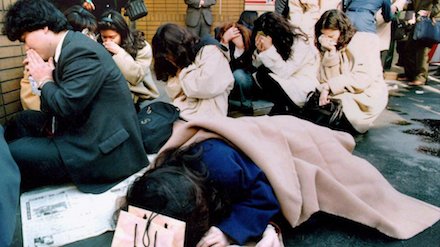
Shoko Asahara and six of his followers in the Aum Shinrikyo cult were hanged today in Japan as authors of one of the most infamous terrorist attacks in recent history: the sarin attack on the Tokyo subway of 1995.

Thirteen people died and several thousand more were injured when members of this millenial sect deposited punctured bags of homemade liquid sarin on multiple rail lines of Tokyo’s subway during Monday rush hour.

It was only one of several gas attacks perpetrated by Aum Shinrikyo during the 1990s; just nine months previous, they had killed nine people in a sarin attack in Matsumoto. But it is by far the most notorious. Images of stricken commuters, blinded and suffocating under the nerve agent’s influence, sprawled on the transit platforms or outside them shocked orderly Japan in 1995, especially so since it came fast on the heels of the devastating January 1995 Kobe earthquake.

These comprised “two of the gravest tragedies in Japan’s postwar history,” according to Haruki Murakami’s Underground: The Tokyo Gas Attack and the Japanese Psyche. “It is no exaggeration to say that there was a marked change in the Japanese consciousness ‘before’ and ‘after’ these events.” Japanese Justice Minister Yoko Kamikawa struck a similar chord in announcing the hangings today: “These crimes … plunged people not only in Japan but in other countries as well into deadly fear and shook society to its core.”

Its mastermind Shoko Asahara, the first man executed this morning, emerged soon thereafter into public view a bedraggled and half-blind fanatic, almost the picture of an agent of chaos. Shockingly, his cult had been able to thrive in the early 1990s thanks in part to murdering an attorney who was investigating Aum Shinrikyo back in 1989.

Beyond the seven hanged on July 6, 2018, six additional members of the cult still remain under sentence of death in Japan for the Tokyo subway atrocity.

On this day..

2006: Sedley Alley

A gentleman with the interesting name of Sedley Alley was executed by lethal injection in Tennessee on this date in 2006, for the positively horrific rape-murder of Lance Corporal Suzanne Marie Collins.

True crime writer John Douglas has explored this case in Journey Into Darkness and Law & Disorder.

The ghastly crime occurred in 1985, when the 19-year-old Collins went for a jog at Millington Air Force Base; her attacker stabbed her about the head with a screwdriver and raped her with a tree branch so violently that the branch tore the young woman’s lung.

Alley’s next-day confession followed by his shifting accounts of the events led him to try a hail-mary insanity defense at trial … a surprising contrast to the innocence claim he floated late in his appeals process.

The generation-long labyrinth of judicial appeals between homicide and execution led Collins’s parents, Jack and Trudy, to become outspoken victims’ rights advocates. “There never will be closure,” Jack Collins once told a filmmaker. “What you get is a modicum of peace. You get a feeling that somebody cares. The state of Tennessee cared enough about our daughter that it carried out an execution on her killer. But no closure until the day we die.”

On this day..

2011: Ruyati binti Sapubi, migrant worker beheaded on film

Indonesian migrant worker Ruyati binti Sapubi was beheaded in Mecca on this date in 2011 for the meat cleaver murder of her mistress. She numbered among the several hundred thousand Indonesian women hired as domestic servants in the Gulf kingdom.

“The maid carried out the killing after she was denied permission to leave the kingdom and return to her family in Indonesia, according to officials in Jakarta,” according to press reports on the very sketchy details allowed by Riyadh.

The mild and passive voice here conveys a wild overreaction by the help, but a moment’s consideration of the scenario — a terribly vulnerable imported domestic worker disallowed from leaving her job — puts matters into a different light. (To add diplomatic insult to injury, the Saudis failed to inform Indonesia when the actual execution was imminent.)

Indeed, just days after the execution, word leaked of a Sri Lankan domestic who had been secretly held in outright slavery for 14 years.

Mature Content: The execution was secretly recorded. This is a snuff film.

The Indonesian government slapped an immediate moratorium on overseas work in Saudi Arabia in the aftermath of this horror. Unfortunately, these and similar measures in the 2010s have only compounded the risk of trafficking, increasing the vulnerability of people desperate to secure work abroad.

On this day..